Received October 2, 2014; Accepted November 26, 2014; Epub December 1, 2014; Published December 15, 2014
Abstract: Pancreata from Sprague Dawley rats of different developmental stages were studied to determine the expression and cellular localization of different c-MET isoforms in the developing rat pancreas. Pancreatic mRNA and protein expression levels of c-MET at different developmental stages from embryo to adult were detected by reverse transcription-polymerase chain reaction and by western blotting. To identify the cellular localization of c-MET
protein in the developing rat pancreas, double immunofluorescent staining was performed using antibodies for cell type-specific markers and for c-MET. The expression of two isoforms of c-MET (190 kDa and 170 kDa) coincided with the development of the pancreas. The 190 kDa isoform of c-MET is expressed during embryonic stages, and its expression is replaced by the expression of the 170 kDa isoform as the pancreas develops. Only the 170 kDa
isoform is expressed in the adult rat pancreas. Throughout all stages of pancreatic development, c-MET is expressed by vimentin-positive cells. In contrast, c-MET staining was stronger in rat pancreata from newborn to adult stages and overlapped with insulin-positive beta-cells. The dynamic expression and localization of different c-MET isoforms in the rat pancreas during different developmental stages indicates that distinct c-MET isoform might be involved in different aspects of pancreatic development.
Keywords: c-MET, development, isoform, pancreas
Introduction
The mammal pancreas is an endodermal organ that is composed of endocrine and exocrine. Pancreatic developmental dysregulation and dysmorphogenesis, including diabetes and pancreatic cancer, can lead to a high incidence and high mortality diseases. Therefore, in-depth understanding of the molecular mecha-nisms regulating pancreatic development will certainly help to improve the treatment of such diseases.
c-MET tyrosine kinase, the receptor for hepato-cyte growth factor (HGF), is critical for normal development and cell survival [1-4] and was ini-tially identified because its mutant forms have oncogenic potential. The HGF/c-MET signaling pathway is involved in a variety of biological functions, such as neuroendocrine cell forma-tion, development, proliferaforma-tion, regeneraforma-tion,
indicated that both HGF and c-MET are expressed in the pancreas; HGF is expressed in endothelial and mesenchymal cells. c-MET also localizes to pancreatic progenitor cells, islet and ductal cells [9-12]. Furthermore, HGF/c-MET signaling increases islet survival in diabet-ic animals. However, HGF and c-MET global knockout mice exhibit early embryonic lethality and postnatal growth retardation, thus limiting their use in elucidating the role of HGF/c-MET signaling in embryonic development [13, 14]. Recent evidence indicates that the survival of beta-cells is dramatically decreased in the absence of HGF/c-MET signaling, resulting in an accelerated onset of diabetes in pancreas-spe-cific c-MET-null mice [15].
Figure 1. c-met mRNA expression levels in the developing rat pancreas as measured by reverse transcription-polymerase chain reaction. A: From embryonic day (E) 15.5 to adulthood, pancreatic c-met mRNA expression was greatest at newborn ages, with decreased expression in the adult (*P < 0.05 vs. E15.5, E18.5 and adult). B: c-met mRNA expression was analyzed and normalized to 18S rRNA levels. The results are indicated in percentages above the 18S rRNA value and are representative of three independent experiments.
spans the membrane and contains a tyrosine kinase catalytic domain, whereas the α subunit is localized extracellularly. The second isoform is a 170 kDa protein that has been demonstrat-ed to have a distinct biological action from the 190 kDa isoform of c-MET [16]. Both c-MET RTK isoforms are autophosphorylated in an in vitro kinase assay. To investigate the physiolog-ical roles of different c-MET isoforms during pancreas development in the rat, we detected the pancreatic expression and cellular localiza-tion of the c-MET receptor during different developmental stages. Our data indicated that the expression and localization of c-MET coin-cided with the development of the pancreas.
Interestingly, both protein isoforms of c-MET were expressed during pancreatic development in the rat. Based on the densitometric quantifi-cation of each isoform, the highest expression level of c-MET was detected between late ges-tation and 2-3 weeks after birth. We also inves-tigated the cellular localization of c-MET and confirmed the presence of c-MET in mesenchy-mal and beta-cells of the developing rat pan-creas. To the best of our knowledge, the expres-sion and localization of different c-MET iso-forms during pancreatic development in rats is poorly understood. This information describing the temporal and spatial expression and cellu-lar localization of different c-MET isoforms will Figure 2. Western blot analysis of c-MET in the pancreas of E15.5, E18.5, P0, P7, P14, P21 and adult rats. A:
West-ern blot analysis using anti-c-MET (sc-8108), an affinity-purified goat monoclonal antibody raised against a peptide mapping to the C-terminus of c-MET, revealed two bands in E18.5 and P0 samples. The molecular weight markers
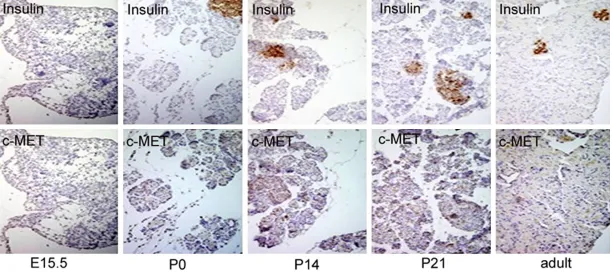
[image:2.612.93.521.304.447.2]Figure 3. Immunohistochemical analysis of insulin and c-MET expression in the developing pancreas of E15.5, P0, P14, P21 and adult rats. Adjacent pancreatic
sections from five stages were stained with antisera against insulin and c-MET. We acquired images using an OLYMPUS DP70 digital camera. Strong staining was
observed for insulin for all stages except E15.5. c-MET immunolocalization experiments revealed sporadic positive staining in the developing pancreas. In P0, P14,
Figure 4. Immunofluorescence localization of c-MET and insulin in the developing pancreas in E18.5, P14, and adult rats. Immunofluorescence microscopy for c-MET (green) and insulin (red) was carried out on the same pancreas
section. Modest, grouped staining for MET was observed in the developing pancreas from E18.5 to adult; the
c-MET staining overlapped with insulin-positive beta-cells. The original magnification was × 400.
be useful in understanding their potential role in pancreatic development.
Materials and methods
All animal procedures were performed in strict adherence to the JSTD Guide for the Care and Use of Laboratory and Animals and were approved by the Committee on the Ethics of Animal Experiments of Nanjing Medical University.
Animals and pancreatic tissue preparation
Female and male Sprague-Dawley (SD) rats were mated. Noon on the day a vaginal plug was discovered was considered embryonic day 0.5 (E0.5). E12.5, E15.5, and E18.5 rat embry-os were isolated from pregnant female SD rats (Nanjing Medical University, China), and pan-creata were isolated from the embryos under a dissecting microscope. Postnatal day 0 (P0), P14, P21 and adult pancreata were isolated Figure 5. Immunofluorescence localization of c-MET and vimentin in the developing pancreas in E18.5, P14, and adult rats. Immunofluorescence microscopy for c-MET (green) and vimentin (red) was performed on the same pan -creas section. Scattered but clearly stained c-MET-positive cells were detected in pan-creas sections from E18.5 to
[image:4.612.92.521.328.517.2]with TRIZOL reagent (Invitrogen Life Tech- nologies, Carlsbad, California, USA). RNA quali-ty was verified by agarose gel electrophoresis. Two micrograms of DNA-free RNA primers and reverse transcriptase was used for each PCR reaction. PCR was performed in a total volume of 25 μl; each reaction contained 25 ng of cDNA, 0.2 nmol of primer pair, and 0.3 μl of Taq DNA polymerase (QIAGEN, CA). The primer pairs were as follows: c-met, forward: 5’-CCAGTT- CAGAAAACGATG-3’, reverse: 5’-TAAGTGCCCGA- AGTGTAA-3’ (1050 bp); 18S rRNA, forward: 5’-ACGAACCAGAGCGAAAGC-3’, reverse: 5’-GG- ACATCTAAGGGCATCACAG-3’ (514 bp). The PCR conditions were as follows: 2 min at 94°C for hot start, followed by 35 cycles of 95°C for 30 s, 55.4°C for 30 s, and 72°C for 45 s, with a final extension for 5 min at 72°C. The products were separated on 1% agarose gels and detect-ed by ethidium bromide staining. All the data were normalized to 18S rRNA levels in each sample.
Western blot analysis
Total protein was extracted from individual tis-sues using a protein extraction kit (Beyotime Biotechnology, China). The protein concentra-tion was determined using the BCA protein kit (Beyotime Biotechnology, China). For each developmental stage examined, a sample con-taining 50 μg protein (extracted from rat pan-creas) in 20 μl buffer was boiled for 3 min, separated by 8% SDS-PAGE, and then trans-ferred to nitrocellulose membranes (Bio-Rad, Hercules, CA). The nitrocellulose membranes were incubated in a solution of 5% fat-free milk in Tris-buffered saline for blocking. The mem-branes were then incubated with a c-MET pri-mary antibody (sc-8108, an affinity-purified mouse monoclonal antibody, diluted 1:200; Santa Cruz, USA) for 12 h at 4°C. After being
The E15.5 (embryo day 15.5), E18.5, newborn and nonpregnant adult pancreas tissues were fixed with 4% paraformaldehyde in PBS for 24 h and then embedded in paraffin. Five-micron-thick sections were cut and mounted on gela-tin/chrome alum-coated glass slides. After deparaffinization, the presence of c-MET and insulin was detected immunohistochemically. To expose antigenic sites of the c-MET/insulin complex, sections were heated three times to 90°C in a 600 W microwave oven and main-tained at 90°C for 7 min, then allowed to cool for 1 h. Endogenous peroxidase activity was blocked by incubating in 0.5% hydrogen perox-ide solution in absolute methanol for 15 min. Non-specific binding was blocked by incubating in 10% non-fat milk in phosphate-buffered saline (PBS) for 1 h at room temperature. The sections were then incubated with a monoclo-nal antibody (sc-8108; Santa Cruz) against c-MET or against insulin (sc-9168; Santa Cruz) at a dilution of 1:100, respectively, for 12 h at 4°C and then incubated for 1 h with horserad-ish peroxidase-conjugated secondary antibody (1:1000 dilution) at room temperature. The antigen-antibody complex was visualized by incubating the sections in a solution of 3’-diami-nobenzidine (DAB) solution for approximately 5 min in the dark. Images were taken at × 400 magnification.
Double immunofluorescence
monoclonal antibody and then with a fluores-cein isothiocyanate (FITC)-labeled rabbit anti-goat IgG secondary antibody (1:100, sc-2777, Santa Cruz). Sections were then further stained for either insulin or vimentin. A mouse anti-insulin monoclonal antibody (1:500, ab6995, Abcam) or a mouse anti-vimentin monoclonal antibody (1:500, CBL202, Chemicon) was used as the primary antibody, and a cy3-labeled anti-mouse IgG antibody (1:400, AP192C, Chemicon) was used as a secondary antibody. Sections were placed in Gel Mount Aqueous Mounting Medium (G0918, Sigma), covered with a cover glass, and examined under an Olympus BX51 microscope. To rule out cross-reactivity, the fol-lowing controls were used: first, single staining with an alternative secondary antibody, and second, staining in the absence of the primary antibody. No staining was detected in either of the controls. Images were taken at × 400 magnification.
Experiments were repeated at least three times.
Statistical analysis
Analysis of experimental data was performed using PDQuest 7.0 software (Bio-Rad Labo- ratories, USA) and paired t-tests. A value of P < 0.05 was considered statistically significant. Data are presented as the mean ± standard error.
Results
Expression of c-met mRNA during rat pancre-atic development
The mRNA expression of c-met throughout the development of the rat pancreas was examined by using reverse transcription-PCR (Figure 1). c-met mRNA expression was detected at E15.5, increased at postnatal stages (P0, P21) and decreased again from P21 to adult.
Expression of c-MET isoforms during rat pan-creatic development
To examine protein expression levels of c-MET during different stages of the developing rat pancreas, we performed western blotting on the pancreata of E15.5, E18.5, P0, P14, P21 and adult rats. The western blotting detected two isoforms of c-MET (190 kDa and 170 kDa)
and showed that their expression patterns are associated with different developmental stag-es in the rat pancreas. The 190 kDa isoform was detected from E18.5 to P21 and was high-ly expressed at P21. In contrast, this isoform was not detectable in adult pancreas tissue. The 170 kDa isoform, which was detectable in the adult pancreas, was also expressed at P14 and P21 (Figure 2A). Based on the densitomet-ric quantification of each isoform, the expres-sion of c-MET was detected at low levels in the prenatal pancreas, dramatically increased at neonatal stages (P14, P21), and declined in the adult rat pancreas (Figure 2B). This temporal expression of the two c-MET isoforms indicates that each of them might have distinct physio-logical functions during the development of the rat pancreas.
Regional and temporal localization of c-MET in the rat pancreas at different developmental stages
To investigate the spatiotemporal localization of c-MET in the developing rat pancreas from fetal to postnatal stages, immunohistochemis-try and double immunofluorescent staining were performed using antibodies for cell type-specific markers and for c-MET. We found that c-MET staining was modest in the developing rat pancreas from E18.5 to adult and over-lapped with insulin-positive beta-cells. In addi-tion, a few c-MET-positive cells were observed at the same developmental period and were scattered throughout the exocrine pancreas (Figures 3, 4). To further identify the cell local-ization pattern of c-MET, double immunofluo-rescent staining for c-MET and vimentin (a mes-enchymal cell marker) was also conducted. Co-expression of c-MET and vimentin was detected throughout all stages of development in the rat pancreas (Figure 5). To the best of our knowledge, the expression of c-MET in the mesenchyme of the rat pancreas has not been previously reported. Collectively, the immunolo-calization experiments demonstrated that c-MET was expressed not only in beta-cells but also in mesenchymal cells within the develop-ing rat pancreas.
Discussion
stages (P14, P21), and decreased again in the adult rat pancreas. We also investigated the cellular localization of c-MET protein in the developing pancreas. Double labeling of c-MET and of cell type-specific markers confirmed the presence of the c-MET receptor on mesenchy-mal and beta-cells in the developing rat pan-creas. Studies have reported that c-Met is expressed in pancreatic progenitor cells, islet, and ductal cells [9-12].
Although loss of c-Met from adult pancreas does not influence beta-cells or glucose homeo-stasis under basic conditions [9, 11, 15]. It was shown that absence of c-Met mediated cyto-kine induced beta-cells death and accelerated the incidence of diabetes in an animal model of low dose streptozotocin administration [15]. Study has reported that HGF/c-Met signaling is critical for beta-cells adaptation during preg-nancy and that its absence can lead to gesta-tional diabetes [17]. Hepatocyte growth factor (HGF) is also a mitogen required for beta-cells replication during pregnancy [18]. The expres-sion of HGF is up-regulated in rat islet endothe-lium at gestational 15 day, when the prolifera-tion of maximal beta-cells is detected [10]. In our study, we detected that c-MET receptor localized on mesenchymal and beta-cells in the developing rat pancreas, and distinct c-MET isoform dynamically expressed in the different stages of developing rat pancreas. These results indicated that different c-MET isoform might be involved respectively in the regulation of development in the rat pancreas.
Organogenesis is a dynamic and tightly coordi-nated process that requires the spatial and temporal regulation of proliferation, differentia-tion, and morphogenesis [19-21]. The develop-ment of exocrine and endocrine pancreas tis-sue involves a process of differentiation that
[23]. The first phase encompasses early organ-ogenesis and is known as the “primary transi-tion.” This phase occurs from approximately E10 to E12.5 and involves the shaping of the pancreatic diverticulum. Endocrine cells appear at this stage as individual cells that are not yet organized into islets [24, 25]. This stage is fol-lowed by a “proto-differentiated state” (from E12.5 to E15.5) characterized by substantial epithelial cell proliferation, which leads to the rapid growth of the epithelium and ductule for-mation. During late embryonic stages, the third phase, or “secondary transitional phase” (from E15.5 to E18.5), occurs. This stage is charac-terized by a dramatic increase in the abun-dance of exocrine and insulin-positive cells (resulting from the rapid differentiation of pro-genitor cells), endocrine cell migration and adhesion. Primary islets take shape at this stage. However, mature islets are not fully formed until E18-E19; islets undergo further remodeling and postnatal maturation for approximately two to three weeks after birth [26]. However, the mechanisms that control the cellular differentiation and morphogenesis of the mammalian pancreas are not yet fully understood [27, 28].
pancreatic “secondary transitional phase”, when an increasing number of endocrine cells migrate. c-MET protein expression increased after birth and peaked at P21 (postnatal day 21); thereafter, c-MET expression declined. Interestingly, we found that the two isoforms of c-MET (190 kDa and 170 kDa) were dynami-cally expressed during the development of the rat pancreas. We found that the 190 kDa iso-form was expressed in the fetal and neonatal pancreas, but it was not detectable in the adult pancreas. The 170 kDa isoform was expressed only after birth. This dynamic expression of c-MET isoforms during different stages of rat pancreatic development indicates that c-MET might play a role in the development of the pan-creas, particularly during the postnatal remod-eling stages, and that each isoform might play a distinct role during pancreatic development. During organogenesis, epithelial cells receive essential signals from the overlying mesen-chyme [32, 33]. The pancreatic epithelium gives rise to exocrine and endocrine cells of the mature organ. Several experiments have shown that both exocrine and endocrine cells of the pancreas are derived from the pancreatic epi-thelium and that soluble factors produced by the mesenchyme are crucial for pancreatic development [34]. These mesenchyme-derived factors act on the developing epithelium to influence cell division and cellular fate deci-sions, even determining the proportion of endo-crine and exoendo-crine cells [35]. Recent studies revealed that mesenchymal cells derived from fetal or adult islets are capable of self-renewal and are multipotent [36]. Mesenchymal cells can be manipulated into differentiating into insulin-producing cells [37]. Moreover, studies have shown that chick foregut mesenchymal cells can differentiate into islet cells when co-cultured with pancreatic epithelium at early embryonic stages [38]. In the present work, we report evidence that c-MET is simultaneously expressed in mesenchymal and beta-cells from late embryonic to neonatal stages. Our data indicate that c-MET may play a role in the bio-logical function of the mesenchyme during the development of the rat pancreas. However, fur-ther study is required to elucidate the different role of c-MET isoforms in this process.
In conclusion, the present study demonstrates for the first time that the two isoforms of c-MET
are dynamically expressed in the rat pancreas during different developmental stages. We have revealed the spatio-temporal localization of c-MET within mesenchymal and beta-cells of the developing rat pancreas. Given that HGF/c-Met signaling is critical for beta-cells adapta-tion during pregnancy, the dynamic expression and localization of different c-MET isoforms in the developing rat pancreas, indicated that dis-tinct c-MET isoform may play different role in pancreatic development, particularly at the islet remodeling stages after birth. Further investigation is needed to verify this hypothe-sis. These observations may highlight the HGF/ c-met signal system as a potential therapeutic target for treatment of diabetes.
Acknowledgements
We would like to thank the Nanjing Medical University vivarium staff for their assistance with animal maintenance. We also thank Dr. Xiao-Ying Zang for helpful comments on a previ-ous draft of this manuscript.
Disclosure of conflict of interest
None.
Address correspondence to: Dr. Xiaohong Guan, Key Lab of Antibody Technique of Health Ministry, Nanjing Medical University, No. 140 Hanzhong
Road, Nanjing, Jiangsu, P. R. China. Tel: (+86) 25-86863100; Fax: (+86) 25-86663100; E-mail: [email protected]
References
[1] Dietrich S, Abou-Rebyeh F, Brohmann H, Bladt F, Sonnenberg-Riethmacher E, Yamaai T,
Lumsden A, Brand-Saberi B, Birchmeier C. The role of SF/HGF and c-Met in the development
of skeletal muscle. Development 1999; 126: 1621-9.
[2] Giordano S, Ponzetto C, Di Renzo MF, Cooper
CS, Comoglio PM. Tyrosine kinase receptor in -distinguishable from the c-met protein. Nature 1989; 339: 155-6.
[3] Li PP, Madhavan R, Peng HB. Differential regu -lation of axonal growth and neuromuscular junction assembly by HGF/c-Met signaling. Dev Dyn 2012; 241: 1562-74.
[4] Schmidt C, Bladt F, Goedecke S, Brinkmann V,
[8] Caton A, Hacker A, Naeem A, Livet J, Maina F,
Bladt F, Klein R, Birchmeier C, Guthrie S. The branchial archesand HGF are growth-promot-ing and chemoattractant for cranial motor ax-ons. Development 2000; 127: 1751-66. [9] Dai C, Huh CG, Thorgeirsson SS, Liu Y.
Beta-cell-specific ablation of the hepatocyte growth
factor receptor results in reduced islet size, impaired insulin secretion, and glucose intoler-ance. Am J Pathol 2005; 167: 429-36.
[10] Johansson M, Mattsson G, Andersson A,
Jansson L, Carlsson PO. Islet endothelial cells
and pancreatic beta-cell proliferation: studies in vitro and during pregnancy in adult rats. Endocrinology 2006; 147: 2315-24.
[11] Roccisana J, Reddy V, Vasavada RC, Gonzalez-Pertusa JA, Magnuson MA, Garcia-Ocaña A. Targeted inactivationof hepatocyte growth fac-tor recepfac-tor c-Met in beta-cells leads to
defec-tive insulin secretion and GLUT-2 downregula -tion without altera-tion of beta-cell mass. Diabetes 2005; 54: 2090-2102.
[12] Suzuki A, Nakauchi H, Taniguchi H. Prospective
isolation of multipotent pancreatic progenitors
using flow-cytometric cell sorting. Diabetes
2004; 53: 2143-52.
[13] Bladt F, Riethmacher D, Isenmann S, Aguzzi A, Birchmeier C. Essential role for the c-met re-ceptor in the migration of myogenic precursor cells into the limb bud. Nature 1995; 376: 768-71.
[14] Uehara Y, Minowa O, Mori C, Shiota K, Kuno J,
Noda T, Kitamura N. Placental defect and
em-bryonic lethality in mice lacking hepatocyte
growth factor/scatter factor. Nature 1995; 373: 702-5.
[15] Mellado-Gil J, Rosa TC, Demirci C, Gonzalez-Pertusa JA, Velazquez-Garcia S, Ernst S, Valle
S, Vasavada RC, Stewart AF, Alonso LC,
Garcia-Ocaña A. Disruption of hepatocyte growth factor/c-Met signaling enhances pancreatic beta-Cell death and accelerates the onset of diabetes. Diabetes 2011; 60: 525-36.
[16] Rodrigues GA, Naujokas MA, Park M.
Alternative splicing generates isoforms of the
β-cell regeneration. Diabetes 2014; 63:
216-23.
[19] Crisera CA, Longaker MT, Gittes GK. Molecular approaches to understanding organogenesis. Semi Pediatr Surg 1999; 8: 109-18.
[20] Hammerman MR. Organogenesis of kidney
and endocrine pancreas: the window opens. Organogenesis 2007; 3: 59-66.
[21] Lo B, Strasser G, Sagolla M, Austin CD, Junttila
M, Mellman I. Lkb1 regulates organogenesis
and early oncogenesis along AMPK-dependent and -independent pathways. J Cell Biol 2012; 199: 1117-30.
[22] Slack JM. Developmental biology of the pan -creas. Development 1995; 121: 1569-80. [23] Gittes GK. Developmental biology of the
pan-creas: a comprehensive review. Dev Biol 2009; 326: 4-35.
[24] Kim SK, MacDonald RJ. Signaling and tran-scriptional control of pancreatic organogene-sis. Curr Opin Genet Dev 2002; 12: 540-7. [25] Mehta S, Gittes GK. Pancreatic differentiation.
J Hepatobiliary Pancreat Surg 2005; 12: 208-17.
[26] Habener JF, Kemp DM, Thomas MK. Transcriptional regulation in pancreatic devel-opment. Endocrinology 2005; 146: 1025-34. [27] Mfopou JK, Willems E, Leyns L, Bouwens L.
Expression of regulatory genes for pancreas development during murine embryonic stem cell differentiation. Int J Dev Biol 2005; 49: 915-22.
[28] Min BH, Jeong SY, Kang SW, Crabo BG, Foster
DN, Chun BG, Bendayan M, Park IS. Transient
expression of clusterin (sulfated glycopro-tein-2) during development of rat pancreas. J Endocrinol 1998; 158: 43-52.
[29] Furge KA, Zhang YW, Vande Woude GF. Met
re-ceptor tyrosine kinase: enhanced signaling
through adapter proteins. Oncogene 2000; 19: 5582-9.
[30] Weidner KM, Di Cesare S, Sachs M, Brinkmann
V, Behrens J, Birchmeier W. Interaction be-tween Gab1 and the c-Met receptor tyrosine
[31] Haines L, Neyt C, Gautier P, Keenan DG,
Bryson-Richardson RJ, Hollway GE, Cole NJ, Currie PD. Met and Hgf signaling controls hyp-axial muscle and lateral line development in
the zebrafish. Development 2004; 131:
4857-69.
[32] Scharfmann R. Control of early development of the pancreas in rodents and humans: implica-tions of signals from the mesenchyme. Diabetologia 2000; 43: 1083-92.
[33] Gradwohl G. Development of the endocrine pancreas. Diabetes Metab 2006; 32: 532-3. [34] Teague WJ, Rowan-Hull AM, Jayanthi NV,
Johnson PR. The competency of foregut mes-enchyme in islet mesmes-enchyme-to-epithelial transition during embryonic development. J Pediatr Surg 2006; 41: 347-51.
[35] Duvillié B, Attali M, Bounacer A, Ravassard P, Basmaciogullari A, Scharfmann R. The mesen-chyme controls the timing of pancreatic beta-cell differentiation. Diabetes 2006; 55: 582-9.
[36] Hu Y, Liao L,Wang Q, Ma L, Ma G, Jiang X, Zhao RC. Isolation and identification of mesenchy -mal stem cells from human fetal pancreas. J
Lab Clin Med 2003; 141: 342-9.
[37] Seeberger KL, Dufour JM, Shapiro AM, Lakey
JR, Rajotte RV, Korbutt GS. Expansion of mes-enchymal stem cells from human pancreatic
ductal epithelium. Lab Invest 2006; 86:
141-53.