arXiv:0807.0838v1 [physics.bio-ph] 5 Jul 2008
Charge fluctuations and their effect on conduction
in biological ion channels
D.G. Luchinsky1,4, R. Tindjong1
, I. Kaufman2
, P.V.E. McClintock1
and R.S. Eisenberg3
1
Department of Physics, Lancaster University, Lancaster, LA1 4YB, UK
2The Russian Research Institute for Metrological Service,
Gosstandart, Moscow, 119361, Russia
3Department of Molecular Biophysics and Physiology, Rush Medical College,
1750 West Harrison, Chicago, IL 60612, USA
4NASA Ames, Mail stop 269-3, Moffett Field, CA, 94035, USA.
E-mail: [email protected]
Abstract. The effect of fluctuations on the conductivity of ion channels is investigated. It is shown that modulation of the potential barrier at the selectivity site due to electrostatic amplification of charge fluctuations at the channel mouth exerts a leading-order effect on the channel conductivity. A Brownian dynamical model of ion motion in a channel is derived that takes into account both fluctuations at the channel mouth and vibrational modes of the wall. The charge fluctuations are modeled as a short noise flipping the height of the potential barrier. The wall fluctuations are introduced as a slow vibrational mode of protein motion that modulates ion conductance both stochastically and periodically. The model is used to estimate the contribution of the electrostatic amplification of charge fluctuations to the conductivity of ion channels.
1. Introduction
Ion transport through the channels in cellular membranes underlies the electrical signal transduction and processing by living organisms. Accordingly ion channels, being natural nanotubes, control a vast range of biological functions in health and disease. The understanding of their structure-properties relationship is the subject of intensive, ever-growing, fundamental and applied research in biology, physics, and nanotechnology [1, 2]. A central problem in studies of ion permeation through biological membrane channels is to understand how channels can be both highly selective between alike ions and yet still conduct millions of ions per second [3]. Indeed, selectivity between ions of the same charge implies that there exists a deep potential well for conducting type ions at the selectivity site of the channel. On the other hand such channels can pass up to 108
ions per second [4] corresponding to almost free diffusion.
channel [5] that discriminates between Na+
and K+
was determined by crystallographic analysis. Furthermore, by detecting the size of the structural fluctuations [6] and conformational changes [7], it has become possible to provide the experimental information needed for molecular modelling of the dynamical features of the observed selectivity and gating [8, 9]. In particular, the minimum radius of the selectivity filter in KcsA is ∼0.85˚A, which is to be compared with 1.33˚A for the ionic radius of K+
, suggesting that flexibility of the filter is coupled to ionic translocation [10]. It has therefore become apparent that fluctuations in the channel walls plays a fundamental role in maintaining high conductivity in highly selective channels (see also Elber [11]).
Another important source of modulation of the electrostatic potential identified in earlier research [12, 13] relates to the interaction of the ion in the channel with charge fluctuations in the bath solutions. The effect of current fluctuations and noise on the channel entrance rates and on the channel conductivity was also considered in [14, 15]. It becomes clear that fluctuations of the electrostatic potential within ion channels induced by various sources may provide a key to the solution of the central problems of permeation and selectivity. Models of such fluctuations have thus become one of the central topics of research on the permeability of ion channels. It is important to note that dynamical models of ion motion in the channel can also provide a link between studies of the permeability of open channels and channels gating. Notwithstanding recent advances, theoretical modeling of the dynamical features of ion channels is still in its infancy. In particular, little is yet known about the relative importance of the different dynamical mechanisms and sources of fluctuations in the ion channels.
In our earlier work we have started to develop a dynamical model [16, 17, 18, 19, 20, 21] of ionic conductivity through open channels. It takes into account the coupling of ion motion to vibrations of the wall [16, 17] and to charge fluctuations at the channel mouth [19, 20]. Our goal is to derive a self-consistent model that allows for analytical estimation of the potential barrier at the selectivity site and for the effects of fluctuations on the conductivity of the channels. The starting point of our approach is a self-consistent quasi-analytical solution of the Poisson and Nernst-Planck equations in the channel, and in the bulk [21], allowing for accurate estimation of the current-voltage characteristics of ion channels [22] (see also [23, 24, 25, 26, 27]). The electrostatic channel potentials resulting from these estimates can be further used to estimate relative contribution to the channel conductivity from the different sources of fluctuations.
A model of 3D Brownian dynamics simulation of ions in the bulk and inside the channel is described in Sec. 2. Using results of the 3D simulations in the bulk we present in Sec. 3 a reduced model of an ion moving in the channel and interacting with the wall vibrational modes and with charge fluctuations at the channel entrance. The model uses the channel potential derived from a self-consistent solution of the Poisson equation and the flipping rates of the potential barrier obtained from simulations of Brownian motion of ions in the bulk. In Sec. 4, we estimate analytically the mean first passage time of the channel. These estimates are based on the assumption that barrier-crossing and barrier-fluctuations are correlated for a general form of the potential barrier [28]. The mean first passage time is calculated as a weighted sum of the escape time τ− over the
low barrier ∆E0, and the escape time τ+ over the high barrier ∆E1. Conclusions are
drawn and future directions of research are outlined in Sec. 5.
2. Brownian dynamics simulations in the bulk and inside the channel
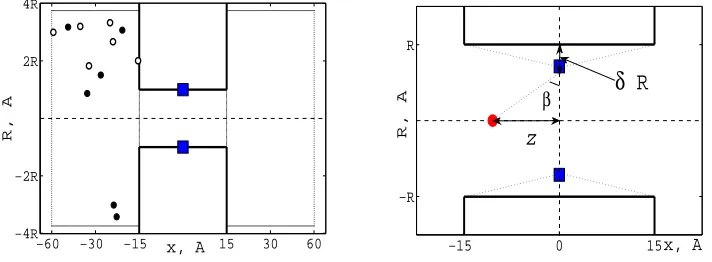
We consider the following Brownian dynamical model of the ion permeation (see sketch in the Fig. 1 (left)). The system is made of three compartments of equal size. The middle block constitutes the protein through which there is a cylindrical hole approximating the open channel. To model the ion’s coupling to the vibrational modes of the channel, we introduce a moving segment of the protein wall that is elastically bound to the wall. The moving segment is charged and represents the selectivity site. The dynamics of the ions in the bath and channel, and of the moving segment, are modeled using Brownian Dynamics (BD) simulations, see eqs. (2)-(5) coupled to the Poisson equation (1).
− ∇ ·(ε(~r)∇φ(~r)) =ρ(~r), (1)
mi~x¨i+miγi~x˙i =F~C,i+F~sr,i+F~H,i+
p
2miγikBT ~ξi(t), (2)
mj~x¨j+mjγj~x˙j =F~C,j+F~sr,j+F~H,j +
p
2mjγjkBT ~ξj(t), (3)
mx¨+mγx˙ =FC +Fch+Fiw,isin(β) +
p
2mγkBT ξ(t), (4)
MδR¨+MΓδR˙ +KδR=Fiw,Mcos(β) +
p
2MΓkBT ν(t) (5)
Here ~rij =~xi−~xj, rij = |~rij|, mi, ~xi and qi, miγi and √2miγikBT ~ξi(t) are the mass,
position, charge, friction coefficient and the stochastic force of theith ion. The distance between ions i and j is rij. In this work, for simplicity, we restrict the analysis to two
types of ions: the indexiwill correspond to Na+
, while indexjcorresponds to Cl−1
−60 −30 −15 15 30 60 −4R
−2R 2R 4R
x, A
R, A
−15 0 15
−R R
R, A
x, A
β
z
δ R
Figure 1. Left: Sketch of the model. The middle block represents the protein, through which there is a cylindrical hole approximating the open ion channel. The moving charged segment of the protein wall, assumed elastically bound to the wall, is shown by the filled squares. Negative ions are shown by the filled circles, and positive ions by the open circles. Right: Sketch of an ion moving along the channel axis. The conducting ion is shown by red circle. The difference between ion coordinate xand location of the selectivity sitexss isz. The vertical displacement of the selectivity site
isδR. The angle between a line connecting the ion with the selectivity site and the vertical axis isβ.
the selectivity site. Keeping only the axial component of the force for the ion motion in the channel, and the radial component of Fiw for the oscillating wall, we have
Fiw,i=
Qqj
4πǫǫ0d2
z
d, Fiw,M = Qqj
4πǫǫ0d2
δR d .
Here d = p((R+δR)2+z2), z = x
− xss where x is the coordinate of the ion in
the channel along the channel axis, and xss is the location of the selectivity site. An
additional coupling of the ion motion to fluctuations of the channel wall is effected via modulation of the channel potential by the moving wall. This is taken into account through the term Fch on the rhs of eq. (4). The ions in the bulk (see eqs. (2), (3))
do not feel the channel potential. Instead, their motion is governed by the Coulomb interaction FC, by the short-range interaction Fsr, and by hydration forces FH (see [3])
~
FC,i =PNj=1 qiqj
4πεε0r2ij
~ rij
rij,
~
Fsr,i =PNj=1 9U0R9c
r10
ij
~ rij
rij,
~
FH,i =PNj=1AU0exp
R
ij−rij
ae
sin2πRij−rij
aw −α
i~r
ij
rij, where A=q1 + ( aw
2πae)
2 and α= arctan( aw
2πae).
In addition the effect of the surroundings is taken into account by an average frictional force with frictional coefficient miγi and a stochastic force √2miγikBT ~ξi(t).
The addition of the pairwise repulsive 1/r9
soft-core interaction potential ensures that ions of opposite charge, attracted by the inter-ion Coulomb force, do not collide and neutralize each other. U0 and Rc are respectively the overall strength of the potential
[image:4.612.112.468.97.228.2]aw is the oscillation length, ae is the exponential drop parameter, and Rij is the origin
of the hydration force which is shifted from Rc by +0.2 ˚A for like ions and by −0.2 ˚A
otherwise [29]. Fch is the dielectric force in the channel, obtained by solving Poisson’s
equation numerically using finite volume methods (FVM) [30]. We use the Langevin equation to model the collective motion of the atoms forming the channel protein charged ring located at the selectivity filter. In this way, our analysis is based on the assumption that the movement of structural domains of the channel protein may be described as the motions of independent, elastically bound Brownian particles [31]. We have included the damping term MΓδR˙ and the corresponding random force √2MΓkBT ν(t), whose
amplitude is related to the damping constant via the fluctuation-dissipation theorem. The function ν(t) is a Gaussian white noise. Q is the total fixed charge on the flexible ring interacting with an ion of charge qj on the channel axis z. R is the channel radius,
δRis a small variation of the channel radius andK is the elastic constant of the channel protein. In the particular case of the Gramicidin A (GA) channel, the value of the elastic constant is estimated by calculating the root-mean-square deviation (RMSD) of the backbone forming its central part, together with the single ion potential of a Na+
ion as it traverses the channel. Using data from [32], we obtain an elastic constant of
∼ 1.6577 N/m for a maximum RMSD of 1 ˚A. The GA channel molecular weight M
is about 4kDa = 6.64×10⁻²⁴
kg [33]. The diffusion constant of the protein in the membrane is between 10−14
and 10−16
m2
/s [34].
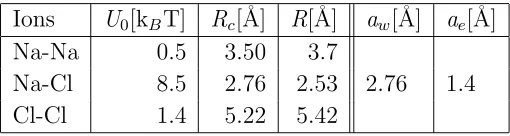
[image:5.612.167.422.477.545.2]The parameters of the ion-ion interaction are presented in Table. 1.
Table 1. Parameters used in the calculation of the short range ion-ion interaction with hydration
Ions U0[kBT] Rc[˚A] R[˚A] aw[˚A] ae[˚A]
Na-Na 0.5 3.50 3.7
Na-Cl 8.5 2.76 2.53 2.76 1.4
Cl-Cl 1.4 5.22 5.42
Other parameters used in simulations are: Dielectric constants: ε2 = 80, ε1 = 2;
Masses (in kg): mN a = 3.8×10
−26
, mCl = 5.9×10
−26
; Diffusion coefficients (in m2
s−1
): DN a = 1.33×10
−9
,DCl= 2.03×10
−9
, (Note that D is related to the friction coefficient via D= kBT
mγ );
Ion radii (in ˚A): rN a = 0.95,rCl = 1.81;
Temperature: T = 298 K.
3. Reduced model for ion channel conduction
vibrations). We further assume that the channel is occupied most of the time by only one ion, and that the transition rate of ions through the channel is mainly determined by escape over the potential barrier at the selectivity site. Then the effect of the many-body ion dynamics in the bulk on the ion motion in the channel is twofold: (i) a delivery of the ions to the channel mouth and (ii) modulation of the channel potential by the charge fluctuations at the channel mouth. Under these physiologically plausible assumptions one can separate the ion motion in the channel from the many-body ion dynamics in the bulk. The resulting equations of ion dynamics in the channel coupled to the wall fluctuations can be written as follows
mγx˙ =−dV(x, t)
dx +
p
2mγkBT ξ(t), (6)
MδR¨+MΓδR˙ +KδR=Fiw,Mcos(β) +
p
2MΓkBT ν(t). (7)
Note that the reduced motion of the conducting ion is overdamped while the wall fluctuations are damped. Damped vibrational mode models the relatively slow (on a time scale of ns) motion of the protein of the channel walls that was suggested [35, 12] to be essential for the ion transport process.
0 4 8 12
0 0.04 0.08 0.12
ρ
(r)
r, A
Na−Na Na−Cl Cl−Cl
0 1 2
0 40 80
τar
ρ
(
τ ar
)
τar≈ 471 ps, e−
τ
[image:6.612.97.479.372.521.2]ar≈ 365 ps, e +
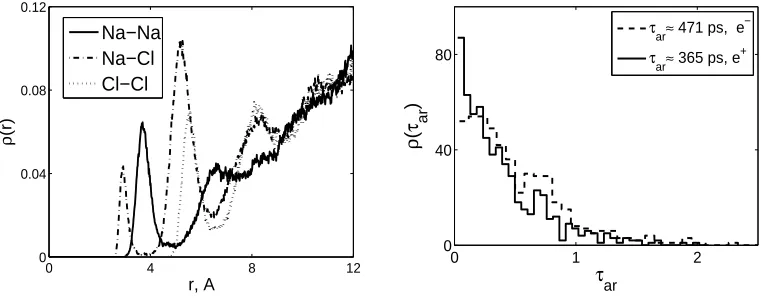
Figure 2. Simulations of Brownian dynamics in the bulk liquid. Left: The number of ions as a function of the distance between ions of different types: C=400 mMol; Box size: 40 A. Forces included in the simulations were: (i) Coulomb interaction; (ii) short range repulsion; (iii) hydration. Right: The arrival time distribution for positives(solid line) and negative(dashed line) for cylindrical channel of radius r=6˚A
The potential V(x, t) in our approximation has three main contributions: (i) the potential of Coulomb interaction with ions in the bulk solution VC; (ii) the electrostatic
potential induced by interaction with the channel protein Vch; (iii) the potential of
analytically the effect of this potential modulation on the channel conductivity as will be discussed in details in the next section.
To quantify the effect of multi-ion motion in the bulk on the conducting ion at the selectivity site, we have simulated ion’s Brownian dynamics in the bulk. The resulting ion-ion distributions in the bulk are shown in the Fig. 2 (left). We emphasize that these distributions are very close to those obtained earlier in both BD simulations [3] and experiments [36]. The arrival time distributions for Na+
and Cl−
ions at the channel mouth (defined as a cylindrical section of radius R and length R) obtained in our simulations is shown in Fig. 2 (right). Note that these distributions are exponential for bothCl−
and Na+
with mean arrival times τ−
= 471 ps andτ+
= 365 ps respectively. These estimates are in agreement with the theoretical estimates in [37]
τarrival =
1
2πcDR (8)
where cis the ion concentration and D= kBT
mγ is the diffusion coefficient.
0.5 1 1.5 2 2.5 3
−2 −1.5 −1 −0.5 0 0.5 1 1.5 2
t, ns
Charge, e
0 20 40 60 80
−4 −3 −2 −1 0 1 2 3 4
E, k
B
T
x, A
[image:7.612.93.482.343.512.2]∆ E0 ∆ E1
Figure 3. (left) Charge fluctuations at the channel mouth. The positive charge is shown by the solid line. The negative charge is shown by the dashed line. (right) The potential energy profiles as a function of the position of the ion when: the first ion is fixed at the channel mouth (dashed line) and the second is moving along the channel axis. The solid line corresponds to the potential energy on a single ion moving on the channel axis, and the potential energy of the passive channel (dotted line). The vertical dashed lines show the channel entrance and exit. The height of the potential energy barrier seen by a single ion at the selectivity site as it moves from left hand to right hand of the channel is denoted ∆E0. In the presence of a second ion at the
channel’s left mouth this barrier is reduced to ∆E1.
corresponding to 0 or−1echarge at the channel mouth. In this approximation the effect of three states of the potential is taken into account by asymmetry of the transition rates between the two effective states. The corresponding transition rates can be estimated as α±
= 1/hT±i, where hT±i are mean residence time of two effective states, giving
(α+
)−1
= 0.22 ns and (α−
)−1
= 0.38 ns. The occupation probabilities of these two states are 0.36 and 0.64 respectively. The effect of the wall oscillations on the channel potential was estimated earlier [20] and for simplicity the wall will be assumed rigid in the rest of the paper.
To estimate the effect of charge fluctuations on the value of the channel potential we solve the Poisson equation for various positions of the conducting ion along the channel axis in two cases: (i) when there are no other ions at the channel entrances; (ii) when there is one positive ion at the left entrance to the channel. The results of these calculations are shown in Figure. 3(right). The low-conductivity effective state of the channel is shown by the blue solid line and corresponds to the potential barrier ≈1kBT
at the selectivity site. The high conducting state is shown by the red dashed line and corresponds to a potential barrier height ≈ 0.2kBT, i.e. practically no barrier state.
It can be seen that the charge fluctuations are enhanced in channels of low dielectric constant, resulting in strong modulation of the potential barrier at the selectivity site [20] (see also [38]).
0 30 45 60 90
−4 −3 −2 −1 0 1 2 3 4
E, k
B
T
x, A
E
0 −
E1− E
1 +
E
0 +
α−
x
0 x1
[image:8.612.188.386.411.560.2]α+
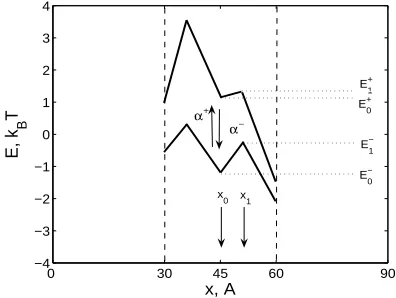
Figure 4. Approximation of the fluctuating potential.
It is therefore possible to build a simple model capable of coupling the motion of ions in the channel to the bath solution. The channel potential becomes
V(x, t) = V++V−
2 +
V+−V−
2 χ(t), χ(t) =±1, (9)
V+=
∆E1
xm
(x−x0) +E +
0, V−=
∆E0
xm
(x−x0) +E
−
0,
where χ(t) is a Poisson random force with two transition rates α± between the states
+1 and−1 . The charge fluctuations at the channel mouth thus result in flipping of the potential. Here ∆E0 =E
−
1 −E
−
0 and ∆E1 =E + 1 −E
+
0 , with ∆E0 >∆E1 are respective
A direct analogy can be made between the model described by Eq. (6) and the model described by Z¨urcher [28] whose barrier fluctuation is controlled by a dichotomic noise of zero mean and exponential correlation. An approximation of the fluctuating potential is sketched in Figure. 4. The similarity of the two problems suggests that there is some possibility of semi-analytical estimations of the effect of the charge fluctuations.
4. Estimation of the mean channel crossing time
We are interested in the transition of a particle initially trapped at the channel selectivity filter. This corresponds to the motion of the ion across the interval [x0, x1]. The
approximate potential in this interval is given by (9). We are interested at the unidirectional current, so there is no backward flow of ions. We assume that on average, the channel is always occupied by a single Na+
ion. This arises from the fact that, when an ion is sitting in the middle of the channel, it is almost impossible for a second ion to enter the channel due to the height of the barrier at the left entrance of the channel, as can be seem from Figure. 4.
As a first approximation, we assume that the mean first passage time (MFPT) is only determined by escape. Therefore the MFPT for the channel is expected to be a function of the two timesτ+andτ−corresponding to the escape times from the potential
minimum in two effective states of the potential. Our derivation follows very closely the earlier discussion by Z¨urcher [28] with the difference that, here, we are interested in the asymmetric case with two transitions rates.
Assuming no back flow, the quantities τ±(x) are defined by (see [39]): −1
mγ dV+
dx dτ+
dx + kBT
mγ d2
τ+
dx2 −α +
τ++α
−
τ− =−p+, (10)
−1
mγ dV−
dx dτ−
dx + kBT
mγ d2
τ−
dx2 −α
−
τ−+α
+
τ+ =−p−, (11)
The potential jumps between positive and negative values, with respective ratesα+
and
α−
. p±are the occupation probabilities of these states. We choose a reflecting boundary
condition (BC) at the bottom of the barrier x=x0 and absorbing BC at the top of the
barrier x=x1,
dτ±(x=x0)
dx = 0, τ±(x=x1) = 0, (12)
With τ+ and τ− specified, the mean exit time of the Brownian particle that is trapped
at the selectivity filter x=x0 is given by:
τ =τ+(x0) +τ−(x0), (13)
Following Z¨urcher [28], the calculations of τ± is straightforward. We introduce
E = ∆E1+ ∆E0
2 , ∆ =
∆E1−∆E0
2 , (14)
and
σ(x) =α+
τ+(x) +α
−
τ−(x), δ(x) = α
+
τ+(x)−α
−
0 0.1 0.2 0.3 0.4 0.5 10 20 30 40 50 60 70 80 90 τ (ns)
α+ (ns)−1
0 0.1 0.2 0.3 0.4 0.5
0 2 4 6 8 10 12 I (pA)
[image:10.612.93.485.95.247.2]α+ (ns)−
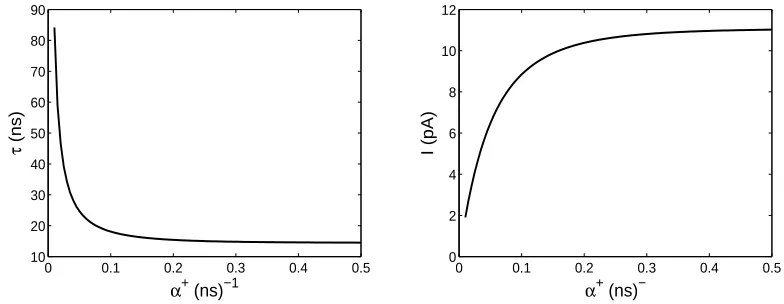
Figure 5. Left: MFPT as a function ofα+
. Right: Current as a function ofα+
.
We find the coupled differential equations
−DE
xmkBT
dσ dx +D
d2
σ dx2 + (α
+
p++α
−
p−) = (α
+
p+−α
−
p−)δ+
D∆
xmkBT
dδ
dx, (16)
−DE
xmkBT
dδ dx +D
d2
δ dx2 −(α
+
p++α
−
p−)δ+ (α
+
p+−α
−
p−) =
D∆
xmkBT
dσ
dx, (17)
where D=DN a and the boundary conditions,
σ(x=x1) = 0,
dσ(x=x0)
dx = 0, δ(x=x1) = 0,
dδ(x=x0)
dx = 0. (18)
We introduce the following scaled dimensionless coordinate,
x= xmkBT
E y. (19)
The model is therefore characterized by the following parameters,
τ0 = 2
(xmkBT)2
DE2 , η=
∆
E, λ= τ0
2(α
+
p++α
−
p−), β =
τ0
2(α
+
p+−α
−
p−). (20)
The coupled differential equations then read,
−dσdy +d
2
σ
dy2 +λ=βδ+η
dδ
dy, (21)
− dδ
dy + d2
δ
dy2 −λδ+β =η
dσ
dy, (22)
and σ(y) and δ(y) are subject to the BC,
σ(y=y1) = 0,
dσ(y=y0)
dy = 0, δ(y=y1) = 0,
dδ(y=y0)
dy = 0. (23)
The solution of this system gives,
δ(y) =
3
X
i=1
aiexp(qiy) +
(β−λη)
The eigenvalues qi, follow from
q1+q2+q3 = 2,
q1q2+q2q3+q3q1 = 1−λ−η2,
q1q2q3 =−(λ−βη).
(25)
The ai are given as follows,
a1 =−
β−λη Ds(λ−βη)
q3(q 2
2−λ)−q2(q 2 3−λ)
exp((q3+q2)y0)
− 1
Ds
λ(β−λη)
λ−βη −β
q3exp(q3y0+q2y1)−q2exp(q3y1+q2y0)
. (26)
Here a2 and a3 are determined by cyclic permutation of the indices of the qi from a1,
and Ds is given by
Ds =q1q2(q2−q1)(q3−1) exp((q1+q2)y0+q3y1) +cycl.perm. (27)
At y0, we have:
σ(y0) =
1 η 3 X i=1 ai h
−1 +qi −
λ qi
exp(qiy0)−
qi−
λ qi
exp(qiy1)
i
−η((βλ−λη) −βη)+
hλ
η
(β−λη) (λ−βη) −
β η
i
(y1−y0) (28)
Combining Eq. (13,15), the mean exit time for the Brownian particle follows:
τ = σ(y0) +δ(y0) 2α+ +
σ(y0)−δ(y0)
2α− . (29)
[image:11.612.75.515.288.644.2]0 0.2 0.4 0.5 1 1.50 100 200 300 α+ (ns)−1 α− (ns)−1 τ (ns) 0 0.2 0.4 0.5 1 1.50 10 20 30 40 α+ (ns)−1 α− (ns)−1 I (pA)
Figure 6. (left) MFPT as function ofα+ and α−. (right) current as function of α+
andα−.
we have used a smaller ion diffusion coefficient inside the channel equal to 1.33×10⁻¹⁰
m2
s−1
. The results of the calculations are shown in the Figs. 5 and 6. It is clear from Fig. 5 that the particle takes longer to cross ∆E0 as compared to ∆E1. There is a
fast drop of the MFPT as the flipping rate α+
increase. The current I = e/τ is also presented as function of α+
. A more general view of the dependance of the MFPT and the current on the two rates is shown in Fig. 6. We emphasize that the obtained transition rates are essentially non-equilibrium. In particular, current saturation effect can be observed as α+
increases in a wide range of parameters. This is in accordance with experimental observations [33] of the current saturation at high concentrations.
5. Conclusion
In summary, we have introduced a Brownian dynamical model of ionic transitions through a channel, taking into account charge fluctuations at the channel mouth and the fluctuations of the channel walls. The statistical properties of the charge fluctuations are reconstructed from 3D Brownian dynamics simulation of multi-ion motion in the bulk solution. It is shown that distributions of ion arrival times at the channel mouth are exponential. It is further shown that these charge fluctuations strongly modulate the potential barrier for the conducting ion at the selectivity site due to amplification of electrostatic interactions in long narrow channels of low dielectric constant. These findings have allowed us to model the mean ion transition time through the channel as an ionic escape from the potential wall at the selectivity site induced by thermal fluctuations and by modulation of the height of the barrier by stochastic Poisson processes. The derived model is a Brownian dynamical model of the “knock-on” mechanism of the type [40, 41]. Our model allows for analytic estimation of transition probabilities in the presence of charge fluctuations, i.e. it allows for analytic estimation of correlations between bulk concentrations and ion currents in charged narrow channels. In particular, it demonstrates the effect of current saturation due to ion concentrations in the bath. The model is essentially of a non-equilibrium nature. This last point is worth emphasizing because traditional approaches assume equilibrium rates of hopping between the sites.
is also worth mentioning that the model that takes into account fluctuations of the wall may account for the dissipation of energy in the channel, for self-induced acceleration of the transition rate of the ion through the channel, and for coupling of the ion motion to the channel gating mechanics. Indeed, in this model, part of the energy induced by a very strong Coulomb interaction between the charged site at the channel wall and the moving ion is stored as the energy of vibrational modes. The later energy is only partially dissipated by the protein phonon modes. The remaining energy can now be used to modulate the potential barrier for the moving ion in a self-consistent manner to accelerate its transition through the channel. It can also be used to assist the conformational changes leading to the channel gating.
The work in progress contains a plethora of unsolved problems. The immediate extension of the proposed model will be to include more then two levels for the potential at the selectivity site, taking into account positive, neutral, and negative charge at the channel mouths at both ends of the channel. The model can be further refined by including the estimates of the return times corresponding to a return of the ion in the channel to the initial bulk solution.
Following the discussion above we can also formulate the following general unsolved problems in ion channels. We believe that they can be tackled by extending the model introduced in this paper:
(i) The role of the membrane fluctuations. (ii) The role of the hydration potential.
(iii) The role of additional binding sites outside the selectivity filter.
(iv) The energetics of the ion transition including energy relaxation due to the coupling to the protein phonon modes (wall oscillations).
(v) The coupling of the ion-wall interaction to the gating mechanism.
In all of these, noise and dynamical effects seem to play a crucial role that is only starting to be elucidated. Our preliminary research shows that the model can be extended to take all of these effects into account.
References
[1] Hille B 1992Ionic Channel Of Excitable Membranes (Sunderland, MA: Sinauer Associates) [2] Eisenberg R S 1998Contemporary Physics 39447–466
[3] Corry B, Allen T W, Kuyucak S and Chung S H 2001Biophysical Journal 80195–214 [4] Jordan P C 2005IEEE Trans Nanobioscience43–9
[5] Doyle D, Cabral J M, Pfuetzer R A, Kuo A, Gulbis J M, Cohen S L, Chait B T and MacKinnon R 1998Science 28069–77
[6] Zhou Y, Morais-Cabral J H, Kaufman A and MacKinnon R 2001Nature 41443–48
[7] Dutzler R, Campbell E B, Cadene M, Chait B T and MacKinnon R 2002Nature 415287–294 [8] Corry B 2006Molecular Biosystems 2527–535
[9] Noskov S Y, Berneche S and Roux B 2004Nature 431830–834
[12] Heinemann S H and Sigworth F J 1990Biophys. J.57 499–514
[13] Nadler B, Schuss Z, Hollerbach U and Eisenberg R S 2004Physical Review E 70part 1 051912 [14] Bezrukov S M and Vodyanoy I 1995Nature 378362–364 10.1038/378362a0 10.1038/378362a0 [15] Adair R K 2003Proceedings of the National Academy of Sciences 10012099–12104
[16] Tindjong R, Applegate A, Eisenberg R S, Kaufman I, Luchinsky D G and McClintock P V E
2004Fluctuations and Noise in Biological, Biophysical and Biomedical Systems II vol 5467 ed
D Abbott S M Bezrukov A D and Sanchez A (Bellingham, WA: SPIE) pp 338–344
[17] Tindjong R, Eisenberg R S, Kaufman I, Luchinsky D G and McClintock P V E 2005Proceedings
of the 18th International Conference on Noise and Fluctuationsvol 780 ed T Gonzalez J M and
Pardo D (Salamanca: AIP Conference) pp 563–566
[18] Tindjong R 2006A self-consistent aproach to the simulation of ionic motion in open Ion channels
Ph.D. thesis Lancaster University Lancaster
[19] Tindjong R, Luchinsky D G, McClintock P V E, Kaufman I and Eisenberg R S 2007Proceedings of
the 19th International Conference on Noise and Fluctuations vol 922 ed Tacano M, Yamamoto
Y and Nakao M (Tokyo: AIP Conference) pp 647–650
[20] Luchinsky D G, Tindjong R, McClintock P V E, Kaufman I and Eisenberg R S 2007 Noise
and Fluctuation in Biological, Biophysical, and Biomedical Systems: D6020-D6020 vol 6602 ed
Bezrukov S M (Bellingham, WA: SPIE)
[21] Luchinsky D G, Tindjong R, McClintock P V E, Kaufman I and Eisenberg R S 2007 Noise
and Fluctuation in Biological, Biophysical, and Biomedical Systems: E6020-E6020 vol 6602 ed
Bezrukov S M (Bellingham, WA: SPIE)
[22] Luchinsky D G, Tindjong R, Kaufman I, McClintock P V E and Eisenberg R S 2008to be submitted to PRE
[23] Chen D P, Barcilon V and Eisenberg R S 1992Biophys. J.611372–1393
[24] Elber R, Chen D P, Rojewska D and Eisenberg R 1995Biophysical Journal 68 906–924 [25] Nonner W and Eisenberg B 1998Biophys. J.75 1287–1305
[26] Chen D P, Xu L, Tripathy A, Meissner G and Eisenberg B 1999Biophys. J.761346–1366 [27] Eisenberg R S 1999J. Membr. Biol 711–24
[28] Z¨urcher U and Doering C R 1993Phys. Rev. E.473862–3869
[29] Moy G, Corry B, Kuyucak S and Chung S H 2000Biophys. J.782349–2363
[30] Ferziger J and Peric M 1996Computational Method for Fluid Dynamics.(Berlin: Springer) [31] L¨auger P 1985Biophys. J.48369–373
[32] Mamonov A B, Coalson R D, Nitzan A and Kurnikova M G 2003Biophys. J.843646–3661 [33] Andersen O S, Koeppe R E and Roux B 2005IEEE Transactions on Nanoscience 410–20 [34] Tuszynski J A and Kurzynski M 2003Introduction to Molecular Biophysics (Florida: CRC Press) [35] Skerra A and Brickmann J 1987Biophys. J.51977–983
[36] Guardia E, Rey R and Padro J A 1991J. Chem. Phys 952823–2831
[37] Eisenberg R S, Klosek M M and Schuss Z 1995J. Chem. Phys.1021767–1780 [38] Bastug T and Kuyucak S 2003Biophys. J.842871–2882
[39] Hanggi P and Talkner P 1985Phys. Rev. A321934–1937 [40] Hodgkin A and keynes R 1955J Physiol 12861–88
[41] Berneche S and Roux B 2003Proceedings of the National Academy of Sciences 1008644–8648 [42] Kutluay E, Roux B and Heginbotham L 2005Biophys. J.881018–1029
[43] Luchinsky D G, Greenall M J and McClintock P V E 2000Phys. Lett. A273316–321
[44] Smelyanskiy V N, Dykman M I, Rabitz H and Vugmeister B E 1997Phys. Rev. Lett.793113–3116 [45] Marchesoni F 1998Physics Letters A 237126–130