1926
https://doi.org/10.1107/S2056989017016103 Acta Cryst.(2017). E73, 1926–1930research communications
Received 2 September 2017 Accepted 7 November 2017
Edited by A. Van der Lee, Universite´ de Montpellier II, France
Keywords:crystal structure; cyclohexane-1,4-dicarboxylic acid; lanthanum(III) complex.
CCDC reference:1546730
Supporting information:this article has supporting information at journals.iucr.org/e
Crystal structure of poly[[di-
l
3-acetato-tetraaqua-bis(
l
2-cyclohexane-1,4-dicarboxylato)dilanthan-um(III)] dihydrate]
R. Drisya,aU. S. Soumya Mol,aP. R. Satheesh Chandran,aM. Sithambaresanb* and M. R. Sudarsankumara
aDepartment of Chemistry, Mahatma Gandhi College, Thiruvananthapuram 695 004, Kerala, India, andbDepartment of
Chemistry, Faculty of Science, Eastern University, Sri Lanka, Chenkalady, Sri Lanka. *Correspondence e-mail: [email protected]
The title compound, {[La2(CH3COO)2(C8H10O4)2(H2O)4]2H2O}n or
[La2(ac)2(e,a-cis-1,4-chdc)2(H2O)4]2H2O, where ac is acetate and 1,4-chdc is
cyclohexane-1,4-dicarboxylate anion, is a binuclear lanthanum(III) complex. Each metal atom is decacoordinated by four O atoms from two distinct 1,4-chdc2ligands, four O atoms from three acetate groups and two O atoms from coordinated water molecules to form a distorted bicapped square-antiprismatic geometry. Two non-coordinated water molecules are also present in the formula unit. The most remarkable feature of this compound is that it possesses a onlycis
conformation for cyclohexane-1,4-dicarboxylic acid, although the raw material consists of a mixture ofcisandtransisomers. The3-
2
:2
coordination mode of the bridging acetate group and the flexible dicarboxylate fragments of 1,4-chdc2 results in the formation of infinite two-dimensional lanthanide– carboxylate layers within the crystal structure. The directionality of strong intermolecular O—H O and weak C—H O interactions provides robustness to the layers, which leads to the construction of a three-dimensional supramolecular network. The crystal studied was refined as a two-component twin.
1. Chemical context
1,4-Cyclohexanedicarboxyic acid (1,4-chdcH2) is a flexible
alicyclic, ditopic ligand having a chair-type backbone struc-ture, which has been used for the construction of many coordination polymers (CPs) with remarkable architectures (Liuet al., 2010). It can exist in three different conformations – twotransisomers, (a,a) and (e,e), and onecis (e,a)form. From a thermodynamical point of view, thetrans(e,e) form is the most stable of the three different conformations as a result of the equatorial–equatorial –COOH groups and thetrans(a,a) isomer is the least stable because of 1,3-diaxial hindrance (Yu
et al., 2007; Gonget al., 2005; Biet al., 2003; Duet al., 2005; Chen et al., 2014)Theoretical calculations suggest that the isomers tend to cause conformational inversion within the ligand structure due to the flexibility of the C—C bond rota-tion and also because of the extremely low free energy change between them (Qiblawiet al., 2013; Lin & Tong, 2011; Liuet al., 2010). Furthermore, the isomeric separation of the organic ligand can be controlled by several factors such as the pH of the solution, the nature of the metal ion, the co-ligand, the reaction solvent and the temperature (Lin & Tong, 2011; Liuet al., 2010).
2. Structural commentary
The asymmetric unit of the title compound consists of one crystallographically unique La metal ion, a fully deprotonated 1,4-chdc2anion, an acetate moiety and three water molecules (two coordinated and one non-coordinated). From the mol-ecular structure (Fig. 1), it is evident that each LaIIIatom has a distorted bicapped square-antiprismatic coordination sphere defined by four oxygen atoms from two distinct 1,4-chdc2 ligands (O1, O2, O7, O8), four oxygen atoms from three acetate groups (O5, O6, O50, O60) and two oxygen atoms from
coordinated water molecules (O3, O4) to form a [LaO10]
coordination polyhedron (Fig. 2). Of the three prevalent conformations of 1,4-chdcH2, low temperature usually favours
the cis (e,a) and high temperature favours the trans (e,e) conformational compounds (Lin & Tong, 2011; Luet al., 2008;
Biet al., 2004). Here, the bent structure of the organic linker possesses an L-shapedcis(e,a) conformation within the crystal structure. The corresponding La—O bond lengths are in the range 2.506 (8)—2.792 (7) A˚ and the O—La—O bond angles vary from 46.51 (19) to 170.7 (2). The La—O bond distances
are comparable with those in several reported structures in which 1,4-cyclohexanedicarboxylic acid exists in various coordination modes and conformations (Raoet al., 2007; Qiet al., 2008).
The bridging 3- 2
:2
coordination mode (each oxygen atom connects two metal atoms) of the acetate group joins two [LaO10] polyhedra by edge sharing to form a dimeric structure.
The dimers are then interlinked by La—O—La bonding and as a consequence of this, infinite zigzag 1D [La2O2] chains are
formed. Within these chains, La La non-bonding distances are found to be 4.5835 (9) and 4.4125 (9) A˚ . Additionally, the
bis-bidentate chelating 2- 1
:1
:1
:1
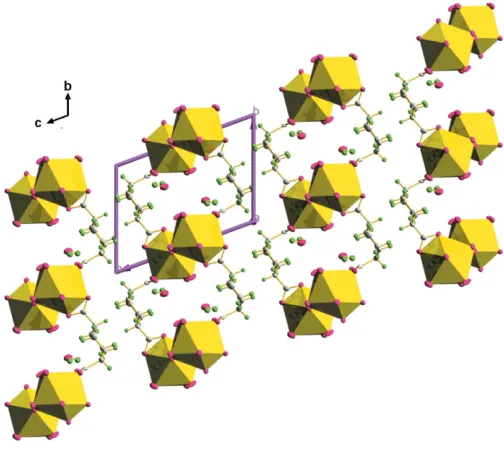
coordination mode of the dicarboxylate group of 1,4-chdc2 connects two metal atoms and hence converts it into a 2D coordination polymeric structure parallel to theabplane. A perspective view of the packing along thecaxis in a wireframe model (Fig. 3) shows
research communications
[image:2.610.351.520.75.258.2]Acta Cryst.(2017). E73, 1926–1930 Drisyaet al. [La2(C2H3O2)2(C8H10O4)2(H2O)4]2H2O
1927
Figure 2
Bicapped square-antiprismatic geometry of an [LaO10] polyhedron.
[image:2.610.44.297.76.314.2]Displacement ellipsoids are drawn at the 80% probability level.
Figure 1
[image:2.610.44.295.545.708.2]ORTEPview of the molecular structure of the title complex with the atom-numbering scheme and ellipsoids drawn at the 50% probability level..
Figure 3
[image:2.610.317.563.575.724.2]the formation of infinite 2D lanthanide–carboxylate layers. The [La2O2] chains are then further interconnected by a
di-carboxylate anion from two 1,4-chdc2 units to form a 24-membered macrocyclic ring as shown in Fig. 4. A series of organotin complexes of thecisandtransisomers of 1,4-chdcH2
show similar 2D networks containing 26- and 36-membered tetratin macrocyclic rings (Maet al., 2009).
3. Supramolecular features
From the polyhedral view along theaaxis (Fig. 5), it is clear that the two lattice water molecules residing in the voids of the 1,4-chdc2 units are responsible for the development of hydrophilic channels within the crystal structure. The hydrogen-bonding interactions (Table 1) shown in Fig. 6 play a vital role in increasing the stability and higher dimensionality of the crystal packing. Here, the oxygen atom O9 of the lattice
water molecule acts as a donor for hydrogen bonds with oxygen atoms O1 and O2 of the carboxylate group of the 1,4-chdc2 ligand [O9—H9A O2 = 2.786 (12) A˚ and O9— H9B O1iii= 2.846 (11) A˚ ]. It also acts as the hydrogen-bond
acceptor for oxygen atoms O3 and O4 of the coordinated water molecules [O3—H3C O9 = 2.858 (12) A˚ and O4— H4D O9ii2.812 (11) A˚ ]. Similarly, oxygen atom O7 of the carboxylate group of 1,4-chdc acts as an acceptor to atoms O3 and O4 of the coordinated water molecules [O3—H3D O7ii = 2.750 (11) A˚ and O4—H4C O7i = 2.771 (10) A˚ ]. Apart from this strong intermolecular hydrogen bonding, there are also weak C—H O interactions between the carbon atom C10 of the coordinated acetate group and the O1 oxygen atom of a carboxylate group of the organic linker [C10— H10C O1 = 3.295 (14) A˚ ].
4. Database survey
In the three-dimensional structures of [La2(1,4-chdc)3(H2O)4],
[La3(1,4-Hchdc)2(1,4-chdc)5(H2O)2]H2O and [La2(1,4-chdc)3
-1928
Drisyaet al. [La2(C2H3O2)2(C8H10O4)2(H2O)4]2H2O Acta Cryst.(2017). E73, 1926–1930research communications
Figure 5
[image:3.610.313.565.71.296.2] [image:3.610.45.297.93.179.2]Polyhedral view along theaaxis showing the free water molecules.
Table 1
Hydrogen-bond geometry (A˚ ,).
D—H A D—H H A D A D—H A
C10—H10C O1 0.96 2.49 3.295 (14) 141 O4—H4C O7i 0.90 (2) 1.92 (5) 2.771 (10) 158 (12) O4—H4D O9ii 0.89 (2) 1.96 (6) 2.812 (11) 158 (12)
O3—H3C O9 0.90 (2) 1.97 (3) 2.858 (12) 172 (13) O3—H3D O7ii 0.90 (2) 1.86 (3) 2.750 (11) 170 (14)
O9—H9A O2 0.90 (2) 2.20 (11) 2.786 (12) 122 (11) O9—H9B O1iii 0.90 (2) 1.97 (5) 2.846 (11) 164 (13)
[image:3.610.46.300.441.720.2]Symmetry codes: (i)xþ1;yþ1;zþ1; (ii)x;yþ1;zþ1; (iii)x1;y;z.
Figure 6
Hydrogen-bonding interactions (dashed lines) in the structure of the title compound. For symmetry operations, see Table 1.
Figure 4
The 24-membered macrocyclic ring formation by 1,4-chdc2
(H2O)]2.5H2O, the dicarboxylate anion exists in different
conformations obtained under hydrothermal conditions (Rao
et al., 2007). Similarly a two-dimensional lanthanum coordin-ation polymer [La2(1,10-phen)2(1,4-chdc)3]2.5H2O with –
stacking was observed by the incorporation of 1,10-phenan-throline as a co-ligand along with 1,4-cyclohexanedicarboxylic acid (Qi et al., 2008). Additionally, dimethyl formamide (DMF) and dimethyl sulfoxide (DMSO) solvent-coordinated lanthanum complexes, one-dimensional [La(cis-chdc)(DMF)2
-(NO3)] and three-dimensional [La2(trans-chdc)3(DMSO)4]
have also been reported. The presence of solvent molecules can completely segregate the cisandtransconformations of 1,4-chdc (Tianet al., 2009).
5. Synthesis and crystallization
Single crystals of the title compound were prepared by the gel-diffusion technique at ambient temperature using sodium metasilicate nonahydrate (Na2S2O39H2O) as the gel medium.
The optimum condition for crystal growth was obtained by dissolving 0.75 g of 1,4-H2chdc in 25 ml of 1.04 g cm
3
dense gel medium. 5 ml of the above solution was poured into glass tubes and the pH of the solution was set to 7.0 by adding glacial acetic acid drop by drop. On completion of the
gel-setting process, 3 ml of 0.5 M concentration of aqueous lanthanum nitrate solution was added as the upper reagent. The whole arrangement was kept undisturbed at room temperature and was covered to protect it from the foreign matter present in the atmosphere. Within seven days, trans-parent, colourless block-shaped crystals were observed at the gel interface. The diffusion of La3+ ions and 1,4-chdcH2
through the fine pores of the gel media lead to the expected chemical reaction as shown below:
2La(NO3)36H2O + 2C8H12O4 + 2CH3COOH !
[La2(CH3COO)2(C8H10O4)2(H2O)4]2H2O + 6HNO3.
Elemental analysis calculated (%) for C20H38La2O18
(844.32): C, 28.42; H, 4.50. Found (%): C, 28.36; H, 4.33. IR (KBr, cm1): 3380, 2940, 1573, 1460, 743, 673, 597.
6. Refinement
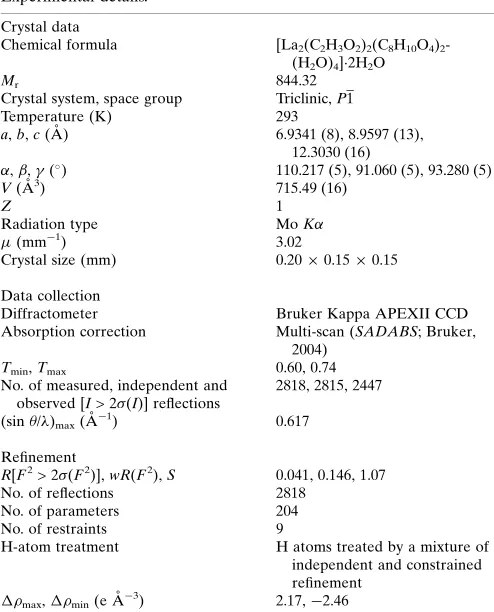
Crystal data, data collection and structure refinement details are summarized in Table 2. Carbon-bound hydrogen atoms were placed in calculated positions and included in the refinement in the riding-model approximation with C—H distances of 0.96–0.98 A˚ and with Uiso(H) = 1.2Ueq(C) for
methyl hydrogen atoms andUiso(H) = 1.2Ueq(C) for all others.
Water hydrogen atoms were located from difference-Fourier maps and refined with an O—H distance restraint of 0.90 (2) A˚ and an H H separation of 1.39 (2) A˚ . The isotropic displacement parameters of the hydrogen atoms attached to atoms O3, O4 and O9 were made equal by using an EDAP instruction. The crystal studied was refined as a two-component twin (BASF = 0.4203).
Acknowledgements
The authors are thankful to the authorities of SAIF, Kochi for instrumental facilities. We are indebted to Dr M. R. Pratha-chandra Kurup, Department of Applied Chemistry, Cochin University of Science and Technology, Kochi, for helping us to visualize the crystal structure usingDIAMONDsoftware. RD is thankful to the University of Kerala, Trivandrum, India, for the award of a University Research Fellowship.
References
Bi, W., Cao, R., Sun, D., Yuan, D., Li, X. & Hong, M. (2003).Inorg. Chem. Commun.6, 1426–1428.
Bi, W. H., Cao, R., Sun, D. F., Yuan, D. Q., Li, X., Wang, Y. Q., Li, X. J. & Hong, M. C. (2004).Chem. Commun.pp. 2104–2105.
Brandenburg, K. (2010).DIAMOND. Crystal Impact GbR, Bonn, Germany.
Bruker (2004). APEX2, SAINT and SADABS. Bruker AXS Inc., Madison, Wisconsin, USA.
Chen, Z. H., Zhao, Y., Wang, P., Chen, S. S. & Sun, W. Y. (2014). Polyhedron,67, 253–263.
Du, M., Cai, H. & Zhao, X. J. (2005).Inorg. Chim. Acta,358, 4034– 4038.
Gong, Y., Hu, C. W., Li, H., Huang, K. L. & Tang, W. (2005).J. Solid State Chem.178, 3152–3158.
Lin, Z. & Tong, M. L. (2011).Coord. Chem. Rev.255, 421–450. Liu, T. F., Lu¨, J. & Cao, R. (2010).CrystEngComm,12, 660–670. Lu¨, J., Bi, W. H., Xiao, F. X., Batten, S. R. & Cao, R. (2008).Chem.
Asian J.3, 542–547.
research communications
[image:4.610.45.292.87.393.2]Acta Cryst.(2017). E73, 1926–1930 Drisyaet al. [La2(C2H3O2)2(C8H10O4)2(H2O)4]2H2O
1929
Table 2
Experimental details.
Crystal data
Chemical formula [La2(C2H3O2)2(C8H10O4)2
-(H2O)4]2H2O
Mr 844.32
Crystal system, space group Triclinic,P1 Temperature (K) 293
a,b,c(A˚ ) 6.9341 (8), 8.9597 (13), 12.3030 (16)
,,() 110.217 (5), 91.060 (5), 93.280 (5)
V(A˚3) 715.49 (16)
Z 1
Radiation type MoK
(mm1) 3.02
Crystal size (mm) 0.200.150.15
Data collection
Diffractometer Bruker Kappa APEXII CCD Absorption correction Multi-scan (SADABS; Bruker,
2004) Tmin,Tmax 0.60, 0.74
No. of measured, independent and observed [I> 2(I)] reflections
2818, 2815, 2447
(sin /)max(A˚ 1
) 0.617
Refinement
R[F2> 2(F2)],wR(F2),S 0.041, 0.146, 1.07
No. of reflections 2818 No. of parameters 204 No. of restraints 9
H-atom treatment H atoms treated by a mixture of independent and constrained refinement
max,min(e A˚
3) 2.17,2.46
Computer programs:APEX2,SAINTandXPREP(Bruker, 2004),SIR92(Sheldrick, 2015),DIAMOND(Brandenburg, 2010),SHELXL2014(Sheldrick, 2015) andpublCIF
Ma, C., Wang, Y. & Zhang, R. (2009).Inorg. Chim. Acta,362, 4137– 4144.
Qi, Y., Li, H., Liu, C. & Hu, C. (2008).J. Coord. Chem.61, 315–321. Qiblawi, S. H., Sposato, L. K. & LaDuca, R. L. (2013).Inorg. Chim.
Acta,407, 297–305.
Rao, K. P., Thirumurugan, A. & Rao, C. N. R. (2007).Chem. Eur. J. 13, 3193–3201.
Sheldrick, G. M. (2015).Acta Cryst.C71, 3–8.
Tian, G., Zhu, G., Su, B.-L. & Qiu, S. (2009).J. Mater. Sci.44, 6576– 6582.
Westrip, S. P. (2010).J. Appl. Cryst.43, 920–925.
Yu, M., Xie, L., Liu, S., Wang, C., Cheng, H., Ren, Y. & Su, Z. (2007). Inorg. Chim. Acta,360, 3108–3112.
1930
Drisyaet al. [La2(C2H3O2)2(C8H10O4)2(H2O)4]2H2O Acta Cryst.(2017). E73, 1926–1930supporting information
sup-1 Acta Cryst. (2017). E73, 1926-1930
supporting information
Acta Cryst. (2017). E73, 1926-1930 [https://doi.org/10.1107/S2056989017016103]
Crystal structure of poly[[di-
µ
3-acetato-tetraaquabis(
µ
2-cyclohexane-1,4-di-carboxylato)dilanthanum(III)] dihydrate]
R. Drisya, U. S. Soumya Mol, P. R. Satheesh Chandran, M. Sithambaresan and M. R.
Sudarsankumar
Computing details
Data collection: APEX2 (Bruker, 2004); cell refinement: APEX2 and SAINT (Bruker, 2004); data reduction: SAINT and
XPREP (Bruker, 2004); program(s) used to solve structure: SIR92 (Sheldrick, 2015); program(s) used to refine structure:
SHELXL2014 (Sheldrick, 2015); molecular graphics: DIAMOND (Brandenburg, 2010); software used to prepare material for publication: SHELXL2014 (Sheldrick, 2015) and publCIF (Westrip, 2010)′.
Poly[[di-µ3-acetato-tetraaquabis(µ2-cyclohexane-1,4-dicarboxylato)dilanthanum(III)] dihydrate]
Crystal data
[La2(C2H3O2)2(C8H10O4)2(H2O)4]·2H2O
Mr = 844.32
Triclinic, P1
a = 6.9341 (8) Å
b = 8.9597 (13) Å
c = 12.3030 (16) Å
α = 110.217 (5)°
β = 91.060 (5)°
γ = 93.280 (5)°
V = 715.49 (16) Å3
Z = 1
F(000) = 416
Dx = 1.960 Mg m−3
Mo Kα radiation, λ = 0.71073 Å Cell parameters from 7100 reflections
θ = 2.8–30.9°
µ = 3.02 mm−1
T = 293 K Block, colourless 0.20 × 0.15 × 0.15 mm
Data collection
Bruker Kappa APEXII CCD diffractometer
Radiation source: Sealed tube
ω and φ scan
Absorption correction: multi-scan (SADABS; Bruker, 2004)
Tmin = 0.60, Tmax = 0.74
2818 measured reflections 2815 independent reflections 2447 reflections with I > 2σ(I)
θmax = 26.0°, θmin = 2.4°
h = −8→8
k = −11→10
l = 0→15
Refinement
Refinement on F2 Least-squares matrix: full
R[F2 > 2σ(F2)] = 0.041
wR(F2) = 0.146
S = 1.07 2818 reflections 204 parameters 9 restraints
Hydrogen site location: mixed
H atoms treated by a mixture of independent and constrained refinement
w = 1/[σ2(F
o2) + (0.0821P)2 + 6.1459P] where P = (Fo2 + 2Fc2)/3
supporting information
sup-2 Acta Cryst. (2017). E73, 1926-1930
Special details
Geometry. All esds (except the esd in the dihedral angle between two l.s. planes) are estimated using the full covariance matrix. The cell esds are taken into account individually in the estimation of esds in distances, angles and torsion angles; correlations between esds in cell parameters are only used when they are defined by crystal symmetry. An approximate (isotropic) treatment of cell esds is used for estimating esds involving l.s. planes.
Refinement. Refined as a two-component twin.
Fractional atomic coordinates and isotropic or equivalent isotropic displacement parameters (Å2)
x y z Uiso*/Ueq
C1 0.2377 (17) 0.7936 (10) 0.7752 (7) 0.0203 (18) C2 0.2486 (18) 0.7706 (11) 0.8920 (8) 0.030 (2)
H2 0.2447 0.8760 0.9522 0.036*
C3 0.0724 (17) 0.6681 (16) 0.9058 (11) 0.033 (3)
H3A 0.0698 0.6715 0.9855 0.040*
H3B −0.0448 0.7116 0.8889 0.040*
C4 0.0778 (17) 0.4962 (14) 0.8253 (10) 0.030 (3)
H4A 0.0694 0.4919 0.7455 0.036*
H4B −0.0331 0.4339 0.8379 0.036*
C5 0.2631 (16) 0.4239 (11) 0.8460 (7) 0.024 (2)
H5 0.2633 0.4196 0.9245 0.028*
C6 0.4375 (16) 0.5264 (15) 0.8372 (11) 0.030 (3)
H6A 0.4468 0.5213 0.7574 0.036*
H6B 0.5526 0.4836 0.8576 0.036*
C7 0.4325 (17) 0.6994 (14) 0.9147 (10) 0.028 (2)
H7A 0.5438 0.7602 0.9010 0.034*
H7B 0.4403 0.7067 0.9952 0.034*
C8 0.2736 (16) 0.2574 (10) 0.7614 (8) 0.0229 (19)
C9 0.7522 (14) 1.0347 (9) 0.6555 (7) 0.0141 (16)
C10 0.7542 (18) 1.0729 (13) 0.7831 (8) 0.030 (2)
H10A 0.7030 1.1749 0.8194 0.046*
H10B 0.8846 1.0758 0.8118 0.046*
H10C 0.6763 0.9926 0.8006 0.046*
O1 0.3916 (11) 0.7991 (10) 0.7225 (7) 0.0280 (18) O2 0.0804 (11) 0.8116 (10) 0.7334 (7) 0.0272 (18) O3 −0.0144 (11) 0.6946 (10) 0.4871 (7) 0.0310 (18) O4 0.3865 (13) 0.6914 (10) 0.4470 (8) 0.039 (2) O5 0.5999 (10) 0.9978 (10) 0.5957 (6) 0.0219 (16)
O6 0.9100 (10) 1.0455 (9) 0.6066 (6) 0.0220 (16)
O7 0.2827 (11) 0.2366 (7) 0.6530 (5) 0.0223 (14)
O8 0.2635 (12) 0.1397 (7) 0.7932 (5) 0.0283 (15)
O9 −0.2682 (13) 0.6345 (9) 0.6499 (7) 0.0384 (18) La1 0.23952 (8) 0.92768 (5) 0.58722 (4) 0.01486 (18)
H4C 0.474 (15) 0.704 (14) 0.398 (8) 0.05 (3)*
H4D 0.326 (16) 0.597 (8) 0.406 (8) 0.05 (3)*
H3C −0.088 (14) 0.668 (17) 0.538 (9) 0.06 (3)*
H3D −0.105 (12) 0.705 (17) 0.437 (9) 0.06 (3)*
supporting information
sup-3 Acta Cryst. (2017). E73, 1926-1930
H9B −0.388 (9) 0.669 (17) 0.663 (10) 0.06 (3)*
Atomic displacement parameters (Å2)
U11 U22 U33 U12 U13 U23 C1 0.026 (5) 0.012 (4) 0.025 (4) −0.004 (4) 0.006 (5) 0.008 (3) C2 0.047 (7) 0.023 (5) 0.019 (4) 0.003 (5) −0.002 (5) 0.008 (4) C3 0.029 (7) 0.041 (7) 0.034 (7) 0.011 (5) 0.007 (5) 0.017 (6) C4 0.031 (7) 0.027 (6) 0.030 (6) 0.004 (5) 0.003 (4) 0.005 (5) C5 0.030 (6) 0.026 (5) 0.016 (4) −0.005 (4) −0.002 (4) 0.011 (4) C6 0.022 (6) 0.037 (7) 0.033 (6) 0.004 (5) −0.005 (4) 0.014 (5) C7 0.041 (8) 0.025 (6) 0.017 (5) 0.001 (5) −0.004 (4) 0.007 (4) C8 0.017 (5) 0.024 (5) 0.029 (5) 0.002 (4) −0.001 (4) 0.012 (4) C9 0.010 (4) 0.012 (3) 0.018 (4) 0.003 (4) −0.002 (4) 0.001 (3) C10 0.026 (6) 0.042 (6) 0.020 (4) −0.006 (5) 0.003 (5) 0.007 (4) O1 0.016 (4) 0.039 (5) 0.039 (5) 0.005 (3) 0.005 (3) 0.025 (4) O2 0.026 (5) 0.031 (5) 0.028 (4) 0.004 (3) −0.005 (3) 0.015 (4) O3 0.026 (5) 0.035 (5) 0.034 (5) −0.005 (3) −0.002 (3) 0.017 (4) O4 0.033 (5) 0.022 (4) 0.051 (5) −0.009 (3) 0.023 (4) −0.001 (4) O5 0.012 (4) 0.037 (4) 0.020 (4) −0.001 (3) 0.002 (3) 0.014 (3) O6 0.011 (4) 0.032 (4) 0.025 (4) −0.001 (3) 0.002 (3) 0.011 (3) O7 0.025 (4) 0.024 (3) 0.018 (3) 0.001 (3) 0.006 (3) 0.007 (2) O8 0.042 (4) 0.021 (3) 0.024 (3) −0.001 (4) −0.004 (3) 0.011 (3) O9 0.023 (5) 0.033 (4) 0.057 (5) 0.004 (4) 0.004 (4) 0.013 (4) La1 0.0121 (3) 0.0169 (3) 0.0169 (3) 0.0017 (2) 0.0015 (2) 0.00745 (18)
Geometric parameters (Å, º)
C1—O2 1.240 (13) C9—La1ii 3.119 (8)
C1—O1 1.266 (13) C10—H10A 0.9600
C1—C2 1.522 (12) C10—H10B 0.9600
C1—La1 2.952 (8) C10—H10C 0.9600
C2—C7 1.521 (17) O1—La1 2.570 (7)
C2—C3 1.533 (17) O2—La1 2.601 (8)
C2—H2 0.9800 O3—La1 2.588 (8)
C3—C4 1.519 (18) O3—H3C 0.90 (2)
C3—H3A 0.9700 O3—H3D 0.90 (2)
C3—H3B 0.9700 O4—La1 2.506 (8)
C4—C5 1.527 (16) O4—H4C 0.90 (2)
C4—H4A 0.9700 O4—H4D 0.89 (2)
C4—H4B 0.9700 O5—La1 2.533 (7)
C5—C8 1.502 (12) O5—La1ii 2.792 (7)
C5—C6 1.505 (15) O6—La1iii 2.552 (7)
C5—H5 0.9800 O6—La1ii 2.674 (7)
C6—C7 1.516 (17) O7—La1i 2.598 (6)
C6—H6A 0.9700 O8—La1i 2.585 (6)
C6—H6B 0.9700 O9—H9A 0.90 (2)
supporting information
sup-4 Acta Cryst. (2017). E73, 1926-1930
C7—H7B 0.9700 La1—O6iv 2.552 (7)
C8—O8 1.244 (11) La1—O8v 2.585 (6)
C8—O7 1.284 (11) La1—O7v 2.598 (6)
C8—La1i 2.983 (9) La1—O6ii 2.674 (7)
C9—O5 1.237 (11) La1—O5ii 2.792 (7)
C9—O6 1.273 (11) La1—C8v 2.983 (9)
C9—C10 1.487 (11)
O2—C1—O1 120.1 (8) C9—O6—La1ii 98.1 (5)
O2—C1—C2 120.4 (9) La1iii—O6—La1ii 115.2 (3)
O1—C1—C2 119.5 (10) C8—O7—La1i 94.3 (5)
O2—C1—La1 61.6 (5) C8—O8—La1i 96.0 (5)
O1—C1—La1 60.2 (5) H9A—O9—H9B 101 (3)
C2—C1—La1 164.8 (6) O4—La1—O5 73.2 (3)
C1—C2—C7 114.2 (9) O4—La1—O6iv 135.8 (3)
C1—C2—C3 110.9 (9) O5—La1—O6iv 143.4 (2)
C7—C2—C3 109.4 (8) O4—La1—O1 77.7 (3)
C1—C2—H2 107.4 O5—La1—O1 73.8 (2)
C7—C2—H2 107.4 O6iv—La1—O1 126.4 (2)
C3—C2—H2 107.4 O4—La1—O8v 146.0 (3)
C4—C3—C2 111.4 (9) O5—La1—O8v 82.5 (3)
C4—C3—H3A 109.4 O6iv—La1—O8v 76.9 (2)
C2—C3—H3A 109.4 O1—La1—O8v 72.8 (2)
C4—C3—H3B 109.4 O4—La1—O3 67.5 (3)
C2—C3—H3B 109.4 O5—La1—O3 140.7 (3)
H3A—C3—H3B 108.0 O6iv—La1—O3 73.0 (3)
C3—C4—C5 111.4 (10) O1—La1—O3 96.1 (3)
C3—C4—H4A 109.4 O8v—La1—O3 131.7 (3)
C5—C4—H4A 109.4 O4—La1—O7v 138.0 (2)
C3—C4—H4B 109.4 O5—La1—O7v 73.7 (2)
C5—C4—H4B 109.4 O6iv—La1—O7v 69.9 (2)
H4A—C4—H4B 108.0 O1—La1—O7v 116.4 (2)
C8—C5—C6 110.0 (9) O8v—La1—O7v 49.88 (18)
C8—C5—C4 111.2 (9) O3—La1—O7v 140.6 (2)
C6—C5—C4 110.4 (8) O4—La1—O2 103.1 (3)
C8—C5—H5 108.4 O5—La1—O2 121.8 (2)
C6—C5—H5 108.4 O6iv—La1—O2 78.8 (2)
C4—C5—H5 108.4 O1—La1—O2 49.7 (2)
C5—C6—C7 113.4 (9) O8v—La1—O2 69.9 (2)
C5—C6—H6A 108.9 O3—La1—O2 67.7 (3)
C7—C6—H6A 108.9 O7v—La1—O2 116.2 (2)
C5—C6—H6B 108.9 O4—La1—O6ii 83.0 (3)
C7—C6—H6B 108.9 O5—La1—O6ii 107.7 (2)
H6A—C6—H6B 107.7 O6iv—La1—O6ii 64.8 (3)
C6—C7—C2 111.4 (9) O1—La1—O6ii 159.3 (3)
C6—C7—H7A 109.3 O8v—La1—O6ii 127.8 (2)
C2—C7—H7A 109.3 O3—La1—O6ii 69.3 (2)
supporting information
sup-5 Acta Cryst. (2017). E73, 1926-1930
C2—C7—H7B 109.3 O2—La1—O6ii 129.9 (2)
H7A—C7—H7B 108.0 O4—La1—O5ii 68.8 (3)
O8—C8—O7 119.6 (8) O5—La1—O5ii 61.3 (3)
O8—C8—C5 121.6 (8) O6iv—La1—O5ii 103.7 (2)
O7—C8—C5 118.7 (7) O1—La1—O5ii 129.6 (2)
O8—C8—La1i 59.5 (5) O8v—La1—O5ii 119.3 (2)
O7—C8—La1i 60.3 (4) O3—La1—O5ii 104.2 (2)
C5—C8—La1i 172.5 (8) O7v—La1—O5ii 72.9 (2)
O5—C9—O6 118.9 (7) O2—La1—O5ii 170.7 (2)
O5—C9—C10 121.7 (9) O6ii—La1—O5ii 46.51 (19)
O6—C9—C10 119.4 (9) O4—La1—C1 93.6 (3)
O5—C9—La1ii 63.3 (4) O5—La1—C1 97.2 (3)
O6—C9—La1ii 58.1 (4) O6iv—La1—C1 101.4 (3)
C10—C9—La1ii 161.8 (6) O1—La1—C1 25.3 (3)
C9—C10—H10A 109.5 O8v—La1—C1 65.9 (2)
C9—C10—H10B 109.5 O3—La1—C1 84.1 (3)
H10A—C10—H10B 109.5 O7v—La1—C1 115.7 (2)
C9—C10—H10C 109.5 O2—La1—C1 24.8 (3)
H10A—C10—H10C 109.5 O6ii—La1—C1 152.5 (3)
H10B—C10—H10C 109.5 O5ii—La1—C1 154.8 (3)
C1—O1—La1 94.4 (6) O4—La1—C8v 151.3 (3)
C1—O2—La1 93.6 (6) O5—La1—C8v 78.0 (3)
La1—O3—H3C 113 (9) O6iv—La1—C8v 70.6 (3)
La1—O3—H3D 120 (9) O1—La1—C8v 94.8 (3)
H3C—O3—H3D 101 (3) O8v—La1—C8v 24.5 (2)
La1—O4—H4C 121 (8) O3—La1—C8v 141.2 (3)
La1—O4—H4D 127 (8) O7v—La1—C8v 25.4 (2)
H4C—O4—H4D 102 (3) O2—La1—C8v 92.3 (3)
C9—O5—La1 147.1 (6) O6ii—La1—C8v 105.7 (2)
C9—O5—La1ii 93.4 (5) O5ii—La1—C8v 97.0 (2)
La1—O5—La1ii 118.7 (3) C1—La1—C8v 90.4 (2)
C9—O6—La1iii 138.0 (6)
O2—C1—C2—C7 161.8 (9) C4—C5—C8—O7 63.7 (13)
O1—C1—C2—C7 −20.4 (13) O2—C1—O1—La1 15.4 (9)
La1—C1—C2—C7 −105 (3) C2—C1—O1—La1 −162.5 (7)
O2—C1—C2—C3 37.7 (12) O1—C1—O2—La1 −15.2 (9)
O1—C1—C2—C3 −144.5 (9) C2—C1—O2—La1 162.6 (7)
La1—C1—C2—C3 131 (3) O6—C9—O5—La1 174.3 (8)
C1—C2—C3—C4 69.6 (12) C10—C9—O5—La1 −8.2 (16)
C7—C2—C3—C4 −57.2 (11) La1ii—C9—O5—La1 −168.1 (12)
C2—C3—C4—C5 57.2 (12) O6—C9—O5—La1ii −17.7 (8)
C3—C4—C5—C8 −176.5 (9) C10—C9—O5—La1ii 159.9 (7)
C3—C4—C5—C6 −54.1 (12) O5—C9—O6—La1iii −124.4 (8)
C8—C5—C6—C7 176.5 (9) C10—C9—O6—La1iii 58.0 (12)
C4—C5—C6—C7 53.4 (11) La1ii—C9—O6—La1iii −143.1 (9)
C5—C6—C7—C2 −55.0 (12) O5—C9—O6—La1ii 18.6 (9)
supporting information
sup-6 Acta Cryst. (2017). E73, 1926-1930
C3—C2—C7—C6 55.3 (11) O8—C8—O7—La1i 4.7 (11)
C6—C5—C8—O8 124.8 (11) C5—C8—O7—La1i −171.5 (9)
C4—C5—C8—O8 −112.5 (12) O7—C8—O8—La1i −4.8 (11)
C6—C5—C8—O7 −59.0 (13) C5—C8—O8—La1i 171.4 (9)
Symmetry codes: (i) x, y−1, z; (ii) −x+1, −y+2, −z+1; (iii) x+1, y, z; (iv) x−1, y, z; (v) x, y+1, z.
Hydrogen-bond geometry (Å, º)
D—H···A D—H H···A D···A D—H···A
C10—H10C···O1 0.96 2.49 3.295 (14) 141
O4—H4C···O7vi 0.90 (2) 1.92 (5) 2.771 (10) 158 (12)
O4—H4D···O9vii 0.89 (2) 1.96 (6) 2.812 (11) 158 (12)
O3—H3C···O9 0.90 (2) 1.97 (3) 2.858 (12) 172 (13)
O3—H3D···O7vii 0.90 (2) 1.86 (3) 2.750 (11) 170 (14)
O9—H9A···O2 0.90 (2) 2.20 (11) 2.786 (12) 122 (11)
O9—H9B···O1iv 0.90 (2) 1.97 (5) 2.846 (11) 164 (13)