Interdiffusion in Co Solid Solutions of Co–Al–Cr–Ni System at 1423 K
Yoritoshi Minamino
1, Yuichiro Koizumi
1, Nobuhiro Tsuji
1, Toru Yamada
1;*and Tomoshi Takahashi
2 1Department of Adaptive Machine Systems, Graduate School of Engineering, Osaka University, Suita 565-0871, Japan2Department of Materials Science and Engineering, Niihama National College of Technology, Niihama 792-8580, Japan
Binary, ternary and quaternary interdiffusion experiments have been investigated in cobalt solid solutions including Al, Cr, and Ni elements at 1423 K. The direct interdiffusion coefficients of Al, Cr and Ni are positive. Amongthem, the coefficients of Al are the largest, and those of Ni are the smallest. The indirect interdiffusion coefficients between Al and Cr are positive, but those between Al (or Cr) and Ni are negative. The addition of Al element to Co solid solution largely enhances diffusion but the addition of Cr and Ni elements slightly enhances diffusion. The effect of the addition of elements on interdiffusion are evaluated quantitatively from the factors related to the solidus temperature of Co solid solutions, the diffusivity of elements in pure Co and the interaction parameters between solute elements. The evaluated values of interdiffusion coefficients are in good agreement with the experimental ones.
(Received July 22, 2002; Accepted August 28, 2002)
Keywords: cobalt–aluminum alloy, cobalt–chromium alloy, cobalt–nickel alloy, cobalt–aluminum–chromium alloy, cobalt–aluminum–nickel alloy, cobalt–chromium–nickel alloy, cobalt–aluminum–chromium–nickel alloy, interdiffusion, interaction parameter, cobalt solid solution
1. Introduction
Accordingto the phase diagrams of Co alloys, there are a lot of solute elements which extend the Co solid solutions over a wide composition range.1)This Co solid solution with the wide composition ranges enables us newly to develop their good mechanical and physical properties or widely to improve them by controllingtheir compositions. For in-stance, the industrial heat-resistance Co alloys include a lot of solute elements: the Cr, Al and Si elements for improvement in resistance of oxidation and vanadium attack, and the Ni, Mo and W elements for improvement in high temperature strength. The interdiffusion coefficients play an important role to understand the phenomena in these multi-component Co alloys caused by the interdiffusion process at high temperatures such as oxidation, creep, transformation, aging and so on. Accordingly, a lot of reports have been published on diffusion in pure Co and binary Co alloys.2)But, these data are often insufficient or unavailable against the complicated phenomena in multi-components alloys, because the diffu-sion coefficients are sensitive to the solute concentrations and the interactions exist between solute elements. In spite of this necessity, the interdiffusion studies in multi-components Co alloys have been performed only in Co–Cr–Ni and Co–Fe–Ni systems.3–6)However, there is no report on interdiffusion in quaternary Co alloys. Thus, the accumulation of diffusion data on multi-component alloys is required, because the commercial Co alloys contain the various elements as mentioned above.
From the Fick’s law, the interdiffusion flux of elementiin an-component alloy,JJ~i, is expressed by followingequation:7)
~
J Ji¼
Xn1
j¼1
~
D Dnij@Cj
@x ði¼1;2;. . .;n1Þ ð1Þ whereCiis the concentration of solute elementi,DD~niiandDD~
n ij
are the interdiffusion coefficients (here, DD~n
ii is also called
‘‘direct interdiffusion coefficient, andDD~n
ij ‘‘indirect one’’). It
is clear from eq. (1) that the ðn1Þ2 interdiffusion coefficients are needed to describe interdiffusion in the n-component alloy. This increase in number of coefficients is due to the interactions between the solute elements, namely, the direct coefficients represent the influences of concentra-tion gradient of elemention its own flux, while the indirect ones represent the influence of the concentration gradients of element j on the flux of element i. Therefore, many interdiffusion coefficients in n-components alloys and an understandingof diffusional and thermodynamic interaction amongthe solute elements make the diffusion experiments more complicated and require more endeavors for evaluation of interdiffusion coefficients in the higher order alloys.
The purposes of this report are systematically to investi-gate the interdiffusion at 1473 K in the Co solid solutions of binary Co alloys (Co–Al, Co–Cr and Co–Ni systems), ternary alloys (Co–Al–Cr, Co–Al–Ni and Co–Cr–Ni systems) and quaternary alloys (Co–Al–Cr–Ni system) because the ele-ments of Al, Cr and Ni are usually added to the Co metals for the industrial use, and quantitatively to express the inter-diffusion coefficients in ternary and quaternary alloys in takingconsideration with interactions between solute ele-ments.
2. Experimental Procedures
2.1 Preparation of diffusion couples
Ingots of pure cobalt, various kinds of binary, ternary and quaternary alloys were prepared with pure metals of 99.99 mass%Al, 99.9 mass%Co, 99.9 mass%Cr and 99.9 mass%Ni by an argon arc melting. Their compositions are given in Table1. Accordingto the phase diagrams, these alloys are in the area of Co solid solution at 1423 K and 1573 K. The ingots were cut into alloy bars of about
101050mm3. These bars were sealed into quartz
capsules with argon gas about 20 kPa and then annealed at 1573 K for 108 ks for homogenization. After the homogeni-zation, these bars were quenched into ice water. The single
*Graduate Student, Osaka University. Present address: Torai Co. Ltd., Otsu
520-0842, Japan.
phase and homogeneity of bars were verified by a metallur-gical optical microscope and an electron probe microanalyzer (EPMA). The blocks of about882mm3 were cut from
the homogenized bars, and their surfaces were polished metallographically with 0.3mm alumina powder. Immedi-ately, the diffusion couples were assembled with the alloy blocks accordingto the combinations of alloys in Table 2, and they were bonded by usinga diffusion bonding apparatus; each couple was heated from the room tempera-ture to 1123 K within 306 s under the vacuum of
9:3102Pa and then pressed for 100 s with the loading of 3.4–13.4 kN as the first bonding. Subsequently, this couple was heated from 1123 to 1273 K for 54 s without loading, pressed again for 90 s with the loading of 3.4–13.4 kN and then held at 1273 K for 300 s without loading. After this bonding, the diffusion couple was cooled from 1273 K to room temperature for 380 s by using the argon gas. The diffusion distance duringthis bondingtreatment is less than 1mm, and it can be ignored when compared with the diffusion distance due to a longdiffusion annealingat higher temperature of 1423 K as mentioned later.
2.2 Diffusion profiles
The diffusion couples were sealed into quartz capsules with argon gas, whose pressure was 90 kPa at annealing temperature of 1423 K, and then all of them were annealed at 1423 K for 172.8 ks. After the diffusion annealing, the diffusion couples were cooled by quenchingthe capsules into ice water and then breakingthe capsules in ice water. These diffusion couples were mounted in quick-mount resin, and then they were sectioned parallel to the direction of diffusion in order to expose the cross section in the middle part of diffusion couples where there are no affect of oxidation and evaporation from surface of the couples. The sections were polished with 0.3mmalumina powder. The X-ray spectra of Al–K, Cr–K and Ni–K radiations were then measured on the polished surface of diffusion couples parallel to the diffusion direction by EPMA. The X-ray intensities were converted to the concentrations for the diffusion profiles by the ZAF method and with help of standard alloys.8)
2.3 Interdiffusion coefficients
The binary interdiffusion coefficients were evaluated from the diffusion profiles in the binary diffusion couples by Matano method and Hall method.9,10) Here, these binary interdiffusion coefficient,DD~2
ii, is described asDD~2Al for Co–Al
alloy,DD~2
Cr for Co–Cr alloy andDD~2Nifor Co–Ni alloy. On the
other hand, four kinds of ternary interdiffusion coefficients,
~
D D3
ii, DD~3ij, DD~3jj and DD~3ji, were calculated from the diffusion
profiles in ternary couples by the extended Matano meth-od.11) This extended Matano method needs the diffusion profiles to have a common concentration, that is, the diffusion paths in two independent ternary diffusion couples annealed at same temperatures must intersect in isothermal ternary phase diagram. These ternary interdiffusion coefficients in Co–i–j system, DD~3
ii and DD~
3
ij, are written as follows:DD~
[image:2.595.46.288.92.492.2]3AlCr AlAl ,
Table 1 Initial alloy compositions for binary, ternary and quaternary diffusion couples.
No Al (at%) Cr (at%) Ni (at%) Co (at%)
P — — — 100
A1 10 — — 90
C1 — 15 — 85
C2 — 20 — 80
C3 — 25 — 75
C4 — 30 — 70
AC1 10 5 — 85
AC2 10 10 — 80
AC3 10 15 — 75
AC4 5 30 — 65
AC5 10 20 — 70
N1 — — 15 85
N2 — — 20 80
N3 — — 25 75
N4 — — 30 70
AN1 10 — 5 85
AN2 10 — 10 80
AN3 10 — 15 75
AN4 5 — 30 65
AN5 10 — 20 70
AN6 10 — 30 60
CN1 — 10 25 65
CN2 — 15 20 65
CN3 — 20 15 65
CN4 — 25 10 65
CN5 — 30 30 40
ACN1 2.5 12.5 14.25 70.75
ACN2 7.5 17.5 16.25 58.75
ACN3 2.5 16.25 17.35 63.75
ACN4 7.5 13.75 12.5 66.25
ACN5 3.75 17.5 12.5 66.25
ACN6 6.25 12.5 17.5 63.75
Table 2 Alloy combinations of the diffusion couples for binary, ternary and quaternary Co alloys.
Binary couples Ternary couples Ternary couples Ternary couples Quaternary couples
Co–X Co–Al–Cr Co–Al–Ni Co–Cr–Ni Co–Al–Cr–Ni
P-A1 P-AC4 P-AN4 P-CN1 ACN1-ACN2
P-C4 P-AC5 P-AN5 P-CN2 ACN3-ACN4
P-N4 C1-AC1 P-AN6 P-CN3 ACN5-ACN6
C2-AC2 N1-AN1 P-CN4
C3-AC3 N2-AN2 P-CN5
N3-AN3 C3-N3
[image:2.595.45.554.668.781.2]~
D
D3AlCrAlCr , DD~3AlCrCrCr and DD~3AlCrCrAl for Co–Al–Cr system, DD~3AlNiAlAl ,
~
D D3AlNi
AlNi ,DD~ 3AlNi NiNi andDD~
3AlNi
NiAl for Co–Al–Ni system, andDD~ 3CrNi CrCr ,
~
D D3CrNi
CrNi ,DD~ 3CrNi NiNi andDD~
3CrNi
NiCr for Co–Cr–Ni system. The detailed
procedure for determiningthe interdiffusion coefficients in binary alloys by Hall method and Matano method, and those in ternary alloys by the extended Matano method also has been thoroughly given elsewhere.12,13)
The nine kinds of quaternary interdiffusion coefficients,
~
D D4
AlAl, DD~4AlCr, DD~4AlNi, DD~4CrAl, DD~4CrCr, DD~4CrNi, DD~4NiAl, DD~4NiCr and
~
D D4
NiNi, were evaluated from the diffusion profiles in
quatern-ary diffusion couples by square root diffusivity method.14)It is quite difficult to evaluate them by applyingthe extended Matano method, because the extended Matano method requires a common concentration of nine diffusion profiles as the intersection of three diffusion paths in isothermal three-dimensional quaternary phase diagram space and this requirement is quite difficult to be satisfied. In order to avoid this difficulty, Morral et al.have presented the square root diffusivity method, which did not strictly need one intersec-tion of three diffusion paths.
The square root diffusivities are defined by the following relationship:14)
½DD~ ¼ ½r½r ð2Þ Elements of [r] matrix for quaternary system, rij, are
calculated from the diffusion profiles by eq. (4), which is derived on the assumption that the diffusivities are constant:
½S ¼ pffiffiffiffiffiffiffit=½r½C ð3Þ
Si¼
Z1
0
ðCiCþi Þdx¼
ffiffiffiffiffiffiffi t=
p X3
k
rikCk0 ð4Þ
whereirefers to one of three solutes in quaternary alloy,C0
i
is the concentration difference from initial concentrations on the right side of the couple to that of the left side,
Ci0¼Cþi C
i , and Si is the amount of solute i which
has passed x¼0 (Matano interface) in time t. On the assumption that the diffusivity is constant, the initial concentration differences in the diffusion couples are needed to be small on the order of 5 at% or less. Therefore,C0i ¼ Cþ
i C
i in this research is designed to be 5 at%. The
experimental procedures to determine the nine interdiffusion coefficients are to measure the diffusion profiles of each element in three kinds of independent diffusion couples with the same average composition of initial concentrations in both side of the couples, and to calculate½DD~by eq. (2) with the elements of ½rsolved from nine values of Si and nine
values ofC0
j of the diffusion profiles by usingeq. (3).
3. Experimental Results
3.1 Diffusion profiles
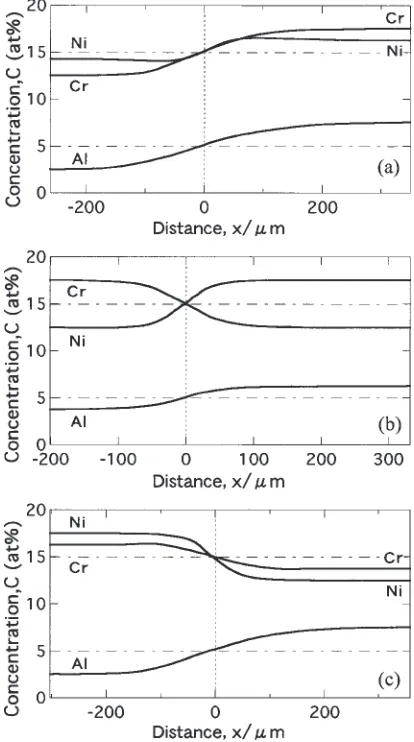
Figures1(a), (b), and (c) show, as examples, the diffusion profiles of quaternary diffusion couples of ACN1-ACN2, ACN3-ACN4 and ACN5-ACN6 annealed at 1423 K for 172.8 ks, respectively. On these profiles, x¼0 refers to the Matano plane. All profiles exhibit the typical symmetrical S-shaped profiles and they have the average concentrations of initial concentrations in both sides of the couples (5 at%Al, 15 at%Cr and 15 at%Ni) quite near the Matano plane because
of the diffusion couples with small difference in terminal compositions of diffusion couples. The diffusion distance of aluminum is the longest and that of nickel is the shortest amongthem. These indicate that the diffusivities are almost constant in the small concentration range between terminal compositions and that the aluminum element diffuses fast and nickel element does slow. The diffusion profile of nickel in the ACN1/ACN2 diffusion couple exposes ‘‘up-hill diffusion’’ as shown in Fig. 1(a); there are maximum on the high Ni concentration side and minimum on the low Ni concentration side in the diffusion couple. The up-hill diffusion is also on the Cr diffusion profile as shown in Fig.
1(c). Accordingto eq. (1), the up-hill diffusion of an element occurs in a higher order than three components alloy, because the diffusion flux of the element in multi-components alloy is brought out by the concentration gradient of other element as well as its own concentration gradient. The magnitude of this diffusion flux due to the gradients of other elements depends on interactions between solute elements.
The typical S typed profiles similar to the quaternary profiles were observed in the binary and ternary diffusion couples. Especially, the up-hill diffusion also appeared in the ternary diffusion profiles. Guy and Philibert reported the up-hill diffusion of Ni element due to the Cr concentration
[image:3.595.323.530.74.445.2]gradient in Co–Cr–Ni system at 1573 K.5)Their experiment results is consistent with the observation of up-hill diffusion in Co–Cr–Ni alloys at 1423 K of this research.
3.2 Diffusion paths
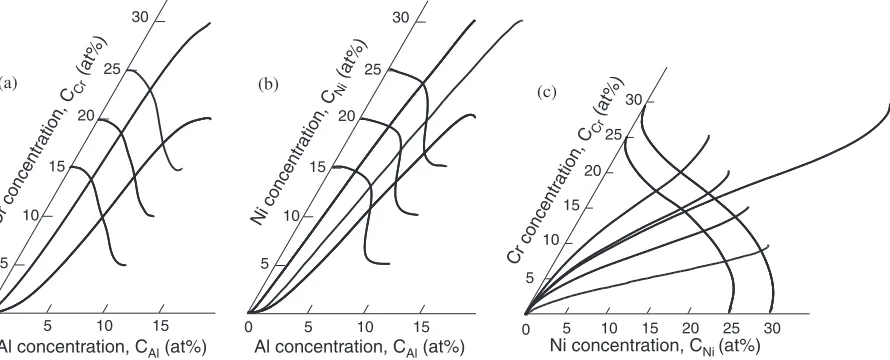
The ternary diffusion paths drawn by re-plottingthe concentration profiles are shown for all ternary couples on Co–Al–Cr, Co–Al–Ni and Co–Cr–Ni ternary triangles in Figs.2(a), (b), and (c), respectively. The diffusion paths show the typical S-shaped curves. The initial direction of the diffusion path tends to run alongthe line of constant composition of more slowly diffusingcomponent. Therefore, the initial directions of the diffusion paths indicate that Al element diffuses faster than the Cr element and Ni in Co–Al– Cr and Co–Al–Ni systems respectively, and that the Cr element is the faster diffusingelement than the Ni one in Co– Cr–Ni system. This is consistent with the results of diffusion profiles as mentioned above. It is also apparent from Fig.2
that the magnitude of the curvature of Co–Al–Ni system is the largest among three systems. This also indicates the fastest diffusingAl element and the slowest diffusingNi element, since the curvature mainly depends on the deference in the diffusivities of components. The diffusion paths intersect one another at many composition points, at which
the interdiffusion coefficients are evaluated from the diffu-sion profiles by the extended Matano method. The quaternary diffusion paths are also shown as the projection onto the Al– Cr plane, the Al–Ni plane and the Cr–Ni plane in Figs.3(a)– (c), respectively. These projections also show the curvature with the initial directions nearly alongthe line of constant composition of more slowly diffusingcomponent; the constant compositions of Cr in Co–Al–Cr system, Ni in Co–Al–Ni system and Ni in Co–Cr–Ni system. Furthermore, the curvature of the diffusion path on Co–Al–Ni plane is also largest. The three kinds of diffusion paths intersect each other quite near the composition of Co–5 at%Al–15 at%Cr– 15 at%Ni. This small deviation from the average concentra-tions of terminal composiconcentra-tions to the composition of intersections enables us to evaluate the quaternary interdiffu-sion coefficients without a significant effect by square root diffusivity method on the results.
3.3 Interdiffusion coefficients
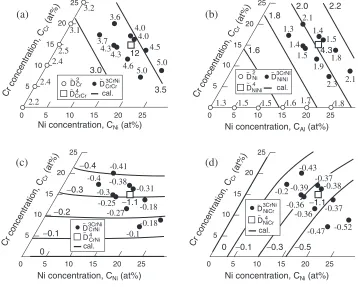
The experimentally evaluated values of binary, ternary and quaternary interdiffusion coefficients are presented on Co-rich parts of the Co–Al–Cr, Co–Al–Ni and Co–Cr–Ni composition triangles in Figs.4, 5, and 6, to show their concentration dependence. For simplicity, the interdiffusion
30
10
5
0
25
20
15
15 10 5
Al concentration, CAl (at%) Cr concentr
ation, C Cr (at%) (a)
30
10
5
0
25
20
15
15 10 5
Al concentration, CAl (at%) Ni concentr
ation, C Ni
(at%) (b)
0 5
Ni concentration, CNi (at%) Cr concentr
ation, C Cr
(at%)
30 25 20 15 10 5
30
25
20
15
10
(c)
Fig. 2 Diffusion paths in (a) Co–Al–Cr system, (b) Co–Al–Ni system and (c) Co–Cr–Ni system.
[image:4.595.79.524.74.254.2] [image:4.595.76.520.298.452.2]Al concentration, CAl (at%) 6.0 2 6 (c) Cr concentr ation, C
Cr (at%) 25 20 15 10 5 15 10 5 0 4 1 4.2 4.8 1.7 2.8 1.3 1.4 0 AlCr 4 D ~AlCr 3CrAl D~ cal. 0 (d) 1.7 1.5 4.8 Cr concentr ation, C
Cr (at%)
Al concentration, CAl (at%)
25 20 15 10 5 15 10 5 4 3 2 1 1.9 5.6 3.2 3.4 0 CrAl 3CrAl D CrAl 4 D ~ cal. ~ (b) 5.1 3.8 4.4 6.7 4.8 12 5 7 Cr concentr ation, C
Cr (at%)
Al concentration, CAl (at%)
25 20 15 10 5 15 10 5 0 2.2 2.4 2.4 2.5 3.1 3.2 CrCr 3CrAl D ~ CrCr 4 D ~ Cr 2 D ~ cal. 9 8.1 (a) 16 11 19 12 22 29 Cr concentr ation, C
Cr (at%)
Al concentration, CAl (at%)
25 20 15 10 5 15 10 5 0 15 20
9.3 21 36
25 AlAl 3CrAl D ~ AlAl 4 D~ Al 2 D ~ cal. 9.5
Fig. 4 Experimental interdiffusion coefficients (1015m2/s) in Co–Al, Co– Cr, Co–Cr–Al and Co–Cr–Ni–Al systems at 1423 K, and calculated contour lines of interdiffusion coefficients.
(a)
Ni concentration, C
Ni (at%)
Al concentration, CAl (at%) 25 20 15 10 5 15 10 5 0 23 27 19 20 22 31 28 25 20 30
9.3 21 36
31 15 AlAl 3NiAl D~ AlAl 4 D ~ Al 2 D ~ cal. 29 5.6 5 7 1.8 (b)
Ni concentration, C
Ni (at%)
Al concentration, CAl (at%) 25 20 15 10 5 15 10 5 0 5.2 4.5 5.6 7.2 12 5.1 6.5 5.3 1.3 1.5 1.5 1.6 1.7 NiNi 3NiAl D ~ NiNi 4 D ~ Ni 2 D ~ cal. 3 6.2 (c) -6.7 15 10 15 5
−2 −4
-1.2 -1.8
Ni concentration, C
Ni (at%)
Al concentration, CAl (at%)
25 20 10 0 5 −6 -3.0 -4.1 −3.8 -4.9 -2.3 -4.3 -4.6 AlNi 3NiAl D ~ AlNi 4 D ~ cal. 0 0 5 (d) -3.3 -3.5 -4.3 -3.8 -14
Ni concentration, C
Ni (at%)
Al concentration, CAl (at%)
25 20 15 10 15 10 5 -4.1 −8 −4 −2 −6 −3.8 -8.8
-5.2 NiAl 3NiAl D ~ NiAl 4 D ~ cal. -9.1 0
Fig. 5 Experimental interdiffusion coefficients (1015m2/s) in Co–Al, Co– Ni, Co–Ni–Al and Co–Cr–Ni–Al systems at 1423 K, and calculated contour lines of interdiffusion coefficients.
(c)
-0.4 -0.18 -0.38 -0.41 -0.27 -0.3 −1.1 -0.25 -0.31 -0.1 -0.18 −0.4 −0.1 25 20 15 10 50 5 10 15 20 25
Cr concentr ation, C
Cr (at%)
Ni concentration, CNi (at%) −0.3 −0.2 CrNi 3CrNi D ~ CrNi4 D~ cal. 0
(d)
-0.2 -0.47 -0.52 −0.3 25 20 15 10 50 5 10 15 20 25
Cr concentr ation, C
Cr (at%)
Ni concentration, CNi (at%)
−0.1 −0.5
NiCr 3CrNi D ~ NiCr4 D ~ cal. −1.1 -0.36 -0.39 -0.43 -0.37 -0.38 -0.37 -0.36 0
(b)
1.8 1.4 2.1 1.9 1.3 4.3 1.5 1.5 2.3 2.1 2.2 1.6 Cr concentr ation, C Cr (at%)Ni concentration, CAl (at%)
0 5 10 15 20 25 25
20
15
10
5
1.3 1.5 1.5 1.6 1.7 1.8
1.4 2.0 1.8 NiNI D ~ NiNi 4 D~ Ni2 D~ cal. 3CrNI
(a)
3.7 4.5 4.0 3.6 4.6 4.3 12 4.3 5.0 5.0 3.0 3.5 25 20 15 10 50 5 10 15 20 25
Cr concentr ation, C
Cr (at%)
Ni concentration, CNi (at%)
2.2 2.4 2.4 2.5 3.1 3.2 4.0 4 D~ Cr 2 D ~ cal. CrCr 3CrNi D ~ CrCr
[image:5.595.285.544.70.397.2] [image:5.595.50.304.73.400.2] [image:5.595.120.478.475.762.2]coefficients at concentration C (at%i) are described as DD~2i (at%i),DD~3
ij(at%i) andDD~
4
ij(at%i). The diffusion coefficients of
Al, Cr and Ni elements in pure Co,DD~2 Alð0Þ,DD~
2
Crð0ÞandDD~ 2 Nið0Þ,
plotted at the Co corners of composition triangles are
9:31015m2/s, 2:21015m2/s and 1:31015m2/s
respectively. The DD~2
Alð0Þ is the largest and DD~2Nið0Þ is the
smallest. The binary interdiffusion coefficients are plotted on the binary Co–Al, Co–Cr and Co–Ni sides of triangles. It can be seen that the binary coefficients increase with solute concentrations fromDD~2
Alð0Þ ¼9:31015m2/s toDD~2Alð10Þ ¼
3:61014m2/s, from DD~2
Crð0Þ ¼2:210
15m2/s to
~
D
D2Crð25Þ ¼3:21015m2/s, and from DD~2
Nið0Þ ¼1:3
1015m2/s to DD~2
Nið25Þ ¼1:810
15m2/s. It appears from
these increases that the Al element enhances the interdiffu-sion largely when compared with Cr and Ni elements.
As shown in Figs.4,5, and6, all of direct coefficients in ternary alloys, DD~3CrAl
AlAl , DD~ 3CrAl CrCr , DD~
3NiAl AlAl , DD~
3NiAl NiNi , DD~
3CrNi
CrCr and
~
D D3CrNi
NiNi , are positive. The DD~ 3CrAl AlAl , DD~
3CrAl CrCr , DD~
3NiAl AlAl and DD~
3NiAl NiNi
increase largely with the Al concentration, but slightly with the Cr or Ni concentrations. On the other hand, theDD~3CrNi
CrCr and
~
D D3CrNi
NiNi reveal a slight increase with Cr and Ni concentrations,
their concentration dependence beingsimilar to each other. From the research of Guyet al.,6)the concentration gradient of elementjbecomes essentially zero and then the diffusion flux of elementiin ternary alloy must be essentailly the same as that in binary alloy, when the concentration of solute element j approaches to zero. Therefore, the direct coeffi-cients become equal to the binary interdiffusion coefficoeffi-cients as follows;
lim Cj!0
~
D
D3iiij¼DD~2i ð5Þ
Thus the ternary direct coefficients are closely linked to the binary coefficients, and their concentration dependence is similar to that of binary interdiffusion in the dilute region of solute elementj.
The indirect coefficients ofDD~3CrAl AlCr andDD~
3CrAl
CrAl are positive,
while theDD~3NiAl NiAl ,DD~
3NiAl AlNi ,DD~
3CrNi CrNi andDD~
3CrNi
NiCr are negative. The
~
D D3AlCr
AlCr andDD~ 3NiAl
AlNi decrease to zero on the Co–Cr and Co–Ni
sides with decreasingAl concentration, beingalmost inde-pendent of the Cr and Ni concentration. Likewise, theDD~3CrNi CrNi
andDD~3CrNi
NiCr respectively approach to zero with decreasingCr
and Ni concentrations, beingindependent of the Ni and Cr concentrations. On the other hand, the DD~3CrAl
CrAl and DD~3NiAlNiAl
show a complicated concentration dependence but they respectively decrease to zero with decreasingCr and Ni concentrations. Their trend to decrease to zero is in good accordance with the relation betweenDD~3ijijand concentrationi presented by Guyet al.,6)
lim Ci!0
~
D
D3ijij¼0 ð6Þ
In the Co–Cr–Ni system at 1573 K, Guyet al.reported that the DD~3CrNi
CrCr ;DD~3CrNiNiNi ;DD~3CrNiCrNi and DD~3CrNiNiCr were 61014;2
1014;11015 and 11016m2/s at Co–9 at%Cr–
21.4 at%Ni respectively.6) On the other hand, the average values of DD~3CrNi
CrCr ¼4:81015, DD~3CrNiNiNi ¼2:01015,
~
D
D3CrNiCrNi ¼ 1:81016 and DD~3CrNi
NiCr ¼ 4:310
16m2/s
are evaluated from the present results near the concentration of Co–9 at%Cr–21.4 at%Ni at 1423 K. Though these values
cannot be directly compared to each other, the signs of coefficients by Guy et al. are consistent with those of this research, and the value ofDD~3CrNi
CrCr =DD~ 3CrNi
NiNi ¼3by Guyet al.is
close to 2.4 of the present research.
Figures4,5, and6also show nine quaternary interdiffusion coefficients at Co–5 at%Al–15 at%Cr–15 at%Ni evaluated by the square root diffusivity method as projections onto the Co– Al–Cr, Co–Al–Ni and Co–Cr–Ni planes. The direct coeffi-cients, DD~4
AlAl, DD~4CrCr and DD~4NiNi, and some of indirect
coefficients, DD~4
AlCr and DD~4CrAl, are positive, while the other
indirect coefficients, DD~4AlNi, DD~4NiAl, DD~4CrNi and DD~4NiCr, are negative. These signs of quaternary coefficients are in accordance with those of ternary coefficients. The absolute values of quaternary coefficients projected on Co–Al–Cr and Co–Al–Ni planes are almost equal to or slightly larger than those of ternary coefficients around the concentrations of Co– 5 at%Al–15 at%Cr and Co–5 at%Al–15 at%Ni respectively. On the other hand, the quaternary absolute values on Co–Cr– Ni plane are comparatively large when compared with those of ternary coefficients around the Co–15 at%Cr–15 at%Ni. These facts indicate that the Al solute element largely enhances interdiffusion in the quaternary alloy.
4. Discussion
It often becomes necessary to make reasonable approx-imations for diffusion coefficients in higher order alloys, since the experimental data on interdiffusion in multi-component alloys are quite limited because of their compli-cated and elaborated experiments. Therefore, it is helpful to establish quantitative procedures for estimation of interdiffu-sion in n-component alloys. In this research, it is found that the binary and ternary interdiffusion coefficients are sensitive to the concentrations of solute elements, and that the quaternary coefficients are also enhanced from the ternary coefficients by additions of the elements to ternary alloys. These results of this research are consistent with the experimental observation by Birchenall15) that alloying elements which lower the meltingpoint of an alloy enhance the diffusivity as their amounts dissolvingto the alloy is increased.15)The quantitative approximations can be made for estimation of interdiffusion coefficients in high order alloys under the concept of the generalization by Birche-nall,15)as follows.
An empirical relationship that the activation energy for diffusion,Q, is a function of meltingtemperature,Tm, and the
reasonable value of frequency factor is approximately constant ofD0¼5105m2/s, has been given by Cahoon
and Sherby as follows.16)For all elements with face centered cubic structure,
Q¼19RTm ð7Þ
where R is the gas constant. This relation is supported by Beke who theoretically has shown that the bondingstrength of metal atoms and theQare proportional to theTm.17)In the
bondingwith surroundingatoms and then attached to the surface of crystal by producingnew atomic bondingwith some surface atoms.18)The migration energy is also related to the bondingenergy, because some of the atomic bonds are broken when atom jumps to the nearest neighbor vacancy site. On the other hand, the meltingtemperature gives an indication of the bonding energy; a crystal has the higher meltingpoint if the atomic bondingis larger because the crystal with stronger atomic bondings sustain its solid structure by overcomingmore severe atomic vibration at higher temperatures.19)It is reasonable to assume that eq. (7) is qualitatively held for diffusion in alloys, because the correlation in alloys can be explained by similar way to what described above.
When eq. (7) is applied to diffusion in alloys, eq. (7) is rewritten as follows;
QðCÞ ¼19RTmðCÞ ð8Þ
where QðCÞis the activation energy for diffusion in alloys with concentrationC, andTmðCÞis the meltingtemperature
of alloy, in other word, the solidus temperature in alloys with concentrationC. For simplicity, the solidus temperatures in Co-rich solid solution of higher order Co alloys are represented in linear relation with the solute concentrations, as follows;
TmðCÞ ¼Tmð0Þ þ
Xn1
i
AiCi ð9Þ
where the meltingpoint of pure Co,Tmð0Þ, is 1768 K, andAi
is the solidus temperature change due to addition of 1 at% solute element in binary alloys. The direct interdiffusion coefficients are represented as the Arrhenius-type equation, by insertingeqs. (8) and (9) to eq. (10) and assumingthat the pre-exponential factor,D0, is constant against the
concentra-tion;
~
D
DniiðcÞ ¼D0exp
QðCÞ RT
¼D0exp
19Tmð0Þ T
exp 19
P
iAiCi T
¼DD~2ið0Þexp 19
P
iAiCi T
ð10Þ
whereDD~2ið0Þis the binary diffusion coefficient at the solute concentration of zero, namely, the impurity diffusion coefficient in pure Co plotted at the Co-corners in Figs. 4,
5, and 6. Figure7 shows the concentration dependence of interdiffusion coefficients in Co–Al, Co–Cr and Co–Ni alloys and their calculated lines by eq. (10) with DD~2
Alð0Þ ¼
9:31015m2/s andA
Al¼ 11:2K/at%Al for Co–Al alloy,
~
D D2
Crð0Þ ¼2:210
15m2/s andA
Cr¼ 1:1K/at%Cr for Co–
Cr alloy, andDD~2
Nið0Þ ¼1:31015m2/s andANi ¼ 1:1K/
at%Cr for Co–Ni alloy. From the Co-rich parts of binary phase diagrams,1)the values ofAi’s were also evaluated to be
about5:8K/at%Al for Co–Al system, about1:2K/at%Cr for Co–Cr system and about0:5K/at%Ni. Though there are some difference between theAi’s used in calculation for the
concentration dependence of diffusion coefficients and the Ai’s from the solidus lines, they are equivalent to each other
in order of magnitude.
From the procedures by Kirkaldy et al. for ternary alloys,20) we have derived the followingrelations between the quaternary direct and indirect coefficients in Co–i–j–k alloys (i;j;k= Al, Cr, Ni andi6¼j6¼k);
~
D D4
ij ~
D D4
ii
¼NiðNiþNCoÞ"ijþNið1þNj"jjÞ þNiNk"jk ðNiþNCoÞð1þNi"iiÞ þNiNj"ijþNiNk"ik
ð11Þ
whereNiis the molar fraction of solute elementi, and"iiand
"ij are Wagner’s interaction parameter defined by lni¼lni0þ
Pn1
k¼1Nk"ikþ , where i is the activity
coefficient. In the case of interdiffusion in ternary alloy (Co– i–jsystem), eq. (11) becomes as follows;
~
D D3ij
~
D D3
ii
¼Nið1NjÞ"ijþNið1þNj"jjÞ ð1NjÞð1þNi"iiÞ þNiNj"ji
ð12Þ
WhenNi¼0andNj ¼0, eq. (12) has the same equation as
the relation in ternary alloys derived by Kirkaldyet al.20)
Figures4,5, and6show the contour lines of interdiffusion coefficients in ternary Co–Al–Cr, Co–Al–Ni and Co–Cr–Ni alloys calculated by eqs. (10) and (12) with the values of
~
D
D2Alð0Þ,DD~2Crð0Þ,DD~2Nið0Þand the interaction parameters given in Table3. Accordingto the calculated contour lines (Figs.4
and5), the similar concentration dependence are calculated for theDD~3CrAl
AlAl ,DD~3CrAlCrCr,DD~3NiAlAlAl ,DD~3NiAlNiNi ,DD~3CrAlAlCr andDD~3NiAlAlNi . The
~
D D3CrAl
AlAl ,DD~3CrAlCrCr ,DD~3NiAlAlAl andDD~3NiAlNiNi increase with Al
tion, beingalmost independent of the Cr and Ni concentra-tions, and theDD~3CrAl
AlCr andDD~3NiAlAlNi approach to zero when the Al
concentration goes to zero. They also satisfy the relations of eqs. (5) and (6). On the other hand, the contour lines ofDD~3CrAl CrAl
and DD~3NiAl
NiAl are similar to each other, but they reveal their
complicated concentration dependence. The DD~3CrAlCrAl and
~
D
D3NiAlNiAl largely depend on the Al concentration in the lower
Al concentration region, but their dependence on Al concentration becomes smaller with increasingAl concen-trations. In addition, the DD~3CrAlCrAl or DD~3NiAlNiAl are calculated to approach to zero as the concentration of Cr or Ni goes to zero
[image:7.595.58.290.500.579.2]respectively. In the Co–Cr–Ni alloys (Fig. 6), it is calculated that theDD~3CrNi
CrCr andDD~3CrNiNiNi increase slightly with both Cr and
Ni concentrations, while the DD~3CrNi
CrNi and DD~3CrNiNiCr approach to
zero with decreasingthe Cr and Ni concentrations respec-tively. Thus, the calculated contour lines fittingly represent the experimental concentration dependence of interdiffusion coefficients in the Co ternary alloys of this research.
The interaction parameters with which the contour lines were calculated (Table3), give us information about the interaction amongsolute atoms in ternary Co alloys. The interaction parameters in Co–Al–Ni alloys are"AlNi¼ 5:8
and"NiAl¼ 9:5, and those in Co–Cr–Ni alloys are"CrNi¼
2:1 and"NiCr¼ 3:0. These negative values indicate that
the Al and Ni atoms more strongly attract to each other than
the Cr and Ni atoms. The relatively strongattraction between Al and Ni atoms is in agreement with the formations of many intermetallic compounds such as NiAl and Ni3Al compounds
between fcc-Al and fcc-Ni metals, while the small interaction between Cr and Ni atoms is also consistent with the simple feature of Cr–Ni phase diagram which has the two phase equilibrium of bcc-Cr and fcc-Ni phases. On the other hand, the positive values of "AlCr¼3:2 and "CrAl¼3:2 indicate
that there is repulsive force between Al and Cr atoms in Co– Al–Cr alloys. However, these positive values are not directly related to the aspect of Al–Cr phase diagram; the Cr element solves in fcc-Al phase quite little, while the Al element can be soluble in bcc-Cr phase over 14 at%Al, and there are a lot of intermetallic compounds in Al–Cr system. Tanakaet al.
have presented the estimation method for interaction para-meters"ij in the dilute solid solutions.21,22)By this method,
the "AlCr¼"CrAl¼3:7, "AlNi¼"NiAl¼ 0:85 and "CrNi¼
"NiCr¼ 0:51are calculated. The interaction parameters of
this research are consistent with the calculated ones, especially on the signs of the parameters. But the absolute values of calculated "ij and experimental ones of this
research have some discrepancies except the "AlCr and
"CrAl. This discrepancy is mainly due to the difference in
concentrations at which the"ij is evaluated: Co–5Al–15Cr–
15Ni for this study and the dilute solid solution range for calculation by method of Tanakaet al.21,22)
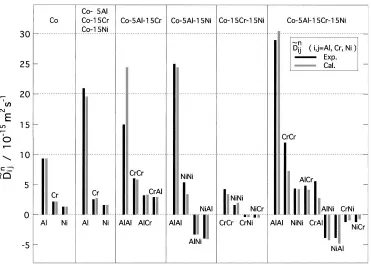
[image:8.595.46.291.103.285.2]Figure8shows the comparison between the experimental and calculated quaternary interdiffusion coefficients in Co alloys with various concentrations: pure Co, Co–5Al, Co– 15Cr, Co–15Ni, Co–5Al–15Cr, Co–5Al–15Ni, Co–15Cr– 15Ni and Co–5Al–15Cr–15Ni (at%). The ternary coefficients drawn in Fig.8 are the average values of the coefficients around three ternary concentrations, DDDD~~3ii andDDDD~~3ij: Co–5Al– 15Cr, Co–5Al–15Ni and Co–15Cr–15Ni. The nine kinds of
Table 3 Wagner’s interaction parameters of Co alloys, diffusion coeffi-cients of elements in pure Co and changes of solidus temperatures due to addition of solute elements used in calculation by eqs. (9)–(12).
"AlAl 16.3 "CrCr 3.47 "NiNi 0.19 "AlCr 3.2 "AlNi 5:8 "CrAl 3.2 "CrNi 2:1 "NiAl 9:5 "NiCr 3 D2
Alð0Þ 9:310
15m2/s
D2
Crð0Þ 2:210
15m2/s
D2
Nið0Þ 1:31015m2/s
AAl 11:2K/at%Al
ACr 1:1K/at%Cr
ANi 1:1K/at%Ni
[image:8.595.114.485.504.770.2]quaternary interdiffusion coefficients were also calculated by eqs. (10) and (11) with DD~2
Alð0Þ;D 2 Crð0Þ;D
2
Nið0Þ and the
parameters used in the case of ternary coefficients. The direct coefficients in each alloy are higher in the order of Al, Cr and Ni. The calculated values are in good agreement with the experimental ones. Especially, it is noticed that the quaternary interdiffusion coefficients were calculated appro-priately from the impurity diffusion coefficients in pure Co, the concentration dependence of binary coefficients and interaction parameters. The comparison between the diffu-sivities clarifies the effect of solute elements on diffusion in Co alloys. The ratios of coefficients are as follows; in the case of solute addition of 5 at%Al,DD~2Alð5Þ=DD~2Alð0Þ ¼2:3,DDDD~~3CrAlCrCr =
~
D D2
Crð15Þ ¼2:4, DDDD~~ 3NiAl NiNi =DD~
2
Nið15Þ ¼3:4, DD~ 4 CrCr=DDDD~~
3CrNi CrCr ¼2:9,
~
D D4
NiNi=DDDD~~ 3CrNi
NiNi ¼2:7,DD~4CrNi=DDDD~~ 3CrNi
CrNi ¼3:7andDD~4NiCr=DDDD~~ 3CrNi
NiCr ¼
3: in the case of addition of 15 at%Cr,DD~2Crð15Þ=DD~2Crð0Þ ¼1:2,
~
D D~ D D3CrAlAlAl =DD~2
Alð5Þ ¼0:7, DDDD~~ 3CrNi NiNi=DD~
2
Nið15Þ ¼1:2,DD~ 4 AlAl=DDDD~~
3NiAl
AlAl ¼
1:2, DD~4 NiNi=DDDD~~
3NiAl
NiNi ¼0:8, DD~4AlNi=DDDD~~ 3NiAl
AlNi ¼1:2 and DD~4NiAl=
~
D D~ D
D3NiAlNiAl ¼1: in the case of solute addition of 15 at%Ni,
~
D D2
Nið15Þ=DD~ 2
Nið0Þ ¼1:2, DDDD~~ 3NiAl AlAl =DD~
2
Alð5Þ ¼1:2, DDDD~~ 3CrNi
CrCr =
~
D D2
Crð15Þ ¼1:7, DD~4AlAl=DDDD~~ 3CrAl
AlAl ¼1:9, DD~4CrCr=DDDD~~ 3CrAl
CrCr ¼2,
~
D
DAlCr4 =DDDD~~3CrAlAlCr ¼1:5andDD~4CrAl=DDDD~~3CrAlCrAl ¼1:9. Thus, the addi-tion of Al to alloys has a greater enhancement in diffusivities than the Cr and Ni additions. These enhancements suggest that the large enhancement due to the Al element reduces the creep properties although the addition of Al element increases the oxidation resistance, while the Cr and Ni elements whose enhancement is small do not reduce the mechanical properties such as creep even by a lot of theirs addition to Co alloys. Thus, it is also noticed that the enhancements of interdiffusion due to the solute additions even in quaternary alloys is fittingly evaluated by the calculation.
5. Conclusions
Binary, ternary and quaternary interdiffusion have been investigated in cobalt solid solutions of Co–Al, Co–Cr, Co– Ni, Co–Al–Cr, Co–Al–Ni, Co–Cr–Ni and Co–Al–Cr–Ni alloys at 1423 K.
1) The diffusion profiles in binary, ternary and quaternary diffusion exhibit the typical symmetrical S-shaped. The up-hill diffusion appears in the ternary and quaternary diffusion profiles.
2) The ternary diffusion paths on Co–Al–Cr, Co–Al–Ni and Co–Cr–Ni ternary triangles show the typical S-shaped curves with the initial directions nearly alongthe line of constant composition of more slowly diffusingcomponent. The quaternary diffusion paths as the projection onto the Al– Cr plane, the Al–Ni plane and the Cr–Ni plane also show the
curvatures, and they intersect each other quite near the composition of Co–5 at%Al–15 at%Cr–15 at%Ni.
3) The binary, ternary and quaternary interdiffusion coefficients evaluated from the diffusion profiles reveal that diffusivities of solute elements are larger in the order of Al, Cr and Ni, and that the solute element of Al enhances the interdiffusion largely when compared with Cr and Ni elements. The direct coefficients and some of indirect coefficients are positive, but the indirect coefficients con-jugate to Ni element are negative.
4) The effect of the addition of elements on interdiffusion are evaluated quantitatively from the parameters related to the solidus temperature of Co solid solutions, the diffusivity of elements in pure Co and the interaction parameters between solute elements. The evaluated values are in good agreement with the experimental ones.
REFERENCES
1) By T. B. Massalski, ed.:Binary Alloy Phase-Diagrams, (American Society of Metals, Metals Park, Ohio 1986) pp. 758–818.
2) A. D. LeClaire:Diffusion in metals in Smithells Metals Reference Book, sixth edition, E. A. Brandes ed., (Butterworths, London 1983) pp. (13-1)–(13-97).
3) V. Leroy:Application in Ternary Nickel–Cobalt–Chrome System(in French), (Centre National de Recherches Metallurgiques: Montoyer 1966) pp. 42–80.
4) A. Vignes and J. P. Sabatier: Trans. Met. Soc. AIME245(1969) 1795– 1802.
5) A. G. Guy and J. Philibert: Z. Metallkde.56(1965) 841–845. 6) A. G. Guy, V. Leroy and T. B. Lindemer: Trans. ASM59(1966) 517–
534.
7) J. S. Kirkaldy: Can. J. Phys.41(1963) 2174–2186.
8) I. Uchiyama, A. Watanabe and S. Kimoto:X-ray Microanalyzer(in Japanese), (Nikkan Kogyo Sinbunsha, Tokyo, 1972) pp. 127–184. 9) J. Crank:The Mathematics of Diffusion, (Clarendon press, Oxford,
1975) pp. 230–234.
10) L. D. Hall: J. Chem. Phys.21(1953) 87–92. 11) J. S. Kirkaldy: Can. J. Phys.35(1963) 435–440.
12) T. Takahashi, T. Yamane, T. Yamamoto, H. Araki, Y. Minamino and Y. Miyamoto: Z. Metallkd.85(1994) 492–497.
13) T. Takahashi, Y. Minamino, K. Hirao and T. Yamane: Mater. Trans., JIM40(1999) 997–1004.
14) M. S. Thompson and J. E. Morral: Acta Metall.24(1986) 2201–2203. 15) C. E. Birchenall:Atom Movements, (Metals Park OH, ASM, 1951)
pp. 112–128.
16) J. R. Cahoon and O. D. Sherby: Met. Trans. A,23A(1992) 2491–2500. 17) D. L. Beke: Defect and Diffusion Forum66–69(1989) 127–156. 18) E. F. Fujita: Metal Physics, Fundamental Materials Science (in
Japanese), (AGNE Gijutu Center, Tokyo, 1996) pp. 167–192. 19) E. F. Fujita: Metal Physics, Fundamental Materials Science (in
Japanese), (AGNE Gijutu Center, Tokyo, 1996) pp. 369–409. 20) J. S. Kirkaldy, Zia-Ul-Haq and L. C. Brown: Trans. ASM Q.56(1963)
834–849.
21) T. Tanaka, N. V. Gokcen, P. J. Spencer, Z. Morita and T. Iida: Z. Metallkd.84(1993) 100–105.