In domestic fowl (Gallus gallus f. domestica), monitoring of both quantitative and qualitative pa-rameters of ejaculates is an indispensable
precon-dition of successful artificial insemination; on the basis of the obtained results it is then possible to se-lect the individuals that produce sufficient amounts
Supported by the Internal Grant Agency AF MENDELU, Mendel University in Brno, Czech Republic (Project No. TP 8/2011).
Relationship of ejaculate quality and selected
biochemical parameters of blood in cockerels
of three laying lines
L. Jarinkovičová
1, L. Máchal
1, J. Máchal
3, R. Filipčík
1, E. Tůmová
2,
R. Horský
11Faculty of Agronomy, Mendel University in Brno, Brno, Czech Republic
2Faculty of Agrobiology, Food and Natural Resources, Czech University of Life Sciences Prague,
Prague, Czech Republic
3Department of Pathophysiology, Faculty of Medicine, Masaryk University, Brno, Czech Republic
AbstRAct: Ejaculates and blood plasma were sampled from cocks of three laying lines: Barred Plymouth Rock (BPR), Sussex Light (SU), and Rhode Island Red (RIR). Ejaculates and blood plasma were sampled four times during the laying period of hens. The following ejaculate parameters were determined: sperm motility, concentrations of sperm cells, ejaculate volume. Sperm morphology was examined. In the blood samples, concentrations of glucose, cholesterol, creatinine, calcium, phosphorus, and magnesium were analysed. The motility of spermatozoa of the cocks was 47.0% (BPR), 47.7% (RIR), and 48.3% (SU), respectively. The high-est volume of ejaculate was found in BPR line (0.66 cm3), the lowest one in SU line (0.46 cm3, P ≤ 0.01); the
highest sperm concentration was in SU line (2.46 × 10⁶/mm3), the lowest one in RIR line (1.96 × 10⁶/mm3, P ≤ 0.01). The number of morphologically abnormal sperm cells was similar in all lines − 47.0% BPR, 47.7% RIR, and 48.3% SU, respectively. In general, the occurrence of defective spermatozoa was high in all three lines; the most frequent were tail defects (from 20.3 to 29.7%), while sperm cells with developmental anomalies were less frequent (only 0.3 to 0.4%). Calculated phenotypic correlation between sperm motility on the one hand and the occurrence of defective sperm cells on the other was negative (rp = −0.28, P ≤ 0.01), as well as the correlation between sperm motility and sperm numbers, and between sperm motility and ejaculate volume (rp = −0.28,
P ≤ 0.01 and rp = −0.31, P ≤ 0.01, respectively). Negative correlations were found between the level of magne-sium in blood plasma and numbers of morphologically defective spermatozoa in the ejaculate, defective heads and defective connecting pieces (rp = −0.33, P ≤ 0.01; rp = −0.23, P ≤ 0.05; and rp = −0.26, P ≤ 0.05). Level of magnesium was positively correlated to sperm motility (rp = 0.26, P ≤ 0.05). However, positive correlations existed between concentration of glucose in blood plasma of cocks and numbers of morphologically defective spermatozoa in sampled ejaculates (rp = 0.27, P ≤ 0.01). Our finding is in accordance with the results found in mammals and other animals, and it shows an important role of magnesium as a key contributor to the quality of ejaculate in aviary species, in our case in laying lines of domestic fowl (Gallus domesticus).
of good-quality semen. There are many methods how to evaluate ejaculate quality and estimate the fertilisation potential of spermatozoa; some of them are rather subjective while others require special laboratory equipment. Ejaculate volume is an im-portant parameter of semen quality, similarly the motility of sperm cells and concentration of sper-matozoa in ejaculates. A direct progressive move-ment is an indicator of the functional quality of the sperm cell. Máchalet al. (1996) mentioned that in cocks the values of spermatozoa motility ranged from 62.4 to 88.3% and the ejaculate volume ranged from 0.16 to 0.80 cm3. Both parameters changed in
dependence on age and the breeding line. Froman and Feltmann (2000) mentioned that in domestic fowl concentrations of motile spermatozoa ranged from 0.52 to 0.95 × 10⁶/ml.
A morphological examination of spermatozoa is one of important qualitative parameters of ejacu-lates. An increased percentage of morphologically modified sperm cells may result in impaired fer-tility (Saacke et al., 2000). A decrease in ferfer-tility and the occurrence of pathological sperm cells may be markedly influenced not only by chemical and physical factors but also, and above all, by stress and age of males.
Serum biochemical profile has been used in sev-eral species of domestic livestock to monitor herd health. Application of this technique to commer-cially raised poultry flock has been limited by a lack of suitable reference ranges for most of the para-meters tested although much work has been done on specific individual parameters. Haematological and biochemical status is a reflection of many fac-tors such as sex, age, breed, diet, management, and stress level. Among the most important biochemi-cal parameters plasma triglycerides and cholester-ol, as well as glucose, creatinine, and minerals like calcium, phosphorus, and magnesium are included. Blood plasma cholesterol level in cocks of laying lines ranges from 2.33 to 2.75 mmol/l, glucose in laying hens lines is between the values of 4.87 to 15.15 mmol/l (Máchal, 1999). Silva et al. (2007) revealed content of creatinine in blood plasma in ranges from 46 to 59 µmol/l. Concentrations of plasma calcium in broiler chicken was from 2.52 to 3.80 mmol/l, phosphorus from 2.78 to 5.27 mmol/l, and plasma magnesium from 0.83 to 0.84 mmol/l (Večerek et al., 2002).
Magnesium is an element that is necessary for the function of dynein-ATPase, intracellular mo-tor for sperm motility (Vívenes et al., 2009). The
literature about the effects of magnesium concen-tration on sperm parameters refers mostly to other than avian species. In humans, sperm cell motility was enhanced by 0.2−1.0mM of Mg2+, while higher
concentration led to the same motility compared to control levels (Magnus et al., 1990). In sea ur-chin, as well as in humans, Mg2+ has been found
to increase viability of spermatozoa in dose-de-pendent manner (Dawson et al., 1998). Enhancing effect of Mg2+ ions of seminal plasma on motility
of spermatozoa was also found, among others, in fish (Hajirezaee et al., 2010; Bozkurt et al., 2011).
The aim of this study was to compare qualitative and quantitative parameters of ejaculates, as well as selected biochemical parameters of blood plasma collected from cocks of three lines of laying hens. Furthermore, relationships between these param-eters regardless of the line were evaluated.
MAteRiAl And Methods
Ejaculates and blood plasma were sampled on a breeding farm from cocks of three laying lines of the following breeds: Barred Plymouth Rock (BPR), Sussex Light (SU), and Rhode Island Red (RIR). Lines of these breeds are used when cre-ating hybrid combinations of layers. At the age of 16 weeks, cockerels were transferred from the poultry-rearing facility into a hall with cage tech-nology for adult cocks. Each cock was placed into one cage (2025 cm2 per cock) and fed a complete
feed mixture with a quantitative restriction of 120 g per day. Drinking water was supplied with nipple drinkers. The light regime was 12/12 h of light and dark per day.
Cocks were divided into three groups according to line, including 21 males from each line. The semen sampling was performed four times, at the age of 173, 239, 315, and 391 days. Blood was sampled from
diluted in 0.5% saline solution (dilution ratio 1 : 5) to evaluate their morphological abnormalities. In each sample, the total number of 200 spermatozoa was evaluated with regard to the following morpho-logical alterations: occurrence of developmental anomalies, numbers of degenerated spermatozoa, changes in the head, changes in the midpiece, and changes in the tail; frequencies were expressed in percents. The following alterations were classified among head changes: the heads too small or too big, twisted heads, curved heads, missing heads; alterations of the midpiece were characterized as its narrowing, widening and/or distortion, and tail changes involved its twisting, bending and/or absence. All spermatozoa with developmental anomalies were classified as degenerated. An ob-jective evaluation of the shape and variability of spermatozoa was performed for example by Severa et al. (2010) who studied also the occurrence of morphologically changed spermatozoa.
Blood samples were centrifuged (3000 rpm for 10 min), and the obtained blood plasma was used for biochemical analyses. Blood analyses were per-formed using BIO-TEST sets (Erba Lachema s.r.o., Brno, Czech Republic). Concentrations of the fol-lowing compounds and elements were estimated in blood plasma of experimental cocks: glucose, cholesterol, creatinine, Ca, P, and Mg.
Statistical analysis was performed using the software package Statistica Vers. 8.0. Differences between the lines of cocks were evaluated
us-ing one-way ANOVA with Tukey’s post-hoc test. Characteristics under study were expressed as means ± standard deviations. Calculated phenotyp-ic correlations (Pearson’s correlation coeffphenotyp-icients) were used for the evaluation of the dependence between ejaculate parameters and biochemical characteristics of blood plasma.
Results And discussion
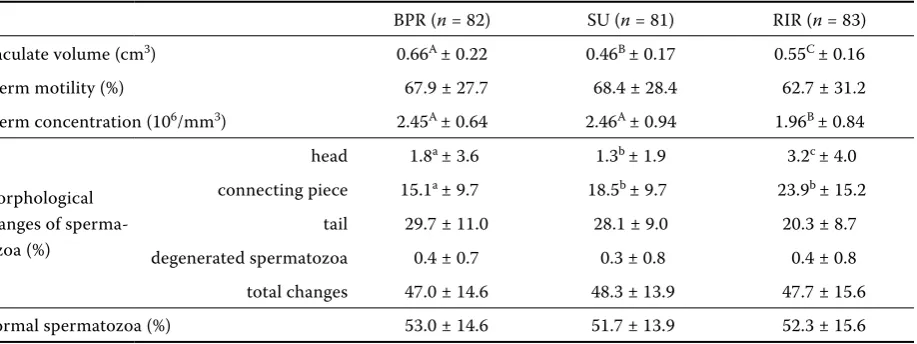
Mean values of both qualitative and quanti-tative parameters of ejaculates collected from cocks originating from three laying lines of BPR, SU, and RIR chicken breeds as recorded in the course of the production period are presented in Table 1. The maximum and the minimum aver-age ejaculate volumes (0.66 and 0.46 cm3,
respec-tively) were found in the lines BPR and SU. These values are lower compared to those found in the study of Siudzińska and Lukaszewicz (2008), and higher in comparison with the results of Máchal and Jankowski (2002) in a laying line of RIR cocks (0.87 cm3). As far as the motility of spermatozoa
[image:3.595.74.533.538.710.2]was concerned, the recorded values were very simi-lar and ranged from 62.7 to 68.4%. There were no statistically significant differences between these values. Máchal et al. (1996) mentioned relatively high percentages of motility in a paternal line of RIR breed (85.5 to 88.3%). In our study, the lowest mean concentration of spermatozoa in ejaculates
Table 1. Qualitative and quantitative parameters of ejaculate in cocks of initial laying lines in the course of the production period (x ± Sx)
BPR (n = 82) SU (n = 81) RIR (n = 83) Ejaculate volume (cm3) 0.66A ± 0.22 0.46B ± 0.17 0.55C ± 0.16
Sperm motility (%) 67.9 ± 27.7 68.4 ± 28.4 62.7 ± 31.2
Sperm concentration (106/mm3) 2.45A ± 0.64 2.46A ± 0.94 1.96B ± 0.84
Morphological changes of sperma-tozoa (%)
head 1.8a ± 3.6 1.3b ± 1.9 3.2c ± 4.0
connecting piece 15.1a ± 9.7 18.5b ± 9.7 23.9b ± 15.2
tail 29.7 ± 11.0 28.1 ± 9.0 20.3 ± 8.7
degenerated spermatozoa 0.4 ± 0.7 0.3 ± 0.8 0.4 ± 0.8 total changes 47.0 ± 14.6 48.3 ± 13.9 47.7 ± 15.6
Normal spermatozoa (%) 53.0 ± 14.6 51.7 ± 13.9 52.3 ± 15.6
BPR = Barred Plymouth Rock, SU = Sussex Light, RIR = Rhode Island Red
was found in the line RIR (1.96 × 10⁶/mm3). On
the other hand, in lines BPR and SU, mean sper-matozoa concentrations were higher and ranged from 2.45 to 2.46 × 10⁶/mm3; the values obtained
in our study are lower compared to those found by Siudzińska and Lukaszewicz (2008) in cocks of laying lines (3.18 to 4.69 × 10⁶/mm3). The
occur-rence of all morphologically changed spermatozoa in ejaculates of cocks of BPR, SU, and RIR lines was not markedly different and ranged from 47.0 to 48.3%; the observed differences were statistically non-significant. Fraction of morphologically ab-normal spermatozoa is similar to the results of Siudzińska and Lukaszewicz (2008) (33.1 to 44.5%) in cocks of laying breeds. The highest occurrence of morphological malformations was observed in tails (20.3% in RIR, 28.1% in SU, and 29.7% in BPR). Lukaszewicz et al. (2008) reported the highest percentage of morphological defects in heads of spermatozoa of cocks of the laying breed Italian Partridge; depending on method of dyeing, these values ranged from 11.0 to 14.3%. When us-ing the dyeus-ing method published by Blom (1981), Lukaszewicz et al. (2008) observed a high number of head deformations (76.1%). The highest and the lowest numbers of spermatozoa with defect heads were found in cocks of the lines RIR and SU (3.2%,
P ≤ 0.01 vs. 1.3%, P ≤ 0.05, respectively). However, the occurrence of developmental anomalies and degenerated spermatozoa was relatively low (0.4% in lines RIR and BPR, 0.3% in line SU).
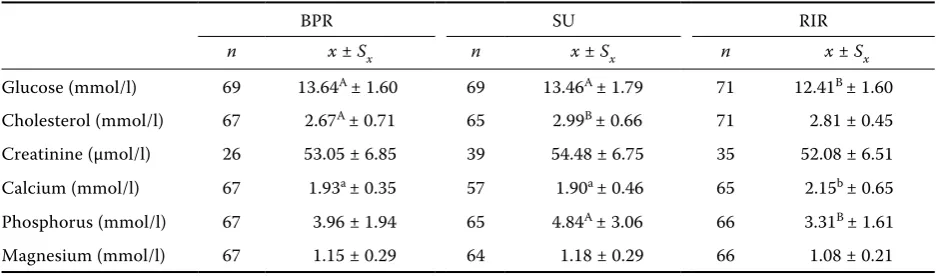
Mean values of blood plasma biochemical pa-rameters of cocks of individual laying lines are
presented in Table 2. The lowest and the highest mean concentrations of glucose in blood plasma were found in cocks of the RIR and BPR laying lines (12.41 and 13.64 mmol/l, P ≤ 0.01, respectively). In the SU line this concentration was also high (13.46 mmol/l). Blahová et al. (2007) observed con-centrations of glucose from 13.01 to 13.73 mmol/l in the male of Ross 308. The lowest concentration of cholesterol, which is an indispensable precursor for synthesis of many important steroid hormones, was 2.67 mmol/l in BPR line. Higher values of plas-matic cholesterol were observed by Tůmová et al. (2004) in laying hens. The level of creatinine in blood plasma was another parameter involved in our study because in poultry it reflects the supply of N-compounds. Mean concentrations of creatinine ranged from 52.08 to 54.48 µmol/land were not affected by line. Mean values of plasmatic min-eral compounds: the concentration of calcium was significantly influenced by line (1.90−2.15 mmol/l,
P ≤ 0.05). The highest value was in RIR and the lowest in SU. However, there was no effect of line on phosphorus (3.31−4.84 mmol/l, P ≤ 0.01) and magnesium (1.08−1.18 mmol/l) concentrations. Blood plasma analyses of the content of mineral substances were also observed by Večerek et al. (2002) in broiler chickens with similar results.
Estimated phenotypic correlations existing be-tween qualitative and quantitative ejaculate param-eters and morphological changes of spermatozoa are presented in Table 3. Calculated phenotypic correlations between motility and occurrence of morphologically changed spermatozoa were
neg-Table 2. Selected biochemical parameters of blood plasma in cocks of initial laying lines in the course of the pro-duction period
BPR SU RIR
n x ± Sx n x ± Sx n x ± Sx Glucose (mmol/l) 69 13.64A ± 1.60 69 13.46A ± 1.79 71 12.41B ± 1.60
Cholesterol (mmol/l) 67 2.67A ± 0.71 65 2.99B ± 0.66 71 2.81 ± 0.45
Creatinine (µmol/l) 26 53.05 ± 6.85 39 54.48 ± 6.75 35 52.08 ± 6.51 Calcium (mmol/l) 67 1.93a ± 0.35 57 1.90a ± 0.46 65 2.15b ± 0.65
Phosphorus (mmol/l) 67 3.96 ± 1.94 65 4.84A ± 3.06 66 3.31B ± 1.61
Magnesium (mmol/l) 67 1.15 ± 0.29 64 1.18 ± 0.29 66 1.08 ± 0.21
BPR = Barred Plymouth Rock, SU = Sussex Light, RIR = Rhode Island Red
[image:4.595.63.533.114.252.2]ative (rp = −0.28); this means that the lower the occurrence of morphologically abnormal sperma-tozoa, the higher their motility. Similarly, negative correlations existed between motility and concen-tration of spermatozoa on one hand and ejaculate volume on the other (rp = −0.28 and −0.31). The correlation between motility and the occurrence of pathological heads was negative and statistically insignificant. Insignificant positive correlation was observed between ejaculate volume and various morphologically changed spermatozoa (rp = 0.02 to 0.20).
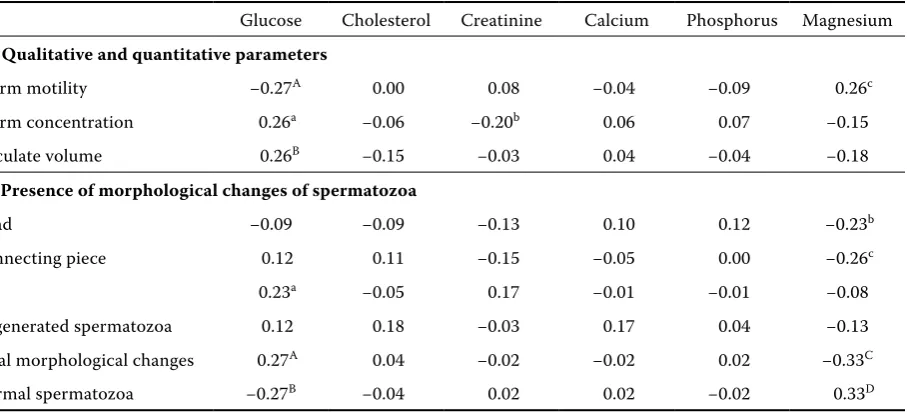
Phenotypic correlations found between qualita-tive and quantitaqualita-tive ejaculate parameters on the
[image:5.595.63.534.117.225.2]one hand and biochemical parameters on the other are presented in Table 4A. There was a negative phenotypic correlation between motility and con-centration of glucose in blood plasma (rp = −0.27). A significant negative correlation was found also between creatinine level in blood plasma and con-centration of spermatozoa in cock’s ejaculate (rp = −0.20, P ≤ 0.05). On the other hand, a significant positive phenotypic correlation existed between motility and Mg concentration in blood plasma (rp = 0.26, P ≤ 0.05). We also observed insignifi-cant negative phenotypic correlations between the concentration of spermatozoa and ejaculate vol-ume (rp = −0.06) and between the concentration of
Table 3. Phenotypic correlation assessment between the cocks of initial laying lines and qualitative and quantitative parameters of cock ejaculate
Sperm con-centration
Ejaculate volume
Morphological changes of spermatozoa
Normal
spermato-zoa head connecting
piece tail
degenerated
spermato-zoa
total mor-phological
changes
Sperm motility −0.28A −0.31B −0.24a −0.38C 0.12 −0.12 −0.28D 0.28E
Sperm concentration 0.09 −0.02 0.00 −0.09 −0.02 −0.08 0.08
Ejaculate volume 0.08 0.04 0.02 0.20 0.08 −0.08
astatistically significant correlation (P ≤ 0.05) A−Estatistically significant correlation (P ≤ 0.01)
Table 4. Phenotypic correlation assessment between (A) qualitative and quantitative parameters, (B) presence of morphological changes of spermatozoa and selected biochemical parameters of blood plasma in cocks
Glucose Cholesterol Creatinine Calcium Phosphorus Magnesium
(A) Qualitative and quantitative parameters
Sperm motility −0.27A 0.00 0.08 −0.04 −0.09 0.26c
Sperm concentration 0.26a −0.06 −0.20b 0.06 0.07 −0.15
Ejaculate volume 0.26B −0.15 −0.03 0.04 −0.04 −0.18
(b) Presence of morphological changes of spermatozoa
Head −0.09 −0.09 −0.13 0.10 0.12 −0.23b
Connecting piece 0.12 0.11 −0.15 −0.05 0.00 −0.26c
Tail 0.23a −0.05 0.17 −0.01 −0.01 −0.08
Degenerated spermatozoa 0.12 0.18 −0.03 0.17 0.04 −0.13
Total morphological changes 0.27A 0.04 −0.02 −0.02 0.02 −0.33C
Normal spermatozoa −0.27B −0.04 0.02 0.02 −0.02 0.33D
[image:5.595.78.532.518.725.2]spermatozoa and the level of cholesterol in blood plasma (rp = −0.15).
Estimates of phenotypic correlations existing be-tween the occurrences of morphologically changed spermatozoa and individual biochemical param-eters of blood plasma are presented in Table 4B. Particularly interesting are significantly negative correlations which were found between the level of Mg in blood plasma and morphologically ab-normal heads of spermatozoa (rp = −0.23, P ≤ 0.05) and abnormal connecting piece of spermatozoa in ejaculates (rp = −0.26, P ≤ 0.05); this means that the higher the Mg level in blood plasma, the lower the occurrence of pathologically changed spermatozoa and the higher the occurrence of morphologically normal ones. Positive effect on sperm cell motility can be attributed to dynein-ATPase, molecular mo-tor of the sperm cell, which is dependent on Mg2+.
Sperm cell motility also significantly decreased with increasing concentration of blood glucose, the effect may be attributed to reactive oxygen species formation in hyperglycaemia (Amaral et al., 2006).
The fact that sperm motility of cocks is in a nega-tive relation to other parameters of ejaculate quality, but also to the frequency of occurrence of mor-phologically abnormal sperm cells can therefore be confirmed. Sperm concentration and ejaculate volume do not seem to be significantly influenced by the plasmatic level of magnesium. Because of the identified negative correlations between concentra-tion of magnesium in blood plasma of cockerels and frequency of morphologically defective spermato-zoa (changes on heads and connecting pieces) of cocks and a positive relationship between magne-sium concentration and sperm motility, it is useful to take care to the body saturation of magnesium during the production period of cockerels.
Our finding is in accordance with the results found in mammals and other animals, and it shows an important role of magnesium as a key contribu-tor to the quality of ejaculate in aviary species, in our case in laying lines of domestic fowl (Gallus domesticus).
RefeRences
Amaral S., Moreno A.J., Santos M.S., Seiça R., Ramalho-Santos J. (2006): Effects of hyperglycemia on sperm and testicular cells of Goto-Kakizaki and streptozo-tocin-treated rat models for diabetes. Theriogenology, 66, 2056−2067.
Blahová J., Dobšíková R., Straková E., Suchý P. (2007): Effect of low temperature on performance and blood system in broiler chickens (Gallus domesticus). Acta Veterinaria Brno, 76, 17−23.
Blom E. (1981): Physiology and pathology of reproduc-tion. Medycyna Weterynaryjna, 4, 239−242.
Bozkurt Y., Öğretmen F., Kökçű Ö., Erçin U. (2011): Re-lationships between seminal plasma composition and sperm quality parameters of the Salmo trutta mac-rostigma (Dumeril, 1858) semen: with emphasis on sperm motility. Czech Journal of Animal Science, 56, 355−364.
Burrows W.H., Quinn J.P. (1937): The collection of sper-matozoa from the domestic fowl and turkey. Poultry Science, 16, 19−24.
Dawson E.B., Ritter S., Harris W.A., Evans D.R., Powell L.C. (1998): Comparison of sperm viability with sem-inal plasma metal levels. Biological Trace Element Re-search, 64, 215−219.
Froman D.P., Feltmann A.J. (2000): Sperm mobility: phe-notype in roosters (Gallus domesticus) determined by concentration of motile sperm and straight line veloc-ity. Biology of Reproduction, 62, 303−309.
Hajirezaee S., Mojazi Amiri B., Mirvaghefi A., Sheikh Ah-madi A. (2010): Evaluation of semen quality of endan-gered Caspian brown trout (Salmo trutta caspius) in different times of spermiation during the spawning sea-son.Czech Journal of Animal Science, 55, 445–455. Lukaszewicz E., Jerysz A., Partyka A., Siudzińska A.
(2008): Efficacy of evaluation of rooster sperm mor-phology using different staining methods. Research in Veterinary Science, 85, 583−588.
Máchal L. (1999): Possibilities of using lipaemia and gly-caemia in blood plasm of both hens and cockerels in breeding and reproduction of original laying strains of hens. Folia Universitatis Agriculturae et Silviculturae Mendelianae Brunensis, 58. (in Czech)
Máchal L., Jankowski J. (2002): Relationship between se-men parameters, fertility and hatchability of eggs in five original laying strains of hens. Polish Journal of Natural Sciences,10, 116−121.
Máchal L., Kalová J., Juráň P., Jeřábek S. (1996): The dy-namics of the relationship between ejaculate quality and cholesterol and total lipids concentration in the blood plasma in two lines of the cocks. Archiv für Tier-zucht, 39, 61−68.
Magnus O., Brekke I., Abyholm T., Purvis K. (1990): Ef-fects of manganese and other divalent cations on pro-gressive motility of human sperm. Archives of Andrology, 24, 159−166.
time to fertilization rate and embryo quality. Animal Reproduction Science, 60, 663−667.
Severa L., Máchal L., Švábová L., Mamica O. (2010): Evaluation of shape variability of stallion sperm heads by means of image analysis and Fourier descriptors. Animal Reproduction Science, 119, 50−55.
Silva P.R.L., Freitas Neto O.C., Laurentiz A.C., Junqueira O.M., Fagliari J.J. (2007): Blood serum components and serum protein test of Hybro-PG broilers of different ages. Revista Brasileira de Ciência Avícola, 9, 229−232. Siudzińska A., Lukaszewicz E. (2008): The effect of breed on freezability of semen of fancy fowl. Animal Science Papers and Reports, 26, 331−340.
Tůmová E., Härtlová H., Ledvinka Z., Fučíková A. (2004): The effect of digitonin on egg quality, cholesterol con-tent in eggs, biochemical and haematological
param-eters in laying hens. Czech Journal of Animal Science, 49, 33−37.
Večerek V., Straková E., Suchý P., Voslářová E. (2002): Influence of high environmental temperature on pro-duction and haematological and biochemical indexes in broiler chickens. Czech Journal of Animal Science, 47, 176−182.
Vívenes C.Y., Peralta-Arias R.D., Camejo M.I., Guerrero K., Fernández V.H., Piñero S., Proverbio T., Proverbio F., Marín R. (2009): Biochemical identification of dy-nein-ATPase activity in human sperm. Zeitschrift für Naturforschung, C, 64, 747−753.
Received: 2012−01−18 Accepted after corrections: 2012−03−30
Corresponding Author
Ing. Lucie Jarinkovičová, Ph.D., Mendel University in Brno, Faculty of Agronomy, Department of Animal Breeding, Zemědělská 1, 613 00 Brno, Czech Republic