Phylogenetic Grammar Induction
Taylor Berg-Kirkpatrick and Dan Klein Computer Science Division
University of California, Berkeley
{tberg, klein}@cs.berkeley.edu
Abstract
We present an approach to multilin-gual grammar induction that exploits a phylogeny-structured model of parameter drift. Our method does not require any translated texts or token-level alignments. Instead, the phylogenetic prior couples languages at a parameter level. Joint in-duction in the multilingual model substan-tially outperforms independent learning, with larger gains both from more articu-lated phylogenies and as well as from
in-creasing numbers of languages. Across
eight languages, the multilingual approach gives error reductions over the standard monolingual DMV averaging 21.1% and reaching as high as 39%.
1 Introduction
Learning multiple languages together should be easier than learning them separately. For exam-ple, in the domain of syntactic parsing, a range of recent work has exploited the mutual constraint between two languages’ parses of the same bi-text (Kuhn, 2004; Burkett and Klein, 2008; Kuz-man et al., 2009; Smith and Eisner, 2009; Sny-der et al., 2009a). Moreover, SnySny-der et al. (2009b) in the context of unsupervised part-of-speech in-duction (and Bouchard-C ˆot´e et al. (2007) in the context of phonology) show that extending be-yond two languages can provide increasing ben-efit. However, multitexts are only available for limited languages and domains. In this work, we consider unsupervised grammar induction without bitexts or multitexts. Without translation exam-ples, multilingual constraints cannot be exploited at the sentence token level. Rather, we capture multilingual constraints at a parameter level, us-ing a phylogeny-structured prior to tie together the various individual languages’ learning problems.
Our joint, hierarchical prior couples model param-eters for different languages in a way that respects knowledge about how the languages evolved.
Aspects of this work are closely related to Co-hen and Smith (2009) and Bouchard-C ˆot´e et al. (2007). Cohen and Smith (2009) present a model for jointly learning English and Chinese depen-dency grammars without bitexts. In their work, structurally constrained covariance in a logistic normal prior is used to couple parameters between the two languages. Our work, though also differ-ent in technical approach, differs most cdiffer-entrally in the extension to multiple languages and the use of a phylogeny. Bouchard-C ˆot´e et al. (2007) consid-ers an entirely different problem, phonological re-construction, but shares with this work both the use of a phylogenetic structure as well as the use of log-linear parameterization of local model com-ponents. Our work differs from theirs primarily in the task (syntax vs. phonology) and the vari-ables governed by the phylogeny: in our model it is the grammar parameters that drift (in the prior) rather than individual word forms (in the likeli-hood model).
Specifically, we consider dependency induction in the DMV model of Klein and Manning (2004). Our data is a collection of standard dependency data sets in eight languages: English, Dutch, Dan-ish, SwedDan-ish, SpanDan-ish, Portuguese, Slovene, and Chinese. Our focus is not the DMV model itself, which is well-studied, but rather the prior which couples the various languages’ parameters. While some choices of prior structure can greatly com-plicate inference (Cohen and Smith, 2009), we choose a hierarchical Gaussian form for the drift term, which allows the gradient of the observed data likelihood to be easily computed using stan-dard dynamic programming methods.
In our experiments, joint multilingual learning substantially outperforms independent
monolin-gual learning. Using a limited phylogeny that
only couples languages within linguistic families reduces error by 5.6% over the monolingual base-line. Using a flat, global phylogeny gives a greater reduction, almost 10%. Finally, a more articu-lated phylogeny that captures both inter- and intra-family effects gives an even larger average relative error reduction of 21.1%.
2 Model
We define our model over two kinds of random variables: dependency trees and parameters. For each languageℓin a setL, our model will generate a collectiontℓof dependency treesti
ℓ. We assume
that these dependency trees are generated by the DMV model of Klein and Manning (2004), which we write asti
ℓ ∼ DMV(θℓ). Here, θℓ is a vector
of the various model parameters for language ℓ.
The prior is what couples theθℓparameter vectors
across languages; it is the focus of this work. We first consider the likelihood model before moving on to the prior.
2.1 Dependency Model with Valence
A dependency parse is a directed treetover tokens in a sentence s. Each edge of the tree specifies a directed dependency from a head token to a de-pendent, or argument token. The DMV is a
gen-erative model for trees t, which has been widely
used for dependency parse induction. The
ob-served data likelihood, used for parameter estima-tion, is the marginal probability of generating the observed sentencess, which are simply the leaves
of the trees t. Generation in the DMV model
in-volves two types of local conditional probabilities:
CONTINUE distributions that capture valence and
ATTACHdistributions that capture argument
selec-tion.
First, the BernoulliCONTINUE probability
dis-tributions PCONTINUE(c|h, dir, adj;θ
ℓ) model the
fertility of a particular head type h. The outcome
c ∈ {stop, continue}is conditioned on the head typeh, directiondir, and adjacencyadj. If a head type’s continue probability is low, tokens of this type will tend to generate few arguments.
Second, the ATTACH multinomial probability
distributionsPATTACH(a|h, dir;θ
ℓ)capture
attach-ment preferences of heads, whereaandhare both
token types. We take the same approach as pre-vious work (Klein and Manning, 2004; Cohen and Smith, 2009) and use gold part-of-speech labels as tokens. Thus, the basic observed “word” types are
English Dutch Danish Swedish Spanish Portuguese Slovene Chinese Global
Indo-European
Germanic
West Germanic
North Germanic
Ibero-Romance
Italic Balto-Slavic
Slavic Sino-Tibetan
[image:2.595.312.522.67.255.2]Sinitic
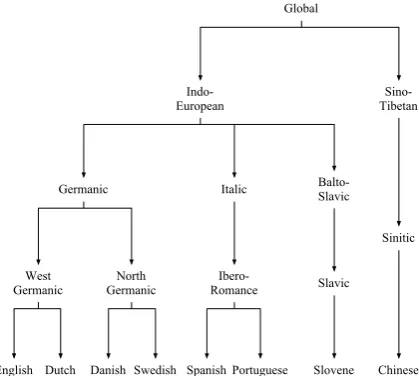
Figure 1: An example of a linguistically-plausible phylo-genetic tree over the languages in our training data. Leaves correspond to (observed) modern languages, while internal nodes represent (unobserved) ancestral languages.
actually word classes.
2.1.1 Log-Linear Parameterization
The DMV’s local conditional distributions were originally given as simple multinomial distribu-tions with one parameter per outcome. However, they can be re-parameterized to give the following log-linear form (Eisner, 2002; Bouchard-C ˆot´e et al., 2007; Berg-Kirkpatrick et al., 2010):
PCONTINUE
(c|h, dir, adj;θℓ) = expˆ
θℓ T
fCONTINUE(c, h, dir, adj)
˜
P c′exp
ˆ
θℓ T
fCONTINUE(c′, h, dir, adj)
˜
PATTACH
(a|h, dir;θℓ) = expˆ
θℓ T
fATTACH(a, h, dir)
˜
P a′exp
ˆ
θℓ T
fATTACH(a′, h, dir)
˜
The parameters are weights θℓ with one weight
vector per language. In the case where the vec-tor of feature functionsf has an indicator for each possible conjunction of outcome and conditions, the original multinomial distributions are recov-ered. We refer to these full indicator features as the set of SPECIFICfeatures.
2.2 Phylogenetic Prior
The focus of this work is coupling each of the pa-rametersθℓin a phylogeny-structured prior.
Con-sider a phylogeny like the one shown in
Fig-ure 1, where each modern language ℓ in L is a
drifts along each branch. A convenient choice is to posit additional parameter variables θℓ+ at
in-ternal nodes ℓ+ ∈ L+, a set of ancestral
lan-guages, and to assume that the conditional dis-tribution P(θℓ|θpar(ℓ))at each branch in the
phy-logeny is a Gaussian centered on θpar(ℓ), where
par(ℓ) is the parent of ℓ in the phylogeny and
ℓ ranges over L ∪L+. The variance structure
of the Gaussian would then determine how much drift (and in what directions) is expected. Con-cretely, we assume that each drift distribution is an isotropic Gaussian with meanθpar(ℓ)and scalar
varianceσ2. The root is centered at zero. We have thus defined a joint distribution P(Θ|σ2) where
Θ = (θℓ:ℓ∈L∪L+).σ2is a hyperparameter for
this prior which could itself be re-parameterized to depend on branch length or be learned; we simply set it to a plausible constant value.
Two primary challenges remain. First, infer-ence under arbitrary priors can become complex. However, in the simple case of our diagonal co-variance Gaussians, the gradient of the observed data likelihood can be computed directly using the DMV’s expected counts and maximum-likelihood estimation can be accomplished by applying
stan-dard gradient optimization methods. Second,
while the choice of diagonal covariance is
effi-cient, it causes components of θ that correspond
to features occurring in only one language to be marginally independent of the parameters of all
other languages. In other words, only features
which fire in more than one language are coupled by the prior. In the next section, we therefore in-crease the overlap between languages’ features by using coarse projections of parts-of-speech.
2.3 Projected Features
With diagonal covariance in the Gaussian drift terms, each parameter evolves independently of
the others. Therefore, our prior will be most
informative when features activate in multiple
languages. In phonology, it is useful to map
phonemes to the International Phonetic Alphabet (IPA) in order to have a language-independent parameterization. We introduce a similarly neu-tral representation here by projecting language-specific parts-of-speech to a coarse, shared inven-tory.
Indeed, we assume that each language has a dis-tinct tagset, and so the basic configurational fea-tures will be language specific. For example, when
SPECIFIC: Activate for only one conjunction of out-come and conditions:
1(c=·, h=·, dir=·, adj=·)
SHARED: Activate for heads from multiple languages using cross-lingual POS projectionπ(·): 1(c=·, π(h) =·, dir=·, adj=·) CONTINUEdistribution feature templates.
SPECIFIC: Activate for only one conjunction of out-come and conditions:
1(a=·, h=·, dir=·)
SHARED: Activate for heads and arguments from multiple languages using cross-lingual POS projectionπ(·):
1(π(a) =·, π(h) =·, dir=·) 1(π(a) =·, h=·, dir=·) 1(a=·, π(h) =·, dir=·) ATTACHdistribution feature templates.
Table 1: Feature templates forCONTINUEandATTACH con-ditional distributions.
an EnglishVBZtakes a left argument headed by a
NNS, a feature will activate specific toVBZ-NNS
-LEFT. That feature will be used in the log-linear
attachment probability for English. However, be-cause that feature does not show up in any other language, it is not usefully controlled by the prior. Therefore, we also include coarser features which activate on more abstract, cross-linguistic config-urations. In the same example, a feature will fire indicating a coarse, direction-freeNOUN-VERB at-tachment. This feature will now occur in multiple languages and will contribute to each of those lan-guages’ attachment models. Although such cross-lingual features will have different weight param-eters in each language, those weights will covary, being correlated by the prior.
The coarse features are defined via a
projec-tion π from language-specific part-of-speech
la-bels to coarser, cross-lingual word classes, and
hence we refer to them as SHAREDfeatures. For
each corpus used in this paper, we use the tagging annotation guidelines to manually define a fixed mapping from the corpus tagset to the following coarse tagset: noun, verb, adjective, adverb, con-junction, preposition, determiner, interjection, nu-meral, and pronoun. Parts-of-speech for which this coarse mapping is ambiguous or impossible are not mapped, and do not have corresponding SHAREDfeatures.
We summarize the feature templates for the
language-independent features to ignore direction.
Again, only the coarse features occur in mul-tiple languages, so all phylogenetic influence is through those. Nonetheless, the effect of the phy-logeny turns out to be quite strong.
2.4 Learning
We now turn to learning with the phylogenetic prior. Since the prior couples parameters across languages, this learning problem requires param-eters for all languages be estimated jointly. We
seek to find Θ = (θℓ : ℓ ∈ L ∪ L+) which
optimizeslogP(Θ|s), wheresaggregates the ob-served leaves of all the dependency trees in all the languages. This can be written as
logP(Θ) + logP(s|Θ)−logP(s)
The third term is a constant and can be ignored. The first term can be written as
logP(Θ) = X ℓ∈L∪L+
1
2σ2kθℓ−θpar(ℓ)k 2
2+C
whereCis a constant. The form oflogP(Θ)
im-mediately shows how parameters are penalized for being different across languages, more so for lan-guages that are near each other in the phylogeny. The second term
logP(s|Θ) =X
ℓ∈L
logP(sℓ|θℓ)
is a sum of observed data likelihoods under the standard DMV models for each language, computable by dynamic programming (Klein
and Manning, 2004). Together, this yields the
following objective function:
l(Θ) =P
ℓ∈L∪L+2σ12kθℓ−θpar(ℓ)k22+ P
ℓ∈LlogP(sℓ|θℓ)
which can be optimized using gradient methods or (MAP) EM. Here we used L-BFGS (Liu et al., 1989). This requires computation of the gradient of the observed data likelihood logP(sℓ|θℓ) which is given by:
∇logP(sℓ|θℓ) =Etℓ|sℓ
∇logP(sℓ,tℓ|θℓ)=
P
c,h,dir,adjec,h,dir,adj(sℓ;θℓ)·
fCONTINUE(c, h, dir, adj)−
P
c′PCONTINUE(c′|h, dir, adj;θℓ)fCONTINUE(c′, h, dir, adj)
P
a,h,direa,h,dir(sℓ;θℓ)·
fATTACH(a, h, dir)−
P a′P
ATTACH
(a′|h, dir;θ
ℓ)fATTACH(a′, h, dir)
The expected gradient of the log joint likelihood of sentences and parses is equal to the gradient of the log marginal likelihood of just sentences, or the observed data likelihood (Salakhutdinov et al., 2003). ea,h,dir(sℓ;θℓ)is the expected count of the
number of times headh is attached toain
direc-tiondirgiven the observed sentencessℓand DMV
parameters θℓ. ec,h,dir,adj(sℓ;θℓ)is defined
simi-larly. Note that these are the same expected counts required to perform EM on the DMV, and are com-putable by dynamic programming.
The computation time is dominated by the com-putation of each sentence’s posterior expected counts, which are independent given the parame-ters, so the time required per iteration is essentially the same whether training all languages jointly or independently. In practice, the total number of it-erations was also similar.
3 Experimental Setup
3.1 Data
We ran experiments with the following languages: English, Dutch, Danish, Swedish, Spanish, Por-tuguese, Slovene, and Chinese. For all languages but English and Chinese, we used corpora from the 2006 CoNLL-X Shared Task dependency parsing data set (Buchholz and Marsi, 2006). We used the shared task training set to both train and test our models. These corpora provide hand-labeled part-of-speech tags (except for Dutch, which is auto-matically tagged) and provide dependency parses, which are either themselves hand-labeled or have been converted from hand-labeled parses of other kinds. For English and Chinese we use sections 2-21 of the Penn Treebank (PTB) (Marcus et al., 1993) and sections 1-270 of the Chinese Tree-bank (CTB) (Xue et al., 2002) respectively. Sim-ilarly, these sections were used for both training and testing. The English and Chinese data sets have hand-labeled constituency parses and part-of-speech tags, but no dependency parses. We used the Bikel Chinese head finder (Bikel and Chiang, 2000) and the Collins English head finder (Collins, 1999) to transform the gold constituency parses into gold dependency parses. None of the corpora are bitexts. For all languages, we ran experiments on all sentences of length 10 or less after punctua-tion has been removed.
Ger-English Dutch DanishSwedish Spanish Portuguese Slovene Chinese West
Germanic
North Germanic
Ibero-Romance Slavic Sinitic
Global
English Dutch DanishSwedish Spanish Portuguese Slovene Chinese
Global (a)
(b)
(c)
English Dutch DanishSwedish Spanish Portuguese Slovene Chinese
West Germanic
North Germanic
Ibero-Romance Slavic Sinitic
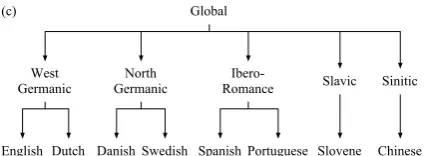
Figure 2: (a) Phylogeny for FAMILIESmodel. (b) Phylogeny for GLOBALmodel. (c) Phylogeny for LINGUISTICmodel.
manic family of languages, whereas Danish and Swedish are part of the North Germanic family. Spanish and Portuguese are both part of the Ibero-Romance family. Slovene is part of the Slavic family. Finally, Chinese is in the Sinitic family, and is not an Indo-European language like the oth-ers. We interchangeably speak of a language fam-ily and the ancestral node corresponding to that family’s root language in a phylogeny.
3.2 Models Compared
We evaluated three phylogenetic priors, each with a different phylogenetic structure. We compare with two monolingual baselines, as well as an all-pairs multilingual model that does not have a phy-logenetic interpretation, but which provides very similar capacity for parameter coupling.
3.2.1 Phylogenetic Models
The first phylogenetic model uses the shallow phy-logeny shown in Figure 2(a), in which only lan-guages within the same family have a shared par-ent node. We refer to this structure as FAMILIES. Under this prior, the learning task decouples into independent subtasks for each family, but no reg-ularities across families can be captured.
The family-level model misses the constraints between distant languages. Figure 2(b) shows an-other simple configuration, wherein all languages
share a common parent node in the prior, meaning that global regularities that are consistent across all languages can be captured. We refer to this structure as GLOBAL.
While the global model couples the parameters for all eight languages, it does so without sensi-tivity to the articulated structure of their descent. Figure 2(c) shows a more nuanced prior
struc-ture, LINGUISTIC, which groups languages first
by family and then under a global node. This
structure allows global regularities as well as reg-ularities within families to be learned.
3.2.2 Parameterization and ALLPAIRSModel
Daum´e III (2007) and Finkel and Manning (2009) consider a formally similar Gaussian hierarchy for domain adaptation. As pointed out in Finkel and Manning (2009), there is a simple equivalence be-tween hierarchical regularization as described here and the addition of new tied features in a “flat” model with zero-meaned Gaussian regularization on all parameters. In particular, instead of param-eterizing the objective in Section 2.4 in terms of multiple sets of weights, one at each node in the phylogeny (the hierarchical parameterization, de-scribed in Section 2.4), it is equivalent to param-eterize this same objective in terms of a single set of weights on a larger of group features (the flat
parameterization). This larger group of features
contains a duplicate set of the features discussed in Section 2.3 for each node in the phylogeny, each of which is active only on the languages that are its descendants. A linear transformation between pa-rameterizations gives equivalence. See Finkel and Manning (2009) for details.
In the flat parameterization, it seems equally reasonable to simply tie all pairs of languages by adding duplicate sets of features for each pair.
This gives the ALLPAIRS setting, which we also
compare to the tree-structured phylogenetic mod-els above.
3.3 Baselines
To evaluate the impact of multilingual constraint, we compared against two monolingual baselines. The first baseline is the standard DMV with only SPECIFICfeatures, which yields the standard
multinomial DMV (weak baseline). To facilitate comparison to past work, we used no prior for this monolingual model. The second baseline is the
DMV with added SHARED features. This model
[image:5.595.76.287.74.119.2] [image:5.595.75.288.234.312.2]pa-Monolingual Multilingual
Phylogenetic
Corpus Size Bas
el
in
e
B
as
el
in
e
w
/
S
H
A
R
E
D
A
L
L
P
A
IR
S
F
A
M
IL
IE
S
B
E
S
T
P
A
IR
G
L
O
B
A
L
L
IN
G
U
IS
T
IC
West Germanic English 6008 47.1 51.3 48.5 51.3 51.3 (Ch) 51.2 62.3
Dutch 6678 36.3 36.0 44.0 36.1 36.2 (Sw) 44.0 45.1
North Germanic Danish 1870 33.5 33.6 40.5 31.4 34.2 (Du) 39.6 41.6
Swedish 3571 45.3 44.8 56.3 44.8 44.8 (Ch) 44.5 58.3
Ibero-Romance Spanish 712 28.0 40.5 58.7 63.4 63.8 (Da) 59.4 58.4
Portuguese 2515 38.5 38.5 63.1 37.4 38.4 (Sw) 37.4 63.0
Slavic Slovene 627 38.5 39.7 49.0 – 49.6 (En) 49.4 48.4
Sinitic Chinese 959 36.3 43.3 50.7 – 49.7 (Sw) 50.1 49.6
[image:6.595.76.526.60.302.2]Macro-Avg. Relative Error Reduction 17.1 5.6 8.5 9.9 21.1
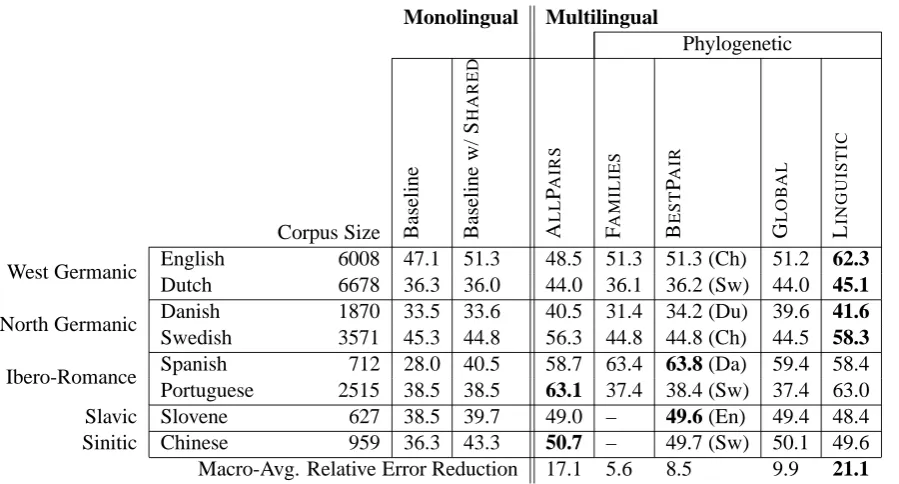
Table 2: Directed dependency accuracy of monolingual and multilingual models, and relative error reduction over the monolin-gual baseline with SHAREDfeatures macro-averaged over languages. Multilingual models outperformed monolingual models in general, with larger gains from increasing numbers of languages. Additionally, more nuanced phylogenetic structures out-performed cruder ones.
rameters. This second baseline is the more direct comparison to the multilingual experiments here (strong baseline).
3.4 Evaluation
For each setting, we evaluated the directed de-pendency accuracy of the minimum Bayes risk (MBR) dependency parses produced by our mod-els under maximum (posterior) likelihood parame-ter estimates. We computed accuracies separately for each language in each condition. In addition, for multilingual models, we computed the relative error reduction over the strong monolingual base-line, macro-averaged over languages.
3.5 Training
Our implementation used the flat parameteriza-tion described in Secparameteriza-tion 3.2.2 for both the
phy-logenetic and ALLPAIRS models. We originally
did this in order to facilitate comparison with the
non-phylogenetic ALLPAIRSmodel, which has no
equivalent hierarchical parameterization. In prac-tice, optimizing with the hierarchical
parameteri-zation also seemed to underperform.1
1We noticed that the weights of features shared across
lan-guages had larger magnitude early in the optimization proce-dure when using the flat parameterization compared to us-ing the hierarchical parameterization, perhaps indicatus-ing that cross-lingual influences had a larger effect on learning in its initial stages.
All models were trained by directly optimizing the observed data likelihood using L-BFGS (Liu et al., 1989). Berg-Kirkpatrick et al. (2010) suggest that directly optimizing the observed data likeli-hood may offer improvements over the more stan-dard expectation-maximization (EM) optimization procedure for models such as the DMV, espe-cially when the model is parameterized using fea-tures. We stopped training after 200 iterations in all cases. This fixed stopping criterion seemed to be adequate in all experiments, but presumably there is a potential gain to be had in fine tuning. To initialize, we used the harmonic initializer pre-sented in Klein and Manning (2004). This type of initialization is deterministic, and thus we did not perform random restarts.
4 Results
Table 2 shows the overall results. In all cases, methods which coupled the languages in some way outperformed the independent baselines that considered each language independently.
4.1 Bilingual Models
The weakest of the coupled models was FAMI
-LIES, which had an average relative error
reduc-tion of 5.6% over the strong baseline. In this case, most of the average improvement came from a sin-gle family: Spanish and Portuguese. The limited improvement of the family-level prior compared to other phylogenies suggests that there are impor-tant multilingual interactions that do not happen within families. Table 2 also reports the maximum accuracy achieved for each language when it was paired with another language (same family or oth-erwise) and trained together with a single common parent. These results appear in the column headed by BESTPAIR, and show the best accuracy for the language on that row over all possible pairings with other languages. When pairs of languages were trained together in isolation, the largest bene-fit was seen for languages with small training cor-pora, not necessarily languages with common an-cestry. In our setup, Spanish, Slovene, and Chi-nese have substantially smaller training corpora than the rest of the languages considered. Other-wise, the patterns are not particularly clear; com-bined with subsequent results, it seems that pair-wise constraint is fairly limited.
4.2 Multilingual Models
Models that coupled multiple languages per-formed better in general than models that only
considered pairs of languages. The GLOBAL
model, which couples all languages, if crudely, yielded an average relative error reduction of 9.9%. This improvement comes as the number of languages able to exert mutual constraint in-creases. For example, Dutch and Danish had large improvements, over and above any improvements these two languages gained when trained with a single additional language. Beyond the simplistic GLOBALphylogeny, the more nuanced LINGUIS
-TIC model gave large improvements for English,
Swedish, and Portuguese. Indeed, the LINGUIS
-TIC model is the only model we evaluated that
gave improvements for all the languages we con-sidered.
It is reasonable to worry that the improvements from these multilingual models might be partially due to having more total training data in the mul-tilingual setting. However, we found that halv-ing the amount of data used to train the English, Dutch, and Swedish (the languages with the most training data) monolingual models did not sub-stantially affect their performance, suggesting that for languages with several thousand sentences or more, the increase in statistical support due to ad-ditional monolingual data was not an important ef-fect (the DMV is a relatively low-capacity model in any case).
4.3 Comparison of Phylogenies
Recall the structures of the three phylogenies
presented in Figure 2. These phylogenies
dif-fer in the correlations they can represent. The
GLOBAL phylogeny captures only “universals,”
while FAMILIES captures only correlations
be-tween languages that are known to be similar. The LINGUISTIC model captures both of these effects
simultaneously by using a two layer hierarchy.
Notably, the improvement due to the LINGUISTIC
model is more than the sum of the improvements
due to the GLOBALand FAMILIESmodels.
4.4 Phylogenetic vs. ALLPAIRS
The phylogeny is capable of allowing appropri-ate influence to pass between languages at
mul-tiple levels. We compare these results to the
ALLPAIRS model in order to see whether
limi-tation to a tree structure is helpful. The ALL
-PAIRS model achieved an average relative error
reduction of 17.1%, certainly outperforming both
the simple phylogenetic models. However, the
rich phylogeny of the LINGUISTIC model, which
incorporates linguistic constraints, outperformed
the freer ALLPAIRS model. A large portion of
this improvement came from English, a language
for which the LINGUISTIC model greatly
outper-formed all other models evaluated. We found that the improved English analyses produced by the LINGUISTICmodel were more consistent with this model’s analyses of other languages. This consis-tency was not present for the English analyses pro-duced by other models. We explore consistency in more detail in Section 5.
4.5 Comparison to Related Work
mod-els are the same, both expanding upon the standard
DMV by adding coarse SHARED features. These
coarse features, even in a monolingual setting, im-proved performance slightly over the weak base-line, perhaps by encouraging consistent treatment of the different finer-grained variants of
parts-of-speech (Berg-Kirkpatrick et al., 2010).2 The
only difference between the multilingual systems and the strong baseline is whether or not cross-language influence is allowed through the prior.
While this progression of model structure is similar to that explored in Cohen and Smith (2009), Cohen and Smith saw their largest im-provements from tying together parameters for the varieties of coarse parts-of-speech monolinugally, and then only moderate improvements from allow-ing cross-lallow-inguistic influence on top of monolin-gual sharing. When Cohen and Smith compared their best shared logistic-normal bilingual mod-els to monolingual counter-parts for the languages they investigate (Chinese and English), they re-ported a relative error reduction of 5.3%. In
com-parison, with the LINGUISTIC model, we saw a
much larger 16.9% relative error reduction over our strong baseline for these languages.
Evaluat-ing our LINGUISTIC model on the same test sets
as (Cohen and Smith, 2009), sentences of length 10 or less in section 23 of PTB and sections 271-300 of CTB, we achieved an accuracy of 56.6 for Chinese and 60.3 for English. The best models of Cohen and Smith (2009) achieved accuracies of 52.0 and 62.0 respectively on these same test sets. Our results indicate that the majority of our model’s power beyond that of the standard DMV is derived from multilingual, and in particular, more-than-bilingual, interaction. These are, to the best of our knowledge, the first results of this kind for grammar induction without bitext.
5 Analysis
By examining the proposed parses we found that
the LINGUISTIC and ALLPAIRSmodels produced
analyses that were more consistent across
lan-guages than those of the other models. We
also observed that the most common errors can be summarized succinctly by looking at attach-ment counts between coarse parts-of-speech. Fig-ure 3 shows matrix representations of dependency
2Coarse features that only tie nouns and verbs are
ex-plored in Berg-Kirkpatrick et al. (2010). We found that these were very effective for English and Chinese, but gave worse performance for other languages.
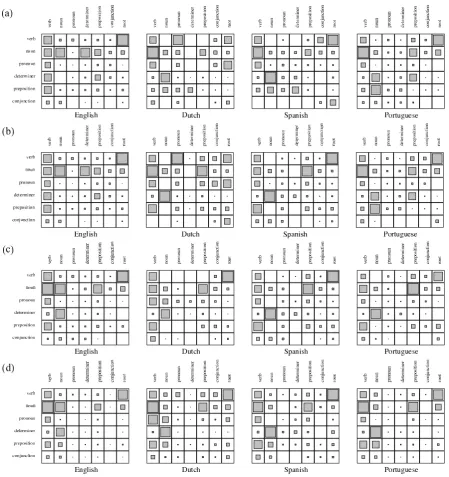
counts. The area of a square is proportional to the number of order-collapsed dependencies where the column label is the head and the row label is the argument in the parses from each system. For ease of comprehension, we use the cross-lingual projections and only show counts for selected in-teresting classes.
Comparing Figure 3(c), which shows
depen-dency counts proposed by the LINGUISTICmodel,
to Figure 3(a), which shows the same for the strong monolingual baseline, suggests that the
analyses proposed by the LINGUISTIC model are
more consistent across languages than are the analyses proposed by the monolingual model. For example, the monolingual learners are divided as to whether determiners or nouns head noun phrases. There is also confusion about which la-bels head whole sentences. Dutch has the problem that verbs modify pronouns more often than pro-nouns modify verbs, and propro-nouns are predicted to head sentences as often as verbs are. Span-ish has some confusion about conjunctions, hy-pothesizing that verbs often attach to conjunctions, and conjunctions frequently head sentences. More subtly, the monolingual analyses are inconsistent in the way they head prepositional phrases. In the monolingual Portuguese hypotheses, preposi-tions modify nouns more often than nouns mod-ify prepositions. In English, nouns modmod-ify prepo-sitions, and prepositions modify verbs. Both the Dutch and Spanish models are ambivalent about the attachment of prepositions.
As has often been observed in other contexts (Liang et al., 2008), promoting agreement can improve accuracy in unsupervised learning. Not
only are the analyses proposed by the LINGUISTIC
model more consistent, they are also more in
ac-cordance with the gold analyses. Under the LIN
-GUISTICmodel, Dutch now attaches pronouns to verbs, and thus looks more like English, its sister
in the phylogenetic tree. The LINGUISTIC model
has also chosen consistent analyses for tional phrases and noun phrases, calling preposi-tions and nouns the heads of each, respectively. The problem of conjunctions heading Spanish sen-tences has also been corrected.
lan-Figure 3: Dependency counts in proposed parses. Row label modifies column label. (a) Monolingual baseline with SHARED features. (b) GLOBALmodel. (c) LINGUISTICmodel. (d) Dependency counts in hand-labeled parses. Analyses proposed by monolingual baseline show significant inconsistencies across languages. Analyses proposed by LINGUISTICmodel are more consistent across languages than those proposed by either the monolingual baseline or the GLOBALmodel.
guages agree that prepositional phrases are headed by prepositions), but not as consistent as those
pro-posed by the LINGUISTIC model.
Finally, Figure 3(d) shows dependency counts in the hand-labeled dependency parses. It appears
that even the very consistent LINGUISTIC parses
do not capture the non-determinism of preposi-tional phrase attachment to both nouns and verbs.
6 Conclusion
Even without translated texts, multilingual con-straints expressed in the form of a phylogenetic
prior on parameters can give substantial gains in grammar induction accuracy over treating lan-guages in isolation. Additionally, articulated phy-logenies that are sensitive to evolutionary structure can outperform not only limited flatter priors but also unconstrained all-pairs interactions.
7 Acknowledgements
[image:9.595.72.522.61.539.2]References
T. Berg-Kirkpatrick, A. Bouchard-Cˆot´e, J. DeNero, and D. Klein. 2010. Painless unsupervised learn-ing with features. In North American Chapter of the
Association for Computational Linguistics.
D. M. Bikel and D. Chiang. 2000. Two statistical pars-ing models applied to the Chinese treebank. In
Sec-ond Chinese Language Processing Workshop.
A. Bouchard-Cˆot´e, P. Liang, D. Klein, and T. L. Grif-fiths. 2007. A probabilistic approach to diachronic phonology. In Empirical Methods in Natural
Lan-guage Processing.
S. Buchholz and E. Marsi. 2006. Computational Nat-ural Language Learning-X shared task on multilin-gual dependency parsing. In Conference on
Compu-tational Natural Language Learning.
D. Burkett and D. Klein. 2008. Two languages are better than one (for syntactic parsing). In Empirical
Methods in Natural Language Processing.
S. B. Cohen and N. A. Smith. 2009. Shared logistic normal distributions for soft parameter tying in un-supervised grammar induction. In North American
Chapter of the Association for Computational Lin-guistics.
M. Collins. 1999. Head-driven statistical models for natural language parsing. In Ph.D. thesis, University
of Pennsylvania, Philadelphia.
H. Daum´e III. 2007. Frustratingly easy domain adap-tation. In Association for Computational
Linguis-tics.
J. Eisner. 2002. Parameter estimation for probabilistic finite-state transducers. In Association for
Compu-tational Linguistics.
J. R. Finkel and C. D. Manning. 2009. Hierarchi-cal bayesian domain adaptation. In North American
Chapter of the Association for Computational Lin-guistics.
D. Klein and C. D. Manning. 2004. Corpus-based induction of syntactic structure: Models of depen-dency and constituency. In Association for
Compu-tational Linguistics.
J. Kuhn. 2004. Experiments in parallel-text based grammar induction. In Association for
Computa-tional Linguistics.
G. Kuzman, J. Gillenwater, and B. Taskar. 2009. De-pendency grammar induction via bitext projection constraints. In Association for Computational
Lin-guistics/International Joint Conference on Natural Language Processing.
P. Liang, D. Klein, and M. I. Jordan. 2008. Agreement-based learning. In Advances in Neural
Information Processing Systems.
D. C. Liu, J. Nocedal, and C. Dong. 1989. On the limited memory BFGS method for large scale opti-mization. Mathematical Programming.
M. P. Marcus, M. A. Marcinkiewicz, and B. Santorini. 1993. Building a large annotated corpus of English: the penn treebank. Computational Linguistics.
R. Salakhutdinov, S. Roweis, and Z. Ghahramani. 2003. Optimization with EM and expectation-conjugate-gradient. In International Conference on
Machine Learning.
D. A. Smith and J. Eisner. 2009. Parser adapta-tion and projecadapta-tion with quasi-synchronous gram-mar features. In Empirical Methods in Natural
Lan-guage Processing.
B. Snyder, T. Naseem, and R. Barzilay. 2009a. Unsu-pervised multilingual grammar induction. In
Asso-ciation for Computational Linguistics/International Joint Conference on Natural Language Processing.
B. Snyder, T. Naseem, J. Eisenstein, and R. Barzi-lay. 2009b. Adding more languages improves un-supervised multilingual part-of-speech tagging: A Bayesian non-parametric approach. In North
Amer-ican Chapter of the Association for Computational Linguistics.
N. Xue, F-D Chiou, and M. Palmer. 2002. Building a large-scale annotated Chinese corpus. In