Evaluating Machine Translations using mNCD
Marcus Dobrinkat and Tero Tapiovaara and Jaakko V¨ayrynen Adaptive Informatics Research Centre
Aalto University School of Science and Technology P.O. Box 15400, FI-00076 Aalto, Finland
{marcus.dobrinkat,jaakko.j.vayrynen,tero.tapiovaara}@tkk.fi
Kimmo Kettunen
Kymenlaakso University of Applied Sciences P.O. Box 9, FI-48401 Kotka, Finland
Abstract
This paper introduces mNCD, a method for automatic evaluation of machine trans-lations. The measure is based on nor-malized compression distance (NCD), a general information theoretic measure of string similarity, and flexible word match-ing provided by stemmmatch-ing and synonyms. The mNCD measure outperforms NCD in system-level correlation to human judg-ments in English.
1 Introduction
Automatic evaluation of machine translation (MT) systems requires automated procedures to en-sure consistency and efficient handling of large amounts of data. In statistical MT systems, au-tomatic evaluation of translations is essential for parameter optimization and system development. Human evaluation is too labor intensive, time con-suming and expensive for daily evaluations. How-ever, manual evaluation is important in the com-parison of different MT systems and for the valida-tion and development of automatic MT evaluavalida-tion measures, which try to model human assessments of translations as closely as possible. Furthermore, the ideal evaluation method would be language in-dependent, fast to compute and simple.
Recently, normalized compression distance (NCD) has been applied to the evaluation of machine translations. NCD is a general in-formation theoretic measure of string similar-ity, whereas most MT evaluation measures, e.g., BLEU and METEOR, are specifically constructed for the task. Parker (2008) introduced BAD-GER, an MT evaluation measure that uses NCD and a language independent word normalization
method. BADGER scores were directly compared against the scores of METEOR and word error rate (WER). The correlation between BADGER and METEOR were low and correlations between BADGER and WER high. Kettunen (2009) uses the NCD directly as an MT evaluation measure. He showed with a small corpus of three language pairs that NCD and METEOR 0.6 correlated for translations of 10–12 MT systems. NCD was not compared to human assessments of translations, but correlations of NCD and METEOR scores were very high for all the three language pairs.
V¨ayrynen et al. (2010) have extended the work by including NCD in the ACL WMT08 evaluation framework and showing that NCD is correlated to human judgments. The NCD measure did not match the performance of the state-of-the-art MT evaluation measures in English, but it presented a viable alternative to de facto standard BLEU (Pa-pineni et al., 2001), which is simple and effective but has been shown to have a number of drawbacks (Callison-Burch et al., 2006).
Some recent advances in automatic MT evalu-ation have included non-binary matching between compared items (Banerjee and Lavie, 2005; Agar-wal and Lavie, 2008; Chan and Ng, 2009), which is implicitly present in the string-based NCD mea-sure. Our motivation is to investigate whether in-cluding additional language dependent resources would improve the NCD measure. We experiment with relaxed word matching using stemming and a lexical database to allow lexical changes. These additional modules attempt to make the reference sentences more similar to the evaluated transla-tions on the string level. We report an experiment showing that document-level NCD and aggregated NCD scores for individual sentences produce very similar correlations to human judgments.
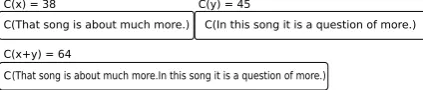
Figure 1: An example showing the compressed sizes of two strings separately and concatenated.
2 Normalized Compression Distance
Normalized compression distance (NCD) is a sim-ilarity measure based on the idea that a stringxis similar to another string y when both share sub-strings. The description ofycan reference shared substrings in the known x without repetition, in-dicating shared information. Figure 1 shows an example in which the compression of the concate-nation ofx andy results in a shorter output than individual compressions ofxandy.
The normalized compression distance, as de-fined by Cilibrasi and Vitanyi (2005), is given in Equation 1, with C(x) as length of the compres-sion of x andC(x, y) as the length of the com-pression of the concatenation ofxandy.
N CD(x, y) = C(x, y)−min{C(x), C(y)}
max{C(x), C(y)}
(1) NCD computes the distance as a score closer to one for very different strings and closer to zero for more similar strings.
NCD is an approximation of the uncomputable normalized information distance (NID), a general measure for the similarity of two objects. NID is based on the notion of Kolmogorov complex-ity K(x), a theoretical measure for the informa-tion content of a stringx, defined as the shortest universal Turing machine that prints x and stops (Solomonoff, 1964). NCD approximates NID by the use of a compressor C(x) that is an upper bound of the Kolmogorov complexityK(x).
3 mNCD
Normalized compression distance was not con-ceived with MT evaluation in mind, but rather it is a general measure of string similarity. Implicit non-binary matching with NCD is indicated by preliminary experiments which show that NCD is less sensitive to random changes on the character level than, for instance, BLEU, which only counts the exact matches between word n-grams. Thus comparison of sentences at the character level could account better for morphological changes.
Variation in language leads to several accept-able translations for each source sentence, which is why multiple reference translations are pre-ferred in evaluation. Unfortunately, it is typical to have only one reference translation. Paraphras-ing techniques can produce additional translation variants (Russo-Lassner et al., 2005; Kauchak and Barzilay, 2006). These can be seen as new refer-ence translations, similar to pseudo referrefer-ences (Ma et al., 2007).
The proposed method, mNCD, works analo-gously to M-BLEU and M-TER, which use the flexible word matching modules from METEOR to find relaxed word-to-word alignments (Agar-wal and Lavie, 2008). The modules are able to align words even if they do not share the same surface form, but instead have a common stem or are synonyms of each other. A similarized transla-tion reference is generated by replacing words in the reference with their aligned counterparts from the translation hypothesis. The NCD score is com-puted between the translations and the similarized references to get the mNCD score.
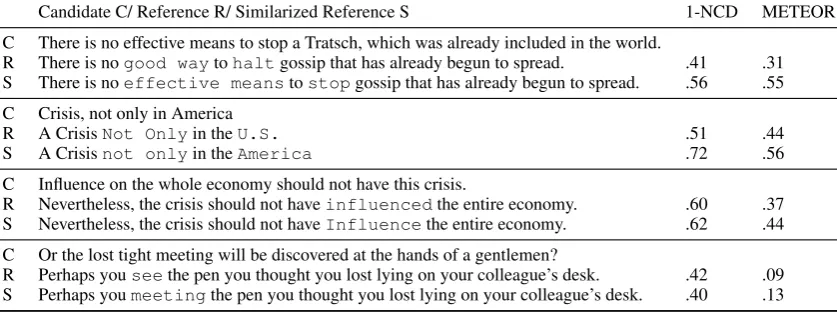
Table 1 shows some hand-picked German– English candidate translations along with a) the reference translations including the 1-NCD score to easily compare with METEOR and b) the simi-larized references including the mNCD score. For comparison, the corresponding METEOR scores without implicit relaxed matching are shown.
4 Experiments
The proposed mNCD and the basic NCD measure were evaluated by computing correlation to hu-man judgments of translations. A high correlation value between an MT evaluation measure and hu-man judgments indicates that the measure is able to evaluate translations in a more similar way to humans.
Relaxed alignments with the METEOR mod-ules exact, stem andsynonym were created for English for the computation of the mNCD score. The synonym module was not available with other target languages.
4.1 Evaluation Data
trans-Candidate C/ Reference R/ Similarized Reference S 1-NCD METEOR C There is no effective means to stop a Tratsch, which was already included in the world.
R There is nogood waytohaltgossip that has already begun to spread. .41 .31 S There is noeffective meanstostopgossip that has already begun to spread. .56 .55 C Crisis, not only in America
R A CrisisNot Onlyin theU.S. .51 .44
S A Crisisnot onlyin theAmerica .72 .56
C Influence on the whole economy should not have this crisis.
R Nevertheless, the crisis should not haveinfluencedthe entire economy. .60 .37 S Nevertheless, the crisis should not haveInfluencethe entire economy. .62 .44 C Or the lost tight meeting will be discovered at the hands of a gentlemen?
[image:3.595.89.508.65.221.2]R Perhaps youseethe pen you thought you lost lying on your colleague’s desk. .42 .09 S Perhaps youmeetingthe pen you thought you lost lying on your colleague’s desk. .40 .13
Table 1: Example German–English translations showing the effect of relaxed matching in the 1-mNCD score (for rows S) compared with METEOR using theexact module only, since the modulesstem andsynonymare already used in the similarized reference. Replaced words are emphasized.
lation evaluations for the translations. There are several tasks, defined by the language pair and the domain of translated text.
The human judgments include three different categories. The RANKcategory has human quality
rankings of five translations for one sentence from different MT systems. The CONSTcategory con-tains rankings for short phrases (constituents), and the YES/NOcategory contains binary answers if a short phrase is an acceptable translation or not.
For the translation tasks into English, the re-laxed alignment using a stem module and the synonym module affected 7.5 % of all words, whereas only5.1 %of the words were changed in the tasks from English into the other languages.
The data was preprocessed in two different ways. For NCD we kept the data as is, which we called real casing (rc). Since the used METEOR align module lowercases all text, we restored the case information in mNCD by copying the correct case from the reference translation to the similar-ized reference, based on METEOR’s alignment. The other way was to lowercase all data (lc).
4.2 System-level correlation
We follow the same evaluation methodology as in Callison-Burch et al. (2008), which allows us to measure how well MT evaluation measures corre-late with human judgments on the system level.
Spearman’s rank correlation coefficient ρ was calculated between each MT evaluation measure and human judgment category using the simplified equation
ρ= 1− 6
P
idi
n(n2−1) (2)
where for each systemi, di is the difference be-tween the rank derived from annotators’ input and the rank obtained from the measure. From the an-notators’ input, thensystems were ranked based on the number of times each system’s output was selected as the best translation divided by the num-ber of times each system was part of a judgment.
We computed system-level correlations for tasks with English, French, Spanish and German as the target language1.
5 Results
We compare mNCD against NCD and relate their performance to other MT evaluation measures.
5.1 Block size effect on NCD scores
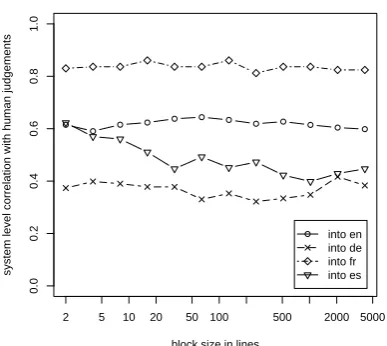
V¨ayrynen et al. (2010) computed NCD between a set of candidate translations and references at the same time regardless of the sentence alignments, analogously to document comparison. We experi-mented with segmentation of the candidate trans-lations into smaller blocks, which were individ-ually evaluated with NCD and aggregated into a single value with arithmetic mean. The resulting system-level correlations between NCD and hu-man judgments are shown in Figure 2 as a function of the block size. The correlations are very simi-lar with all block sizes, except for Spanish, where smaller block size produces higher correlation. An experiment with geometric mean produced similar results. The reported results with mNCD use max-imum block size, similar to V¨ayrynen et al. (2010).
2 5 10 20 50 100 500 2000 5000
0.0
0.2
0.4
0.6
0.8
1.0
block size in lines
system level correlation with human judgements
[image:4.595.311.521.64.229.2]into en into de into fr into es
Figure 2: The block size has very little effect on the correlation between NCD and human judg-ments. The right side corresponds to document comparison and the left side to aggregated NCD scores for sentences.
5.2 mNCD against NCD
Table 2 shows the average system level correlation of different NCD and mNCD variants for trans-lations into English. The two compressors that worked best in our experiments were PPMZ and bz2. PPMZ is slower to compute but performs slightly better compared to bz2, except for the
Method Parameters RA
N
K
C
O
N
S
T
Y
E
S
/N
O
Mean
mNCD PPMZ rc .69 .74 .80 .74
NCD PPMZ rc .60 .66 .71 .66
mNCD bz2 rc .64 .73 .73 .70
NCD bz2 rc .57 .64 .69 .64
mNCD PPMZ lc .66 .80 .79 .75
NCD PPMZ lc .56 .79 .75 .70
mNCD bz2 lc .59 .85 .74 .73
NCD bz2 lc .54 .82 .71 .69
Table 2: Mean system level correlations over all translation tasks into English for variants of mNCD and NCD. Higher values are emphasized. Parameters are the compressor PPMZ or bz2 and the preprocessing choice lowercasing (lc) or real casing (rc).
Target Lang Corr
Method Parameters EN DE FR ES
mNCD PPMZ rc .69 .37 .82 .38 NCD PPMZ rc .60 .37 .84 .39
mNCD bz2 rc .64 .32 .75 .25 NCD bz2 rc .57 .34 .85 .42
mNCD PPMZ lc .66 .33 .79 .23
NCD PPMZ lc .56 .37 .77 .21
mNCD bz2 lc .59 .25 .78 .16
[image:4.595.80.274.84.257.2]NCD bz2 lc .54 .26 .77 .15
Table 3: mNCD versus NCD system correlation RANKresults with different parameters (the same as in Table 2) for each target language. Higher values are emphasized. Target languages DE, FR
and ESuse only thestemmodule.
lowercased CONSTcategory.
Table 2 shows that real casing improves RANK
correlation slightly throughout NCD and mNCD variants, whereas it reduces correlation in the cat-egories CONST, YES/NOas well as the mean.
The best mNCD (PPMZ rc) improves the best NCD (PPMZ rc) method by 15% in the RANK
category. In the CONSTcategory the best mNCD (bz2 lc) improves the best NCD (bz2 lc) by 3.7%. For the total average, the best mNCD (PPMZ rc) improves the the best NCD (bz2 lc) by 7.2%.
Table 3 shows the correlation results for the RANKcategory by target language. As shown al-ready in Table 2, mNCD clearly outperforms NCD for English. Correlations for other languages show mixed results and on average, mNCD gives lower correlations than NCD.
5.3 mNCD versus other methods
Table 4 presents the results for the selected mNCD (PPMZ rc) and NCD (bz2 rc) variants along with the correlations for other MT evaluation methods from the WMT’08 data, based on the results in Callison-Burch et al. (2008). The results are av-erages over language pairs into English, sorted by RANK, which we consider the most
Method RA
N
K
C
O
N
S
T
Y
E
S
/N
O
Mean
DP .81 .66 .74 .73 ULCh .80 .68 .78 .75 DR .79 .53 .65 .66 meteor-ranking .78 .55 .63 .65 ULC .77 .72 .81 .76 posbleu .75 .69 .78 .74 SR .75 .66 .76 .72 posF4gram-gm .74 .60 .71 .68 meteor-baseline .74 .60 .63 .66 posF4gram-am .74 .58 .69 .67 mNCD (PPMZ rc) .69 .74 .80 .74 NCD (PPMZ rc) .60 .66 .71 .66 mbleu .50 .76 .70 .65 bleu .50 .72 .74 .65 mter .38 .74 .68 .60 svm-rank .37 .10 .23 .23
[image:5.595.81.283.62.355.2]Mean .67 .62 .69 .66
Table 4: Average system-level correlations over translation tasks into English for NCD, mNCD and other MT evaluations measures
degrades the averages. Considering the mean of the categories instead, mNCD’s correlation of .74 is third best together with ’posbleu’.
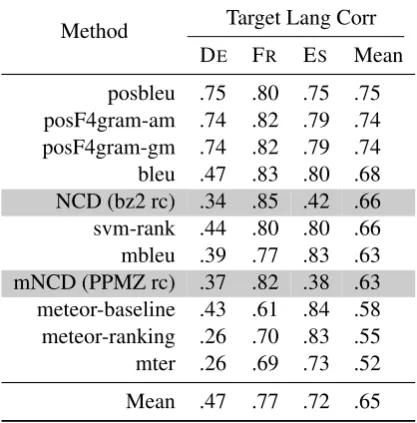
Table 5 shows the results from English. The ta-ble is shorter since many of the better MT mea-sures use language specific linguistic resources that are not easily available for languages other than English. mNCD performs competitively only for French, otherwise it falls behind NCD and other methods as already shown earlier.
6 Discussion
We have introduced a new MT evaluation mea-sure, mNCD, which is based on normalized com-pression distance and METEOR’s relaxed align-ment modules. The mNCD measure outperforms NCD in English with all tested parameter com-binations, whereas results with other target lan-guages are unclear. The improved correlations with mNCD did not change the position in the RANKcategory of the MT evaluation measures in the 2008 ACL WMT shared task.
The improvement in English was expected on the grounds of the synonym module, and indicated also by the larger number of affected words in the
Method Target Lang Corr DE FR ES Mean
posbleu .75 .80 .75 .75 posF4gram-am .74 .82 .79 .74 posF4gram-gm .74 .82 .79 .74 bleu .47 .83 .80 .68 NCD (bz2 rc) .34 .85 .42 .66 svm-rank .44 .80 .80 .66 mbleu .39 .77 .83 .63 mNCD (PPMZ rc) .37 .82 .38 .63 meteor-baseline .43 .61 .84 .58 meteor-ranking .26 .70 .83 .55 mter .26 .69 .73 .52
[image:5.595.312.521.64.276.2]Mean .47 .77 .72 .65
Table 5: Average system-level correlations for the RANK category from English for NCD, mNCD and other MT evaluation measures.
similarized references. We believe there is poten-tial for improvement in other languages as well if synonym lexicons are available.
We have also extended the basic NCD measure to scale between a document comparison mea-sure and aggregated sentence-level meamea-sure. The rather surprising result is that NCD produces quite similar scores with all block sizes. The different result with Spanish may be caused by differences in the data or problems in the calculations.
After using the same evaluation methodology as in Callison-Burch et al. (2008), we have doubts whether it presents the most effective method ex-ploiting all the given human evaluations in the best way. The system-level correlation measure only awards the winner of the ranking of five differ-ent systems. If a system always scored second, it would never be awarded and therefore be overly penalized. In addition, the human knowledge that gave the lower rankings is not exploited.
References
Abhaya Agarwal and Alon Lavie. 2008. METEOR, M-BLEU and M-TER: evaluation metrics for high-correlation with human rankings of machine
trans-lation output. In StatMT ’08: Proceedings of the
Third Workshop on Statistical Machine Translation, pages 115–118, Morristown, NJ, USA. Association for Computational Linguistics.
Satanjeev Banerjee and Alon Lavie. 2005. METEOR: An automatic metric for MT evaluation with
im-proved correlation with human judgments. In
Pro-ceedings of the ACL Workshop on Intrinsic and Ex-trinsic Evaluation Measures for Machine Transla-tion and/or SummarizaTransla-tion, pages 65–72, Ann Ar-bor, Michigan, June. Association for Computational Linguistics.
Chris Callison-Burch, Miles Osborne, and Philipp
Koehn. 2006. Re-evaluating the role of BLEU
in machine translation research. In Proceedings of
EACL-2006, pages 249–256.
Chris Callison-Burch, Cameron Fordyce, Philipp Koehn, Christoph Monz, and Josh Schroeder. 2008. Further meta-evalutation of machine translation.
ACL Workshop on Statistical Machine Translation.
Yee Seng Chan and Hwee Tou Ng. 2009. MaxSim: performance and effects of translation fluency. Ma-chine Translation, 23(2-3):157–168.
Rudi Cilibrasi and Paul Vitanyi. 2005. Clustering
by compression. IEEE Transactions on Information
Theory, 51:1523–1545.
David Kauchak and Regina Barzilay. 2006.
Para-phrasing for automatic evaluation. InProceedings
of the main conference on Human Language Tech-nology Conference of the North American Chap-ter of the Association of Computational Linguistics, pages 455–462, Morristown, NJ, USA. Association for Computational Linguistics.
Kimmo Kettunen. 2009. Packing it all up in search for a language independent MT quality measure tool. In
In Proceedings of LTC-09, 4th Language and Tech-nology Conference, pages 280–284, Poznan.
Yanjun Ma, Nicolas Stroppa, and Andy Way. 2007. Bootstrapping word alignment via word packing. In
Proceedings of the 45th Annual Meeting of the As-sociation of Computational Linguistics, pages 304– 311, Prague, Czech Republic, June. Association for Computational Linguistics.
K. Papineni, S. Roukos, T. Ward, and W. Zhu.
2001. BLEU: a method for automatic evaluation
of machine translation. Technical Report RC22176 (W0109-022), IBM Research Division, Thomas J. Watson Research Center.
Steven Parker. 2008. BADGER: A new machine
trans-lation metric. In Metrics for Machine Translation
Challenge 2008, Waikiki, Hawai’i, October. AMTA.
Grazia Russo-Lassner, Jimmy Lin, and Philip Resnik.
2005. A paraphrase-based approach to machine
translation evaluation. Technical Report
LAMP-TR-125/CS-TR-4754/UMIACS-TR-2005-57, Uni-versity of Maryland, College Park.
Ray Solomonoff. 1964. Formal theory of inductive inference. Part I. Information and Control,, 7(1):1– 22.
Jaakko J. V¨ayrynen, Tero Tapiovaara, Kimmo Ket-tunen, and Marcus Dobrinkat. 2010. Normalized compression distance as an automatic MT
evalua-tion metric. InProceedings of MT 25 years on. To