Learning Lexicalized Reordering Models from Reordering Graphs
Jinsong Su, Yang Liu, Yajuan L ¨u, Haitao Mi, Qun Liu Key Laboratory of Intelligent Information Processing
Institute of Computing Technology Chinese Academy of Sciences P.O. Box 2704, Beijing 100190, China
{sujinsong,yliu,lvyajuan,htmi,liuqun}@ict.ac.cn
Abstract
Lexicalized reordering models play a crucial role in phrase-based translation systems. They are usually learned from the word-aligned bilingual corpus by examining the reordering relations of adjacent phrases. Instead of just checking whether there is one phrase adjacent to a given phrase, we argue that it is important to take the number of adjacent phrases into account for better estimations of reordering models. We propose to use a structure named
reordering graph, which represents all phrase segmentations of a sentence pair, to learn lex-icalized reordering models efficiently. Exper-imental results on the NIST Chinese-English test sets show that our approach significantly outperforms the baseline method.
1 Introduction
Phrase-based translation systems (Koehn et al., 2003; Och and Ney, 2004) prove to be the state-of-the-art as they have delivered translation perfor-mance in recent machine translation evaluations. While excelling at memorizing local translation and reordering, phrase-based systems have difficulties in modeling permutations among phrases. As a result, it is important to develop effective reordering mod-els to capture such non-local reordering.
[image:1.595.342.511.237.306.2]The early phrase-based paradigm (Koehn et al., 2003) applies a simple distance-based distortion penalty to model the phrase movements. More re-cently, many researchers have presented lexicalized reordering models that take advantage of lexical information to predict reordering (Tillmann, 2004; Xiong et al., 2006; Zens and Ney, 2006; Koehn et
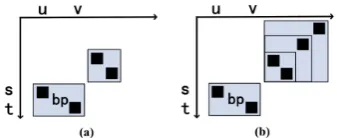
Figure 1: Occurrence of a swap with different numbers of adjacent bilingual phrases: only one phrase in (a) and three phrases in (b). Black squares denote word align-ments and gray rectangles denote bilingual phrases. [s,t] indicates the target-side span of bilingual phrasebpand [u,v] represents the source-side span of bilingual phrase
bp.
al., 2007; Galley and Manning, 2008). These mod-els are learned from a word-aligned corpus to pre-dict three orientations of a phrase pair with respect to the previous bilingual phrase: monotone (M), swap (S), and discontinuous (D). Take the bilingual phrase bp in Figure 1(a) for example. The word-based reordering model (Koehn et al., 2007) ana-lyzes the word alignments at positions(s−1, u−1)
and (s− 1, v + 1). The orientation of bp is set to D because the position(s−1, v + 1) contains no word alignment. The phrase-based reordering model (Tillmann, 2004) determines the presence of the adjacent bilingual phrase located in position
(s−1, v+ 1)and then treats the orientation ofbpas
S. Given no constraint on maximum phrase length, the hierarchical phrase reordering model (Galley and Manning, 2008) also analyzes the adjacent bilingual phrases forbpand identifies its orientation asS.
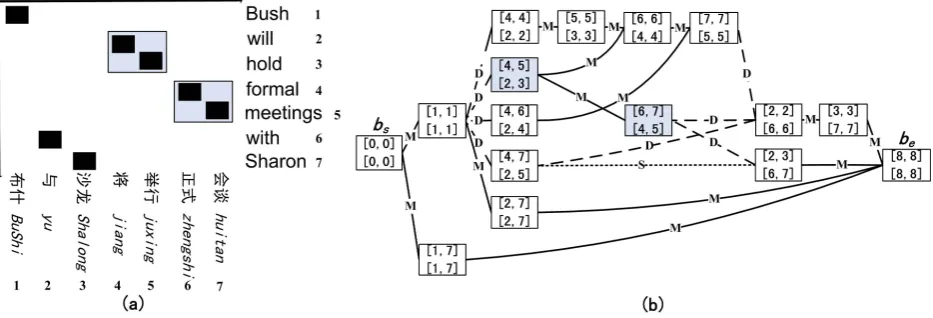
Fig-Figure 2: (a) A parallel Chinese-English sentence pair and (b) its corresponding reordering graph. In (b), we denote each bilingual phrase with a rectangle, where the upper and bottom numbers in the brackets represent the source and target spans of this bilingual phrase respectively. M = monotone (solid lines), S = swap (dotted line), and D = discontinuous (segmented lines). The bilingual phrases marked in the gray constitute a reordering example.
ure 1 for illustration. In Figure 1(a),bpis in a swap order with only one bilingual phrase. In Figure 1(b),
bp swaps with three bilingual phrases. Lexicalized reordering models do not distinguish different num-bers of adjacent phrase pairs, and just give bp the same count in the swap orientation.
In this paper, we propose a novel method to better estimate the reordering probabilities with the con-sideration of varying numbers of adjacent bilingual phrases. Our method uses reordering graphs to rep-resent all phrase segmentations of parallel sentence pairs, and then gets the fractional counts of bilin-gual phrases for orientations from reordering graphs in an inside-outside fashion. Experimental results indicate that our method achieves significant im-provements over the traditional lexicalized reorder-ing model (Koehn et al., 2007).
This paper is organized as follows: in Section 2, we first give a brief introduction to the traditional lexicalized reordering model. Then we introduce our method to estimate the reordering probabilities from reordering graphs. The experimental results are reported in Section 3. Finally, we end with a conclusion and future work in Section 4.
2 Estimation of Reordering Probabilities Based on Reordering Graph
In this section, we first describe the traditional lexi-calized reordering model, and then illustrate how to construct reordering graphs to estimate the
reorder-ing probabilities.
2.1 Lexicalized Reordering Model
Given a phrase pair bp= (ei, fai), where ai
de-fines that the source phrase fai is aligned to the target phrase ei, the traditional lexicalized
reorder-ing model computes the reorderreorder-ing count of bp in the orientation o based on the word alignments of boundary words. Specifically, the model collects bilingual phrases and distinguishes their orientations with respect to the previous bilingual phrase into three categories:
o=
M ai−ai−1= 1
S ai−ai−1=−1
D |ai−ai−1| 6= 1
(1)
Using the relative-frequency approach, the re-ordering probability regardingbpis
p(o|bp) = PCount(o, bp)
o0Count(o0, bp)
(2)
2.2 Reordering Graph
[image:2.595.74.541.73.232.2]bilingual phrases are linked according to the target-side order. Some bilingual phrases, which have no adjacent bilingual phrases because of maximum length limitation, are linked to the nearest bilingual phrases in the target-side order.
Shown in Figure 2(b), the reordering graph for the parallel sentence pair (Figure 2(a)) can be rep-resented as an undirected graph, where each rect-angle corresponds to a phrase pair, each link is the orientation relationship between adjacent bilingual phrases, and two distinguished rectanglesbs andbe
indicate the beginning and ending of the parallel sen-tence pair, respectively. With the reordering graph, we can obtain all reordering examples containing the given bilingual phrase. For example, the bilin-gual phrasehzhengshi huitan, formal meetingsi(see Figure 2(a)), corresponding to the rectangle labeled with the source span [6,7] and the target span [4,5], is in a monotone order with one previous phrase and in a discontinuous order with two subsequent phrases (see Figure 2(b)).
2.3 Estimation of Reordering Probabilities
We estimate the reordering probabilities from re-ordering graphs. Given a parallel sentence pair, there are many translation derivations correspond-ing to different paths in its reordercorrespond-ing graph. As-suming all derivations have a uniform probability, the fractional counts of bilingual phrases for orien-tations can be calculated by utilizing an algorithm in the inside-outside fashion.
Given a phrase pair bp in the reordering graph, we denote the number of paths frombs tobp with α(bp). It can be computed in an iterative way
α(bp) = Pbp0α(bp0), wherebp0 is one of the
pre-vious bilingual phrases ofbpandα(bs)=1. In a
sim-ilar way, the number of paths frombetobp, notated
as β(bp), is simply β(bp) = Pbp00β(bp00), where bp00is one of the subsequent bilingual phrases ofbp
andβ(be)=1. Here, we show theαandβvalues of
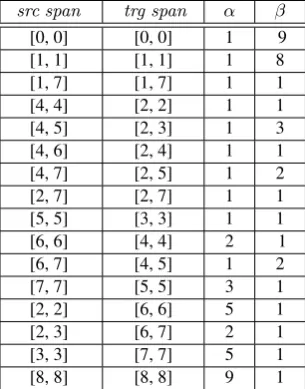
all bilingual phrases of Figure 2 in Table 1. Espe-cially, for the reordering example consisting of the bilingual phrases bp1=hjiang juxing, will holdi and
bp2=hzhengshi huitan, formal meetingsi, marked in
the gray color in Figure 2, theαandβvalues can be calculated: α(bp1) = 1,β(bp2) = 1+1 = 2,β(bs) =
8+1 = 9.
Inspired by the parsing literature on pruning
src span trg span α β
[0, 0] [0, 0] 1 9
[1, 1] [1, 1] 1 8
[1, 7] [1, 7] 1 1
[4, 4] [2, 2] 1 1
[4, 5] [2, 3] 1 3
[4, 6] [2, 4] 1 1
[4, 7] [2, 5] 1 2
[2, 7] [2, 7] 1 1
[5, 5] [3, 3] 1 1
[6, 6] [4, 4] 2 1
[6, 7] [4, 5] 1 2
[7, 7] [5, 5] 3 1
[2, 2] [6, 6] 5 1
[2, 3] [6, 7] 2 1
[3, 3] [7, 7] 5 1
[image:3.595.350.503.72.267.2][8, 8] [8, 8] 9 1
Table 1: The αand β values of the bilingual phrases shown in Figure 2.
(Charniak and Johnson, 2005; Huang, 2008), the fractional count of(o, bp0, bp)is
Count(o, bp0, bp) = α(bp0)·β(bp) β(bs)
(3)
where the numerator indicates the number of paths containing the reordering example (o, bp0, bp) and
the denominator is the total number of paths in the reordering graph. Continuing with the reordering example described above, we obtain its fractional count using the formula (3):Count(M, bp1, bp2) = (1×2)/9 = 2/9.
Then, the fractional count ofbpin the orientation
ois calculated as described below:
Count(o, bp) =X bp0
Count(o, bp0, bp) (4)
For example, we compute the fractional count of
bp2 in the monotone orientation by the formula (4):
Count(M, bp2) = 2/9.
As described in the lexicalized reordering model (Section 2.1), we apply the formula (2) to calculate the final reordering probabilities.
3 Experiments
phrase-based system (Koehn et al., 2007). The msd-fe reordering model has three msd-features, which rep-resent the probabilities of bilingual phrases in three orientations: monotone, swap, or discontinuous. If a msd-bidirectional-fe model is used, then the number of features doubles: one for each direction.
3.1 Experiment Setup
Two different sizes of training corpora are used in our experiments: one is a small-scale corpus that comes from FBIS corpus consisting of 239K bilin-gual sentence pairs, the other is a large-scale corpus that includes 1.55M bilingual sentence pairs from LDC. The 2002 NIST MT evaluation test data is used as the development set and the 2003, 2004, 2005 NIST MT test data are the test sets. We choose the MOSES1(Koehn et al., 2007) as the
ex-perimental decoder. GIZA++ (Och and Ney, 2003) and the heuristics “grow-diag-final-and” are used to generate a word-aligned corpus, where we extract bilingual phrases with maximum length 7. We use SRILM Toolkits (Stolcke, 2002) to train a 4-gram language model on the Xinhua portion of Gigaword corpus.
In exception to the reordering probabilities, we use the same features in the comparative experi-ments. During decoding, we set ttable-limit = 20, stack = 100, and perform minimum-error-rate train-ing (Och, 2003) to tune various feature weights. The translation quality is evaluated by case-insensitive BLEU-4 metric (Papineni et al., 2002). Finally, we conduct paired bootstrap sampling (Koehn, 2004) to test the significance in BLEU scores differences.
3.2 Experimental Results
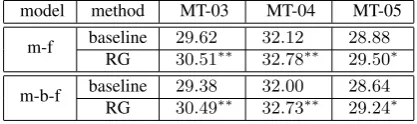
Table 2 shows the results of experiments with the small training corpus. For the msd-fe model, the BLEU scores by our method are 30.51 32.78 and 29.50, achieving absolute improvements of 0.89, 0.66and0.62on the three test sets, respectively. For the msd-bidirectional-fe model, our method obtains BLEU scores of 30.49 32.73 and 29.24, with abso-lute improvements of 1.11, 0.73and0.60 over the baseline method.
1The phrase-based lexical reordering model (Tillmann,
2004) is also closely related to our model. However, due to the limit of time and space, we only use Moses-style reordering model (Koehn et al., 2007) as our baseline.
model method MT-03 MT-04 MT-05 baseline 29.62 32.12 28.88
m-f
RG 30.51∗∗ 32.78∗∗ 29.50∗ baseline 29.38 32.00 28.64
m-b-f
[image:4.595.322.531.72.134.2]RG 30.49∗∗ 32.73∗∗ 29.24∗
Table 2: Experimental results with thesmall-scale cor-pus. m-f: msd-fe reordering model. m-b-f: msd-bidirectional-fe reordering model. RG: probabilities esti-mation based on Reordering Graph. * or **: significantly better than baseline (p<0.05 or p<0.01).
model method MT-03 MT-04 MT-05 baseline 31.58 32.39 31.49
m-f
RG 32.44∗∗ 33.24∗∗ 31.64 baseline 32.43 33.07 31.69
m-b-f
[image:4.595.321.532.214.277.2]RG 33.29∗∗ 34.49∗∗ 32.79∗∗
Table 3: Experimental results with thelarge-scale cor-pus.
Table 3 shows the results of experiments with the large training corpus. In the experiments of the msd-fe model, in exception to the MT-05 test set, our method is superior to the baseline method. The BLEU scores by our method are 32.44, 33.24 and 31.64, which obtain 0.86, 0.85 and0.15 gains on three test set, respectively. For the msd-bidirectional-fe model, the BLEU scores produced by our approach are 33.29, 34.49 and 32.79 on the three test sets, with0.86, 1.42and1.1points higher than the baseline method, respectively.
4 Conclusion and Future Work
In this paper, we propose a method to improve the reordering model by considering the effect of the number of adjacent bilingual phrases on the reorder-ing probabilities estimation. Experimental results on NIST Chinese-to-English tasks demonstrate the ef-fectiveness of our method.
Acknowledgement
The authors were supported by National Natural Sci-ence Foundation of China, Contracts 60873167 and 60903138. We thank the anonymous reviewers for their insightful comments. We are also grateful to Hongmei Zhao and Shu Cai for their helpful feed-back.
References
Eugene Charniak and Mark Johnson. 2005. Coarse-to-fine n-best parsing and maxent discriminative rerank-ing. InProc. of ACL 2005, pages 173–180.
Michel Galley and Christopher D. Manning. 2008. A simple and effective hierarchical phrase reordering model. InProc. of EMNLP 2008, pages 848–856. Liang Huang. 2008. Forest reranking: Discriminative
parsing with non-local features. InProc. of ACL 2008, pages 586–594.
Philipp Koehn, Franz Josef Och, and Daniel Marcu. 2003. Statistical phrase-based translation. In Proc. of HLT-NAACL 2003, pages 127–133.
Philipp Koehn, Hieu Hoang, Alexandra Birch, Chris Callison-Burch, Marcello Federico, Nicola Bertoldi, Brooke Cowan, Wade Shen, Christine Moran, Richard Zens, Chris Dyer, Ondrej Bojar, Alexandra Con-stantin, and Evan Herbst. 2007. Moses: Open source toolkit for statistical machine translation. InProc. of ACL 2007, Demonstration Session, pages 177–180. Philipp Koehn. 2004. Statistical significance tests for
machine translation evaluation. In Proc. of EMNLP 2004, pages 388–395.
Franz Josef Och and Hermann Ney. 2003. A system-atic comparison of various statistical alignment mod-els. Computational Linguistics, 29(1):19–51.
Franz Joseph Och and Hermann Ney. 2004. The align-ment template approach to statistical machine transla-tion. Computational Linguistics, pages 417–449. Franz Josef Och. 2003. Minimum error rate training in
statistical machine translation. InProc. of ACL 2003, pages 160–167.
Kishore Papineni, Salim Roukos, Todd Ward, and Wei-Jing Zhu. 2002. Bleu: a method for automatic eval-uation of machine translation. InProc. of ACL 2002, pages 311–318.
Andreas Stolcke. 2002. Srilm - an extensible language modeling toolkit. InProc. of ICSLP 2002, pages 901– 904.
Christoph Tillmann. 2004. A unigram orientation model for statistical machine translation. In Proc. of HLT-ACL 2004, Short Papers, pages 101–104.
Deyi Xiong, Qun Liu, and Shouxun Lin. 2006. Maxi-mum entropy based phrase reordering model for statis-tical machine translation. InProc. of ACL 2006, pages 521–528.