Discriminative Language Modeling with
Conditional Random Fields and the Perceptron Algorithm
Brian Roark
Murat Saraclar
AT&T Labs - Research
{roark,murat}@research.att.comMichael Collins
Mark Johnson
MIT CSAIL
Brown University
[email protected] Mark [email protected]
Abstract
This paper describes discriminative language modeling for a large vocabulary speech recognition task. We con-trast two parameter estimation methods: the perceptron algorithm, and a method based on conditional random fields (CRFs). The models are encoded as determin-istic weighted finite state automata, and are applied by intersecting the automata with word-lattices that are the output from a baseline recognizer. The perceptron algo-rithm has the benefit of automatically selecting a rela-tively small feature set in just a couple of passes over the training data. However, using the feature set output from the perceptron algorithm (initialized with their weights), CRF training provides an additional 0.5% reduction in word error rate, for a total 1.8% absolute reduction from the baseline of 39.2%.
1
Introduction
A crucial component of any speech recognizer is the lan-guage model (LM), which assigns scores or probabilities to candidate output strings in a speech recognizer. The language model is used in combination with an acous-tic model, to give an overall score to candidate word se-quences that ranks them in order of probability or plau-sibility.
A dominant approach in speech recognition has been to use a “source-channel”, or “noisy-channel” model. In this approach, language modeling is effectively framed as density estimation: the language model’s task is to define a distribution over the source – i.e., the possible strings in the language. Markov (n-gram) models are of-ten used for this task, whose parameters are optimized to maximize the likelihood of a large amount of training text. Recognition performance is a direct measure of the effectiveness of a language model; an indirect measure which is frequently proposed within these approaches is the perplexity of the LM (i.e., the log probability it as-signs to some held-out data set).
This paper explores alternative methods for language modeling, which complement the source-channel ap-proach through discriminatively trained models. The lan-guage models we describe do not attempt to estimate a generative modelP(w)over strings. Instead, they are trained on acoustic sequences with their transcriptions, in an attempt to directly optimize error-rate. Our work builds on previous work on language modeling using the perceptron algorithm, described in Roark et al. (2004). In particular, we explore conditional random field meth-ods, as an alternative training method to the perceptron. We describe how these models can be trained over
lat-tices that are the output from a baseline recognizer. We also give a number of experiments comparing the two ap-proaches. The perceptron method gave a 1.3% absolute improvement in recognition error on the Switchboard do-main; the CRF methods we describe give a further gain, the final absolute improvement being 1.8%.
A central issue we focus on concerns feature selection. The number of distinct n-grams in our training data is close to 45 million, and we show that CRF training con-verges very slowly even when trained with a subset (of size 12 million) of these features. Because of this, we ex-plore methods for picking a small subset of the available features.1 The perceptron algorithm can be used as one
method for feature selection, selecting around 1.5 million features in total. The CRF trained with this feature set, and initialized with parameters from perceptron training, converges much more quickly than other approaches, and also gives the optimal performance on the held-out set. We explore other approaches to feature selection, but find that the perceptron-based approach gives the best results in our experiments.
While we focus on n-gram models, we stress that our methods are applicable to more general language mod-eling features – for example, syntactic features, as ex-plored in, e.g., Khudanpur and Wu (2000). We intend to explore methods with new features in the future. Ex-perimental results with n-gram models on 1000-best lists show a very small drop in accuracy compared to the use of lattices. This is encouraging, in that it suggests that models with more flexible features than n-gram models, which therefore cannot be efficiently used with lattices, may not be unduly harmed by their restriction to n-best lists.
1.1 Related Work
Large vocabulary ASR has benefitted from discrimina-tive estimation of Hidden Markov Model (HMM) param-eters in the form of Maximum Mutual Information Es-timation (MMIE) or Conditional Maximum Likelihood Estimation (CMLE). Woodland and Povey (2000) have shown the effectiveness of lattice-based MMIE/CMLE in challenging large scale ASR tasks such as Switchboard. In fact, state-of-the-art acoustic modeling, as seen, for example, at annual Switchboard evaluations, invariably includes some kind of discriminative training.
Discriminative estimation of language models has also been proposed in recent years. Jelinek (1995) suggested an acoustic sensitive language model whose parameters
are estimated by minimizingH(W|A), the expected un-certainty of the spoken text W, given the acoustic se-quence A. Stolcke and Weintraub (1998) experimented with various discriminative approaches including MMIE with mixed results. This work was followed up with some success by Stolcke et al. (2000) where an “anti-LM”, estimated from weighted N-best hypotheses of a baseline ASR system, was used with a negative weight in combination with the baseline LM. Chen et al. (2000) presented a method based on changing the trigram counts discriminatively, together with changing the lexicon to add new words. Kuo et al. (2002) used the generalized probabilistic descent algorithm to train relatively small language models which attempt to minimize string error rate on the DARPA Communicator task. Banerjee et al. (2003) used a language model modification algorithm in the context of a reading tutor that listens. Their algorithm first uses a classifier to predict what effect each parame-ter has on the error rate, and then modifies the parameparame-ters to reduce the error rate based on this prediction.
2
Linear Models, the Perceptron
Algorithm, and Conditional Random
Fields
This section describes a general framework, global linear models, and two parameter estimation methods within the framework, the perceptron algorithm and a method based on conditional random fields. The linear models we describe are general enough to be applicable to a di-verse range of NLP and speech tasks – this section gives a general description of the approach. In the next section of the paper we describe how global linear models can be applied to speech recognition. In particular, we focus on how the decoding and parameter estimation problems can be implemented over lattices using finite-state tech-niques.
2.1 Global linear models
We follow the framework outlined in Collins (2002; 2004). The task is to learn a mapping from inputsx∈ X
to outputs y ∈ Y. We assume the following compo-nents: (1) Training examples(xi, yi)for i = 1. . . N. (2) A functionGENwhich enumerates a set of candi-dates GEN(x) for an input x. (3) A representation Φ mapping each (x, y) ∈ X × Y to a feature vector Φ(x, y)∈Rd. (4) A parameter vectorα¯ ∈Rd.
The components GEN,Φ and α¯ define a mapping from an inputxto an outputF(x)through
F(x) = argmax
y∈GEN(x)
Φ(x, y)·α¯ (1)
whereΦ(x, y)·α¯ is the inner productP
sαsΦs(x, y). The learning task is to set the parameter valuesα¯ using the training examples as evidence. The decoding algo-rithm is a method for searching for theythat maximizes Eq. 1.
2.2 The Perceptron algorithm
We now turn to methods for training the parameters ¯
α of the model, given a set of training examples
Inputs: Training examples(xi, yi)
Initialization: Setα¯= 0
Algorithm:
Fort= 1. . . T,i= 1. . . N
Calculatezi= argmaxz∈GEN(xi)Φ(xi, z)·α¯
If(zi6=yi) thenα¯= ¯α+ Φ(xi, yi)−Φ(xi, zi)
Output: Parametersα¯
Figure 1:A variant of the perceptron algorithm.
(x1, y1). . .(xN, yN). This section describes the per-ceptron algorithm, which was previously applied to lan-guage modeling in Roark et al. (2004). The next section describes an alternative method, based on conditional random fields.
The perceptron algorithm is shown in figure 1. At each training example(xi, yi), the current best-scoring hypothesis zi is found, and if it differs from the refer-ence yi , then the cost of each feature2 is increased by the count of that feature inziand decreased by the count of that feature inyi. The features in the model are up-dated, and the algorithm moves to the next utterance. After each pass over the training data, performance on a held-out data set is evaluated, and the parameterization with the best performance on the held out set is what is ultimately produced by the algorithm.
Following Collins (2002), we used the averaged pa-rameters from the training algorithm in decoding held-out and test examples in our experiments. Sayα¯t
iis the parameter vector after the i’th example is processed on the t’th pass through the data in the algorithm in fig-ure 1. Then the averaged parametersα¯AV Gare defined as α¯AV G =Pi,tα¯
t
i/N T. Freund and Schapire (1999) originally proposed the averaged parameter method; it was shown to give substantial improvements in accuracy for tagging tasks in Collins (2002).
2.3 Conditional Random Fields
Conditional Random Fields have been applied to NLP tasks such as parsing (Ratnaparkhi et al., 1994; Johnson et al., 1999), and tagging or segmentation tasks (Lafferty et al., 2001; Sha and Pereira, 2003; McCallum and Li, 2003; Pinto et al., 2003). CRFs use the parameters α¯ to define a conditional distribution over the members of
GEN(x)for a given inputx:
pα¯(y|x) =
1
Z(x,α¯)exp (Φ(x, y)·α¯)
where Z(x,α¯) = P
y∈GEN(x)exp (Φ(x, y)·α¯) is a normalization constant that depends onxandα¯.
Given these definitions, the log-likelihood of the train-ing data under parametersα¯is
LL( ¯α) = N
X
i=1
logpα(¯ yi|xi)
= N
X
i=1
[Φ(xi, yi)·α¯−logZ(xi,α¯)] (2)
Following Johnson et al. (1999) and Lafferty et al. (2001), we use a zero-mean Gaussian prior on the pa-rameters resulting in the regularized objective function:
LLR( ¯α) = N
X
i=1
[Φ(xi, yi)·α¯−logZ(xi,α¯)]−||
¯ α||2
2σ2 (3)
The valueσ dictates the relative influence of the log-likelihood term vs. the prior, and is typically estimated using held-out data. The optimal parameters under this criterion areα¯∗= argmaxα¯LLR( ¯α).
We use a limited memory variable metric method (Benson and Mor´e, 2002) to optimizeLLR. There is a general implementation of this method in the Tao/PETSc software libraries (Balay et al., 2002; Benson et al., 2002). This technique has been shown to be very effec-tive in a variety of NLP tasks (Malouf, 2002; Wallach, 2002). The main interface between the optimizer and the training data is a procedure which takes a parameter vec-torα¯ as input, and in turn returnsLLR( ¯α)as well as the gradient ofLLR atα¯. The derivative of the objec-tive function with respect to a parameterαsat parameter valuesα¯is
∂LLR ∂αs
=
N X
i=1
Φs(xi, yi)− X
y∈GEN(xi)
pα¯(y|xi)Φs(xi, y)
−
αs σ2 (4)
Note thatLLR( ¯α)is a convex function, so that there is a globally optimal solution and the optimization method will find it. The use of the Gaussian prior term||α¯||2/2σ2 in the objective function has been found to be useful in several NLP settings. It effectively ensures that there is a large penalty for parameter values in the model becoming too large – as such, it tends to control over-training. The choice ofLLRas an objective function can be justified as maximum a-posteriori (MAP) training within a Bayesian approach. An alternative justification comes through a connection to support vector machines and other large margin approaches. SVM-based approaches use an op-timization criterion that is closely related toLLR– see Collins (2004) for more discussion.
3
Linear models for speech recognition
We now describe how the formalism and algorithms in section 2 can be applied to language modeling for speech recognition.
3.1 The basic approach
As described in the previous section, linear models re-quire definitions ofX,Y,xi,yi,GEN,Φand a param-eter estimation method. In the language modeling setting we takeXto be the set of all possible acoustic inputs;Y
is the set of all possible strings, Σ∗, for some vocabu-lary Σ. Eachxi is an utterance (a sequence of acous-tic feature-vectors), andGEN(xi)is the set of possible transcriptions under a first pass recognizer. (GEN(xi) is a huge set, but will be represented compactly using a lattice – we will discuss this in detail shortly). We take
yito be the member ofGEN(xi)with lowest error rate with respect to the reference transcription ofxi.
All that remains is to define the feature-vector repre-sentation,Φ(x, y). In the general case, each component
Φi(x, y)could be essentially any function of the acous-tic input xand the candidate transcriptiony. The first feature we define isΦ0(x, y)as the log-probability ofy
givenxunder the lattice produced by the baseline recog-nizer. Thus this feature will include contributions from the acoustic model and the original language model. The remaining features are restricted to be functions over the transcription y alone and they track all n-grams up to some length (sayn= 3), for example:
Φ1(x, y) = Number of times “the the of” is seen iny
At an abstract level, features of this form are introduced for all n-grams up to length3seen in some training data lattice, i.e., n-grams seen in any word sequence within the lattices. In practice, we consider methods that search for sparse parameter vectors α¯, thus assigning many n-grams0 weight. This will lead to more efficient algo-rithms that avoid dealing explicitly with the entire set of n-grams seen in training data.
3.2 Implementation using WFA
We now give a brief sketch of how weighted finite-state automata (WFA) can be used to implement linear mod-els for speech recognition. There are several papers de-scribing the use of weighted automata and transducers for speech in detail, e.g., Mohri et al. (2002), but for clar-ity and completeness this section gives a brief description of the operations which we use.
For our purpose, a WFA A = (Σ, Q, qs, F, E, ρ), whereΣis the vocabulary, Qis a (finite) set of states,
qs ∈ Qis a unique start state, F ⊆ Qis a set of final states,E is a (finite) set of transitions, andρ : F → R is a function from final states to final weights. Each tran-sitione∈Eis a tuplee= (l[e], p[e], n[e], w[e]), where
l[e] ∈ Σis a label (in our case, words),p[e] ∈Qis the origin state of e,n[e] ∈ Qis the destination state ofe, and w[e] ∈ R is the weight of the transition. A suc-cessful path π = e1. . . ej is a sequence of transitions, such that p[e1] = qs,n[ej] ∈ F, and for1 < k ≤ j, n[ek−1] =p[ek]. LetΠAbe the set of successful pathsπ in a WFAA. For anyπ=e1. . . ej,l[π] =l[e1]. . . l[ej]. The weights of the WFA in our case are always in the log semiring, which means that the weight of a pathπ=
e1. . . ej∈ΠAis defined as:
wA[π] = j
X
k=1 w[ek]
!
+ρ(ej) (5)
By convention, we use negative log probabilities as weights, so lower weights are better. All WFA that we will discuss in this paper are deterministic, i.e. there are no transitions, and for any two transitionse, e0 ∈ E, if p[e] = p[e0], thenl[e] 6= l[e0]. Thus, for any string
w = w1. . . wj, there is at most one successful path π ∈ ΠA, such thatπ = e1. . . ej and for1 ≤ k ≤ j, l[ek] =wk, i.e.l[π] =w. The set of stringswsuch that there exists aπ ∈ ΠA withl[π] = wdefine a regular languageLA⊆Σ.
• λA. For a set of transitionsE andλ ∈ R, define
λE = {(l[e], p[e], n[e], λw[e]) : e ∈ E}.Then, for any WFAA= (Σ, Q, qs, F, E, ρ), defineλAforλ∈R as follows:λA= (Σ, Q, qs, F, λE, λρ).
•A◦A0. The intersection of two deterministic WFAs
A ◦ A0 in the log semiring is a deterministic WFA such that LA◦A0 = LATLA0. For anyπ ∈ ΠA◦A0, wA◦A0[π] = wA[π1] +wA0[π2], wherel[π] = l[π1] = l[π2].
•BestPath(A). This operation takes a WFAA, and returns the best scoring pathπˆ= argminπ∈Π
AwA[π].
• MinErr(A, y). Given a WFA A, a stringy, and an error-function E(y,w), this operation returns πˆ = argminπ∈ΠAE(y, l[π]). This operation will generally be used withyas the reference transcription for a particular training example, andE(y,w)as some measure of the number of errors inwwhen compared toy. In this case, the MinErroperation returns the path π ∈ ΠA such l[π]has the smallest number of errors when compared to
y.
•Norm(A). Given a WFAA, this operation yields a WFAA0 such thatLA = LA0 and for everyπ ∈ ΠA there is aπ0∈ΠA0 such thatl[π] =l[π0]and
wA0[π0] = wA[π] + log
X
¯ π∈ΠA
exp(−wA[¯π])
!
(6)
Note that
X
π∈Norm(A)
exp(−wNorm(A)[π]) = 1 (7)
In other words the weights define a probability distribu-tion over the paths.
•ExpCount(A,w). Given a WFAAand an n-gram
w, we define the expected count ofwin A as
ExpCount(A,w) = X
π∈ΠA
wNorm(A)[π]C(w, l[π])
whereC(w, l[π])is defined to be the number of times the n-gramwappears in a stringl[π].
Given an acoustic inputx, let Lx be a deterministic word-lattice produced by the baseline recognizer. The latticeLxis an acyclic WFA, representing a weighted set of possible transcriptions ofxunder the baseline recog-nizer. The weights represent the combination of acoustic and language model scores in the original recognizer.
The new, discriminative language model constructed during training consists of a deterministic WFA which we will denoteD, together with a single parameterα0. The parameter α0 is the weight for the log probability featureΦ0 given by the baseline recognizer. The WFA Dis constructed so thatLD = Σ∗and for allπ∈ΠD
wD[π] =
d
X
j=1
Φj(x, l[π])αj
Recall thatΦj(x,w)forj >0is the count of thej’th n-gram inw, andαj is the parameter associated with that
w wi-2 i-1 w w wi-1 i
i
wi-1 φ
wi φ
wi
[image:4.595.356.499.72.155.2]ε φ wi
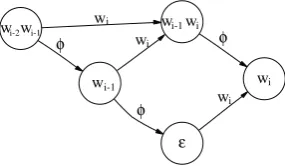
Figure 2:Representation of a trigram model with failure transitions. n-gram. Then, by definition,α0L ◦ Daccepts the same set of strings asL, but
wα0L◦D[π] = d
X
j=0
Φj(x, l[π])αj
andargmin
π∈L
Φ(x, l[π])·α¯ =BestPath(α0L ◦ D).
Thus decoding under our new model involves first pro-ducing a latticeLfrom the baseline recognizer; second, scaling Lwithα0and intersecting it with the discrimi-native language modelD; third, finding the best scoring path in the new WFA.
We now turn to training a model, or more explicitly, deriving a discriminative language model(D, α0)from a set of training examples. Given a training set(xi, ri)for i = 1. . . N, wherexi is an acoustic sequence, andriis a reference transcription, we can construct latticesLifor i = 1. . . N using the baseline recognizer. We can also derive target transcriptionsyi =MinErr(Li, ri). The training algorithm is then a mapping from (Li, yi) for i= 1. . . N to a pair(D, α0). Note that the construction of the language model requires two choices. The first concerns the choice of the set of n-gram featuresΦi for i = 1. . . d implemented by D. The second concerns the choice of parametersαifori= 0. . . dwhich assign weights to the n-gram features as well as the baseline featureΦ0.
Before describing methods for training a discrimina-tive language model using perceptron and CRF algo-rithms, we give a little more detail about the structure of D, focusing on how n-gram language models can be implemented with finite-state techniques.
3.3 Representation of n-gram language models
Note that in such a deterministic representation, the entire weight of all features associated with the word
wi following history hmust be assigned to the transi-tion labeled with wi leaving the statehin the automa-ton. For example, if h = wi−2wi−1, then the trigram wi−2wi−1wi is a feature, as is the bigramwi−1wi and the unigramwi. In this case, the weight on the transi-tionwi leaving statehmust be the sum of the trigram, bigram and unigram feature weights. If only the trigram feature weight were assigned to the transition, neither the unigram nor the bigram feature contribution would be in-cluded in the path weight. In order to ensure that the cor-rect weights are assigned to each string, every transition encoding an orderkn-gram must carry the sum of the weights for all n-gram features of orders≤k. To ensure that every string inΣ∗ receives the correct weight, for any n-gramhw represented explicitly in the automaton,
h0wmust also be represented explicitly in the automaton, even if its weight is 0.
3.4 The perceptron algorithm
The perceptron algorithm is incremental, meaning that the language modelD is built one training example at a time, during several passes over the training set. Ini-tially, we buildDto accept all strings inΣ∗with weight 0. For the perceptron experiments, we chose the param-eterα0to be a fixed constant, chosen by optimization on the held-out set. The loop in the algorithm in figure 1 is implemented as:
Fort= 1. . . T, i= 1. . . N:
•Calculatezi= argmaxy∈GEN(x)Φ(x, y)·α¯
=BestPath(α0Li◦ D)
• Ifzi 6= MinErr(Li, ri), then update the feature weights as in figure 1 (modulo the sign, because of the use of costs), and modifyDso as to assign the correct weight to all strings.
In addition, averaged parameters need to be stored (see section 2.2). These parameters will replace the un-averaged parameters inDonce training is completed.
Note that the only n-gram features to be included in
D at the end of the training process are those that oc-cur in either a best scoring pathzior a minimum error pathyiat some point during training. Thus the percep-tron algorithm is in effect doing feature selection as a by-product of training. GivenN training examples, and
Tpasses over the training set,O(N T)n-grams will have non-zero weight after training. Experiments in Roark et al. (2004) suggest that the perceptron reaches optimal performance after a small number of training iterations, for exampleT = 1orT = 2. ThusO(N T)can be very small compared to the full number of n-grams seen in all training lattices. In our experiments, the perceptron method chose around 1.4 million n-grams with non-zero weight. This compares to 43.65 million possible n-grams seen in the training data.
This is a key contrast with conditional random fields, which optimize the parameters of a fixed feature set. Fea-ture selection can be critical in our domain, as training and applying a discriminative language model over all
n-grams seen in the training data (in either correct or in-correct transcriptions) may be computationally very de-manding. One training scenario that we will consider will be using the output of the perceptron algorithm (the averaged parameters) to provide the feature set and the initial feature weights for use in the CRF algorithm. This leads to a model which is reasonably sparse, but has the benefit of CRF training, which as we will see gives gains in performance.
3.5 Conditional Random Fields
The CRF methods that we use assume a fixed definition of the n-gram features Φi for i = 1. . . din the model. In the experimental section we will describe a number of ways of defining the feature set. The optimization meth-ods we use begin at some initial setting forα¯, and then search for the parameters α¯∗ which maximize LLR( ¯α) as defined in Eq. 3.
The optimization method requires calculation of
LLR( ¯α)and the gradient ofLLR( ¯α)for a series of val-ues forα¯. The first step in calculating these quantities is to take the parameter valuesα¯, and to construct an ac-ceptorDwhich accepts all strings inΣ∗, such that
wD[π] =
d
X
j=1
Φj(x, l[π])αj
For each training latticeLi, we then construct a new lat-ticeL0i = Norm(α0Li◦ D). The latticeL0irepresents (in the log domain) the distributionpα¯(y|xi)over strings y ∈GEN(xi). The value oflogpα¯(yi|xi)for anyican be computed by simply taking the path weight ofπsuch thatl[π] =yi in the new latticeL0i. Hence computation ofLLR( ¯α)in Eq. 3 is straightforward.
Calculating the n-gram feature gradients for the CRF optimization is also relatively simple, onceL0
ihas been constructed. From the derivative in Eq. 4, for eachi = 1. . . N, j= 1. . . dthe quantity
Φj(xi, yi)−
X
y∈GEN(xi)
pα¯(y|xi)Φj(xi, y) (8)
must be computed. The first term is simply the num-ber of times thej’th n-gram feature is seen inyi. The second term is the expected number of times that the
j’th n-gram is seen in the acceptor L0
i. If the j’th n-gram is w1. . . wn, then this can be computed as
ExpCount(L0
i, w1. . . wn). The GRM library, which was presented in Allauzen et al. (2003), has a direct im-plementation of the functionExpCount, which simul-taneously calculates the expected value of all n-grams of order less than or equal to a givennin a latticeL.
The one non-ngram feature weight that is being esti-mated is the weightα0given to the baseline ASR nega-tive log probability. Calculation of the gradient ofLLR with respect to this parameter again requires calculation of the term in Eq. 8 for j = 0andi = 1. . . N. Com-putation ofP
y∈GEN(xi)pα¯(y|xi)Φ0(xi, y)turns out to
the sum of negative log probabilities of each transition in the path. We index each transition in the latticeLi, and store its negative log probability under the baseline model. We can then calculate the required gradient from
L0
i, by calculating the expected value inL0i of each in-dexed transition inLi.
We found that an approximation to the gradient of
α0, however, performed nearly identically to this exact gradient, while requiring substantially less computation. Letw1nbe a string ofnwords, labeling a path in word-latticeL0
i. For brevity, letPi(wn1) = pα¯(wn1|xi)be the conditional probability under the current model, and let Qi(w1n)be the probability ofw1nin the normalized base-line ASR latticeNorm(Li). LetLibe the set of strings in the language defined byLi. Then we wish to compute Eifori= 1. . . N, where
Ei =
X
wn
1∈Li
Pi(w1n) log Qi(w
n
1)
= X
wn
1∈Li X
k=1...n
Pi(wn1) log Qi(wk|wk1−1) (9)
The approximation is to make the following Markov assumption:
Ei ≈
X
wn
1∈Li X
k=1...n
Pi(wn1) log Qi(wk|wkk−−12)
= X
xyz∈Si
ExpCount(L0i, xyz) log Qi(z|xy)(10)
whereSiis the set of all trigrams seen inLi. The term
log Qi(z|xy)can be calculated once before training for every lattice in the training set; theExpCountterm is calculated as before using the GRM library. We have found this approximation to be effective in practice, and it was used for the trials reported below.
When the gradients and conditional likelihoods are collected from all of the utterances in the training set, the contributions from the regularizer are combined to give an overall gradient and objective function value. These values are provided to the parameter estimation routine, which then returns the parameters for use in the next it-eration. The accumulation of gradients for the feature set is the most time consuming part of the approach, but this is parallelizable, so that the computation can be divided among many processors.
4
Empirical Results
We present empirical results on the Rich Transcription 2002 evaluation test set (rt02), which we used as our de-velopment set, as well as on the Rich Transcription 2003 Spring evaluation CTS test set (rt03). The rt02 set con-sists of 6081 sentences (63804 words) and has three sub-sets: Switchboard 1, Switchboard 2, Switchboard Cel-lular. The rt03 set consists of 9050 sentences (76083 words) and has two subsets: Switchboard and Fisher.
We used the same training set as that used in Roark et al. (2004). The training set consists of 276726 tran-scribed utterances (3047805 words), with an additional 20854 utterances (249774 words) as held out data. For
0 500 1000
37 37.5 38 38.5 39 39.5 40
Iterations over training
Word error rate
[image:6.595.324.532.70.232.2]Baseline recognizer Perceptron, Feat=PL, Lattice Perceptron, Feat=PN, N=1000 CRF, σ = ∞, Feat=PL, Lattice CRF, σ = 0.5, Feat=PL, Lattice CRF, σ = 0.5, Feat=PN, N=1000
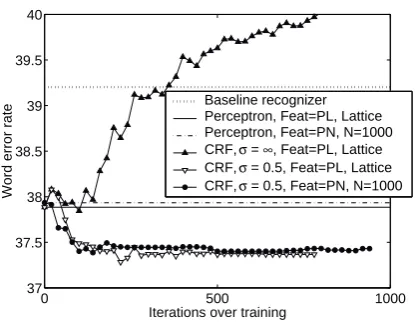
Figure 3: Word error rate on the rt02 eval set versus training iterations for CRF trials, contrasted with baseline recognizer performance and perceptron performance. Points are at every 20 iterations. Each point (x,y) is the WER at the iteration with the best objective function value in the interval (x-20,x].
each utterance, a weighted word-lattice was produced, representing alternative transcriptions, from the ASR system. From each word-lattice, the oracle best path was extracted, which gives the best word-error rate from among all of the hypotheses in the lattice. The oracle word-error rate for the training set lattices was 12.2%. We also performed trials with 1000-best lists for the same training set, rather than lattices. The oracle score for the 1000-best lists was 16.7%.
To produce the word-lattices, each training utterance was processed by the baseline ASR system. However, these same utterances are what the acoustic and language models are built from, which leads to better performance on the training utterances than can be expected when the ASR system processes unseen utterances. To somewhat control for this, the training set was partitioned into 28 sets, and baseline Katz backoff trigram models were built for each set by including only transcripts from the other 27 sets. Since language models are generally far more prone to overtrain than standard acoustic models, this goes a long way toward making the training conditions similar to testing conditions.
There are three baselines against which we are com-paring. The first is the ASR baseline, with no reweight-ing from a discriminatively trained n-gram model. The other two baselines are with perceptron-trained n-gram model re-weighting, and were reported in Roark et al. (2004). The first of these is for a pruned-lattice trained trigram model, which showed a reduction in word er-ror rate (WER) of 1.3%, from 39.2% to 37.9% on rt02. The second is for a 1000-best list trained trigram model, which performed only marginally worse than the lattice-trained perceptron, at 38.0% on rt02.
4.1 Perceptron feature set
0 500 1000 1500 2000 2500 37
37.5 38 38.5 39 39.5 40
Iterations over training
Word error rate
[image:7.595.81.290.69.230.2]Baseline recognizer Perceptron, Feat=PL, Lattice CRF, σ = 0.5, Feat=PL, Lattice CRF, σ = 0.5, Feat=E, θ=0.01 CRF, σ = 0.5, Feat=E, θ=0.9
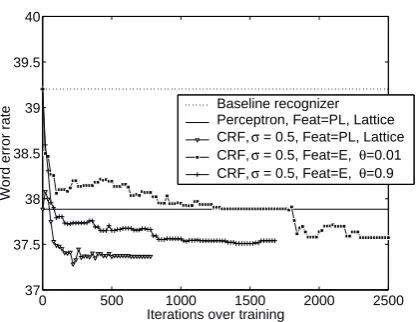
Figure 4: Word error rate on the rt02 eval set versus training iterations for CRF trials, contrasted with baseline recognizer performance and perceptron performance. Points are at every 20 iterations. Each point (x,y) is the WER at the iteration with the best objective function value in the interval (x-20,x].
the CRF algorithm. In the first two trials, the training set consists of the pruned lattices, and the feature set is from the perceptron algorithm trained on pruned lat-tices. There were 1.4 million features in this feature set. The first trial set the regularizer constantσ=∞, so that the algorithm was optimizing raw conditional likelihood. The second trial is with the regularizer constantσ= 0.5, which we found empirically to be a good parameteriza-tion on the held-out set. As can be seen from these re-sults, regularization is critical.
The third trial in this set uses the feature set from the perceptron algorithm trained on 1000-best lists, and uses CRF optimization on these on these same 1000-best lists. There were 0.9 million features in this feature set. For this trial, we also usedσ = 0.5. As with the percep-tron baselines, the n-best trial performs nearly identically with the pruned lattices, here also resulting in 37.4% WER. This may be useful for techniques that would be more expensive to extend to lattices versus n-best lists (e.g. models with unbounded dependencies).
These trials demonstrate that the CRF algorithm can do a better job of estimating feature weights than the per-ceptron algorithm for the same feature set. As mentioned in the earlier section, feature selection is a by-product of the perceptron algorithm, but the CRF algorithm is given a set of features. The next two trials looked at selecting feature sets other than those provided by the perceptron algorithm.
4.2 Other feature sets
In order for the feature weights to be non-zero in this ap-proach, they must be observed in the training set. The number of unigram, bigram and trigram features with non-zero observations in the training set lattices is 43.65 million, or roughly 30 times the size of the perceptron feature set. Many of these features occur only rarely with very low conditional probabilities, and hence cannot meaningfully impact system performance. We pruned this feature set to include all unigrams and bigrams, but only those trigrams with an expected count of greater than 0.01 in the training set. That is, to be included, a
Trial Iter rt02 rt03
ASR Baseline - 39.2 38.2
Perceptron, Lattice - 37.9 36.9 Perceptron, N-best - 38.0 37.2 CRF, Lattice, Percep Feats (1.4M) 769 37.4 36.5 CRF, N-best, Percep Feats (0.9M) 946 37.4 36.6 CRF, Lattice,θ= 0.01(12M) 2714 37.6 36.5 CRF, Lattice,θ= 0.9(1.5M) 1679 37.5 36.6
Table 1: Word-error rate results at convergence iteration for various trials, on both Switchboard 2002 test set (rt02), which was used as the dev set, and Switchboard 2003 test set (rt03).
trigram must occur in a set of paths, the sum of the con-ditional probabilities of which must be greater than our thresholdθ = 0.01. This threshold resulted in a feature set of roughly 12 million features, nearly 10 times the size of the perceptron feature set. For better comparabil-ity with that feature set, we set our thresholds higher, so that trigrams were pruned if their expected count fell be-lowθ= 0.9, and bigrams were pruned if their expected count fell belowθ = 0.1. We were concerned that this may leave out some of the features on the oracle paths, so we added back in all bigram and trigram features that oc-curred on oracle paths, giving a feature set of 1.5 million features, roughly the same size as the perceptron feature set.
Figure 4 shows the results for three CRF trials versus our ASR baseline and the perceptron algorithm baseline trained on lattices. First, the result using the perceptron feature set provides us with a WER of 37.4%, as pre-viously shown. The WER at convergence for the big feature set (12 million features) is 37.6%; the WER at convergence for the smaller feature set (1.5 million fea-tures) is 37.5%. While both of these other feature sets converge to performance close to that using the percep-tron features, the number of iterations over the training data that are required to reach that level of performance are many more than for the perceptron-initialized feature set.
Table 1 shows the word-error rate at the convergence iteration for the various trials, on both rt02 and rt03. All of the CRF trials are significantly better than the percep-tron performance, using the Matched Pair Sentence Seg-ment test for WER included with SCTK (NIST, 2000). On rt02, the N-best and perceptron initialized CRF trials were were significantly better than the lattice perceptron atp <0.001; the other two CRF trials were significantly better than the lattice perceptron atp < 0.01. On rt03, the N-best CRF trial was significantly better than the lat-tice perceptron at p < 0.002; the other three CRF tri-als were significantly better than the lattice perceptron at
p <0.001.
[image:7.595.316.538.70.160.2]CRF Features Percep approx exact Lattice, Percep Feats (1.4M) 7.10 1.69 3.61 N-best, Percep Feats (0.9M) 3.40 0.96 1.40 Lattice,θ= 0.01(12M) - 2.24 4.75
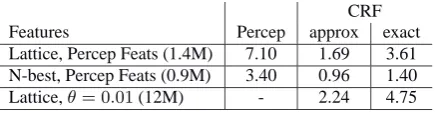
Table 2: Time (in hours) for one iteration on a single Intel Xeon 2.4Ghz processor with 4GB RAM.
iteration can be shared among multiple processors. Our most common training setup for the CRF algorithm was parallelized between 20 processors, using the approxi-mation to the gradient. In that setup, using the 1.4M fea-ture set, one iteration of the perceptron algorithm took the same amount of real time as approximately 80 itera-tions of CRF.
5
Conclusion
We have contrasted two approaches to discriminative language model estimation on a difficult large vocabu-lary task, showing that they can indeed scale effectively to handle this size of a problem. Both algorithms have their benefits. The perceptron algorithm selects a rela-tively small subset of the total feature set, and requires just a couple of passes over the training data. The CRF algorithm does a better job of parameter estimation for the same feature set, and is parallelizable, so that each pass over the training set can require just a fraction of the real time of the perceptron algorithm.
The best scenario from among those that we investi-gated was a combination of both approaches, with the output of the perceptron algorithm taken as the starting point for CRF estimation.
As a final point, note that the methods we describe do not replace an existing language model, but rather com-plement it. The existing language model has the benefit that it can be trained on a large amount of text that does not have speech transcriptions. It has the disadvantage of not being a discriminative model. The new language model is trained on the speech transcriptions, meaning that it has less training data, but that it has the advan-tage of discriminative training – and in particular, the ad-vantage of being able to learn negative evidence in the form of negative weights on n-grams which are rarely or never seen in natural language text (e.g., “the of”), but are produced too frequently by the recognizer. The methods we describe combines the two language models, allowing them to complement each other.
References
Cyril Allauzen, Mehryar Mohri, and Brian Roark. 2003. Generalized algorithms for constructing language models. In Proceedings of the
41st Annual Meeting of the Association for Computational Linguis-tics, pages 40–47.
Satish Balay, William D. Gropp, Lois Curfman McInnes, and Barry F. Smith. 2002. Petsc users manual. Technical Report ANL-95/11-Revision 2.1.2, Argonne National Laboratory.
Satanjeev Banerjee, Jack Mostow, Joseph Beck, and Wilson Tam. 2003. Improving language models by learning from speech recog-nition errors in a reading tutor that listens. In Proceedings of the
Second International Conference on Applied Artificial Intelligence,
Fort Panhala, Kolhapur, India.
Steven J. Benson and Jorge J. Mor´e. 2002. A limited memory vari-able metric method for bound constrained minimization. Preprint ANL/ACSP909-0901, Argonne National Laboratory.
Steven J. Benson, Lois Curfman McInnes, Jorge J. Mor´e, and Jason Sarich. 2002. Tao users manual. Technical Report ANL/MCS-TM-242-Revision 1.4, Argonne National Laboratory.
Zheng Chen, Kai-Fu Lee, and Ming Jing Li. 2000. Discriminative training on language model. In Proceedings of the Sixth
Interna-tional Conference on Spoken Language Processing (ICSLP),
Bei-jing, China.
Michael Collins. 2002. Discriminative training methods for hidden markov models: Theory and experiments with perceptron algo-rithms. In Proceedings of the Conference on Empirical Methods
in Natural Language Processing (EMNLP), pages 1–8.
Michael Collins. 2004. Parameter estimation for statistical parsing models: Theory and practice of distribution-free methods. In Harry Bunt, John Carroll, and Giorgio Satta, editors, New Developments
in Parsing Technology. Kluwer.
Yoav Freund and Robert Schapire. 1999. Large margin classification using the perceptron algorithm. Machine Learning, 3(37):277–296. Frederick Jelinek. 1995. Acoustic sensitive language modeling. Tech-nical report, Center for Language and Speech Processing, Johns Hopkins University, Baltimore, MD.
Mark Johnson, Stuart Geman, Steven Canon, Zhiyi Chi, and Stefan Riezler. 1999. Estimators for stochastic “unification-based” gram-mars. In Proceedings of the 37th Annual Meeting of the Association
for Computational Linguistics, pages 535–541.
Sanjeev Khudanpur and Jun Wu. 2000. Maximum entropy techniques for exploiting syntactic, semantic and collocational dependencies in language modeling. Computer Speech and Language, 14(4):355– 372.
Hong-Kwang Jeff Kuo, Eric Fosler-Lussier, Hui Jiang, and Chin-Hui Lee. 2002. Discriminative training of language models for speech recognition. In Proceedings of the International Conference
on Acoustics, Speech, and Signal Processing (ICASSP), Orlando,
Florida.
John Lafferty, Andrew McCallum, and Fernando Pereira. 2001. Con-ditional random fields: Probabilistic models for segmenting and labeling sequence data. In Proc. ICML, pages 282–289, Williams College, Williamstown, MA, USA.
Robert Malouf. 2002. A comparison of algorithms for maximum en-tropy parameter estimation. In Proc. CoNLL, pages 49–55. Andrew McCallum and Wei Li. 2003. Early results for named entity
recognition with conditional random fields, feature induction and web-enhanced lexicons. In Proc. CoNLL.
Mehryar Mohri, Fernando C. N. Pereira, and Michael Riley. 2002. Weighted finite-state transducers in speech recognition. Computer
Speech and Language, 16(1):69–88.
NIST. 2000. Speech recognition scoring toolkit (sctk) version 1.2c. Available athttp://www.nist.gov/speech/tools. David Pinto, Andrew McCallum, Xing Wei, and W. Bruce Croft. 2003.
Table extraction using conditional random fields. In Proc. ACM
SI-GIR.
Adwait Ratnaparkhi, Salim Roukos, and R. Todd Ward. 1994. A max-imum entropy model for parsing. In Proceedings of the
Interna-tional Conference on Spoken Language Processing (ICSLP), pages
803–806.
Brian Roark, Murat Saraclar, and Michael Collins. 2004. Corrective language modeling for large vocabularyASRwith the perceptron al-gorithm. In Proceedings of the International Conference on
Acous-tics, Speech, and Signal Processing (ICASSP), pages 749–752.
Fei Sha and Fernando Pereira. 2003. Shallow parsing with conditional random fields. In Proc. HLT-NAACL, Edmonton, Canada. A. Stolcke and M. Weintraub. 1998. Discriminitive language
model-ing. In Proceedings of the 9th Hub-5 Conversational Speech
Recog-nition Workshop.
A. Stolcke, H. Bratt, J. Butzberger, H. Franco, V. R. Rao Gadde, M. Plauche, C. Richey, E. Shriberg, K. Sonmez, F. Weng, and J. Zheng. 2000. The SRI March 2000 Hub-5 conversational speech transcription system. In Proceedings of the NIST Speech
Transcrip-tion Workshop.
Hanna Wallach. 2002. Efficient training of conditional random fields. Master’s thesis, University of Edinburgh.