Munich Personal RePEc Archive
Application of Bat Evolutionary
Algorithm in Optimization of Economic
Dispatch for Unit-Commitment Problem
with Large Uncertainties and High
Efficiency
Weng, Shou and Chen, Lee and Odendaal, Kong
Zhejiang University (National Che Kiang University), China
13 July 2016
Online at
https://mpra.ub.uni-muenchen.de/72528/
Application of Bat Evolutionary Algorithm in Optimization of
Economic Dispatch for Unit-Commitment Problem with Large
Uncertainties and High Efficiency
Shou Weng, Lee Chen, Kong Odendaal
Zhejiang University (National Che Kiang University), China
AbstractIn the recent years, unit commitment (UC) has been increasingly directed towards improving the quality of power to satisfy the customers’ demand at a minimum cost. As a result, minimizing the cost function of the unit commitment problem has become a challenge for many research studies while assuring the power availability in distribution systems. In this paper, the new Bat Algorithm (BA) as an evolutionary algorithm is proposed to minimize the unit commitment cost function and to decrease the fluctuation of power in the distribution system. The cost function employs constraints including spinning reserve and generator ramp rate in addition to commonly used load balance, power limits, etc. Simulation studies on a 10-unit distribution system shows significant improvement in the convergence speed and minimum calculated cost when compared to the available methods.
Keywords Power System Operation, Unit Commitment, Optimization, Economic Dispatch, Smart Grids
NOMENCLATURE
𝑁 Number of Units.
𝑇 Scheduling horizon time
𝑇𝐶 Total Cost
𝐹𝐶 Fuel cost
𝑆𝑈𝑖 Start-up cost of the 𝑖𝑡ℎ unit
𝐷𝑡 Load demand at time 𝑡
𝑆𝑃𝑡 Spinning reserve at time t
𝑈𝑖𝑡 Operation status of 𝑖𝑡ℎ unit at time 𝑡. When the unit is off it is equal to 0 and when unit is on it is equal to 1.
𝑅𝑈𝑖 Ramp-Up rate for the 𝑖𝑡ℎ unit
𝑅𝐷𝑖 Ramp-Down rate for the 𝑖𝑡ℎ unit
𝑇𝑖ℎ𝑜𝑡 Hot start cost of unit 𝑖
𝑇𝑖𝐶𝑜𝑙𝑑 Cold start cost of unit 𝑖
𝑃𝑖𝑡 The output power of 𝑖𝑡ℎ unit at time 𝑡
𝑃𝑖 𝑚𝑎𝑥 The maximum output power of the 𝑖𝑡ℎ unit
𝑃𝑖 𝑚𝑖𝑛 The minimum output power of the 𝑖𝑡ℎ unit
𝑃𝑖 𝑚𝑎𝑥𝑡 The maximum output power of the 𝑖𝑡ℎ unit at time 𝑡
𝑃𝑖 𝑚𝑖𝑛𝑡 The minimum output power of the 𝑖𝑡ℎ unit at time 𝑡
1. INTRODUCTION
commitment problems which is considered and satisfied in this paper such as ramp rates and spinning reserve. In many cases, usually, these two constraints are neglected to solve the problem easily. However, in this paper, these constraints are applied and the optimal cost function is calculated.
Solving unit commitment problems needed to solve two sub problems at the same time. First, take a decision to determine which units should be on or off during the schedule time according to the load demand. Second, the economic dispatch problem should be satisfied among the generation units with varying load demands which is quadratic programming problem.
In the recent years, many research papers with different methods tried to solve unit commitment problems such as dynamic programming (DP) [1], [2], genetic algorithm (GA) [3-8] and particle swarm optimization (PSO) [9-14]. However, these methods are associated with some problems. For instance, genetic algorithms needed a long time to solve unit commitment problems and there is no guarantee to find an optimal solution. Also, dynamic programming need more mathematical complexity and time. DP is a good method for less units while by increasing the number of units and taken more constraints system needed more time to solve the UC problems and in high level cases will goes to fault. Furthermore, particle swarm optimization needed more time to solve the unit commitment problems. In this paper, bat evolutionary algorithms which is proposed in [15-18] is applied to solve unit commitment problems with 10 units and one day scheduling time (24 hours). The results proved the high performance of the proposed method compared to other evolutionary algorithms.
Section two will explain about the mathematical model of the unit commitment. Constrain of the unit commitment has been reviewed in section three. Bat algorithm is explained in section four. Section five is about the case study and results of the paper. Finally section six is the conclusion.
2. Mathematical Model of Unit Commitmentj
The main goal and objective of this paper is try to minimize the cost function of the unit commitment. The cost function of the unit commitment is the combination of fuel and start-up/ shut down cost. As a result, the total cost of the unit commitment are:
𝑇𝐶(𝑋) = ∑𝑁𝑡=1∑𝑗𝑖=1𝐹𝐶𝑖𝑡+ 𝑆𝑈𝑖𝑡 (1)
Where N is the number of the units which is 10 in this paper, TC is the total cost, FC is the fuel cost and SU is the start-up cost of the 𝑖𝑡ℎ unit at time 𝑡.
The fuel cost of is a quadratic function as below:
𝐹𝐶
𝑖𝑡= 𝑈
𝑖𝑡(𝑎 𝑓
𝑖+ 𝑏 𝑓
𝑖𝑃
𝑖𝑡+ 𝑐 𝑓
𝑖(𝑃
𝑖𝑡)
2)
(2)
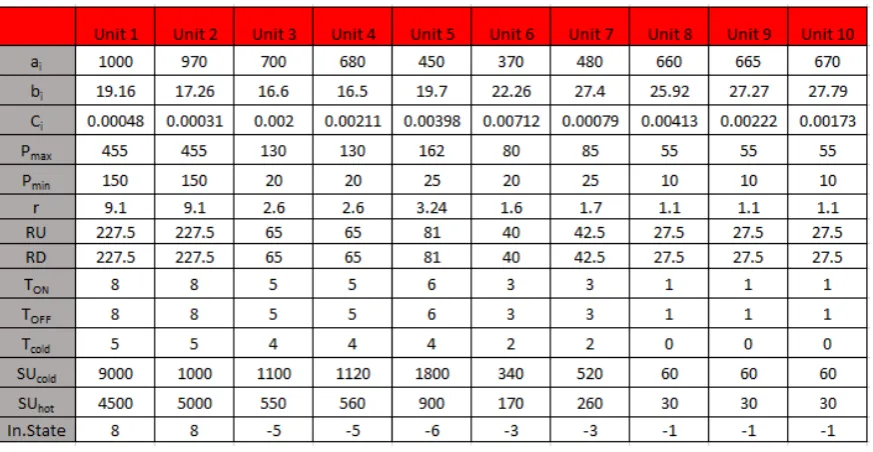
Where 𝑎, 𝑏, 𝑐 are the coefficients of the fuel cost. Table 1 shown the assumption of the unit of the UC. On the other hand, the start-up/ shut down cost is defined in equation (3):
𝑆𝑡𝑖𝑡= ∑ 𝑈𝑖𝑘 . 𝑆𝑈𝑖𝑡= 𝑓(𝑥) = {𝑆𝑈𝑖 ℎ𝑜𝑡 . 𝑈
𝑖𝑡 . (1 − 𝑈𝑖𝑡−1), 𝑖𝑓 𝑆𝑡𝑖𝑡> 0
𝑆𝑈𝑖ℎ𝑜𝑡 . 𝑈𝑖𝑡 , 𝑖𝑓 𝑆𝑡𝑖𝑡= 0 𝑡−1
𝑘=𝑡−𝑇𝑖𝑂𝐹𝐹−𝑇𝑖𝐶𝑜𝑙𝑑 (3)
Table 1: Assumption of the Unit Commitment problem
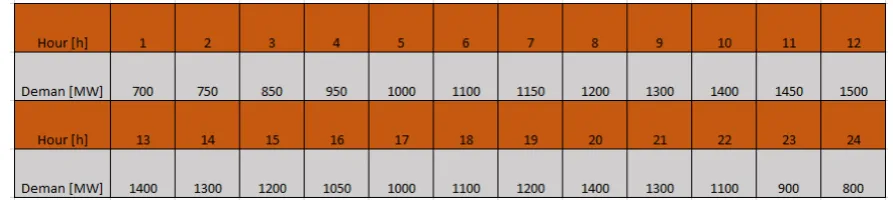
Also, the horizon schedule time for this paper is a day scheduling time (24 hours). As a result, load demand for 24 hours has been shown in table 2 and figure 1.
Figure 1: Load demand for one day scheduling time
[image:4.595.151.458.400.589.2]Table 2: Load demmand for 24 hours
3. Constraints on Unit Commitment Problem
Solving the unit commitment problem needed to consider two different sub problems at the same time. First, take a decision to find out which units should be on or off during the operation time and second the economic dispatch between the units in order to satisfy the load demand. Based on these sub problems, some constrain will be risen as below [16-25]:
3.1 Constraint on load balancing
One of the most important constraint on unit commitment problems is loading balancing. Indeed, the generation power should be equal to the load demand because it is impossible to storage the power energy and electricity for the further uses. As a result, the generation power should at least equal to the load demand. The calculation on the load balancing for unit commitment problems has been defined by following. This limitation can be taken into account by the equation (4):
∑
𝑛𝑖=1𝑃
𝑖𝑡. 𝑈
𝑖𝑡= 𝐷
𝑡(4)
Where 𝑃 is the power of the 𝑖𝑡ℎ unit at time 𝑡 and 𝑈 is the number which could be 0 (means the 𝑖𝑡ℎ unit is turn off) or 1 (means the 𝑖𝑡ℎ unit is turn on). As a result, the load demand at the time 𝑡 should be equal to 𝐷 which is determined by the load prediction (table 2). It means, the power generation in every interval hour should be at least equal to the energy demand at that time.
3.2. Constraints on power generations
In the unit commitment, every unit is designed based on a specific characteristic. As the result, every unit has some limitation in power generation. This limitation can be taken into account by the following equation:
𝑃𝑖,𝑚𝑖𝑛≤ 𝑃𝑖𝑡 ≤ 𝑃𝑖,𝑚𝑎𝑥 (5)
Where 𝑃 is the power of the 𝑖𝑡ℎ unit, 𝑃𝑖,𝑚𝑖𝑛is the minimum power which is affordable to produce by 𝑖𝑡ℎ unit and 𝑃𝑖,𝑚𝑎𝑥 is the maximum power which can generate by 𝑖𝑡ℎ unit based on its designed.
3.3. Constraints on power generations
Any changes in power generation of every unit have some constraint and limitations. In fact, every unit could not be able to increase or decrease its power generation rapidly. Changing the power needs time and in many cases it is not affordable and it’s depended on the unit design. This limitation can be taken into account by the following equation:
Where 𝑅𝐷𝑖and 𝑅𝑈𝑖 are hourly rate reduction and increase for ith unit respectively.
3.4. Constraints on Spinning Researve
Sometimes the prediction for load demand is not correct because of unknown condition and situation. As a result, the load demand will increase or decrease rapidly and satisfy the load demand is difficult without any reservation. Moreover, the storage of the electricity is impossible. As a result, a spinning reserve should be consider for the worse case situation. This limitation can be taken into account by the following equation:
𝑆𝑅𝑈𝑃𝑡 = ∑𝑁𝑖=1𝑚𝑖𝑛(𝑃𝑖,𝑚𝑎𝑥− 𝑃𝑖𝑡 , 𝑀𝑟𝑖). 𝑈𝑖𝑡 (6)
𝑆𝑅𝑑𝑛𝑡 = ∑𝑁𝑖=1𝑚𝑖𝑛( 𝑃𝑖𝑡− 𝑃𝑖,𝑚𝑖𝑛− , 𝑀𝑟𝑖). 𝑈𝑖𝑡 (7)
Where 𝑺𝑹𝑼𝑷𝒕 represents the increase of the spinning reserve and 𝑆𝑅𝑑𝑛𝑡 represent represents the decrease of the spinning reserve and 𝑀𝑟𝑖 is the ramp rate coeeficient which is explained in the next section.
3.5. Ramp Rate
The ramping-up and -down limits of unit 𝑖 while changing its power generation from time intervals (𝑡− 1) to 𝑡 need to be taken into account in the UC problem. This leads to the following constraint:
𝑝𝑖𝑡− 𝑝𝑖(𝑡−1)≤ 𝑅𝑈𝑖+ 𝑀(2 − 𝐼𝑖(𝑡−1)− 𝐼𝑖𝑡) (8)
𝑝𝑖(𝑡−1)− 𝑝𝑖𝑡≤ 𝑅𝐷𝑖+ 𝑀(2 − 𝐼𝑖(𝑡−1)− 𝐼𝑖𝑡) (9)
Where 𝑅𝑈𝑖 and 𝑅𝐷𝑖 are maximum ramp-up and -down rate of unit 𝑖 in MW/hour, and 𝑀 is a sufficiently large value.
3.6. Constraints on minimum and maximum ON or OFF time
Every unit has a limitation in the number of turn off and on in a day. For instance, consider a wind generation as a one unit. It is obviously clear that turn on the wind generation require some conditions such as weather in the system. As a result, it is impossible to turn off or on the wind generation every time a day. On the other hand, consider a fossil generation as a unit. It is not acceptable to turn on and off frequently a day because of the high cost. As a result, in this research paper, every unit can turn on or off just 5 times in a day.
4. Bat Algorithm
Bat algorithm is an evolutionary algorithm which has been developed in 2010 [23].This algorithm is based on the following:
All the bats use echolocation to find out their distance with foods and Obstacles
Every bat uses a random position (𝑥𝑖), with the velocity of 𝑉𝑖 with a varying frequency of the 𝑓𝑖 The frequency is same for all of the population [𝑓min , 𝑓𝑚𝑎𝑥], which is related to the wavelength
[λmin , λ𝑚𝑎𝑥].
The code of this algorithm is defined based on above assumptions. The process of the bat evolutionary algorithm is explained by following:
1: Generate the initial population
2: Evaluate the fitness function for each individual 3: while the termination criterion is not satisfied do 4: for i =1 to 𝑁𝑏𝑎𝑡 do
6: according to the following equations. 7. 𝛽(𝑟𝑖𝑗) = 𝛽𝑚𝑎𝑥exp(−𝛾𝑟𝑖𝑗2 )
8. 𝑋𝑖𝑘= 𝑋𝑖𝑘−1+ 𝑉𝑖𝑘
9. 𝑓𝑖= 𝑓𝑖𝑚𝑖𝑛+ 𝑟𝑎𝑛𝑑(. )( 𝑓𝑖𝑚𝑎𝑥− 𝑓𝑖𝑚𝑖𝑛)
10: Generate a new solution for each bat locally using random walk: 11: if 𝑟𝑎𝑛𝑑(. ) > 𝑟𝑖𝑘 then
12: Generate a local solution around the 𝑃𝑏𝑒𝑠𝑡𝑖𝑘 as follows 13: 𝑓𝑖= 𝑓𝑖𝑚𝑖𝑛+ 𝑟𝑎𝑛𝑑(. )( 𝑓𝑖𝑚𝑎𝑥− 𝑓𝑖𝑚𝑖𝑛)
14: else
15: Generate a local solution around the randomly 16: selected solution m≠i as follows
17: 𝑋𝑖,𝑛𝑒𝑤𝑘 = 𝑋𝑖𝑘+ 𝜀 𝐴𝑚𝑒𝑎𝑛𝑘 (𝑋𝑚𝑘 − 𝑋𝑖𝑘) 18: end if
19: if (𝑟𝑎𝑛𝑑(. ) < 𝐴𝑘𝑖) and 𝑓(𝑋𝑖,𝑛𝑒𝑤𝑘 ) < 𝑓( 𝑋𝑖𝑘) then 20: 𝑋𝑖𝑘 = 𝑋𝑖,𝑛𝑒𝑤𝑘
21: Increase 𝑟𝑖𝑘 and decrease 𝐴𝑖𝑘 as follows: 22: 𝑋𝑖,𝑛𝑒𝑤𝑘 = 𝑋𝑖𝑘+ 𝜀 𝐴𝑚𝑒𝑎𝑛𝑘 (𝑋𝑚𝑘 − 𝑋𝑖𝑘) 23: end if
24: end for 25: end while
It should be mention that 𝑃𝑏𝑒𝑠𝑡𝑖𝑘 is the best position of the bat in the 𝑘𝑡ℎ iteration, 𝑓𝑖𝑚𝑎𝑥, 𝑓𝑖𝑚𝑖𝑛 are the maximum and minimum frequency which can be determine by th ith bat and 𝜀 is the random variable between -1 and 1. 𝛽 𝑎𝑛𝑑 𝛾 are constants which has been considered as 0.9.
5. Case Study and Results
In this paper, Bat evolutionary algorithm is applied for 10 unit-commitment problem with all of its constraints for 24 hours (a day) scheduling time. The main objective of this paper is minimize the cost function and find a global cost. Then, the result of the proposed method is compared with other evolutionary algorithm. Moreover, the speed performance of the proposed method is compared with other methods too. The result, will proved the high performance and best minimum cost of the proposed method which back to its less mathematical calculation and flexibility of the optimization methods.
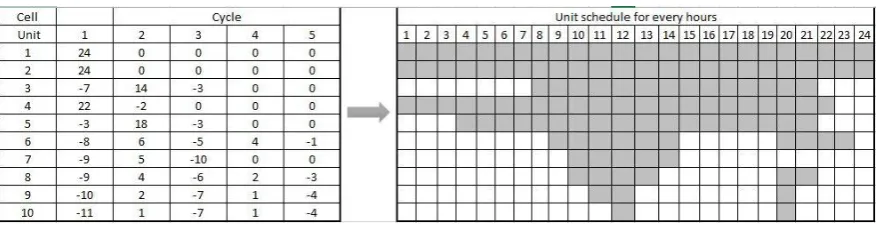
Table 3: Operation time for every unit
[image:8.595.165.458.305.495.2]Figure 2 will show the decrease of the cost function when the Bat evolutionary algorithm is applied to the UC problem. According to the figure, in the first iteration, the total cost function is very high, but during the time and with more iteration, the cost is decreased. The final cost is the global and optimal cost by proposed method which is compared by other research studies in the same situation and environments.
Figure 2: Decrease the cost by increase the iteration
Table 4: Comprasion between methods
6. Conclusion
In this paper, Bat algorithm (BA) as a new method of optimization has been proposed for
unit commitment problem. This method is compared with other optimizations methods such
as GA, PSO and DP. In many cases, especially when the number of unit are two or three, the
performance of DP and GA is better than BA. But in complicated cases, the performance of
the BA is more acceptable than other methods because of less calculation and forward
method. BA is a new algorithm with a reasonable computation effort and fluent concept. As
the future work, the BA algorithm can also be employed to solve other complex linear and
nonlinear optimization problems in the electric power systems.
REFERENCES
[1] C. K. Pang, G. B. Sheble, and F. Albuyeh, “Evaluation of dynamic programming based methods and multiple area representation for thermal unit commitment,” IEEE Trans. Power App. Syst., vol. PAS-100, pp.
[2] W. . L. Snyder, Jr., H. D. Powell, Jr., and J. C. Rayburn, “Dynamic programming approach to unit commitment,” IEEE Trans. Power yst., vol. 2, no. 2, pp. 339–347, May 1987.
[3] S. A. Kazarlis, A. G. Bakirtzis, and V. Petridis, “A genetic algorithm solution to the unit commitment problem,” IEEE Trans. Power Syst, vol. 11, no. 1, pp. 83–92, Feb. 1996.
[4] A. Rudolf and R. Bayrleithner, “A genetic algorithm for solving the unit commitment problem of a hydro-thermal power systems,”
IEEE Trans. Power Syst., vol. 14, no. 4, pp. 1460–1468, Nov. 1999.
[5] H. Yang, P. Yang, and C. Huang, “A parallel genetic algorithm aproach to solving the unit commitment problem: Implementation on the transputer networks,” IEEE Trans. Power Syst., vol. 12, no. 2, pp. 661–668, May 1997.
[6] K. S. Swarup and S. Yamashiro, “Unit commitment solution methodology using genetic algorithm,” IEEE Trans. Power Syst., vol. 17, no. 1, pp. 87–91, Feb. 2002.
[7] J. M. Arroyo and A. J. Conejo, “A parallel repair genetic algorithm to solve the unit commitment problem,” IEEE Trans. Power Syst., vol. 17, no. 4, pp. 1216–1224, Nov. 2002.
[8] I. G. Damousis, A. G. Bakirtzis, and P. S. Dokopoulos, “A solution to the unit commitment problem using integer-coded genetic algorithm,” IEEE Trans. Power Syst., vol. 19, no. 2, pp. 1165–1172, May 2004.
[9] W. Xiong, M. J. Li, and Y. Cheng, “An improved particle swarm optimization algorithm for unit commitment,” in Proc. ICICTA 2008.
[10] V. S. Pappala and I. Erlich, “A new approach for solving the unit commitment problem by adaptive particle swarm optimization,” in
Proc. IEEE Power and Energy Soc. General Meeting, Jul. 2008, pp. 1–6.
[11] P. Bajpai and S. N. Singh, “Fuzzy adaptive particle swarm optimization for bidding strategy in uniform price spot market,” IEEE Trans. Power Syst., vol. 22, no. 4, pp. 2152–2160, Nov. 2007.
[12] A. Y. Saber, T. Senjyu, N. Urasaki, and T. Funabashi, “Unit commitment computation—A novel fuzzy adaptive particle swarm optimization approach,” in Proc. IEEE PSCE, Nov. 2006, pp. 1820–1828.
[13] Z. L. Gaing, “Discrete particle swarm optimization algorithm for unit commitment,” in Proc. IEEE Power Eng. Soc. General Meeting, Jul. 2003, vol. 1, pp. 13–17.
[14] Ashkaboosi, Maryam, Seyed Mehdi Nourani, Peyman Khazaei, Morteza Dabbaghjamanesh, and Amirhossein Moeini. "An Optimization Technique Based on Profit of Investment and Market Clearing in Wind Power Systems."American Journal of Electrical and Electronic Engineering 4, no. 3 (2016): 85-91.
[15] Rakhshan, Mohsen, Navid Vafamand, Mokhtar Shasadeghi, Morteza Dabbaghjamanesh, and Amirhossein Moeini. "Design of networked polynomial control systems with random delays: sum of squares approach."International Journal of Automation and Control 10, no. 1 (2016): 73-86.
[16] T. O. Ting, M. V. C. Rao, and C. K. Loo, “A novel approach for unit commitment problem via an effective hybrid particle swarm
[17] X.-S. Yang, A New Metaheuristic Bat-Inspired Algorithm, in: Nature Inspired Cooperative Strategies for Optimization (NISCO 2010) (Eds. J. R. Gonzalez et al.), Studies in Computational Intelligence, Springer Berlin, 284, Springer, 65-74 (2010).