Automatic Detection of Machine Translated Text and Translation Quality
Estimation
Roee Aharoni Dept. of Computer Science
Bar Ilan University Ramat-Gan, Israel 52900 [email protected]
Moshe Koppel Dept. of Computer Science
Bar Ilan University Ramat-Gan, Israel 52900
Yoav Goldberg Dept. of Computer Science
Bar Ilan University Ramat-Gan, Israel 52900 [email protected]
Abstract
We show that it is possible to automati-cally detect machine translated text at sen-tence level from monolingual corpora, us-ing text classification methods. We show further that the accuracy with which a learned classifier can detect text as ma-chine translated is strongly correlated with the translation quality of the machine translation system that generated it. Fi-nally, we offer a generic machine transla-tion quality estimatransla-tion technique based on this approach, which does not require ref-erence sentences.
1 Introduction
The recent success and proliferation of statistical machine translation (MT) systems raise a number of important questions. Prominent among these are how to evaluate the quality of such a system efficiently and how to detect the output of such systems (for example, to avoid using it circularly as input for refining MT systems).
In this paper, we will answer both these ques-tions. First, we will show that using style-related linguistic features, such as frequencies of parts-of-speech n-grams and function words, it is pos-sible to learn classifiers that distinguish machine-translated text from human-machine-translated or native English text. While this is a straightforward and not entirely novel result, our main contribution is to relativize the result. We will see that the suc-cess of such classifiers are strongly correlated with the quality of the underlying machine translation system. Specifically, given a corpus consisting of both machine-translated English text (English be-ing the target language) and native English text (not necessarily the reference translation of the machine-translated text), we measure the accuracy of the system in classifying the sentences in the
corpus as machine-translated or not. This accu-racy will be shown to decrease as the quality of the underlying MT system increases. In fact, the correlation is strong enough that we propose that this accuracy measure itself can be used as a mea-sure of MT system quality, obviating the need for a reference corpus, as for example is necessary for BLEU (Papineni et al., 2001).
The paper is structured as follows: In the next section, we review previous related work. In the third section, we describe experiments regarding the detection of machine translation and in the fourth section we discuss the use of detection tech-niques as a machine translation quality estimation method. In the final section we offer conclusions and suggestions for future work.
2 Previous Work
2.1 Translationese
The special features of translated texts have been studied widely for many years. Attempts to de-fine their characteristics, often called ”Translation Universals”, include (Toury, 1980; Blum-Kulka and Levenston, 1983; Baker, 1993; Gellerstam, 1986). The differences between native and trans-lated texts found there go well beyond systematic translation errors and point to a distinct ”Transla-tionese” dialect.
Using automatic text classification methods in the field of translation studies had many use cases in recent years, mainly as an empirical method of measuring, proving or contradicting translation universals. Several works (Baroni and Bernar-dini, 2006; Kurokawa et al., 2009; Ilisei et al., 2010) used text classification techniques in order to distinguish human translated text from native language text at document or paragraph level, us-ing features like word and POS n-grams, propor-tion of grammatical words in the text, nouns, fi-nite verbs, auxiliary verbs, adjectives, adverbs,
merals, pronouns, prepositions, determiners, con-junctions etc. Koppel and Ordan (2011) classi-fied texts to original or translated, using a list of 300 function words taken from LIWC (Pen-nebaker et al., 2001) as features. Volanski et al. (2013) also tested various hypotheses regarding ”Translationese”, using 32 different linguistically-informed features, to assess the degree to which different sets of features can distinguish between translated and original texts.
2.2 Machine Translation Detection
Regarding the detection of machine translated text, Carter and Inkpen (2012) translated the Hansards of the 36th Parliament of Canada us-ing the Microsoft Bus-ing MT web service, and conducted three detection experiments at docu-ment level, using unigrams, average token length, and type-token ratio as features. Arase and Zhou (2013) trained a sentence-level classifier to distinguish machine translated text from human generated text on English and Japanese web-page corpora, translated by Google Translate, Bing and an in-house SMT system. They achieved very high detection accuracy using application-specific fea-ture sets for this purpose, including indicators of the ”Phrase Salad” (Lopez, 2008) phenomenon or ”Gappy-Phrases” (Bansal et al., 2011).
While Arase and Zhou (2013) considered MT detection at sentence level, as we do in this pa-per, they did not study the correlation between the translation quality of the machine translated text and the ability to detect it. We show below that such detection is possible with very high accuracy only on low-quality translations. We examine this detection accuracy vs. quality correlation, with various MT systems, such as rule-based and sta-tistical MT, both commercial and in-house, using various feature sets.
3 Detection Experiments
3.1 Features
We wish to distinguish machine translated En-glish sentences from either human-translated sen-tences or native English sensen-tences. Due to the sparseness of the data at the sentence level, we use common content-independent linguistic fea-tures for the classification task. Our feafea-tures are binary, denoting the presence or absence of each of a set of part-of-speech n-grams acquired using the Stanford POS tagger (Toutanova et al., 2003),
as well as the presence or absence of each of 467 function words taken from LIWC (Pennebaker et al., 2001). We consider only those entries that ap-pear at least ten times in the entire corpus, in order to reduce sparsity in the data. As our learning al-gorithm we use SVM with sequential minimal op-timization (SMO), taken from the WEKA machine learning toolkit (Hall et al., 2009).
3.2 Detecting Different MT Systems
In the first experiment set, we explore the ability to detect outputs of machine translated text from different MT systems, in an environment contain-ing both human generated and machine translated text. For this task, we use a portion of the Cana-dian Hansard corpus (Germann, 2001), containing 48,914 parallel sentences from French to English. We translate the French portion of the corpus using several MT systems, respectively: Google Trans-late, Systran, and five other commercial MT sys-tems available at the http://itranslate4.eu website, which enables to query example MT systems built by several european MT companies. After trans-lating the sentences, we take 20,000 sentences from each engine output and conduct the detection experiment by labeling those sentences as MT sen-tences, and another 20,000 sensen-tences, which are the human reference translations, labeled as ref-erence sentences. We conduct a 10-fold cross-validation experiment on the entire 40,000 sen-tence corpus. We also conduct the same exper-iment using 20,000 random, non-reference sen-tences from the same corpus, instead of the ref-erence sentences. Using simple linear regression, we also obtain anR2 value (coefficient of
deter-mination) over the measurements of detection ac-curacy and BLEU score, for each of three feature set combinations (function words, POS tags and mixed) and the two data combinations (MT vs. reference and MT vs. non reference sentences). The detection andR2results are shown in Table 1.
10 20 30 60
70 80 90
BLEU
detection
accurac
y
(%)
mix-nr mix-r fw-nr fw-r pos-nr
pos-r
Figure 1: Correlation between detection accu-racy and BLEU score on commercial MT systems, using POS, function words and mixed features against reference and non-reference sentences.
score is very high, as we can also see from theR2
values in Table 1.
3.3 In-House SMT Systems
Parallel Monolingual BLEU
SMT-1 2000k 2000k 28.54
SMT-2 1000k 1000k 27.76
SMT-3 500k 500k 29.18
SMT-4 100k 100k 23.83
SMT-5 50k 50k 24.34
SMT-6 25k 25k 22.46
[image:3.595.73.285.58.258.2]SMT-7 10k 10k 20.72
Table 3: Details for Moses based SMT systems
In the second experiment set, we test our de-tection method on SMT systems we created, in which we have control over the training data and the expected overall relative translation quality. In order to do so, we use the Moses statistical ma-chine translation toolkit (Koehn et al., 2007). To train the systems, we take a portion of the Europarl corpus (Koehn, 2005), creating 7 different SMT systems, each using a different amount of train-ing data, for both the translation model and lan-guage model. We do this in order to create dif-ferent quality translation systems, details of which are described in Table 3. For purposes of classifi-cation, we use the same content independent fea-tures as in the previous experiment, based on
func-20 22 24 26 28 30
72 73 74 75 76
BLEU
detection
accurac
y
(%)
R2 = 0.789
Figure 2: Correlation between detection accu-racy and BLEU score on in-house Moses-based SMT systems against non-reference sentences us-ing content independent features.
tion words and POS tags, again with SMO-based SVM as the classifier. For data, we use 20,000 ran-dom, non reference sentences from the Hansard corpus, against 20,000 sentences from one MT system per experiment, again resulting in 40,000 sentence instances per experiment. The relation-ship between the detection results for each MT system and the BLEU score for that system, re-sulting inR2 = 0.774, is shown in Figure 2.
4 Machine Translation Evaluation
4.1 Human Evaluation Experiments
[image:3.595.310.522.64.279.2] [image:3.595.83.280.410.529.2]refer-Features Data Google Moses Systran ProMT Linguatec Skycode Trident R2
mixed MT/non-ref 63.34 72.02 72.36 78.2 79.57 80.9 89.36 0.946
mixed MT/ref 59.51 69.47 69.77 75.86 78.11 79.24 88.85 0.944
func. w. MT/non-ref 60.43 69.17 69.87 69.78 71.38 75.46 84.97 0.798
func. w. MT/ref 57.27 66.05 67.48 67.06 68.58 73.37 84.79 0.779
POS MT/non-ref 60.32 64.39 66.61 73 73.9 74.33 79.6 0.978
[image:4.595.75.543.63.164.2]POS MT/ref 57.21 65.55 64.12 70.29 73.06 73.04 78.84 0.948
Table 1: Classifier performance, including theR2coefficient describing the correlation with BLEU.
MT Engine Example
Google Translate ”Thesedays,all but one weresubjectto avote, and all had adirect linkto thepost September 11th.” Moses ”thesedays ,except one were thesubjectof avote ,
and all had adirect linkwith the after11 September .” Systran ”From thesedays,all except one were theobjectof avote,
and all wereconnectedadirect linkwith afterSeptember 11th.” Linguatec ”Of thesedays,all except one weremakingtheobjectof avote
and all had astraightforward tiewith afterSeptember 11.” ProMT ”Thesedays,verysafeone allmade objectavote,
and had adirect linkwith afterSeptember 11th.” Trident ”From these alldays,except oneoperated object voting,
and all had adirect ropewith after11 septembre.” Skycode ”In thesedays,allsafeonemadetheobjectin avote
[image:4.595.104.495.197.407.2]and all had adirect connectionwith him after11ofSeptember.”
Table 2: Outputs from several MT systems for the same source sentence (function words marked in bold)
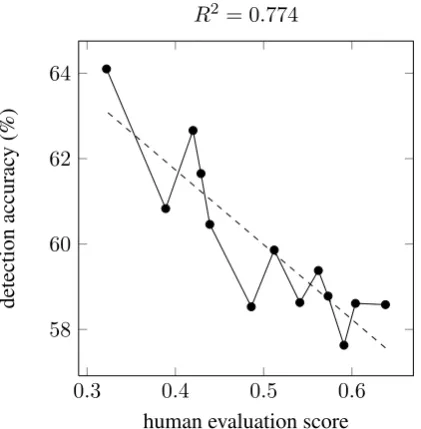
0.3 0.4 0.5 0.6 58
60 62 64
human evaluation score
detection
accurac
y
(%)
R2 = 0.774
Figure 3: Correlation between detection accuracy and human evaluation scores on systems from WMT13’ against reference sentences.
0.3 0.4 0.5 0.6 73
74 75 76 77
human evaluation score
detection
accurac
y
(%)
R2 = 0.556
[image:4.595.76.287.464.679.2] [image:4.595.311.520.469.687.2]0.3 0.4 0.5 0.6 62
64 66
human evaluation score
detection
accurac
y
(%)
R2 = 0.829
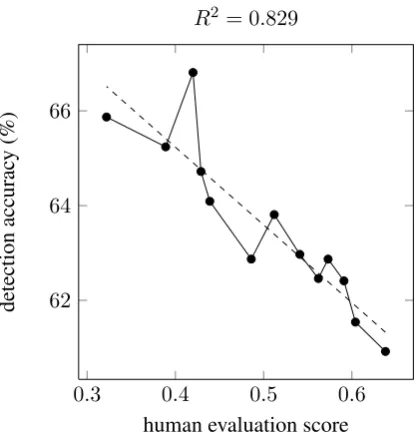
Figure 5: Correlation between detection accu-racy and human evaluation scores on systems from WMT 13’ against non-reference sentences, using the syntactic CFG features described in section 4.2
ence sentences from the WMT13’ English refer-ence translations, against the matching 3000 out-put sentences from one MT system at a time, re-sulting in 6000 sentence instances per experiment. As can be seen in Figure 3, the detection accuracy is strongly correlated with the evaluations scores, yielding R2 = 0.774. To provide another
mea-sure of correlation, we compared every pair of data points in the experiment to get the proportion of pairs ordered identically by the human evalu-ators and our method, with a result of 0.846 (66 of 78). In the second experiment, we use 3000 random, non reference sentences from the new-stest 2011-2012 corpora published in WMT12’ (Callison-Burch et al., 2012) against 3000 output sentences from one MT system at a time, again re-sulting in 6000 sentence instances per experiment. While applying the same classification method as with the reference sentences, the detection accu-racy rises, while the correlation with the transla-tion quality yieldsR2 = 0.556, as can be seen in
Figure 4. Here, the proportion of identically or-dered pairs is0.782(61 of 78).
4.2 Syntactic Features
We note that the second leftmost point in Figures 3, 4 is an outlier: that is, our method has a hard time detecting sentences produced by this system although it is not highly rated by human
evalu-ators. This point represents the Joshua (Post et al., 2013) SMT system. This system is syntax-based, which apparently confound our POS and FW-based classifier, despite it’s low human evalu-ation score. We hypothesize that the use of syntax-based features might improve results. To ver-ify this intuition, we create parse trees using the Berkeley parser (Petrov and Klein, 2007) and ex-tract the one-level CFG rules as features. Again, we represent each sentence as a boolean vector, in which each entry represents the presence or ab-sence of the CFG rule in the parse-tree of the sen-tence. Using these features alone, without the FW and POS tag based features presented above, we obtain an R2 = 0.829with a proportion of
iden-tically ordered pairs at0.923(72 of 78), as shown in Figure 5.
5 Discussion and Future Work
We have shown that it is possible to detect ma-chine translation from monolingual corpora con-taining both machine translated text and human generated text, at sentence level. There is a strong correlation between the detection accuracy that can be obtained and the BLEU score or the human evaluation score of the machine translation itself. This correlation holds whether or not a reference set is used. This suggests that our method might be used as an unsupervised quality estimation method when no reference sentences are available, such as for resource-poor source languages. Further work might include applying our methods to other language pairs and domains, acquiring word-level quality estimation or integrating our method in a machine translation system. Furthermore, ad-ditional features and feature selection techniques can be applied, both for improving detection ac-curacy and for strengthening the correlation with human quality estimation.
Acknowledgments
[image:5.595.76.284.63.281.2]References
Yuki Arase and Ming Zhou. 2013. Machine transla-tion detectransla-tion from monolingual web-text. In Pro-ceedings of the 51st Annual Meeting of the Associa-tion for ComputaAssocia-tional Linguistics (Volume 1: Long Papers), pages 1597–1607, Sofia, Bulgaria, August. Association for Computational Linguistics.
Mona Baker. 1993. Corpus linguistics and transla-tion studies: Implicatransla-tions and applicatransla-tions. Text and technology: in honour of John Sinclair, 233:250. Mohit Bansal, Chris Quirk, and Robert C. Moore.
2011. Gappy phrasal alignment by agreement. In Dekang Lin, Yuji Matsumoto, and Rada Mihalcea, editors,ACL, pages 1308–1317. The Association for Computer Linguistics.
Marco Baroni and Silvia Bernardini. 2006. A new approach to the study of translationese: Machine-learning the difference between original and trans-lated text.LLC, 21(3):259–274.
Shoshana Blum-Kulka and Eddie A. Levenston. 1983. Universals of lexical simplification. Strategies in In-terlanguage Communication, pages 119–139.
Ondˇrej Bojar, Christian Buck, Chris Callison-Burch, Christian Federmann, Barry Haddow, Philipp Koehn, Christof Monz, Matt Post, Radu Soricut, and Lucia Specia. 2013. Findings of the 2013 Work-shop on Statistical Machine Translation. In Pro-ceedings of the Eighth Workshop on Statistical Ma-chine Translation, pages 1–44, Sofia, Bulgaria, Au-gust. Association for Computational Linguistics.
Chris Callison-Burch, Philipp Koehn, Christof Monz, Matt Post, Radu Soricut, and Lucia Specia. 2012. Findings of the 2012 workshop on statistical ma-chine translation. In Proceedings of the Seventh Workshop on Statistical Machine Translation, pages 10–51, Montr´eal, Canada, June. Association for Computational Linguistics.
Dave Carter and Diana Inkpen. 2012. Searching for poor quality machine translated text: Learning the difference between human writing and machine translations. In Leila Kosseim and Diana Inkpen, editors, Canadian Conference on AI, volume 7310 ofLecture Notes in Computer Science, pages 49–60. Springer.
Martin Gellerstam. 1986. Translationese in swedish novels translated from english. In Lars Wollin and Hans Lindquist, editors,Translation Studies in Scandinavia, pages 88–95.
Ulrich Germann. 2001. Aligned hansards of the 36th parliament of canada release 2001-1a.
Mark Hall, Eibe Frank, Geoffrey Holmes, Bernhard Pfahringer, Peter Reutemann, and Ian H. Witten. 2009. The weka data mining software: an update. SIGKDD Explor. Newsl., 11(1):10–18.
Iustina Ilisei, Diana Inkpen, Gloria Corpas Pastor, and Ruslan Mitkov. 2010. Identification of transla-tionese: A machine learning approach. In Alexan-der F. Gelbukh, editor, CICLing, volume 6008 of Lecture Notes in Computer Science, pages 503–511. Springer.
Philipp Koehn, Hieu Hoang, Alexandra Birch, Chris Callison-Burch, Marcello Federico, Nicola Bertoldi, Brooke Cowan, Wade Shen, Christine Moran, Richard Zens, Chris Dyer, Ondrej Bojar, Alexandra Constantin, and Evan Herbst. 2007. Moses: Open source toolkit for statistical machine translation. In ACL. The Association for Computer Linguistics.
Philipp Koehn. 2005. Europarl: A Parallel Corpus for Statistical Machine Translation. InConference Proceedings: the tenth Machine Translation Sum-mit, pages 79–86, Phuket, Thailand. AAMT, AAMT. Moshe Koppel and Noam Ordan. 2011. Translationese and its dialects. In Dekang Lin, Yuji Matsumoto, and Rada Mihalcea, editors,ACL, pages 1318–1326. The Association for Computer Linguistics.
David Kurokawa, Cyril Goutte, and Pierre Isabelle. 2009. Automatic Detection of Translated Text and its Impact on Machine Translation. In Conference Proceedings: the twelvth Machine Translation Sum-mit.
Adam Lopez. 2008. Statistical machine translation. ACM Computing Surveys (CSUR), 40(3):8.
Kishore Papineni, Salim Roukos, Todd Ward, and Wei-Jing Zhu. 2001. Bleu: a method for automatic evaluation of machine translation. Technical report, IBM Research Report.
J.W. Pennebaker, M.E. Francis, and R.J. Booth. 2001. Linguistic inquiry and word count: Liwc 2001. Mahway: Lawrence Erlbaum Associates.
Slav Petrov and Dan Klein. 2007. Improved infer-ence for unlexicalized parsing. InHuman Language Technologies 2007: The Conference of the North American Chapter of the Association for Computa-tional Linguistics, Proceedings of the Main Confer-ence, pages 404–411.
Marius Popescu. 2011. Studying translationese at the character level. In Galia Angelova, Kalina Bontcheva, Ruslan Mitkov, and Nicolas Nicolov, ed-itors,RANLP, pages 634–639. RANLP 2011 Organ-ising Committee.
Matt Post, Juri Ganitkevitch, Luke Orland, Jonathan Weese, Yuan Cao, and Chris Callison-Burch. 2013. Joshua 5.0: Sparser, better, faster, server. In Pro-ceedings of the Eighth Workshop on Statistical Ma-chine Translation, August 8-9, 2013., pages 206– 212. Association for Computational Linguistics. Gideon Toury. 1980.In Search of a Theory of
Kristina Toutanova, Dan Klein, Christopher D. Man-ning, and Yoram Singer. 2003. Feature-rich part-of-speech tagging with a cyclic dependency network. InIN PROCEEDINGS OF HLT-NAACL, pages 252– 259.
Hans van Halteren. 2008. Source language markers in europarl translations. In Donia Scott and Hans Uszkoreit, editors,COLING, pages 937–944. Vered Volansky, Noam Ordan, and Shuly Wintner.