Diffusion Monte Carlo Study of Atomic Systems from Li to Ne
Kenta Hongo, Yoshiyuki Kawazoe and Hiroshi Yasuhara
Institute for Materials Research, Tohoku University, Sendai 980-8577, JapanA systematic diffusion Monte Carlo (DMC) study of both neutral and charged atomic systems from Li to Ne in the ground state is performed to evaluate the correlation energy (Ec), the ionization energy (IE), and the electron affinity (EA) of these systems. The present study is based on the fixed-node approximation in which the nodal surfaces of the DMC wavefunction is assumed to be the same as those of the Hartree-Fock wavefunction. The present calculations reproduce907% of the exact value of correlation energy for the cations,913% for the neutral atoms, and922% for the anions, respectively. The theoretical values of IE and EA in the present study are in good agreement with experimental values within an accuracy of 0.3 eV for IE and 0.1 eV for EA. The variation ofEcand IE with respect to the atomic numberZis interpreted. [doi:10.2320/matertrans.47.2612]
(Received June 12, 2006; Accepted August 15, 2006; Published November 15, 2006)
Keywords: diffusion Monte Carlo, electron correlation, ionization energy, electron affinity
1. Introduction
Owing to its self-consistency, Hartee-Fock (HF) theory1–3)
describes the true ground state of all atoms in complete agreement with Hund’s first and second rules and reproduces 99.5% of the exact ground-state energy. On the other hand, an accurate evaluation of the ionization energy (IE) and the electron affinity (EA) for atoms,i.e., information about one-electron excitations, requires a sophisticated theoretical treatment involving correlation beyond the scope of HF theory.
We shall start with the evaluation of IE and EA in the framework of HF theory. According to Koopmans’ theo-rem,4) the negative sign of the highest occupied orbital
energy and the lowest unoccupied orbital energy can respectively be interpreted as IE and EA, if correlation and orbital relaxation are both neglected. The Koopmans’ interpretation generally gives a good evaluation of IE for atoms within an accuracy of 8%. This is because a considerable amount of cancellation favorably occurs be-tween the two errors arising from lack of correlation and orbital relaxation. On the other hand, the same interpretation gives a quite poor evaluation of EA for atoms since the two errors are accumulated instead of being cancelled; according to the Koopmans’ interpretation, the (Nþ1) state (anion) cannot be stabilized for most cases.
If one takes full account of only orbital relaxation in the evaluation of IE,i.e., if one evaluates both the (N1) and the N state energies by the HF variational theory, the resulting IE for atoms is necessarily underestimated in magnitude by about 10% since no cancellation occurs between the two errors. The same evaluation of EA still remains underestimated in magnitude by an amount of about 1 eV.
Diffusion Monte Carlo (DMC) method5) can provide
accurate numerical results involving correlation, which is comparable to the conventional quantum chemistry method such as configuration interaction (CI) method. There are a number of DMC studies about light atoms and molecules. For example, Langfelder et al. have already evaluated the correlation energy for neutral atoms from Li to Ne,6)based on the fixed-node approximation7,8) in which the nodal
surfaces of the DMC wavefunction is assumed to be the same as those of the HF wavefunction. Their calculations have reproduced 934% of the exact value of the correlation energy for the atoms. However, no one has ever tried to evaluate by DMC method IE and EA of atoms as well as the correlation energy for the positively and negatively ionized states of atoms.
In the present study, we have performed a systematic DMC study of both neutral and charged atomic systems from Li to Ne in order to evaluate the ionization energy and the electron affinity as well as the correlation energy. Section II deals with the computational methods. Section III provides numerical results and some discussions.
2. Computational Methods
DMC is a powerful technique in which the exact function component is extracted from a starting trial wave-function to develop into its complete form. The time-dependent Schro¨dinger equation has an exponential factor with an imaginary argument expðiHHt^ =hÞ, where HH^ is the many-electron Hamiltonian. By introducing the imaginary-time¼it, the equation is transformed into a diffusion-type Fokker-Planck equation. Its imaginary-time evolution, owing to the presence of a damping factor expðHH^=hÞ, can in principle lead to the exact wavefunction after a long enough interval, unless the starting trial wavefunction happens to be orthogonal to the exact one.
The practice of DMC method depends strongly on a starting trial wavefunction chosen: (1) DMC usually resorts to the fixed-node approximation.7,8)If the nodal surfaces of
the trial wavefunction is accurate enough, this approximation is expected to give a very accurate energy. Generally, the fixed-node DMC energy is variational in the sense that it is less than or equal to the energy calculated with the starting trial wavefunction that is called the variational Monte Carlo (VMC) energy and greater than or equal to the exact energy. (2) Owing to the singular behavior of the Coulomb interaction at short distances, the many-electron wavefunc-tion exhibits spatial singularities called cusps.9) It forms a cusp-like shape whenever an electron approaches any nucleus or any two electrons approach each other with
Special Issue on Advances in Computational Materials Science and Engineering IV
parallel or antiparallel spin configuration and hence its first-order derivative has a discontinuity at riI ¼0 or rij¼0,
where riI denotes the distance between an electron and a
nucleus andrijthe interelectronic distance. Unless such cusp
discontinuities are properly taken into account in a starting trial wavefunction, no reasonably convergent result can be obtained for the DMC energy.
A single-determinant Slater-Jastrow type function is adopted as a starting trial wavefunction in the present study. We have calculated the HF orbitals entering the Slater determinant with the GAUSSIAN98 code10) and a
6-311++G(3df) basis set. The resulting HF orbitals are by construction unable to reproduce the nucleus-electron cusp. In order to recover the nucleus-electron cusp we have adopted an extrapolation method in which the main-body behavior of these HF orbitals is smoothly connected to an appropriate analytic form near the nucleus.11) The Jastrow factor is usually constructed from homogeneous isotropic electron-electron terms and isotropic nucleus-electron terms centered on the nucleus.12,13)The first terms are responsible for the description of both the antiparallel and spin-parallel electron-electron cusps.
The Jastrow factor we have adopted here includes 12 parameters which are optimized by minimizing the variance of the VMC energy.14,15)In order to arrive at high accuracy
we have accumulated the numerical results over 3106
steps. A time step of0:0020:003a.u. is used to make the time-step error negligibly small. We have used the CASINO code.16)
3. Results and Discussions
3.1 Correlation energy
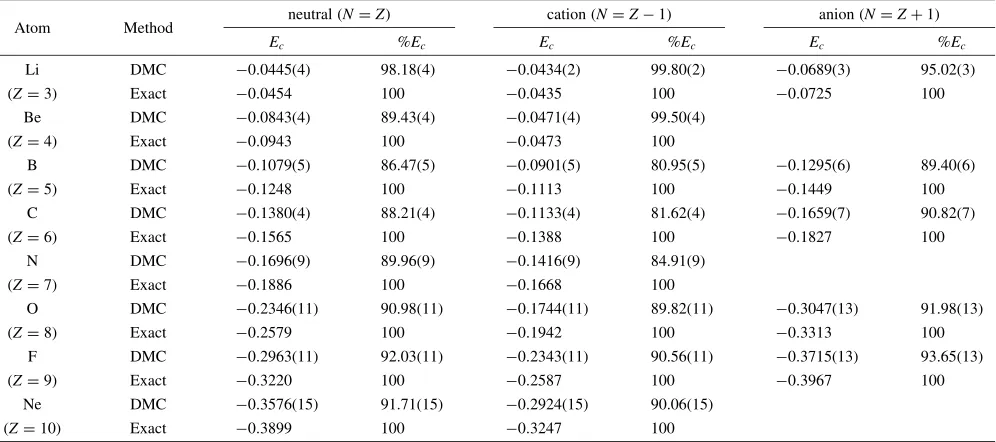
Table 1 gives a list of an estimated exact correlation energy and the present DMC correlation energy for the neutral atoms from Li to Ne and their cations and anions. The
exact correlation energy is defined as the difference between the exact energy Eexact and the HF energy EHF. We have calculatedEHFfrom the HF code due to Fischeret al.17)Eexact
[image:2.595.51.549.105.326.2]is the value that Chakravorty et al. have estimated from a systematic investigation of various isoelectronic systems.18) The recovering percentage of the estimated exact correlation energy for the present DMC calculations is also given in Table 1.
The present DMC study gives the recovering percentage of
913% for neutral atoms, which is comparable to the previously reported value 934%.6) For the cations and
anions, the recovering percentage amounts to 907% and
922%, respectively. The recovering percentage tends to be somewhat improved as the electron number of the system is increased.
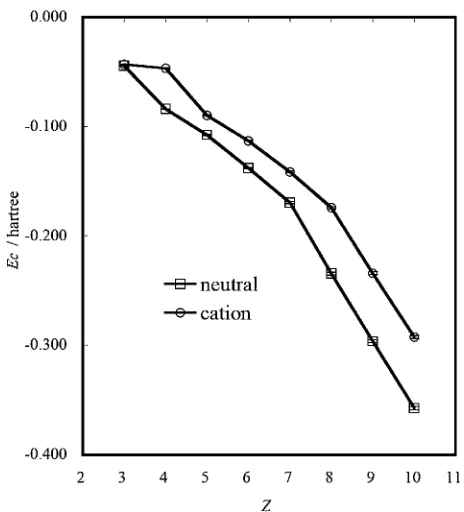
Figure 1 shows the dependence of the correlation energy
Econ the atomic numberZfor neutral atoms and their cations
in the present DMC calculations. As is obvious from Fig. 1, the correlation energy Ec for both neutral atoms and their
cations is reduced nearly linearly with increasing Z. The difference in Ec between neutral atoms and their cations, if
averaged, amounts to about 1 eV. This is ascribed to the presence of an extra electron in neutral atoms. For neutral atoms, one can observe a discontinuity in the linear coefficient of Ec versus Z at Z ¼7 (N). For their cations,
the same kind of discontinuity is shifted toZ¼8(Oþ). The
negative slope of Ec with respect to Z becomes steeper
abruptly at Z¼7 for neutral atoms and Z¼8 for their cations where the spherically symmetric distribution of the electron density is realized owing to completion of all the possible spin-parallel pair arrangements. Thus, the variation in the magnitude of correlation energy with respect to Z
reflects the electronic structure in neutral atoms and their cations. The presence of the spin-antiparallel pair arrange-ments in the valence electron density is responsible for such an abrupt increase in the negative slope of Ec, which
Table 1 The correlation energyEcfor both neutral and charged atomic systems from Li to Ne in the ground state. Statistical errors in the present DMC study are indicated in the parenthesis. All energies are in hartree units. The recovering percentage of the exact correlation energy (%Ec) is also given.
neutral (N¼Z) cation (N¼Z1) anion (N¼Zþ1)
Atom Method
Ec %Ec Ec %Ec Ec %Ec
Li DMC 0:0445ð4Þ 98.18(4) 0:0434ð2Þ 99.80(2) 0:0689ð3Þ 95.02(3)
(Z¼3) Exact 0:0454 100 0:0435 100 0:0725 100
Be DMC 0:0843ð4Þ 89.43(4) 0:0471ð4Þ 99.50(4)
(Z¼4) Exact 0:0943 100 0:0473 100
B DMC 0:1079ð5Þ 86.47(5) 0:0901ð5Þ 80.95(5) 0:1295ð6Þ 89.40(6)
(Z¼5) Exact 0:1248 100 0:1113 100 0:1449 100
C DMC 0:1380ð4Þ 88.21(4) 0:1133ð4Þ 81.62(4) 0:1659ð7Þ 90.82(7)
(Z¼6) Exact 0:1565 100 0:1388 100 0:1827 100
N DMC 0:1696ð9Þ 89.96(9) 0:1416ð9Þ 84.91(9)
(Z¼7) Exact 0:1886 100 0:1668 100
O DMC 0:2346ð11Þ 90.98(11) 0:1744ð11Þ 89.82(11) 0:3047ð13Þ 91.98(13)
(Z¼8) Exact 0:2579 100 0:1942 100 0:3313 100
F DMC 0:2963ð11Þ 92.03(11) 0:2343ð11Þ 90.56(11) 0:3715ð13Þ 93.65(13)
(Z¼9) Exact 0:3220 100 0:2587 100 0:3967 100
Ne DMC 0:3576ð15Þ 91.71(15) 0:2924ð15Þ 90.06(15)
continues until all the possible spin-antiparallel pair arrange-ments are completed. The contribution to Ec from a
spin-antiparallel pair is about three times larger in magnitude than that from a spin-parallel pair, i.e., the spin-antiparallel contribution to Ec from the Coulomb hole due to the
Coulomb repulsive interaction is by a factor of about 3 larger than the spin-parallel contribution toEcfrom the deepening
Fermi hole due to the Coulomb repulsive interaction. To conclude, an abrupt change in the nearly linear coefficient of
Ec observed at Z¼7 or 8 comes from the fact that the
number of spin-parallel pairs is increased for Z<7ð8Þ
following the Hund’s first and second rules and thereafter the number of spin-antiparallel pairs is increased forZ >7ð8Þ. In a word, an abrupt change observed in the variation ofEcwith
respect toZreflects the Hund’s first and second rules.
[image:3.595.52.284.68.324.2]3.2 Ionization energy
Table 2 shows a list of various theoretical values and experimental values19)for IE of the eight atoms. The DMC
calculations evaluate IE as the difference in the total energy between a cation and a neutral atom. ByHF we mean the method for evaluating IE from the difference between the two HF variational calculations. The HF method necessarily underestimates IE since it takes full account of orbital relaxation alone. The averaged magnitude of the under-estimate amounts to about 1 eV, which is equivalent to an increase in the correlation energy due to the presence of an extra electron. The Koopmans’ interpretation underestimates IE for metallic elements (Li and Be) by about 0.5 eV and overestimates IE for non-metallic elements (B, C, N, O, F, and Ne) by about 1.5 eV. All values of IE in the present DMC study are in good agreement with experimental values within an accuracy of 0.3 eV.
[image:3.595.308.544.117.583.2]Figure 2 gives a comparison of three different theoretical values of IE with experimental values. As is seen from the figure, IE takes its local maximum values atZ¼4, 7, and 10 where the spherically symmetric distribution of the electron density is realized. This is because the spherically symmetric distribution causes a remarkable contraction of the electron density around the nucleus to lower effectively the nucleus-electron attractive Coulomb interaction energy. Both DMC and HF give an appropriate description of all the local maximum values of IE (exceptZ ¼11for DMC), while the Koopmans’ interpretation fails to reproduce two local maximum values atZ¼4, 7.
Table 2 The ionization energies for the neutral atoms. Statistical errors in the present DMC study are indicated in the parenthesis. ByHF we mean the method for evaluating IE from the difference between the two HF variational calculations. All energies are in eV units.
Atom Koopmans HF DMC Experiment
Li (Z¼3) 5.34 5.34 5.35(2) 5.39
Be (Z¼4) 8.42 8.04 9.06(1) 9.32
B (Z¼5) 8.43 7.93 8.41(2) 8.30
C (Z¼6) 11.79 10.79 11.46(2) 11.27
N (Z¼7) 15.44 13.96 14.71(3) 14.55
O (Z¼8) 17.19 11.89 13.52(4) 13.62
F (Z¼9) 19.86 15.72 17.40(4) 17.43
Ne (Z¼10) 23.14 19.84 21.61(6) 21.62
Fig. 2 A comparison of three different theoretical values for IE with experimental values. Statistical errors in the figure are too small to discern. The DMC value of IE forZ¼11is missing.
Here we give an explanation of why the Koopmans’ interpretation fails to reproduce the two local maximum values of IE atZ¼4, 7 and succeeds to reproduce the third local maximum atZ ¼10. The exact, or experimental value of IE (IEexp) and the value of IE evaluated from Koopmans’
theorem (IEKT) are related as follows:
IEexp¼IEKTþERþEc;
ERIEHFIEKT; ð1Þ
EcIEexpIEHF;
where IEHF is the value of IE evaluated from the HF method, ERð<0Þ is the orbital relaxation energy, and
Ecð>0Þis the difference in the correlation energy between
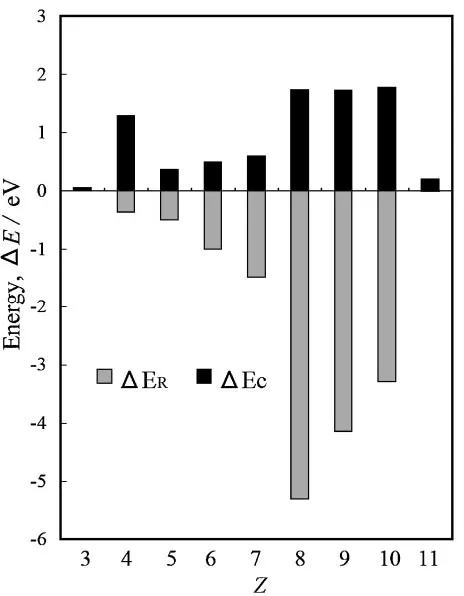
a cation and a neutral atom. Figure 3 gives a plot of both
ER and Ec. As is obvious from Fig. 3, the correlation
contribution to IE for metallic elements (Li and Be) is greater than that for non-metallic elements (B, C, N, O, F, and Ne). On the other hand, the orbital relaxation contribution to IE for the non-metallic elements is greater than that for the metallic elements. The reason why the Koopmans’ interpretation fails to give the local maximum at Z¼4 is that the correlation contribution to IE for the Be atom (Z¼4) is particularly important among all the atoms forZ7since the presence of occupied 2s levels and near-degenerate unoccupied 2p
levels gives rise to a local increase in the magnitude ofEc. On
the other hand, the reason why the Koopmans’ interpretation fails to give the local maximum atZ¼7is different from the case ofZ ¼4. As is obvious from Fig. 2, it is because the Koopmans’ interpretation overestimates IEKT of the
neigh-boring O atom (Z¼8) by more than 3 eV for lack of orbital relaxation; the overestimate is too large for IEKT of the N atom (Z ¼7) to be prominent. The third local maximum at
Z ¼10 is successfully described by the Koopmans’ inter-pretation since no remarkable behavior appears in the magnitude of Ec atZ¼10and in the magnitude of orbital
relaxation at the neighboring atom (Z¼11).
3.3 Electron affinity
Table 3 gives a list of various theoretical values and experimental values20)for EA of Li, B, C, O, and F atoms.
The DMC method evaluates EA as the difference in the total energy between a neutral atom and an anion. Note that each of Be, N, and Ne atoms is unable to form a stable negative ion. This is because remarkable contraction of the electron density around the nucleus due to its spherically symmetric distribution occurring in each of these atoms screens its nuclear attractive Coulomb interaction so perfectly that an additional electron can no more be bounded to the nucleus. This interpretation is based on the assumption that in the formation of a negative iron the original electron config-uration for a neutral atom is not changed by adding an extra electron to it.
For lack of correlation, theHF method fails to stabilize a negative ion for each of Li, B, and O atoms. All values of EA in the present DMC study are in good agreement with experimental values within an accuracy of 0.1 eV. The agreement in the evaluation of EA is better than in the evaluation of IE. This probably reflects that the recovering percentage of the correlation energy tends to be somewhat improved as the electron number of the system is increased.
Acknowledgments
The authors would like to thank the Center for Computa-tional Materials Science of the Institute for Materials Research, Tohoku University for support of the SR 8000 supercomputing facilities.
REFERENCES
1) E. Clementi and C. Roetti: At. Data Nuc. Data Tables14(1974) 177– 478.
2) S. Fraga, J. Karwouski and K. M. S. Saxena:Handbook of Atomic Data, (Elsevier, Amsterdam, 1976).
3) C. F. Fischer: The Hartree-Fock Method for Atoms —A numerical Approach(Wiley, New York, 1977).
4) T. Koopmans: Physica1(1933) 104–113.
5) W. M. C. Foulkes, L. Mitas, R. J. Needs and G. Rajagopal: Rev. Mod. Fig. 3 A plot of both the orbital relaxation energy (ER) and the
[image:4.595.55.287.69.367.2]correlation energy difference between a cation and a neutral atom (Ec) as a function ofZ.
Table 3 The electron affinities for the neutral atoms. Statistical errors in the present DMC study are indicated in the parenthesis. ByHF we mean the method for evaluating EA from the difference between the two HF variational calculations. All energies are in eV units.
Atom HF DMC Experiment
Li (Z¼3) 0:12 0.54(1) 0.62
B (Z¼5) 0:31 0.32(2) 0.28
C (Z¼6) 0.46 1.31(2) 1.26
O (Z¼8) 0:58 1.37(5) 1.46
[image:4.595.304.550.114.192.2]Phys.73(2001) 33–83.
6) P. Langfelder, S. M. Rothstein and J. Vrbik: J. Chem. Phys.107(1997) 8525–8535.
7) J. B. Anderson: J. Chem. Phys.65(1976) 4121–4127.
8) P. J. Reynolds, D. M. Ceperley, B. J. Alder and W. A. Lester, Jr.: J. Chem. Phys.77(1982) 5593–5603.
9) T. Kato: Commun. Pure Appl. Math.10(1957) 151–177.
10) M. J. Frisch, et al.: GAUSSIAN98 Users Manual (Gaussian Inc., Pittsburgh, PA) (1998).
11) A. Ma, M. D. Towler, N. D. Drummond and R. J. Needs: J. Chem. Phys. 122(2005) 224322-1-224322-7.
12) R. J. Jastrow: Phys. Rev.98(1955) 1479–1484.
13) A. J. Williamson, S. D. Kenny, G. Rajagopal, A. J. James, R. J. Needs, L. M. Fraser, W. M. C. Foulkes and P. Maccallum: Phys. Rev. B53 (1996) 9640–9648.
14) C. J. Umrigar, K. G. Wilson and J. W. Wilkins: Phys. Rev. Lett.60
(1988) 1719–1722.
15) P. R. C. Kent, F. J. Needs and G. Rajagopal: Phys. Rev. B59(1999) 12344–12351.
16) R. J. Needs, M. D. Towler, N. D. Drummond, P. R. C. Kent, G. Rajagopal and A. J. Williamson:CASINO version 1.5 User’s Manual, (University of Cambridge, Cambridge, 2002).
17) G. Gaigalasa and C. F. Fischer: Comput. Phys. Commun.98(1996) 255–264.
18) S. J. Chakravorty, S. R. Gwaltney, E. R. Davidson, F. A. Parpia and C. F. Fischer: Phys. Rev. A47(1993) 3649–3670.
19) W. C. Martin and W. L. Wiese:Atomic, Molecular, & Optical Physics Handbook, ed. by G. W. F. Drake (AIP, Woodbury, NY. 1996) Chapter 10, pp. 135–153.