Proceedings of the 49th Annual Meeting of the Association for Computational Linguistics:shortpapers, pages 687–692,
Getting the Most out of Transition-based Dependency Parsing
Jinho D. Choi
Department of Computer Science University of Colorado at Boulder
Martha Palmer
Department of Linguistics University of Colorado at Boulder
Abstract
This paper suggests two ways of improving transition-based, non-projective dependency parsing. First, we add a transition to an exist-ing non-projective parsexist-ing algorithm, so it can perform either projective or non-projective parsing as needed. Second, we present a boot-strapping technique that narrows down dis-crepancies between gold-standard and auto-matic parses used as features. The new ad-dition to the algorithm shows a clear advan-tage in parsing speed. The bootstrapping technique gives a significant improvement to parsing accuracy, showing near state-of-the-art performance with respect to other parsing approaches evaluated on the same data set.
1 Introduction
Dependency parsing has recently gained consider-able interest because it is simple and fast, yet pro-vides useful information for many NLPtasks (Shen
et al., 2008; Councill et al., 2010). There are two main dependency parsing approaches (Nivre and McDonald, 2008). One is a transition-based ap-proach that greedily searches for local optima (high-est scoring transitions) and uses parse history as fea-tures to predict the next transition (Nivre, 2003). The other is a graph-based approach that searches for a global optimum (highest scoring tree) from a complete graph in which vertices represent word tokens and edges (directed and weighted) represent dependency relations (McDonald et al., 2005).
Lately, the usefulness of the transition-based ap-proach has drawn more attention because it gener-ally performs noticeably faster than the graph-based
approach (Cer et al., 2010). The transition-based ap-proach has a worst-case parsing complexity ofO(n) for projective, and O(n2) for non-projective pars-ing (Nivre, 2008). The complexity is lower for pro-jective parsing because it can deterministically drop certain tokens from the search space whereas that is not advisable for non-projective parsing. Despite this fact, it is possible to perform non-projective parsing in linear time in practice (Nivre, 2009). This is because the amount of non-projective dependen-cies is much smaller than the amount of projective dependencies, so a parser can perform projective parsing for most cases and perform non-projective parsing only when it is needed. One other advan-tage of the transition-based approach is that it can use parse history as features to make the next pre-diction. This parse information helps to improve parsing accuracy without hurting parsing complex-ity (Nivre, 2006). Most current transition-based ap-proaches use gold-standard parses as features dur-ing traindur-ing; however, this is not necessarily what parsers encounter during decoding. Thus, it is desir-able to minimize the gap between gold-standard and automatic parses for the best results.
This paper improves the engineering of different aspects of transition-based, non-projective depen-dency parsing. To reduce the search space, we add a transition to an existing non-projective parsing algo-rithm. To narrow down the discrepancies between gold-standard and automatic parses, we present a bootstrapping technique. The new addition to the algorithm shows a clear advantage in parsing speed. The bootstrapping technique gives a significant im-provement to parsing accuracy.
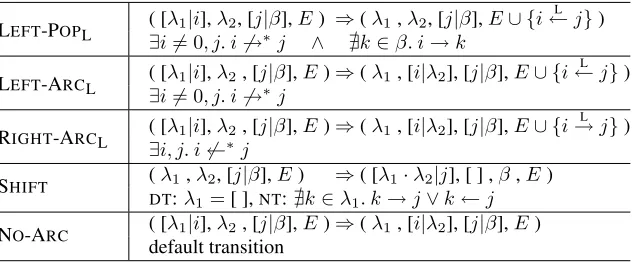
LEFT-POPL ( [λ1|i],λ2, [j|β],E) ⇒(λ1,λ2, [j|β],E∪ {i
L ←j}) ∃i6= 0, j. i6→∗j ∧
@k∈β. i→k
LEFT-ARCL ( [λ1|i],λ2, [j|β],E)⇒(λ1, [i|λ2], [j|β],E∪ {i
L ←j}) ∃i6= 0, j. i6→∗j
RIGHT-ARCL ( [λ1|i],λ2, [j|β],E)⇒(λ1, [i|λ2], [j|β],E∪ {i
L →j}) ∃i, j. i6←∗j
SHIFT (λ1,λ2, [j|β],E) ⇒( [λ1·λ2|j], [ ] ,β,E) DT:λ1=[ ],NT:@k∈λ1. k→j∨k←j
NO-ARC ( [λ1|i],λ2, [j|β],E)⇒(λ1, [i|λ2], [j|β],E)
[image:2.612.149.465.71.202.2]default transition
Table 1: Transitions in our algorithm. For each row, the first line shows a transition and the second line shows preconditions of the transition.
2 Reducing search space
Our algorithm is based on Choi-Nicolov’s approach to Nivre’s list-based algorithm (Nivre, 2008). The main difference between these two approaches is in their implementation of the SHIFTtransition. Choi-Nicolov’s approach divides the SHIFTtransition into
two, deterministic and non-deterministic SHIFT’s, and trains the non-deterministic SHIFTwith a classi-fier so it can be predicted during decoding. Choi and Nicolov (2009) showed that this implementation re-duces the parsing complexity fromO(n2) to linear time in practice (a worst-case complexity isO(n2)). We suggest another transition-based parsing ap-proach that reduces the search space even more. The idea is to merge transitions in Choi-Nicolov’s non-projective algorithm with transitions in Nivre’s projective algorithm (Nivre, 2003). Nivre’s projec-tive algorithm has a worst-case complexity ofO(n), which is faster than any non-projective parsing al-gorithm. Since the number of non-projective depen-dencies is much smaller than the number of projec-tive dependencies (Nivre and Nilsson, 2005), it is not efficient to perform non-projective parsing for all cases. Ideally, it is better to perform projective parsing for most cases and perform non-projective parsing only when it is needed. In this algorithm, we add another transition to Choi-Nicolov’s approach, LEFT-POP, similar to the LEFT-ARC transition in
Nivre’s projective algorithm. By adding this tran-sition, an oracle can now choose either projective or non-projective parsing depending on parsing states.1
1
We also tried adding the RIGHT-ARC transition from Nivre’s projective algorithm, which did not improve parsing performance for our experiments.
Note that Nivre (2009) has a similar idea of per-forming projective and non-projective parsing selec-tively. That algorithm uses a SWAP transition to reorder tokens related to non-projective dependen-cies, and runs in linear time in practice (a worst-case complexity is stillO(n2)). Our algorithm is distin-guished in that it does not require such reordering.
Table 1 shows transitions used in our algorithm. All parsing states are represented as tuples (λ1,λ2,
β,E), whereλ1,λ2, andβare lists of word tokens.
E is a set of labeled edges representing previously identified dependencies.Lis a dependency label and i,j,krepresent indices of their corresponding word tokens. The initial state is ([0], [ ], [1,. . . ,n],∅). The 0 identifier corresponds to an initial token,w0, intro-duced as the root of the sentence. The final state is (λ1,λ2, [ ],E), i.e., the algorithm terminates when all tokens inβare consumed.
The algorithm uses five kinds of transitions. All transitions are performed by comparing the last to-ken in λ1, wi, and the first token in β, wj. Both
LEFT-POPL and LEFT-ARCL are performed when
wj is the head of wi with a dependency relation L.
The difference is that LEFT-POPremoves wi from λ1 after the transition, assuming that the token is no longer needed in later parsing states, whereas LEFT -ARC keeps the token so it can be the head of some
tokenwj<k≤n inβ. Thiswi → wkrelation causes
a non-projective dependency. RIGHT-ARCL is per-formed whenwiis the head ofwjwith a dependency
relation L. SHIFT is performed when λ1 is empty (DT) or there is no token inλ1that is either the head or a dependent ofwj(NT). NO-ARCis there to move
It1 was2 in3 my4 interest5 to6
Root0 see7 you8
SBJ ROOT
PRD NMOD
PMOD
IM NMOD
OBJ
Transition λ1 λ2 β E
0 [0] [ ] [1|β] ∅
1 SHIFT(NT) [λ1|1] [ ] [2|β]
2 LEFT-ARC [0] [1] [2|β] E ∪ {1←SBJ−2} 3 RIGHT-ARC [ ] [0|λ2] [2|β] E ∪ {0−ROOT→2}
4 SHIFT(DT) [λ1|2] [ ] [3|β]
5 RIGHT-ARC [λ1|1] [2] [3|β] E ∪ {2−PRD→3}
6 SHIFT(NT) [λ1|3] [ ] [4|β]
7 SHIFT(NT) [λ1|4] [ ] [5|β]
8 LEFT-POP [λ1|3] [ ] [5|β] E ∪ {4←NMOD−5}
9 RIGHT-ARC [λ1|2] [3] [5|β] E ∪ {3−PMOD→5}
10 SHIFT(NT) [λ1|5] [ ] [6|β]
11 NO-ARC [λ1|3] [5] [6|β]
12 NO-ARC [λ1|2] [3|λ2] [6|β]
13 NO-ARC [λ1|1] [2|λ2] [6|β]
14 RIGHT-ARC [0] [1|λ2] [6|β] E ∪ {1−NMOD→6}
15 SHIFT(NT) [λ1|6] [ ] [7|β]
16 RIGHT-ARC [λ1|5] [6] [7|β] E ∪ {6−IM→7}
17 SHIFT(NT) [λ1|7] [ ] [8|β]
18 RIGHT-ARC [λ1|6] [7] [8|β] E ∪ {7−OBJ→8}
[image:3.612.109.507.72.411.2]19 SHIFT(NT) [λ1|8] [ ] [ ]
Table 2: Parsing states for the example sentence. After LEFT-POPis performed (#8), [w4=my] is removed from the
search space and no longer considered in the later parsing states (e.g., between #10 and #11).
During training, the algorithm checks for the pre-conditions of all transitions and generates training instances with corresponding labels. During decod-ing, the oracle decides which transition to perform based on the parsing states. With the addition of LEFT-POP, the oracle can choose either projective or non-projective parsing by selecting LEFT-POPor LEFT-ARC, respectively. Our experiments show that this additional transition improves both parsing ac-curacy and speed. The advantage derives from im-proving the efficiency of the choice mechanism; it is now simply a transition choice and requires no addi-tional processing.
3 Bootstrapping automatic parses
Transition-based parsing has the advantage of using parse history as features to make the next prediction. In our algorithm, when wi and wj are compared,
subtree and head information of these tokens is
par-tially provided by previous parsing states. Graph-based parsing can also take advantage of using parse information. This is done by performing ‘higher-order parsing’, which is shown to improve parsing accuracy but also increase parsing complexity (Car-reras, 2007; Koo and Collins, 2010).2 Transition-based parsing is attractive because it can use parse information without increasing complexity (Nivre, 2006). The qualification is that parse information provided by gold-standard trees during training is not necessarily the same kind of information pro-vided by automatically parsed trees during decod-ing. This can confuse a statistical model trained only on the gold-standard trees.
To reduce the gap between gold-standard and au-tomatic parses, we use bootstrapping on auau-tomatic parses. First, we train a statistical model using
standard trees. Then, we parse the training data us-ing the statistical model. Durus-ing parsus-ing, we ex-tract features for each parsing state, consisting of automatic parse information, and generate a train-ing instance by jointrain-ing the features with the gold-standard label. The gold-gold-standard label is achieved by comparing the dependency relation betweenwi
andwj in the gold-standard tree. When the parsing
is done, we train a different model using the training instances induced by the previous model. We repeat the procedure until a stopping criteria is met.
The stopping criteria is determined by performing validation. For each stage, we perform cross-validation to check if the average parsing accuracy on the current cross-validation set is higher than the one from the previous stage. We stop the procedure when the parsing accuracy on cross-validation sets starts decreasing. Our experiments show that this simple bootstrapping technique gives a significant improvement to parsing accuracy.
4 Related work
Daum´e et al. (2009) presented an algorithm, called SEARN, for integrating search and learning to solve complex structured prediction problems. Our boot-strapping technique can be viewed as a simplified version of SEARN. During training, SEARN itera-tively creates a set of new cost-sensitive examples using a known policy. In our case, the new examples are instances containing automatic parses induced by the previous model. Our technique is simpli-fied because the new examples are not cost-sensitive. Furthermore, SEARNinterpolates the current policy with the previous policy whereas we do not per-form such interpolation. During decoding, SEARN
generates a sequence of decisions and makes a fi-nal prediction. In our case, the decisions are pre-dicted dependency relations and the final prediction is a dependency tree. SEARNhas been successfully
adapted to several NLP tasks such as named entity recognition, syntactic chunking, and POS tagging. To the best of our knowledge, this is the first time that this idea has been applied to transition-based parsing and shown promising results.
Zhang and Clark (2008) suggested a transition-based projective parsing algorithm that keepsB dif-ferent sequences of parsing states and chooses the
one with the best score. They use beam search and show a worst-case parsing complexity ofO(n)given a fixed beam size. Similarly to ours, their learn-ing mechanism uslearn-ing the structured perceptron al-gorithm involves training on automatically derived parsing states that closely resemble potential states encountered during decoding.
5 Experiments
5.1 Corpora and learning algorithm
All models are trained and tested on English and Czech data using automatic lemmas, POS tags, and feats, as distributed by the CoNLL’09 shared task (Hajiˇc et al., 2009). We use Liblinear L2-L1 SVMfor learning (L2 regularization, L1 loss; Hsieh et al. (2008)). For our experiments, we use the fol-lowing learning parameters:c= 0.1(cost),e= 0.1 (termination criterion),B = 0(bias).
5.2 Accuracy comparisons
First, we evaluate the impact of the LEFT-POP
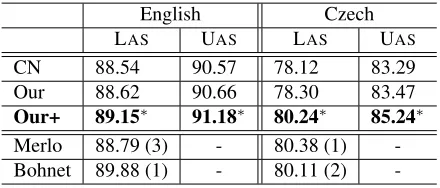
tran-sition we add to Choi-Nicolov’s approach. To make a fair comparison, we implemented both approaches and built models using the exact same feature set. The ‘CN’ and ‘Our’ rows in Table 3 show accuracies achieved by Choi-Nicolov’s and our approaches, re-spectively. Our approach shows higher accuracies for all categories. Next, we evaluate the impact of our bootstrapping technique. The ‘Our+’ row shows accuracies achieved by our algorithm using the boot-strapping technique. The improvement from ‘Our’ to ‘Our+’ is statistically significant for all categories (McNemar, p < .0001). The improvment is even more significant in a language like Czech for which parsers generally perform more poorly.
English Czech
LAS UAS LAS UAS
CN 88.54 90.57 78.12 83.29
Our 88.62 90.66 78.30 83.47 Our+ 89.15∗ 91.18∗ 80.24∗ 85.24∗
Merlo 88.79 (3) - 80.38 (1) -Bohnet 89.88 (1) - 80.11 (2)
[image:4.612.317.537.572.666.2]Finally, we compare our work against other state-of-the-art systems. For the CoNLL’09 shared task, Ges-mundo et al. (2009) introduced the best transition-based system using synchronous syntactic-semantic parsing (‘Merlo’), and Bohnet (2009) introduced the best graph-based system using a maximum span-ning tree algorithm (‘Bohnet’). Our approach shows quite comparable results with these systems.3
[image:5.612.78.294.498.626.2]5.3 Speed comparisons
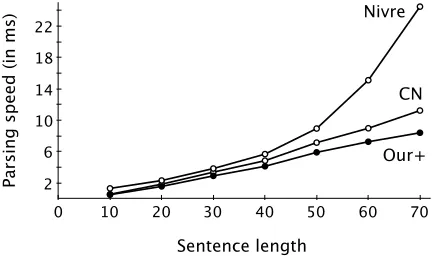
Figure 1 shows average parsing speeds for each sentence group in both English and Czech eval-uation sets (Table 4). ‘Nivre’ is Nivre’s swap algorithm (Nivre, 2009), of which we use the implementation from MaltParser (maltparser. org). The other approaches are implemented in our open source project, called ClearParser (code. google.com/p/clearparser). Note that fea-tures used in MaltParser have not been optimized for these evaluation sets. All experiments are tested on an Intel Xeon 2.57GHz machine. For general-ization, we run five trials for each parser, cut off the top and bottom speeds, and average the middle three. The loading times for machine learning mod-els are excluded because they are independent from the parsing algorithms. The average parsing speeds are 2.86, 2.69, and2.29(in milliseconds) for Nivre, CN, and Our+, respectively. Our approach shows linear growth all along, even for the sentence groups where some approaches start showing curves.
0 10 20 30 40 50 60 70
2 6 10 14 18 22
Sentence length
Pa
rsing
sp
eed
(
in
ms)
Our+ CN Nivre
Figure 1: Average parsing speeds with respect to sentence groups in Table 4.
3
Later, ‘Merlo’ and ‘Bohnet” introduced more advanced systems, showing some improvements over their previous ap-proaches (Titov et al., 2009; Bohnet, 2010).
<10 <20 <30 <40 <50 <60 <70
1,415 2,289 1,714 815 285 72 18
Table 4: # of sentences in each group, extracted from both English/Czech evaluation sets. ‘< n’ implies a group containing sentences whose lengths are less thann.
We also measured average parsing speeds for ‘Our’, which showed a very similar growth to ‘Our+’. The average parsing speed of ‘Our’ was 2.20ms; it per-formed slightly faster than ‘Our+’ because it skipped more nodes by performing more non-deterministic SHIFT’s, which may or may not have been correct decisions for the corresponding parsing states.
It is worth mentioning that the curve shown by ‘Nivre’ might be caused by implementation details regarding feature extraction, which we included as part of parsing. To abstract away from these im-plementation details and focus purely on the algo-rithms, we would need to compare the actual num-ber of transitions performed by each parser, which will be explored in future work.
6 Conclusion and future work
We present two ways of improving transition-based, non-projective dependency parsing. The additional transition gives improvements to both parsing speed and accuracy, showing a linear time parsing speed with respect to sentence length. The bootstrapping technique gives a significant improvement to parsing accuracy, showing near state-of-the-art performance with respect to other parsing approaches. In the fu-ture, we will test the robustness of these approaches in more languages.
Acknowledgments
References
Bernd Bohnet. 2009. Efficient parsing of syntactic and semantic dependency structures. InProceedings of the 13th Conference on Computational Natural Language
Learning: Shared Task (CoNLL’09), pages 67–72.
Bernd Bohnet. 2010. Top accuracy and fast depen-dency parsing is not a contradiction. InThe 23rd In-ternational Conference on Computational Linguistics
(COLING’10).
Xavier Carreras. 2007. Experiments with a higher-order projective dependency parser. InProceedings of the CoNLL Shared Task Session of EMNLP-CoNLL’07
(CoNLL’07), pages 957–961.
Daniel Cer, Marie-Catherine de Marneffe, Daniel Juraf-sky, and Christopher D. Manning. 2010. Parsing to stanford dependencies: Trade-offs between speed and accuracy. InProceedings of the 7th International Conference on Language Resources and Evaluation
(LREC’10).
Jinho D. Choi and Nicolas Nicolov. 2009. K-best, lo-cally pruned, transition-based dependency parsing us-ing robust risk minimization. In Recent Advances in
Natural Language Processing V, pages 205–216. John
Benjamins.
Isaac G. Councill, Ryan McDonald, and Leonid Ve-likovich. 2010. What’s great and what’s not: Learn-ing to classify the scope of negation for improved sen-timent analysis. InProceedings of the Workshop on Negation and Speculation in Natural Language
Pro-cessing (NeSp-NLP’10), pages 51–59.
Hal Daum´e, Iii, John Langford, and Daniel Marcu. 2009. Search-based structured prediction. Machine Learn-ing, 75(3):297–325.
Andrea Gesmundo, James Henderson, Paola Merlo, and Ivan Titov. 2009. A latent variable model of syn-chronous syntactic-semantic parsing for multiple lan-guages. In Proceedings of the 13th Conference on Computational Natural Language Learning: Shared
Task (CoNLL’09), pages 37–42.
Jan Hajiˇc, Massimiliano Ciaramita, Richard Johans-son, Daisuke Kawahara, Maria Ant`onia Mart´ı, Llu´ıs M`arquez, Adam Meyers, Joakim Nivre, Sebastian Pad´o, Jan ˇStˇep´anek, Pavel Straˇn´ak, Mihai Surdeanu, Nianwen Xue, and Yi Zhang. 2009. The conll-2009 shared task: Syntactic and semantic dependencies in multiple languages. In Proceedings of the 13th Con-ference on Computational Natural Language Learning
(CoNLL’09): Shared Task, pages 1–18.
Cho-Jui Hsieh, Kai-Wei Chang, Chih-Jen Lin, S. Sathiya Keerthi, and S. Sundararajan. 2008. A dual coordinate descent method for large-scale linear svm. In Proceed-ings of the 25th international conference on Machine
learning (ICML’08), pages 408–415.
Terry Koo and Michael Collins. 2010. Efficient third-order dependency parsers. InProceedings of the 48th Annual Meeting of the Association for Computational Linguistics (ACL’10).
Ryan McDonald, Fernando Pereira, Kiril Ribarov, and Jan Hajiˇc. 2005. Non-projective dependency pars-ing uspars-ing spannpars-ing tree algorithms. InProceedings of the Conference on Human Language Technology and Empirical Methods in Natural Language Processing
(HLT-EMNLP’05), pages 523–530.
Joakim Nivre and Ryan McDonald. 2008. Integrating graph-based and transition-based dependency parsers.
InProceedings of the 46th Annual Meeting of the
As-sociation for Computational Linguistics: Human
Lan-guage Technologies (ACL:HLT’08), pages 950–958.
Joakim Nivre and Jens Nilsson. 2005. Pseudo-projective dependency parsing. InProceedings of the 43rd An-nual Meeting of the Association for Computational Linguistics (ACL’05), pages 99–106.
Joakim Nivre. 2003. An efficient algorithm for pro-jective dependency parsing. In Proceedings of the 8th International Workshop on Parsing Technologies
(IWPT’03), pages 23–25.
Joakim Nivre. 2006. Inductive Dependency Parsing. Springer.
Joakim Nivre. 2008. Algorithms for deterministic incre-mental dependency parsing. Computational Linguis-tics, 34(4):513–553.
Joakim Nivre. 2009. Non-projective dependency parsing in expected linear time. InProceedings of the Joint Conference of the 47th Annual Meeting of the ACL and the 4th International Joint Conference on Natural
Lan-guage Processing of the AFNLP (ACL-IJCNLP’09),
pages 351–359.
Libin Shen, Jinxi Xu, and Ralph Weischedel. 2008. A new string-to-dependency machine translation algo-rithm with a target dependency language model. In
Proceedings of the 46th Annual Meeting of the Asso-ciation for Computational Linguistics: Human
Lan-guage Technologies (ACL:HLT’08), pages 577–585.
Ivan Titov, James Henderson, Paola Merlo, and Gabriele Musillo. 2009. Online graph planarisation for syn-chronous parsing of semantic and syntactic depen-dencies. In Proceedings of the 21st International Joint Conference on Artificial Intelligence (IJCAI’09), pages 1562–1567.
Yue Zhang and Stephen Clark. 2008. A tale of two parsers: investigating and combining graph-based and transition-graph-based dependency parsing using beam-search. In Proceedings of the Conference on Empirical Methods in Natural Language Processing
![Table 2: Parsing states for the example sentence. After LEFT-POP is performed (#8), [w4 = my] is removed from thesearch space and no longer considered in the later parsing states (e.g., between #10 and #11).](https://thumb-us.123doks.com/thumbv2/123dok_us/226408.522007/3.612.109.507.72.411/parsing-example-sentence-performed-removed-thesearch-considered-parsing.webp)