General-to-Specific Model Selection
for Subcategorization Preference*
T a k e h i t o U t s u r o a n d T a k a s h i M i y a t a a n d Y u j i M a t s u m o t o
G r a d u a t e S c h o o l o f I n f o r m a t i o n S c i e n c e , N a r a I n s t i t u t e o f S c i e n c e a n d T e c h n o l o g y 8916-5,
Takayama-cho, Ikoma-shi,
Nara, 630-0101, J A P A NE-mail: utsuro@is, a i s t - n a r a , ac. jp, URL: h t t p : / / c l , a i s t - n a r a , ac. j p / - u t s u r o /
A b s t r a c t
This paper proposes a novel method for learning probability models of subcategorization preference of verbs. We consider the issues of case dependencies and noun class generalization in a uniform way by em- ploying the maximum entropy modeling method. We also propose a new model selection algorithm which starts from the most general model and gradually ex- amines more specific models. In the experimental evaluation, it is shown that both of the case depen- dencies and specific sense restriction selected by the proposed method contribute to improving the perfor- mance in subcategorization preference resolution.
1 I n t r o d u c t i o n
In empirical approaches to parsing, lexi-
cal/semantic collocation extracted from corpus has been proved to be quite useful for ranking parses in syntactic analysis. For example, Mager- man (1995), Collins (1996), and Charniak (1997) proposed statistical parsing models which incor- porated lexical/semantic information. In their models, syntactic and lexical/semantic features are dependent on each other and are combined together. This paper also proposes a method of utilizing lexical/semantic features for the pur- pose of applying t h e m to ranking parses in syn- tactic analysis. However, unlike the models of Magerman (1995), Collins (1996), and Char- niak (1997), we assume t h a t syntactic and lex- ical/semantic features are independent. Then, we focus on extracting lexical/semantic colloca- tional knowledge of verbs which is useful in syn- tactic analysis.
More specifically, we propose a novel method for learning a probability model of subcategoriza- tion preference of verbs. In general, when learn- ing lexical/semantic collocational knowledge of verbs from corpus, it is necessary to consider the two issues of 1) case dependencies, and 2) noun class generalization. W h e n considering 1), we have to decide which cases are dependent on each other and which cases are optional and in-
* This research was partially supported by the Ministry of Education, Science, Sports and Culture, Japan, Grant- in-Aid for Encouragement of Young Scientists, 09780338, 1998. An extended version of this paper is available from the above URL.
dependent of other cases. When considering 2), we have to decide which superordinate class gen- erates each observed leaf class in the verb-noun collocation. So far, there exist several works which worked on these two issues in learning col- locational knowledge of verbs and also evaluated the results in terms of syntactic disambiguation. Resnik (1993) and Li and Abe (1995) studied how to find an optimal abstraction level of an argu- ment noun in a tree-structured thesaurus. Their works are limited to only one argument. Li and Abe (1996) also studied a m e t h o d for learning de- pendencies between case slots and reported t h a t dependencies were discovered only at the slot- level and not at the class-level.
r i z a t i o n preference, it is s h o w n t h a t b o t h of t h e case d e p e n d e n c i e s a n d specific sense r e s t r i c t i o n selected by t h e p r o p o s e d m e t h o d c o n t r i b u t e to i m p r o v i n g t h e p e r f o r m a n c e in s u b c a t e g o r i z a t i o n p r e f e r e n c e r e s o l u t i o n (section 5).
2 A M o d e l o f G e n e r a t i n g a V e r b - N o u n C o l l o c a t i o n f r o m S u b c a t e g o r i z a t i o n F r a m e ( s )
T h i s section i n t r o d u c e s a m o d e l of g e n e r a t i n g a v e r b - n o u n c o l l o c a t i o n f r o m s u b c a t e g o r i z a t i o n f r a m e ( s ) .
2.1 D a t a S t r u c t u r e
V e r b - N o u n C o l l o c a t i o n V e r b - n o u n c o l l o c a - t i o n is a d a t a s t r u c t u r e for t h e c o l l o c a t i o n of a v e r b a n d all of its a r g u m e n t / a d j u n c t nouns. A v e r b - n o u n c o l l o c a t i o n e is r e p r e s e n t e d b y a fea- t u r e s t r u c t u r e which consists of t h e v e r b v a n d all t h e p a i r s of c o - o c c u r r i n g c a s e - m a r k e r s p a n d t h e s a u r u s classes e of c a s e - m a r k e d nouns:
F r e d : v Pl : cx
e = . ( 1 )
Pk : Ck
We a s s u m e t h a t a t h e s a u r u s is a t r e e - s t r u c t u r e d t y p e h i e r a r c h y in which e a c h n o d e r e p r e s e n t s a s e m a n t i c class, a n d e a c h t h e s a u r u s class 0 , . . . , Ck in a v e r b - n o u n c o l l o c a t i o n is a leaf class in t h e t h e s a u r u s . We also i n t r o d u c e ~ c as t h e s u p e r o r d i n a t e - s u b o r d i n a t e r e l a t i o n of classes in a t h e s a u r u s : cl ___e c2 m e a n s t h a t cl is s u b o r d i -
1 n a t e to c2.
S u b c a t e g o r i z a t i o n F r a m e A s u b c a t e g o r i z a - t i o n f r a m e s is r e p r e s e n t e d b y a f e a t u r e s t r u c t u r e which consists of a v e r b v a n d t h e p a i r s of case- m a r k e r s p a n d sense r e s t r i c t i o n c of c a s e - m a r k e d a r g u m e n t / a d j u n c t nouns:
F r e d : v pl : cl
s = . (2)
Pl : cl
Sense r e s t r i c t i o n cl, • • •, ct of c a s e - m a r k e d a r g u - m e n t / a d j u n c t n o u n s a r e r e p r e s e n t e d b y classes at a r b i t r a r y levels of t h e t h e s a u r u s .
S u b s u m p t i o n R e l a t i o n We i n t r o d u c e t h e s u b s u m p t i o n r e l a t i o n "~s$ of a v e r b - n o u n c o l l o -
1Although we ignore sense ambiguities of case-marked nouns in the definitions of this section, in the current implementation, we deal with sense ambiguities of case- marked nouns by deciding that a class c is superordinate to an ambiguous leaf class Cl if c is superordinate to at least one of the possible unambiguous classes of Ct.
c a t i o n e a n d a s u b c a t e g o r i z a t i o n f r a m e s:
e --sl s iff. for each case-marker Pi in s and its noun class csi, there exists the same case-marker pi in e and its noun class cei is subordinate to c~i, i.e. C e i "<c C s i
T h e s u b s u m p t i o n r e l a t i o n "~s$ is a p p l i c a b l e also as a s u b s u m p t i o n r e l a t i o n of t w o s u b c a t e g o r i z a - t i o n f r a m e s .
2 . 2 G e n e r a t i n g a V e r b - N o u n C o l l o c a t i o n f r o m S u b c a t e g o r i z a t i o n F r a m e ( s ) S u p p o s e a v e r b - n o u n c o l l o c a t i o n e is given as:
F r e d : v Pl : Cel
e = . (3)
Pk : Cek
T h e n , let us c o n s i d e r a t u p l e ( s l , . . . , s n ) of p a r t i a l s u b c a t e g o r i z a t i o n f r a m e s w h i c h satisfies t h e following r e q u i r e m e n t s : i) t h e u n i f i c a t i o n s l A . . . A s n of all t h e p a r t i a l s u b c a t e g o r i z a t i o n f r a m e s h a s e x a c t l y t h e s a m e c a s e - m a r k e r s as e h a s as in (4), ii) e a c h s e m a n t i c class Csi of a c a s e - m a r k e d n o u n of t h e p a r t i a l s u b c a t e g o r i z a - t i o n f r a m e s is s u p e r o r d i n a t e to t h e c o r r e s p o n d - ing leaf s e m a n t i c class eei of e as in (5), a n d iii) a n y p a i r si a n d si, (i 7£ i I) do not h a v e c o m m o n c a s e - m a r k e r s as in (6):
S 1 A • " " A S n ~ -
w e d : v P l : C s l
Pk : Csk
c s i ( i = l , . . . , k )
(4)
p r e d : v ]
J
v j v j ' pij # pi,j,si = P i j : C i j ' ( i , i ' = l , . . , n , i # i ' ) (6)
W h e n a t u p l e (Sl, . . . , s n ) satisfies t h e a b o v e t h r e e r e q u i r e m e n t s , we a s s u m e t h a t t h e t u p l e (Sl, . . . , s n ) c a n g e n e r a t e t h e v e r b - n o u n c o l l o c a t i o n e a n d d e n o t e as below:
(~,..., ~.)
, e ( 7 )As we will d e s c r i b e in s e c t i o n 3.2, we a s s u m e t h a t t h e p a r t i a l s u b c a t e g o r i z a t i o n f r a m e s Sl, . . . , Sn are r e g a r d e d as e v e n t s o c c u r r i n g i n d e p e n d e n t l y of e a c h o t h e r a n d e a c h of t h e m is assigned an i n d e p e n d e n t p a r a m e t e r .
2 . 3 E x a m p l e
The
A m b i g u i t y o f C a s eDependencies
The problem of the ambiguity of case dependen- cies is caused by the fact that, only by observing each verb-noun collocation in corpus, it is not de- cidable which cases are dependent on each other and which cases are optional and independent of other cases. Consider the following example: E x a m p l e 1Kodomo-ga kouen-de juusu-wo nomu.
child-NOM park-at juice-A CC drink (A child drinks juice at the park.)
The verb-noun collocation is represented as a feature structure e below:
pred : n o m u ] ga : Cc
]
e = wo : cj (8)
de : cp
where co, cp, and cj represent the leaf classes (in the thesaurus) of the nouns "kodomo(child)",
"kouen(park)", and '~uusu(juice)'.
Next, we assume t h a t the concepts "hu- man", "place", and "beverage" are superordi- hate to "kodomo(child)", "kouen(park)", and '~uusu(juice)", respectively, and introduce the corresponding classes Chum, Cplc, and Cbe v as sense restriction in subcategorization frames. Then, according to the dependencies of cases, we can consider several patterns of subcategorization frames each of which can generate the verb-noun collocation e.
If the three cases " g a ( N O M ) " , " w o ( A C C ) " , and "de(at)" are dependent on each other and it is not possible to find any division into several independent subcategorization frames, e can be regarded as generated from a subcategorization frame containing all of the three cases:
ga : C h u m :' e (9)
W O : C b e v de : Cptc
Otherwise, if only the two cases " g a ( N O M ) " and "wo(A C C ) " are dependent on each other and the "de(at)" case is independent of those two cases, e can be regarded as generated from the following two subcategorization frames indepen- dently:
g a : C h u m ' de : Cpl c ~ e W O : Cbe v
T h e A m b i g u i t y o f N o u n C l a s s G e n e r a l i z a - t i o n The problem of the ambiguity of noun class generalization is caused by the fact that, only by observing each verb-noun collocation in corpus, it is not decidable which superordinate class generates each observed leaf class in the verb-noun collocation. Let us again consider Ex- ample 1. We assume t h a t the concepts "mam- m a l " and "liquid" are superordinate to "human"
and "beverage", respectively, and introduce the corresponding classes Cma m and Ctiq. If we addi- tionally allow these superordinate classes as sense restriction in subcategorization frames, we can consider several additional patterns of subcate- gorization frames which can generate the verb- noun collocation e.
Suppose t h a t only the two cases " g a ( N O M ) " and " w o ( A C C ) " are dependent on each other and the "de(at)" case is independent of those two cases as in the formula (10). Since the leaf class cc ("child") can be generated from either Chum or cream, and also the leaf class cj ( ' ~ u i c e ' ) can be generated from either Cbe v o r Cliq, e can be regarded as generated according to either of the four formulas (10) and (11),~(13):
ga : C m a m ~ de : Cpl c ) e W O : Cbe v
ga : C h u m ' de : Cpl c > W O : Cliq
ga : c . . . . de : %to , e
(13)
W O : Cliq3 M a x i m u m E n t r o p y M o d e l i n g o f S u b c a t e g o r i z a t i o n P r e f e r e n c e
This section describes how we apply the maxi- m u m entropy modeling approach of Della Pietra et al. (1997) and Berger et al. (1996) to model learning of subcategorization preference.
3.1 M a x i m u m E n t r o p y M o d e l i n g
Given the training sample C of the events (x, y), our task is to estimate the conditional probabil- ity p ( y I x) that, given a context x, the process will o u t p u t y. In order to express certain features of the whole event (x, y), a binary-valued indica- tor function is introduced and called a feature function. Usually, we suppose t h a t there exists a large collection F of candidate features, and in- clude in the model only a subset S of the full set of candidate features .T. We call S the set of ac- tive features. Now, we assume t h a t S contains n feature functions. For each feature f i ( E S ) , the sets Vzi and Vyi indicate the sets of the values of x and y for t h a t feature. According to those sets, each feature function fi will be defined as follows:
1 i f x E V ~ i a n d y E V y i f i ( x , y ) = 0 otherwise
for each feature
fi.
exp(~-'~)qfi(x,y))
p Cy I x)
= ~(14)
y i
The parameter values )¢i are estimated by an algorithm called
Improved Iterative Scaling
(IIS) algorithm.F e a t u r e S e l e c t i o n b y O n e - b y - o n e F e a t u r e A d d i n g The feature selection process pre- sented in Della Pietra et al. (1997) and Berger et al. (1996) is an incremental procedure t h a t builds up S by successively adding features one- by-one. It starts with S as empty, and, at each step, selects the candidate feature which, when adjoined to the set of active features S, pro- duces the greatest increase in log-likelihood of the training sample.
3.2 M o d e l i n g S u b c a t e g o r i z a t i o n P r e f e r - e n c e
E v e n t s In our task of model learning of sub- categorization preference, each
event (x,y)
in the training sample is a verb-noun collocation e, which is defined in the formula (1). A verb-noun collocation e can be divided into two parts: one is the verbal part ev containing the verb v while the other is the nominal part ep containing all the pairs of case-markers p and thesaurus leaf classes c of case-marked nouns:Pk Ck Then, we define the
context x
of an event(x, y)
as the verb v and theoutput y
as the nominal part & of e, and each event in the training sample is denoted as (v, %):x = v, y -~ ep
F e a t u r e s We represent each partial subcatego- rization frame as a
feature
in the m a x i m u m en- tropy modeling. According to the possible vari- ations of case dependencies and noun class gen- eralization, we consider every possible patterns of subcategorization frames which can generate a verb-noun collocation, and then construct the full set ~- of candidate features. Next, for the given verb-noun collocation e, tuples of partial subcategorization frames which can generate e are collected into the setSF(e)
as below:Then, for each partial subcategorization frame s, a binary-valued feature function fs(V, ep) is de- fined to be true if and only if at least one element of the set
SF(e)
is a tuple ( s l , . . . , s , . . . , s n ) t h a t contains s:1 if 3 ( s l , . . . , s , . . . , s n )
f,(v, ep) =
• SF(e=([pred : v] A %))
0 otherwise
In the m a x i m u m entropy modeling approach, each feature is assigned an independent param- eter, i.e., each (partial) subcategorization frame is assigned an independent parameter.
P a r a m e t e r E s t i m a t i o n Suppose t h a t the set S(C_ ~') of active features is found by the pro- cedure of the next section. Then, the param- eters of subcategorization frames are estimated according to IIS Algorithm and the conditional probability distribution
p s ( & [ v)
is given as::,~s
(15)% f~ E S
4 G e n e r a l - t o - S p e c i f i c F e a t u r e S e l e c - t i o n
This section describes the new feature selection algorithm which utilizes the subsumption rela- tion of subcategorization frames. It starts from the most
general
model, i.e., a model with no case dependency as well as the most general sense restrictions which correspond to the high- est classes in the thesaurus. This starting model has high coverage of the test data. Then, the al- gorithm gradually examines morespecific
mod- els with case dependencies as well as more spe- cific sense restrictions which correspond to lower classes in the thesaurus. The model search pro- cess is guided by a model evaluation criterion. 4.1 P a r t i a l l y - O r d e r e d F e a t u r e S p a c e In section 2.1, we introduced subsumption rela- tion ~ s l of two subcategorization frames. All the subcategorization frames are partially ordered according to this subsumption relation, and el- ements of the set .T of candidate features consti- tute a partially ordered feature space.C o n s t r a i n t o n A c t i v e F e a t u r e S e t
Throughout the feature selection process,
we put the following constraint on the active feature set S:
Case Covering Constraint:
for each verb-nouncollocation in the training set C, each case p (and the leaf class marked by p) of e has to be covered by at least one feature in S.
I n i t i a l A c t i v e F e a t u r e S e t Initial set So of active features is constructed by collecting fea- tures which are not subsumed by any other can- didate features in ~-:
So = ( f s l V f s , ( • f s ) E ~ , s 7~sf S t } (16)
Candidate Non-active
F e a t u r e s f o r R e - p l a c e m e n t At each step of f e a t u r e selection, one of the active features is r e p l a c e d w i t h sev- eral n o n - a c t i v e features. L e t G be a set of non- active features which have n e v e r b e e n active until t h a t step. T h e n , for each active f e a t u r efs(E S),
t h e setDI, (C ~)
of c a n d i d a t e n o n - a c t i v e f e a t u r e s w i t h whichfs
is r e p l a c e d has to satisfy t h e fol- lowing two r e q u i r e m e n t s 2 3.1. Subsumption with s:
for each elementfs'
of DI. ,s' has to be subsumed by s.
2. Upper Bound of ~: for each element fs, of DI, ,
and for each element ft of G, t does not subsume s', i.e., DI, is a subset of the upper bound of with respect to the subsumption relation ~sI- A m o n g all t h e possible r e p l a c e m e n t s , t h e most a p p r o p r i a t e one is selected a c c o r d i n g to a m o d e l e v a l u a t i o n criterion.4 . 2 M o d e l E v a l u a t i o n
Criterion
As t h e m o d e l e v a l u a t i o n criterion d u r i n g f e a t u r e selection, we consider t h e following two types. 4 . 2 . 1 M D L
Principle
T h e M D L ( M i n i m u m D e s c r i p t i o n L e n g t h ) prin- ciple (Rissanen, 1984) is a m o d e l selection crite- rion. It is designed so as to "select t h e m o d e l t h a t has as m u c h fit to a given d a t a as possible a n d t h a t is as simple as possible." T h e M D L princi- ple selects t h e m o d e l t h a t minimizes t h e follow-
ing
description length l( M, D)
of the p r o b a b i l i t ym o d e l M for t h e d a t a D: 1 N
l(M,D) = -logLM(D) + ~
M l o g l O I (17)w h e r e
logLM(D)
is t h e log-likelihood o f t h e m o d e l M to t h e d a t aD, NM
is t h e n u m b e r of t h e p a r a m e t e r s in the m o d e l 21I, a n d IDI is t h e size of t h e d a t a D.Description
L e n g t h o fSubcategorization
P r e f e r e n c e M o d e l T h e d e s c r i p t i o n l e n g t hl(ps, £)
of t h e p r o b a b i l i t y m o d e l Ps (of (15)) fort h e t r a i n i n g d a t a set C is given as below: 4
l(ps,C) = - ~
logps(%
I v ) +llsIloglCI
(18)(v,e,.)~
2The general-to-specific feature selection considers only a small portion of the non-active features as the next can- didate for the active feature, while the feature selection by
one-by-one feature adding
considers all the non-active fea-tures as the next candidate. Thus, in terms of efficiency,
the
general-to-specific feature selection has an advantage
over the
one-by-one feature adding algorithm, especially
when the number of the candidate features is large.3As long as the case covering constraint
is satisfied, theset
Df, of candidate non-active features with which f, is replaced could be an empty set 0.4More precisely, we slightly modify the probability model ps by multiplying the probability of generating the verb-noun collocation e from the (partial) subcategoriza- tion frames that correspond to active features evaluating to true for e, and then apply the MDL principle to this modified model. The probability of generating a verb- noun collocation from (partial) subcategorization frames is simply estimated as the product of the probabilities
4 . 2 . 2
Subcategorization Preference
T e s tusing P o s i t i v e / N e g a t i v e Examples
T h e o t h e r t y p e of t h e m o d e l e v a l u a t i o n c r i t e r i o n is t h e p e r f o r m a n c e in the s u b c a t e g o r i z a t i o n pref- e r e n c e test p r e s e n t e d in U t s u r o a n d M a t s u m o t o (1997), in which t h e g o o d n e s s of t h e m o d e l is m e a s u r e d a c c o r d i n g to how m a n y of t h e posi- tive e x a m p l e s can be j u d g e d as m o r e a p p r o p r i a t e t h a n the negative examples. T h i s s u b c a t e g o r i z a - tion p r e f e r e n c e test can be r e g a r d e d as m o d e l i n g t h e s u b c a t e g o r i z a t i o n a m b i g u i t y of an a r g u m e n t n o u n in a J a p a n e s e s e n t e n c e w i t h m o r e t h a n one v e r b s like t h e one in E x a m p l e 2.Example 2
TV-de mouketa shounin-wo mita
TV-by/on
earn money
merchant-A CC
see
(If the phrase
"TV-de'(by/on TV) modifies the verb
"mouketa'(earn money),
the sentence means that"(Somebody) saw a merchant who earned money by (selling) TV." On the other hand, if the phrase
"TV-
de"(by/on TV)
modifies the verb"mita'(see),
thesentence means that "On TV, (somebody) saw a mer- chant who earned money.")
N e g a t i v e e x a m p l e s are artificially g e n e r a t e d f r o m t h e positive e x a m p l e s by choosing a case e l e m e n t in a positive e x a m p l e of one v e r b at r a n d o m a n d m o v i n g it to a positive e x a m p l e of a n o t h e r verb. C o m p a r e d w i t h t h e c a l c u l a t i o n of t h e descrip- tion l e n g t h
l(ps, C)
in (18), t h e c a l c u l a t i o n of t h e a c c u r a c y of s u b c a t e g o r i z a t i o n p r e f e r e n c e t e s t re- quires c o m p a r i s o n of p r o b a b i l i t y values for suffi- cient n u m b e r of positive a n d n e g a t i v e d a t a a n d its c o m p u t a t i o n a l cost is m u c h h i g h e r t h a n t h a t of c a l c u l a t i n g t h e d e s c r i p t i o n length. T h e r e - fore, at p r e s e n t , we e m p l o y the d e s c r i p t i o n l e n g t hl(ps,C)
in (18) as t h e m o d e l e v a l u a t i o n crite-rion d u r i n g t h e general-to-specific f e a t u r e selec- tion p r o c e d u r e , which we will d e s c r i b e in t h e n e x t section in detail. A f t e r o b t a i n i n g a s e q u e n c e of active f e a t u r e sets (i.e., s u b c a t e g o r i z a t i o n pref- e r e n c e models) which are t o t a l l y o r d e r e d from general to specific, we select an o p t i m a l s u b c a t e - g o r i z a t i o n p r e f e r e n c e m o d e l a c c o r d i n g to t h e ac- c u r a c y of s u b c a t e g o r i z a t i o n p r e f e r e n c e test, as we will describe in section 4.4.
4 . 3
Feature Selection
A l g o r i t h mT h e following gives the details of t h e
general-to-
specific
f e a t u r e selection a l g o r i t h m , w h e r e the de-scription length l(ps, g) in (18) is employed as the model evaluation criterion: 5
General-to-Specific Feature Selection
Input: Training data set E;
collection ~- of candidate features Output: Set `S of active features;
model Ps incorporating these features 1. Start with ,S = ,So of the definition (16) and with
g = ~ ' - &
2. D o for each active feature f E `S and every pos-
sible replacement D I C G:
Compute the model PSuD/-U} using IIS Algorithm.
Compute the decrease in the descrip- tion length of (18).
3. Check the termination condition s
4. Select the feature j and its replacement D] with
m a x i m u m decrease in the description length
5. S , - - - - S u D ] - { ] } , G ~ - - - G - D ] 6. Compute ps using IIS Algorithm 7. Go to step 2
4.4 S e l e c t i n g a M o d e l w i t h A p p r o x - i m a t e l y O p t i m a l S u b c a t e g o r i z a t i o n P r e f e r e n c e A c c u r a c y
Suppose t h a t we are constructing subcategoriza- tion preference models for the verbs V l , . . . , V m . By the general-to-specific feature selection algo- rithm in the previous section, for each verb vi, a totally ordered sequence of ni active feature sets S i 0 , . . .
,'-"¢ini
(i.e., subcategorization prefer- ence models) are obtained from the training sam- ple g. Then, using another training sample C ~ which is different from C and consists of positive as well as negative data, a model with optimal subcategorization preference accuracy is approx- imately selected by the following procedure. Let ~ , . . . , 7-m denote the current sets of active fea- tures for verbs V l , . . . , Vm, respectively:1. Initially, for each verb vi, set ~ as the most gen- eral one `sis of the sequence `sio,..., `sire. 2. For each verb vi, from the sequence ` s n , . . . , `sire,
search for an active feature set which gives a maximum subcategorization preference accuracy for g~, then set Ti as it.
3. Repeat the same procedure as 2.
4. Return the current sets ~ , . . . , 7-m as the approx- imately optimal active feature sets 'S1,.--,'~r~ for verbs Vl,..., vm, respectively.
5Note that this feature selection algorithm is a hill- climbing one and the model selected here may have a de- scription length greater than the global minimum.
6In the present implementation, the feature selection process is terminated after the description length of the model stops decreasing and then certain number of active features are replaced.
5 E x p e r i m e n t a n d E v a l u a t i o n 5.1 C o r p u s a n d T h e s a u r u s
As the training and test corpus, we used the E D R Japanese bracketed corpus (EDR, 1995), which contains about 210,000 sentences collected
from newspaper and magazine articles. We
used 'Bunrui Goi Hyou'(BGH) (NLRI, 1993) as the Japanese thesaurus. BGH has a seven- layered abstraction hierarchy and more t h a n 60,000 words are assigned at the leaves and its nominal part contains about 45,000 words.
5.2 T r a i n i n g / T e s t E v e n t s a n d F e a t u r e s We conduct the model learning experiment under the following conditions: i) the noun class gener- alization level of each feature is limited to above the level 5 from the root node in the thesaurus, ii) since verbs are independent of each other in our model learning framework, we collect verb- noun collocations of one verb into a training d a t a set and conduct the model learning procedure for each verb separately.
For the experiment, seven Japanese verbs 7 are selected so t h a t the difficulty of the subcatego- rization preference test is balanced among verb pairs. The number of training events for each verb varies from about 300 to 400, while the number of candidate features for each verb varies from 200 to 1,350. From this data, we construct the following three types of d a t a set, each pair of which has no common element: i) the training d a t a ~: which consists of positive d a t a only, and is used for selecting a sequence of active feature sets by the general-to-specific feature selection algorithm in section 4.3, ii) the training d a t a g' which consists of positive and negative d a t a and is used in the procedure of section 4.4, and iii) the test d a t a C ts which consists of positive and neg- ative d a t a and is used for evaluating the selected models in terms of the performance of subcate- gorization preference test. The sizes of the d a t a sets g, g', and g ts are 2,333, 2,100, and 2,100. 5.3 Results
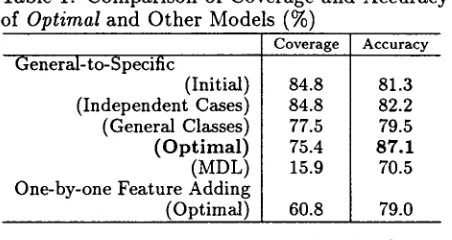
Table 1 shows the performance of subcategoriza- tion preference test described in section 4.2.2, for the approximately optimal models selected by the procedure in section 4.4 (the "Optimal" mode] of "General-to-Specific" method), as well as for several other models including baseline models. Coverage is the rate of test instances which sat- isfy the case covering constraint of section 4.1. Accuracy is measured with the following heuris- tics: i) verb-noun collocations which satisfy the
Table 1: Comparison of Coverage and Accuracy
of O p t i m a l and Other Models (%)
General-to-Specific
(Initial) (Independent Cases) (General Classes) (Optimal) (MDL) One-by-one Feature Adding
(Optimal)
Coverage
84.8 84.8 77.5 75.4 15.9
60.8
Accuracy
81.3 82.2 79.5 87.1 70.5
79.0
case covering c o n s t r a i n t are preferred, it) even
those verb-noun collocations which do not satisfy
the case covering constraint are assigned the con-
ditional probabilities in (15) by neglecting cases which are not covered by the model. W i t h these heuristics, subcategorization preference can be judged for all the test instances, and test set cov- erage becomes 100%.
In Table 1, the "Initial" model is the one constructed according to the description in sec- tion 4.1, in which cases are independent of each other and the sense restriction of each case is (one of) the most general class(es). The "Inde- pendent Cases" model is the one obtained by re- moving all the case dependencies from the "Op- timal" model, while the "General Classes" model is the one obtained by generalizing all the sense restriction of the "Optimal" model to the most general classes. The "MDL" model is the one with the m i n i m u m description length. This is for evaluating the effect of the MDL principle in the task of subcategorization preference model learning. The "Optimal" model of "One-by-one Feature Adding" m e t h o d is the one selected from the sequence of one-by-one feature adding in sec- tion 3.1 by the procedure in section 4.4.
The "Optimal" model of 'General-to-Specific" method performs best among all the models in Table 1. Especially, it outperforms the "Op- timal" model of "One-by-one Feature Adding" method b o t h in coverage and accuracy. As for the size of the optimal model, the average num- ber of the active feature set is 126 for "General- to-Specific" method and 800 for "One-by-one Feature Adding" method. Therefore, general-to-
specific feature selection algorithm achieves sig-
nificant improvements over the one-by-one fea-
ture adding algorithm with much smaller num-
ber of active features. The "Optimal" model of "General-to-Specific" method outperforms both the "Independent Cases" and "General Classes" models, and thus both of the case dependencies and specific sense restriction selected by the pro- posed method have much contribution to improv- ing the performance in subcategorization prefer-
ence test. The "MDL" model performs worse t h a n the "Optimal" model, because the features of the "MDL" model have much more specific sense restriction t h a n those of the "Optimal" model, and the coverage of the "MDL" model is much lower than t h a t of the "Optimal" model.
6 C o n c l u s i o n
This paper proposed a novel method for learn- ing probability models of subcategorization pref- erence of verbs. Especially, we proposed a new model selection algorithm which starts from the most general model and gradually examines more specific models. In the experimental evaluation, it is shown t h a t both of the case dependencies and specific sense restriction selected by the pro- posed method contribute to improving the per- formance in subcategorization preference resolu- tion. As for future works, it is i m p o r t a n t to eval- uate the performance of the learned subcatego- rization preference model in the real parsing task.
R e f e r e n c e s
A. L. Berger, S. A. Della Pietra, and V. J. Della Pietra. 1996. A Maximum Entropy Approach to Nat- ural Language Processing. Computational Linguistics,
22(1):39-71.
E. Charniak. 1997. Statistical Parsing with a Context- free Grammar and Word Statistics. In Proceedings of
the 14th AAAI, pages 598-603.
M. Collins. 1996. A New Statistical Parser Based on Bi- gram Lexical Dependencies. In Proceedings of the 34th
Annual Meeting of ACL, pages 184-191.
S. Della Pietra, V. Della Pietra, and J. Lafferty. 1997. Inducing Features of Random Fields. IEEE Transac- tions on Pattern Analysis and Machine Intelligence,
19(4):380-393.
EDR (Japan Electronic Dictionary Research Institute, Ltd.). 1995. EDR Electronic Dictionary Technical
Guide.
H. Li and N. Abe. 1995. Generalizing Case Frames Using a Thesaurus and the MDL Principle. In Proceedings of International Conference on Recent Advances in Natu-
ral Language Processing, pages 239-248.
H. Li and N. Abe. 1996. Learning Dependencies between Case Frame Slots. In Proceedings of the 16th COLING,
pages 10-15.
D. M. Magerman. 1995. Statistical Decision-Tree Models for Parsing. In Proceedings of the 33rd Annual Meeting
of A CL, pages 276-283.
NLRI (National Language Research Institute). 1993.
Word List by Semantic Principles. Syuei Syuppan. (in
Japanese).
P. Resnik. 1993. Semantic Classes and Syntactic Ambigu- ity. In Proceedings of the Human Language Technology
Workshop, pages 278-283.
J. Rissanen. 1984. Universal Coding, Information, Pre- diction, and Estimation. IEEE Transactions on Infor-
mation Theory, IT-30(4):629-636.
[image:7.612.75.301.86.206.2]