PARSING WITH LOGICAL VARIABLES
Timothy W. Finln and Martha Stone Palmer Department of Computer and Information Science
University of Pennsylvania Philadelphia, PA 19104
ABSTRACT
L o g i c b a s e d p r o g r a m m i n g s y s t e m s h a v e e n j o y e d an i n c r e a s i n g p o p u l a r i t y i n a p p l i e d AI work i n t h e last few years. One of t h e contributions to Computational Linguistics made by the Logic Programming Paradigm has been the Definite Clause Grammar. In comparing DCG's wlth previous parsing mechanisms such as ATN's, certain clear advantages are seen. We feel that the most important of these advantages are due to the use of Logical Variables with Unification as the fundamental operation on them. To illustrate the power of the Logical Variable, we have implemented an experimental ATN system which treats ATN registers as Logical Variables and provides a unification operation over them. We would llke to simultaneously encourage the use of the powerful mechanisms available in DCG's, and demonstrate that some of these techniques can be captured without reference to a resolution theorem prover.
[ . Introduction
Logic based programming systems have enjoyed an increasing popularity in applied AI work in the last few years. One of the contributions to Computational Linguistics made by t h e Logic Programming Paradigm has been the Deflnite Clause Grammar. An excellent introduction t o this formalism can be found in [Perelra] in which the authors present the formalism and make a detailed comparison to Augmented Transition Networks as a means of both specifying a language and parsing sentences in a language.
We feel Chat the major strengths offered by the DCG formalism arise from its use of Logical variables with Unification as the fundamental operation on them. These techniques can be abstracted from the theorem proving paradigm and adapted to other parsing systems (see [Kay] and [Bossie] ). We have implemented an experimental ATN system which treats ATN registers as Logic variables and provides a unification operation over them.
The DCG formalism provides a powerful mechanism for parsing based on a context free grammar. The grammar rule
S -> NP VP
can be seen as the universally quantified logical statement,
For all x, y, and z :
N'P(x) /\ VP(y) /\ Concatenate(x,y,z) -> S(z). where "x" and "y" represent sequences of words which can be concatenated together to produce a sentence, "S." Prolog, a progra~mulng language b a a e d on predicate calculus, allows logical statements to be input as Horn clauses in the foilowlng (reversed) form:
s(Z) <- np(X),vp(Y),Concatenate(X,Y,Z).
The resolution theorem prover that "interprets" the Prolog clauses would take the oegatlon of S as the goal and try and produce the null clause. Thus the preceding clause can be interpreted procedurally as, "To establish goal S, try and establish subgoals, NP, VP and Concatenate." DCG's provide syntactic sugar on top of Prolog so that the arrow can be reversed and the
"Concatenate" predicate can be dispensed with. The
words in the input string are looked at sequentially each time a "[Word]" predicate is executed which implicitly tests for concatenation (see figure [). DCG's allow grammar rules to be expressed very cleanly, while still allowing ATN-type augmentation through the addition of arbitrary tests on the contents of the variables.
Pereira and Warren argue that the DCG formalism is well suited for specifying a formal description of a language and also for use with a parser. In particular, they assert that it is a significant advance over an ATN approach on both philosophical and practical grounds. Their chief claims are that:
[. DCGs provide a common formalism for theoretlcal work in Computational Linguistics and for writing efficient natural language processors.
62
2. The rule based nature of a DCG result %n systems of greater clarity and modularity.
the rules of a conscltuenc and easy Co create a structure for a constituent thac depends on items not yec encountered in the sentence.
Fig. 1 . A DeflniCe C l a u e e Grammar s ( P ) -> rip(X, P l , P ) , vp(X, P t ) .
The flrsC two points have been discussed in the past whenever the ATN formalism is compared with a rule-based grammar (see [PracC] , [Heldorn] , [Codd] , o r [ B a t e s ] ) . The outcome of s u c h discussions v a r y . I t i s safe Co s a y c h a t how one feels about these points depends quite heavily on past experience in using the two formalisms.
We f i n d t h e t h i r d p o i n t co be w e l l f o u n d e d , however. Ic i s c l e a r chac t h e DCG d i f f e r s moeC from p r e v i o u s r u l e - b a a e d p a r s i n g s y s t e m s i n i c e i n c l u s i o n of L o g i c a l v a r i a b l e s . T h e s e r e s u l t i n g r e a t e r f l e x i b i l i t y i n b u i l d i n g s t r u c t u r e s co r e p r e s e n t c o n s t i t u e n t s t h a t do mot follow t h e I n h e r e n t s t r u c t u r e d e t e r m i n e d by t h e r u l e s
themselves. They also allow one co create
structures which refer Co Items chac have not yec
been discovered i n the course of analysing the
sentence.
We have b u i l t an e x p e r i m e n t a l ATN s y s t e m which c a n c r e s t ATN r e g i s t e r s a s L o g i c a l v a r i a b l e s and, we f e e l , c a p t u r e t h e s e i m p o r t a n t s t r e n g t h s o f f e r e d by the DCG formalism in the ocherwlse standard ATN formalism.
The s e c o n d s e c t i o n g i v e s a more d e t a i l e d d e s c t p C t o n of DCG's and p r e s e n t s a s i m p l e grammar. In t h e t h i r d s e c t i o n we show am ATN grammar which i s " e q u i v a l e n t " t o t h e DCC grammar and d i s c u s s t h e
source of Its awkwardness. The fourth section chert
presence an ATN formalism extended co include
viewing ATN registers as Logical variables which are subject to the standard unlficacloa operaclon. The final section concludes this note and suggests
that logical variables might be fruitfully
i n t r o d u c e d i n t o o c h e r p a r s i n g a l g o r i t h m s and systems.
rip(X, Pl, P) -> dec(X, P2, PI, P), n(X, P3),
relclauee(X, P3, P2). rip(X, P , P) -> name(X).
vp(X, P) -> t r a n e v ( X , Y, P l ) , np(Y, P l , P ) . vp(X, P) -> t n c r a n s v ( X , P ) .
r e l c l a u s e ( X , P I , (And PI P2)) -> [ c h a t ] , vp(X, P 2 ) . r e l c l a u a e ( X , P, P) -> [],
dec(X, Pl, P2, (ForAll X (-> P! P2))) -> [everyl. dec(X, P l , P2, (ForSome X (And Pt P 2 ) ) ) -> [ a ] . n(X, (man X)) -> [,u.].
n(X, ( w o u n X ) ) -> [wom~.]. n(X, (dog X)) -> [dog]. n a m e ( J o h n ) -> [John] name(mary) -> [mary] n a m I ( f l d o ) -> [fido]
transv(X, Y, (loves X Y)) -> [loves]. transv(X, Y, (breaches X Y)) -> [breathesl. I n c r a n e v ( X , ( l o v e s X) -> [ l o v e s ] .
l n c r a n s v ( X , ( l i v e s X).-> [ l i v e s ] . i n c r a n e v ( X , ( b r e a t h e s X) -> [ b r e a t h e s ] .
2. Definite Clause Grammars
Figure [ shows a simple DCG grammar adapted from [Perelra] . Figure 2 gives a sentence in the language recognized by thls grammar together wlth the associated surface syntactic structure and the semantic structure built by the grammar.
F i E • 2 . A S e n t e n c e , S t r u c t u r e and R e p r e s e n t a t i o n SENTENCE
"John loves every woman who breathes"
The way in which unification produces the
appropriate bindings for this example ls actually quite subtle, and requires a detailed analysis of the parse, as represented by the refutation graph
in Figure 3. For the the refutation graph the
Prolog clauses have been put into claueal normal
form. Some liberties have been taken with the
ordering of the predicates in the interest of
compactness.
In trying to establish the "s(P)" goal, the "np(X,Pt,P)" is first attempted. The "PI" is an
empty variable that is a "place-holder" for
predicate information chat will come from the verb. It will "hold" a place in the sentence structure that will be provided by =he determiner. "P" i s
destined to contain the sentence structure. The
SYNTACTIC STRUCTURE (S (NP (NAME john))
(VP (TRANSV loves) (NP (DET every)
(NOUN woman)
(REL (VP (INTRANSV breathes)))))))
SEMANTIC REPRESENTATION
Pig.
3. Refutation Graph
- . . ~ / ~
\ /-np(X.Pt,e)
\ /-vp(X,et)
" v p ( X , P t ) \ / ' n p ( X , P i , P ) np(X.P,P) V
- ~ , . q . . ~ ~
\ / - [ j o h n ]"vD(to~~.,~.~\/'transv(X,Y,Pt)\/-n
~
_ ~
-np(Y,PL,P),/-transv(John.Y.Pl)~rnn.v(X-Y-love.(X.Y~\/-[Loves]~'~l]
) flovesl
[
1-det(X,F2,PL,P)\/
nD(Yloves
~ohn
Y) P
\ / loveqve
-n(X'P3)\/relclause(X'P31P2)\/n~
[ ~ [ _ _ s r y _ ] \ / - d e t ( X , P i , P 2 t ( F o r a l X X
(>Pl P2)))
- d e c C Y . P 2 . L o v e s ( i o h n . Y ) . P ) \ //
-n(Y,P3)\/-relclause(Y,P3,P2)
(P is bound to "Forall
Y(=>~ lo~s(john,Y))")
[ ]
"[woman]\/-n(X,{woma~V'relclause(Y,P3,P2)
[woman]
"[woman]\/ -relclause(Y.(woman Y).P2~
-vp(X,P2)\/ -[that]\/
\
r e l ¢
PL .0o)).
(PI is bound to "And-(woman
Y) P2")//lause(x'PL'(And
intransv(X.~eathes(X~
-Int~'~nq.(V:P2~~ /
(P2 is bound
Co"breathes(Y)")
first " n p " clause will be matched, but it will eventually fall since no determiner is present. The second "rip" clause will'succeed, having forever identified the contents o f "Pl" with the contents of "P, " whatever they may be. S i n c e t h e r e is no determiner in the first noun phrase, there is no quantification information. The quantlflcatlonal structure must be supplied by the verb phrase, so
t h e s t r u c t u r e f o r t h e s e n t e n c e will be t h e same a s t h e s t r u c t u r e f o r t h e v e r b p h r a s e . The v a r i a b l e
" X " w i l l be bound t o " J o h n " .
I n t r y i n g co e s t a b l i s h " v p ( J o h n , P l ) , " t h e
first "wp" clause w(ll succeed, since "loves" is a transitive verb. It is important n o t to get the variables confused. Within the "vp" clause our original "Pl" has been renamed "P" and and we have a new "PI" variable that will be Instantlated to "(loves John Y)" by the success of the "=canny" goal. The "Y" I s as y e t undetermined, b u t we can see that I t will be supplied by the next
" n p ( Y , ( l o v e s J o h n ¥ ) , P ) " g o a l . I t shows g r e a t f o r e s i g h t on " t r a n s v ' s " p a r t to p a s s b a c k a v a r i a b l e in s u c h a way t h a t i t will c o r r e s p o n d t o a v a r i a b l e t h a t h a s a l r e a d y b e e n named. T h i s p a t t e r n i s r e p e a t e d t h r o u g h o u t t h e g r a m m a r , w i t h p o w e r f u l l r e p u r c u s s l o n s . I t i s e v e n c l e a r e r I n t h e s u c c e s s
of the "np(Y,(loves John Y),P)" goal, where the presence of the determiner "every" causes "P" to be bound to
( F o r a l l Y ( - > PI ( l o v e s J o h n Y ) )
This "P" is of course the "P" mentioned above which has been waiting for the verb phrase to supply It with a quantlflcatlonal structure.
As the relative clause for this "up" is processed, the "PI" embedded in this structure,
( o u r second new PII), is eventually bound t o "(And (woman Y) (breaches Y))" giving us the full structure:
(Forall Y (-> (And (woman Y) (breaches Y)) (loves John Y)))
This is whac is returned as the binding to the first "Pl" in the original "vp(X,Pt)" goal. Since our "np(X,P[,F)" goal identified "P" wlth "Pl, " our "s(P)" goal succeeds with the binding of
(Forall Y (=> (And (woman Y) (breathes Y)) (loves John Y)))
for "P" - the final structure built for the
s e n t e n c e .
In following the execution of this grammar i t
becomes clear that very ~trong predictions are made about which parrs of the parse will be supplying particular ~ypes of information. Determiners will provide the quanClElers for the propositional ~tructure of the sentence, the flrsc noun phrase and the noun phrase following the verb will be the two participants in ~he predicate implied by the verb, etc. Obviously this is a simple grammar, but the power of the logical variables can only be made use o f t h r o u g h t h e e n c o d i n g o f t h e s e s t r o n g l i n g u i s t i c a s s u m p t i o n s . DCG's seem t o p r o v i d e , a = e c h a n l s m w e l l q u a l i f i e d f o r e x p r e s s i n g such
assumptions and then executing them. Coming up with the assumptions in the first place Is, of
c o u r s e , s o m e t h i n g o f a m a j o r t a s k I n i t s e l f .
3. Comparing DC and ATN Grammars
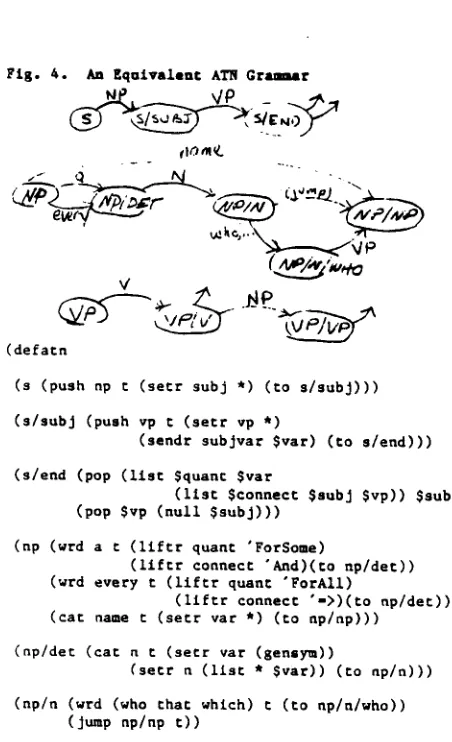
Figure 4 shows an ATN grammar which is the "equivalent" of the DCG grammar given in Figure t. The format used to specify the grammar is the one described in [flninl] and [finln2] . There are only two minor ways that this particular formalism differs from the standard ATN formalism described in [WoodsY0] or [Bates] . First, the dollar sign Character (i.a. $) followed by the name of a register stands for the contents of that register. Second, the function DEFATN defines a set of arcs, each of which is represented by a llst whose first element is the name of the state and whose remaining elements are the arcs emanating from the state.
I n a d d i t i o n , t h i s e x a m p l e u s e s a v e r y s i m p l e l e x i c a l m a n a g e r i n w h i c h a w o r d has ( 1 ) a s e t o f
s y n t a c t i c c a t e g o r i e s t o which It belongs (2) an optional set of features and (3) an optional root form for the word. These attributes are associated with a word ualng the function LEX, which supplies
a p p r o p r i a t e default values f o r unspecified arguments.
In the standard ATN model, a PUSH arc invokes a sub-computatlon which takes no arguments and, if successful, returns a single value. One can achieve the affect of passing parameters to a sub-computatlon by giving a register an initial value via a SENDR register setting action. There are two methods by which one can achieve the effect of returning more than one value from a sub-computatlon. The values to be returned can be packaged into a llst or the LIFTR register setting action can be used to directly set values in the higher level computation. This grammar makes use of SENDR and LIFTR to pass parameters into and ouC of ATN computations and thus the actions of the DCC example.
C o n s i d e r w h a t must h a p p e n when l o o k i n g f o r a n o u n p h r a s e . The r e p r e s e n t a t i o n f o r a NP w i l l be a
p r e d i c a t e i f t h e noun p h r a s e i s i n d e f i n i t e ( i . e . " a man" b e c o m e s (man X)) o r a c o n s t a n t I f t h e noun
Fig. 4. An E q u i v a l a u t ATN G r a ~ a r
¢lOmq~
V
(defatn
(s (push n p t ( s e t r s u b j *) ( t o s / s u b J ) ) ) ( s / s u b J (push vp t ( s e t r vp *)
( s e n d r s u b J v a r $ v a r ) (to s / e n d ) ) )
(s/end (pop ( l i s t $quanc $var
( l i s t $connect $aubJ $vp)) $subj)
(pop gYp (null gsubj))) (np (wrd a t (liftr quant "ForSome)
(llftr connect "And)(co np/det)) (wrd every t (liftr quant "ForAll)
(liftr connect "->)(to n p / d e t ) )
( c a t name t ( s e t r v a t *) (to rip/rip))) ( n p / d e t ( c a t n t ( s e c t var (gensym))
( s e t r n (list * S v a r ) ) ( t o n p / n ) ) ) (np/n (wrd (who that which) t (to up/n/who))
(Jump np/np t))
( n p / n p (pop gn C ( l i f t r v a r ) ) )
(np/n/who
(push vp t (sendr subJvar gvar)
( s e r f n ( l i s t "And gn *)) ( t o np/np)))
(vp ( c a t v t ( s e t r v *) (co v p / v ) ) )
(vp/v (push np ( g e t f trans Sv) (sect obJ *) (seCt objvar Svar) ( t o vp/vp))
(pop (list gv $subjvar) (gaff lntrans $v))) (vp/vp (pop (list gquant $objvar
(list $connect $obJ
(list gv $ s u b J v a r $objvar))> $obj)
(pop (flat $v gsubjvar $obJvar) (null $obJ)))~ ; (le× <word> <category> <features> <rootform>) (lex man n)
(lex woman n)
(lax loves v (intrans crans)) (lax breathes v (incrans trans)) (lax lives v (Intrans))
(lex john name) (lex mary name) (lex fldo name)
66
Similarly, when we are lookzn8 for a verb
phrase, we must know what token (i.e. variable name or constant) represents the subject (if the verb phrase is dominated by a S) or the head noun (if
the verb phrase acts as a relative clause). This
is done by sanding the subJvar register in the
sub-computation the appropriate value via the SENDR
function. The techniques used to quancificatlon
and build an overall sentence structure in chls ATN
grammar are similar co those used in th~ BBN Lunar Grammar [Woods72] .
This heavy use of SENDR and LIFTR co
communicate between levels in the grammar makes the ATN grammar cumbersome and difficult to unaerstand.
In the next secton we investigate treating ATN
registers as logic variables and providing a
unification operation on them.
4. Replacing ATN Registers with ATN Variables
Although the previous &TN grammar does the
Job, it is clearly awkward. We can achieve much of
the elegance of the DCG example by treating the ATN r e g i s t e r s as l o g i c a l v a r i a b l e s and i n c l u d i n g a
unification operation on them. We will call such
registers ATN Variables.
Since our ATN variables must not be tampered
with between unifications, assignment operations
such as SETR, LIFTR and SENDR are precluded. Thus
the only operations on ATN Registers are access and ualfy. I t is possible to provide operations similar t o the standard SENDR and LIFTR by defining
unification operations which do the unification in
the another environment, but we have not explored
these possibilities.
The scheduler component of the ATN parser has
been modified to be sensitive to the success or
failure of attempted unifications, if a
unification operation on an arc fails, the arc is blocked and may not be taken.
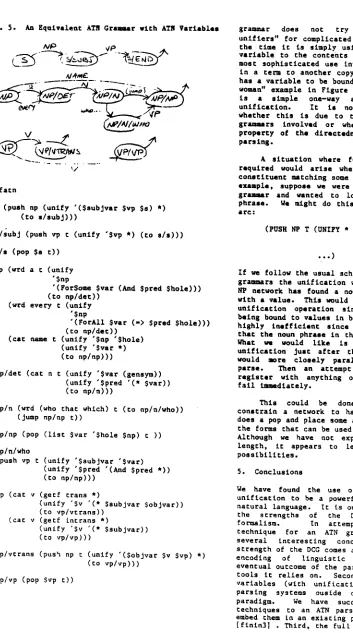
Figure 5 shows a grammar in the extended ATN formalism. A symbol preceded by a "$" represents an ATN Variable and "*" will again stand for ~he
current constituenE. Thus in the state S in the
grammar:
(S (PUSH NP (UNIFY "($SUBJVAR gYP $S) *) (TO S/SUBJ)))
the parser pushes to the state NP co parse a noun
phrase. If one is found, it will pop back wi~h a
value which will then be unified wi~h the
expression (SSUBJVAR $VF $S). If this unification
is successful, the parser will advance to state
S/SUBJ. If It fails, the arc is blocked causing
the parser to backtrack into the NP network.
Although our grammar succeeds in mimicking the behavlour of the DCG, there are some open questions Involvlng the use of unification [n parsing natural
languages. An examination of ~his ATN grammar
shows that we are really using unification as a
method of passing parameters. The full power of
[image:5.612.92.318.81.452.2]F i g . 5. An E q u i v a l e n t ATN Gra.mar w i t h ATN V a r i a b l e s
N P
....
(defatn
( s (push np ( u n i f y " ( $ s u b J v a r $vp e s ) *)
(to s/subJ)))
( s / s u b J (push vp t ( u n i f y "$vp * ) (tO s / s ) ) ) ( s / s (pop e s t ) )
(np (wrd a t (unify "$np
'(gorSome $var (And epred ehole))) (to n p / d e t ) )
(wrd e v e r y t (unify 'Sup
" ( F o r A l l e v e r (=> e p r e d S h o l e ) ) ) ( t o n p / d e t ) )
( c a t name t (unify 'Sap ' $ h o l e )
(unify "eYrir *) (tO np/np)))
(np/det (cat n C (unify "$var (gensym)) (unify "$pred "(* evar)) ( t o n p / n ) ) )
( n p / n (wrd (who t h a t which) t (to n p / u l w h o ) ) (Jump rip/rip t))
(up/up (pop (Slat evar "$hole $np) t )) (np/n/who
(push vp t (unify " $ s u b J v a r '$var) (unify "$pred "(And Spred *)) (to up/up)))
(vp ( c a t v (getf trans *)
(unify "$v "(* esubjvar $obJvar)) ( t o v p / v t r a n s ) )
(cat v (getf [ntrans *)
(unify "$v '(* $subjvar)) ( t o v p / v p ) ) )
(vp/vtrans (push np t (unify "($objvar ev $vp) *) (tO v p / v p ) ) )
(vp/vp (pop evp t ) )
grammar does not try to find "most-general
unifiers" for complicated sets of terms. Most of the time it is simply using unification to bind a v a r i a b l e to the contents of another variable. The most sophisticated use involves binding a variable i n a term t o another copy of that term which also has a variable to be bound as in the "a man loves a woman" example in Figure 6. But even this binding
is a simple one-way application of standard
unification. St is n o t clear t o the authors
whether this is due to the s i m p l e nature of the grammars i n v o l v e d o r w h e t h e r it i s an i n h e r e n t p r o p e r t y of t h e d l r e c t e d n e e e of n a t u r a l language p a r s i n g .
A situation where full unification eight be required would arise when one is looking for a
constituent matching some partial description. For
example, suppose we were working with a syntactic
grammar and wanted to look for a singular noun
phrase. We might do this with the following PUSH
arc:
(PUSH NP T (UNIFY * '(NP (DET eDET)
(NUMBER SINGULAR)
(ADJ $ADJS) ...))
If we follow the usual schedule of interpreting ATN g r a . - - - r s the unification will not occur until the NP network has found a noun phrase and popped back with a v a l u e . This would r e q u i r e a fully symmetric
unification operation since there a r e variables
being bound to values in both arguments. It is also highly i n e f f i c i e n t since we may know rlghc away that the noun phrase in the input is not singular.
What we would iike is to be able to do the
unification Just after the push is done, which
would more closely parallel a Prolog-based DCG
parse. Then an attempt to "unify" the number register with anything other than singular will fall i m m e d i a t e l y .
This could be done automatically if we
constrain a network to have only one state which does a pop and place some additional constraints on the forms that can be used as values to be popped.
Although we have not explored this idea at any
length, it appears to lead co some interesting
possibilities.
5. Conclusions
We have found the use of l o g i c a l v a r i a b l e s and
u n i f i c a t i o n to be a p o w e r f u l t e c h n i q u e i n p a r s i n g n a t u r a l language. I t [s one of t h e main s o u r c e s of
the strengths of the Definite Clause Grammar
f o r m a l i s m . In a t t e m p t i n g t o c a p t u r e t h i s
t e c h n i q u e f o r an ATN grammar we have come co
several interesting conclusions, First, the
strength of the DCG comes as much from the skillful
encoding of linguistic assumptions about the
eventual outcome of the parse as from the powerful
tools it relies on. Second, the notion of logical
variables (with unification) can be adapted to
parsing systems ouside of the theorem proving
paradigm. We have successfully adapted these
[image:6.612.91.444.77.710.2]not be dddessary tO suddessfully u&e ldgidal variables in natural lanuage parsers.
Fig. 6. Zxatple Pa~Ses w i t h t h e ATW G ~ a m ~
"John loves every woman who breathes"
(ForAll XI (-> (And (woman Xl) (breathes XI))
(loves John Xl)))
"John loves a woman"
(ForSome Xl (And (woman Xl) (loves John XI)))
"a man loves a woman" (ForSome XI
(And (man X[)
(ForSome X2 (And (woman X2) (loves Xl X2))))
"every man who lives loves"
(ForAll Xl (-> (And (man XI) (lives XI)) (loves Zi)))
"every man who loves mary loves a woman who loves john"
(ForAll Xl
('> (And (man XI) (loves XI mary)) (ForSome X2 (And (And (woman X2)
(loves X2 John)) (loves XI X2)))))
"every man who loves a woman who loves every dog loves every dog"
(ForAll XI
(=> (And (man XI) (ForSome X2
(And (And (woman X2) (ForAll X3
(=> (dog X3)
(loves X2 X3)))) (loves Xl X2))))
(ForAll X4
(-> (dog X4) (loves Xl X4)))))
6. References
[. Bates, M., Theory and Practice or %ugmented
Transition Network Grammars, in Natural Language
Communication with Computers, ~ 7 - - " ~ c ~
Springer-Verlag, [978.
2. Bossle, S., "A Tactical Component for Text
Generation: Sentence Generation Using a Functional
Grammar", r e p o r t HS-CIS-[982-26, Computer and
Informatlon Science, University of Pennsylvania,
1982.
3. Codd, E. F., A r n o l d , R.S., Cad[on, J-M., Chang, C. L. and Roussopoulos, N., RENDEZVOUS Version 1: An Experimental Engllsh-Language Query Formulation System for Casual Users of Relational Data Bases, Report RJ2144, IBM Research Laboratory, San Jose, January 1978
4. Coimerauer, A., "Metamor1~hosls Grammars", in L. Bolt (Ed.), Natural Language Communication with
Computers,
Sprlnger-Verlas, I978.5. Finln, T., An Interpreter and Compiler for
Augmented Transition Networks, Coordinated Science Laboratory technical report T-48, University of
Illinois, 1977.
6. Finln, T., Parsing with ATN Grammars; to a p p e a r an Leonard Bolt (ed.) Data Base question Answerin~ Systems, Sprlnger-Verlag, Berlin, [982.
7. Fin[n, T. and B. L. Webber, BUP - A Bottom Up
Parser, report MS-CZS-[982-27, Computer and
Information Science, University of Pennsylvania, [982.
8. ffeidorn, G., Augmented Phrase Structure Grammar, TINLAP-[, [975.
9. Kay, H., "Functional Grammar", Proceedings of th__ee Fifth Annual Meeting of the Berkeley Lin~uistic Sgciety , [979.
[0. Pratt, V. "LINGOL, A Progress Report", IJCAI ~,
1975.
I[. ?ereira, F. and D. Warren, "Definite, Clause Grammars for Language Analysis - A Survey of the
Formalism and a Comparison with Augmented
Transition Networks"., Artificial Intelligence [3 ( [ 9 8 0 ) , 231-278.
[2. Winograd, T . , Language a s ~ Co~nitive P r o c e ~ - , Addison-Wesley Publishing Co.,Inc,[983, 349-351.
13. Woods, W., Transition Network Grammars ~
Natural Language Analysis, CACM 13:10, 1970. 14. Woods, W. A., R. M. Kaplan and B. L. Webbe "The Lunar 3ciences Natural Language Informatio:
System: F~nal Report", BBN report 2378, [972.