Are These Documents Written from Different Perspectives? A Test of
Different Perspectives Based On Statistical Distribution Divergence
Wei-Hao Lin
Language Technologies Institute School of Computer Science
Carnegie Mellon University Pittsburgh, PA 15213 U.S.A.
Alexander Hauptmann Language Technologies Institute
School of Computer Science Carnegie Mellon University Pittsburgh, PA 15213 U.S.A.
Abstract
In this paper we investigate how to auto-matically determine if two document col-lections are written from different
per-spectives. By perspectives we mean a
point of view, for example, from the per-spective of Democrats or Republicans. We propose a test of different perspectives based on distribution divergence between the statistical models of two collections. Experimental results show that the test can successfully distinguish document collec-tions of different perspectives from other types of collections.
1 Introduction
Conflicts arise when two groups of people take very different perspectives on political, socio-economical, or cultural issues. For example, here are the answers that two presidential candidates, John Kerry and George Bush, gave during the third presidential debate in 2004 in response to a ques-tion on aborques-tion:
(1) Kerry: What is an article of faith for me is not something that I can legislate on some-body who doesn’t share that article of faith. I believe that choice is a woman’s choice. It’s between a woman, God and her doctor. And that’s why I support that.
(2) Bush: I believe the ideal world is one in which every child is protected in law and wel-comed to life. I understand there’s great dif-ferences on this issue of abortion, but I be-lieve reasonable people can come together and put good law in place that will help re-duce the number of abortions.
After reading the above transcripts some readers may conclude that one takes a “pro-choice” per-spective while the other takes a “pro-life” perspec-tive, the two dominant perspectives in the abortion controversy.
Perspectives, however, are not always mani-fested when two pieces of text together are put to-gether. For example, the following two sentences are from Reuters newswire:
(3) Gold output in the northeast China province of Heilongjiang rose 22.7 pct in 1986 from 1985’s level, the New China News Agency said.
(4) Exco Chairman Richard Lacy told Reuters the acquisition was being made from Bank of New York Co Inc, which currently holds a 50.1 pct, and from RMJ partners who hold the remainder.
A reader would not from this pair of examples per-ceive as strongly contrasting perspectives as the Kerry-Bush answers. Instead, as the Reuters an-notators did, one would label Example 3 as “gold” and Example 4 as “acquisition”, that is, as two
top-ics instead of two perspectives.
Why does the contrast between Example 1 and Example 2 convey different perspectives, but the contrast between Example 3 and Example 4 result in different topics? How can we define the impal-pable “different perspectives” anyway? The defi-nition of “perspective” in the dictionary is “subjec-tive evaluation of rela“subjec-tive significance,”1 but can we have a computable definition to test the exis-tence of different perspectives?
1The American Heritage Dictionary of the English
Lan-guage, 4th ed. We are interested in identifying “ideologi-cal perspectives” (Verdonk, 2002), not first-person or second-person “perspective” in narrative.
The research question about the definition of different perspectives is not only scientifically in-triguing, it also enables us to develop important natural language processing applications. Such a computational definition can be used to detect the emergence of contrasting perspectives. Me-dia and political analysts regularly monitor broad-cast news, magazines, newspapers, and blogs to see if there are public opinion splitting. The huge number of documents, however, make the task ex-tremely daunting. Therefore an automated test of different perspectives will be very valuable to in-formation analysts.
We first review the relevant work in Section 2. We take a model-based approach to develop a computational definition of different perspectives. We first develop statistical models for the two doc-ument collections,AandB, and then measure the degree of contrast by calculating the “distance” betweenAandB. How document collections are statistically modeled and how distribution differ-ence is estimated are described in Section 3. The document corpora are described in Section 4. In Section 5, we evaluate how effective the proposed test of difference perspectives based on statistical distribution. The experimental results show that the distribution divergence can successfully sepa-rate document collections of different perspectives from other kinds of collection pairs. We also in-vestigate if the pattern of distribution difference is due to personal writing or speaking styles.
2 Related Work
There has been interest in understanding how be-liefs and ideologies can be represented in comput-ers since mid-sixties of the last century (Abelson and Carroll, 1965; Schank and Abelson, 1977). The Ideology Machine (Abelson, 1973) can simu-late a right-wing ideologue, and POLITICS (Car-bonell, 1978) can interpret a text from conserva-tive or liberal ideologies. In this paper we take a statistics-based approach, which is very differ-ent from previous work that rely very much on manually-constructed knowledge base.
Note that what we are interested in is to deter-mine if two document collections are written from different perspectives, not to model individual per-spectives. We aim to capture the characteristics, specifically the statistical regularities of any pairs of document collections with opposing perspec-tives. Given a pair of document collectionsAand
B, our goal is not to construct classifiers that can predict if a document was written from the per-spective ofAorB(Lin et al., 2006), but to deter-mine if the document collection pair (A,B) con-vey opposing perspectives.
There has been growing interest in subjectivity and sentiment analysis. There are studies on learn-ing subjective language (Wiebe et al., 2004), iden-tifying opinionated documents (Yu and Hatzivas-siloglou, 2003) and sentences (Riloff et al., 2003; Riloff and Wiebe, 2003), and discriminating be-tween positive and negative language (Turney and Littman, 2003; Pang et al., 2002; Dave et al., 2003; Nasukawa and Yi, 2003; Morinaga et al., 2002). There are also research work on automati-cally classifying movie or product reviews as pos-itive or negative (Nasukawa and Yi, 2003; Mullen and Collier, 2004; Beineke et al., 2004; Pang and Lee, 2004; Hu and Liu, 2004).
Although we expect by its very nature much of the language used when expressing a perspective to be subjective and opinionated, the task of la-beling a document or a sentence as subjective is orthogonal to the test of different perspectives. A subjectivity classifier may successfully identify all subjective sentences in the document collection pair A and B, but knowing the number of sub-jective sentences inAand Bdoes not necessarily tell us if they convey opposing perspectives. We utilize the subjectivity patterns automatically ex-tracted from foreign news documents (Riloff and Wiebe, 2003), and find that the percentages of the subjective sentences in the bitterlemons corpus (see Section 4) are similar (65.6% in the Pales-tinian documents and 66.2% in the Israeli docu-ments). The high but almost equivalent number of subjective sentences in two perspectives suggests that perspective is largely expressed in subjective language but subjectivity ratio is not enough to tell if two document collections are written from the same (Palestinian v.s. Palestinian) or different per-spectives (Palestinian v.s. Israeli)2.
3 Statistical Distribution Divergence
We take a model-based approach to measure to what degree, if any, two document collections are different. A document is represented as a point 2However, the close subjectivity ratio doesn’t mean that
in aV-dimensional space, whereV is vocabulary size. Each coordinate is the frequency of a word in a document, i.e., term frequency. Although vec-tor representation, commonly known as a bag of words, is oversimplified and ignores rich syntactic and semantic structures, more sophisticated rep-resentation requires more data to obtain reliable models. Practically, bag-of-word representation has been very effective in many tasks, including text categorization (Sebastiani, 2002) and infor-mation retrieval (Lewis, 1998).
We assume that a collection of N documents,
y1, y2, . . . , yN are sampled from the following process,
θ ∼ Dirichlet(α)
yi ∼ Multinomial(ni, θ).
We first sample aV-dimensional vectorθ from a Dirichlet prior distribution with a hyperparameter
α, and then sample a documentyirepeatedly from a Multinomial distribution conditioned on the pa-rameterθ, whereniis the document length of the
ith document in the collection and assumed to be known and fixed.
We are interested in comparing the parameterθ
after observing document collectionsAandB:
p(θ|A) = p(A|θ)p(θ)
p(A)
= Dirichlet(θ|α+ X
yi∈A
yi).
The posterior distribution p(θ|·)is a Dirichlet dis-tribution since a Dirichlet disdis-tribution is a conju-gate prior for a Multinomial distribution.
How should we measure the difference between two posterior distributions p(θ|A) and p(θ|B)? One common way to measure the difference be-tween two distributions is Kullback-Leibler (KL) divergence (Kullback and Leibler, 1951), defined as follows,
D(p(θ|A)||p(θ|B))
=
Z
p(θ|A) logp(θ|A)
p(θ|B)dθ. (5)
Directly calculating KL divergence according to (5) involves a difficult high-dimensional integral. As an alternative, we approximate KL divergence using Monte Carlo methods as follows,
1. SampleP θ1, θ2, . . . , θM fromDirichlet(θ|α+ yi∈Ayi).
2. ReturnDˆ = M1 PMi=1logp(θi|A)
p(θi|B) as a Monte Carlo estimate ofD(p(θ|A)||p(θ|B)). Algorithms of sampling from Dirichlet distribu-tion can be found in (Ripley, 1987). AsM → ∞, the Monte Carlo estimate will converge to true KL divergence by the Law of Large Numbers.
4 Corpora
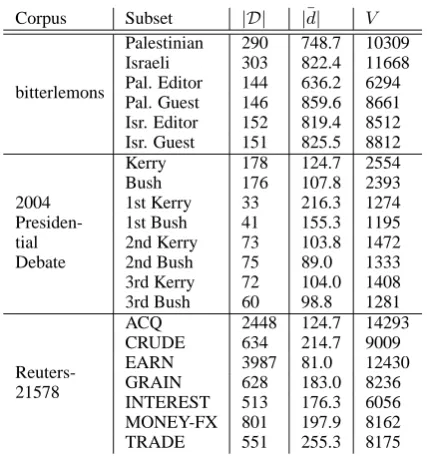
[image:3.595.310.524.300.529.2]To evaluate how well KL divergence between pos-terior distributions can discern a document collec-tion pair of different perspectives, we collect two corpora of documents that were written or spoken from different perspectives and one newswire cor-pus that covers various topics, as summarized in Table 1. No stemming algorithms is performed; no stopwords are removed.
Corpus Subset |D| |¯d| V
bitterlemons
Palestinian 290 748.7 10309 Israeli 303 822.4 11668 Pal. Editor 144 636.2 6294 Pal. Guest 146 859.6 8661 Isr. Editor 152 819.4 8512 Isr. Guest 151 825.5 8812
2004 Presiden-tial Debate
Kerry 178 124.7 2554
Bush 176 107.8 2393
1st Kerry 33 216.3 1274 1st Bush 41 155.3 1195 2nd Kerry 73 103.8 1472 2nd Bush 75 89.0 1333 3rd Kerry 72 104.0 1408 3rd Bush 60 98.8 1281
Reuters-21578
ACQ 2448 124.7 14293
CRUDE 634 214.7 9009
EARN 3987 81.0 12430
GRAIN 628 183.0 8236
INTEREST 513 176.3 6056 MONEY-FX 801 197.9 8162
TRADE 551 255.3 8175
Table 1: The number of documents |D|, average document length |¯d| , and vocabulary size V of the three corpora.
The first perspective corpus consists of arti-cles published on the bitterlemons website3 from late 2001 to early 2005. The website is set up to “contribute to mutual understanding [between Palestinians and Israelis] through the open ex-change of ideas”4. Every week an issue about the Israeli-Palestinian conflict is selected for discus-sion (e.g., “Disengagement: unilateral or coordi-nated?”), and a Palestinian editor and an Israeli editor each contribute one article addressing the
3
http://www.bitterlemons.org/
4http://www.bitterlemons.org/about/
issue. In addition, the Israeli and Palestinian ed-itors interview a guest to express their views on the issue, resulting in a total of four articles in a weekly edition. The perspective from which each article is written is labeled as either Palestinian or Israeli by the editors.
The second perspective corpus consists of the transcripts of the three Bush-Kerry presidential de-bates in 2004. The transcripts are from the website of the Commission on Presidential Debates5. Each spoken document is roughly an answer to a ques-tion or a rebuttal. The transcript are segmented by the speaker tags already in the transcripts. All words from moderators are discarded.
The topical corpus contains newswire from Reuters in 1987. Reuters-215786 is one of the most common testbeds for text categorization. Each document belongs to none, one, or more of the 135 categories (e.g., “Mergers” and “U.S. Dol-lars”.) The number of documents in each category is not evenly distributed (median 9.0, mean 105.9). To estimate statistics reliably, we only consider categories with more than 500 documents, result-ing in a total of seven categories (ACQ, CRUDE, EARN, GRAIN, INTEREST, MONEY-FX, and TRADE).
5 Experiments
A test of different perspectives is acute when it can draw distinctions between document collec-tion pairs of different perspectives and document collection pairs of the same perspective and others. We thus evaluate the proposed test of different per-spectives in the following four types of document collection pairs(A,B):
Different Perspectives (DP) A and B are
writ-ten from different perspectives. For example,
Ais written from the Palestinian perspective and Bis written from the Israeli perspective in the bitterlemons corpus.
Same Perspective (SP) AandBare written from
the same perspective. For example,AandB consist of the words spoken by Kerry.
Different Topics (DT) A and B are written on
different topics. For example, A is about 5
http://www.debates.org/pages/ debtrans.html
6http://www.ics.uci.edu/∼kdd/
databases/reuters21578/reuters21578.html
acquisition (ACQ) and B is about crude oil (CRUDE).
Same Topic (ST) A and B are written on the
same topic. For example, Aand Bare both about earnings (EARN).
The effectiveness of the proposed test of differ-ent perspectives can thus be measured by how the distribution divergence of DP document collection pairs is separated from the distribution divergence of SP, DT, and ST document collection pairs. The little the overlap of the range of distribution di-vergence, the sharper the test of different perspec-tives.
To account for large variation in the number of words and vocabulary size across corpora, we nor-malize the total number of words in a document collection to be the sameK, and consider only the topC%frequent words in the document collection pair. We vary the values ofKandC, and find that
K changes the absolute scale of KL divergence but does not change the rankings of four condi-tions. Rankings among four conditions is consis-tent when C is small. We only report results of
K = 1000, C = 10in the paper due to space limit.
There are two kinds of variances in the estima-tion of divergence between two posterior distribu-tion and should be carefully checked. The first kind of variance is due to Monte Carlo methods. We assess the Monte Carlo variance by calculat-ing a100αpercent confidence interval as follows,
[ ˆD−Φ−1(α
2)
ˆ
σ
√
M,
ˆ
D+ Φ−1(1− α
2)
ˆ
σ
√
M]
whereσˆ2is the sample variance ofθ1, θ2, . . . , θM, and Φ(·)−1 is the inverse of the standard normal cumulative density function. The second kind of variance is due to the intrinsic uncertainties of data generating processes. We assess the second kind of variance by collecting 1000 bootstrapped sam-ples, that is, sampling with replacement, from each document collection pair.
5.1 Quality of Monte Carlo Estimates
A B Dˆ 95% CI
ACQ ACQ 2.76 [2.62, 2.89]
[image:5.595.76.287.61.137.2]Palestinian Palestinian 3.00 [3.54, 3.85] Palestinian Israeli 27.11 [26.64, 27.58] Israeli Palestinian 28.44 [27.97, 28.91] Kerry Bush 58.93 [58.22, 59.64] ACQ EARN 615.75 [610.85, 620.65]
Table 2: The Monte Carlo estimate Dˆ and 95% confidence interval (CI) of the Kullback-Leibler divergence of several document collection pairs
(A,B) with the number of Monte Carlo samples
M = 1000.
of the pair (Israeli, Palestinian) is not necessarily the same as (Palestinian, Israeli). KL divergence is greater than zero (Cover and Thomas, 1991) and equal to zero only when document collections A andBare exactly the same. Here (ACQ, ACQ) is close to but not exactly zero because they are dif-ferent samples of documents in the ACQ category. Since the CIs of Monte Carlo estimates are reason-ably tight, we assume them to be exact and ignore the errors from Monte Carlo methods.
5.2 Test of Different Perspectives
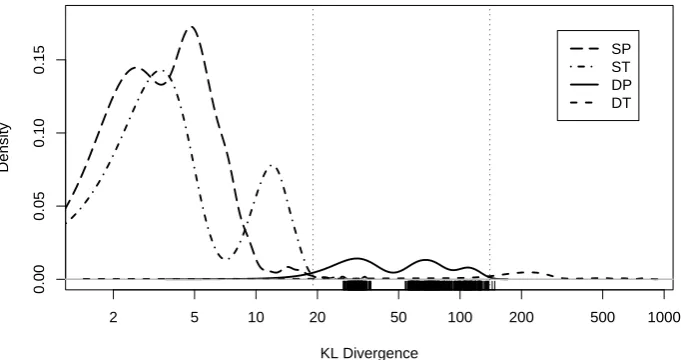
We now present the main result of the paper. We calculate the KL divergence between poste-rior distributions of document collection pairs in four conditions using Monte Carlo methods, and plot the results in Figure 1. The test of different perspectives based on statistical distribution gence is shown to be very acute. The KL diver-gence of the document collection pairs in the DP condition fall mostly in the middle range, and is well separated from the high KL divergence of the pairs in DT condition and from the low KL diver-gence of the pairs in SP and ST conditions. There-fore, by simply calculating the KL divergence of a document collection pair, we can reliably pre-dict that they are written from different perspec-tives if the value of KL divergence falls in the middle range, from different topics if the value is very large, from the same topic or perspective if the value is very small.
5.3 Personal Writing Styles or Perspectives?
One may suspect that the mid-range distribution divergence is attributed to personal speaking or writing styles and has nothing to do with differ-ent perspectives. The doubt is expected because
half of the bitterlemons corpus are written by one Palestinian editor and one Israeli editor (see Ta-ble 1), and the debate transcripts come from only two candidates.
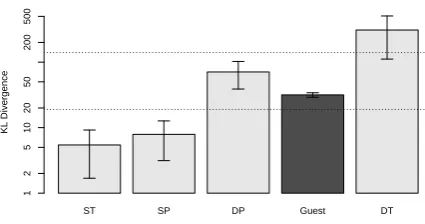
We test the hypothesis by computing the dis-tribution divergence of the document collection pair (Israeli Guest, Palestinian Guest), that is, a Different Perspectives (DP) pair. There are more than 200 different authors in the Israeli Guest and Palestinian Guest collection. If the distribution di-vergence of the pair with diverse authors falls out of the middle range, it will support that mid-range divergence is due to writing styles. On the other hand, if the distribution divergence still fall in the middle range, we are more confident the effect is attributed to different perspectives. We com-pare the distribution divergence of the pair (Israeli Guest, Palestinian Guest) with others in Figure 2.
ST SP DP Guest DT
KL Divergence
1
2
5
10
20
50
200
500
Figure 2: The average KL divergence of document collection pairs in the bitterlemons Guest subset (Israeli Guest vs. Palestinian Guest), ST ,SP, DP, DT conditions. The horizontal lines are the same as those in Figure 1.
The results show that the distribution diver-gence of the (Israeli Guest, Palestinian Guest) pair, as other pairs in the DP condition, still falls in the middle range, and is well separated from SP and ST in the low range and DT in the high range. The decrease in KL divergence due to writing or speak-ing styles is noticeable, and the overall effect due to different perspectives is strong enough to make the test robust. We thus conclude that the test of different perspectives based on distribution diver-gence indeed captures different perspectives, not personal writing or speaking styles.
5.4 Origins of Differences
[image:5.595.309.522.335.447.2]2 5 10 20 50 100 200 500 1000
0.00
0.05
0.10
0.15
KL Divergence
Density
[image:6.595.123.464.97.277.2]SP ST DP DT
Figure 1: The KL divergence of the document collection pairs in four conditions: Different Perspectives (DP), Same Perspective (SP), Different Topics (DT), and Same Topic (ST). Note that the x axis is in log scale. The Monte Carlo estimatesDˆ of the pairs in DP condition are plotted as rugs. Dˆ of the pairs in other conditions are omitted to avoid clutter and summarized in one-dimensional density using Kernel Density Estimation. The vertical lines are drawn at the points with equivalent densities.
wonder why the distribution divergence of the document collection pair with different perspec-tives falls in the middle range and what causes the large and small divergence of the document collec-tion pairs with different topics (DT) and the same topic (ST) or perspective (SP), respectively. In other words where do the differences result from? We answer the question by taking a closer look at the causes of the distribution divergence in our model. We compare the expected marginal dif-ference of θ between two posterior distributions
p(θ|A)and p(θ|B). The marginal distribution of the i-th coordinate ofθ, that is, the i-th word in the vocabulary, is a Beta distribution, and thus the ex-pected value can be easily calculated. We plot the
∆θ= E[θi|A]−E[θi|B]againstE[θi|A]for each condition in Figure 3.
How∆θis deviated from zero partially explains different patterns of distribution divergence in Fig-ure 1. In FigFig-ure 3d we see that the ∆θ increases asθincreases, and the deviance from zero is much greater than those in the Same Perspective (Fig-ure 3b) and Same Topic (Fig(Fig-ure 3a) conditions. The large∆θnot only accounts for large distribu-tion divergence of the document pairs in DT con-ditions, but also shows that words in different top-ics that is frequent in one topic are less likely to be
frequent in the other topic. At the other extreme, document collection pairs of the Same Perspective (SP) or Same Topic (ST) show very little differ-ence inθ, which matches our intuition that docu-ments of the same perspective or the same topic use the same vocabulary in a very similar way.
The manner in which ∆θ is varied with the value ofθ in the Different Perspective (DP) con-dition is very unique. The∆θin Figure 3c is not as small as those in the SP and ST conditions, but at the same time not as large as those in DT conditions, resulting in mid-range distribution di-vergence in Figure 1. Why do document collec-tions of different perspectives distribute this way? Partly because articles from different perspectives focus on the closely related issues (the Palestinian-Israeli conflict in the bitterlemons corpus, or the political and economical issues in the debate cor-pus), the authors of different perspectives write or speak in a similar vocabulary, but with emphasis on different words.
6 Conclusions
pro-0.00 0.01 0.02 0.03 0.04 0.05 0.06
−0.04
−0.02
0.00
0.02
0.04
(a) Same Topic (ST)
0.00 0.01 0.02 0.03 0.04 0.05 0.06
−0.04
−0.02
0.00
0.02
0.04
(b) Same Topic (SP)
0.00 0.01 0.02 0.03 0.04 0.05 0.06
−0.04
−0.02
0.00
0.02
0.04
0.00 0.01 0.02 0.03 0.04 0.05 0.06
−0.04
−0.02
0.00
0.02
0.04
[image:7.595.319.516.81.331.2](c) Two examples of Different Perspective (DP)
Figure 3: The ∆θvs. θplots of the typical docu-ment collection pairs in four conditions. The hori-zontal line is∆θ= 0.
0.00 0.01 0.02 0.03 0.04 0.05 0.06
−0.04
−0.02
0.00
0.02
0.04
0.00 0.01 0.02 0.03 0.04 0.05 0.06
−0.04
−0.02
0.00
0.02
0.04
[image:7.595.85.284.92.691.2](d) Two examples of Different Topics (DT)
Figure 3: Cont’d
posed test can successfully separate document col-lections of different perspectives from other types of document collection pairs. The distribution di-vergence falling in the middle range can not sim-ply be attributed to personal writing or speaking styles. From the plot of multinomial parameter difference we offer insights into where the differ-ent patterns of distribution divergence come from. Although we validate the test of different per-spectives by comparing the DP condition with DT, SP, and ST conditions, the comparisons are by no means exhaustive, and the distribution diver-gence of some document collection pairs may also fall in the middle range. We plan to investigate more types of document collections pairs, e.g., the document collections from different text genres (Kessler et al., 1997).
Acknowledgment
References
Robert P. Abelson and J. Douglas Carroll. 1965. Com-puter simulation of individual belief systems. The
American Behavioral Scientist, 8:24–30, May.
Robert P. Abelson, 1973. Computer Models of Thought
and Language, chapter The Structure of Belief
Sys-tems, pages 287–339. W. H. Freeman and Company.
Philip Beineke, Trevor Hastie, and Shivakumar Vaithyanathan. 2004. The sentimental factor: Im-proving review classification via human-provided information. In Proceedings of the Association for
Computational Linguistics (ACL-2004).
Jaime G. Carbonell. 1978. POLITICS: Automated ideological reasoning. Cognitive Science, 2(1):27– 51.
Thomas M. Cover and Joy A. Thomas. 1991. Elements
of Information Theory. Wiley-Interscience.
Kushal Dave, Steve Lawrence, and David M. Pennock. 2003. Mining the peanut gallery: Opinion extraction and semantic classification of product reviews. In
Proceedings of the 12th International World Wide Web Conference (WWW2003).
Minqing Hu and Bing Liu. 2004. Mining and summa-rizing customer reviews. In Proceedings of the 2004
ACM SIGKDD International Conference on Knowl-edge Discovery and Data Mining.
Brett Kessler, Geoffrey Nunberg, and Hinrich Sch ¨utze. 1997. Automatic detection of text genre. In
Pro-ceedings of the 35th Conference on Association for Computational Linguistics, pages 32–38.
S. Kullback and R. A. Leibler. 1951. On information and sufficiency. The Annals of Mathematical
Statis-tics, 22(1):79–86, March.
David D. Lewis. 1998. Naive (Bayes) at forty: The in-dependence assumption in information retrieval. In
Proceedings of the 9th European Conference on Ma-chine Learning (ECML).
Wei-Hao Lin, Theresa Wilson, Janyce Wiebe, and Alexander Hauptmann. 2006. Which side are you on? identifying perspectives at the document and sentence levels. In Proceedings of Tenth Conference
on Natural Language Learning (CoNLL).
S. Morinaga, K. Yamanishi, K. Tateishi, and T. Fukushima. 2002. Mining product reputations on the web. In Proceedings of the 2002 ACM SIGKDD
International Conference on Knowledge Discovery and Data Mining.
Tony Mullen and Nigel Collier. 2004. Sentiment anal-ysis using support vector machines with diverse in-formation sources. In Proceedings of the
Confer-ence on Empirical Methods in Natural Language Processing (EMNLP-2004).
T. Nasukawa and J. Yi. 2003. Sentiment analysis: Capturing favorability using natural language pro-cessing. In Proceedings of the 2nd International
Conference on Knowledge Capture (K-CAP 2003).
Bo Pang and Lillian Lee. 2004. A sentimental edu-cation: Sentiment analysis using subjectivity sum-marization based on minimum cuts. In
Proceed-ings of the Association for Computational Linguis-tics (ACL-2004).
Bo Pang, Lillian Lee, and Shivakumar Vaithyanathan. 2002. Thumbs up? Sentiment classification using machine learning techniques. In Proceedings of the
Conference on Empirical Methods in Natural Lan-guage Processing (EMNLP-2002).
Ellen Riloff and Janyce Wiebe. 2003. Learning ex-traction patterns for subjective expressions. In
Pro-ceedings of the Conference on Empirical Methods in Natural Language Processing (EMNLP-2003).
Ellen Riloff, Janyce Wiebe, and Theresa Wilson. 2003. Learning subjective nouns using extraction pattern bootstrapping. In Proceedings of the 7th Conference
on Natural Language Learning (CoNLL-2003).
B. D. Ripley. 1987. Stochastic Simulation. Wiley.
Roger C. Schank and Robert P. Abelson. 1977. Scripts,
plans, goals, and understanding: an inquiry into hu-man knowledge structures. Lawrene Erlbaum
Asso-ciates.
Fabrizio Sebastiani. 2002. Machine learning in au-tomated text categorization. ACM Computing
Sur-veys, 34(1):1–47, March.
Peter Turney and Michael L. Littman. 2003. Mea-suring praise and criticism: Inference of semantic orientation from association. ACM Transactions on
Information Systems (TOIS), 21(4):315–346.
Peter Verdonk. 2002. Stylistics. Oxford University Press.
Janyce Wiebe, Theresa Wilson, Rebecca Bruce, Matthew Bell, and Melanie Martin. 2004. Learn-ing subjective language. Computational LLearn-inguistics, 30(3).
Hong Yu and Vasileios Hatzivassiloglou. 2003. To-wards answering opinion questions: Separating facts from opinions and identifying the polarity of opin-ion sentences. In Proceedings of the Conference on