A Bottom-up Approach to Sentence Ordering
for Multi-document Summarization
Danushka Bollegala Naoaki Okazaki∗
Graduate School of Information Science and Technology The University of Tokyo
7-3-1, Hongo, Bunkyo-ku, Tokyo, 113-8656, Japan {danushka,okazaki}@mi.ci.i.u-tokyo.ac.jp
Mitsuru Ishizuka
Abstract
Ordering information is a difficult but important task for applications
generat-ing natural-language text. We present
a bottom-up approach to arranging sen-tences extracted for multi-document sum-marization. To capture the association and order of two textual segments (eg, sen-tences), we define four criteria, chronol-ogy, topical-closeness, precedence, and succession. These criteria are integrated into a criterion by a supervised learning approach. We repeatedly concatenate two textual segments into one segment based on the criterion until we obtain the overall segment with all sentences arranged. Our experimental results show a significant im-provement over existing sentence ordering strategies.
1 Introduction
Multi-document summarization (MDS) (Radev and McKeown, 1999) tackles the information overload problem by providing a condensed
ver-sion of a set of documents. Among a number
of sub-tasks involved in MDS, eg, sentence ex-traction, topic detection, sentence ordering, infor-mation extraction, sentence generation, etc., most MDS systems have been based on an extraction method, which identifies important textual seg-ments (eg, sentences or paragraphs) in source doc-uments. It is important for such MDS systems to determine a coherent arrangement of the tex-tual segments extracted from multi-documents in order to reconstruct the text structure for summa-rization. Ordering information is also essential for
∗
Research Fellow of the Japan Society for the Promotion of Science (JSPS)
other text-generation applications such as Ques-tion Answering.
A summary with improperly ordered sen-tences confuses the reader and degrades the
qual-ity/reliability of the summary itself.
Barzi-lay (2002) has provided empirical evidence that proper order of extracted sentences improves their
readability significantly. However, ordering a
set of sentences into a coherent text is a non-trivial task. For example, identifying rhetorical relations (Mann and Thompson, 1988) in an or-dered text has been a difficult task for computers, whereas our task is even more complicated: to reconstruct such relations from unordered sets of sentences. Source documents for a summary may have been written by different authors, by different writing styles, on different dates, and based on dif-ferent background knowledge. We cannot expect that a set of extracted sentences from such diverse documents will be coherent on their own.
Several strategies to determine sentence order-ing have been proposed as described in section 2. However, the appropriate way to combine these strategies to achieve more coherent summaries re-mains unsolved. In this paper, we propose four criteria to capture the association of sentences in the context of multi-document summarization for newspaper articles. These criteria are integrated into one criterion by a supervised learning ap-proach. We also propose a bottom-up approach in arranging sentences, which repeatedly concate-nates textual segments until the overall segment with all sentences arranged, is achieved.
2 Related Work
Existing methods for sentence ordering are di-vided into two approaches: making use of chrono-logical information (McKeown et al., 1999; Lin
and Hovy, 2001; Barzilay et al., 2002; Okazaki et al., 2004); and learning the natural order of sen-tences from large corpora not necessarily based on chronological information (Lapata, 2003; Barzi-lay and Lee, 2004). A newspaper usually dissem-inates descriptions of novel events that have oc-curred since the last publication. For this reason, ordering sentences according to their publication date is an effective heuristic for multidocument summarization (Lin and Hovy, 2001; McKeown et al., 1999). Barzilay et al. (2002) have proposed an improved version of chronological ordering by first grouping sentences into sub-topics discussed in the source documents and then arranging the sentences in each group chronologically.
Okazaki et al. (2004) have proposed an algo-rithm to improve chronological ordering by re-solving the presuppositional information of
ex-tracted sentences. They assume that each
sen-tence in newspaper articles is written on the basis that presuppositional information should be trans-ferred to the reader before the sentence is inter-preted. The proposed algorithm first arranges sen-tences in a chronological order and then estimates the presuppositional information for each sentence by using the content of the sentences placed before each sentence in its original article. The evaluation results show that the proposed algorithm improves the chronological ordering significantly.
Lapata (2003) has suggested a probabilistic model of text structuring and its application to the sentence ordering. Her method calculates the tran-sition probability from one sentence to the next from a corpus based on the Cartesian product be-tween two sentences defined using the following features: verbs (precedent relationships of verbs in the corpus); nouns (entity-based coherence by keeping track of the nouns); and dependencies
(structure of sentences). Although she has not
compared her method with chronological order-ing, it could be applied to generic domains, not re-lying on the chronological clue provided by news-paper articles.
Barzilay and Lee (2004) have proposed con-tent models to deal with topic transition in do-main specific text. The content models are formal-ized by Hidden Markov Models (HMMs) in which the hidden state corresponds to a topic in the do-main of interest (eg, earthquake magnitude or pre-vious earthquake occurrences), and the state tran-sitions capture possible information-presentation
orderings. The evaluation results showed that
their method outperformed Lapata’s approach by a wide margin. They did not compare their method with chronological ordering as an application of multi-document summarization.
As described above, several good
strate-gies/heuristics to deal with the sentence ordering problem have been proposed. In order to integrate multiple strategies/heuristics, we have formalized them in a machine learning framework and have considered an algorithm to arrange sentences us-ing the integrated strategy.
3 Method
We define notation a  b to represent that
sen-tenceaprecedes sentenceb. We use the term
seg-ment to describe a sequence of ordered sentences.
When segmentAconsists of sentencesa1,a2, ...,
amin this order, we denote as:
A= (a1Âa2 Â...Âam). (1)
The two segmentsAandB can be ordered either
B after A or A after B. We define the notation
AÂBto show that segmentAprecedes segment
B.
Let us consider a bottom-up approach in arrang-ing sentences. Startarrang-ing with a set of segments ini-tialized with a sentence for each, we concatenate two segments, with the strongest association (dis-cussed later) of all possible segment pairs, into one segment. Repeating the concatenating will eventually yield a segment with all sentences ar-ranged. The algorithm is considered as a variation of agglomerative hierarchical clustering with the ordering information retained at each concatenat-ing process.
The underlying idea of the algorithm, a bottom-up approach to text planning, was proposed by Marcu (1997). Assuming that the semantic units (sentences) and their rhetorical relations (eg, sen-tence a is an elaboration of sensen-tence d) are given, he transcribed a text structuring task into the prob-lem of finding the best discourse tree that satisfied the set of rhetorical relations. He stated that global coherence could be achieved by satisfying local coherence constraints in ordering and clustering, thereby ensuring that the resultant discourse tree was well-formed.
a
A B C D
b c d
E = (b a)
G = (b a c d)
F = (c d)
Segments
Sentences
f
[image:3.595.110.254.62.171.2](association strength)
Figure 1: Arranging four sentencesA,B,C, and
Dwith a bottom-up approach.
task for computers. However, the bottom-up algo-rithm for arranging sentences can still be applied only if the direction and strength of the associa-tion of the two segments (sentences) are defined.
Hence, we introduce a functionf(AÂB)to
rep-resent the direction and strength of the association
of two segmentsAandB,
f(AÂB) =
½
p (ifAprecedesB)
0 (ifBprecedesA) , (2)
where p (0 ≤ p ≤ 1) denotes the association
strength of the segments A andB. The
associa-tion strengths of the two segments with different
directions, eg,f(AÂB)andf(B ÂA), are not
always identical in our definition,
f(AÂB)6=f(BÂA). (3)
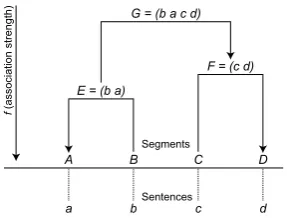
Figure 1 shows the process of arranging four
sentencesa,b,c, andd. Firstly, we initialize four
segments with a sentence for each,
A= (a), B= (b), C = (c), D= (d). (4)
Suppose thatf(B Â A)has the highest value of
all possible pairs, eg,f(AÂB),f(C ÂD), etc,
we concatenateB andAto obtain a new segment,
E = (bÂa). (5)
Then we search for the segment pair with the
strongest association. Supposing thatf(C Â D)
has the highest value, we concatenateCandDto
obtain a new segment,
F = (cÂd). (6)
Finally, comparingf(E ÂF)andf(F ÂE), we
obtain the global sentence ordering,
G= (bÂaÂcÂd). (7)
In the above description, we have not defined the association of the two segments. The previ-ous work described in Section 2 has addressed the association of textual segments (sentences) to ob-tain coherent orderings. We define four criteria to capture the association of two segments: chronol-ogy; topical-closeness; precedence; and succes-sion. These criteria are integrated into a function
f(AÂB)by using a machine learning approach.
The rest of this section explains the four criteria and an integration method with a Support Vector Machine (SVM) (Vapnik, 1998) classifier.
3.1 Chronology criterion
Chronology criterion reflects the chronological or-dering (Lin and Hovy, 2001; McKeown et al., 1999), which arranges sentences in a chronologi-cal order of the publication date. We define the
as-sociation strength of arranging segmentsBafterA
measured by a chronology criterionfchro(AÂB)
in the following formula,
fchro(AÂB)
=
1 T(am)<T(b1)
1 [D(am) = D(b1)]∧[N(am)<N(b1)]
0.5 [T(am) = T(b1)]∧[D(am)6= D(b1)]
0 otherwise
.
(8)
Here, am represents the last sentence in segment
A; b1 represents the first sentence in segment B;
T(s) is the publication date of the sentence s;
D(s) is the unique identifier of the document to
which sentencesbelongs: andN(s)denotes the
line number of sentence s in the original
docu-ment. The chronological order of arranging
seg-mentB afterAis determined by the comparison
between the last sentence in the segmentAand the
first sentence in the segmentB.
The chronology criterion assesses the
appropri-ateness of arranging segment B after A if:
sen-tenceam is published earlier thanb1; or sentence
am appears beforeb1 in the same article. If
sen-tenceamandb1are published on the same day but
appear in different articles, the criterion assumes the order to be undefined. If none of the above conditions are satisfied, the criterion estimates that
segmentBwill precedeA.
3.2 Topical-closeness criterion
a1 a2 .... .. .. .... .. ... ... . ... ... .. .., .... ... .... . ... ... .. .., .... ... .... . ... ... .. .., .... ... .... .... .. .. .... .. ... ... .... .. .. .... .. ... ... . ... ... .. .., .... ... .... . ... ... .. .., .... ... .... a3 a4 .... .. .. .... .. ... ... . ... ... .. .., .... ... .... .... .. .. .... .. ... ... . ... ... .. .., .... ... .... b1 b2 b3 b3 b2 b1 Pb1
Pb2 Pb3
.... .. .. .... .. ... ... . ... ... .. .., .... ... .... .... .. .. .... .. ... ... . ... ... .. .., .... ... .... .... .. .. .... .. ... ... . ... ... .. .., .... ... ....
Segment A
?
Segment B Original article
for sentence b
Original article
for sentence b2
Original article
for sentence b3
[image:4.595.323.508.58.231.2].... .. .. .... .. ... ... . ... ... .. .., .... ... .... .... .. .. .... .. ... ... .... .. .. .... .. ... ... . ... ... .. .., .... ... .... . ... ... .. .., .... ... .... Original article 1 . ... ... .. .., .... ... .... . ... ... .. .., .... ... .... .... .. .. .... .. ... ... . ... ... .. .., .... ... .... . ... ... .. .., .... ... .... . ... ... .. .., .... ... .... . ... ... .. .., .... ... .... . ... ... .. .., .... ... .... . ... ... .. .., .... ... .... .... .. .. .... .. ... ... 1 Original article max average max max
Figure 2: Precedence criterion
segments. The criterion reflects the ordering strat-egy proposed by Barzilay et al (2002), which groups sentences referring to the same topic. To measure the topical closeness of two sentences, we represent each sentence with a vector whose
ele-ments correspond to the occurrence1of the nouns
and verbs in the sentence. We define the topical
closeness of two segmentsAandBas follows,
ftopic(AÂB) = 1
|B|
X
b∈B
max
a∈Asim(a, b). (9)
Here,sim(a, b)denotes the similarity of sentences
aandb, which is calculated by the cosine
similar-ity of two vectors corresponding to the sentences.
For sentence b ∈ B, maxa∈Asim(a, b) chooses
the sentencea∈Amost similar to sentenceband
yields the similarity. The topical-closeness crite-rion ftopic(A Â B) assigns a higher value when
the topic referred by segmentBis the same as
seg-mentA.
3.3 Precedence criterion
Let us think of the case where we arrange
seg-ment A before B. Each sentence in segmentB
has the presuppositional information that should be conveyed to a reader in advance. Given
sen-tence b ∈ B, such presuppositional information
may be presented by the sentences appearing
be-fore the sentence b in the original article.
How-ever, we cannot guarantee whether a sentence-extraction method for multi-document
summa-rization chooses any sentences beforebfor a
sum-mary because the extraction method usually
deter-1
The vector values are represented by boolean values, i.e., 1 if the sentence contains a word, otherwise 0.
a1 a2 .... .. .. .... .. ... ... . ... ... .. .., .... ... .... .... .. .. .... .. ... ... . ... ... .. .., .... ... .... a3 .... .. .. .... .. ... ... . ... ... .. .., .... ... .... b b2 b3 a3 a2 a1 Sa1
Sa2 Sa3
. ... ... .. .., .... ... ....
.... .. .. .... .. ... ... . ... ... .. .., .... ... ....
.... .. .. .... .. ... ... . ... ... .. .., .... ... ....
Segment A
?
Segment B
Original article for sentence a1
Original article for sentence a2
Original article for sentence a3
[image:4.595.90.272.61.235.2]Original article for sentence for sentence max average max max .... .. .. .... .. ... ... . ... ... .. .., .... ... .... .... .. .. .... .. ... ... b1 Original article .... .. .. .... .. ... ... Original article for sentence .... .. .. .... .. ... ... .... .. .. .... .. ... ... .... .. .. .... .. ... ... .... .. .. .... .. ... ... . ... ... .. .., .... ... .... 1 b for sentence Original article
Figure 3: Succession criterion
mines a set of sentences, within the constraint of summary length, that maximizes information cov-erage and excludes redundant information. Prece-dence criterion measures the substitutability of the
presuppositional information of segment B (eg,
the sentences appearing before sentenceb) as
seg-ment A. This criterion is a formalization of the
sentence-ordering algorithm proposed by Okazaki et al, (2004).
We define the precedence criterion in the fol-lowing formula,
fpre(AÂB) = |B1| X
b∈B
max
a∈A,p∈Pb
sim(a, p).
(10)
Here,Pbis a set of sentences appearing before
sen-tence b in the original article; and sim(a, b)
de-notes the cosine similarity of sentences a and b
(defined as in the topical-closeness criterion). Fig-ure 2 shows an example of calculating the
prece-dence criterion for arranging segmentB afterA.
We approximate the presuppositional information
for sentence bby sentences Pb, ie, sentences
ap-pearing before the sentenceb in the original
arti-cle. Calculating the similarity among sentences in
Pb andA by the maximum similarity of the
pos-sible sentence combinations, Formula 10 is inter-preted as the average similarity of the precedent
sentences∀Pb(b∈B)to the segmentA.
3.4 Succession criterion
The idea of succession criterion is the exact op-posite of the precedence criterion. The succession criterion assesses the coverage of the succedent
a
b
c
d Partitioning point
segment before the partitioning point
segment after the partitioning point
Partitioning window
Figure 4: Partitioning a human-ordered extract into pairs of segments
afterA:
fsucc(AÂB) = |A1| X
a∈A
max
s∈Sa,b∈B
sim(s, b).
(11)
Here,Sais a set of sentences appearing after
sen-tence a in the original article; and sim(a, b)
de-notes the cosine similarity of sentences a and b
(defined as in the topical-closeness criterion). Fig-ure 3 shows an example of calculating the
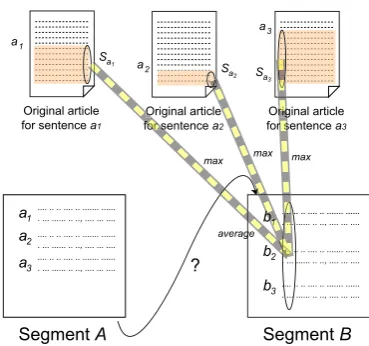
succes-sion criterion to arrange segmentsBafterA. The
succession criterion measures the substitutability of the succedent information (eg, the sentences
ap-pearing after the sentencea∈A) as segmentB.
3.5 SVM classifier to assess the integrated criterion
We integrate the four criteria described above
to define the function f(A Â B) to represent
the association direction and strength of the two
segments A and B (Formula 2). More
specifi-cally, given the two segmentsA andB, function
f(A ÂB)is defined to yield the integrated
asso-ciation strength from four values, fchro(A Â B),
ftopic(AÂB),fpre(AÂB), andfsucc(AÂB).
We formalize the integration task as a binary clas-sification problem and employ a Support Vector Machine (SVM) as the classifier. We conducted a supervised learning as follows.
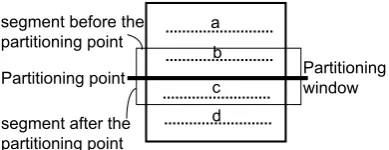
We partition a human-ordered extract into pairs each of which consists of two non-overlapping segments. Let us explain the partitioning process
taking four human-ordered sentences, a  b Â
c  d shown in Figure 4. Firstly, we place the
partitioning point just after the first sentence a.
Focusing on sentence a arranged just before the
partition point and sentence b arranged just after
we identify the pair {(a),(b)} of two segments
(a)and(b). Enumerating all possible pairs of two
segments facing just before/after the partitioning
point, we obtain the following pairs, {(a),(b Â
c)}and{(a),(b  c  d)}. Similarly, segment
+1 : [fchro(AÂB), ftopic(AÂB), fpre(AÂB), fsucc(AÂB)]
[image:5.595.84.279.63.138.2]−1 : [fchro(BÂA), ftopic(BÂA), fpre(BÂA), fsucc(BÂA)]
Figure 5: Two vectors in a training data generated
from two ordered segmentsAÂB
pairs, {(b),(c)}, {(a  b),(c)}, {(b),(c  d)},
{(a  b),(c  d)}, are obtained from the
parti-tioning point between sentence b and c. Collect-ing the segment pairs from the partitionCollect-ing point
between sentencescandd(i.e.,{(c),(d)},{(b Â
c),(d)}and{(a Âb  c),(d)}), we identify ten
pairs in total form the four ordered sentences. In
general, this process yieldsn(n2−1)/6pairs from
orderednsentences. From each pair of segments,
we generate one positive and one negative training instance as follows.
Given a pair of two segmentsAandBarranged
in an order A Â B, we calculate four values,
fchro(A Â B), ftopic(A Â B), fpre(A Â B),
and fsucc(A Â B) to obtain the instance with
the four-dimensional vector (Figure 5). We label
the instance (corresponding toA ÂB) as a
posi-tive class (ie,+1). Simultaneously, we obtain
an-other instance with a four-dimensional vector
cor-responding to B Â A. We label it as a negative
class (ie, −1). Accumulating these instances as
training data, we obtain a binary classifier by using a Support Vector Machine with a quadratic kernel. The SVM classifier yields the association
direc-tion of two segments (eg,A ÂB orB ÂA) with
the class information (ie, +1or−1). We assign
the association strength of two segments by using the class probability estimate that the instance
be-longs to a positive (+1) class. When an instance
is classified into a negative (−1) class, we set the
association strength as zero (see the definition of Formula 2).
4 Evaluation
We evaluated the proposed method by using the 3rd Text Summarization Challenge (TSC-3)
cor-pus2. The TSC-3 corpus contains 30 sets of
ex-tracts, each of which consists of unordered
sen-tences3 extracted from Japanese newspaper
arti-cles relevant to a topic (query). We arrange the extracts by using different algorithms and evaluate
2
http://lr-www.pi.titech.ac.jp/tsc/tsc3-en.html
Table 1: Correlation between two sets of human-ordered extracts
Metric Mean Std. Dev Min Max
Spearman 0.739 0.304 -0.2 1
Kendall 0.694 0.290 0 1
Average Continuity 0.401 0.404 0.001 1
the readability of the ordered extracts by a subjec-tive grading and several metrics.
In order to construct training data applica-ble to the proposed method, we asked two hu-man subjects to arrange the extracts and obtained
30(topics) ×2(humans) = 60 sets of ordered
extracts. Table 1 shows the agreement of the or-dered extracts between the two subjects. The cor-relation is measured by three metrics, Spearman’s rank correlation, Kendall’s rank correlation, and average continuity (described later). The mean
correlation values (0.74for Spearman’s rank
cor-relation and 0.69 for Kendall’s rank correlation)
indicate a certain level of agreement in sentence orderings made by the two subjects. 8 out of 30 extracts were actually identical.
We applied the leave-one-out method to the pro-posed method to produce a set of sentence
or-derings. In this experiment, the leave-out-out
method arranges an extract by using an SVM model trained from the rest of the 29 extracts. Re-peating this process 30 times with a different topic for each iteration, we generated a set of 30 ex-tracts for evaluation. In addition to the proposed method, we prepared six sets of sentence orderings produced by different algorithms for comparison. We describe briefly the seven algorithms (includ-ing the proposed method):
Agglomerative ordering (AGL) is an ordering arranged by the proposed method;
Random ordering (RND) is the lowest anchor, in which sentences are arranged randomly;
Human-made ordering (HUM) is the highest anchor, in which sentences are arranged by a human subject;
Chronological ordering (CHR) arranges sen-tences with the chronology criterion defined
in Formula 8. Sentences are arranged in
chronological order of their publication date;
Topical-closeness ordering (TOP) arranges sen-tences with the topical-closeness criterion de-fined in Formula 9;
0 20 40 60 80 100
Unacceptable Poor
Acceptable Perfect
HUM AGL CHR RND
%
Figure 6: Subjective grading
Precedence ordering (PRE) arranges sentences with the precedence criterion defined in For-mula 10;
Suceedence ordering (SUC) arranges sentences with the succession criterion defined in For-mula 11.
The last four algorithms (CHR, TOP, PRE, and SUC) arrange sentences by the corresponding cri-terion alone, each of which uses the association strength directly to arrange sentences without the integration of other criteria. These orderings are expected to show the performance of each expert independently and their contribution to solving the sentence ordering problem.
4.1 Subjective grading
Evaluating a sentence ordering is a challenging
task. Intrinsic evaluation that involves human
judges to rank a set of sentence orderings is a nec-essary approach to this task (Barzilay et al., 2002; Okazaki et al., 2004). We asked two human judges to rate sentence orderings according to the follow-ing criteria. A perfect summary is a text that we cannot improve any further by re-ordering. An ac-ceptable summary is one that makes sense and is unnecessary to revise even though there is some room for improvement in terms of readability. A poor summary is one that loses a thread of the story at some places and requires minor amend-ment to bring it up to an acceptable level. An un-acceptable summary is one that leaves much to be improved and requires overall restructuring rather than partial revision. To avoid any disturbance in rating, we inform the judges that the summaries were made from a same set of extracted sentences and only the ordering of sentences is different.
or-Teval = (eÂaÂbÂcÂd)
Tref = (aÂbÂcÂdÂe)
Figure 7: An example of an ordering under
evalu-ationTevaland its referenceTref.
derings has 30(topics)×2(judges) = 60ratings.
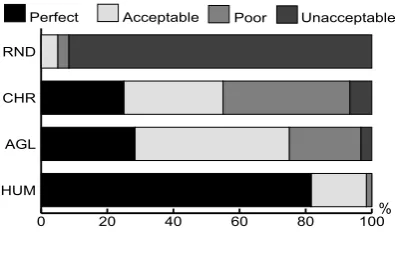
Most RND orderings are rated as unacceptable. Although CHR and AGL orderings have roughly
the same number of perfect orderings (ca. 25%),
the AGL algorithm gained more acceptable
order-ings (47%) than the CHR alghrotihm (30%). This
fact shows that integration of CHR experts with other experts worked well by pushing poor order-ing to an acceptable level. However, a huge gap between AGL and HUM orderings was also found.
The judges rated 28% AGL orderings as perfect
while the figure rose as high as 82% for HUM
orderings. Kendall’s coefficient of concordance
(Kendall’sW), which asses the inter-judge
ment of overall ratings, reported a higher
agree-ment between the two judges (W = 0.939).
4.2 Metrics for semi-automatic evaluation
We also evaluated sentence orderings by reusing two sets of gold-standard orderings made for the training data. In general, subjective grading con-sumes much time and effort, even though we cannot reproduce the evaluation afterwards. The previous studies (Barzilay et al., 2002; Lapata, 2003) employ rank correlation coefficients such as Spearman’s rank correlation and Kendall’s rank correlation, assuming a sentence ordering to be a rank. Okazaki et al. (2004) propose a metric that assess continuity of pairwise sentences com-pared with the gold standard. In addition to Spear-man’s and Kendall’s rank correlation coefficients, we propose an average continuity metric, which extends the idea of the continuity metric to
contin-uousksentences.
A text with sentences arranged in proper order does not interrupt a human’s reading while moving from one sentence to the next. Hence, the qual-ity of a sentence ordering can be estimated by the number of continuous sentences that are also re-produced in the reference sentence ordering. This is equivalent to measuring a precision of continu-ous sentences in an ordering against the reference
ordering. We definePnto measure the precision of
Table 2: Comparison with human-made ordering
Method Spearman Kendall Average
coefficient coefficient Continuity
RND -0.127 -0.069 0.011
TOP 0.414 0.400 0.197
PRE 0.415 0.428 0.293
SUC 0.473 0.476 0.291
CHR 0.583 0.587 0.356
AGL 0.603 0.612 0.459
ncontinuous sentences in an ordering to be
evalu-ated as,
Pn= N −mn+ 1. (12)
Here, N is the number of sentences in the
refer-ence ordering; nis the length of continuous
sen-tences on which we are evaluating;mis the
num-ber of continuous sentences that appear in both the evaluation and reference orderings. In Figure 7,
the precision of3continuous sentencesP3 is
cal-culated as:
P3= 5−23 + 1 = 0.67. (13)
The Average Continuity (AC) is defined as the
logarithmic average ofPnover2tok:
AC= exp
Ã
1
k−1
k
X
n=2
log(Pn+α)
!
. (14)
Here,kis a parameter to control the range of the
logarithmic average; andαis a small value in case
if Pn is zero. We setk = 4 (ie, more than five
continuous sentences are not included for
evalua-tion) andα = 0.01. Average Continuity becomes
0 when evaluation and reference orderings share
no continuous sentences and 1 when the two
or-derings are identical. In Figure 7, Average
Conti-nuity is calculated as0.63. The underlying idea of
Formula 14 was proposed by Papineni et al. (2002) as the BLEU metric for the semi-automatic evalu-ation of machine-translevalu-ation systems. The origi-nal definition of the BLEU metric is to compare a machine-translated text with its reference transla-tion by using the word n-grams.
4.3 Results of semi-automatic evaluation
0.0 0.1 0.2 0.3 0.4 0.5 0.6 0.7 0.8
AGL CHR
SUC PRE
TOP RND
8 7 6 5 4 3 2
Precision P
n
[image:8.595.73.293.61.203.2]Length n
Figure 8: Precision vs unit of measuring continu-ity.
rest in all evaluation metrics, although the chrono-logical ordering (CHR) appeared to play the major role. The one-way analysis of variance (ANOVA) verified the effects of different algorithms for
sen-tence orderings with all metrics (p < 0.01). We
performed Tukey Honest Significant Differences (HSD) test to compare differences among these al-gorithms. The Tukey test revealed that AGL was significantly better than the rest. Even though we could not compare our experiment with the prob-abilistic approach (Lapata, 2003) directly due to the difference of the text corpora, the Kendall co-efficient reported higher agreement than Lapata’s experiment (Kendall=0.48 with lemmatized nouns and Kendall=0.56 with verb-noun dependencies).
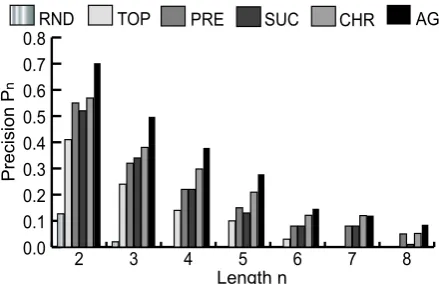
Figure 8 shows precision Pn with different
length values of continuous sentencenfor the six
methods compared in Table 2. The number of continuous sentences becomes sparse for a higher
value of lengthn. Therefore, the precision values
decrease as the lengthnincreases. Although RND
ordering reported some continuous sentences for
lowernvalues, no continuous sentences could be
observed for the highernvalues. Four criteria
de-scribed in Section 3 (ie, CHR, TOP, PRE, SUC) produce segments of continuous sentences at all
values ofn.
5 Conclusion
We present a bottom-up approach to arrange sen-tences extracted for multi-document summariza-tion. Our experimental results showed a signif-icant improvement over existing sentence order-ing strategies. However, the results also implied that chronological ordering played the major role in arranging sentences. A future direction of this
study would be to explore the application of the proposed framework to more generic texts, such as documents without chronological information.
Acknowledgment
We used Mainichi Shinbun and Yomiuri Shinbun newspaper articles, and the TSC-3 test collection.
References
Regina Barzilay and Lillian Lee. 2004. Catching the drift: Probabilistic content models, with applications to generation and summarization. In HLT-NAACL
2004: Proceedings of the Main Conference, pages
113–120.
Regina Barzilay, Noemie Elhadad, and Kathleen McK-eown. 2002. Inferring strategies for sentence order-ing in multidocument news summarization. Journal
of Artificial Intelligence Research, 17:35–55.
Mirella Lapata. 2003. Probabilistic text structuring: Experiments with sentence ordering. Proceedings of
the annual meeting of ACL, 2003., pages 545–552.
C.Y. Lin and E. Hovy. 2001. Neats:a multidocument summarizer. Proceedings of the Document
Under-standing Workshop(DUC).
W. Mann and S. Thompson. 1988. Rhetorical structure theory: Toward a functional theory of text organiza-tion. Text, 8:243–281.
Daniel Marcu. 1997. From local to global coherence: A bottom-up approach to text planning. In
Proceed-ings of the 14th National Conference on Artificial Intelligence, pages 629–635, Providence, Rhode
Is-land.
Kathleen McKeown, Judith Klavans, Vasileios Hatzi-vassiloglou, Regina Barzilay, and Eleazar Eskin.
1999. Towards multidocument summarization by
reformulation: Progress and prospects. AAAI/IAAI, pages 453–460.
Naoaki Okazaki, Yutaka Matsuo, and Mitsuru
Ishizuka. 2004. Improving chronological sentence
ordering by precedence relation. In Proceedings
of 20th International Conference on Computational Linguistics (COLING 04), pages 750–756.
Kishore Papineni, Salim Roukos, Todd Ward, and Wei-Jing Zhu. 2002. Bleu:a method for automatic eval-uation of machine translation. Proceedings of the
40th Annual Meeting of the Association for Compu-tational Linguistics (ACL), pages 311–318.
Dragomir R. Radev and Kathy McKeown. 1999.
Generating natural language summaries from
mul-tiple on-line sources. Computational Linguistics,
24:469–500.