T O W A R D S A S E L F - E X T E N D I N G PARSER
Jaime G. Carbonell Department Of Computer Science
Carnegie-Mellon University Pittsburgh, PA 15213
A b s t r a c t
This p a p e r discusses an approach to incremental learning in natural language processing. The t e c h n i q u e of projecting and integrating semantic c o n s t r a i n t s to learn word definitions is analyzed as Implemented in the POLITICS system. E x t e n s i o n s and improvements of this technique a r e d e v e l o p e d . The problem of generalizing e x i s t i n g word meanings and understanding m e t a p h o r i c a l uses of words Is addressed In terms o f s e m a n t i c constraint Integration.
1 . I n t r o d u c t i o n
N a t u r a l language analysis, like most other subfields of A r t i f i c i a l I n t e l l i g e n c e and Computational Linguistics, suffers from t h e f a c t t h a t computer systems are unable to a u t o m a t i c a l l y b e t t e r themselves. Automated learning ia c o n s i d e r e d a v e r y difficult problem, especially when applied t o n a t u r a l language understanding. Consequently, little e f f o r t ha8 b e e n f o c u s e d on this problem. Some pioneering work in A r t i f i c i a l i n t e l l i g e n c e , such as AM [ I ] and Winston's learning s y s t e m 1"2] s t r o v e to learn or discover concept descriptions in w e l l - d e f i n e d domains. Although their efforts produced i n t e r e s t i n g Ideas and techniques, these techniques do not f u l l y e x t e n d to • domain as complex as natural language a n a l y s i s .
R a t h e r t h a n a t t e m p t i n g the formidable task of creating a l a n g u a g e learning system, I will discuss techniques for I n c r e m e n t a l l y Increasing the abilities of a flexible language a n a l y z e r . There are many tasks that can be considered " I n c r e m e n t a l language learning". Initially the learning domain Is r e s t r i c t e d to learning the meaning of new words and g e n e r a l i z i n g e x i s t i n g word definitions. There ere a number of A.I. t e c h n i q u e s , and combinations of these techniques c a p a b l e of e x h i b i t i n g incremental learning behavior. I first d i s c u s s FOULUP and POLITICS, two programs that exhibit a limited c a p a b i l i t y for Incremental word learning. Secondly, the t e c h n i q u e of semantic constraint projection end Integration, a s Implemented in POLITICS, Is analyzed in some detail. Finally, I discuss the application of some general learning t e c h n i q u e s to t h e problem of generalizing word definitions e n d u n d e r s t a n d i n g metaphors.
2 . L e a r n i n g F r o m S c r i p t E x p e c t a t i o n s
L e a r n i n g w o r d definitions In semantically-rich c o n t e x t s Is p e r h a p s o n e of t h e simpler tasks of incremental learning. Initially I confine my discussion to situations where the m e a n i n g o f a word can be learned from the Immediately s u r r o u n d i n g c o n t e x t . Later I relax this criterion to see how g l o b a l c o n t e x t and multiple examples can help to learn the
m e a n i n g of unknown words.
T h e FOULUP program [ 3 ] learned the meaning of some u n k n o w n w o r d s in the c o n t e x t of applying s script to u n d e r s t a n d a s t o r y . Scripts [4, 5] are frame-like knowledge r e p r e s e n t a t i o n s a b s t r a c t i n g the important features and c a u s a l s t r u c t u r e of mundane events. Scripts have general e x p e c t a t i o n s of the actions and o b j e c t s that will be e n c o u n t e r e d in processing a story. For Instance, the r e s t a u r a n t s c r i p t e x p e c t s to see menus, waitresses, and c u s t o m e r s ordering and eating food (at d i f f e r e n t p r e - s p e c i f l e d times In the story).
FOULUP took a d v a n t a g e of these script e x p e c t a t i o n s to c o n c l u d e t h a t Items r e f e r e n c e d in the story, which w e r e part o f e x p e c t e d actions, w e r e Indeed names of o b j e c t s that the s c r i p t e x p e c t e d to see. These e x p e c t a t i o n s w e r e used to form d e f i n i t i o n s of n e w words. For instance, FOULUP induced t h e meaning of " R a b b i t " in, "A Rabbit v e e r e d off the road a n d s t r u c k a t r e e , " to be a self-propelled vehicle. The s y s t e m u s e d information about the automobile accident script t o m a t c h t h e unknown word with the script-role "VEHICLE", b e c a u s e t h e s c r i p t knows that the only o b j e c t s that v e e r o f f r o a d s t o smash Into r o a d - s i d e obstructions ere self propelled v e h i c l e s .
3 . C o n s t r a i n t P r o j e c t i o n In P O L I T I C S
The POLITICS system E6, 7] induces the meanings of u n k n o w n w o r d s b y a one*pass syntactic and semantic c o n s t r a i n t p r o j e c t i o n followed by conceptual enrichment from p l a n n i n g and w o r l d - k n o w l e d g e inferences. Consider how POLITICS p r o c e e d s when It encounters the unknown word " M P L A " In analyzing the sentence:
" R u s s i a s e n t massive arms shipments to the MPLA In Angola."
S i n c e "MPLA" follows the article '*the N it must be a noun, a d j e c t i v e or a d v e r b . After the word "MPLA", the preposition " i n " Is e n c o u n t e r e d , thus terminating the current p r e p o s i t i o n a l phrase begun with "to". Hence, since all w e l l - f o r m e d prepositional phrases require a head noun, and t h e " t o " p h r a s e has no other noun, "MPLA" must be the head noun. Thus, b y projecting the syntactic constraints n e c e s s a r y for t h e s e n t e n c e to be well formed, one learn8 t h e s y n t a c t i c c a t e g o r y of an unknown word. it Is not always
possible
t o narrow the categorization of a word to a single s y n t a c t i c c a t e g o r y from one example. In such cases, I p r o p o s e I n t e r s e c t i n g the s e t s of possible s y n t a c t i c c a t e g o r i e s from more then one sample use of the unknown w o r d until t h e Intersection has a single element.a b o v e , POLITICS analyzes the verb "to send" as either i n ATRANS or s PTRAflS. (Schank [ 8 ] discusses the Conceptual D e p e n d e n c y case frames. Briefly, a PTRANS IS s physical t r a n s f e r o f location, and an ATRANS Is an abstract transfer
o f ownership, possession or control.) The reason why
POLITICS c a n n o t d e c i d e on the t y p e of TRANSfer is that it d o e s n o t k n o w w h e t h e r the destination of the transfer (i.e., t h e MPLA) Is s location or an agent. Physical objects, such a s w e a p o n s , are PTRANSed to locations but ATRANSed to a g e n t s . The c o n c e p t u a l analysis of the sentence, with MPLA as y e t u n r e s o l v e d , Is diagrammed below:
*SUSSIA* <-~
• [ C I P S l < i s > LOC v i i ~qNGOLAe t l mlq.R) RTRRNS • d IN, iq[CIPill
I I N < ,,ffi/$SIRi,
I
J~ERPONe <ls~ NWISER vii (, llOMI)
W h a t has t h e a n a l y z e r learned about "MPLA" as s result of f o r m u l a t i n g t h e CD case frame? Clearly the MPLA can only be an a c t o r (I.e., s person, an Institution or s political e n t i t y in t h e POLITICS domain) or s location. Anything else would v i o l a t e t h e constraints for the recipient case In both ATRANS e n d PTRANS. Furthermore, the analyzer knows t h a t the l o c a t i o n o f t h e MPLA Is Inside Angola. This Item of Information is i n t e g r a t e d w i t h the case constraints to form a partial d e f i n i t i o n o f "MPLA". Unfortunately both Iocatlcms and actors c a n b e l o c a t e d inside countries; thus, the identity of the MPLA is still not uniquely resolved. POLITICS assigns t h e n a m e RECIP01 t o the partial definition of "MPLA" and p r o c e e d s t o a p p l y Its Inference rules tO understand the p o l i t i c a l Implications of the e v e n t . Here I discuss only the I n f e r e n c e s r e l e v a n t for further specifying the meaning of -MPLA m .
4 . U n c e r t a i n I n f e r e n c e in L e a r n i n g
POLITICS Is a goal-driven tnferencer. It must explain ell a c t i o n s In terms of the goals of the actors and recipients. The emphasis on inducing the goals of actors and relating t h e i r a c t i o n s t o means of achieving these goals is Integral to t h e t h e o r y o f s u b j e c t i v e understanding embodied in POLITICS. ( S e e [ 7 ] for a detailed discussion.) Thus, POLITICS t r i e s t o d e t e r m i n e how the action of sending weapons can be r e l a t e d t o t h e goals of the Soviet Union or any other possible a c t o r s i n v o l v e d in the situation. POLITICS k ~ s that Angola w a s Jn a s t a t e of civto war; that Is, a s t a t e w h e r e political f a c t i o n s w e r e .'xerclstng their goals of taking military and, t h e r e f o r e , political control of a country. Since po6ssssing w e a p o n s Is a precondition to military actions, POLITICS infers t h a t t h e r e c i p i e n t of the weapons may have been one of the poliUcal factions. (Weapons ere s means to fulfUllng the goal o f • p o l i t i c a l faction, t h e r e f o r e POLITICS Is able to explain w h y t h e f a c t i o n w a n t s to r e c e i v e weapons.) Thus, MPLA Is I n f e r r e d to be a political faction. This Inference is Integrated w i t h t h e e x i s t i n g partial definition and found to be c o n s i s t e n t . Finally, the original action Is refined to be an ATRANS, as t r a n s f e r of possession of the weapons (not m e r e l y t h e i r k:mation) helps the political faction to a c h i e v e Its m i l i t a r y goal.
N e x t , POLITICS tries to determine how sending weapons to s
m i l i t a r y f a c t i o n can further the goals of the Soviet Union. Communist countries have the goal of spreading their ' I d e o l o g y . POLITICS concludes that this goal can be fulfilled o n l y if t h e g o v e r n m e n t of Angola becomes communist. Military aid t o s political faction has the standard goal of military t a k e o v e r o f the government. Putting these t w o f a c t s t o g e t h e r , POLITICS concludes that the Russian goal can be f u l f i l l e d if t h e MPLA, which may become the n e w Angeles g o v e r n m e n t , is Communist. The definition formed for MPLA Is a e f o l l o w s :
QI~'I i~a1"~ tntrvI
(OPS flPLA (POS NOUN (TYPE PROgI[R))) (TOK efllq.A.) )
(PARTOF. luRN6OLR.) (|oEOLOGY . ~¢OiltlUN|STe) (GORLSt ((ACTOR (*flPLA*) iS
(SCONT O§JI[CT (dN6OLRe) Vm. (IR)))))P
The r e a s o n w h y memory entries are distinct from dictionary d e f i n i t i o n s is t h a t t h e r e is no o n e - t o - o n e mapping b e t w e e n t h e t w o . For Instance, "Russia" and "Soviet Union" are t w o s e p a r a t e d i c t i o n a r y entries that refer to the same concept in m e m o r y . Similarly, the c o n c e p t of SCONT (social or political c o n t r o l ) a b s t r a c t s Information useful for the goal-driven i n f e r e n c e s , but has no corresponding e n t r y in the lexicon, as I f o u n d no e x a m p l e w h e r e such concept was e x p l i c i t l y m e n t i o n e d In n e w s p a p e r headlines of political conflicts (i.e., POLITICS' domain).
Some o f t h e I n f e r e n c e s t h a t POLITICS made a r e much more p r o n e t o e r r o r than others. More specifically, the s y n t a c t i c c o n s t r a i n t p r o j e c t i o n s and the CD case-frame projections e r e q u i t e certain, but t h e goal-driven Inferences are only r e a s o n a b l e g u e s s e s . For Instance, the MPLA coWd h a v e b e e n • p l a t e a u w h e r e Russia dePosited Its weapons for l a t e r d e l i v e r y .
5 . A S t r a t e g y f o r D e a l i n g w i t h U n c e r t a i n t y
G i v e n such possibilities for error, t w o possible s t r a t e g i e s to d e e i w i t h t h e problem of uncertain inference come to mind. F i r s t , t h e s y s t e m could be r e s t r i c t e d to making only the more c e r t a i n c o n s t r a i n t p r o j e c t i o n and integration inferences. This d o e s n o t usually produce s complete definition, but t h e p r o c e s s may b e I t e r a t e d for o t h e r exemplars w h e r e t h e u n k n o w n w o r d Is used in d i f f e r e n t semantic c o n t e x t s . Each t i m e t h e n e w word Is encountered, the semantic constraints a r e i n t e g r a t e d with the previous partial definition until a c o m p l e t e definition is formulated. The problem with this p r o c e s s Is t h a t it may require a substantial number of i t e r a t i o n s t o c o n v e r g e upon s meaning representation, end w h e n it e v e n t u a l l y does, this representation wtll not be as rich a s t h e r e p r e s e n t a t i o n resulting from the less certain g o a l - d r i v e n i n f e r e n c e s . For Instance, it would be impossible t o c o n c l u d e t h a t t h e MPLA was Communist and w a n t e d to t a k e o v e r Angola only b y projecting semantic constraints.
blame t o t h e a p p r o p r i a t e culprit, i.e., the inference rule t h a t a s s e r t e d t h e i n c o r r e c t conclusion. Subsequently, the system must d e l e t e t h e inaccurate assertion and later inferences t h a t d e p e n d e d upon it. (See [ 9 ] for a model of truth m a i n t e n a n c e . ) The final s t e p is to use the new information to c o r r e c t t h e memory entry. The optimal system within my p a r a d i g m would use a combination of both strategies - It w o u l d u s e Its maximal Inference capability, r e c o v e r when I n c o n s i s t e n c i e s arise, and i t e r a t e over many exemplars to r e f i n e and confirm the meaning of the new word. The first t w o c r i t e r i a are p r e s e n t in the POLITICS implementation, but t h e s y s t e m sto~s building a new definition after processing a s i n g l e e x e m p l a r unless it d e t e c t s a contradiction.
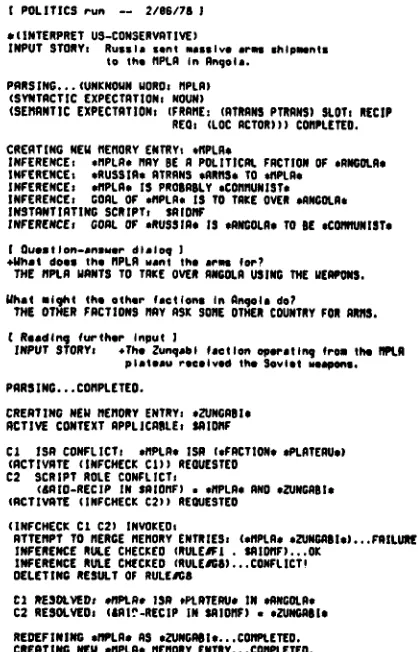
L e t us b r i e f l y t r a c e through an example where PC~.ITICS la t o l d t h a t the MPLA is indeed a pisteau after it inferred the meaning t o b e a political faction.
I POLITICS Pun - - 2/06/76 !
• : INTERPRET US-CONSERVRT IVE)
INPUT STORY, Russia sent massive arms ship.eats to the flPL.A in Re,gels.
PARSING... (UNKNOUN UOROI MPLA) :SYNTACTIC EXPECTATION! NOUN)
(SERRNTIC EXPECTATION; (FRANC: (ATRONS PTRONS) SLOTI RECIP REQ, ILOC ROTOR))) COflPLETEO.
CREATING N( u MEMORY ENTRY, *flPLRo
INFERENCE, ~,MPLRo MIAY BE A POLXTICI:n. FACTION OF mARGOt.fiG |NFEfl(NCE, eflUSSIAe RTRRNS eRRMSo TO tAPLRo
INFERENCE; *MPLAe IS PNOOROLY aCOflMUNXSTe INFERENCE, GOAL OF aMPLRa IS TO TAK( OVEN eANOOl.Ae INSTANTIATING SCAIPTJ SRIONF
INFERENCE; GOAL OF eRUSSIAa I$ toNGOLflo TO BE ¢comflNl|$Te
I Question-salem- dialog )
441hst does the MPLA ~ent the arms foP?
TNE RPLR MANTa TO TAKE OVER RNGOLR USING THE NEIMONS.
I~he( might the ether factionS in An(iolll de?
[image:3.612.66.275.268.594.2]THE OTHER FACTIONS NAY ASK SORE OTHER COUNTRY FOR RRflS.
| Reading furthcP Input ]
INPUT STORY; + T h e Zunqabl faction oleoPatlng fPoe the I~PLA
plateau received the $ovist uealNme.
PARS |NO... CONPLETEO •
GREAT|NO NEW N(NORY ENTRY: aZUNGRO|a ACTIVE CONTEXT RPPLJCRItLE, ~IONF
C1 ISR CONFLICT, eMPLRe ISR (eFRCTIONo sPI.RTERUe)
(ACTIVATE' (|NFCN(CK C|)) R(OUEST(O C2 SCRIPT ROLE CONFLICT,
(&R[O-RECXP |N SRIOMF) • aMPLRe RNO aZUNGABIe (ACTIVATE (INFCHECK C2)) RE~JEST[O
(INFCHECK C1 C2) INVOKEOt
RTTERPT TO MERGE MEMORY ENTRIES, (*M~.Ae aZON~Ia)...FAIUJRE' INFER(lICE RULE CHECK(O (RULEJFI . SRIOMF)...OK
INFERENCE RUt.E CHECKED (flULEIGO)...CONFLICT! OELETING RESULT OF RULE/GO
C2 RESOt.VEDt ~f'~'LRe ]SA *PLRTEIqJe IN eRNGOLRs C2 flESOLVEO; UlAI?-RECIP IN SRIOMF) • eZONGROIo
REDEFINING enPLRe AS eZUNGRe|O...COMPI.IrTEO. CREATING HEM orlPLRo fl(NORY (NTNY...CORPLET(O.
POLITICS realizes t h a t there is an Inconsistency In Its I n t e r p r e t a t i o n w h e n It tries to integrate "the MPLA plateau" w i t h its p r e v i o u s definition of "MPLA". Political factions and p l a t e a u s ere d i f f e r e n t conceptual classes. Furthermore, the n e w Input s t a t e s that the Zungsbl received the weapons, n o t t h e MPLA. Assuming that the Input Its correct, POLITICS s e a r c h e s for an Inference rule to assign blame for the p r e s e n t contradiction. This Is done simply by temporarily d e l e t i n g t h e result of each inference rule that was a c t i v a t e d in t h e original i n t e r p r e t a t i o n until the contradiction no longer e x i s t s . The rule t h a t concluded that the MPLA was a political f a c t i o n Is found to resolve both contradictions If deleted.
S i n c e r e c i p i e n t s of military aid must be political entitles, the MPLA b e i n g s geographical location no longer qualifies as a m i l i t a r y aid recipient.
Finally, POLITICS must check whether the inference rules t h a t d e p e n d e d upon the result of the deleted rule are no l o n g e r a p p l i c a b l e . Rules, such as the one that concluded t h a t t h e p o l i t i c a l f a c t i o n was communist, depended upon there b e i n g a political faction receiving military aid from Russia. The Zungabi now fulfll:s this role; therefore, the inferences a b o u t t h e MPLA are t r a n s f e r e d to the Zungabl, and th~ MPLA Is r e d e f i n e d to be a plateau. (Note: the word "Zungabl" was c o n s t r u c t e d for this example. The MPLA is the present ruling b o d y o f Angola.)
6 . E x t e n d i n g t h e P r o j e c t a n d I n t e g r a t e M e t h o d
T h e POL)TICS Implementation of the p r o j e c t - a n d - i n t e g r a t e t e c h n i q u e ts b y no means complete. POLITICS can only I n d u c e t h e meaning of c o n c r e t e or proper nouns when there Is s u f f i c i e n t c o n t e x t u a l information In a single exemplar. Furthermore, POLITICS assumes that each unknown word will h a v e o n l y one meaning. In general It is useful to realize when a w o r d Is u s e d to mean something other than Its definition, a n d s u b s e q u e n t l y formulate an alternative definition.
I I l l u s t r a t e t h e c a s e where many examples are required to n a r r o w d o w n t h e meaning of s word with the following e x a m p l e : "Johnny told Mary that If she didn't give him the t o y , he would <unknown-word) her." One can induce that the u n k n o w n w o r d Is a verb, but its meaning can only be guessed at, In g e n e r a l terms, to be something unfavorable to Mary. For I n s t a n c e , t h e unknown word could mean " t a k e the o b j e c t f r o m " , or " c a u s e injury to". One needs more then one e x a m p l e of t h e unknown word used to mean the same thing In d i f f e r e n t c o n t e x t s . Then one has s much richer, combined c o n t e x t from which the meaning can be p r o j e c t e d with g r e a t e r precision.
Figure 1 diagrams the general p r o j e c t - a n d - i n t e g r a t e algorithm. This e x t e n d e d version of POLITICS' word-learning t e c h n i q u e a d d r e s s e s the problems of iterating o v e r many e x a m p l e s , multiple word definitions, and does not restrict its Input t o c e r t a i n c l a s s e s of nouns.
7 . G e n e r a l i z i n g W o r d D e f i n i t i o n s .
W o r d s c a n h a v e many senses, some more n"neral than o t h e r s . L e t us look at the problem of gen lizlng the s e m a n t i c definition of a word. Consider the case where " b a r r i e r " is d e f i n e d to be a physical o b j e c t that dlsenables a t r a n s f e r of location. (e.g. "The barrier on the road Is blocking my w a y . " ) Now, l e t us interpret the sentence, "Import quotas form a b a r r i e r to International trade." Clearly, an Import quota Is n o t • p h y s i c a l o b j e c t . Thus, one can minimally generalize " b a r r i e r " to mean "anything that d i s c . s h i e s s physical t r a n s f e r o f location."
F I g h t 1: The prijeat-a.d-lntsgPete Nthed far Indu@l~ Re. ueP4 and :oe~ept detlnitleml
c o n t a l n l . | •hi URK~O~ •lard
PROJECT the s~ntaetie Imd semantic ¢onstrai.tl! fPoa eft Imelvslt of the other eowDonints
]N~qRTE
• 1! Oh• ©onttrilntl tQ tM, imlite • w d deflflltl(m
INTEGRRTE
91ob•l Cento•t to (mrlch 4Qtlnitiqm
I COn•cut"air OlealmPseaedelp Jml goil,.dPiwm Int.fqm~te
NO
emcm~ in t M, Imee~. u•Ing a I•eet- q:m" •also-! IP•|
NO [111101
Postul•te • mm .erd same aml build a I terlqlte defiflitie~
Delete culpell I n f • r ~ e mid ~ . J
g e n e r a l i z a t i o n process must be remembered because t h e original meaning is o f t e n preferred, or metaphorically r e f e r e n c e d . Consider: "The trade barriers w e r e lifted. • and "The n e w legislation bulldozed existing trade barriers. • r h e a s s e n t e n c e s can only be understood metaphorically. r h a t is, one needs to r e f e r to the original meaning of ~barrier" as a physical object, In order for •lifting" or ' b u l l d o z i n g " t o make sense. After understanding the literal
leaning
o f a "bulldozed barrier", the n e x t step Is to infer he c o n s e q u e n c e of such aft action, namely, the barrier no ) n g e r e x i s t s . Finally, one can refer to the generalized l e a n i n g o f " b a r r i e r " to i n t e r p r e t the proPoaltion that •The e w l e g i s l a t i o n caused the trade barriers to be no longer In x i e t e n c e . "p r o p o s e t h e *ollowing rules to generalize word definitions l d u n d e r s t a n d metaphorical references to their ortglnol, mmel definition:
1 ) If t h e definition of a word violates the semantic c o n s t r a i n t s p r o j e c t e d from an interpretation of the r e s t o f t h e sentence, c r e a t e a new word-sense d e f i n i t i o n t h a t copies the old deflnltiml minimally r e l a x i n g (I.e., generalizing) the violated constraint.
2 ) In Interpreting new sentences always prefer t h e mast specific definition if applicable.
3 ) If t h e generalized definition Is encountered again i n Interpreting t e x t , make It part of the p e r m a n e n t dictionary.
4 ) If • word definition requires further
g e n e r a l i z a t i o n , choose the existing most general d e f i n i t i o n and minimally r e l a x Its violated semantic c o n s t r a i n t s until a new, y e t more general definition Is formed.
5 ) If t h e c a s e frame formulated in interpreting a s e n t e n c e p r o j e c t s more specific semantic c o n s t r a i n t s onto the word meaning than those c o n s i s t e n t with rite entire sentence, Interpret the w o r d usln(! t h e most specific definition c o n s l s t e . t w i t h t h e c a s e frame. If the resultant meaning of t h e c a s e frame Is inconsistent with the i n t e r p r e t a t i o n of the whole sentence, Infer the most l i k e l y consequence of the pMtlally-build C o n c e p t u a l D e p e n d e n c y case frame, and use this c o n s e q u e n c e In Interpreting the rest of the s e n t e n c e .
The p r o c e s s d e s c r i b e d b y rule 5 enables one to Interpret the m e t a p h o r i c a l uses of words like " l i f t e d " and "bulldozed" In o u r e a r l i e r e x a m p l e s . The literal meaning of each word i8 a p p l i e d t o t h e o b j e c t case, (i.e., "barrier•), and t h e Inferred c o n s e q u e n c e (i.e., destruction of the barrier) i8 used t o I n t e r p r e t t h e full s e n t e n c e .
8 . C o r a l . c l i n g R e m a r k s
T h e r e a r e a multitude of w a y s to incrementally Improve t h e l a n g u a g e understanding capabilities of a system. In this p a p e r I d i s c u s s e d in some detail the process of learning n e w w ~ r d e . In l e s s e r d e t a i l I presented some ideas on how t o g e n e r a l i z e word meanings and Interpret metaphorical uses of i n d i v i d u a l w o r d s . There are many more aspects to learning l a n g u a g e and understanding metaphors that I have not t o u c h e d upon, For Instance, many metaphors transcend I n d i v i d u a l w o r d s and phrases. Their Interpretation may r e q u i r e d e t a i l e d cultural knowledge [ 1 0 ] .
In o r d e r t o p l a c e some p e r s p e c t i v e on p r o j e c t - a n d - i n t e g r a t e l e a r n i n g method, consider t h r o e general learning mechanisms c a p a b l e o f implementing d i f f e r e n t aspects of Incremental l a n g u a g e learning.
L e a r n i n g h y e x a m p l e . This Is perhaps the most g e n e r a l learning s t r a t e g y . From several exemplars, o n e can i n t e r s e c t the common concept by, If n e c e s s a r y , minimally generalizing the meaning of t h e known part of each example until a common a u b p a r t Is found by Intersection. This common e u b p a r t Is likely to be the meaning of the unknown s e c t i o n o f each exemplar.
L e a r n i n g b y n e a r - m i s s analysis. Winston [ 2 ] t a k e s full a d v a n t a g e of this technique, i t may be u s e f u l l y applied to a natural language system that c a n I n t e r a c t l v e i y g e n e r a t e utterances using the w o r d s it learned, and l a t e r be told whether It used t h o s e words c o r r e c t l y , whether It erred seriously, or w h e t h e r It came close but failed to understand a s u b t l e n u a n c e In meaning.
linguistic element whose meaning Is to be Induced. Much more mileage can be gotten from this method, especially If one uses strong syntactic c o n s t r a i n t s and expectations from other k n o w l e d g e sources, such as s discourse model, s n a r r a t i v e model, knowledge about who is providing t h e information, and why the information Is being p r o v i d e d .
9 . R e f e r e n c e s
T.
2.
3.
4 .
5.
6.
7.
8 .
9.
TO.
Lenet, 0. AMz Discovery In Mathematics as Heuristic Search. Ph.D. Th., Stanford University, 1977.
Winston, P. Learning Structural Descriptions from Examples. Ph.D. Th., MIT, 1970.
Granger, R. FOUL-UPt A Program that Figures Out Meanings of Worcls from Context. IJCAI-77, 1977.
Schank, R. C. and Abelson, R.P. Scripts, Goals, Plans and Unclerstancling. Hillside, NJ: Lawrence Erlbaum, 1977.
Cullingford, R. Script Appllcationt Computer Uncleratandlng of Newspaper Stories. Ph.D. Th., Yale University, 1977.
Carbonell, J.G. POLITICS: Automated Ideological Reasoning. Cognitive Science 2, 1 (1978), 2 7 - 5 1 .
Carbonell, J.G. Subjective Unclerstancllng:
Computer Mo<lels of Belief Systems.. Ph.D. Th., Yale University, 1979.
Sohsnk, R.C. Conceptual Information Processing. Amsterdam: North-Holland, 1975.
Doyle, J. Truth Malntenanoe Systems for Problem Solving. Master Th., M.I.T., 1978.
Lakoff, G. and Johnson, M. Towards an