Munich Personal RePEc Archive
Statistics and IQ in Developing
Countries: A Note
Kodila-Tedika, Oasis and Asongu, Simplice and Azia-Dimbu,
Florentin
September 2015
Online at
https://mpra.ub.uni-muenchen.de/68323/
1
AFRICAN GOVERNANCE AND DEVELOPMENT
INSTITUTE
A G D I Working Paper
WP/15/030
Statistics and IQ in Developing Countries: A Note
Oasis Kodila-Tedika
University of Kinshasa Department of Economics, DRC
Simplice A. Asongu
African Governance and Development Institute (AGDI), [email protected]
Florentin Azia-Dimbu
Université Pédagogique Nationale Faculté de Psychologie, RDC
2 © 2015 African Governance and Development Institute WP/15/030
AGDI Working Paper
Research Department
Oasis Kodila-Tedika, Simplice A. Asongu & Florentin Azia-Dimbu
September 2015
Abstract
The purpose of this study is to assess the nexus between intelligence (or human capital) and
statistical capacity in developing countries. The line of inquiry is motivated essentially by: (i)
the scarce literature devoted to elucidating poor statistics in developing countries and (ii) an
evolving stream of literature on knowledge economy. We have established a positive
association between intelligence quotient (IQ) and statistical capacity. The relationship is: (i)
consistent with the employment of alternative specifications based on varying conditioning
information sets and (ii) robust to the control of outliers. Policy implications are discussed.
JEL Classification: D02, D73, I20
Keywords: Statistics; Intelligence; Developing countries
1. Introduction
Incorrect national statistics negatively bears on government effectiveness (Kodila-Tedika,
2014a) and potentially creates debates in policy circles. This debate which has been
articulated with fundamental growth issues in Africa, coincided with the publication of some
notable works on data revision, inter alia: Jerven (2013a), Devarajan (2013), Harttgen, Klasen
and Vollmer (2013). While Jerven (2013b) has clearly outlined the issues in a new book,
Young (2012) has established that some indicators on Africa’s development are growing
3
of literature on the subject, notably a recent book premised on whether Africa’s recent growth
resurgence is a reality or a myth (Fosu, 2015ab).
In light of the above, it is important to elucidate why good statistics may be present in
some countries and not others. To the best of our knowledge, very little has been covered on
this stream of literature, essentially owing to the relatively new stream of debate. As far as we
have reviewed, only Kodila-Tedika (2013) has attempted to elucidate this concern of
statistical quality in African countries. The present line of inquiry aims to extend this stream
of the literature from a human capital angle, notably: on the role of intelligence or intelligence
quotient (IO) in statistical capacity.
The positioning of the line of inquiry on human capital aligns well with an evolving
stream of African development literature, articulating the imperative for African countries to
catch-up with the rest of the world by enhancing their transition from product-based
economies to knowledge-based economies (Anyanwu, 2012; Asongu, 2014a; Oluwatobi et
al., 2014; Andrés et al., 2014; Asongu, 2015a)1.
Our theoretical hypothesis is founded on the following arguments. Indeed, educated
persons tend to be good and well informed citizens (Reynal-Querol and Besley, 2011;Besley
et al., 2011). A high degree of citizenship and information should include being more reliable
and indebted (Botero et al., 2012). Lynn et al. (2007) and Lynn and Milk (2007) have shown
that the IQ is highly correlated with education. Accordingly, people with high IQs can easily
use their education for various purposes. Within the framework of this line of inquiry,
societies enjoying relatively high IQ should be associated with a higher demand for accurate
information, collected as statistics. This theoretical postulation broadly aligns with
recommendations for better statistics from Young (2012) and Henderson et al. (2012). Based
1
4 on the above theoretical postulations, our testable hypothesis is as follows: on average,
countries with high IQ present better statistics, relative to their low IQ counterparts.
The rest of the paper is structured as follows. Section 2 discusses the data and
methodology. Empirical results are presented Section 3 while Section 4 concludes with
implications.
2. Data and Methodology
The indicator of the Bulletin Board on Statistical Capacity (BBSC), developed by the
Development Data Group of the World Bank, which focuses on improving the monitoring and
measuring of statistical capacity of the International Development Association (IDA)
countries in close collaboration with users and countries. The database embodies information
from a plethora of aspects of national statistical systems and entails a country-level statistical
capacity indicator which is based on a set of criteria that are consistent with international
recommendations.
The BBSC discloses information on various dimensions of national statistical systems of
developing nations, embodying a statistical capacity indicator at the country-level. This
indicator examines the capacity of statistical systems with the help of a diagnostic framework
which entails three investigative areas, notably: data sources; methodology and periodicity
and timeliness (institutional framework is excluded). The rating ranges from 0 to 100, with
higher values denoting better capacity.
The data on intelligence is from Meisenberg and Lynn (2011) and its previous versions can be
found in Lynn and Vanhanen (2002, 2006). This dataset is a compilation of hundreds of
average national IQ tests observed over the 20th and the 21st centuries using best practice
5 nation's labor quality (Hanushek & Kimko, 2000; Hanushek & Woessmann, 2008; Jones &
Schneider, 2006).
The choice of the statistical indicator and intelligence measurement are broadly
consistent with recent economic development and intelligence literature (Weede & Kämpf,
2002; Jones & Schneider, 2006; Ram, 2007; Potrafke, 2012; Kodila-Tedika &
Kanyama-Kalonda, 2014; Kodila-Tedika, 2014b; Rindermann et al., 2014; Kodila-Tedika & Mustacu,
2014; Kodila-Tedika & Bolito-Losembe, 2014; Kodila-Tedika and Asongu, 2015ab). It is
interesting to note that data from Hanushek on the one hand and from Lynn and Vanhanen on
the other hand are continuously being improved (Meisenberg & Lynn, 2011; 2012).
In accordance with recent literature on statistical capacity (Kodila-Tedika, 2013,
2014a), we control for GDP per capita, trade openness (openness), state fragility, ethnic
fractionalization and government effectiveness. While data on GDP per capita and trade is
sourced from Pen World Tables, ethnic fractionalization is from Alesina et al. (2003). The
state fragility variable is from the International Monetary Fund (IMF, 2011) based on the
World Bank classification while the government effectiveness measurement is provided by
Kaufmann et al. (2010). The expected signs of the control variables are engaged concurrently
with the discussion of empirical results.
Consistent with recent human capital or intelligence (Kodila-Tedika & Asongu,
2015ab) and development (Asongu, 2013) literature, the specification in Eq. (1) below
assesses the correlation between human capital and statistical capacity.
i i i
i HC C
SC 12 3 (1)
Where: SCi(HCi) represents a Statistical capacity (Human Capital) indicator for country i,
1
is a constant, C is the vector of control variables, and i the error term. HC is the Human
Capital variable while C entails: GDP per capita, trade openness (openness), state fragility,
6 capital literature, the objective of Eq. (1) is to estimate if intelligence affects statistical
capacity by Ordinary Least Squares (OLS) using standard errors that are corrected for
heteroscedasticity.
3. Empirical results
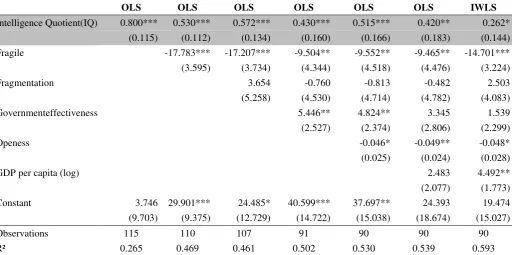
The first Column shows univariate regressions confirms the expected positive correlation
between intelligence and Statistical Capacity. Hence, intelligence is positively correlated with
Statistical Capacity. Columns 2 to Column 7 assess the relationship conditional on other
covariates (control variables). From the results, the positive correlation is broadly confirmed
across specifications in terms of the significance of the estimated human capital (or
intelligence) coefficient. Accordingly, the estimated coefficients varies between 0.8 and 0.3
and the degree of adjustment (or explanatory power) of estimated coefficients also varies
between 26.5 % and 59.3%. It is logical to expect an increasing R² with more control
variables into the specifications. Hence, we could infer from the baseline estimations that
[image:7.595.75.588.465.720.2]countries with high IQ are associated with higher degrees of Statistical Capacity.
Table 1. Main results
OLS OLS OLS OLS OLS OLS IWLS
Intelligence Quotient(IQ) 0.800*** 0.530*** 0.572*** 0.430*** 0.515*** 0.420** 0.262* (0.115) (0.112) (0.134) (0.160) (0.166) (0.183) (0.144) Fragile -17.783*** -17.207*** -9.504** -9.552** -9.465** -14.701***
(3.595) (3.734) (4.344) (4.518) (4.476) (3.224) Fragmentation 3.654 -0.760 -0.813 -0.482 2.503
(5.258) (4.530) (4.714) (4.782) (4.083) Governmenteffectiveness 5.446** 4.824** 3.345 1.539
(2.527) (2.374) (2.806) (2.299)
Openess -0.046* -0.049** -0.048*
(0.025) (0.024) (0.028)
GDP per capita (log) 2.483 4.492**
(2.077) (1.773)
Constant 3.746 29.901*** 24.485* 40.599*** 37.697** 24.393 19.474 (9.703) (9.375) (12.729) (14.722) (15.038) (18.674) (15.027)
Observations 115 110 107 91 90 90 90
7 Given that the estimations by the OLS technique may be weak in the presence of
outliers, we verify the robustness of corresponding estimates by employing an estimation
technique that controls for the presence of such outliers. For this purpose of robustness we use
Iteratively weighted least squares (IWLS). The process of robustness checks is consistent with
Asongu and Kodila-Tedika (2015c) in the intelligence literature. The findings presented in the
last column are consistent in sign and significance with OLS results, though with a relatively
lower magnitude. The corresponding lower magnitude implies that outliers influence the
investigated nexus between statistical capacity and intelligence. Hence, further justify the
engaged robustness check.
Most of the significant control variables have the expected signs. (i) State fragility
should intuitively be negatively related with the ability of governments to collect good data
because some regions in a given country may be affected by political strife, civil conflicts and
wars, hence, rendering data collection very difficult. (ii) Government effectiveness has been
documented to be positively associated with statistical capacity (Kodila-Tedika, 2014a). (iii)
Trade openness may decrease the ability to collect good data in inherently corrupt developing
countries because underlying trading activities are very likely to be associated with
misinvoicing, bribery and unfair lobbying. (iv) The positive nexus of the dependent variable
with GDP per capita essentially builds on the intuition that, wealthier countries are endowed
with more financial resources for good data collection, relative to their less-wealthy
counterparts.
4. Concluding implications
The purpose of this note has been to assess the nexus between intelligence or human capital
and a nation’s statistical capacity. The line of inquiry has been essentially motivated by: (i)
the scarce literature devoted to elucidating availability of poor statistics in developing
8 positive association between intelligence quotient (IQ) and statistical capacity. The
relationship is: (i) consistent with the employment of alternative specifications based on
varying conditioning information sets and (ii) robust to the control of outliers.
The above findings imply that as average levels of IQ in developing countries
increase, we should expect to see countries revising their national statistics substantially. This
has been the recent experiences of Nigeria and Kenya in Africa. Given the leading roles of
these countries on the continent in education, innovation and information and communication
technology (ICT) (Tchamyou, 2014), the intuition for associating the higher IQs with better
statistical capacity is sound. This is essentially because the highlighted variables are three of
the four dimensions of the World Bank’s knowledge economy index: the fourth being,
‘economic incentives and institutional regime’. Accordingly, for better statistics to be
collected, broad-based ICTs are essential to facilitate exchanges and accuracies between the
data collector and data provider (institutions and civil societies). Moreover, with improvement
in the levels of education, more skilled researchers would be available to refine and improve
techniques of data collection, simulation, aggregation and computation, inter alia.
Future lines of inquiry devoted to improving the extant literature on the subject could
focus on understanding: (i) the channels via which the IQ improves statistical capacity and (ii)
which dimensions of knowledge economy drive the IQ on the one hand and a nation’s
9 References
Alesina, A., Devleeschauwer, A., Easterly, W., Kurlat, S. and Wacziarg, R. (2003). Fractionalization. Journal of Economic Growth 8 (2): 155–94.
Andrés, A. R., Asongu, S. A., and Amavilah, V. H. S., (2014). The Impact of Formal Institutions on Knowledge Economy. Journal of the Knowledge
Economy:http://link.springer.com/article/10.1007%2Fs13132-013-0174-3
Anyanwu, J. C. (2012). Developing Knowledge for the Economic Advancement of Africa.
International Journal of Academic Research in Economics and Management Sciences 1(2): 73-111.
Asongu, S. A. (2013). How has mobile phone penetration stimulated financial development inAfrica?
Journal of African Business, 14(1): 7-18.
Asongu, S. A. (2015a). The Comparative Economics of Knowledge Economy in Africa: Policy Benchmarks, Syndromes, and Implications, Journal of the Knowledge
Economy:http://link.springer.com/journal/13132/onlineFirst/page/1
Asongu, S. A., (2015b). Book review:Growth and Institutions in African DevelopmentbyAugustin K. Fosu,Journal of African Development: Forthcoming.
Asongu, S. A. (2014a). Knowledge economy and financial sector competition in African countries,
African Development Review 26(2): 333-346.
Asongu, S. A. (2014b). Software Piracy and Scientific Publications: Knowledge Economy Evidence from Africa, African Development Review 26(4): 572-583.
Asongu, S. A. (2014c). Software piracy, inequality and the poor: evidence from Africa, Journal of Economic Studies 41(4): 526-553.
Besley, T., Montalvo, J.G. and Reynal‐Querol, M. 2011. Do Educated Leaders Matter?,Economic Journal, 121(554), F205–08.
Botero, J., Ponce, A. and Shleifer, A. 2012. Education and the Quality of Government, NBER Working Papers 18119.
Devarajan, S. (2013). Africa’s Statistical Tragedy. Review of Income and Wealth, 59(Issue
Supplement S1): S9–S15. DOI 10.1111/roiw.12013.
Fosu, A. K. (2015a). Growth and Institutions in African Development, First edited by Augustin K. Fosu, , Routledge Studies in Development Economics: New York
Fosu, A. K. (2015b). Growth and institutions in African Development, in Growth and Institutions in African Development, First edited by Augustin K. Fosu, 2015, Chapter 1, pp. 1-17, Routledge Studies in Development Economics: New York.
Hanushek, E. A., & Kimko, D. D. (2000). Schooling, Labor-Force Quality, and the Growth of Nations.
American Economic Review, 90, 1184-1208.
Hanushek, E. A. and Woessmann, L. (2008). The Role of Cognitive Skills in Economic Development.
Journal of Economic Literature, 46(3), 607-668.
Harttgen, K., S. Klasen, and S. Vollmer (2013). ‘An African Growth Miracle? Or: What do Asset Indices Tell Us about Trends in Economic Performance?’.Review of Income and Wealth, 59(Issue Supplement S1): S37–S61. DOI 10.1111/roiw.12016.
Henderson, J.V., A. Storeygard, and D.N. Weil (2012). ‘Measuring Growth from Outer Space’.
American Economic Review, 102(2): 994–1028.
IMF, 2011, “Macroeconomic and Operational Challenges in Countries in Fragile Situations”(Washington: International Monetary Fund).
Jerven, M. (2013a), African growth miracle or statistical tragedy? Interpreting trends in the data over the past two decades. This paper has been presented at the UNU-WIDER ‘Conference on
Inclusive Growth in Africa: Measurement, Causes, and Consequences’, held 20-21 September
2013 in Helsinki, Finland.
Jerven, M. (2013b). Poor Numbers: How We Are Misled by African Development Statistics and What to Do about It. Ithaca, NY: Cornell University Press.
10 Kaufmann, D., Kraay, A., Mastruzzi, M., 2010. The worldwide governance indicators:
methodology and analytical issues. Policy Research Working Paper Series 5430. The World Bank.
Kodila-Tedika, O. (2013), “Pauvrete´ de chiffres: explication de la trage´diestatistiqueafricaine”, MPRA Paper No. 43734, University Library of Munich, Munich.
Kodila-Tedika, O. (2014a), Africa’s statistical tragedy:best statistics, best government effectiveness,
International Journal of Development Issues Vol. 13 No. 2, pp. 171-178. DOI 10.1108/IJDI-12-2013-0090
Kodila-Tedika, O. (2014b), Governance and Intelligence: Empirical Analysis from African Data,
Journal of African Development, 16(1), 83-97.
Kodila-Tedika, O. and Asongu, S. A. (2015a). The effect of intelligence on financial development: a cross-country comparison. Intelligence, 51(July-August), pp. 1-9.
Kodila-Tedika, O. and Asongu, S. A. (201b). Intelligence, Human Capital and HIV/AIDS: Fresh Exploration, African Governance and Development Institute Working Paper, No. 15/027, Yaoundé. Revised and Resubmitted: Intelligence.
Kodila-Tedika, O. and Bolito-Losembe, R. (2014). Poverty and Intelligence: Evidence Using Quantile Regression, EconomiicResearrchGuarrdian, (1): 25-32.
Kodila-Tedika, O. andMutascu, M.(2014). Tax Revenues and Intelligence: A Cross-Sectional Evidence, MPRA Paper 57581, University Library of Munich, Germany.
Lynn, R. and Mikk, J. (2007). National differences in intelligence and educational attainment. Intelligence, 35, 115–121.
Lynn, R. andVanhanen, T. (2002) IQ and the Wealth of Nations. Westport CT: Praeger.
Lynn, R. andVanhanen, T. (2006) IQ and Global Inequality. Augusta GA: Washington Summit.
Lynn, R., Meisenberg, G., Mikk, J. and Williams, A. (2007). National differences in intelligence and educational attainment. Journal of Biosocial Science, 39, 861–874.
Meisenberg, G. & Lynn, R. (2011). Intelligence: A measure of human capital in nations. Journal of Social, Political and Economic Studies, 36(4), 421-454.
Meisenberg, G. & Lynn, R. (2012). Cognitive Human Capital and Economic Growth:Defining the Causal Paths. Journal of Social, Political and Economic Studies, 37(4), 141-179.
Oluwatobi, S., Efobi, U., Olurinola, I., and Alege, P. (2014). Innovation in Africa: Why Institutions Matter?,South African Journal of
Economics;http://onlinelibrary.wiley.com/doi/10.1111/saje.12071/abstract Potrafke, N. (2012). Intelligence and corruption. Economics Letters, 114,109-112.
Ram, R. (2007). IQ and economic growth: Further augmentation ofMankiw-Romer-Weil model.
Economics Letters, 94, 7-11.
Reynal-Queroln, M. and Besley, T. 2011. Do democracies select more educated leaders?,American Political Science Review, 105(3).
Rindermann, H., Kodila-Tedika, O. and Christainsen, G. 2014. Cognitive capital, good governance, and the wealth of nations, MPRA Paper 57563, University Library of Munich, Germany.
Tchamyou, S. V. (2014). The Role of Knowledge Economy in African Business, HEC-Ulg Management School.
Weede, E. andKämpf, S. (2002). The impact of intelligence and institutionalimprovements on economic growth. Kyklos, 55, 361-380.