Evolutionary computation for wind farm layout
optimization
Dennis Wilsona, Silvio Rodriguesb, Carlos Segurad, Ilya Loshchilove,
Frank Huttere, Guillermo López Buenfild, Ahmed Kheirif, Ed Keedwellg,
Mario Ocampo-Pinedad, Ender Özcanh, Sergio Ivvan Valdez Peñad,
Brian Goldmani, Salvador Botello Riondad, Arturo Hernández-Aguirred,
Kalyan Veeramachanenic, Sylvain Cussat-Blanca
aUniversity of Toulosue - IRIT - CNRS UMR5505,
{dennis.wilson, sylvain.cussat-blanc}@irit.fr
bDelft University of Technology, [email protected] cMIT - LIDS, [email protected]
dCenter for Research in Mathematics,
{carlos.segura, manuel.lopez, mario.ocampo, ivvan, botello, artha}@cimat.mx eUniversity of Freiburg, {ilya,fh}@cs.uni-freiburg.de
fLancaster University, [email protected] gUniversity of Exeter, [email protected] hUniversity of Nottingham, [email protected]
iMichigan State University, [email protected]
Abstract
This paper presents the results of the second edition of the Wind Farm Layout Optimization Competition, which was held at the 22ndGenetic and Evolution-ary Computation COnference (GECCO) in 2015. During this competition, com-petitors were tasked with optimizing the layouts of five generated wind farms based on a simplified cost of energy evaluation function of the wind farm layouts. Online and offline APIs were implemented in C++, Java, Matlab and Python for this competition to offer a common framework for the competitors. The top four approaches out of eight participating teams are presented in this paper and their results are compared. All of the competitors’ algorithms use evolution-ary computation, the research field of the conference at which the competition was held. Competitors were able to downscale the optimization problem size (number of parameters) by casting the wind farm layout problem as a geometric optimization problem. This strongly reduces the number of evaluations (limited in the scope of this competition) with extremely promising results.
Keywords: Wind farm layout optimization, evolutionary algorithm,
1. Introduction
1
Wind farm design is a complex task and the recent trend of larger farm
2
sizes has greatly increased demands on designers. Traditionally, a small,
well-3
connected, land area is divided into smaller cells and turbine placement among
4
cells is decided through a simple search algorithm with a pre-specified cost
5
function. This function is usually limited to minimizing inter-turbine wake
6
interferences and thus maximizing energy capture. Few approaches consider
7
additional factors such as operation and maintenance costs, turbine costs, or
8
cable layout.
9
Modern farms cover large areas and boast hundreds, and sometimes even
10
thousands, of turbines. The layout design process is iterative, computationally
11
expensive, burdened with global and local constraints, and ultimately controlled
12
by subjective assessments due to the involvement of a variety of stakeholders.
13
During each step, designers must either refine an incremental layout or
pro-14
pose a new layout which they have generated by incorporating new constraints.
15
Additionally, evaluating a layout requires varied multi-disciplinary models and
16
sub-modules that are extremely computationally expensive.
17
The wind farm layout optimization problem is the identification of turbine
18
positions in a 2-D plane such that the energy capture is maximized while costs
19
associated with a number of other factors are minimized. The energy capture
20
for a turbine takes into account the wind scenario (wind force distribution and
21
terrain), the turbines’ power curve (power generated by the turbine in function
22
of the wind input) and wake effects (inter-turbine interferences) [1].
23
When optimizing both the position and the number of turbines to build,
24
genetic algorithms (GAs) are commonly used to optimize wind farm layout.
25
The farm area is discretized with a grid [2, 3, 4, 5, 6, 7, 8]. The GA optimizes a
26
binary genome in which each gene represents the presence or absence of a turbine
27
in each cell of the grid, therefore both optimizing the number of turbines and
28
their discrete placement. Other techniques have been evaluated using particle
29
swarm optimization [9, 10, 11] and local modification with different optimization
30
algorithms [12, 13]. Wilson et al. have also proposed an innovative interactive
31
approach based on cell-based developmental model in [14]. Interested readers
32
can find overviews of existing methods for wind farm layout optimization in
33
Khan et al. [15] and Samorani [16].
34
In this paper, we report on a competition we ran at the Genetic and
Evo-35
lutionary Computation Conference 2015 (GECCO 2015) during which experts
36
from the evolutionary computation community optimized wind farm layouts.
37
Eight teams participated and proposed innovative algorithms, all evaluated in
38
the same context: the same wind scenarios, power curve and wake effect
mod-39
els. This paper presents the results of the top 4 participants and is organized as
40
follows. Section 2 presents the rules and the framework used during the
com-41
petition. Section 3 details the top 4 algorithms of the competition, which are
42
then compared with a standard binary GA in section 4. Finally, this article
43
discusses these algorithms and opens novel questions that could be addressed
44
using evolutionary algorithms in this domain of research.
2. Competition rules and framework
46
2.1. Competition rules 47
Whereas the first edition of the wind farm layout optimization competition,
48
held at the 2014 Genetic and Evolutionary Computation COnference (GECCO),
49
consisted in only optimizing the wake free ratio (actual energy output over
po-50
tential output without wake), the second edition focuses on the economical
51
viability of the produced layouts. Layouts generated by the competitors’
al-52
gorithms are evaluated in the cloud on 5 unknown wind scenarios (wind rose,
53
layout shape and obstacles, turbine specifications, etc.) using the cost
func-54
tion presented below. In order to keep the computation cost acceptable, the
55
competitors have a finite number of possible evaluations: they can only call
56
the evaluation function 10,000 times for all 5 scenarios combined. This limited
57
amount of evaluation credits aims to represent the CPU cost of layout
evalua-58
tion and to promote efficient algorithms. This metric was preferred to CPU time
59
because the computation was held on a shared research cluster with no exclusive
60
access guaranteed. In order to develop their algorithms, competitors also have
61
access to 20 known scenarios, 10 without obstacles and 10 with obstacles, all
62
different from the ones used during the competition.
63
Based on the best layouts submitted, the competing algorithms are compared
64
on each scenario to optimize the cost of energy function. The algorithms are
65
ranked on each scenario with a point system provided in Table 1.
66
Position 1st 2nd 3rd 4th 5th 6th
Points 10 6 4 3 2 1
Table 1: Point system
Places below 6th receive 0 points. The winner of the competition is the
67
competitor that has the highest number of points among the 5 scenarios.
68
2.2. Layout evaluation 69
For each layout generated, the goal of the competitors is to minimize the
70
cost of energyf calculated as follows:
71
f =
(
ctn+cs⌊mn⌋
)
+cOMn
(
1−(1−r)−y)/r ∗
1
8760P +
0.1
n (1)
wherect is the turbine cost,cs is the price of a substation,mis the number of
72
turbines per substation,ris the interest rate,yis the farm lifetime in years,cOM
73
is the operation and maintenance costs,nis the number of turbines of the layout,
74
P is the layout’s energy output. The last term of the fitness function rewards
75
layouts with more turbines: without this term, smaller layouts would be more
76
optimal, which would be counterproductive with regard to the optimization.
77
This cost function corresponds to the production price of a kilowatt: the
78
competitors must produce the layout that minimizes the cost of energy with
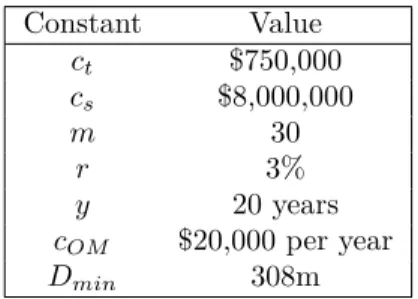
respect to the scenario provided. Table 2 provides the constant values used in
80
the previous equation.
81
Note that a set of constraints must be fulfilled by a wind farm layout to
82
be valid. First, all the turbines must be located inside the terrain where the
83
wind farm will be deployed, i.e. all turbine positions must be smaller than a
84
maximum x and y provided in each scenario. Second, the distance between
85
turbines must be larger than a given security threshold, which is called Dmin
86
and in our studies was set to 8 times the turbine rotor radius.
87
Constant Value
ct $750,000
cs $8,000,000
m 30
r 3%
y 20 years
cOM $20,000 per year
Dmin 308m
Table 2: Constant values used in the calculation of the cost of energy.
To evaluate the energy output of the wind farm, Kusiak’s model has been
88
used [1]. It provides the energy outputP of the layout generated by the
com-89
petitor optimizers.
90
2.3. Inter-turbine interference model 91
The energy capture for a turbine takes into account the following:
92
• Wind Scenario: Wind speed, v, represented as a random variable with
93
a Weibull distribution that is a summary of wind speed at that location
94
for a period of time. This is given by pv(v;c, k|θ), where c and k are
95
Weibull shape and scale parameters andθ is a wind directional bin. The
96
wind speed distribution is different for different directional bins,θ.
Addi-97
tionally, wind flows from a certain direction with some probabilityp(θ).
98
Together pv(v;c, k|θ)and p(θ) are referred to as wind resource/scenario
99
in this paper.
100
• Power curve: A function η(v), known as a power curve, gives the power
101
generated by a turbine for the given wind speed v. The power curve is
102
dependent on the turbine make and model.
103
• Wake effects: In a particular directional bin, for a given turbineilocated
104
at xi, yi a number of other turbines affect the wind it experiences. This
105
is called wake effect. Given the other turbines’ locations xj, yj for all
106
j∈ {1. . . i−1, i+ 1. . . n}, the turbines that affect the particular turbine
107
are determined using awakemodel. This is documented in [1]. If a turbine
108
located at xi, yi is in the wake of another turbine located at xj, yj in a
109
given direction, the wind speed distribution experienced by the turbine
is modified by changing the parameter c resulting in a turbine specific
111
ci|θ. The valueci< cis reduced in proportion to the Euclidean distance
112
betweeniandj.
113
To evaluate the energy capture, the objective function needs the expected 114
value of the energy capture for a given wind resource and turbine positions. For
115
a single turbine at position(xi, yi), it first determines its modified wind resource
116
for each directional bin based on other turbine positions and then calculates its
117
energy capture using:
118 E= ∫ θ p(θ) ∫ v
pθv(v;ci, ki|θ)η(v). (2)
Equation 2 evaluates the overall average energy over all wind speeds for a
119
given wind direction, and then averages this energy over all wind directions.
120
Energy is calculated for every turbine and then summed together to give global
121
energy capture.
122
2.4. Framework 123
In order to reduce the competitors’ development efforts, we have developed
124
an open-source API, called WindFLO, that implements the cost function (and
125
the inter-turbine interference model) in multiple languages (C++, Java, Matlab
126
0"15"30" 45" 60" 75" 90" 105" 120" 135" 150" 165" 180" 195" 210" 225" 240" 255" 270" 285" 300" 315"330" 345" Scenario 3
0"15"30" 45" 60" 75" 90" 105" 120" 135" 150" 165" 180" 195" 210" 225" 240" 255" 270" 285" 300" 315"330" 345" 0"15"30"
45" 60" 75" 90" 105" 120" 135" 150" 165" 180" 195" 210" 225" 240" 255" 270" 285" 300" 315"330" 345"
0"15"30" 45" 60" 75" 90" 105" 120" 135" 150" 165" 180" 195" 210" 225" 240" 255" 270" 285" 300" 315"330" 345" 0" 15"30" 45" 60" 75" 90" 105" 120" 135" 150" 165" 180" 195" 210" 225" 240" 255" 270" 285" 300" 315"330" 345" Scenario 2 Scenario 1 Scenario 4 Scenario 5 9240m x 6545m
6545m x 5005m
6930m x 12320m
10780m x 9240m
5390m x 6545m
and Python)1. The API provides a simple GA as an example of use of the
127
library.
128
2.5. Wind scenarios 129
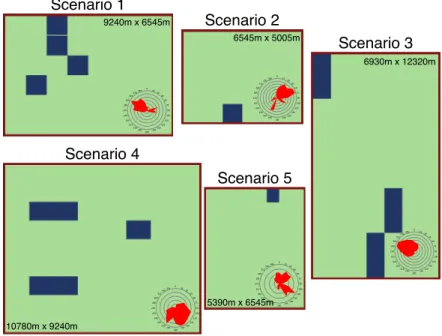
Figure 1 depicts the scenarios (terrain sizes, obstacles and wind roses) used
130
to evaluate the competitors’ algorithms. Wind roses graphically represent the
131
wind repartition in force and probability in each direction. These scenarios can
132
be downloaded from the WindFLO repository.
133
3. Competitors’ algorithms
134
The second edition of the competition received a total of 8 submissions.
135
This section presents the top four approaches. In our opinion, they are the
136
most relevant to the wind farm optimization community and provides the best
137
results in term of quality of layouts obtained. These four algorithms are available
138
in the WindFLO API presented above. These algorithms are the following:
139
1. 3s-MDE: from Carlos Segura, Guillermo López Buenfil, Mario Ocampo
140
Pineda, Sergio Ivvan Valdez Peña, Salvador Botello Rionda, and Arturo
141
Hernández-Aguirre. The 3-Stages Memetic Differential Evolution
(3s-142
MDE) starts by creating a surrogate model which approximates the cost
143
function. Then, a memetic differential evolution is used to pre-optimize
144
the model based on a geometric distortion of a layout based on rhomboids.
145
The pre-optimized layout is then refined by locally modifying the
candi-146
date solution. The more accurate model is used only to evaluate solutions
147
with a promising behaviour in the surrogate model.
148
2. CMA-ES: from Ilya Loshchilov and Frank Hutter, this second approach
149
uses the Covariance Matrix Adaptation Evolution Strategy (CMA-ES) to
150
optimize a layout described by 5 variables: scale (horizontal and vertical),
151
shift from the origin, rotation, and shift from a given location.
152
3. SSHH: from Ahmed Kheiri and Ed Keedwell, the Sequence-based
Selec-153
tion Hyper-Heuristic (SSHH) approach discretized the layout and then
154
a solution is represented by three integer variables that corresponds to
155
the distance between neighbouring turbines and a shift factor. A hidden
156
Markov model produces a sequence of low level heuristics which create the
157
final layout.
158
4. GM: from Brian Goldman, the Goldman Method (GM) presented in this
159
paper uses a pair of lattice vectors to calculate turbine locations. It
160
also uses the cost of substation, which is larger than the turbine cost
161
itself, to leverage the size of the evaluated layouts. A deterministic
best-162
improvement local search method is then used to optimize the lattice
vec-163
tors.
164
The source codes of these four algorithms are available on the competition
165
github: https://github.com/d9w/WindFLO. We now discuss these approaches
166
in turn.
167
3.1. Memetic Differential Evolution with Surrogate Model and Ad-hoc Improve-168
ments (3s-MDE) 169
In this section we present a three-stage optimizer — see Algorithm 1 — that
170
combines a memetic differential evolution (mde) with a novel representation of
171
candidate solutions, a surrogate model and ad-hoc improvements. This method
172
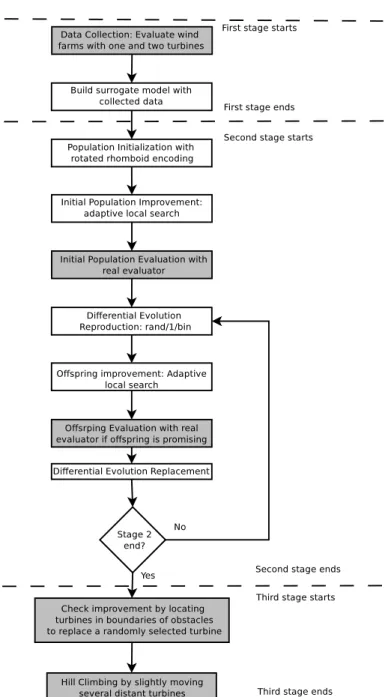
is referred to as3s-mde in the rest of the paper. A detailed flowchart of the
173
scheme describing the three stages is given in Fig. 2. In this flowchart, the boxes
174
that perform evaluations in the real simulator — in contrast to those that use
175
the surrogate model — are shown in gray. The following sections describe each
176
stage of this optimizer.
Algorithm 1Memeticdewith Surrogate Model and Ad-hoc Improvements
1: Stage 1: Create a Surrogate ModelSM.
2: Stage 2: Apply a memetic DE/rand/1/bin usingSMwith a representation based on rhomboids.
3: Stage 3: Apply ad-hoc improvements to the best solution obtained in Stage 2.
3.1.1. First Stage: Construction of a Surrogate Model 178
One of the main difficulties when dealing with complex engineering problems
179
is that evaluating a solution is usually quite an expensive process. Surrogate
180
models can be used to alleviate this difficulty [17]. Different ways of
build-181
ing surrogate models have been proposed. Problem-dependent models rely on
182
ad-hoc knowledge of the problem, whereas with problem-independent models,
183
machine learning methods are usually employed [18].
184
For this optimizer, a problem-dependent surrogate model is built to
approx-185
imate the energy generated by a given set of turbines. In order to construct
186
the surrogate model, a set of simple candidate solutions where only two
tur-187
bines are placed in the wind farm are evaluated using the original evaluator.
188
Additionally, one evaluation with a single turbine is carried out to estimate the
189
maximum energy that it can generate. For each evaluation with two turbines,
190
the penalty on the energy produced in both turbines with respect to the case
191
where only one turbine is placed in the wind farm is calculated. Specifically, the
192
following set of distances are checked: Dmin,1.5Dmin,2Dmin,2.5Dmin,3Dmin
193
and3.5Dmin, whereDminrepresents the minimum admissible distance between
194
turbines. For the case in which the distance between turbines is set to Dmin,
195
720 equidistributed different angles are checked, whereas in the remaining cases,
196
360 different angles are used.
197
The surrogate model uses the saved data to approximate the energy
gen-198
erated by layouts that use any number of turbines. The model assumes that
199
the energy generated by one turbine is not influenced by any other turbines
200
placed further away than3.5Dmin. Thus, for each turbine, the set of conflicting
201
turbines — those at a distance not greater than3.5Dmin — is detected and the
202
negative influence is estimated based on the saved data. Specifically, if for a
203
given turbine there exists another turbine at a distanceD and angle γ, then
204
the four surrounding cases — combining the nearest distances and angles — are
205
identified and linear interpolations are used to estimate the negative influence.
206
Note that the computational complexity of identifying the surrounding cases
207
with values higher and lower thanD andγ is constant, so this process is quite
208
fast. The total energy generated by a given turbine is the estimate of the
maxi-209
mum attainable energy minus the sum of the estimated negative influences. The
210
total energy estimated for a given layout is the sum of the energies estimated
211
for each turbine.
212
3.1.2. Second Stage: Memetic Differential Evolution 213
In the second stage, one of the most well-known variants of deis applied.
214
Specifically, the DE/rand/1/bin is used [19]. This variant has the property
Figure 2: 3s-MDE Flowchart
of being more explorative than schemes that apply the “best” strategy. This
216
feature was vitally important due to the small population size (N) used in the
217
runs. In the currentmdeimplementation, a special initialization of the
popu-218
lation is used. First, 200 individuals are created; then, the bestN individuals
Figure 3: Encoding of Individuals inmde
are selected to form the initial population.
220
One of the keys to designing proper Evolutionary Algorithms (eas) is the
221
selection of a suitable encoding of the individuals [20]. Directly encoding the
222
coordinates of the turbines yields too large a search space, thus an alternative
223
encoding was adopted. Specifically, a solution is encoded with four real-valued
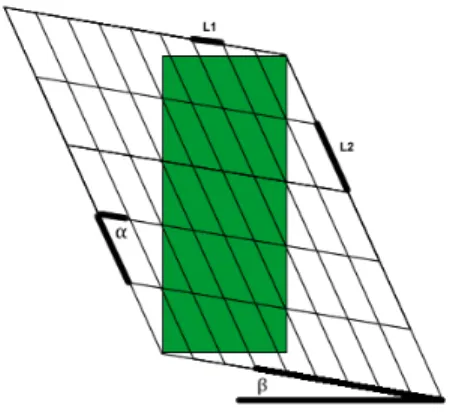
224
parameters, which establish the geometry of a possibly rotated rhomboid (see
225
Figure 3): L1 and L2 are the lengths of the sides of the rhomboid; α is the
226
angle formed between two sides of the rhomboid; finally, β rotates the whole
227
rhomboid. This rhomboid is used to establish the positions where the turbines
228
are deployed, which is illustrated in Figure 3. Specifically, the given scenario —
229
green zone — is covered with a set of rhomboids with the specified geometry
230
and the turbines are positioned at the vertexes of these rhomboids. One of the
231
vertexes of the rhomboids is placed in the bottom-left corner of the wind farm.
232
Since some turbines might be too close to one another, a repairing method is
233
used to remove conflicting turbines. First, the turbines are randomly shuffled.
234
Then, each turbine is sequentially examined and is accepted only if it does not
235
conflict with any previously accepted turbine, i.e. it is accepted if the distance
236
to any already selected turbine is not smaller thanDmin. Additionally, when a
237
vertex is inside an obstacle, no turbine is located in such a vertex.
238
In order to improve upon the intensification capabilities, dewas integrated
239
with an adaptive local search, which is applied both in the creation of the initial
240
population and after the creation of the offspring. The number of evaluations
241
used in each application of the local search is set with the local search budget
242
(LSB) parameter. The adaptive search starts with a given step size (SS) for
243
each parameter which is progressively decreased linearly with the aim of
in-244
creasing the intensification capabilities. The reduction is calculated in such a
245
way that by the end of the local search the resulting value is 0. When each
246
neighbor is created, any of the four parameters is changed with a probability
247
equal to 0.25. Specifically, they are modified by summing or subtracting the
248
step size corresponding to the iteration. Note that applying the real evaluator
in the local search would be very expensive. As a result, the adaptive local
250
search uses the surrogate model and only the best solution obtained after the
251
application of each local search might be evaluated with the original evaluator.
252
Specifically, the obtained solution is evaluated with the original evaluator only
253
if it is not worse than1.20multiplied by the best so far obtained fitness. Thus,
254
the surrogate model is also used to filter out poor solutions, which is a typical
255
use of surrogates.
256
3.1.3. Third Stage: Ad-hoc Improvement 257
The last stage starts from the best solution identified by the memetic de
258
and applies two methods to further improve it. Note that in this last phase,
259
the surrogate model is not used because some minor modifications are made
260
to the candidate solutions, thus making it impossible to properly measure the
261
promising behavior of these changes with the surrogate model.
262
The first method is applied only in the scenarios where obstacles are
in-263
cluded. First, given a budget B for evaluations, B
2 potential locations are
264
identified. Specifically, at each edge of the obstacles, B
NOBS∗4∗2 locations are
265
equidistributed, where NOBS is the number of obstacles. Then, for each
se-266
lected location, a new solution is evaluated that considers the establishment of
267
a turbine in that position and the removal of a randomly selected turbine. The
268
modification is maintained only if the fitness is improved.
269
Finally, the remaining evaluations are used to apply a local search. In the
270
initial version of the local search, neighbors were generated by slightly moving a
271
single turbine. Specifically, a maximum step (M S) was established — here set to
272
6.25 units — and in order to generate a neighbor, a turbine was movedS units,
273
whereSwas a randomly generated number between 0 andM S. The direction of
274
movement was also randomly generated. Given that the number of evaluations
275
is very restricted, instead of moving a single turbine, the local search moves
276
several turbines simultaneously, following the same method explained above.
277
Distant turbines are selected using the process below. First, a safety distance
278
(SD) is established to6×Dmin. Then, a turbine present in the current solution
279
is randomly selected and a grid of square cells with a side length equal toSD 280
is set up in the wind farm in such a way that the center of a cell is in the
281
position of the selected turbine. Then, for each cell, the turbine that is closest
282
to the center is selected. In this way, a set of distant turbines is generated. The
283
new candidate solution is created by moving each selected turbine. Then, the
284
energy generated in each cell is calculated and the cells where the amount of
285
energy generated is increased are considered to be promising moves. Finally,
286
the movements involving unsuccessful cells are undone and the new candidate
287
solution is reevaluated. If the fitness of the new solution improves the original
288
solution, it is accepted. This process is repeated until the budget for the number
289
of evaluations is exhausted.
290
3.1.4. Parameterization 291
3s-mdeneeds a set of parameters, which were tuned with the set of instances
292
given in the first part of the contest. Table 3 provides the parameters used in
this competition.
294
Parameter name Notation value
Population size N 10
Crossover rate CR 0.9
Mutation scale factor F Gaussian dist. N(0.5,0.3)
L1 Step size L1-SS 125
L2 Step size L2-SS 125
αStep Size α-SS 22.5 degrees
β Step Size β-SS 22.5 degrees
Local search budget (Initialization) I-LSB 15000 Local Search budget (Offspring) O-LSB 5000
Criterion to pass to third stage N/A 90% of Evaluations
Table 3: Parameters of the 3s-mde method.
3.2. CMA-ES for layout optimization (CMA-ES) 295
The Covariance Matrix Adaptation Evolution Strategy (CMA-ES) [21] is
296
the method of choice when dealing with hard black-box optimization problems
297
which are nonlinear, multimodal and/or noisy. The algorithm is invariant to
298
rank-preserving transformations of the objective function and affine
transforma-299
tions of the search space which makes it parameter-less in practice. CMA-ES
300
has repeatedly demonstrated good performance at various platforms for
compar-301
ing continuous optimizers such as the Black-Box Optimization Benchmarking
302
(BBOB) workshop [22, 23, 24] and the Special Session at Congress on
Evo-303
lutionary Computation [25, 26]. Thus, CMA-ES seems naturally suitable for
304
the wind farm layout optimization problem especially when a low-dimensional
305
parameterization of the design problem is considered.
306
In this section, we discuss the application of CMA-ES to the wind farm
307
layout optimization problem. In a nutshell, CMA-ES works as follows. In its
308
iterationt, a mean mt of the mutation distribution (which can be interpreted
309
as an estimation of the optimum) is used to generate λ candidate solutions
310
xk ∈IRnby adding a random Gaussian mutation defined by a (positive definite)
311
covariance matrixCt∈IRn×n. Thek-th sampled candidate solutionxt
k is then
312
defined as:
313
xtk ∼ N
(
mt, σt2Ct
)
=mt+σtN(0, Ct), (3)
whereσtis a mutation step-size. Theseλsolutions then should be evaluated
314
on an objective functionf. The old mean of the mutation distribution is stored
315
inmtand a new meanmt+1is computed as a weighted sum of the bestµparent
316
individuals selected among theλgenerated offspring individuals. The algorithm
317
adaptsmtandCtin order to increase the likelihood of the successful sampling
318
steps to appear again and to proceed towards the optimum.
319
Since we optimize both the number of turbines and their positions, the
di-320
rect representation of turbine positions as variables would lead to a large-scale
Parameter Notation Optimized
Layout height H No (input)
Layout width W No (input)
Turbine radius R No (input)
Layout scale factor h1 No, fixed to 4
Interturbine scale on x-axis h2 No, fixed to 4
Interturbine scale on y-axis h3 No, fixed to 4
Interturbine distance on x-axis x1 Yes
Interturbine distance on y-axis x2 Yes
Rotation angle x3 Yes
Shift on x-axis x4 Yes
Shift on y-axis x5 Yes
Table 4: Parameters optimized with CMA-ES and constants used in this approach.
optimization problem which is often intractable [13]. Similarly to other
algo-322
rithms presented in this paper, we therefore parameterize the search space of
323
wind-farm layouts with only a few variables. We use 5 continuous variables to i)
324
fill a rectangular grid of turbines, ii) shift it to the origin, iii) rotate it, and then
325
iv) shift it to some location. Finally, all turbines which violate the constraints
326
(e.g., obstacles, target size of the layout) are removed from the grid.
327
We parameterize the original optimization problem as follows:
328
STEP 1 The initial rectangular grid is selected to beh1= 4times larger than the
329
maximum size(W;H)of the target layout to take into account its rotation
330
in STEP 2. The minimum distance between turbines on the x-axis is set
331
by Dx = Dmin+ (0.2x1)h2 ×(W −Dmin), where Dmin = 8R and h2
332
is a hyperparameter set to 4. Similarly, the distance on y-axis is set by
333
Dy =Dmin+ (0.2x2)h3×(H−Dmin). Thus, the total number of turbines
334
is(⌊h1×W/Dx⌋+ 1)(⌊h1×H/Dy⌋+ 1).
335
STEP 2 Shift the grid to the origin by substracting (h1×W/2;h1×H/2) and
336
rotate turbine coordinates by an angleθ=−π+ 2πx3.
337
STEP 3 Shift the rotated grid by((0.5 + 0.2x4)×W; (0.5 + 0.2x5)×H).
338
STEP 4 Remove all infeasible turbines.
339
Table 4 summarizes the various constants used as well as the five variables
340
x1 to x5 optimized by CMA-ES. All these 5 variables are constrained to be in
341
[0,1]and are optimized with the active CMA-ES [27, 28] in its default settings
342
and withm0= [0.5]5 andσ0= 0.3.
343
3.3. A Sequence-based Selection Hyper-heuristic (SSHH) 344
In contrast to the other techniques, hyper-heuristics operate at the level
345
above (meta-)heuristics such as EAs. Selection hyper-heuristics are high level
346
control methods that mix and manage a predefined set of low level heuristics
347
for solving hard computational problems. Hence, online learning is a crucial
348
component of such methods which are capable of discovering the appropriate
combinations of low level heuristics yielding an improved overall performance.
350
More on different types of hyper-heuristics, including an overview of different
351
algorithmic components and designs, and their applications can be found in [29].
352
Traditionally, a selection hyper-heuristic employs two methods,
consecu-353
tively: aheuristic selectionmethod to choose a suitable low level heuristic (move
354
operator) which is applied to a candidate solution, and then amove acceptance 355
method to decide whether to accept or reject the newly generated solution. This
356
study presents a sequence-based selection hyper-heuristic (SSHH) consisting of
357
a learning sequence of heuristics selection method and an adaptive threshold
358
move acceptance method to solve the wind farm layout optimization problem.
359
3.3.1. Representation and overall search 360
In order to pick the best locations for a set of turbines, a given region is split
361
into a grid consisting of a certain number of rows and columns with
neighbour-362
ing cells having an interval of size (0.1×TurbineRadius) in between them. A
363
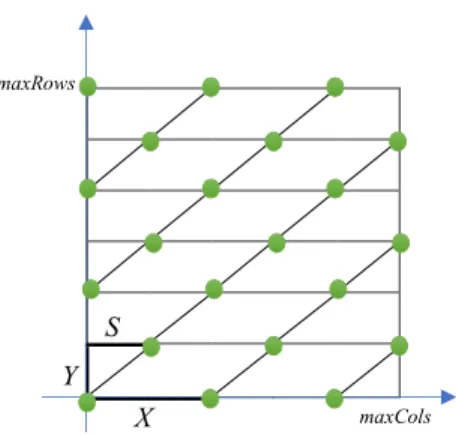
given solution is represented using three integer variables,X, Y andS, where
364
M ≤X < maxCols,M ≤Y < maxRows, and0 ≤S; M is the minimum
al-365
lowed distance between neighbouring turbines,maxRowsandmaxColsare the
366
maximum number of rows and columns, respectively (see Figure 4). Based on
367
the values of those variables, a binary matrix is formed by spreading
neighbour-368
ing turbines with a separating distance ofX cells at each row and a separating
369
distance ofY cells at each column. A cyclic shift is performed at each row
start-370
ing from the second row. The S parameter is used to reduce the wake effect
371
from a neighbouring turbine and deals with differing wind directions by
shift-372
ing wind turbines. Algorithm 1 provides the pseudocode of how the solution is
373
constructed.
374
Algorithm 1:The pseudocode of how a solution is constructed
input : scenario,X,Y andS output: grid
1 fori←0;i < maxCols;i+=Xdo 2 forj←0;j < maxRows;j+=Y do 3 l= (i+ (j/Y)∗S)%maxCols;
4 ifscenario.isValidLocation(l, j)then
5 grid.insertTurbineAtLocation(l, j);
6 end
7 end
8 end
SSHH performs the search under an iterative framework maintaining the
375
best solution detected so far. Solutions are always made feasible by removing
376
the invalid turbines which are placed on obstacles, before evaluation.
377
3.3.2. Low level heuristics 378
The low level heuristics (LLHs) used in this work are parameterized low
379
level heuristics. Assume that H(V1, p, V2) is a heuristic, where p has one of
Y S
X maxRows
maxCols
Figure 4: Encoding of Individuals inSSHH
three values: 1, rand[1,10] or rand[10,79]; and rand[L, U] is a random integer
381
in [L, U] and this low level heuristic modifies (increases or decreases) the value
382
of the variableV1 byp, and then with a probability of 0.30 resets the valueV2.
383
SSHH controls the following low level heuristics during the search process:
384
• LLH0: ApplyH(X, p, S) 385
• LLH1: ApplyH(Y, p, S) 386
• LLH2: ApplyH(S, p, X), then with a probability of 0.30 reset the value
387
ofY.
388
• LLH3: increase or decrease the value ofX byp; then updatepand apply
389
H(Y, p, S).
390
• LLH4: increase or decrease the value of X by p; then update p and
391
increase or decrease the value ofY byp; and finally updatepand increase
392
or decrease the value ofS byp.
393
3.3.3. Heuristic sequence selection and move acceptance 394
The selection component forms and applies a sequence of low level
heuris-395
tics to a candidate solution as a single operation, thereby generating
super-396
heuristics through the combination of more than one low level heuristic. This
397
online learning method analyses and produces sequences of heuristics during
398
the search process using a hidden Markov model, in which the hidden states
399
are low level heuristics (LLHs) and observations are sequence-based acceptance
400
strategies (AS). We make use of two matrices: a transition probability matrix to
401
determine the movement between states and an emission probability matrix to
402
determine whether the sequence of heuristics that has been constructed will be
403
applied to a candidate solution or that sequence will be extended by including
404
another LLH. As explained earlier, each heuristic is associated with a
parame-405
ter, pinfluencing its behaviour. Therefore, an additional emission probability
matrix is implemented to set the value ofp. A detailed description of this
al-407
gorithm can be found in [30, 31, 32]. The threshold move acceptance method
408
accepts all improving moves by default. However, the non-improving moves are
409
accepted only if the cost of the new solution is less than or equal to a threshold
410
which changes with respect to the best solution during the search process. The
411
threshold is always set to the (1.01) of the cost of the best solution found so far,
412
whenever a non-improving move occurs.
413
3.4. The Goldman Method (GM) 414
3.4.1. Representation 415
There are two straightforward approaches to representing turbine locations
416
in the field, both of which have significant limitations.
417
The first method would be to enforce a maximally compact two-dimensional
418
mesh, with each mesh point representing a possible turbine. This method
han-419
dles obstacles gracefully as invalid mesh points can be removed before beginning
420
search. As search focuses on which mesh points to include as turbines, the total
421
number of turbines in the field is easy to manipulate. However, the mesh
struc-422
ture does not allow turbines to orient themselves with the wind. For example,
423
it is possible that the wind is blowing parallel to one of mesh axes, resulting in
424
all turbines in a row (or column) interfering with each other.
425
The second method would be to specify some number of turbines and then
426
search their possible locations in the field. While this can overcome the problem
427
of interference, it massively increases the search space. Furthermore, it now
428
becomes challenging to determine the correct number of turbines to use and to
429
avoid obstacles.
430
In an attempt to gain the best of both techniques, while simultaneously
re-431
ducing the search space size, the Goldman method represents a layout as two
432
vector lattice. In this form, search is performed over the space of a pair of
433
two-dimensional vectors. These vectors are converted to a layout by placing a
434
turbine at all integer linear combinations of the two lattice vectors. As with
435
the mesh representation any invalid turbine is removed, resulting in simple
ob-436
stacle handling. Yet unlike that method turbines can orient at any angle to
437
each other, with a flexible amount of space between each, to avoid interference.
438
To aid search, the Goldman method encodes the two lattice vectors as (angle,
439
magnitude) pairs.
440
3.4.2. Number of Turbines 441
A significant cost of any layout is how many substations must be purchased.
442
The cost of energy function includes the termcs∗⌊MN⌋. The cost of a substation,
443
cs, is an order of magnitude larger than the cost of a turbine. As a result the
444
cost of energy is often minimized when NmodM = M −1 as this uses the
445
maximum number of turbines before a new substation must be purchased.
446
The Goldman method leveraged this knowledge when evaluating layouts.
447
Along with calculating the global cost of energy, each evaluation provides the
448
user with information about the “fitness” of individual turbines in the layout.
The Goldman method used this information to reduce each tested layout to
450
the nearest complete substation by naïvely removing the least fit turbines. The
451
reduced layout is then evaluated, meaning that every lattice requires at most
452
two evaluations.2 The lattice’s cost of energy is then considered to be whichever
453
version was cheaper.
454
3.4.3. Search Method 455
Given the limited evaluation budget, the Goldman method utilizes a
deter-456
ministic best-improvement local search method to explore the space of lattice
457
vectors. To simplify this process and further reduce the search space, the four
458
variables (two angles and two magnitudes) which encode the lattice were
dis-459
cretized. Angles were restricted to 36 intervals spacedπ/18apart. Magnitudes
460
ranged from the minimum allowable interval between turbines up to 5 times
461
that size in 64 evenly spaced steps.
462
To perform local search, the algorithm began from a lattice with the vectors
463
perpendicular to each other, one using the minimum magnitude and the other
464
using the middle of the magnitude range. All alternatives to each variable were
465
then tested sequentially, such that only the best changing improvement to a
466
variable is made before continuing to the next variable. This process continues
467
until no single variable can be changed to make the lattice better. To improve
468
rotational symmetry, this process is run starting with the long vector parallel
469
to the x-axis, and then again parallel to the y-axis. Duplicate work is prevented
470
by caching the quality of each discrete lattice.
471
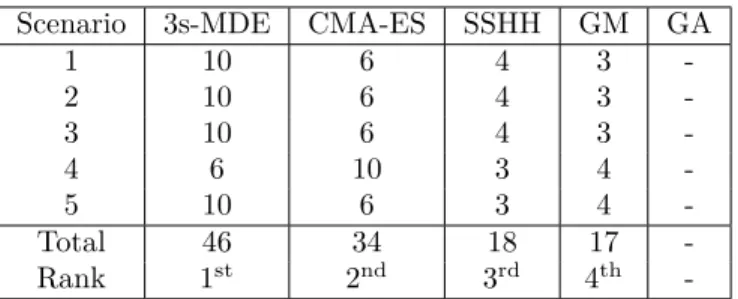
3s-MDE CMA-ES SSHH GM
Figure 5: Best layouts obtained by the 4 competitors on scenario 1.
4. Competition results
472
4.1. Competition results 473
The algorithms presented in the previous section, in addition to four others
474
not described in this paper, were run on the 5 scenarios presented in the
compe-475
tition rules section. As mentioned above, the competitors were given a budget
476
of 10,000 evaluations to split between the 5 scenarios for computational cost
477
reasons. Table 5 provides the costs of energy fitness of each algorithms. As a
478
basis of comparison, we have compared the results to a genetic algorithm. GAs
479
have been used many times in this domain and offer a familiar and standard
480
benchmark against other algorithms from the field of evolutionary computation.
481
For this problem, a GA optimizes a binary genome that decides whether or not
482
a turbine is located in each grid of a discretized layout. The fitness function
483
used to evaluate each layout is the one presented in equation 1. The GA is set
484
up with a population size of 20 individuals, a 4-player tournament selection with
485
elitism, 5% mutation and 40% crossover. Mutating a layout consists in switch
486
a Boolean of the grid and crossing is a standard one-point crossover. The GA
487
is run for 50 generations, which represents 2000 evaluation per scenario.
488
Table 7 provides both the number of turbines and of substations of the best
489
layouts obtained by the different competitors on the different scenarios. It is
490
worth noting that obtained layouts are of comparable size in terms of number
491
of turbines for each scenario. Also, the algorithms, either naturally or due to
492
specific strategies, limit the number of turbines to a value very close to the
493
constraints of the substations. When evaluating the cost of energy function, the
494
cost of building a substation is subsequently greater than the total price of the
495
turbines. Therefore, the number of substations, even though not directly
high-496
lighted in the problem description, is of primary importance. Figure 5 depicts
497
Scenario 3s-MDE CMA-ES SSHH GM GA
1 1.164422E−3 1.172731E−3 1.181129E−3 1.185466E−3 1.269266E−3
2 1.00929E−3 1.029998E−3 1.039825E−3 1.044906E−3 1.158464E−3
3 6.26867E−4 6.30916E−4 6.40241E−4 6.49096E−4 6.91265E−4
4 6.53861E−4 6.5356E−4 6.66205E−4 6.64341E−4 7.18626E−4
5 1.142309E−3 1.152661E−3 1.167168E−3 1.16033E−3 1.269238E−3
Scenario 3s-MDE CMA-ES SSHH GM GA
1 10 6 4 3
-2 10 6 4 3
-3 10 6 4 3
-4 6 10 3 4
-5 10 6 3 4
-Total 46 34 18 17
-Rank 1st 2nd 3rd 4th
-Table 6: Competition results in points and ranking. Note that GA was not part of the competition and is therefore not ranked. The results of other competitors are not presented in this table.
Scenario #Turbines #Substations
3s-MDE CMA-ES SSHH GM 3s-MDE CMA-ES SSHH GM 1 539 539 561 479 18(0) 18(0) 19(-8) 16(0)
2 388 239 329 324 13(-1) 8(0) 11(0) 11(-5)
3 899 804 809 680 30(0) 27(-5) 27(0) 23(-9)
4 929 929 958 898 31(0) 31(0) 32(-1) 30(-1)
5 359 358 348 356 12(0) 12(-1) 12(-1) 12(-3)
Table 7: Number of turbines and of substations of the best layouts obtained by the competi-tors on each scenarios. In the substation part of the table, the value parenthesis represents the number of missing turbines in order to have all substations fully used (30 turbines per substation).
Scenario 1 Scenario 2 Scenario 3 Scenario 4 Scenario 5
3s-MDE 3s-MDE 3s-MDE CMA-ES 3s-MDE
the four layouts obtained by the four competitors for scenario 1. We can note
498
similarities of the geometric arrangement strategies used by the competitors,
499
albeit with different approaches, to compress the number of variables induced
500
by the problem to a lower amount. They mostly operate on a transformation
501
(shift, scale and rotation) of a grid layout prior to a removal of turbines that
502
violate constraints (obstacles) and local deletion for layout refinement. Figure 6
503
presents the best layouts across all competitors obtained for each scenario. Once
504
again this geometric arrangement strategy appears on the obtained layout with
505
various rotations and shifts depending on the terrain characteristics.
506
4.2. Convergence comparison 507
Figure 7 shows the convergence curves of the different algorithms. They
508
represent the competitor algorithms’ best evaluations. Each algorithm curve
509
stops at the final evaluation. As an example, the GA is always used with a fixed
510
2000 evaluation steps for each scenario.
511
First, the 3s-MDE optimization strategy is noticeable on the plots: whereas
512
good fitness values appear as soon as the first evaluation in other approaches,
513
3s-MDE only has competitive fitness values after 1260 evaluations. This
corre-514
sponds to the duration needed by the algorithm to build the surrogate model.
515
During this initial phase, the algorithm evaluates layouts with only two turbines,
516
which generate very poor layouts (not represented in the plot for visualization
517
purposes).
518
Secondly, it can be noticed that all other algorithms converge in few
itera-519
tions (approximately 300 evaluations) to a very good solutions before starting
520
local optimization. Even though 3s-MDE needs more evaluation steps to
pro-521
duce a good layout, the initial 1260 evaluations are only made with 2 turbines
522
which is costless in comparison to layouts with hundreds to thousands of
tur-523
bines. Therefore, we can argue that the layouts can be presented to the farm
524
designer very early in the optimization loop across all presented methods.
1,10E-03
1,20E-03
1,30E-03
1,40E-03
1,50E-03
1,60E-03 1,70E-03
1,80E-03
1 251 501 751 1001 1251 1501 1751 2001 2251 2501 2751 3001 Cost of energy (USD/kW)
Evaluations
Cost of energy evolution - Scenario 1
3s-MDE CMA-ES SSHH GM GA
1,00E-03 1,10E-03 1,20E-03 1,30E-03 1,40E-03 1,50E-03 1,60E-03 1,70E-03
1 251 501 751 1001 1251 1501 1751 2001
Cost of energy (USD/kW)
Evaluations Cost of energy evolution - Scenario 2
3s-MDE CMA-ES SSHH GM GA
6,00E-04
6,50E-04 7,00E-04
7,50E-04 8,00E-04
8,50E-04 9,00E-04
1 251 501 751 1001 1251 1501 1751 2001
Cost of energy (USD/kW)
Evaluations
Cost of energy evolution - Scenario 3
3s-MDE CMA-ES SSHH GM GA
6,00E-04
6,50E-04 7,00E-04
7,50E-04 8,00E-04
8,50E-04 9,00E-04
1 251 501 751 1001 1251 1501 1751 2001
Cost of energy (USD/kW)
Evaluations Cost of energy evolution - Scenario 4
3s-MDE CMA-ES SSHH GM GA
1,10E-03 1,20E-03 1,30E-03 1,40E-03 1,50E-03 1,60E-03 1,70E-03
1 251 501 751 1001 1251 1501 1751
Cost of energy (USD/kW)
Evaluations Cost of energy evolution - Scenario 5
3s-MDE CMA-ES SSHH GM GA
5. Conclusion
526
This paper presented the results of the 2015 competition on wind farm layout
527
optimization. With this event, we were able to propose innovative algorithms to
528
optimize large wind farms with a strong computational constraint. Thanks to
529
this competition, we were also able to compare these approaches with
state-of-530
the-art algorithms and observe the potential improvement of the optimization
531
algorithms used to generate the wind farm layouts.
532
This competition also provides a framework to compare future algorithms
533
with existing ones on a comparative basis. The competition framework is freely
534
available in multiple programming languages (C++, Java, Matlab and Python)
535
with a set of randomly generated wind scenarios.
536
Because solutions were obtained with acceptable computational costs in this
537
competition, we can now imagine targeting new optimization objectives. The
538
3D structure of the terrain, and/or heterogeneous wind distribution within the
539
terrain, heterogeneous wind turbines with different height, width and power
540
curves could be considered. In this competition, cable and road networks were
541
not taken into account, but these are of great importance for the initial
invest-542
ment to build the wind farm. They could be added to the framework and the
543
cost of energy function in order to be addressed by the optimization algorithms.
544
One of the main points we learned from this competition is that the
algo-545
rithms proposed by the competitors mainly work on optimizing very few
pa-546
rameters in comparison to state-of-the-art algorithms; instead of optimizing the
547
Cartesian coordinates of individual turbines, it seams preferable to optimize
geo-548
metric parameters. By doing so, the complexity of the search space is drastically
549
reduced, leading to very acceptable optimization time, even for very large wind
550
farms. These geometric parameters allow for continuous turbine placement over
551
the entire grid, which is clearly advantageous over the discrete grid used by the
552
GA and previously in the literature [15]. Furthermore, these parameters could
553
be exposed to human wind farm designers to allow them to understand the
554
optimal placement of turbines based on the wind scenario and the constraints
555
given to the optimization. Understanding optimized grids such as Figures 3
556
and 4 would allow human wind farm designers the flexibility of choosing
tur-557
bine placement while still benefiting from an optimized energy cost.
558
Beyond demonstrating the utility of reducing this problem to an
optimiza-559
tion of geometric parameters, the successful use of a surrogate model in this
560
problem is novel and significant. As a surrogate could be built using gathered
561
wind data a single time before layout design starts, the computational load of
562
optimization during design can be greatly reduced. Surrogates could be used
563
while considering new constraints to allow for more rapid design, and then
fi-564
nally rebuilt once constraints are more firmly understood. While this was not
565
the focus of this competition, it was encouraging to see a surrogate model achieve
566
such promising results.
567
This competition also encouraged the use of intelligent stop criteria by
al-568
lowing competitors to develop a strategy to best allocate their evaluation over
569
the five scenarios. The stop criterion of the optimization is still an open question
for evolutionary algorithms and is a difficult one to address: even if
evolution-571
ary algorithms have been proven to converge to the optimal solution [33], it is
572
impossible to determine when and even if the current best solution is a local
573
optimum or the global one. This is due to the size of search space explored in
574
this kind of problem. However, transformations on the search space can reduce
575
its complexity, and the convergence of most algorithms here suggests that
sim-576
pler search space created by optimizing geometric parameters allows for a more
577
natural stop condition. Furthermore, we imagine the integration of this type
578
of optimization into wind layout software will be part of an iterative design
579
process, as numerous factors, including human design, come into play during
580
wind farm design. The optimization process could be run for a desired
num-581
ber of steps or amount of computational time before being further reviewed or
582
modified, matching the needs of human designers and mitigating the issue of a
583
stop criterion.
584
Acknowledgments
585
D. Wilson is supported by ANR-11-LABX-0040-CIMI, within programme
586
ANR-11-IDEX-0002-02. C. Segura acknowledges the financial support from
587
CONACyT through the “Cienca Básica” project no. 285599. The work of A.
588
Kheiri and E. Keedwell was funded by EPSRC grant no. EP/K000519/1.
References
590
[1] Andrew Kusiak and Zhe Song. Design of wind farm layout for maximum
591
wind energy capture. Renewable Energy, 35(3):685–694, 2010.
592
[2] G Mosetti, Carlo Poloni, and B Diviacco. Optimization of wind turbine
593
positioning in large windfarms by means of a genetic algorithm. Journal of 594
Wind Engineering and Industrial Aerodynamics, 51(1):105–116, 1994.
595
[3] SA Grady, MY Hussaini, and Makola M Abdullah. Placement of wind
596
turbines using genetic algorithms. Renewable Energy, 30(2):259–270, 2005.
597
[4] Hou-Sheng Huang. Distributed genetic algorithm for optimization of wind
598
farm annual profits. InIntelligent Systems Applications to Power Systems, 599
2007. ISAP 2007. International Conference on, pages 1–6. IEEE, 2007.
600
[5] Chunqiu Wan, Jun Wang, Geng Yang, Xiaolan Li, and Xing Zhang.
Opti-601
mal micro-siting of wind turbines by genetic algorithms based on improved
602
wind and turbine models. InDecision and Control, 2009 held jointly with 603
the 2009 28th Chinese Control Conference. CDC/CCC 2009. Proceedings 604
of the 48th IEEE Conference on, pages 5092–5096. IEEE, 2009.
605
[6] Alireza Emami and Pirooz Noghreh. New approach on optimization in
606
placement of wind turbines within wind farm by genetic algorithms. Re-607
newable Energy, 35(7):1559–1564, 2010.
608
[7] Sedat Şişbot, Özgü Turgut, Murat Tunç, and Ünal Çamdalı. Optimal
609
positioning of wind turbines on gökçeada using multi-objective genetic
al-610
gorithm. Wind Energy, 13(4):297–306, 2010.
611
[8] Chang Xu, Yan Yan, De You Liu, Yuan Zheng, and Chen Qi Li.
Opti-612
mization of wind farm micro sitting based on genetic algorithm. Advanced 613
Materials Research, 347:3545–3550, 2012.
614
[9] Chunqiu Wan, Jun Wang, Geng Yang, and Xing Zhang. Optimal
micro-615
siting of wind farms by particle swarm optimization. InAdvances in swarm 616
intelligence, pages 198–205. Springer, 2010.
617
[10] Souma Chowdhury, Jie Zhang, Achille Messac, and Luciano Castillo.
Un-618
restricted wind farm layout optimization (uwflo): Investigating key factors
619
influencing the maximum power generation. Renewable Energy, 38(1):16–
620
30, 2012.
621
[11] Kalyan Veeramachaneni, Markus Wagner, U-M O’Reilly, and Frank
Neu-622
mann. Optimizing energy output and layout costs for large wind farms
623
using particle swarm optimization. In Evolutionary Computation (CEC), 624
2012 IEEE Congress on, pages 1–7. IEEE, 2012.
625
[12] Markus Wagner, Jareth Day, and Frank Neumann. A fast and effective local
626
search algorithm for optimizing the placement of wind turbines. Renewable 627
Energy, 51(0):64 – 70, 2013.
[13] Markus Wagner, Kalyan Veeramachaneni, Frank Neumann, and Una-May
629
O’Reilly. Optimizing the layout of 1000 wind turbines. European Wind 630
Energy Association Annual Event, pages 205–209, 2011.
631
[14] Dennis Wilson, Sylvain Cussat-Blanc, Kalyan Veeramachaneni, Una-May
632
O’Reilly, and Hervé Luga. A continuous developmental model for wind
633
farm layout optimization. In Proceedings of the 2014 Annual Conference 634
on Genetic and Evolutionary Computation, pages 745–752. ACM, 2014.
635
[15] Salman A Khan and Shafiqur Rehman. Iterative non-deterministic
algo-636
rithms in on-shore wind farm design: A brief survey. Renewable and Sus-637
tainable Energy Reviews, 19:370–384, 2013.
638
[16] Michele Samorani. The wind farm layout optimization problem. In Hand-639
book of wind power systems, pages 21–38. Springer, 2013.
640
[17] Yaochu Jin. Surrogate-assisted evolutionary computation: Recent advances
641
and future challenges. Swarm and Evolutionary Computation, 1(2):61 – 70,
642
2011.
643
[18] Alexander E.I. Brownlee, John R. Woodward, and Jerry Swan.
Metaheuris-644
tic design pattern: Surrogate fitness functions. InProceedings of the Com-645
panion Publication of the 2015 Annual Conference on Genetic and Evo-646
lutionary Computation, GECCO Companion ’15, pages 1261–1264, New
647
York, NY, USA, 2015. ACM.
648
[19] K. Price, R.M. Storn, and J. Lampinen. Differential Evolution: A Prac-649
tical Approach to Global Optimization. Natural Computing Series. U.S.
650
Government Printing Office, 2005.
651
[20] A.E. Eiben and J.E. Smith.Introduction to Evolutionary Computing.
Nat-652
ural Computing Series. Springer, 2003.
653
[21] N. Hansen, S.D. Müller, and P. Koumoutsakos. Reducing the time
complex-654
ity of the derandomized evolution strategy with covariance matrix
adapta-655
tion (CMA-ES). Evolutionary Computation, 11(1):1–18, 2003.
656
[22] S. Finck, N. Hansen, R. Ros, and A. Auger. Real-parameter black-box
657
optimization benchmarking 2010: Experimental setup. Technical Report
658
2009/21, Research Center PPE, 2010.
659
[23] A. Auger, S. Finck, N. Hansen, and R. Ros. BBOB 2010: Comparison
660
Tables of All Algorithms on All Noiseless Functions. Technical Report
661
RR-7215, INRIA, 2010.
662
[24] Ilya Loshchilov, Marc Schoenauer, and Michèle Sebag. Bi-population
CMA-663
ES agorithms with surrogate models and line searches. In Genetic and 664
Evolutionary Computation Conference, pages 1177–1184. ACM, 2013.
[25] Salvador García, Daniel Molina, Manuel Lozano, and Francisco Herrera.
666
A study on the use of non-parametric tests for analyzing the evolutionary
667
algorithms’ behaviour: a case study on the CEC’2005 Special Session on
668
Real Parameter Optimization. Journal of Heuristics, 15:617–644, 2009.
669
[26] Ilya Loshchilov. CMA-ES with restarts for solving CEC 2013 benchmark
670
problems. In Evolutionary Computation (CEC), 2013 IEEE Congress on,
671
pages 369–376. IEEE, 2013.
672
[27] Nikolaus Hansen and Raymond Ros. Benchmarking a weighted negative
673
covariance matrix update on the BBOB-2010 noiseless testbed. InGenetic 674
and Evolutionary Computation Conference, pages 1673–1680. ACM, 2010.
675
[28] Graheme A. Jastrebski and Dirk V. Arnold. Improving Evolution
Strate-676
gies through Active Covariance Matrix Adaptation. In IEEE Congress on 677
Evolutionary Computation, pages 2814–2821, 2006.
678
[29] E. K. Burke, M. Gendreau, M. Hyde, G. Kendall, G. Ochoa, E. Özcan, and
679
R. Qu. Hyper-heuristics: a survey of the state of the art. Journal of the 680
Operational Research Society, 64(12):1695–1724, 2013.
681
[30] Ahmed Kheiri and Ed Keedwell. A hidden markov model approach to the
682
problem of heuristic selection in hyper-heuristics with a case study in high
683
school timetabling problems. Evolutionary Computation, 25(3):473–501,
684
2017.
685
[31] Ahmed Kheiri and Ed Keedwell. A sequence-based selection hyper-heuristic
686
utilising a hidden Markov model. In Proceedings of the 2015 on Genetic 687
and Evolutionary Computation Conference, GECCO ’15, pages 417–424,
688
New York, NY, USA, 2015. ACM.
689
[32] Ahmed Kheiri, Edward Keedwell, Michael J. Gibson, and Dragan Savic.
Se-690
quence analysis-based hyper-heuristics for water distribution network
op-691
timisation. Procedia Engineering, 119:1269–1277, 2015. Computing and
692
Control for the Water Industry (CCWI2015) Sharing the best practice in
693
water management.
694
[33] Agoston E Eiben, Emile HL Aarts, and Kees M Van Hee. Global
con-695
vergence of genetic algorithms: A markov chain analysis. In International 696
Conference on Parallel Problem Solving from Nature, pages 3–12. Springer,
697
1990.