To appear inMolecular Physics Vol. 00, No. 00, Month 2015, 1–12
RESEARCH ARTICLE
Electron Localisation Function in Current-Density-Functional Theory
James W. Furnessa Ulf Ekstr¨omb, Trygve Helgakerb and Andrew M. Tealeab∗
aSchool of Chemistry, University of Nottingham, University Park, Nottingham, NG7
2RD, UK;
bCentre for Theoretical and Computational Chemistry, Department of Chemistry,
University of Oslo, P. O. Box 1033, Blindern, N-0315, Oslo, Norway
(Received 00 Month 200x; final version received 00 Month 200x)
We present a generalisation of the electron localisation function (ELF) to current-density-functional theory as a descriptor for the properties of molecules in the presence of magnetic fields. The resulting current ELF (cELF) is examined for a range of small molecular systems in field strengths up toB0= 235 kT (one atomic unit). The cELF clearly depicts the compression
of the molecular electronic structure in the directions perpendicular to the applied field and exhibits a structure similar to that of the physical current densities. A topological analysis is performed to examine the changes in chemical bonding upon application of a magnetic field.
Keywords:chemical bonding, electron localisation function, density-functional theory, current density-functional theory, molecular magnetic properties
1. Introduction
The electron localisation function (ELF), introduced for Hartree–Fock theory by Becke and Edgecombe [1] and extended to Kohn–Sham density-functional theory (DFT) via an alternative interpretation due to Savin [2], has enjoyed enormous success as a tool for understanding and visualising chemical bonding. The ELF has been widely applied to understand bonding in atoms [3], molecules [4–9], clus-ters [10–13], and solid-state structures [14, 15]. A topological analysis of ELF in the spirit of Bader’s atoms-in-molecules approach [16] yields further information on bonding in a given system [2, 17–20], although some caution should be exercised in interpretations based on this analysis [21].
Recently, we have studied exchange–correlation functionals in current DFT (CDFT) for calculations of molecules in the presence of strong uniform magnetic fields [22–25]. In particular, in Ref. [25], we showed that the current-dependent generalisation of the Tao–Perdew–Staroverov–Scuseria (TPSS) meta-generalised-gradient-approximation (meta-GGA) functional [26], denoted cTPSS (see also Ref. [27] for the use of cTPSS in response theory) provides a reasonable descrip-tion of molecules in strong magnetic fields. In such fields, a new form of bonding, perpendicular paramagnetic bonding, has recently been identified [28]. The na-ture of this bonding interaction was accurately capna-tured and analysed in terms of
molecular-orbital energies and electron-density differences at the CDFT level in Ref. [25] using the cTPSS functional.
In Section 2, we propose a generalisation of the ELF for molecules in a mag-netic field. This generalisation is applied to study chemical bonding in Section 3.1, whereas a topological analysis is performed in Section 3.2. Finally, in Section 3.3, the physical current density induced by the field is visualised alongside the gener-alised ELF, illustrating the striking similarity in the topologies of these quantities.
2. Theory
After reviewing the ELF as introduced in Hartree–Fock theory in Sec. 2.1, we consider its adaption for Kohn–Sham theory in Sec. 2.2. Finally, we discuss the generalisation of the ELF to systems in magnetic fields in Sec. 2.3.
2.1. ELF in Hartree–Fock theory
The definition of the ELF by Becke and Edgecombe [1] focused on Hartree–Fock theory and the same-spin pair density,
P2σσ(r,r0) =ρσ(r)ρσ(r0)− |ρσ1(r,r0)|2, ρσ1(r,r0) = Nσ
X
i=1
ϕ∗iσ(r0)ϕiσ(r). (1)
Expansion of the spherically averaged same-spin conditional pair density
Pcondσσ (r,r0) =ρσ(r0)−
|ρσ1(r,r0)|2 ρσ(r)
(2)
to leading order gives
Pcondσσ (r, s) = 1 3
"Nσ X
i=1
|∇ϕiσ(r)|2−
1 4
|∇ρσ(r)|2
ρσ(r)
#
s2+· · ·= 1
3Dσ(r)s
2. . . , (3)
wheresis the radius of a spherical shell aroundr. The term in brackets is related to the Fermi-hole curvaturederived by Becke [29] and generalised by to non-zero
current densities by Dobson [30]. Becke and Edgecombe [1] proposed to use this
term as a measure of electron localisation, introducing the relative ELF measure
fELF,σ(r) =
1
1 + [Dσ(r)/D0σ(r)]2
. (4)
Here Dσ(r) is defined in Eq. (3), while D0σ(r) is the corresponding quantity for a
homogeneous electron gas
Dσ0(r) = 25/3cFρσ(r)5/3, cF=
3 10(3π
2)2/3. (5)
Defined in this manner, the ELF is a dimensionless quantity between 0 and 1. The upper limitfELF,σ(r) = 1 corresponds to perfect localisation, whereasfELF,σ(r) =
2.2. ELF in Kohn–Sham theory
The ELF as proposed for Hartree–Fock theory relies on the definition of the con-ditional pair-density, Pcondσσ (r, s), for the interacting system. This quantity is not accessible in the same manner in Kohn–Sham DFT, since the determinantal wave function is then used to describe a system ofnon-interacting electrons rather than to approximate the physical system. On the other hand, Savin et al. [14] noted that the leading term in Eq. (3) is accessible in Kohn–Sham theory, being related in a simple manner to the Pauli kinetic-energy density:
τσPauli(r) =τσ(r)−τσvW(r) =
1
2Dσ(r) (6)
where
τσ(r) =
1 2
Nσ
X
i=1
|∇ϕiσ(r)|2, τσvW(r) =
1 8
|∇ρσ(r)|2
ρσ(r)
, (7)
The termτσ(r) is theσ-spin contribution to the non-interacting kinetic-energy
den-sity in the everywhere-positive gauge. Integration of this quantity over all space yields theσ-spin component of the non-interacting kinetic energyTs used in Kohn–
Sham theory. This form reflects the fact that, although non-interacting, the Kohn– Sham wave function is a single Slater determinant, preserving the fermionic charac-teristics of the electrons. The second term in Eq. (6),τσvW(r), is the von Weizs¨acker (vW) kinetic-energy density, which can be interpreted as the kinetic-energy density for a system of bosonic particles with orbitals proportional to√ρσ. The difference in
Eq. (6) can then be interpreted as thechange in the kinetic-energy density induced by the Pauli principle. Since the von Weizs¨acker kinetic-energy density provides a lower bound on the non-interacting kinetic energy density,
τσ(r)≥τσvW(r), (8)
the Pauli kinetic-energy density is everywhere nonnegative.
Given that τσPauli(r) contains the same information as doesDσ(r), we may
con-sider whether the ratioDσ(r)/Dσ0(r) required forfELF,σ(r) may be derived from it.
Savinet al.[14] noted that this can indeed be achieved by using the kinetic-energy density of a uniform electron gas
τσUEG(r) = 22/3cFρ5σ/3 =
1 2D
0
σ(r), (9)
yielding
Dσ(r)
D0 σ(r)
= τ
Pauli σ (r)
τUEG σ (r)
. (10)
The ELF may then be interpreted as a measure of localisation that reflects changes arising from the fermionic nature of the electrons and the satisfaction of the Pauli principle. This observation goes a long way towards rationalising the practical util-ity offELF,σ(r) for chemical interpretation, bearing in mind that the Pauli principle
those between opposite-spin electrons (dynamical correlation). As a result, the in-terpretation of same-spin interactions, as in ELF, can serve as a useful qualitative tool for interpretation.
The ELF formula discussed above involves two separate functions, one for each spin. Kohout and Savin [3] proposed instead the spin-polarised form
fELF(r) =
1
1 +ταPauli(r)+τ
Pauli
β (r) τUEG
α (r)+τβUEG(r)
2. (11)
We consider closed-shell systems, for which the values offELF(r) from Eqs. (4) and
(11) are identical.
2.3. Extension of ELF to magnetic fields
In a magnetic field,fELF(r) becomes gauge dependent through its dependence on
the kinetic energy densityτ, itself a gauge variant quantity (see Refs. [25, 27, 30–34]
for further discussion).This unphysical dependence can be removed by introducing
terms dependent on the paramagnetic current density, such as those that arise in the discussion of the spherical average of the exchange hole by Dobson [30]. This can be accomplished either in the expansion of Eq. (3) or by replacing the first term of Eq. (6) according to
τσ →˜τσ =τσ−
|jpσ(r)|2
ρσ(r)
(12)
wherejpσ(r) is the paramagnetic current density,
jpσ(r) =−
i 2
occ
X
i
[ϕ∗iσ∇ϕiσ−ϕiσ∇ϕ∗iσ]. (13)
This generalisation has previously been used to compute time-dependentELFs [35, 36]and in the generalisation of meta-GGA functionals to calculate response proper-ties perturbatively [27] and magnetic properproper-ties non-perturbatively [25]. The latter implementation allows for the self-consistent determination of molecular energies and orbitals in a magnetic field using London atomicorbitals [37–39] (also known
as gauge-including atomic orbitals (GIAOs)). We note that the gauge
indepen-dent kinetic energy density is not unique, and several other formshave been
pro-posed [32, 34]. However, the choice Eq. (12) has the advantage that the kinetic
energy density is independent of the external magnetic field, as well as satisfying Eq. (8). These issues have previously been examined in the context of meta-GGA functionals in Ref. [34]. Here, we use the cTPSS functional to perform calcula-tions at a finite magnetic field, computing the generalised ELF as a function of field strength. Following the notation cTPSS for the TPSS functional with the substitution in (12), we use the acronym cELF for the similarly modified ELF.
3. Results
All cELF calculations use the London program [40, 41] with the CDFT
been carried out in an uncontracted Cartesian aug-cc-pCVTZ basis set [43, 44] of London atomic orbitals [37]. Unless otherwise noted, zero-field TPSS geometries are used.
3.1. Electron Confinement
For a magnetic field of strengthB along thez-axis, the molecular electronic Hamil-tonian takes the form (in atomic units)
H=H0+
1
2BLz+BSz+ 1 8B
2X
i
(x2i +yi2), (14)
whereH0 is the unperturbed electronic Hamiltonian, 12BLz is the orbital Zeeman
operator expressed in terms of the orbital angular momentum operator Lz in the
field direction, BSz is the spin Zeeman operator expressed in terms of the spin
angular momentum operatorSz in the field direction, and 18B2Pi(x2i +yi2) is the
diamagnetic operator.
Whereas the Zeeman terms may raise or lower the energy, the diamagnetic term always raises the energy, becoming dominant in a field stronger than one atomic unit B0 ≈ 235 kT. From the form of the diamagnetic term, we see that the field
confines the system in the directions perpendicular to the field vector. As a re-sult, the field exerts a significant influence over the electronic structure and, in particular, the localisation of the electrons.
3.1.1. Paramagnetic Bonding
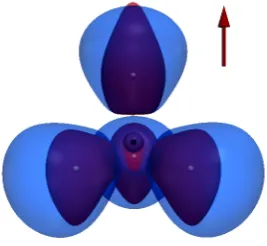
We first consider the recently discovered phenomenon of perpendicular paramag-netic bonding [28]. In Figure 1, we present iso-volumes for He2in a zero field (blue)
and in a uniform field of strengthB0 perpendicular to the internuclear axis (red).
The bond distance of 2.864a0 has been optimised at the cTPSS/u-aug-cc-pCVTZ
level in the same field. In Ref. [28], the paramagnetic bonding in He2 was
ratio-nalised in terms of induced electron rotation. The bonding was further analysed at the Kohn–Sham level in Ref. [25], in terms of molecular-orbital energies and density distortions relative to non-bonded atoms in the same field.
The confinement induced by the field, shown in red in Fig 1, is clearly captured by the cELF. In the field, the iso-surfaces contract around the atoms, becoming much more compact in the perpendicular directions than in the zero field (blue). Relaxation to the equilibrium geometry at zero field (not presented) gives similarly diffuse but near-spherical zero-field ELF iso-surfaces.
3.1.2. Covalent Bonding
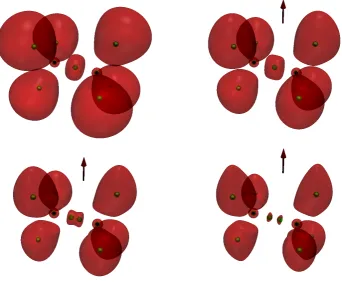
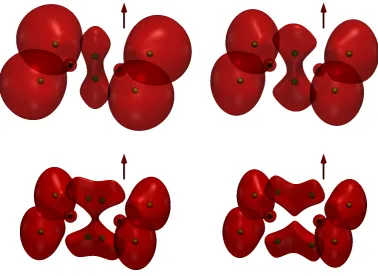
To illustrate the utility of the cELF in understanding features of covalent bonding in magnetic fields, we consider methane, ethane, ethene, and ethyne as prototypical systems containing single, double, and triple bonds. In Figure 2, the methane results are shown. In the absence of a field, the blue iso-surfaces are consistent with those obtained in earlier studies; in the presence of field, the iso-surfaces around the atoms contract. The structure of the cELF is similar for ethane, see Figure 3. An additional region of electron localisation is seen at the centre of the C-C bond both at zero field and atB = 0.4B0. As the field increases, the localisation becomes less
pronounced, eventually splitting into two separate regions.
Figure 1. Perpendicular paramagnetic bonding in He2. The iso-volumes depict the regions offELF≥0.8
at zero field(blue-lighter)and in the presence of a perpendicular magnetic field of strengthB0(red-darker).
The system is considered at the equilibrium geometry ofR= 2.864a0 as determined in a perpendicular
field ofB=B0
Figure 2. The cELF for methane calculated at the cTPSS/u-aug-cc-pCVTZ level at the corresponding zero-field geometry. The blue iso-volumes depict the regions offELF≥0.8 in the absence of a magnetic
field(blue-lighter)and in a field of strengthB0(red-darker). The direction of the field is indicated by the
red arrow.
developing eventually into two new structures with localisation above and below the C=C bond. Around the hydrogen atoms, the cELF surfaces of ethene contract in a manner similar to that observed for methane and ethane.
Finally, in Figure 5, we present plots for ethyne. At zero field, the ELF structure is similar to that reported elsewhere [2], with a characteristic ring structure about the triple bond. The ring is distorted at 0.1B0, splits into two at 0.5B0, and eventually
becomes reminiscent of that for ethene at 1.0B0, with localisation above and below
the bond.
The features of the cELF observed here can help to rationalise the success of the cTPSS meta-GGA functional in strong fields relative to conventional GGA func-tionals and also the local-density approximation (LDA), see Ref. [25]. In the cTPSS functional, the same modification of Eq. (12) is employed, entering the functional viaα(r) = [˜τσ(r)−τσvW(r)]/τσUEG(r) andτσvW(r)/τ˜σ(r). Note thatα(r) contains the
same information as the cELF, to which it is related asfELF,σ(r) = 1/(1 +α2σ(r)).
Henceα(r) also characterises the nature of different bonding regions, vanishing in one-orbital regions. However, it is not restricted to values between 0 and 1. The ratioτσvW(r)/τ˜σ(r) also serves as a useful indicator of one-orbital regions.
Our visualisations suggest that, as the field increases, regions of largefELF(r)and
[image:6.595.195.361.51.178.2] [image:6.595.212.346.263.386.2]Figure 3. The cELF for ethane calculated at the cTPSS/u-aug-cc-pCVTZ at the corresponding zero-field geometry. Therediso-volumes depict the regions offELF≥0.8 for 0.0B0(upper left), 0.4B0(upper right),
0.7B0 (lower left), and 1.0B0 (lower right). Field direction is indicated by the red arrow. 3.2. Topological Analysis
The functionfELF is a continuous scalar field and can therefore be subjected to a
topological analysis similar to that used for the electron density by Bader [16]. This approach has been extensively used to highlight features of the ELF related to the chemical bonding in systems at zero field. In particular, the positions of attractors, which correspond to maxima of fELF, highlight regions of high localisation and
are known to coincide with traditional chemical notions of bonding [2]. Changes in the number and arrangement of attractors in a magnetic field can therefore be indicative of deeper changes in the electronic structure induced by the field.
The attractors for ethane (determined on a uniform grid with spacing 0.05a0)
are shown in Figure 3. At zero field and 0.4B0, a single attractor is present at
the centre of the C-C bond. As the field increases, two attractors appear along the C-C bond axis, reflecting two separate maxima in the cELF. In Figure 4, the central dumb-bell shape of ethene encompasses two attractors. With increasing field strength, new features evolve, with two pairs of attractors appearing above and below the C=C bond.
In Figure 5, the attractors for ethyne are shown, the high symmetry of this system leading to a ring attractor about the bond. A magnetic field perpendicular to the bond axis destroys the linear symmetry, breaking the ring attractor into two point attractors. At 0.5B0, two further attractors appear above and below the
C≡C bond axis. Finally, at 1.0B0, the cELF resembles that for ethene in the same
field, with attractors above and below the C≡C bond axis.
[image:7.595.108.451.56.344.2]Figure 4. The cELF for ethene calculated at the cTPSS/u-aug-cc-pCVTZ at the corresponding zero-field geometry. Therediso-volumes depict the regions offELF≥0.8 for 0.0B0(upper left), 0.4B0(upper right),
0.7B0 (lower left), and 1.0B0 (lower right). Field direction is indicated by the red arrow.
The total physical current density j is the physically observable electron current
induced by the magnetic field. It is related to the total paramagnetic current density
that enters ˜τ = ˜τα+ ˜τβ (Eqs. (11) and (12)) and hence the cELF by
j(r) =jp(r) +ρ(r)A(r), (15)
where the second term is the diamagnetic current, dependent on the magnetic
vector potential related to the physical fieldB asB=∇ ×A.
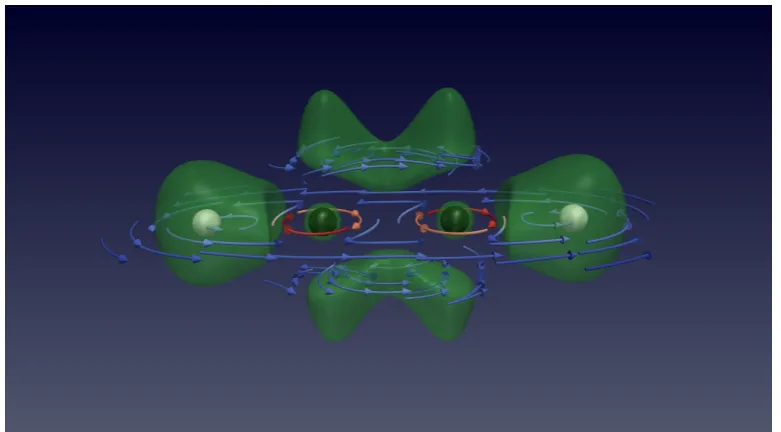
Visualisation of this quantity can aid with the understanding of the magnetic field’s influence on a system. Figure 6 shows the physical current vector field su-perimposed over a cELF contour plot for ethyne at 1.0B0 in the molecular plane
(left) and 1.15a0 above it (right). The current streamlines follow the structure of
the cELF, circulating around the attractors and following contour regions of high localisation. In this sense, the current plots are complementary to the cELF, high-lighting localised and bonding regions in a field. However, unlike the cELF, the current density vanishes in field-free DFT and is only of interest in a magnetic field.
4. Conclusions
[image:8.595.88.467.56.332.2]per-Figure 5. The cELF for ethyne calculated at the cTPSS/u-aug-cc-pCVTZ at the corresponding zero-field geometry. Therediso-volumes depict the regions offELF≥0.8 for 0.0B0(upper left), 0.1B0(upper right),
0.5B0 (lower left), and 1.0B0 (lower right). Field direction is indicated by the red arrow.
-3 -2 -1 0 1 2 3
-4 -2 0 2 4
0.1 0.3 0.5 0.7 0.9
-6 -4 -20246
-3 -2 -1 0 1 2 3
-4
-2 0 2 4
0.2 0.4 0.6 0.8
-6
-4
-20246
[image:9.595.97.467.56.338.2] [image:9.595.114.447.394.686.2]pendicular to the field are particularly evident. For covalently bound systems, the effects are more subtle but the cELF provides a clear representation of field-induced changes in electronic structure, as illustrated by application to methane, ethane, ethene and ethyne. We expect cELF to become a useful tool for the interpretation of changes in chemical bonding and reactivity in magnetic fields.
Acknowledgements
It is a pleasure to dedicate this paper to Prof. Savin on the occasion of his 65th birthday. His infectious enthusiasm and willingness to openly share scien-tific thoughts and ideas continue to inspire further progress in the field. We look forward to many more inspiring collaborations in the future.
A. M. T. is grateful for support from the Royal Society University Research Fellowship scheme. We are grateful for access to the University of Nottingham High Performance Computing Facility. This work was supported by the Norwe-gian Research Council through the CoE Centre for Theoretical and Computa-tional Chemistry (CTCC) Grant No. 179568/V30 and the Grant No. 171185/V30 and through the European Research Council under the European Union Seventh Framework Program through the Advanced Grant ABACUS, ERC Grant Agree-ment No. 267683.
References
[1] A. D. Becke and K. E. Edgecombe,J. Chem. Phys.92, 5397 (1990) [2] B. Silvi and A. Savin,Nature371, 683 (1994)
[3] A. Savin and M. Kohout,Int. J. Quantum Chem.60, 875 (1996)
[4] A. Savin, A. D. Becke, J. Flad, R. Nesper, H. Preuss and H. G. von Schering,Angew. Chem. Int. Ed. Engl.30, 409 (1991)
[5] A. Savin, H. J. Flad, J. Flad, H. Preuss and H. G. von Schnering, Angew. Chem. Int. Ed. Engl.31, 185 (1992)
[6] H. Binder, I. Duttlinger, H. Loos, K. Locke, A. Pfitzner, H.-J. Flad, A. Savin and M. Kohout,
Zeitschrift fur Anorganische und Allgemeine Chemie 621, 400 (1995)
[7] X. Krokidis, V. Goncalves and A. Savin,J. Phys. Chem. A 102, 5065 (1998) [8] D. B. Chesnut, and A. Savin,J. Am. Chem. Soc.121, 2335 (1999)
[9] P. Fuentealba, and A. Savin,J. Phys. Chem. A104, 10882 (2000)
[10] A. Burkhardt, U. Wedig, H. G. von Schnering and A. Savin,Zeitschrift fur Anorganische und Allgemeine Chemie 619, 437 (1993)
[11] R. Llusar, A. Beltran, J. Andres, B. Silvi and A. Savin,J. Phys. Chem.99, 12483 (1995) [12] H. J. Flad, F. Schautz, Y. X. Wang, M. Dolg and A. Savin,European Physical Journal D6,
243 (1999)
[13] P. Fuentealba and A. Savin,J. Phys. Chem. A105, 11531 (2001)
[14] A. Savin, O. Jepsen, J. Flad, K. O. Andersen, H. Preuss and H. G. von Schnering,Angew. Chem. Int. Ed. Engl.31, 187 (1992)
[15] Y. Grin, U. Wedig, F. Wagner, H. G. von Schnering and A. Savin,Journal of Alloys and Compounds255, 203 (1997)
[16] R. F. W. Bader, S. Johnson, T.-H. Tang, P. L. A. Popelier, J. Phys. Chem., 100, 1539815415(1996)
[17] A. Savin, B. Silvi and F. Colonna,Can. J. Chem74, 1088 (1996)
[18] A. Savin, R. Nesper, S. Wengert and T. F. F¨assler,Angew. Chem. Int. Ed. Engl.36, 1808 (1997)
[19] D. Marx, and A. Savin,Angew. Chem. Int. Ed. Engl.36, 2077 (1997) [20] S. Noury, F. Colonna, A. Savin and B. Silvi,J. Mol. Struct.45059 (1998) [21] A. Savin,J. Mol. Struct: THEOCHEM 727, 127 (2005)
[23] E. I. Tellgren, A. M. Teale, J. W. Furness, K. K. Lange, U. Ekstr¨om and T. Helgaker, J. Chem. Phys.140, 034101 (2014)
[24] S. Reimann, U. Ekstr¨om, S. Stopkowicz, A. M. Teale, A. Borgoo, T. Helgaker,Phys. Chem. Chem. Phys.17, 18834 (2015)
[25] J. W. Furness, J. Verbeke, E. I. Tellgren, S. Stopkowicz, U. Ekstr¨om, T. Helgaker and A. M. Teale,J. Chem. Theory Comput.11, 4169 (2015)
[26] J. Tao, J. P. Perdew, V. Staroverov, G. E. Scuseria,Phys. Rev. Lett.91, 146401 (2003) [27] J. E. Bates and F. Furche,J. Chem. Phys.137, 164105 (2012)
[28] K. K. Lange, E. I. Tellgren, M. R. Hoffmann, T. Helgaker,Science 80, 327-331 (2012) [29] A. D. Becke,Int. J. Quantum Chem.23, 19151922 (1983)
[30] J. F. Dobson,J. Chem. Phys.94, 4328 (1991) [31] A. D. Becke,J. Chem. Phys.117, 6935 (2002)
[32] S. N. Maximoff and G. E. Scuseria,Chem. Phys. Lett.390, 408 (2004) [33] J. Tao,Phys. Rev. B 71, 205107 (2005)
[34] E. Sagvolden, U. Ekstr¨om, E. Tellgren,Mol. Phys.,111, 1295-1302 (2013)
[35] T. Burnus, M. A. L. Marques and E. K. U. Gross,Phys. Rev. A71, 010501(R) (2005) [36] J. Pilm, E. Luppi, J. Bergs, C. Houe-Lvin and A. de la Lande,J. Mol. Model. 20,
2368-2381(2014)
[37] F. J. London,Phys. le Radium 8, 397-409 (1937) [38] R. Ditchfield;Mol. Phys.27, 789807 (1974)
[39] R. Ditchfield;Chem. Phys. Lett.65, 31233133 (1976)
[40] LONDON, a quantum-chemistry program for plane-wave/GTO hybrid basis sets and finite magnetic field calculations. By E. Tellgren (primary author), T. Helgaker, A. Soncini, K. K. Lange, A. M. Teale, U. Ekstrm, S. Stopkowicz, and J. H. Austad. See londonprogram.org for more information.
[41] E. I. Tellgren, A. Soncini and T. Helgaker,J. Chem. Phys.129, 154114 (2008)
[42] U. Ekstr¨om, L. Visscher, R. Bast, A. J. Thorvaldsen, K. Ruud,J. Chem. Theory Comput.6, 1971 (2010)
[43] T. H. Dunning Jr.,J. Chem. Phys.90, 1007 (1989)
The following image is the graphical abstract for the paper and offered for con-sideration as a cover image for the issue.