Open Access
Methodology article
An efficient one-step site-directed deletion, insertion, single and
multiple-site plasmid mutagenesis protocol
Huanting Liu* and James H Naismith*
Address: SSPF, Centre for Biomolecular Science, University of St Andrews, North Haugh, St Andrews KY16 9ST, UK Email: Huanting Liu* - [email protected]; James H Naismith* - [email protected]
* Corresponding authors
Abstract
Background: Mutagenesis plays an essential role in molecular biology and biochemistry. It has also been used in enzymology and protein science to generate proteins which are more tractable for biophysical techniques. The ability to quickly and specifically mutate a residue(s) in protein is important for mechanistic and functional studies. Although many site-directed mutagenesis methods have been developed, a simple, quick and multi-applicable method is still desirable.
Results: We have developed a site-directed plasmid mutagenesis protocol that preserved the simple one step procedure of the QuikChange™ site-directed mutagenesis but enhanced its efficiency and extended its capability for multi-site mutagenesis. This modified protocol used a new primer design that promoted primer-template annealing by eliminating primer dimerization and also permitted the newly synthesized DNA to be used as the template in subsequent amplification cycles. These two factors we believe are the main reasons for the enhanced amplification efficiency and for its applications in multi-site mutagenesis.
Conclusion: Our modified protocol significantly increased the efficiency of single mutation and also allowed facile large single insertions, deletions/truncations and multiple mutations in a single experiment, an option incompatible with the standard QuikChange™. Furthermore the new protocol required significantly less parental DNA which facilitated the DpnI digestion after the PCR amplification and enhanced the overall efficiency and reliability. Using our protocol, we generated single site, multiple single-site mutations and a combined insertion/deletion mutations. The results demonstrated that this new protocol imposed no additional reagent costs (beyond basic QuikChange™) but increased the overall success rates.
Background
Site-directed mutagenesis is the cornerstone of modern molecular biology allowing exquisite control of protein sequence. This technique is essential in functional study, genetic engineering, biochemistry and protein engineer-ing. The last category is particularly diverse, including the humanization of antibodies, introduction of new catalytic activities and creation of proteins more suited to
biophys-ical (predominantly structural) characterization. A number of strategies have been developed [1-12] with the QuikChange™ Site-Directed Mutagenesis System devel-oped by Stratagene (La Jolla, CA) probably the most favored. QuikChange™ works by using a pair of comple-mentary primers with a mutation. In a round of PCR cycles these primers anneal to the template DNA, replicat-ing the plasmid DNA with the mutation. The mutant DNA
Published: 4 December 2008
BMC Biotechnology 2008, 8:91 doi:10.1186/1472-6750-8-91
Received: 21 September 2008 Accepted: 4 December 2008
This article is available from: http://www.biomedcentral.com/1472-6750/8/91
© 2008 Liu and Naismith; licensee BioMed Central Ltd.
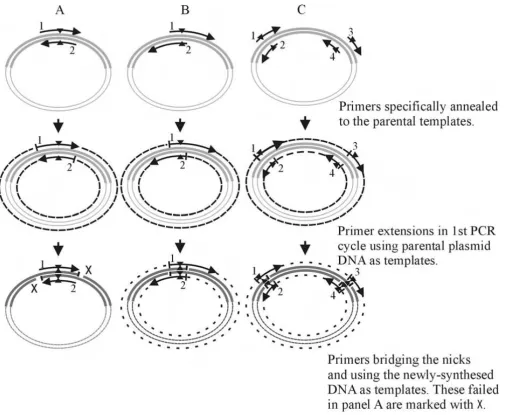
product has a strand break (nick) (Figure 1A). The result-ing DNA pool (mutant and parental) is then treated with DpnI to destroy the parental methylated DNA from the newly synthesized unmethylated mutant DNA and trans-formed into E. coli cells where the nick is ligated by host repair enzymes. The process while extremely useful and simple does have some limitations [13]. As the primers completely overlap, self annealing is quite favorable and care in primer design is required to avoid self pairing com-peting with template annealing. As the newly synthesized
DNA is "nicked", it cannot be used as a template for sub-sequent amplification in contrast to "normal" PCR (Fig-ure 1A). This constraint leads to a lower PCR amplification efficiency. Although increasing the amount of parental template DNA can help to alleviate this prob-lem it can introduce other complications. As originally developed QuikChange™ cannot introduce multiple mutations, a modified version of the kit (QuikChange™ Multi Site-Directed Mutagenesis kit) has been released and some other adaptations have been reported [14-19].
[image:2.612.56.563.216.631.2]Schematic presentations of mutagenesis PCR amplification processes
Figure 1
However, these procedures are either multistep and/or require phosphorylation of oligos and/or enzymatic liga-tion steps. Addiliga-tion of short (around 8 base) non-overlap-ping ends to the primers has been reported and this modification simplified primer design [13]. Deletion or insertion mutations however remain beyond the scope of basic QuikChange™.
In our structural proteomics lab, site-directed mutagene-sis, truncation and deletion mutagenesis are routine methods used by variety of personnel with different exper-tise in molecular biology. Although most problems with QuikChange™ can be overcome with modification or refinement, we encountered problems in mutation of low GC sequences from cloned Sulfolobus islandicus rudivirus (SIRV) CAG38830 and CAG38833 [20] which we were unable to solve. These problems led us to consider a mod-ification to QuikChange™ that would preserve its simplic-ity but enhance its efficiency and applicabilsimplic-ity. Our modified method uses primers containing extended non-overlapping sequences at the 3' end (significantly larger than suggested in [13]) and primer-primer complemen-tary sequences at the 5' end (Figure 2). We used this mod-ified method to make various mutations, including insertions (18 residues) and deletions (25 residues) in a cloned vraR gene of methicillin resistant Staphylococcus aureus (MRSA) [21]. We have also used four primers to create multiple-site mutations, deletions and insertions. This modified procedure has proven to be highly efficient.
Results
Primer designOur new primer design scheme minimized the primer-primer dimerisation and enabled the primer-primers to use the PCR products as the template. The schematic presentation of our new primer design is shown in Figure 2. Each primer pair contains non-overlapping sequences at their 3' end and primer-primer complementary (overlapping) sequences at the 5' end. The non-overlapping sequences are larger (significantly larger than suggested in [13]) than the complementary sequences to make the melting tem-perature of non-overlapping sequences (Tm no) 5 to 10°C higher than the melting temperature of primer-primer complementary sequences (Tm pp). The mutation sites can
be placed either in the complementary region or non-overlapping region. Using the primers designed by our new scheme, the newly synthesized PCR products can be used as the templates in the subsequent PCR amplifica-tion cycles, which significantly increased the PCR effi-ciency and required less template DNA while it is unfeasible in the QuickChange™ or the modification reported previously [13].
Single-site mutation and deletion
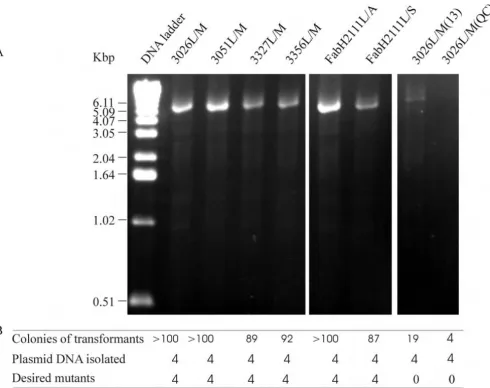
Using the primer pair of 3026L/M, 3051L/M, 3327L/M, 3056L/M, FabH2111C/A, FabH2111C/S (Table 1), six single-site mutagenesis reactions were carried out to sub-stitute residues Leu26, Leu51 in CAG38830, Leu27 and Leu56 in CAG38833 by methionines and Cys111 in FabH2 by an alanine and a serine respectively. As controls one primer pair of 3026L/M designed as recommended in the QuikChange™ manual and another designed as described in [13] were tested. Agarose gel electrophoresis showed the synthesis of the full-length plasmid DNA (Fig-ure 3A). DNA quantification showed that amplifications of 3026L/M, 3051L/M and FabH2111C/S produced approximately 1 μg of the synthesized plasmid DNA respectively in each reaction while amplifications of 3327L/M, 3056L/M and FabH2111C/A produced approx-imately 500 ng respectively. In comparison with the DNA produced using the primer pairs designed by our new scheme the control PCR reactions produced 35 ng for 3026L/M(13) and about 5 ng for 3026L/M(QC). Trans-formation of E. coli cells with these DNA resulted in a large number of colonies (Figure 3B) indicating a high PCR amplification efficiency. DNA sequencing showed that in each mutagenesis reaction all four transformants con-tained the desired mutations (Figure 3B). Under these conditions neither control experiment gave colonies which harbored the desired mutants despite five attempts.
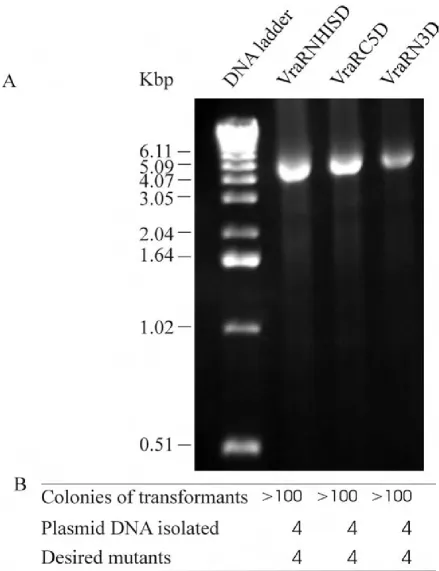
Using the primer pairs of VRARN3, VRARC5 and VRAR-DHIS (Table 1), we successfully generated a vraR clone with three residues deleted from its N-terminus, a clone with five residues deleted from its C-terminus and a clone with its His tag removed from the N-terminus. PCR ampli-fications of these mutants again showed high amplifica-tion efficiency (Figure 4A). Transformaamplifica-tion of E. coli cells with these PCR products produced more than 100 colo-nies (Figure 4B). Sequencing the plasmid DNA showed that in each reaction all four isolated recombinants con-tained the desired deletions.
Multiple-site mutations, deletions and insertions
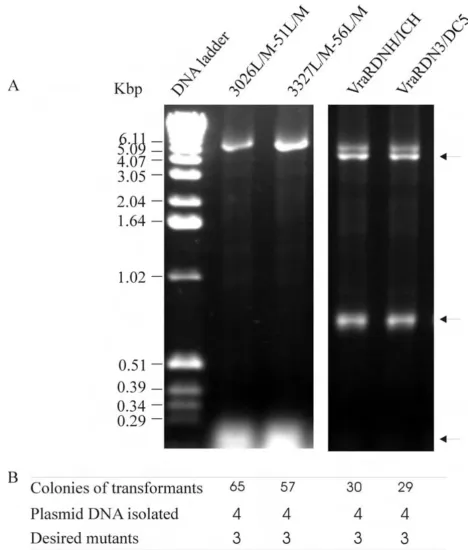
pDESVRAR for maximum likelihood of crystallisation. A similar experiment with two primer pairs VRARDHIS and VRARIHIS was set up to remove the N-terminal TEV pro-tease cleavable His-tag and insert a C-terminal His-tag in a single reaction. Analysis of the PCR products is shown in
Figure 5A. In addition to the full-length PCR products, some partial PCR fragments accumulated in these PCR reactions. These partial amplified DNA fragments were generated with a forward primer and a reverse primer of the downstream primer pair (schematically presented in
Schematic diagram of the primer design for site-directed mutagenesis
Figure 2
Figure 1C, primer 1 and primer 4, primer 3 and primer 2) misbridging the "nicks" during the amplification. These partial DNA fragments share some overlap sequences within their primer pairs and could anneal via primer-primer overlapping sequences or act as megaprimer-primers [6] annealed to the template and elongated into the full length plasmid DNA in the subsequent amplification cycles or similar to that described [7]. The synthesis of the full length PCR products for the double-site mutations (3026L/M-51L/M and 3327L/M-56L/M) was more effi-cient than the multiple-site deletions (Figure 5A). Never-theless full-length products were produced and transformation of the E. coli cells with these products pro-duced viable transformants. DNA sequencing showed that
three of four transformants contained the desired muta-tions.
Discussion
QuickChange™ site-directed mutagenesis has transformed the ability of labs to carry out site-directed mutagenesis. However its relatively low PCR amplification efficiency can lead to problems and the primer design needs care. Adding additional template alleviates this but can decrease the success rate for obtaining mutants as it leads to a increase of the amount of hemimethylated DNA mol-ecules (newly synthesized strand combined with parental strand) which is resistant to DpnI digestion [22]. Incom-plete digestion results in recovery of non-mutated DNA.
PCR amplification for single-site mutagenesis
Figure 3
Modified primer design which destabilizes primer pairs has been proposed [13] to simplify the procedure. How-ever, this and the original method can only use the paren-tal DNA as template in the amplification cycles. This is because the primers either do not bridge or are too short to efficiently bridge the "nick" in the newly synthesized strands. By significantly increasing the non-overlapping region the primers should be long enough to bridge the "nick" and bind to the newly synthesized DNA and thus use it as template (Figure 1B, C) in the same way as nor-mal PCR. We therefore designed primers which contain non-overlapping sequence and primer-primer comple-mentary (overlapping) with a Tm no 5 to 10°C higher than the Tm pp so that the non-overlapping sequences can
bridge the "nick" and bind to the newly synthesized DNA efficiently. These primer lengths are within the normal range suggested for QuikChange™ and therefore do not impose any additional costs to the laboratory. The PCR amplification using these primers showed high efficiency and as a result it required less than half the parental tem-plate and fewer amplification cycles. The decreased amount of parental DNA has the significant added benefit that decreases the amount of methylated and hemimeth-ylated DNA which needs to be destroyed by DpnI, reduc-ing the potential to recover the parental DNA.
[image:6.612.53.558.100.348.2]The modified primer design as with that proposed earlier [13] eliminates the problems associated with primer pair self-annealing, and Tm values can be designed as these for conventional PCR [23]. Moreover the restriction upon primer length is also lifted which enhances the utility of the technique. The removal of the primer length limita-tion allows adjacent multiple mutalimita-tions to be made in a single step with a pair of mutagenesis primers without any limitation. We have successfully generated double muta-tions, double deletion and N-terminal deletion and C-ter-minal insertion mutants simultaneously in a single experiment, demonstrating that this modified method is efficient for multiple site-directed mutagenesis. PCR amplification for multiple-site mutagenesis produced par-tial DNA fragments with the forward primer in a primer pair (primer 1, Figure 1C) and the reverse primer of the downstream primer pair (primer 4, Figure 1C). These par-tial elongated DNA fragments annealed each other with their overlap sequences and extended to the full-length plasmid DNA in the subsequent PCR cycles [24] or func-tioned as the megaprimers in the subsequent cycles as described [11]. There is no distance restriction of the mutation sites. However a long single pair primer should be used for the adjacent multiple mutations. In our exper-iments the double mutations (3026L/M-51L/M and
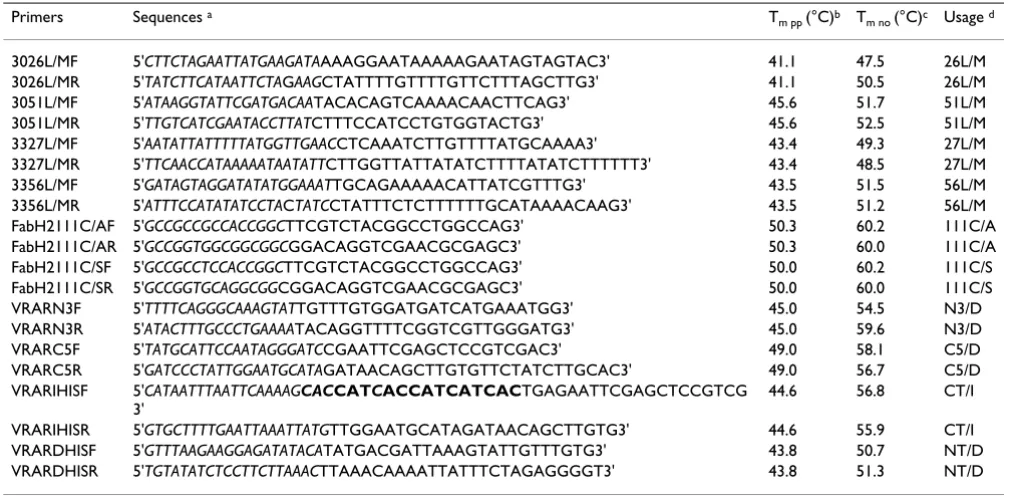
Table 1: Primers used for mutagenesis
Primers Sequences a T
m pp (°C)b Tm no (°C)c Usage d
3026L/MF 5'CTTCTAGAATTATGAAGATAAAAGGAATAAAAAGAATAGTAGTAC3' 41.1 47.5 26L/M 3026L/MR 5'TATCTTCATAATTCTAGAAGCTATTTTGTTTTGTTCTTTAGCTTG3' 41.1 50.5 26L/M 3051L/MF 5'ATAAGGTATTCGATGACAATACACAGTCAAAACAACTTCAG3' 45.6 51.7 51L/M 3051L/MR 5'TTGTCATCGAATACCTTATCTTTCCATCCTGTGGTACTG3' 45.6 52.5 51L/M 3327L/MF 5'AATATTATTTTTATGGTTGAACCTCAAATCTTGTTTTATGCAAAA3' 43.4 49.3 27L/M 3327L/MR 5'TTCAACCATAAAAATAATATTCTTGGTTATTATATCTTTTATATCTTTTTT3' 43.4 48.5 27L/M 3356L/MF 5'GATAGTAGGATATATGGAAATTGCAGAAAAACATTATCGTTTG3' 43.5 51.5 56L/M 3356L/MR 5'ATTTCCATATATCCTACTATCCTATTTCTCTTTTTTGCATAAAACAAG3' 43.5 51.2 56L/M FabH2111C/AF 5'GCCGCCGCCACCGGCTTCGTCTACGGCCTGGCCAG3' 50.3 60.2 111C/A FabH2111C/AR 5'GCCGGTGGCGGCGGCGGACAGGTCGAACGCGAGC3' 50.3 60.0 111C/A FabH2111C/SF 5'GCCGCCTCCACCGGCTTCGTCTACGGCCTGGCCAG3' 50.0 60.2 111C/S FabH2111C/SR 5'GCCGGTGCAGGCGGCGGACAGGTCGAACGCGAGC3' 50.0 60.0 111C/S VRARN3F 5'TTTTCAGGGCAAAGTATTGTTTGTGGATGATCATGAAATGG3' 45.0 54.5 N3/D VRARN3R 5'ATACTTTGCCCTGAAAATACAGGTTTTCGGTCGTTGGGATG3' 45.0 59.6 N3/D VRARC5F 5'TATGCATTCCAATAGGGATCCGAATTCGAGCTCCGTCGAC3' 49.0 58.1 C5/D VRARC5R 5'GATCCCTATTGGAATGCATAGATAACAGCTTGTGTTCTATCTTGCAC3' 49.0 56.7 C5/D VRARIHISF 5'CATAATTTAATTCAAAAGCACCATCACCATCATCACTGAGAATTCGAGCTCCGTCG
3'
44.6 56.8 CT/I
VRARIHISR 5'GTGCTTTTGAATTAAATTATGTTGGAATGCATAGATAACAGCTTGTG3' 44.6 55.9 CT/I VRARDHISF 5'GTTTAAGAAGGAGATATACATATGACGATTAAAGTATTGTTTGTG3' 43.8 50.7 NT/D VRARDHISR 5'TGTATATCTCCTTCTTAAACTTAAACAAAATTATTTCTAGAGGGGT3' 43.8 51.3 NT/D
a: Primer-primer overlapping sequences are in italic. The sequence insertion is in bold face. b: T
m pp (°C) was calculated from the primer-primer overlap sequence. c: T
m no (°C) was calculated from the primer sequence matched to the template.
d: N3/D: three amino acids deleted from the N-terminus; C5/D: five amino acids deleted from the C-terminus: NT/D: N-terminal His tag and TEV
PCR amplification for single-site deletions
Figure 4
PCR amplification for multiple-site mutagenesis
Figure 5
3327L/M-56L/M) spanned around 80 base pairs pro-duced more full-length plasmid suggesting that the short partial PCR products could act as megaprimers in the sub-sequent amplification cycles more efficiently in compari-son with the longer PCR fragments (VraRDNH/ICH and VraRDN3/DC5). An extra a few cycles using Tm pp-5 as the annealing temperature can increase the synthesis of the full-length plasmid and placing the mutation sites within the primer-primer overlap sequence can increase the mutation efficiency. Although Tm pp and Tm no of the primer pairs can be variable, a Tm no volume of the primer pairs 5°C to 10°C higher than Tm pp is required for an
effi-cient PCR amplification. Under our PCR conditions, no plasmid concatemers were detected.
Our results demonstrated that the modified protocol is a high efficient method for single site mutagenesis and can be extended to multiple site-directed insertion deletion mutagenesis protocol without any extra steps such as liga-tion or phosphorylaliga-tion.
Conclusion
As a result of this research, we have modified the site-directed mutagenesis protocol which increased the effi-ciency for single- and multiple-site mutations and also enabled facile large single insertions and deletions/trun-cations in a single experiment, an option incompatible with the standard QuikChange™ protocol or with the pro-tocols reported previously [8,12,13,17,19,25-27]. This single-step protocol utilized a new primer designing scheme and required significantly less parental DNA which facilitated its digestion after the PCR and enhanced the overall efficiency and reliability.
Six single-site mutations and three deletion mutants were generated using this modified protocol. The PCR amplifi-cations with the primers designed by the new scheme revealed high amplification efficiency and required less parental DNA and PCR cycles. Sequence analysis the plas-mid DNA revealed that in each mutagenesis reaction all four transformants contained the desired mutations or deletions. Four site mutations and two double-site deletions or deletion/insertion were generated using this method. A large number of recombinants demon-strated that our mutagenesis protocol was effective for engineering double mutations, deletions and insertions. Despite the fact that partial elongation products were pro-duced and the syntheses of the full-length plasmid DNA variable, transformation of the resulting products into E. coli cells produced viable transformants. Three of four sequenced transformants contained the desired muta-tions.
Our new protocol has been used successfully to generate single and multiple-site mutations, deletions, insertion
and combined insertion/deletions. The resulted mutants have been successfully used to express the proteins for structure determination (data not shown). The results demonstrated that this new protocol imposed no addi-tional reagent costs but increased the overall success rates.
Methods
Plasmid pDESTSIRV30, pDESTSIRV33 expressing the SIRV proteins (CAG38830 and CAG38833), pDESTAVRA expressing MRSA vraR protein (CAG40961) and pDESTFaBH2 expressing Pseudomonas aeruginosa FaBH2 protein (AAG06721)[28] were constructed using a modi-fied Gateway technology with an N-terminal TEV protease cleavable His tag [29]. All the plasmids were propagated in DH5α E. coli cells (Stratagene, La Jolla) and plasmids were prepared using Qiagen miniprep kits (Qiagen, Ger-many). Pfu DNA polymerase, DpnI restriction enzyme are provided with QuikChange™ kit purchased from Strata-gene, additional Pfu DNA polymerase was purchased from Promega when required. All the primers were syn-thesized by Eurogentec and simply purified by SePOP desalting. The melting temperature was calculated as Tm = 81.5 + 16.6(log([K+]/(1+0.7 [K+])) + 0.41(% [G+C]) – 500/(probe length in base) – 1.0(%mismatch) [30]. The Tm pp and Tm no were calculated for each primer. All prim-ers and their Tm no and Tm pp are detailed in Table 1. PCR cycling was carried out using a Px2 thermal cycler (Thermo Electro Cooperation).
Publish with BioMed Central and every scientist can read your work free of charge
"BioMed Central will be the most significant development for disseminating the results of biomedical researc h in our lifetime."
Sir Paul Nurse, Cancer Research UK
Your research papers will be:
available free of charge to the entire biomedical community
peer reviewed and published immediately upon acceptance
cited in PubMed and archived on PubMed Central
yours — you keep the copyright
Submit your manuscript here:
http://www.biomedcentral.com/info/publishing_adv.asp
BioMedcentral
verify the mutations, 500 ng of plasmid DNA was mixed with 50 pmole of T7 sequencing primer in a volume of 15
μl. DNA sequencing was carried out using the Sequencing Service, University of Dundee. For multiple site-directed mutations, deletions and insertions, the PCR was carried out in 50 μl of reaction containing 10 ng of template, 1
μM of each of the two primer pairs, 200 μM dNTPs and 3 units of Pfu DNA polymerase. The PCR cycles, DNA quan-tification, transformation and mutation verification were essentially the same as described above.
Authors' contributions
HL designed the experiments, carried out the practical work and drafted the manuscript. JHN was involved in the research discussion and helped to finalise the manuscript. All authors read and approved the final manuscript.
Acknowledgements
This work was carried out at Scottish Structural Proteomics Facility, which is funded by BBSRC, Scottish Funding Council (SFC) and the University of St. Andrews.
References
1. Kunkel TA: Rapid and efficient site-specific mutagenesis with-out phenotypic selection. Proc Natl Acad Sci USA 1985,
82:488-492.
2. Cormack B: Introduction of a point mutation by sequential PCR steps. Curr Protoc Mol Biol 1994, 2:8.5.7-9.
3. Ishii TM, Zerr P, Xia XM, Bond CT, Maylie J, Adelman JP: Site-directed mutagenesis. Methods Enzymol 1998, 293:53-71. 4. Ling MM, Robinson BH: Approaches to DNA mutagenesis: an
overview. Anal Biochem 1997, 254:157-178.
5. Vandeyar MA, Weiner MP, Hutton CJ, Batt CA: A simple and rapid method for the selection of oligodeoxynucleotide-directed mutants. Gene 1988, 65:129-133.
6. Sarkar G, Sommer SS: The "megaprimer" method of site-directed mutagenesis. Biotechniques 1990, 8:404-407.
7. Klock HE, Koesema EJ, Knuth MW, Lesley SA: Combining the polymerase incomplete primer extension method for clon-ing and mutagenesis with microscreenclon-ing to accelerate structural genomics efforts. Proteins 2008, 71:982-994. 8. Chapnik N, Sherman H, Froy O: A one-tube site-directed
muta-genesis method using PCR and primer extension. Anal Bio-chem 2008, 372:255-257.
9. Kumar R, Rajagopal K: Single-step overlap-primer-walk polymerase chain reaction for multiple mutagenesis without overlap extension. Anal Biochem 2008, 377:105-107.
10. Li X, Qiu Y, Shen Y, Ding C, Liu P, Zhou J, Ma Z: Splicing together different regions of a gene by modified polymerase chain reaction-based site-directed mutagenesis. Anal Biochem 2008,
373:398-400.
11. Tseng WC, Lin JW, Wei TY, Fang TY: A novel megaprimed and ligase-free, PCR-based, site-directed mutagenesis method.
Anal Biochem 2008, 375:376-378.
12. Li J, Li C, Xiao W, Yuan D, Wan G, Ma L: Site-directed mutagen-esis by combination of homologous recombination and DpnI digestion of the plasmid template in Escherichia coli. Anal Bio-chem 2008, 373:389-391.
13. Zheng L, Baumann U, Reymond JL: An efficient one-step site-directed and site-saturation mutagenesis protocol. Nucleic Acids Res 2004, 32:e115.
14. Mikaelian I, Sergeant A: A general and fast method to generate multiple site directed mutations. Nucleic Acids Res 1992, 20:376. 15. Jensen PH, Weilguny D: Combination primer polymerase chain reaction for multi-site mutagenesis of close proximity sites.
J Biomol Tech 2005, 16:336-340.
16. Young L, Dong Q: TAMS technology for simple and efficient in vitro site-directed mutagenesis and mutant screening.
Nucleic Acids Res 2003, 31:e11.
17. Kim YG, Maas S: Multiple site mutagenesis with high targeting efficiency in one cloning step. Biotechniques 2000, 28:196-198. 18. Wang W, Malcolm BA: Two-stage PCR protocol allowing
intro-duction of multiple mutations, deletions and insertions using QuikChange Site-Directed Mutagenesis. Biotechniques 1999,
26:680-682.
19. Post MA: Site directed mutagenesis by ligation-during-ampli-fication: Change-IT Multiple Site Directed Mutagenesis Kit.
The FASEB Journal 2007, 21:795.3.
20. Kessler A, Brinkman AB, Oost J van der, Prangishvili D: Transcrip-tion of the rod-shaped viruses SIRV1 and SIRV2 of the hyper-thermophilic archaeon sulfolobus. J Bacteriol 2004,
186:7745-7753.
21. Boyle-Vavra S, Yin S, Daum RS: The VraS/VraR two-component regulatory system required for oxacillin resistance in com-munity-acquired methicillin-resistant Staphylococcus aureus. FEMS Microbiol Lett 2006, 262:163-171.
22. Vovis GF, Lacks S: Complementary action of restriction enzymes endo R-DpnI and Endo R-DpnII on bacteriophage f1 DNA. J Mol Biol 1977, 115:525-538.
23. Rychlik W, Rhoads RE: A computer program for choosing opti-mal oligonucleotides for filter hybridization, sequencing and in vitro amplification of DNA. Nucleic Acids Res 1989,
17:8543-8551.
24. Aiyar A, Xiang Y, Leis J: Site-directed mutagenesis using overlap extension PCR. Methods Mol Biol 1996, 57:177-191.
25. Hansson MD, Rzeznicka K, Rosenback M, Hansson M, Sirijovski N:
PCR-mediated deletion of plasmid DNA. Anal Biochem 2008,
375:373-375.
26. Ho SN, Hunt HD, Horton RM, Pullen JK, Pease LR: Site-directed mutagenesis by overlap extension using the polymerase chain reaction. Gene 1989, 77:51-59.
27. Seyfang A, Jin JH: Multiple site-directed mutagenesis of more than 10 sites simultaneously and in a single round. Anal Bio-chem 2004, 324:285-291.
28. Stover CK, Pham XQ, Erwin AL, Mizoguchi SD, Warrener P, Hickey MJ, Brinkman FS, Hufnagle WO, Kowalik DJ, Lagrou M, et al.: Com-plete genome sequence of Pseudomonas aeruginosa PA01, an opportunistic pathogen. Nature 2000, 406:959-964. 29. Liu H, Rudolf J, Johnson KA, McMahon SA, Oke M, Carter L,
McRob-bie AM, Brown SE, Naismith JH, White MF: Structure of the DNA repair helicase XPD. Cell 2008, 133:801-812.
30. Wetmur JG: DNA probes: applications of the principles of nucleic acid hybridization. Crit Rev Biochem Mol Biol 1991,