Automatic presentations and semigroup
constructions
Alan J. Cain1, Graham Oliver2, Nik Ruˇskuc3, Richard M. Thomas4
1,3
School of Mathematics and Statistics, University of St Andrews, North Haugh, St Andrews, Fife KY16 9SS, United Kingdom.
2,4
Department of Computer Science, University of Leicester, University Road, Leicester, LE1 7RH, United Kingdom
1
Abstract
An automatic presentation for a relational structure is, informally, an abstract representation of the elements of that structure by means of a regular language such that the relations can all be recognized by finite automata. A structure admitting an automatic presenta-tion is said to be FA-presentable. This paper studies the interac-tion of automatic presentainterac-tions and certain semigroup construcinterac-tions, namely: direct products, free products, finite Rees index extensions and subsemigroups, strong semilattices of semigroups, Rees matrix semigroups, Bruck–Reilly extensions, zero-direct unions, semidirect products, wreath products, ideals, and quotient semigroups. For each case, the closure of the class of FA-presentable semigroups under that construction is considered, as is the question of whether the FA-presentability of the semigroup obtained from such a construction implies the FA-presentability of the original semigroup[s]. Classifications are also given of the FA-presentable finitely generated Clifford semigroups, completely simple semigroups, and completely 0-simple semigroups.
1
Introduction
by synchronous finite state automata. Any FA-presentable structure — that is, any structure admitting an automatic presentation — has decidable first-order theory. This is an important motivation for studying FA-presentable structures. The theory of automatic presentations continues to be developed; see, for example, [2, 3, 4, 18].
A common theme in the research thus far on automatic presentations has been the classification of those structures, within particular species, that admit automatic presentations. The second and fourth authors showed that a finitely generated group admits an automatic presentations if and only if it is virtually abelian (see Theorem 2.8 below). The authors together proved that a finitely generated cancellative semigroup admits an automatic presentation if and only if it embeds into a virtually abelian group [6, 7].
The present paper studies the interaction of automatic presentations and certain semigroup constructions, namely: direct products, free prod-ucts, finite Rees index extensions and subsemigroups, strong semilattices of semigroups, Rees matrix semigroups, Bruck–Reilly extensions, zero-direct unions, semidirect products, wreath products, ideals, and quotient semi-groups. For each case, the closure of the class of FA-presentable semigroups under that construction is considered, as is the question of whether the FA-presentability of the semigroup obtained from such a construction implies the FA-presentability of the original semigroup[s].
This study of constructions leads to new characterizations of FA-presentable semigroups of certain classes:
• The finitely generated FA-presentable Clifford semigroups are precisely the finitely generated strong semilattices of virtually abelian groups (Theorem 7.7).
• The finitely generated FA-presentable completely simple and com-pletely 0-simple semigroups are precisely those arising as Rees ma-trix semigroups over virtually abelian groups (Theorem 8.6 and Corol-lary 8.7).
2
Automatic Presentations
Definition 2.1. Let Lbe a regular language over a finite alphabetA. De-fine, forn∈N,
Let $ be a new symbol not inA. The mapping conv : (A∗)n→((A∪ {$})n)∗
is defined as follows. Suppose
w1 =w1,1w1,2· · ·w1,m1,
w2 =w2,1w2,2· · ·w2,m2,
.. .
wn=wn,1wn,2· · ·wn,mn,
wherewi,j ∈A. Then conv(w1, . . . , wn) is defined to be
(w1,1, w2,1, . . . , wn,1)(w1,2, w2,2, . . . , wn,2)· · ·(w1,m, w2,m, . . . , wn,m),
wherem= max{mi :i= 1, . . . , n} and withwi,j = $ whenever j > mi.
Observe that the mapping conv maps an n-tuple of words to a word of
n-tuples.
Definition 2.2. LetAbe a finite alphabet, and letR⊆(A∗)nbe a relation
onA∗. ThenR is said to be regular if
{conv(w1, . . . , wn) : (w1, . . . , wn)∈R}
is a regular language over (A∪ {$})n.
Definition 2.3. Let S = (S, R1, . . . , Rn) be a relational structure. Let L
be a regular language over a finite alphabet A, and let φ : L → S be a surjective mapping. Then (L, φ) is anautomatic presentation forS if:
1. the relation L=={(w1, w2)∈L2 :w1φ=w2φ} is regular, and
2. for each relationRi of arityri, the relation
LRi ={(w1, w2, . . . , wri)∈L
ri :R(w
1φ, . . . , wriφ)}
is regular.
A semigroup can be viewed as a relational structure, with the binary operation ◦ becoming a ternary relation. The following definition simply restates the preceding one in the special case when the structure is a semi-group:
Definition 2.4. LetS be a semigroup. LetLbe a regular language over a finite alphabet A, and let φ:L→ S be a surjective mapping. Then (L, φ) is an automatic presentation forS if the relations
L=={(w1, w2)∈L2 :w1φ=w2φ}
and
L◦ ={(w1, w2, w3)∈L3 : (w1φ)(w2φ) =w3φ}
Definition 2.5. Let (L, φ) be an automatic presentation for a structure. Then (L, φ) is a binary automatic presentation if the language L is over a two-letter alphabet; and it is an injective automatic presentation if the mapping φ is injective (so that every element of the structure has exactly one representative inL).
Proposition 2.6 ([2, Lemma 3.3 & Theorem 3.4]). Any structure that ad-mits an automatic presentation adad-mits an injective binary automatic pre-sentation.
The fact that a tuple of elements (a1, . . . , an) of a structureS satisfies a
first-order formulaθ(x1, . . . , xn) is denotedS|=θ(a1, . . . , an).
Proposition 2.7 ([15]). Let S be a structure with an automatic presenta-tion. For every first-order formula θ(x1, . . . , xn) over the structure there is
an automaton which accepts(w1, . . . , wn)if and only ifS |=θ(w1φ, . . . , wnφ).
Moreover, this automaton may be effectively constructed.
Theorem 2.8 ([16]). A finitely generated group admits an automatic pre-sentation if and only if it is virtually abelian. In particular, a group Gwith a subgroupZn of index l admits an automatic presentation (L, φ), where L
is the language of words
giconv(ε1z1, . . . , εnzn),
where εi ∈ {+,−}, zi is a natural number in reverse binary notation,
g1, . . . , gl are representives of the cosets of Zn in G, with φ : L → G
be-ing defined in the natural way:
φ(giconv(ε1z1, . . . , εnzn)) =gi(ε1z1, . . . , εnzn).
Theorem 2.9. Any finitely generated subsemigroup of a semigroup admit-ting an automatic presentation has polynomial growth. In particular, any FA-presentable finitely generated semigroup has polynomial growth.
Proof. This result was proved for groups in [16]; the proof immediately generalizes to semigroups (see [7]).
3
Direct products
Before embarking on the counterexample, notice that it is particularly important in light of the long-standing open problem of whether automatic-ity in the sense of Epstein et al. [11] and Campbell et al. [9] is preserved on passing to direct factors; this question is open even in the restricted case of groups.
Example 3.1. LetY be a non-recursively enumerable subset of the natural numbers. For eachy∈Y, letPy be a set ofy elements, with all the sets Py
being pairwise disjoint. Let eand zbe new elements. Let
S ={e, z} ∪ [
y∈Y
Py.
Define a multiplication onS by
uv= (
e ifu, v ∈Py for somey∈Y;
z ifu∈Px andv ∈Py for x, y∈Y withx6=y;
ue=eu=uz =zu=z foru∈S.
(It is easy to check that this multiplication is associative and soSis a semi-group.) Then S is not FA-presentable, for if it were, one could enumerate the setY: to determine whetherk lies in Y, one would check whether the set
(x1, . . . , xk) : (∀i, j∈ {1, . . . , k}) (i6=j =⇒ xi6=xj)∧(xixj =e)
∧(∀y∈S) (yx1 =e) =⇒ (∃k∈ {1, . . . , k})(y=xk)
is non-empty. (That is, check whether there is a set of kdistinct elements with pairwise producteand that this set does lie inside a larger such set.)
Let T be a countable null semigroup, with all products being equal to
f ∈T. Then T is FA-presentable.
Observe thatS×T consists of elements
(e, f),(z, f),(p, f),(e, t),(z, t),(p, t),
wheret∈T − {f}and p∈Py for somey∈Y.
Supposey0, y1, . . .andt0, t1. . .are the elements ofY andT respectively,
listed in some fixed order witht0 =f. For each i∈N∪ {0}}, let{qi,j :j ∈
N∪ {0}} consist of the [countably many] elements (p, t) wherep∈Py i and
t∈T. Letaand bbe symbols and let
L={conv(a, j),conv(b, j),conv(i, j) :i, j∈N∪ {0}},
whereiand j are understood to be in reverse binary notation. Notice that
Lis a regular language. Define φ:L→S×T by
conv(a, j)7→(e, tj)
conv(b, j)7→(z, tj)
The mapφis bijective, soL=={(w, w) :w∈L}. Moreover,
L◦ ={(conv(a, j),conv(a, k),conv(b,0)) :j, k ∈N∪ {0}} ∪ {(conv(a, j),conv(b, k),conv(b,0)) :j, k ∈N∪ {0}} ∪ {(conv(a, j),conv(h, k),conv(b,0)) :h, j, k ∈N∪ {0}} ∪ {(conv(b, j),conv(a, k),conv(b,0)) :j, k ∈N∪ {0}} ∪ {(conv(b, j),conv(b, k),conv(b,0)) :j, k ∈N∪ {0}} ∪ {(conv(b, j),conv(h, k),conv(b,0)) :h, j, k∈N∪ {0}} ∪ {(conv(i, j),conv(a, k),conv(b,0)) :j, k∈N∪ {0}} ∪ {(conv(i, j),conv(b, k),conv(b,0)) :i, j, k∈N∪ {0}}
∪ {(conv(i, j),conv(h, k),conv(a,0)) :h, i, j, k∈N∪ {0}, h=i} ∪ {(conv(i, j),conv(h, k),conv(b,0)) :h, i, j, k ∈N∪ {0}, h6=i}.
The relationL◦ is regular, since the only checking the automaton has to
per-form is when the first two tracks on the input tape are labelled by conv(i, j) and conv(h, k), when it must check whetherh and icoincide.
Thus (L, φ) is an automatic presentation for S×T. Thus S×T is an example of an FA-presentable direct product with a direct factor S that is not FA-presentable.
In the above example, the countable null semigroupT is FA-presentable. This raises the following question:
Question 3.2. Do there exist semigroups S and T such thatS×T is FA-presentable butneither S norT are?
4
Free products
The present section characterizes those semigroup and monoid free products that are FA-presentable. A semigroup free product is only FA-presentable in one very restricted case:
Proposition 4.1. The semigroup free product of two semigroups S and T
is FA-presentable if and only if S andT are trivial.
Proof. Suppose S is non-trivial. Let s1 and s2 be distinct elements of S
and let t ∈ T. Then {s1t, s2t} generates a free subsemigroup of S ∗T,
which contradicts the fact that every finitely generated subsemigroup of an FA-presentable semigroup has polynomial growth (Theorem 2.9).
Now suppose S = {s} and T = {t} are both trivial. Then every ele-ment ofS∗T is an alternating product of symbols sand t and is uniquely determined by the leftmost symbol and the length of the product. So let
and define φ:L→S∗T be letting (xn)φ be the element of S∗T (viewed as a set of alternating products) that starts withx and has length equal to the number represented in reverse binary notation byn.
To see that (L, φ) is an automatic presentation for S ∗ T, reason as follows: Every element of S ∗T has a unique representative in L, so the equality relation is simply the diagonal relation {(w, w) : w ∈ L}. The multiplication relation is
(xn, ym, xp) : (x=y)∧(n≡0 mod 2)∧(p=n+m)
∨ (x=y)∧(n≡1 mod 2)∧(p=n+m−1)
∨ (x6=y)∧(n≡0 mod 2)∧(p=n+m−1)
∨ (x6=y)∧(n≡1 mod 2)∧(p=n+m) ,
since (xn)φ ends withx if and only if nis odd. Since addition of numbers in reverse binary notation and checking such numbers for divisibility by 2 can be carried out by an automaton, this relation is regular.
For monoid free products — where the identities of the two monoids are amalgamated — there is marginally more freedomn:
Proposition 4.2. The monoid free product of two monoids S and T is FA-presentable if and only if one of the following cases holds:
1. S is FA-presentable andT is trivial, or vice versa;
2. S andT both contain exactly two elements.
Proof. If T is trivial then S∗T is isomorphic to S. So assume bothS and
T are non-trivial.
SupposeScontains at least three elements. Lets1ands2be non-identity
elements of S and let t be a non-identity element of T. Then {s1t, s2t}
generates a free subsemigroup of S∗T, which is a contradiction, as in the proof of the preceding result.
Now suppose thatSand T each have two elements. Then every element of S∗T is either the identity or an alternating product of the non-identity elementssof S andt ofT which is determined by its leftmost multiplicand and its length. As in the previous proof, let
L={e} ∪ {xn:x∈ {s, t}, n∈ {0,1}+1},
and defineφ:L→S∗T by letting eφbe the identity and letting (xn)φbe the element ofS∗T (viewed as a set of alternating products) that starts with
xhas length equal to the number represented in reverse binary notation by
n.
Reasoning similar to the preceding proof shows that (L, φ) is an auto-matic structure: the only difference is that there are several cases, depending on whethers2 =sors2= 1
Notice that the characterization of FA-presentable monoid free products also characterizes FA-presentable free products of groups.
5
A noteworthy example
This section exhibits a particular FA-presentable semilattice which is, in some sense, an extreme example: several semigroup constructions based on this semilattice turn out not to be FA-presentable. More simply, this semilattice is the starting-point for various counterexamples that show the class of FA-presentable semigroups is not closed under certain constructions. Recall that a semilattice (S,≤) forms a commutative semigroup of idem-potents (S,◦), wheres◦tis defined to be the greatest lower bound of{s, t}. That is, s◦tis the [necessarily unique] element x∈S such that
(x≤s)∧(x≤t)∧(∀y∈S) (y≤s)∧(y≤t) =⇒ (y≤x).
Therefore◦ is first-order definable over (S,≤) and similarly ≤is first-order definable over (S,◦), since
s≤t ⇐⇒ (s◦t=s).
Ergo, for the purposes of automatic presentations, one is free to view a semilattice either as an ordered set or as a semigroup.
LetS be the set
{0} ∪[
i∈N
Mi,
where Mi = {mi,j : 1 ≤ j ≤ i} for each i ∈ N. Let be the following
relation on S:
0mi,j for alli, j ∈Nwith j≤i
mi,j mi,k for alli, j, k ∈N withj≤k≤i.
The relationis a partial order onS. Furthermore, any two elements of S
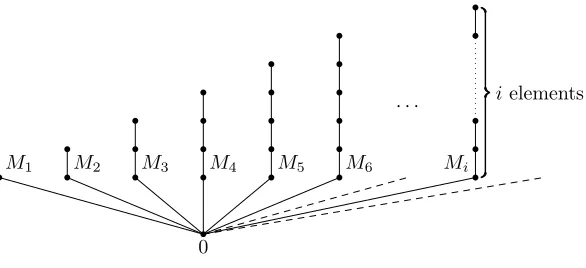
have a greatest lower bound under. ThusS is a semilattice. The Hasse diagram of (S,) is shown in Figure 1.
Proposition 5.1. The semilattice(S,)admits an automatic presentation.
Proof. LetL be the language
{z} ∪ {conv(i, j) :i, j ∈N, j≤i},
where the natural numbersiandjare understood to be expressed in reverse binary notation; an automaton can ensure that j does not exceed i. The mapφ:L→S is defined by
z7→0,
0
ielements
· · ·
[image:9.595.152.445.125.259.2]M1 M2 M3 M4 M5 M6 Mi
Figure 1: Hasse diagram for (S,)
Notice that the mappingφis injective; thus the equality relation is simply
L=={(w, w) :w∈L},
and is therefore regular. The order relation is
L={(z, w) :w∈L} (5.1)
∪ {(conv(i, j),conv(i, k)) :i, j, k ∈N, j ≤k≤i}. (5.2)
The relation (5.1) is clearly regular. Moreover, (5.2) is regular since an automaton can check that the first components on each input tape match, that the second components do not exceed the first, and that the second component on the first tape is less than the second component on the second tape.
Furthermore, (S,) has the following useful property:
Lemma 5.2. Let (T,◦) be a semigroup containing(S,◦) as a subsemigroup. Suppose that(L, φ)is an injective automatic presentation for(T,◦)and that
J = (S− {0})φ−1 is a regular language. Then, for any word u ∈ J with uφ∈Mi (for some i∈N), the setHu =Miφ−1 can be effectively computed,
and so the indexi=|Mi|=|Hu|can also be computed.
Proof. The first-order formula
(uφumaxφ)∧(∀w∈J) (uφwφ) =⇒ (wφumaxφ)
is satisfied (inJ) by the unique wordumax such thatumaxφis the maximum
element ofMi; thus this wordumax can be effectively computed.
Construct the language
Hu ={w∈J :wφumaxφ};
6
Finite Rees index subsemigroups and extensions
The Rees index of a subsemigroupT of a semigroupSis defined to be|S−T|. If the Rees index ofT inS is finite, thenT is alarge subsemigroupofSand
S is a small extension of T. Many properties of semigroups are preserved on passing to small extensions and large subsemigroups: for example, finite generation [8], finite presentability [17], and automaticity [13]. Generally, the proofs of these results for passing to small extensions are easy, and the proofs for passing to large subsemigroups are hard. [For example, the proof of the preservation of finite presentability on passing to small extensions [17, Theorem 4.1] is about twenty lines long; the proof for passing to large subsemigroups is over ten pages long [17, p. 388–398] and very technical (a gap in the original proof is fixed in [12]).] In contrast to this is the situation for automatic presentations: the present section exhibits an easy proof of the preservation of FA-presentability on passing to large subsemigroups, and an example to show that FA-presentability is not, in general, closed under passing to small extensions.
Proposition 6.1. Let S be a semigroup with a subsemigroup T of finite Rees index. ThenT admits an automatic presentation if S does.
Proof. Let (L, φ) be an injective automatic presentation forS. LetXbe the finite set{w∈L:wφ∈S−T}. ThenK =L−X is regular andKφ=T. Now, K= = L=∩(K ×K) and K◦ = L◦∩(K ×K), so K= and K◦ are
regular. Thus (K, φ|K) is an automatic presentation for T.
Let (S,) be the semilattice from Section 5. Let Y be a non-recursively enumerable subset ofN. Let P be the setS∪ {e}, and extend the relation to P by defining
0e,
mi,j e for alli∈Y andj∈Nwithj ≤i.
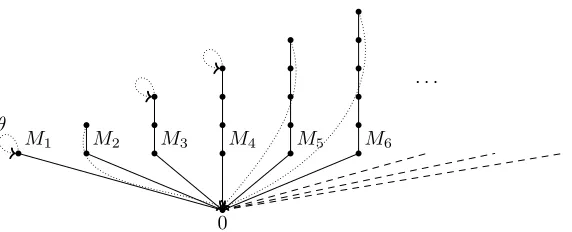
The relation is is a partial order on P and (P,) is again a semilattice. The Hasse diagram of (P,) is similar to that of (S,): the only difference is that there is a new elementewhich is above those subchainsMifori∈Y;
see Figure 2.
Proposition 6.2. The semilattice (P,) does not admit an automatic pre-sentation.
Proof. Suppose, with the aim of obtaining a contradiction, that (P,) has an automatic presentation (L, φ); without loss of generality, suppose that this automatic presentation is injective. Then it is possible to enumerateY
as follows. Letz∈Lrepresent 0; letf ∈Lrepresente. LetK=L− {f, z}.
0 e
· · ·
[image:11.595.162.436.124.275.2]M1 M2 M3 M4 M5 M6
Figure 2: Hasse diagram for (P,), assuming (for the sake of illustration) that 2, 5, and 6 are inY.
2. For each enumerated word u ∈ K, use Lemma 5.2 to construct Hu
and so obtaini=|Mi|=|Hu|withuφ∈Mi.
3. Now,
i∈Y ⇐⇒ (uφ)≺(f φ).
This first-order condition can be checked: output i if the condition holds.
Now, (P,) is a finite Rees index extension of (S,), but the latter is FA-presentable while the former is not. This establishes the following result:
Proposition 6.3. The class of FA-presentable semigroups is not closed un-der finite Rees index extensions; indeed, it is not closed unun-der extensions of index1.
However, the class of FA-presentable semigroups is closed under form-ing two special types of finite Rees index extension: adjoinform-ing a zero and adjoining an identity:
Proposition 6.4. Let S be a semigroup. Then:
1. S is FA-presentable if and only ifS0 is FA-presentable.
2. S is FA-presentable if and only ifS1 is FA-presentable.
Proof. SupposeSadmits an automatic presentation (L, φ). LetL′=L∪{z}
where z is a new symbol and extend φ to φ′ : L′ → S0 by letting zφ= 0.
ThenL′ is regular sinceL is regular and L′φ=S0. Furthermore,
L′
is regular since L◦ is regular. So (L′, φ′) is an automatic presentation for
S0.
IfS0 admits an automatic presentation, then so does its finite Rees index
subsemigroupS.
The reasoning for S1 is similar.
7
Finitely generated Clifford semigroups
The aim of the present section is to characterize those finitely generated Clifford semigroups that admit automatic presentations. Clifford semigroups are a standard notion in semigroup theory, being a species of semigroups that are ‘close’ to being groups. They admit several equivalent definitions [14, Theorem 4.2.1]. For the purposes of this section, it is best to consider a Clifford semigroup as a particular type of strong semilattice of groups. Recall the definition of the more general concept of a strong semilattice of semigroups:
Definition 7.1. Let Y be a semilattice. For each α ∈ Y, let Sα be a
semigroup. For α≥β, let φα,β:Sα →Sβ be a homomorphism such that
1. For each α∈Y, the homomorphismφα,α is the identity mapping.
2. For all α, β, γ ∈Y withα≥β ≥γ,
φα,βφβ,γ =φα,γ.
Thestrong semilattice of semigroups S=S[Y;Sα;φα,β] consists of the
dis-joint unionSα∈Y Sαwith the following multiplication: ifx∈Sα andy∈Sβ,
then
xy= (xφα,α∧β)(yφβ,α∧β),
whereα∧β denotes the greatest lower bound of α andβ.
The definition of a Clifford semigroup is now easy:
Definition 7.2. AClifford semigroupis a strong semilattice ofgroups: that is, a semigroup S[Y;Gα;φα,β], where eachGα is a group.
[For further information on Clifford semigroups, see [14, Chapter 4].]
Proposition 7.3. Let S = S[Y;Gα;φα,β] be an FA-presentable Clifford
semigroup. Then the semilatticeY and all the groupsMαare FA-presentable.
Proof. Let (L, φ) be an injective automatic presentation forS. Let
this set, being first-order definable, is regular. By definition,Eφis the set of idempotents in S — the identities of the groupsGα — which is isomorphic
to the semilattice Y. The multiplication in Eφ is simply the restriction of the multiplication inS, so the relation
E◦=L◦∩(E×E)
is regular. So (E, φ|E) is an automatic presentation forY.
Choose any groupGα with identity 1α. The elements ofGα are precisely
those elementsxofS such that (1) 1αacts as an identity onx and (2) there
is no idempotent e with e < 1α (in the semilattice Eφ) such that e acts
as an identity on x. Thus, the subset of L representing elements of Gα is
precisely
K =u∈L: (uφ)1α = 1α(uφ) =uφ
∧(∀v∈E) (vφ≤1α)∧((uφ)(vφ) = (vφ)(uφ) =uφ)
=⇒ (1α =vφ) .
So (K, φ|K) is an automatic presentation for Gα.
Corollary 7.4. Let S=S[Y;Gα;φα,β]be an FA-presentable finitely
gener-ated Clifford semigroup. ThenY is finite and every Gα is virtually abelian.
Proof. SinceSis finitely generated, the semilatticeY, being a homomorphic image of S, must also finitely generated. Any finitely generated semilattice is finite; thus Y is finite.
Choose any one of the groups Gα. By Proposition 7.3, Gα is
FA-presentable. Choose a finite generating set X for S, and let X′ be those
elements ofXlying in groups Gβ withβ ≥α. ThenGα is finitely generated
by the images of the elements ofX′ under the various homomorphismsφ
β,α.
Thus, by Theorem 2.8, Gα is virtually abelian.
Proposition 7.5. LetG1, . . . , Gnbe finitely generated virtually abelian groups.
Then there is a finite-index normal abelian subgroup Hi ≃ Zni (for some
ni∈N∪ {0}) of eachGi such that, ifφ:Gi →Gj is a homomorphism, then
Hiφ⊆Hj.
Proof. Each group Gi has an index-ki normal abelian subgroup Ji
isomor-phic to Zn′i for some n′
i ∈N∪ {0}. Let K be the least common multiple of
the exponents of the various factor groups Gi/Ji. Let Hi be the subgroup
ofGi generated by{xK :x∈Gi}. By the choice ofK, every elementxK of
Gi lies in Ji. So Hi is a subgroup ofJi and so isomorphic to Zni for some
ni ∈ N∪ {0}. Furthemore, the factor group Ji/Hi is a finitely generated
abelian group of finite exponent and is therefore finite. So the index of Hi
Now, letφ:Gi →Gj be a homomorphism. Any K-th power inGi must
be mapped to aK-th power inGj, so the subgroup ofGi generated byK-th
powers — namelyHi— must be mapped into the subgroup ofGj generated
by K-th powers — namely Hj. Finally, each Hi is normal in Gi since it is
generated by all theK-th powers.
Proposition 7.6. Let S = S[Y;Gα;φα,β] be a finitely generated Clifford
semigroup where each group Gα is virtually abelian. Then S admits an
automatic presentation.
Proof. Since S is finitely generated, the semilattice Y must be finite. By Proposition 7.5, one can view each groupGα as having a finite-index
normal abelian subgroupHα ≃Znα such that for allα, β ∈Y with α≥β,
Hαφα,β ⊆Hβ.
For each α∈Y, choose a set of representativesgα,1, . . . , gα,lα for each of
the cosets ofHα inGα. Define the language
Lα={gα,iconv(ǫ1z1, . . . , ǫnznα) :i= 1, . . . , lα, ǫi ∈ {+,−}, zj ∈N∪ {0}},
where the various zi are understood to be in reverse binary notation. The
languageLα, being a finite union of regular languages, is itself regular. The
virtually abelian group Gα admits Lα as an automatic presentation. Let
L=Sα∈Y Lα. The aim is to show thatL is an automatic presentation for
S.
The first task is to show that the homomorphisms φα,β are all regular
(that is, the relationsφα,β are regular as relations). Now,φα,βis determined
by the images of the variousgα,i and the elements (1,0, . . . ,0), (0,1, . . . ,0),
. . . , (0, . . . ,0,1). Suppose that, for i= 1, . . . , lα,
gα,iφα,β =gβ,ji(zβ,i,1, . . . , zβ,i,nβ)
and
(. . . ,0,1,0, . . .)
| {z }
i-th coordinate is 1
φα,β = (yβ,i,1, . . . , yβ,i,nβ).
(Recall thatHαφα,β ⊆Hβ.)
So
(gα,i(z1, . . . , znα))φα,β
=gβ,ji
(zβ,i,1, . . . , zβ,i,nβ) +
nα
X
j=1
zj(yβ,j,1, . . . , yβ,j,nβ)
That is,
φα,β=
n
(gα,i(z1, . . . , znα), gβ,ji(x1, . . . , xnβ)) :i∈ {1, . . . , lα},
(Z,+)|=
(x1=zβ,i,1+
nα
X
j=1
zjyβ,j,1)∧
(x2=zβ,i,2+
nα
X
j=1
zjyβ,j,2)∧
.. .
(xnβ =zβ,i,nβ +
nα
X
j=1
zjyβ,j,nβ)
o
,
wherezjyβ,j,h is understood to be an abbreviation for
zj+. . .+zj
| {z }
yβ,j,htimes
.
By Proposition 2.7, the relation φα,β is regular.
Define
Mα,β={(u, v, w) :u∈Lα, v ∈Lβ, w ∈Lα∧β,
(∃u′, v′ ∈Lα∧β) (u, u′)∈φα,α∧β,
(v, v′)∈φ
β,α∧β,(u′, v′, w)∈(Lα∧β)◦
}.
This language is regular and describes the multiplication of elements inGα
and Gβ. Finally, let
M = [
α,β∈Y
Mα,β.
By the definition of a Clifford semigroup, the regular relation M de-scribes multiplication inS. This completes the proof.
From Corollary 7.4 and Proposition 7.6 follows immediately the char-acterization of those finitely generated Clifford semigroups admitting auto-matic presentations:
Theorem 7.7. Let S =S[Y;Gα;φα,β]be a finitely generated Clifford
semi-group. Then S admits an automatic presentation if and only if each group
Gα is virtually abelian.
0α
0β
· · ·
Mα
1 M2α M3α M4α M5α M6α
· · ·
M1β M β
2 M
β
3 M
β
4 M
β
5 M
β 6
[image:16.595.151.443.121.353.2]φ φ
Figure 3: Schematic diagram of the semigroupT =S[Y;Sα;φα,β], assuming
(for the sake of illustration) that 2, 5, and 6 are in X. The dotted lines indicate the mappingφα,β.
Example 7.8. Let Y ={α, β} be the two-element semilattice withβ < α. LetSα andSβ be two copies of the semilattice from Section 5. (Distinguish
elements and subsets of these two semilattices using superscript symbolsα
orβ, as appropriate.) LetX be a non-recursively enumerable subset of the natural numbers. Define the mappingφα,β by
0α7→0β
mαi,j7→
(
0β ifi∈X
mβi,j ifi /∈X
)
fori, j∈Nwith j≤i.
The mapping φα,β is a homomorphism. Let T be the strong semilattice of
semigroups S[Y;Sα;φα,β]; see Figure 3 for a schematic diagram ofT.
Forreductio ad absurdum, suppose thatT admits an automatic presenta-tion (L, φ). Without loss of generality, assume (L, φ) is injective. Lety∈L
be such thatyφ= 0α. Let
K′ ={w∈L: (wφ)(yφ) = (yφ)};
thenK′ is regular and K′=S
αφ−1. Let J =L−K′; thenJ =Sβφ−1. Let
z ∈ J be such that zφ = 0β. Let K = K′− {y}. So J and K are both
regular.
1. Fix an effective enumeration of K.
2. For each enumerated word u ∈ K, use Lemma 5.2 to construct Hu
and so obtaini=|Mi|=|Hu|withuφ∈Mi.
3. Now,
i∈X ⇐⇒ (uφ)φα,β = 0β ⇐⇒ (∀v∈J) (vφ)(uφ) = (zφ).
This first-order condition can be checked: output i if the condition holds.
8
Completely simple & completely
0
-simple
semi-groups
Definition 8.1. LetS be a semigroup,I and Λ be index sets, and P be a Λ×I matrix over S ∪ {0} whose λ, i-th element is pλ,i. The Rees matrix
semigroup M0[S;I,Λ;P] is defined to be the set (I ×S ×Λ)∪ {0} with multiplication
(i, g, λ)(j, h, µ) = (
(i, gpλ,jh, µ) ifpλ,j 6= 0,
0 ifpλ,j = 0,
and
(i, g, λ)0 = 0(i, g, λ) = 00 = 0.
Now restrictPto be a matrix overS. The Rees matrix semigroupM[S;I,Λ;P] is defined to be the set I×S×Λ with multiplication
(i, g, λ)(j, h, µ) = (i, gpλ,jh, µ).
Recall that a semigroup is completely 0-simple if it has no proper two-sided ideals, is not the two-element null semigroup, and contains a primi-tive idempotent (that is, an idempotente such that, for all idempotentsf,
ef =f e=f =⇒ e=f). The celebrated Rees theorem [14, Section 3.2] as-serts that all completely 0-simple semigroups are isomorphic to a semigroup
M0[G;I,Λ;P], whereGis a group and I and Λ are finite sets.
Proposition 8.2. Let G be a group. If the completely 0-simple semigroup
M0[G;I,Λ;P] is FA-presentable, then the group G is FA-presentable.
Proof. Choose a word w∈Lsuch thatwφis idempotent. Then theH-class containing wφ is manifestly non-null and so isomorphic to G [14, Propo-sition 2.3.6]. Let Q be the subset of L consisting of words representing elements that are H-related to wφ; since Green’s relations are first-order definable, the language Q is regular. Therefore (Q, φ|Q) is an automatic
presentation for theH-class containing wφ, which is isomorphic toG. SoG
Corollary 8.3. Let G be a group. If the completely simple semigroup
M[G;I,Λ;P] is FA-presentable, then the group G is FA-presentable.
Proof. Let S =M[G;I,Λ;P]. ThenS0 ≃ M0[G;I,Λ;P]. Now, since S is FA-presentable, thenS0 is FA-presentable (by Proposition 6.4), and soGis FA-presentable (by Proposition 8.2).
Corollary 8.3 no longer holds if one generalizes to Rees matrix semigroups over arbitrary base semigroups. To see this, let X be a finite alphabet and let F be the free semigroup over X. By Theorem 2.9, the semigroup
F is not FA-presentable, since it does not have polynomial growth. Let
T =M[F0, I,Λ, P], whereI and Λ are arbitrary finite sets and every entry
of the matrixP is 0. Every product inT is therefore an element of the form (i,0, λ). Let
L={iλw:i∈I, λ∈Λ, w∈F0}
(allowing a slight abuse of notation in viewingF0 as both a semigroup and
a set of words) and define φ:L →T by (iλw)φ= (i, w, λ). Then (L, φ) is an automatic presentation forT, since
L=={(u, u) :i∈L},
and
L◦ ={(iλu, jµv, iµ0) :i, j∈I, λ, µ∈Λ, u, v∈F}
={(iλ, jµ, iµ)}{(u, v,0) :u, v ∈F},
which is regular since it is the concatenation of a finite relation and one that is manifestly regular. SoT is FA-presentable, but the underlying semigroup
F0 is not.
Proposition 8.4 ([1]). The completely 0-simple semigroup M0[G;I,Λ;P]
is finitely generated if and only if the group G is finitely generated and the sets I and Λ are finite.
Proposition 8.5. LetG be FA-presentable and letI andΛ be finite. Then, for any Λ×I matrix P over G0, the Rees matrix semigroup M0[G;I,Λ;P]
is FA-presentable.
Proof. Let (L, φ) be an automatic presentation forG. Let
K={iλw:i∈I, λ∈Λ, w∈L} ∪ {z},
and letψ:K → M0[G;I,Λ;P] be defined by
The aim is now to show that (K, ψ) is an automatic presentation for the semigroupM0[G;I,Λ;P]. The equality relation is
K=={(iλu, iλv) :i∈I, λ∈Λ,(u, v)∈L=} ∪ {(z, z)},
which is regular sinceL= is regular. Now fix λ∈Λ and j ∈I and observe
that the relation
Kλ,j
◦ ={(iλu, jµv, iµw) :i∈I, µ∈Λ, u, v, w ∈L,(uφ)pλ,j(vφ) =wφ}
∪ {(iλu, jµv, z) :i∈I, µ∈Λ, u, v∈L, pλ,j = 0},
being first-order definable in terms ofL◦, is regular. So the relation
K◦ ={(z, z, z),(z, iλu, z),(iλu, z, z) :u∈L} ∪
[
λ∈Λ
j∈I
K◦λ,j
is regular.
Theorem 8.6. A finitely generated completely0-simple semigroupM0[G;I,Λ;P]
is FA-presentable if and only if the group G is virtually abelian.
Proof. LetS =M0[G;I,Λ;P].
Suppose S is FA-presentable. Then by Proposition 8.2, the group G is FA-presentable. The semigroupS is finitely generated, and so, by Proposi-tion 8.4, the groupGis also finitely generated. Therefore, by Theorem 2.8,
Gis virtually abelian.
For the converse, suppose G is virtually abelian. Since S is finitely generated, Gis also, and so by Theorem 2.8, Gis FA-presentable. Thus, by Proposition 8.5, the semigroupS is FA-presentable.
Corollary 8.7. A finitely generated completely simple semigroupM[G;I,Λ;P]
has an automatic presentation if and only if the groupGis virtually abelian.
Proof. Let S =M[G;I,Λ;P]. Then S0 =M0[G;I,Λ;P]. Now, S admits
an automatic presentation if and only ifS0admits an automatic presentation
(by Proposition 6.4) if and only ifG is virtually abelian.
Corollary 8.7 parallels an established result for automatic completely simple semigroups: if S is a finitely generated completely simple semigroup
9
Bruck–Reilly extensions
This section shows that if a Bruck–Reilly extension admits an automatic pre-sentation, then so does its base semigroup (Proposition 9.2). An example is then exhibited to show that a Bruck–Reilly extension of an FA-presentable semigroup need not be FA-presentable (Example 9.3). This parallels the situation for automatic (in the sense of [11, 9]) semigroups: the first author proved that an automatic Bruck–Reilly extension has an automatic underly-ing semigroup [5, Theorem 3.3], and that the class of automatic semigroups is not closed under forming Bruck–Reilly extensions [5, Theorem 5.2].
Definition 9.1. Let S be a monoid and let θ be an endomorphism of S. TheBruck–Reilly extension BR(S, θ) is the semigroup
(N∪ {0})×SI×(N∪ {0})
(whereSI isSwith an identity adjoined unless one is already present), with
the multiplication
(m, s, n)(p, t, q) = (
(m, s(tθn−p), q+n−p) ifn≥p,
(m+p−n,(sθp−n)t, q) ifn≤p.
If S is presented by hA| Ri, then the Bruck–Reilly extension BR(S, θ) is presented by
hA∪ {b, c} | R,(bc,1),(ba,(aθ)b),(ac, c(aθ)) :a∈Ai. (9.1)
Every element of BR(S, θ) can be expressed as a word of the form cγwbβ
wherew∈A∗ and γ, β∈N∪ {0}. Furthermore, the exponents γ and β are
uniquely determined.
Proposition 9.2. Let S be a semigroup and θ an endomorphism of S. Suppose BR(S, θ) admits an automatic presentation. Then S admits an automatic presentation.
Proof. Let (L, φ) be an automatic presentation for BR(S, θ). Let u, v ∈ L
be such thatuφ=bandvφ=c. (The elements bandcare as in (9.1).) Let
Dbe the set of words in Lrepresenting right multiples of c. Since
D={w∈L: (∃p∈L)((v, p, w)∈L◦)},
the setDis regular. Similarly, the setGof words representing left multiples of b is regular. The elements of S are precisely those elements of BR(S, θ) that are neither right multiples of c nor left multiples of b. So (L−(D∪ G))φ=S. Therefore (L−(D∪G), φ|L−(D∪G)) is an automatic presentation
0
· · ·
[image:21.595.157.443.123.239.2]M1 M2 M3 M4 M5 M6 θ
Figure 4: Schematic diagram of the Bruck–Reilly extension BR(S, θ), as-suming (for the sake of illustration) that 2, 5, and 6 are inY.
Example 9.3. Let (S,) be the semilattice from Section 5. Let Y be a non-recursively enumerable subset of the natural numbers. Defineθ:S →S
by
07→0
mi,j 7→
0 if i∈Y mi,j if i /∈Y
fori, j∈N withj≤i.
It is easy to see thatθis an endomorphism of the semilattice (S,). Suppose BR(S, θ) admits an automatic presentation (L, φ); without loss of generality, suppose that this automatic presentation is injective. Then it is possible to enumerate Y as follows. Construct the subset K′ of L with
K′φ = S; by the proof of the preceding result, K′ is regular. Let z ∈ K′
represent 0; letK =K′− {z}
1. Fix an effective enumeration of the regular language K.
2. For each enumerated word u ∈ K, use Lemma 5.2 to construct Hu
and so obtaini=|Mi|=|Hu|withuφ∈Mi.
3. Now,
i∈Y ⇐⇒ (uφ)θ= 0 ⇐⇒ b(uφ)c= 0.
(The elements b and c are as in (9.1).) This first-order condition can be checked: outputiif the condition holds.
This procedure enumeratesY. This is a contradiction, so BR(S, θ) does not admit an automatic presentation.
10
Zero-direct unions
For each i ∈ I, let Si be a semigroup with a zero 0i. Their zero-direct
their zeroes, and defining the products ∈ Si and t ∈Sj to be this zero if
i6=j, orst∈Si ifi=j.
The class of FA-presentable semigroups is closed under forming finite zero-direct unions:
Proposition 10.1. Let SandT be semigroups with zeroes and suppose both are FA-presentable. Then their zero-direct union also admits an automatic presentation.
Proof. Let (L, φ) and (M, ψ) be injective automatic presentations forS and
T respectively, with L and M being disjoint. Let x ∈ L and y ∈ M be the representatives of the zeroes of S and T respectively. Let K =L∪M. Defineθfrom K to the zero-direct union ofS andT by wθ=wφforw∈L
and wθ =wψ for w∈ M. To see that (K, θ) is an automatic presentation for the zero-direct union ofS and T, reason as follows: the equality relation is
K= ={(x, y),(y, x)} ∪ {(w, w) :w∈K},
which is manifestly regular, and the multiplication relation is
K◦ =L◦∪M◦
∪ {(u, v, y) : (u, v, x) ∈L◦} ∪ {(u, v, x) : (u, v, y)∈M◦}
∪ {(u, v, x),(u, v, y),(v, u, x),(v, u, y) :u∈L, v∈M},
which is easily seen to be regular sinceL◦,M◦,L, andM are all regular.
However, the converse does not hold: the FA-presentability of a zero-direct union does not imply the FA-presentability of the original semigroups:
Example 10.2. Let S be the semilattice from Section 5. Let Y be a non-recursively enumerable subset of the natural numbers. Let
T ={z} ∪ [
i∈Y
Mi and U ={z} ∪
[
i∈N−Y
Mi.
ThenS is the zero-direct union ofT andU, each of which is the zero-direct union of countably many subsemilattices Mi∪ {z} (each of which is finite
and thus FA-presentable).
SupposeT admits an injective automatic presentation (L, φ). Then it is possible to enumerate Y as follows. Let z∈L represent the zero of T. Let
K=L− {z}.
As in the proof of Proposition 5.2, fix an effective enumeration ofK. For each enumerated word w ∈ K (lying in some Mi), construct H ⊆ L with
Hφ= Mi. The language H is finite and its cardinality is i; output this i.
Thus T is a non-FA-presentable semigroup that forms a component of an FA-presentable zero-direct unionS.
In the preceding example, T is a non-FA-presentable countable zero-direct union of FA-presentable semigroups Mi ∪ {z}. Thus the class of
FA-presentable semigroups is not closed under countable zero-direct unions. However, it is closed under countable zero-direct unions ofisomorphic semi-groups:
Proposition 10.3. Let S be a semigroup with a zero that admits an au-tomatic presentation. Let Si be isomorphic to S for all i ∈ N. Then the
zero-direct union of the Si admits an automatic presentation.
Proof. Let T be the zero-direct union of the Si. Let (L, φ) be an injective
automatic presentation forS; lety ∈Lbe such thatyφis the zero ofS. Let
K be the language
{conv(u, i) :u∈L, i∈N},
where i is in reverse binary notation. Observe that K is regular. Define
ψ:K→T by letting (conv(u, i))ψ be the element uφ lying inSi. Then
K=={(conv(y, i),conv(y, j)) :i, j∈N} ∪ {(w, w) :w∈K}
and
K◦={(conv(u, i),conv(v, i),conv(w, i)) : (u, v, w)∈L◦, u, v, w∈L− {y}, i∈N} ∪ {(conv(u, i),conv(v, i),conv(y, j)) : (u, v, y) ∈L◦, i, j ∈N}
∪ {(conv(u, i),conv(v, j),conv(y, k)) :i, j, k∈N, i6=j},
both of which are easily seen to be regular since L◦ is regular and the
equality of natural numbers in reverse binary notation can be checked by a finite state automaton.
11
Semidirect and wreath products
Let S and T be monoids. Denote by S⊕T the set of functions from T to
S with finite support (that is, where only finitely many elements of T have non-identity image in S). The [restricted] wreath product S≀T of monoids
S and T is the setS⊕T ×T under the operation
(f, t)(g, t′) = (f gt, tt′),forf, g :T →S and t, t′ ∈T,
wheregt:T → S is defined by (x)gt= (xt)g and f gt:T →S by (x)f gt=
Proposition 11.1. Let S be FA-presentable and let T be finite. ThenS≀T
is FA-presentable.
Proof. Suppose T ={t1, . . . , tk}. Let (L, φ) be an injective automatic
pre-sentation forS. Let
M =T{conv(u1, . . . , uk) :ui ∈L},
where T is treated as an abstract set of symbols. Observe that M is a concatenation of a finite language and a regular language and is thus itself regular. Defineψ:M →S≀T by
tconv(u1, . . . , uk)7→(f, t),
wheref :T →S is defined by ti7→uiφ.
To see that (M, ψ) is an automatic presentation for S≀T, note first that every element ofS≀T has a unique representative inM (sinceφis injective). Now consider the automaton reading a triple
(tconv(u1· · ·uk), t′conv(v1, . . . , vk), sconv(w1, . . . , wk))
to check whether it lies inM◦. First of all, the automaton checks thats=tt′.
Then, for each i ∈ {1, . . . , k}, it finds j such thattjt= ti and checks that
(ui, vj, wi) ∈ L◦. (That this is possible inside a finite automaton is due to
the finiteness of T.)
On the other hand, ifSis finite andT FA-presentable, thenS≀Tneed not be FA-presentable. For example, let S={1, c} be the cyclic group of order 2. Define mappingsf, g :Z→ S by zf = 1 for all z∈Zand by 0g=cand zg= 1 for z∈Z− {0}. Then the subsemigroup of S≀Zgenerated by (f,1)
and (g,1) is free, and so, by Theorem 2.9, S≀Zcannot be FA-presentable.
The following example shows that class of FA-presentable semigroups is not closed under forming semidirect products, even if the top semigroup is finite.
Example 11.2. Let (S,) be the semilattice from Section 5 and let θ :
S → S be the endomorphism defined using a non-recursively enumerable subset Y of N in Example 9.3. Let X = {id, θ}, where id is the identity
mapping on S. Then X is a subsemigroup of EndS, since θ2 = θ. Let T
be the semidirect product X⋉S, where X acts on S (from the right) in
the obvious manner. Identify S with the subsemigroup of T consisting of elements of the form [id, s] for some s∈S.
SupposeT admits an injective automatic presentation (L, φ). Letz, z′ ∈
Lbe such that zφ= [id,0] andz′φ= [θ,0]. Let
K′ ={w∈L: (wφ)(zφ) = (zφ)};
thenK′φ=S. LetK =K′− {z}. Let J =L−K′. Observe thatK and J
1. Fix an effective enumeration of the regular language K.
2. For each enumerated word u ∈ K, use Lemma 5.2 to construct Hu
and so obtaini=|Mi|=|Hu|withuφ∈Mi.
3. Now,
i∈Y ⇐⇒ (uφ)θ= (zφ) ⇐⇒ (∀v∈J) (uφ)(vφ) = (zφ).
This first-order condition can be checked: output i if the condition holds.
This procedure enumeratesY. This is a contradiction, soT does not admit an automatic presentation.
[The semidirect product defined in the preceding example is actually isomorphic to the strong semilattice of semigroups defined in Example 7.8.] Since a finitely generated group is FA-presentable if and only if it is virtually abelian, the class of finitely generated FA-presentable groups is closed under semidirect products with finite groups. It remains open whether the class of all FA-presentable groups is closed under semidirect products with finite groups, or under finite extensions generally.
12
Ideals & quotients
Let S be a semigroup with an automatic presentation (L, φ). Let K be a regular (possibly finite) subset ofL. Then the ideal generated by Kφis the set of elements represented by the regular language
I(K) =w∈L: (∃p, q∈L)(∃u∈K) (pφ)(uφ)(qφ) = (wφ)
∨(∃p∈L)(∃u∈K) (pφ)(uφ) = (wφ)
∨(∃q∈L)(∃u∈K) (uφ)(qφ) = (wφ)
∨(∃u∈K) (uφ) = (wφ) .
One can therefore test membership of ideals generated by subsets described by regular languages. Furthermore, one can test whether such ideals are principal: simply check whether the regular language
v∈L: (∀w∈K) w∈I({v})
is non-empty.
Moreover, the quotient semigroup
0
M1’s
M2’s
M3’s
M4’s
M5’s
· · · ·
[image:26.595.142.454.124.244.2]· · · ·
Figure 5: Hasse diagram for the zero-direct union of countably many copies of (S,).
(where any product in S that lies in I(K)φ is taken to be 0) is also FA-presentable: let K= (L−I(K))∪ {z}, wherez is a new symbol. It is easy to see that the regularity ofK= and K◦ follows from that of L= and L◦.
The converse does not hold, however: the FA-presentability of a semi-groupT does not follow from the FA-presentability of an idealIofT and the quotient semigroup T /I. The counterexample is the semigroupT from Ex-ample 7.8, which is not FA-presentable, but which possesses an idealI =Sβ
such that bothI and T /I≃Sα0 are FA-presentable.
Furthermore, the class of FA-presentable semigroups is not closed under forming ideals: in Example 10.2,T is a non-presentable ideal of the FA-presentable semigroupS. Indeed, the following example shows that an ideal
I of a semigroupS may not be FA-presentable even when both S and S/I
are FA-presentable.
Example 12.1. Let (S,) be the semilattice from Section 5. Let Si be
isomorphic to S for each i ∈ N. Then the zero-direct union T of the Si
is FA-presentable by Proposition 10.3, and is isomorphic to the semilattice whose Hasse diagram is shown in Figure 5. Let Y be a non-recursively enumerable subset of the natural numbers. Let
I ={z} ∪ [
i∈Y
Mi,
where the subsets Mi lie in S1. Then I is an ideal of S that is not
FA-presentable, being isomorphic to the semigroup T of Example 10.2. Fur-thermore, the factor semigroup S/I is ismorphic toS itself: to obtain S/I
fromI, one simply deletes one of the [countably many] copies ofMi therein
for each i∈Y; it is clear that the result is isomorphic to S.
References
[1] H. Ayik and N. Ruˇskuc. Generators and relations of Rees matrix semi-groups. Proc. Edinburgh Math. Soc. (2), 42(3):481–495, 1999.
[2] A. Blumensath.Automatic Structures. Diploma thesis, RWTH Aachen, 1999.
[3] A. Blumensath. Axiomatising tree-interpretable structures. Theory Comput. Syst., 37(1):3–27, 2004. Symposium on Theoretical Aspects of Computer Science (Antibes-Juan les Pins, 2002).
[4] A. Blumensath and E. Gr¨adel. Finite presentations of infinite struc-tures: automata and interpretations. Theory Comput. Syst., 37(6):641– 674, 2004.
[5] A. J. Cain. Automatic semigroups and Bruck–Reilly extensions. Sub-mitted
[6] A. J. Cain, G. Oliver, N. Ruˇskuc, and R. M. Thomas. Automatic pre-sentations for cancellative semigroups. In C. Mart´ın-Vide, H. Fernau, and F. Otto, editors, Language and Automata Theory and Applica-tions: Second International Conference, Tarragona, Spain, March 13– 19, 2008, number 5196 in Lecture Notes in Computer Science, pages 149–159. Springer, 2008.
[7] A. J. Cain, G. Oliver, N. Ruˇskuc, and R. M. Thomas. Automatic presentations for semigroups. Inform. and Comput., 2009. To appear.
[8] C. M. Campbell, E. F. Robertson, N. Ruˇskuc, and R. M. Thomas. Reidemeister–Schreier type rewriting for semigroups. Semigroup Fo-rum, 51(1):47–62, 1995.
[9] C. M. Campbell, E. F. Robertson, N. Ruˇskuc, and R. M. Thomas. Automatic semigroups.Theoret. Comput. Sci., 250(1–2):365–391, 2001.
[10] C. M. Campbell, E. F. Robertson, N. Ruˇskuc, and R. M. Thomas. Au-tomatic completely simple semigroups. Acta Math. Hungar., 95(3):201– 215, 2002.
[11] D. B. A. Epstein, J. W. Cannon, D. F. Holt, S. V. F. Levy, M. S. Paterson, and W. P. Thurston. Word Processing in Groups. Jones & Bartlett, Boston, Mass., 1992.
[13] M. Hoffmann, R. M. Thomas, and N. Ruˇskuc. Automatic semigroups with subsemigroups of finite Rees index. Internat. J. Algebra Comput., 12(3):463–476, 2002.
[14] J. M. Howie. Fundamentals of Semigroup Theory, volume 12 of Lon-don Mathematical Society Monographs (New Series). Clarendon Press, Oxford University Press, New York, 1995.
[15] B. Khoussainov and A. Nerode. Automatic presentations of structures. In D. Leivant, editor,Logic and computational complexity (Indianapolis, IN, 1994), volume 960 of Lecture Notes in Computer Science, pages 367–392. Springer, Berlin, 1995.
[16] G. P. Oliver and R. M. Thomas. Automatic presentations for finitely generated groups. In V. Diekert and B. Durand, editors, 22nd Annual Symposium on Theoretical Aspects of Computer Science (STACS’05), Stuttgart, Germany, volume 3404 of Lecture Notes in Comput. Sci., pages 693–704, Berlin, 2005. Springer.
[17] N. Ruˇskuc. On large subsemigroups and finiteness conditions of semi-groups. Proc. London Math. Soc. (3), 76(2):383–405, 1998.

![Figure 3: Schematic diagram of the semigroup Tindicate the mapping = S[Y ; Sα; φα,β], assuming(for the sake of illustration) that 2, 5, and 6 are in X](https://thumb-us.123doks.com/thumbv2/123dok_us/8566244.367142/16.595.151.443.121.353/figure-schematic-diagram-semigroup-tindicate-mapping-assuming-illustration.webp)