Bayesian Word Alignment for Massively Parallel Texts
Robert ¨Ostling Department of Linguistics
Stockholm University
Abstract
There has been a great amount of work done in the field of bitext alignment, but the problem of aligning words in mas-sively parallel texts with hundreds or thou-sands of languages is largely unexplored. While the basic task is similar, there are also important differences in purpose, method and evaluation between the prob-lems. In this work, I present a non-parametric Bayesian model that can be used for simultaneous word alignment in massively parallel corpora. This method is evaluated on a corpus containing 1144 translations of the New Testament. 1 Introduction
Bitext word alignment is the problem of finding links between words given pairs of translated sen-tences (Tiedemann, 2011). Initially, this was mo-tivated by Statistical Machine Translation (SMT) applications (Brown et al., 1993), but word-aligned texts have also been used to transfer lin-guistic annotation between languages (Yarowsky et al., 2001; T¨ackstr¨om, 2013), for Word Sense Disambiguation (WSD) (Diab and Resnik, 2002) and lexicon extraction (Wu and Xia, 1994).
Massively parallel texts, in the sense used by Cysouw and W¨alchli (2007), are essentially the same as bitexts, only with hundreds or thousands of languages rather than just two. Parallel corpora used in SMT, for instance the Europarl Corpus (Koehn, 2005), tend to contain few (up to tens of) languages, but many (up to billions of) words in each language. Massively parallel corpora, on the other hand, contain many (hundreds of) languages, but usually fewer (less than a million) words in each language.
Additionally, aligned massively parallel corpora have different applications than traditional paral-lel corpora with pairwise alignments. Whereas the
latter tend to be used for the various NLP tasks mentioned above, massively parallel corpora have mostly been used for investigations in linguistic typology (Cysouw and W¨alchli, 2007).
There has been surprisingly few studies on mul-tilingual word alignment. Mayer and Cysouw (2012) treat alignment as a clustering problem, where the words in each sentence are clustered ac-cording to some measure of co-occurrence. They provide no evaluation, but alignment methods based on co-occurrence statistics have been found to have lower accuracy than even very simple gen-erative models (Och and Ney, 2003), so this might not be a promising direction as far as accuracy is concerned.
A related line of research is due to Lardilleux et al. (2011), who learn sets of multilingual trans-lation equivalent phrases. Although later work (Lardilleux et al., 2013) uses phrase pairs ex-tracted with this method for (bitext) word align-ment, their method solves a somewhat different problem from what is considered here.
Some authors have studied how multilingual parallel corpora can be used to improve bitext alignment. Filali and Bilmes (2005) use (bitext) alignments to addditional languages as features in bitext alignment, while Kumar et al. (2007) in-terpolate alignments through multiple bridge lan-guages to produce a bitext alignment for another language pair. Since the goal of this research is not multilingual alignment, it will not be consid-ered further here.
2 Multilingual Alignment
In bitext alignment, the goal is to find links be-tween individual word tokens in parallel sentence pairs. The IBM models (Brown et al., 1993) for-malize this in a directional fashion where each word j in a source languageis linked to word i
in thetarget languagethrough alignment variables
i = aj, thus specifying a 1-to-n mapping from
source language words to target language words. An intuitively appealing way to formalize the multilingual alignment problem is through a com-mon representation(orinterlingua) to which each individual language is aligned. If the common rep-resentation is isomorphic to one of the languages in the corpus, this is equivalent to using that lan-guage as a bridge. However, since all lanlan-guages (and all translations) have their own idiosyncrasies that make linking to other translations difficult, it seems better to learn a common representation that corresponds to information in a sentence that is present in as many of the translations as possible. 3 Method
Recently, it has been shown that Bayesian meth-ods that use priors to bias towards linguistically more plausible solutions can improve bitext word alignment (Mermer and Sarac¸lar, 2011; Riley and Gildea, 2012; Gal and Blunsom, 2013). Given these promising results and the fact that massively parallel texts tend to be rather short, which makes the role of realistic priors more important, I have decided to use a Bayesian alignment model for this work.
3.1 Model
The model used in this work uses a common rep-resentation of concepts generated by a Chinese Restaurant Process (CRP), which is aligned to each of the languages in a corpus using the model of Mermer and Sarac¸lar (2011).
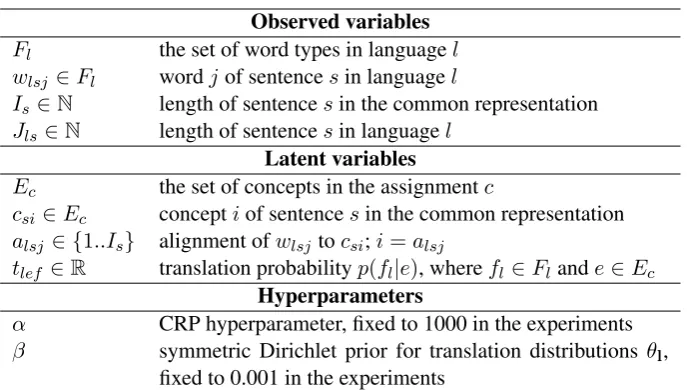
Table 1 introduces the variables (observed and latent) as well as the hyperparameters of the model. Basically, the model consists of a common representationc(where tokeniof sentencesis de-notedcsi), which is aligned to one or more words wlsj(from languagel, sentences, tokenj) through
a set of alignment variablesalsjwhich contain the
index withincsthatwlsj is linked to.
The probability of an assignmentcis:
CRP(c;α) = Γ (Γ (1 +n+αα))·α|Ec|−1· Y
e∈Ec
(ne−1)!
whereneis the number of occurrences of concept
typeein the assignmentc, andn =Pene is the
(fixed) total number of tokens in the common rep-resentation.
For the translation probabilities, I follow Mermer and Sarac¸lar (2011) in assuming that
p(fl|e) ∼ Dir(tl;θl), and that the priors θl are
symmetric (i.e. all values in these vectors are equal,θlef = β). By specifying a low value for β(asparseprior), we can encode our prior knowl-edge that translation probability functionsp(fl|e)
tend to have a low entropy, or in other words, that each concept is typically only translated into a very small number of words in each language.
The joint probability of the common represen-tation and the alignments is given by:
p(c, a, w, t;α, θ) =
p(c;α)·p(w|c, a, t)·p(a|c)·p(t;θ) (1) where p(c;α) = CRP(c;α) and the remaining factors are the same as in Mermer and Sarac¸lar (2011) with the common representation being the “target language”, except that there is a product across all languagesl. Note that since word order is not modeled,p(a|c)is constant.
3.2 Learning
The model is trained using a collapsed Gibbs sam-pler. Due to space limitations, the full derivation is omitted, but the sampling distribution turns out to be as follows for the common representation:
p(csi =e0)∝ n−11 +α ·
(
α ifne0 = 1
ne0−1 ifne0 >1
·Y
l
Q
f∈AlsiQmlsifk=1 nle0f +θle0f −k
QP
fmlsif
k=1 Pf∈Flnle0f +θle0f −k
(2) whereAlsiis the set of word typesf in languagel
which are aligned tocsi, andmlsif is the number
of times each suchf is aligned tocsi. In order to
speed up calculations, the product in Equation 2 can be approximated by lettinglrun over a small random subset of languages. The experiments car-ried out in this work only use this approximation when the full corpus of 1144 translations is used, then a subset of 24 languages is randomly selected when each csi is sampled. An empirical
evalua-tion of the effects of this approximaevalua-tion is left for future work.
The alignment sampling distribution is:
p(alsj =i)∝ Pnle0f0+θle0f0−1
f nle0f+θle0f−1 (3)
where e0 = cs
alsj is the concept type aligned to
word typef0=wlsj.
Table 1: Variables used in the model.
Observed variables
Fl the set of word types in languagel wlsj ∈Fl wordjof sentencesin languagel
Is∈N length of sentencesin the common representation Jls∈N length of sentencesin languagel
Latent variables
Ec the set of concepts in the assignmentc
csi∈Ec conceptiof sentencesin the common representation alsj ∈ {1..Is} alignment ofwlsjtocsi;i=alsj
tlef ∈R translation probabilityp(fl|e), wherefl∈Flande∈Ec
Hyperparameters
α CRP hyperparameter, fixed to 1000 in the experiments
β symmetric Dirichlet prior for translation distributions θl,
fixed to 0.001 in the experiments
p(csi = e0)λ and pˆ(alsj = i) ∝ p(alsj = i)λ.
The temperature parameter λcan be varied dur-ing traindur-ing to change the amount of randomness while sampling.
3.3 Initialization
In order to obtain a reasonable initial state for the Gibbs sampling, one can simply initialize the com-mon representation to be identical to one of the languages in the corpus. For this language one then (trivially) has a perfect alignment, while the remaining languages are initialized randomly and their alignments are learned. Random initializa-tion of the common representainitializa-tion is possible, but turns out to perform poorly.
4 Experiments
The most basic question about the present model is whether sampling the common representation is helpful, compared to simply choosing a language and aligning all other languages to that one.
In order to test this, I initialize the model as de-scribed in section 3.3 and sample alignments (but not the common representation) for 200 iterations withλlinearly increasing from 0 to 2, followed by two iterations with λ → ∞. This gives a strong baseline, from which one can start learning the joint model.
4.1 Data
I use a corpus containing verse-aligned transla-tions of the New Testament into a great number of languages. After some exclusions due to e.g. non-standard formatting or improperly segmented text,
the version used in this work contains 1144 trans-lations in 986 different languages. The mean num-ber of tokens among the translations is 236 000, and the mean number of types is 9 500.
4.2 Evaluation Measures
Previous authors have tended to avoid multilingual evaluation altogether. Mayer and Cysouw (2012) do not evaluate their method, while Lardilleux et al. (2011) only use bilingual evaluation.
Cysouw et al. (2007) use the fact that some translations of the Bible have been annotated with Strong’s Numbers, which map most word tokens to the lemma of its translation equivalent in the original language, to perform bilingual evaluation of Bible corpus alignments.
Strong’s Numbers can be used in a different way to evaluate the type of multilingual alignment produced by the method in this work. Both the Strong’s Numbers and the common representation can be interpreted as clusterings of the word to-kens in each language. Ideally one would want these two clusterings to be identical, as they would be if the original language had been perfectly con-structed. Standard clustering evaluation measures can be used for this task, and in this work I use normalized mutual information (also reinvented as
mea-0 200 400 600 800 1000 Iterations
0.68 0.70 0.72 0.74 0.76 0.78 0.80
Normalized Mutual Information
deu eng eng
fra
ind ind nld
[image:4.595.313.506.63.208.2]por rus
Figure 1: Alignment quality of Mandarin-initialized model.
sure, only a successful reconstruction of the origi-nal text (minus inflections) would.
In the Bible corpus used here, nine translations in seven languages contain Strong’s Numbers an-notations: English and Indonesian (two transla-tions each), as well as German, French, Dutch, Portuguese and Russian (one translation each).
4.3 Results
Figure 1 shows alignment quality during training in a model initialized using a translation in Man-darin, which is not related to any of the languages in the evaluation sample and was chosen to avoid initialization bias. After an initial drop when noise is introduced during the Gibbs sampling process, alignment quality quickly increases as the com-mon representation moves towards the versions in the evaluation sample. The final two iterations (withλ→ ∞) remove the sampling noise and the model rapidly converges to a local maximum, re-sulting in a sharp increase in alignment quality at the end. Further iterations only result in minor im-provements.
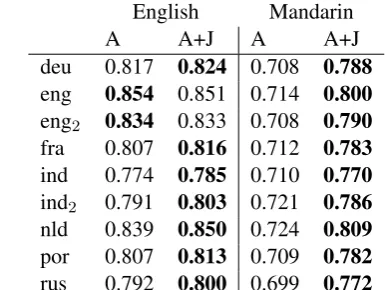
Table 2 contains the baseline and joint model re-sults for models initialized with either English or Mandarin versions. The joint model outperforms the baseline in all cases except when the initial-ization language is the same as the evaluation lan-guage (the two English translations in the left col-umn), which is expected since it is easy to align a text to itself or to a very similar version.
The two models described so far only use the nine-translation evaluation sample to learn the common representation, since using additional languages would unfairly penalize the joint
learn-English Mandarin
A A+J A A+J
deu 0.817 0.824 0.708 0.788
eng 0.854 0.851 0.714 0.800
eng2 0.834 0.833 0.708 0.790
fra 0.807 0.816 0.712 0.783
ind 0.774 0.785 0.710 0.770
ind2 0.791 0.803 0.721 0.786
nld 0.839 0.850 0.724 0.809
por 0.807 0.813 0.709 0.782
rus 0.792 0.800 0.699 0.772
Table 2: Normalized mutual information with re-spect to Strong’s Numbers, using alignment only (A) or joint alignment + common representation learning (A+J), for models initialized using En-glish or Mandarin.
ing model. I have also tested the model on the full corpus of 1144 translations with an English-initialized model and the same training setup as above (initialized from English). In this case, alignment quality decreased somewhat for the lan-guages most similar to English, which is to be ex-pected since the majority of languages in the cor-pus are unrelated to English and pull the common representation away from the European languages in the evaluation sample. Although it is not possi-ble to directly evaluate alignment quality outside the evaluation sample with Strong’s Numbers, the log-probability of the entire data under the model (Equation 1) increases as expected, by about 5%.
5 Conclusions and Future Work
As the number of translations in a parallel cor-pus increases, the problem of aligning them be-comes a rather different one from aligning trans-lationpairs. I have presented a Bayesian method that jointly learns a common structure along with alignments to each language in the corpus. In an empirical evaluation, the joint method outper-forms the baseline where the common structure is one of the languages.
Currently the underlying alignment model is quite simplistic, and preliminary results indicate that including the HMM word order model of Vo-gel et al. (1996) further improves alignments.
Acknowledgments
[image:4.595.81.294.70.232.2]References
Peter F. Brown, Vincent J. Della Pietra, Stephen
A. Della Pietra, and Robert L. Mercer. 1993.
The mathematics of statistical machine translation:
Parameter estimation. Computational Linguistics,
19(2):263–311, June.
Michael Cysouw and Bernhard W¨alchli. 2007. Paral-lel texts: Using translational equivalents in linguistic
typology. STUF - Language Typology and
Univer-sals, 60(2):95–99.
Michael Cysouw, Chris Biemann, and Matthias Ongy-erth. 2007. Using Strong’s Numbers in the Bible to test an automatic alignment of parallel texts. STUF -Language Typology and Universals, 60(2):158–171. Mona Diab and Philip Resnik. 2002. An unsupervised method for word sense tagging using parallel
cor-pora. In Proceedings of the 40th Annual Meeting
on Association for Computational Linguistics, ACL ’02, pages 255–262, Stroudsburg, PA, USA. Associ-ation for ComputAssoci-ational Linguistics.
Karim Filali and Jeff Bilmes. 2005. Leveraging multi-ple languages to improve statistical MT word
align-ments. In IEEE Workshop on Automatic Speech
Recognition and Understanding, pages 92–97, San Juan, November. IEEE.
Yarin Gal and Phil Blunsom. 2013. A systematic bayesian treatment of the ibm alignment models. In Proceedings of the 2013 Conference of the North American Chapter of the Association for Computa-tional Linguistics: Human Language Technologies, Stroudsburg, PA, USA. Association for Computa-tional Linguistics.
Philipp Koehn. 2005. Europarl: A parallel corpus for
statistical machine translation. In The Tenth
Ma-chine Translation Summit, Phuket, Thailand. Shankar Kumar, Franz J. Och, and Wolfgang
Macherey. 2007. Improving word alignment with
bridge languages. InProceedings of the 2007 Joint
Conference on Empirical Methods in Natural guage Processing and Computational Natural Lan-guage Learning (EMNLP-CoNLL), pages 42–50, Prague, Czech Republic, June. Association for Com-putational Linguistics.
Adrien Lardilleux, Yves Lepage, and Franois Yvon. 2011. The contribution of low frequencies to multi-lingual sub-sentential alignment: a differential asso-ciative approach. International Journal of Advanced Intelligence, 3(2):189–217.
Adrien Lardilleux, Francois Yvon, and Yves Lepage. 2013. Hierarchical sub-sentential alignment with
Anymalign. InProceedings of the 16th EAMT
Con-ference, pages 279–286, Trento, Italy, 28-30 May 2012.
Thomas Mayer and Michael Cysouw. 2012. Lan-guage comparison through sparse multilingual word
alignment. InProceedings of the EACL 2012 Joint
Workshop of LINGVIS & UNCLH, EACL 2012, pages 54–62, Stroudsburg, PA, USA. Association for Computational Linguistics.
Cos¸kun Mermer and Murat Sarac¸lar. 2011. Bayesian word alignment for statistical machine translation. In Proceedings of the 49th Annual Meeting of the Association for Computational Linguistics: Human Language Technologies: short papers - Volume 2, HLT ’11, pages 182–187, Stroudsburg, PA, USA. Association for Computational Linguistics.
Franz Josef Och and Hermann Ney. 2003. A sys-tematic comparison of various statistical alignment
models. Computational Linguistics, 29(1):19–51,
March.
Darcey Riley and Daniel Gildea. 2012. Improving the IBM alignment models using variational Bayes. In Proceedings of the 50th Annual Meeting of the Asso-ciation for Computational Linguistics: Short Papers - Volume 2, ACL ’12, pages 306–310, Stroudsburg, PA, USA. Association for Computational Linguis-tics.
Andrew Rosenberg and Julia Hirschberg. 2007. V-measure: A conditional entropy-based external
clus-ter evaluation measure. InProceedings of the 2007
Joint Conference on Empirical Methods in Natural Language Processing and Computational Natural Language Learning (EMNLP-CoNLL), pages 410– 420, Prague, Czech Republic, June. Association for Computational Linguistics.
Oscar T¨ackstr¨om. 2013. Predicting Linguistic
Struc-ture with Incomplete and Cross-Lingual Supervi-sion. Ph.D. thesis, Uppsala University, Department of Linguistics and Philology.
J¨org Tiedemann. 2011. Bitext Alignment. Synthesis
Lectures on Human Language Technologies. Mor-gan & Claypool Publishers.
Stephan Vogel, Hermann Ney, and Christoph Tillmann. 1996. HMM-based word alignment in statistical
translation. InProceedings of the 16th Conference
on Computational Linguistics - Volume 2, COLING ’96, pages 836–841, Stroudsburg, PA, USA. Associ-ation for ComputAssoci-ational Linguistics.
Dekai Wu and Xuanyin Xia. 1994. Learning an English-Chinese lexicon from a parallel corpus. In Proceedings of the First Conference of the Associa-tion for Machine TranslaAssocia-tion in the Americas, pages 206–213.