Encoding Semantic Resources in Syntactic Structures
for Passage Reranking
Kateryna Tymoshenko
Trento RISE 38123 Povo (TN), Italy
Alessandro Moschitti
Qatar Computing Research Instit. 5825 Doha, Qatar
Aliaksei Severyn
University of Trento 38123 Povo (TN), Italy
Abstract
In this paper, we propose to use seman-tic knowledge from Wikipedia and large-scale structured knowledge datasets avail-able as Linked Open Data (LOD) for the answer passage reranking task. We represent question and candidate answer passages with pairs of shallow syntac-tic/semantic trees, whose constituents are connected using LOD. The trees are pro-cessed by SVMs and tree kernels, which can automatically exploit tree fragments. The experiments with our SVM rank algo-rithm on the TREC Question Answering (QA) corpus show that the added relational information highly improves over the state of the art, e.g., about 15.4% of relative im-provement in P@1.
1 Introduction
Past work in TREC QA, e.g. (Voorhees, 2001), and more recent work (Ferrucci et al., 2010) in QA has shown that, to achieve human perfor-mance, semantic resources, e.g., Wikipedia1,
must be utilized by QA systems. This requires the design of rules or machine learning features that exploit such knowledge by also satisfying syntactic constraints, e.g., the semantic type of the answer must match the question focus words. The engineering of such rules for open domain QA is typically very costly. For instance, for automatically deriving the correctness of the answer passage in the following question/answer passage (Q/AP) pair (from the TREC corpus2):
Q:What company owns the soft drink brand “Gatorade”? A: Stokely-Van Camp bought the formula and started marketing the drink as Gatorade in 1967. Quaker Oats Co. took over Stokely-Van Camp in 1983.
1http://www.wikipedia.org
2It will be our a running example for the rest of the paper.
we would need to write the following complex rules:
is(Quaker Oats Co.,company),
own(Stokely-Van Camp,Gatorade),
took over(Quaker Oats Co.,Stokely-Van Camp), took over(Y, Z)→own(Z,Y),
and carry out logic unification and resolution. Therefore, approaches that can automatically generate patterns (i.e., features) from syntactic and semantic representations of the Q/AP are needed. In this respect, our previous work, e.g., (Moschitti et al., 2007; Moschitti and Quarteroni, 2008; Moschitti, 2009), has shown that tree kernels for NLP, e.g., (Moschitti, 2006), can exploit syntactic patterns for answer passage reranking significantly improving search engine baselines. Our more recent work, (Severyn and Moschitti, 2012; Severyn et al., 2013b; Severyn et al., 2013a), has shown that using automatically produced semantic labels in shallow syntactic trees, such as question category and question focus, can further improve passage reranking and answer extraction (Severyn and Moschitti, 2013).
However, such methods cannot solve the class of examples above as they do not use background knowledge, which is essential to answer com-plex questions. On the other hand, Kalyanpur et al. (2011) and Murdock et al. (2012) showed that semantic match features extracted from large-scale background knowledge sources, including the LOD ones, are beneficial for answer rerank-ing.
In this paper, we tackle the candidate answer passage reranking task. We define kernel func-tions that can automatically learn structural pat-terns enriched by semantic knowledge, e.g., from LOD. For this purpose, we carry out the follow-ing steps: first, we design a representation for the Q/AP pair by engineering a pair of shallow syn-tactic trees connected with relational nodes (i.e.,
NLP Annotators
Focus and Question classifiers
NLP Annotators Focus and Question classifiers
syntactic/semantic graph syntactic/semantic
graph train/testdata
Kernel-based reranker
Kernel-based reranker
Reranked AP
Evaluation
Evaluation Candidate
AP Question
UIMA pipeline
Search engine
Search engine q/a similarity
features q/a similarity
features
Wikipedia link annotator
Wikipedia link annotator
Wikipedia
Wikipedia
LOD type annotator
LOD type annotator
LOD datasets
[image:2.595.91.285.73.232.2]LOD datasets
Figure 1:Kernel-based Answer Passage Reranking System
those matching the same words in the question and in the answer passages).
Secondly, we use YAGO (Suchanek et al., 2007), DBpedia (Bizer et al., 2009) and Word-Net (Fellbaum, 1998) to match constituents from Q/AP pairs and use their generalizations in our syntactic/semantic structures. We employ word sense disambiguation to match the right entities in YAGO and DBpedia, and consider all senses of an ambiguous word from WordNet.
Finally, we experiment with TREC QA and sev-eral models combining traditional feature vectors with automatic semantic labels derived by statis-tical classifiers and relational structures enriched with LOD relations. The results show that our methods greatly improve over strong IR baseline, e.g., BM25, by 96%, and on our previous state-of-the-art reranking models, up to 15.4% (relative improvement) in P@1.
2 Reranking with Tree Kernels
In contrast to ad-hoc document retrieval, struc-tured representation of sentences and paragraphs helps to improve question answering (Bilotti et al., 2010). Typically, rules considering syntactic and semantic properties of the question and its candi-date answer are handcrafted. Their modeling is in general time-consuming and costly. In contrast, we rely on machine learning and automatic fea-ture engineering with tree kernels. We used our state-of-the-art reranking models, i.e., (Severyn et al., 2013b; Severyn et al., 2013a) as a baseline. Our major difference with such approach is that we encode knowledge and semantics in different ways, using knowledge from LOD. The next sec-tions outline our new kernel-based framework, al-though the detailed descriptions of the most
inno-vative aspects such as new LOD-based representa-tions are reported in Section 3.
2.1 Framework Overview
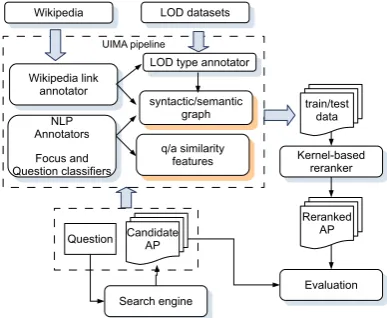
Our QA system is based on a rather simple rerank-ing framework as displayed in Figure 1: given a question Q, a search engine retrieves a list of can-didate APs ranked by their relevancy. Next, the question together with its APs are processed by a rich NLP pipeline, which performs basic tok-enization, sentence splitting, lemmatization, stop-word removal. Various NLP components, em-bedded in the pipeline as UIMA3annotators,
per-form more involved linguistic analysis, e.g., POS-tagging, chunking, NE recognition, constituency and dependency parsing, etc.
Each Q/AP pair is processed by a Wikipedia link annotator. It automatically recognizes n-grams in plain text, which may be linked to Wikipedia and disambiguates them to Wikipedia URLs. Given that question passages are typically short, we concatenate them with the candidate an-swers to provide a larger disambiguation context to the annotator.
These annotations are then used to produce computational structures (see Sec. 2.2) input to the reranker. The semantics of such relational struc-tures can be further enriched by adding links be-tween Q/AP constituents. Such relational links can be also generated by: (i) matching lemmas as in (Severyn and Moschitti, 2012); (ii) match-ing the question focus type derived by the ques-tion classifiers with the type of the target NE as in (Severyn et al., 2013a); or (iii) by matching the constituent types based on LOD (proposed in this paper). The resulting pairs of trees connected by semantic links are then used to train a kernel-based reranker, which is used to re-order the retrieved answer passages.
2.2 Relational Q/AP structures
We use the shallow tree representation that we proposed in (Severyn and Moschitti, 2012) as a baseline structural model. More in detail, each Q and its candidate AP are encoded into two trees, where lemmas constitute the leaf level, the part-of-speech (POS) tags are at the pre-terminal level and the sequences of POS tags are organized into the third level of chunk nodes. We encoded struc-tural relations using theRELtag, which links the related structures in Q/AP, when there is a match
Figure 2:Basic structural representations using a shallow chunk tree structure for the Q/AP in the running example. Curved line indicates the tree fragments in the question and its answer passage linked by the relationalRELtag.
between the lemmas in Q and AP. We marked the parent (POS tags) and grand parent (chunk) nodes of such lemmas by prepending aRELtag.
However, more general semantic relations, e.g., derived from the question focus and category, can be encoded using the REL-FOCUS-<QC>tag, where <QC> stands for the question class. In (Severyn et al., 2013b; Severyn et al., 2013a), we used statistical classifiers to derive question focus and categories of the question and of the named entities in the AP. We again mark (i) the focus chunk in the question and (ii) the AP chunks con-taining named entities of type compatible with the question class, by prepending the above tags to their labels. The compatibility between the cat-egories of named entities and questions is evalu-ated with a lookup to a manually predefined map-ping (see Table 1 in (Severyn et al., 2013b)). We also prune the trees by removing the nodes beyond a certain distance (in terms of chunk nodes) from theREL andREL-FOCUSnodes. This removes irrelevant information and speeds up learning and classification. We showed that such model outper-forms bag-of-words and POS-tag sequence mod-els (Severyn et al., 2013a).
An example of a Q/AP pair encoded using shal-low chunk trees is given in Figure 2. Here, for ex-ample, the lemma “drink” occurs in both Q and AP (we highlighted it with a solid line box in the fig-ure). “Company” was correctly recognized as a fo-cus4, however it was misclassified as “HUMAN”
(“HUM”). As no entities of the matching type “PERSON” were found in the answer by a NER system, no chunks were marked asREL-FOCUS
on the answer passage side.
We slightly modify the REL-FOCUS encod-ing into the tree. Instead of prependencod-ing REL-FOCUS-<QC>, we only prependREL-FOCUS
to the target chunk node, and add a new node
QCas the rightmost child of the chunk node, e.g, in Figure 2, the focus node would be marked as
REL-FOCUS and the sequence of its children would be [WP NN HUM]. This modification
in-4We used the same approach to focus detection and
ques-tion classificaques-tion used in (Severyn et al., 2013b)
tends to reduce the feature sparsity.
3 LOD for Semantic Structures
We aim at exploiting semantic resources for build-ing more powerful rerankers. More specifically, we use structured knowledge about properties of the objects referred to in a Q/AP pair. A large amount of knowledge has been made available as LOD datasets, which can be used for finding addi-tional semantic links between Q/AP passages.
In the next sections, we (i) formally define novel semantic links between Q/AP structures that we introduce in this paper; (ii) provide basic notions of Linked Open Data along with three of its most widely used datasets, YAGO, DBpedia and Word-Net; and, finally, (iii) describe our algorithm to generate linked Q/AP structures.
3.1 Matching Q/AP Structures: Type Match
We look for token sequences (e.g., complex nomi-nal groups) in Q/AP pairs that refer to entities and entity classes related byisa(Eq. 1) and isSubclas-sOf (Eq. 2) relations and then link them in the structural Q/AP representations.
isa:entity×class→ {true, false} (1)
isSubclassOf :class×class→ {true, false} (2) Here, entities are all the objects in the world both real or abstract, while classes are sets of en-tities that share some common features. Informa-tion about entities, classes and their relaInforma-tions can be obtained from the external knowledge sources such as the LOD resources. isareturnstrue if an entity is an element of a class (false otherwise), while isSubclassOf(class1,class2) returns true if all elements ofclass1belong also toclass2.
We refer to the token sequences introduced above as to anchors and the entities/classes they refer to asreferences. We define anchors to be in a Type Match (TM) relation if the entities/classes they refer to are in isa or isSubclassOf relation. More formally, given two anchorsa1 anda2
be-longing to two text passages, p1 andp2,
(
isa(r1, r2) :if isEntity(r1)∧isClass(r2)
subClassOf(r1, r2) :if isClass(r1)∧isClass(r2)(3) wherer1 = R(a1, p1),r2 = R(a2, p2)and
isEn-tity(r)andisClass(r)return true ifris an entity or a class, respectively, andfalseotherwise. It should be noted that, due to the ambiguity of natural lan-guage, the same anchor may have different refer-ences depending on the context.
3.2 LOD for linking Q/A structures
LOD consists of datasets published online accord-ing to the Linked Data (LD) principles5and
avail-able in open access. LOD knowledge is repre-sented following the Resource Description Frame-work (RDF)6 specification as a set ofstatements.
A statement is a subject-predicate-object triple, where predicate denotes the directed relation, e.g., hasSurnameorowns, between subject and object. Each object described by RDF, e.g., a class or an entity, is called a resource and is assigned a Unique Resource Identifier (URI).
LOD includes a number of common schemas, i.e., sets of classes and predicates to be reused when describing knowledge. For example, one of them is RDF Schema (RDFS)7, which contains
predicatesrdf:typeandrdfs:SubClassOf
similar to theisaandsubClassOf functions above. LOD contains a number of large-scale cross-domain datasets, e.g., YAGO (Suchanek et al., 2007) and DBpedia (Bizer et al., 2009). Datasets created before the emergence of LD, e.g., Word-Net, are brought into correspondence with the LD principles and added to the LOD as well.
3.2.1 Algorithm for detecting TM
Algorithm 1 detects n-grams in the Q/AP struc-tures that are in TM relation and encodes TM knowledge in the shallow chunk tree representa-tions of Q/AP pairs. It takes two text passages,P1
andP2, and a LOD knowledge source, LODKS,
as input. We run the algorithm twice, first with AP as P1 and Q asP2 and then vice versa. For
example, P1 andP2 in the first run could be,
ac-cording to our running example, Q and AP candi-date, respectively, andLODKS could be YAGO,
DBpedia or WordNet.
Detecting anchors.getAnchors(P2,LODKS)
in line 1 of Algorithm 1 returns all anchors in the
5http://www.w3.org/DesignIssues/
LinkedData.html
6http://www.w3.org/TR/rdf-concepts/ 7http://www.w3.org/TR/rdf-schema/
Algorithm 1Type Match algorithm
Input: P1,P2 - text passages;LODKS- LOD knowledge source.
1: for allanchor∈getAnchors(P2,LODKS)do 2: for alluri∈getURIs(anchor,P2,LODKS)do 3: for alltype∈getTypes(uri,LODKS)do 4: for allch∈getChunks(P1)do
5: matchedT okens ← checkMatch(ch, type.labels)
6: ifmatchedT okens6=∅then
7: markAsTM(anchor,P2.parseT ree) 8: markAsTM(matchedT okens,
P1.parseT ree)
given text passage, P2. Depending on LODKS
one may have various implementations of this pro-cedure. For example, when LODKS is
Word-Net,getAnchorreturns token subsequences of the chunks inP2of lengthsn-k, wherenis the number
of tokens in the chunk andk= [1, .., n−1). In case when LODKS is YAGO or DBpedia,
we benefit from the fact that both YAGO and DB-pedia are aligned with WikiDB-pedia on entity level by construction and we can use the so-called wikifica-tiontools, e.g., (Milne and Witten, 2009), to detect the anchors. The wikification tools recognize n-grams that may denote Wikipedia pages in plain text and disambiguate them to obtain a unique Wikipedia page. Such tools determine whether a certain n-gram may denote a Wikipedia page(s) by looking it up in a precomputed vocabulary cre-ated using Wikipedia page titles and internal link network (Csomai and Mihalcea, 2008; Milne and Witten, 2009).
Obtaining references.In line 2 of Algorithm 1 for each anchor, we determine the URIs of enti-ties/classes it refers to in LODKS. Here again,
we have different strategies for differentLODKS.
In case of WordNet, we use the all-senses strat-egy, i.e., getURI procedure returns a set of URIs of synsets that contain the anchor lemma.
In case when LODKS is YAGO or DBpedia,
we usewikificationtools to correctly disambiguate an anchor to a Wikipedia page. Then, Wikipedia page URLs may be converted to DBpedia URIs by substituting the en.wikipedia.org/wiki/
prefix to thedbpedia.org/resource/; and YAGO URIs by querying it for subjects of the RDF triples with yago:hasWikipediaUrl8
as a predicate and Wikipedia URL as an object. For instance, one of the anchors detected in the running example AP would be “Quaker oats”,
8yago: is a shorthand for the http prefix http://
a wikification tool would map it to wiki:
Quaker_Oats_Company9, and the respective
YAGO URI would be yago:Quaker_Oats_
Company.
Obtaining type information. Given auri, if it is an entity, we look for all the classes it belongs to, or if it is a class, we look for all classes for which it is a subclass. This process is incorpo-rated in thegetTypesprocedure in line 3 of Algo-rithm 1. We call such classestypes. If LODKS
is WordNet, then our types are simply the URIs of the hypernyms ofuri. IfLODKS is DBpedia or
YAGO, we query these datasets for the values of
the rdf:typeandrdfs:subClassOf
prop-erties of theuri(i.e., objects of the triples withuri as subject andtype/subClassOf as predicates) and add their values (which are also URIs) to thetypes set. Then, we recursively repeat the same queries for each retrieved type URI and add their results to thetypes. Finally, thegetTypesprocedure returns the resultingtypesset.
The extracted URIs returned by getTypes are HTTP ids, however, frequently they have human-readable names, or labels, specified by therdfs:
label property. If no label information for a
URI is available, we can create the label by re-moving the technical information from the type URI, e.g.,httpprefix and underscores.type.labels denotes a set of type human-readable labels for a specific type. For example, one of the types extracted for yago:Quaker_Oats_Company
would have label ”company”.
Checking for TM. Further, the checkMatch procedure checks whether any of the labels in the type.labels matches any of the chunks in P1
re-turned bygetChunks, fully or partially (line 5 of Algorithm 1). Here,getChunksprocedure returns a list of chunks recognized in P1 by an external
chunker.
More specifically, given a chunk,ch, and a type label,type.label,checkMatchchecks whether the
chstring matches10type.labelor its last word(s).
If no match is observed, we remove the first to-ken from ch and repeat the procedure. We stop when the match is observed or when no tokens in ch are left. If the match is observed, check-Match returns all the tokens remaining in ch as
matchedT okens. Otherwise, it returns an empty set. For example, the question of the running
ex-9wiki:is a shorthand for the http prefixhttp://en.
wikipedia.org/wiki/
10case-insensitive exact string match
ample contains the chunk “what company”, which partially matches the human readable “company” label of one of the types retrieved for the “Quaker oats” anchor from the answer. Our implemen-tation of the checkMatch procedure would re-turn “company” from the question as one of the matchedTokens.
If the matchedT okens set is not empty, this means that T M R anchor, P2, R
matchedT okens, P1 in Eq. 3 returns true.
Indeed, a1 is an anchor and a2 is the
matched-Tokenssequence (see Eq. 3), and their respective references, i.e., URI assigned to the anchor and URI of one of its types, are either insubClassOf or inisa relation by construction. Naturally, this is only one of the possible ways to evaluate the
T M function, and it may be noise-prone.
Marking TM in tree structures. Finally, if the TM match is observed, i.e., matchedTo-kensis not an empty set, we mark tree subtures corresponding to the anchor in the struc-tural representation of P2 (P2.parseT ree) and
those corresponding to matchedTokens in that of
P1 (P1.parseT ree) as being in a TM relation. In
our running example, we would mark the substruc-tures corresponding to ”Quaker oats” anchor in the answer (our P2) and the “company”
matchedTo-kenin the question (ourP1) shallow syntactic tree
representations. We can encode TM match infor-mation into a tree in a variety of ways, which we describe below.
3.2.2 Encoding TM knowledge in the trees
a1 anda2 from Eq. 3 are n-grams, therefore they
correspond to the leaf nodes in the shallow syn-tactic trees of p1 and p2. We denote the set of
their preterminal parents as NT M. We
consid-ered the following strategies of encoding TM re-lation in the trees: (i)TM node (T MN). Add leaf
sibling tagged withTMto all the nodes inNT M.
(ii) Directed TM node (T MND). Add leaf
sib-ling tagged with TM-CHILDto all the nodes in
NT M corresponding to the anchor, and leaf
sib-lings tagged withTM-PARENTto the nodes cor-responding to matchedTokens. (iii) Focus T M
(T MNF). Add leaf siblings to all the nodes in
NT M. If matchedTokens is a part of a question
focus label them as TM-FOCUS. Otherwise, la-bel them as TM. (iv) ComboT MNDF. Encode
using theT MND strategy. IfmatchedTokensis a
Intu-Figure 3: Fragments of a shallow chunk parse tree anno-tated inT MNDmode.
itively,T MND,T MNF,T MNDF are likely to
re-sult in more expressive patterns. Fig. 3 shows an example of theT MNDannotation.
3.3 Wikipedia-based matching
Lemma matching for detectingRELmay result in low coverage, e.g., it is not able to match differ-ent variants for the same name. We remedy this by using Wikipedia link annotation. We consider two word sequences (in Q and AP, respectively) that are annotated with the same Wikipedia link to be in a matching relation. Thus, we add new
RELtags to Q/AP structural representations as de-scribed in Sec. 2.2.
4 Experiments
We evaluated our different rerankers encoding sev-eral semantic structures on passage retrieval task, using a factoid open-domain TREC QA corpus.
4.1 Experimental Setup
TREC QA 2002/2003. In our experiments, we opted for questions from years 2002 and 2003, which totals to 824 factoid questions. The AQUAINT corpus11is used for searching the
sup-porting passages.
Pruning. Following (Severyn and Moschitti, 2012) we prune the shallow trees by removing the nodes beyond distance of 2 from theREL, REL-FOCUSorTMnodes.
LOD datasets. We used the core RDF distribu-tion of YAGO212, WordNet 3.0 in RDF13, and the
datasets from the 3.9 DBpedia distribution14. Feature Vectors. We used a subset of the sim-ilarity functions between Q and AP described in (Severyn et al., 2013b). These are used along with the structural models. More explicitly: Term-overlap features: i.e., a cosine similarity over question/answer,simCOS(Q, AP), where the
in-put vectors are composed of lemma or POS-tag
11http://catalog.ldc.upenn.edu/
LDC2002T31
12http://www.mpi-inf.mpg.de/yago-naga/
yago1_yago2/download/yago2/yago2core_ 20120109.rdfs.7z
13http://semanticweb.cs.vu.nl/lod/wn30/ 14http://dbpedia.org/Downloads39
n-grams with n = 1, ..,4. PTK score: i.e., out-put of the Partial Tree Kernel (PTK), defined in (Moschitti, 2006), when applied to the structural representations of Q and AP,simP T K(Q, AP) =
P T K(Q, AP)(note that, this is computed within a pair). PTK defines similarity in terms of the number of substructures shared by two trees. Search engine ranking score:the ranking score of our search engine assigned to AP divided by a nor-malizing factor.
SVM re-ranker. To train our models, we use SVM-light-TK15, which enables the use of
struc-tural kernels (Moschitti, 2006) in SVM-light (Joachims, 2002). We use default parameters and the preference reranking model described in (Sev-eryn and Moschitti, 2012; Sev(Sev-eryn et al., 2013b). We used PTK and the polynomial kernel of degree 3 on standard features.
Pipeline. We built the entire processing pipeline on top of the UIMA framework.We included many off-the-shelf NLP tools wrapping them as UIMA annotators to perform sentence detection, tok-enization, NE Recognition, parsing, chunking and lemmatization. Moreover, we used annotators for building new sentence representations starting from tools’ annotations and classifiers for question focus and question class.
Search engines. We adopted Terrier16 using the
accurate BM25 scoring model with default param-eters. We trained it on the TREC corpus (3Gb), containing about 1 million documents. We per-formed indexing at the paragraph level by splitting each document into a set of paragraphs, which are then added to the search index. We retrieve a list of 50 candidate answer passages for each question.
Wikipedia link annotators. We use the Wikipedia Miner (WM) (Milne and Witten, 2009)17 tool and the Machine Linking (ML)18
web-service to annotate Q/AP pairs with links to Wikipedia. Both tools output annotation confi-dence. We use all WM and ML annotations with confidence exceeding 0.2 and 0.05, respectively. We obtained these figures heuristically, they are low because we aimed to maximize the Recall of the Wikipedia link annotators in order to
maxi-15http://disi.unitn.it/moschitti/
Tree-Kernel.htm
16http://terrier.org
17http://sourceforge.net/projects/
wikipedia-miner/files/wikipedia-miner/ wikipedia-miner_1.1, we use only topic detector module which detects and disambiguates anchors
[image:6.595.76.296.62.102.2]System MRR MAP P@1
BM25 28.02±2.94 0.22±0.02 18.17±3.79 CH+V (CoNLL, 2013) 37.45 0.3 27.91 CH+V+QC+TFC
[image:7.595.72.291.61.132.2](CoNLL, 2013) 39.49 0.32 30 CH + V 36.82±2.68 0.30±0.02 26.34±2.17 CH + V+ QC+TFC 40.20±1.84 0.33±0.01 30.85±2.35 CH+V+QC+TFC* 40.50±2.32 0.33±0.02 31.46±2.42
Table 1: Baseline systems
mize the number of TMs. In all the experiments, we used a union of the sets of the annotations pro-vided by WM and ML.
Metrics.We used common QA metrics: Precision at rank 1 (P@1), i.e., the percentage of questions with a correct answer ranked at the first position, and Mean Reciprocal Rank (MRR). We also report the Mean Average Precision (MAP). We perform 5-fold cross-validation and report the metrics aver-aged across all the folds together with the std.dev.
4.2 Baseline Structural Reranking
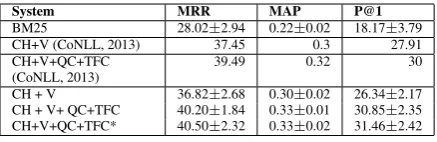
In these experiments, we evaluated the accuracy of the following baseline models: BM25 is the BM25 scoring model, which also provides the ini-tial ranking;CH+Vis a combination of tree struc-tures encoding Q/AP pairs using relational links with the feature vector; andCH+V+QC+TFCis
CH+Vextended with the semantic categorial links introduced in (Severyn et al., 2013b).
Table 1 reports the performance of our base-line systems. The base-lines marked with (CoNLL, 2013) contain the results we reported in (Sev-eryn et al., 2013b). Lines four and five report the performance of the same systems, i.e.,CH+V
and CH+V+QC+TFC, after small improvement and changes. Note that in our last version, we have a different set ofVfeatures than in(CoNLL, 2013). Finally, CH+V+QC+TFC* refers to the performance of CH+V+QC+TFC with question type information of semanticREL-FOCUSlinks represented as a distinct node (see Section 2.2). The results show that this modification yields a slight improvement over the baseline, thus, in the next experiments, we add LOD knowledge to
CH+V+QC+TFC*.
4.3 Impact of LOD in Semantic Structures
These experiments evaluated the accuracy of the following models (described in the previous sec-tions): (i) a system using Wikipedia to establish the REL links; and (ii) systems which use LOD knowledge to find type matches (TM).
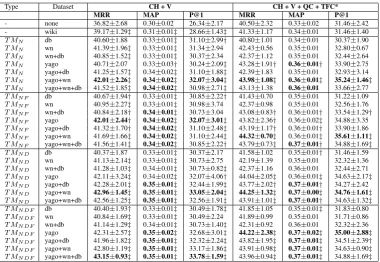
The first header line of the Table 2 shows which baseline system was enriched with the TM knowl-edge.Typecolumn reports the TM encoding
strat-egy employed (see Section 3.2.2).Datasetcolumn reports which knowledge source was employed to find TM relations. Here, yago is YAGO2, db is DBpedia, and wn is WordNet 3.0. The first re-sult line in Table 2 reports the performance of the strong CH+V and CH+V+QC+TFC* base-line systems. Line with the “wiki” dataset re-ports on CH+V and CH+V+QC+TFC* using both Wikipedia link annotations provided by ML and MW and hard lemma matching to find the re-lated structures to be marked by REL (see Sec-tion 3.3 for details of the Wikipedia-based REL matching). The remainder of the systems is built on top of the baselines using both hard lemma and Wikipedia-based matching. We used bold font to mark the top scores for each encoding strategy.
The tables show that all the systems ex-ploiting LOD knowledge, excluding those us-ing DBpedia only, outperform the strong CH+V
and CH+V+QC+TFC* baselines. Note that
CH+V enriched with TM tags performs com-parably to, and in some cases even outper-forms, CH+V+QC+TFC*. Compare, for exam-ple, the outputs ofCH+V+T MNDF using YAGO,
WordNet and DBpedia knowledge and those of
CH+V+QC+TFC*with no LOD knowledge. Adding TM tags to the top-performing base-line system, CH+V+QC+TFC*, typically re-sults in further increase in performance. The best-performing system in terms of MRR and P@1 is CH+V+QC+TFC*+T MNF system
us-ing the combination of WordNet and YAGO2 as source of TM knowledge and Wikipedia for REL-matching. It outperforms theCH+V+QC+TFC*
baseline by 3.82% and 4.15% in terms of MRR and P@1, respectively. Regarding MAP, a num-ber of systems employing YAGO2 in combina-tion with WordNet and Wikipedia-based REL-matching obtain 0.37 MAP score thus outperform-ing theCH+V+QC+TFC*baseline by 4%.
We used paired two-tailed t-test for evaluating the statistical significance of the results reported in Table 2.‡and†correspond to the significance lev-els of 0.05 and 0.1, respectively. We compared (i) the results in thewikiline to those in thenoneline; and (ii) the results for theTMsystems to those in thewikiline.
Type Dataset CH + V CH + V + QC + TFC*
MRR MAP P@1 MRR MAP P@1
- none 36.82±2.68 0.30±0.02 26.34±2.17 40.50±2.32 0.33±0.02 31.46±2.42 - wiki 39.17±1.29‡ 0.31±0.01‡ 28.66±1.43‡ 41.33±1.17 0.34±0.01 31.46±1.40 T MN db 40.60±1.88 0.33±0.01‡ 31.10±2.99† 40.80±1.01 0.34±0.01 30.37±1.90
T MN wn 41.39±1.96‡ 0.33±0.01‡ 31.34±2.94 42.43±0.56 0.35±0.01 32.80±0.67
T MN wn+db 40.85±1.52‡ 0.33±0.01‡ 30.37±2.34 42.37±1.12 0.35±0.01 32.44±2.64
T MN yago 40.71±2.07 0.33±0.03† 30.24±2.09‡ 43.28±1.91† 0.36±0.01† 33.90±2.75
T MN yago+db 41.25±1.57‡ 0.34±0.02‡ 31.10±1.88‡ 42.39±1.83 0.35±0.01 32.93±3.14
T MN yago+wn 42.01±2.26‡ 0.34±0.02‡ 32.07±3.04‡ 43.98±1.08‡ 0.36±0.01‡ 35.24±1.46‡
T MN yago+wn+db 41.52±1.85‡ 0.34±0.02‡ 30.98±2.71‡ 43.13±1.38 0.36±0.01 33.66±2.77
T MNF db 40.67±1.94† 0.33±0.01‡ 30.85±2.22† 41.43±0.70 0.35±0.01 31.22±1.09
T MNF wn 40.95±2.27‡ 0.33±0.01‡ 30.98±3.74 42.37±0.98 0.35±0.01 32.56±1.76
T MNF wn+db 40.84±2.18† 0.34±0.01‡ 30.73±3.04 43.08±0.83† 0.36±0.01† 33.54±1.29†
T MNF yago 42.01±2.44† 0.34±0.02‡ 32.07±3.01‡ 43.82±2.36† 0.36±0.02‡ 34.88±3.35
T MNF yago+db 41.32±1.70† 0.34±0.02‡ 31.10±2.48‡ 43.19±1.17† 0.36±0.01† 33.90±1.86
T MNF yago+wn 41.69±1.66‡ 0.34±0.02‡ 31.10±2.44‡ 44.32±0.70‡ 0.36±0.01‡ 35.61±1.11‡
T MNF yago+wn+db 41.56±1.41‡ 0.34±0.02‡ 30.85±2.22† 43.79±0.73‡ 0.37±0.01† 34.88±1.69‡
T MND db 40.37±1.87 0.33±0.01‡ 30.37±2.17 41.58±1.02 0.35±0.01† 31.46±1.59
T MND wn 41.13±2.14‡ 0.33±0.01‡ 30.73±2.75 42.19±1.39 0.35±0.01 32.32±1.36
T MND wn+db 41.28±1.03‡ 0.34±0.01‡ 30.73±0.82‡ 42.37±1.16 0.36±0.01 32.44±2.71
T MND yago 42.11±3.24‡ 0.34±0.02‡ 32.07±4.06† 44.04±2.05‡ 0.36±0.01‡ 34.63±2.17‡
T MND yago+db 42.28±2.01‡ 0.35±0.01‡ 32.44±1.99‡ 43.77±2.02† 0.37±0.01† 34.27±2.42
T MND yago+wn 42.96±1.45‡ 0.35±0.01‡ 33.05±2.04‡ 44.25±1.32‡ 0.37±0.00‡ 34.76±1.61‡
T MND yago+wn+db 42.56±1.25‡ 0.35±0.01‡ 32.56±1.91‡ 43.91±1.01‡ 0.37±0.01† 34.63±1.32‡
T MNDF db 40.40±1.93† 0.33±0.01‡ 30.49±1.78‡ 41.85±1.05 0.35±0.01‡ 31.83±0.80
T MNDF wn 40.84±1.69‡ 0.33±0.01‡ 30.49±2.24 41.89±0.99 0.35±0.01 31.71±0.86
T MNDF wn+db 41.14±1.29‡ 0.34±0.01‡ 30.73±1.40‡ 42.31±0.92 0.36±0.01 32.32±2.36
T MNDF yago 42.31±2.57‡ 0.35±0.02‡ 32.68±3.01‡ 44.22±2.38‡ 0.37±0.02‡ 35.00±2.88‡
T MNDF yago+db 41.96±1.82‡ 0.35±0.01‡ 32.32±2.24‡ 43.82±1.95‡ 0.37±0.01‡ 34.51±2.39†
T MNDF yago+wn 42.80±1.19‡ 0.35±0.01‡ 33.17±1.86‡ 43.91±0.98‡ 0.37±0.01‡ 34.63±0.90‡
[image:8.595.109.490.60.322.2]T MNDF yago+wn+db 43.15±0.93‡ 0.35±0.01‡ 33.78±1.59‡ 43.96±0.94‡ 0.37±0.01‡ 34.88±1.69‡
Table 2:Results in 5-fold cross-validation on TREC QA corpus
taxonomy and contain many synonymous labels per class/entity thus allowing us to have a good coverage with TM-links. DBpedia ontology that we employed in thedbexperiments is more shal-low and contains fewer labels for classes, there-fore the amount of discovered TM matches is not always sufficient for increasing performance. YAGO2 provides better coverage for TM relations between entities and their classes, while Word-Net contains more relations between classes19.
Note that in (Severyn and Moschitti, 2012), we also used supersenses of WordNet (unsuccess-fully) whereas here we use hypernymy relations and a different technique to incorporate semantic match into the tree structures.
Different TM-knowledge encoding strategies,
T MN,T MND,T MNF, T MNDF produce small
changes in accuracy. We believe, that the differ-ence between them would become more signifi-cant when experimenting with larger corpora.
5 Conclusions
This paper proposes syntactic structures whose nodes are enriched with semantic information from statistical classifiers and knowledge from LOD. In particular, YAGO, DBpedia and Word-Net are used to match and generalize constituents from QA pairs: such matches are then used in
19We consider the WordNet synsets to be classes in the
scope of our experiments
syntactic/semantic structures. The experiments with TREC QA and the above representations also combined with traditional features greatly im-prove over a strong IR baseline, e.g., 96% on BM25, and on previous state-of-the-art rerank-ing models, up to 15.4% (relative improvement) in P@1. In particular, differently from previous work, our models can effectively use semantic knowledge in statistical learning to rank methods. These promising results open interesting future directions in designing novel semantic structures and using innovative semantic representations in learning algorithms.
Acknowledgments
This research is partially supported by the EU’s 7th
Framework Program (FP7/2007-2013) (#288024 LIMOSINE project) and by a Shared University Research award from the IBM Watson Research Center - Yorktown Heights, USA and the IBM Center for Advanced Studies of Trento, Italy. The third author is supported by the Google Europe Fellowship 2013 award in Machine Learning.
References
ACM international Conference on Information and Knowledge Management (CIKM), pages 459–468. Christian Bizer, Jens Lehmann, Georgi Kobilarov,
S¨oren Auer, Christian Becker, Richard Cyganiak, and Sebastian Hellmann. 2009. Dbpedia - a crys-tallization point for the web of data. Web Seman-tics: Science, Services and Agents on the World Wide Web, 7(3):154–165, September.
Andras Csomai and Rada Mihalcea. 2008. Linking documents to encyclopedic knowledge. IEEE Intel-ligent Systems, 23(5):34–41.
Christiane Fellbaum, editor. 1998. WordNet: An Elec-tronic Lexical Database. MIT Press.
David Ferrucci, Eric Brown, Jennifer Chu-Carroll, James Fan, David Gondek, Aditya Kalyanpur, Adam Lally, J. William Murdock, Eric Nyberg, John Prager, Nico Schlaefer, and Chris Welty. 2010. Building watson: An overview of the deepqa project. AI Magazine, 31(3).
Thorsten Joachims. 2002. Optimizing search engines using clickthrough data. In ACM SIGKDD Con-ference on Knowledge Discovery and Data Mining (KDD), pages 133–142. ACM.
Aditya Kalyanpur, J William Murdock, James Fan, and Christopher Welty. 2011. Leveraging community-built knowledge for type coercion in question an-swering. In The Semantic Web–ISWC 2011, pages 144–156. Springer.
David Milne and Ian H Witten. 2009. An open-source toolkit for mining wikipedia. InNew Zealand Com-puter Science Research Student Conference (NZC-SRSC).
Alessandro Moschitti and Silvia Quarteroni. 2008. Kernels on linguistic structures for answer extrac-tion. In Proceedings of the 46th Annual Meet-ing of the Association for Computational LMeet-inguis- Linguis-tics on Human Language Technologies: Short Pa-pers (ACL), pages 113–116.
Alessandro Moschitti, Silvia Quarteroni, Roberto Basili, and Suresh Manandhar. 2007. Exploiting syntactic and shallow semantic kernels for ques-tion/answer classification. In Proceedings of the 45th Annual Meeting of the Association of Compu-tational Linguistics (ACL), pages 776–783.
Alessandro Moschitti. 2006. Efficient convolution kernels for dependency and constituent syntactic trees. InProceedings of the 17th European Confer-ence on Machine Learning (ECML), pages 318–329. Springer.
Alessandro Moschitti. 2009. Syntactic and seman-tic kernels for short text pair categorization. In
Proceedings of the 12th Conference of the Euro-pean Chapter of the Association for Computational Linguistics (EACL), pages 576–584. Association for Computational Linguistics.
J William Murdock, Aditya Kalyanpur, Chris Welty, James Fan, David A Ferrucci, DC Gondek, Lei Zhang, and Hiroshi Kanayama. 2012. Typing can-didate answers using type coercion. IBM Journal of Research and Development, 56(3.4):7–1.
Aliaksei Severyn and Alessandro Moschitti. 2012. Structural relationships for large-scale learning of answer re-ranking. In Proceedings of the 35th in-ternational ACM SIGIR conference on Research and development in information retrieval (SIGIR), pages 741–750. ACM.
Aliaksei Severyn and Alessandro Moschitti. 2013. Au-tomatic feature engineering for answer selection and extraction. InProceedings of the 2013 Conference on Empirical Methods in Natural Language Pro-cessing (EMNLP), pages 458–467.
Aliaksei Severyn, Massimo Nicosia, and Alessandro Moschitti. 2013a. Building structures from clas-sifiers for passage reranking. InProceedings of the 22nd ACM international conference on Conference on information & knowledge management (CIKM), pages 969–978. ACM.
Aliaksei Severyn, Massimo Nicosia, and Alessandro Moschitti. 2013b. Learning adaptable patterns for passage reranking. In Proceedings of the Seven-teenth Conference on Computational Natural Lan-guage Learning (CoNLL).
Fabian M. Suchanek, Gjergji Kasneci, and Gerhard Weikum. 2007. Yago: a core of semantic knowl-edge. InProceedings of the 16th international con-ference on World Wide Web (WWW), pages 697–706. ACM Press.