Proceedings of the 2019 Conference on Empirical Methods in Natural Language Processing 942
Revisit Automatic Error Detection for Wrong and Missing Translation –
A Supervised Approach
Wenqiang Lei1,2, Weiwen Xu2, Ai Ti Aw2, Yuanxin Xiang2, Tat-Seng Chua1
1National University of Singapore, Singapore
2Institute for Infocomm Research, A*STAR, Singapore
{xuw1, aaiti, xiang yuanxin}@i2r.a-star.edu.sg [email protected]
Abstract
While achieving great fluency, current ma-chine translation (MT) techniques are bottle-necked by adequacy issues. To have a closer study of these issues and accelerate model development, we propose automatic detect-ing adequacy errors in MT hypothesis for MT model evaluation. To do that, we anno-tate missing and wrong translations, the two most prevalent issues for current neural ma-chine translation model, in 15000 Chinese-English translation pairs. We build a super-vised alignment model for translation error de-tection (AlignDet) based on a simple Align-ment Trianglestrategy to set the benchmark for automatic error detection task. We also dis-cuss the difficulties of this task and the benefits of this task for existing evaluation metrics.
1 Introduction
Different translation errors impact translation comprehensibility and adequacy differently. For example, wrong product or terminology transla-tion can be considered more severe than missing translation in the eCommerce domain. Though many machine translation evaluation (MTE) met-rics have been proposed, most of them are not able to provide a direct connection between the score and the error class to emphasize the differ-ent impact on translation comprehension and ad-equacy. Most MTE scores measure the similarity between the MT hypothesis and the reference us-ing n-gram and are useful in providus-ing immediate feedback on model performance for system devel-opment and objective evaluation for system com-parison. To further analyse the MT hypothesis, fine-grained translation analysis is normally con-ducted manually which involves expensive human effort (Popovi´c and Ney, 2011; Popovi´c, 2011b; Fishel et al.,2012;Vilar et al.,2006).
This motivates early unsupervised error detec-tion methods (Popovi´c and Ney, 2011). Such methods find the erroneous words by calculating the edit distance between the MT hypothesis and its corresponding reference. However, such un-supervised methods suffer from low accuracy and inability to provide and distinguish certain error classes likeMissing wordsandWrong translation1
(c.f. Sec 3). On the other hand, the works on supervised methods are few due to limited train-ing resources available. The annotated corpus are mainly collected from outputs of Phrase-based Machine Translation systems and usually suffer from small quantity (around 200 instances per lan-guage pair) (Fishel et al., 2012), noisy contents (derived from student assignments) (Wisniewski et al., 2014) or overabundant efforts (additional human efforts are required on postediting the MT hypothesis) (Popovi´c and Arcan, 2016), making the progress and development of this task chal-lenging.
We believe a corpus annotated with differ-ent translation error classes will facilitate the re-search on translation error detection. There-fore, we construct a high quality annotated corpus (TransErr) comprising 15000 Chinese-English translation pairs with inter-annotator agreement at 0.804 measured by Cohen’s Kappa (Cohen, 1960). Different from existing error detection works which focus on all error classes, we cur-rently only take care of missing and wrong trans-lation (Specia et al., 2018), the major errors re-lated to adequacy, which is a wide-known issue in neural machine translation (NMT) (Zheng et al., 2019). The errors tags are annotated on source (Chinese) sentences to reflect the loyalty and ad-equacy with respect to the source. Based on
TransErr, we discuss the error distribution of
dif-1The
ferent systems and challenges of unsupervised er-ror annotations using post-edits.
TransErr enables the study task of supervised MT error detection. We benchmark this task by providing a simple yet efficient model called (AlignDet). AlignDetis based on our observation of theAlignment Trianglewhose basic idea is that if a word is well translated, the translated word and the corresponding word in reference should be equivalent. We implement such observation by employing both monolingual and bilingual align-ment systems as well as various features. We fur-ther provide error analyses of AlignDet to give more insight to this task.
To study the application of this task, we further conduct a discussion on the impact of different error classes on MT evaluation metrics based on WMT Chinese–English Direct Assessment (DA) corpus (Bojar et al.,2017). We find that embrac-ing the results of our simpleAlignDetmodel in ex-isting MTE metrics helps to achieve significantly better correlation with human. Our further analy-sis on gold standard error annotation suggests that wrong translation tends to produce worse transla-tion. This discovery gives further credence for the usefulness of our proposed adequacy-oriented er-ror detection task.
In short, the paper is towards carrying out the first systematic study of supervised approaches for error detection, with the goal of accelerating the research and development of MT towards human translation quality. Our systematic contribution lies on annotated data, supervised model and dis-cussions of its potential to help existing machine translation evaluation task. Specifically:
• We propose a task of adequacy-oriented er-ror detection for machine translation eval-uation and contribute a high-quality corpus
TransErr annotated by professional annota-tors for machine translation. The corpus are available2.
• We propose an AlignDet to set the bench-mark of this task based on our key obser-vation ofAlignment Triangle. As far as we know, this is the first model making use of all three alignments from source, MT hypothesis and reference concurrently.
2Please contact us to get the
TranErr corpus and the
AlignDetsource code. Before that, you need to have access to LDC NIST MT evaluation sets{LDC2005T06, NIST02, NIST03, NIST04, NIST05, NIST08}.
• We conduct various discussions on the chal-lenges of this task and its potential to help existing machine translation evaluation task.
2 Related Work
Existing automatic MTE focus on measuring the similarity between MT hypothesis and references. Various dimensions have been considered, such as lexical level (Papineni et al., 2002; Snover et al., 2009; Lo, 2017; Popovi´c, 2017), syn-tax level (Owczarzak et al., 2007; Duma and Menzel, 2017; Liu and Gildea, 2005), semantic level (Stanojevi´c and Sima’an, 2015; Shimanaka et al., 2018) and discourse level (Guzm´an et al., 2014). However, such methods give an overall score to a system or give a relative ranking to a pair of systems, without any detailed insight of MT system output.
To get the fine-grained insights of the MT model performance, Popovi´c and Ney (2011); Popovi´c et al. (2011a) make the first step towards auto-matic translation error detection using unsuper-vised approach by performing monolingual align-ment between a MT hypothesis and its corre-sponding reference through WER (Levenshtein, 1966) and PER (Tillmann et al., 1997). Popovi´c (2011b) further develop this algorithm into an open-source tool and demonstrates that the de-tected errors helps to build better evaluation met-rics. However, the edit distance algorithm is not robust (c. f. Sec. 3.2). Zeman et al. (2011) improve the monolingual alignment by borrowing ideas from HMM (Vogel et al.,1996) but the error detection performance is still far from real appli-cation. To facilitate this task, Wisniewski et al. (2014) derive corpus of 4,854 source sentences from the assignment of master student specializ-ing on translation but the data turns out to be too noisy.
task differs from the word-level QE task in the fol-lowing aspects:
• The QE task is for confidence estima-tion (Specia et al., 2010) which estimates whether an output is good for an end user. Our error detection task is for fine-grained evaluation and comparison during model de-velopment.
• QE only haveGOODandBADtag on the MT hypothesis. It cannot make robust distinction on different error classes due to the intrinsic shortcomings of the edit distance algorithm.
• Existing QE data does not have reliable la-bel on the source sentence to indicate which source word cause the errors (c.f. Sec. 3.2), which is claimed as “particularly important to translation adequacy” in WMT 18 (Specia et al.,2018) and WMT 193.
3 TranErr Corpus and Analysis
TransErrcorpus comprises 15000 triples<source, MT hypothesis, reference> with source sen-tences extracted from LDC NIST MT evaluation sets {LDC2005T06, NIST02, NIST03, NIST04, NIST05, NIST08}. MT hypothesis is obtained through an NMT engine trained on 25 million Chinese-English parallel sentences. To study the correlation between error detection and human evaluation, we also conduct additional annotation on WMT17 Direct Assessment (DA) dataset con-taining 560 Chinese-English translation pairs.
Annotation is conducted by two professional translators who specialize on Chinese-English translation. All three information <source, MT hypothesis, reference> are given during annota-tion. Annotators are instructed to mark on the source the two adequacy related errors (Missing
&Wrong) found in the MT hypothesis and to fol-low the minimum span principle, i.e. identify-ing the minimum number of words whose content are not (correctly) conveyed in the MT hypothe-sis regardless of fluency and grammatical correct-ness. If a span in the source is incorrectly trans-lated in the MT hypothesis, all words in that span will be marked as Wrong (W); if totally missing, it will be marked as Missing(M). Due to the in-trinsic difference between the two languages, not all words in the source need to be translated in the
3http://www.statmt.org/wmt19/
MT hypothesis. In this case, we do NOT anno-tate them as missing. We also have more strin-gent conditions for proper nouns and terminolo-gies since their translations are more specific and domain dependent. They have to be unerringly correct or otherwise, marked asWrong Terminol-ogy (WT) or Missing Terminology(MT4). All cor-rectly translated words are automatically assigned a labelOK.
Annotators are first asked to annotate 100 sen-tence pairs followed by a discussion among the project team to resolve any disagreement. After 5 such iterations, we start the formal annotation. 10% overlapped instances are given to each an-notator for monitoring the inter-annotation agree-ment (IAA). The disagreed instances are discussed every day. We obtain an overall IAA of 0.804 mea-sured by Cohen’s Kappa. The speed for both an-notators is about 50 sentence pairs per hour.
3.1 Translation Error Analysis
Table 1 shows the error distribution of TransErr
and WMT 17 corpus. The corpora have differ-ent BLEU withTransErrhaving more missing (M) errors and WMT17 more wrong (W) errors. As WMT17 contains output from multiple MT sys-tems, we further investigate the errors distribu-tions among the different systems, in particular the output from AFRL and NRC. AFRL and NRC have comparable BLEU but different human eval-uation. Error distributions for the two corpora vary quite significantly with AFRL having more
W errors (45% W and 19% WT) while NRC has moreMerrors (31%Mand 31%MT). This demon-strates the importance of classifying translation er-rors and the need for the erer-rors to be considered during evaluation.
3.2 Challenges of Automatic Translation Error Annotation
Though MTE and error detection are two different tasks, they are closely related. Popovi´c and Ney (2011) presented the first framework for automatic analysis and classification of translation errors us-ing unsupervised approach for SMT systems. The work has been evolved to word-level QE task in WMT. Instead of directly annotating errors on the source as in our proposed task, we re-implement
4In this paper, we conventionally use the normal font MT
Human BLEU Sen Word OK W WT M MT
TransErr - 19.1 15000 403691 388372 4529 / 0.29 1694 / 0.11 8234 / 0.54 862 / 0.06
WMT17 - 16.2 560 14090 13025 410 / 0.39 206 / 0.19 320 / 0.30 129 / 0.12
AFRL -0.016 20.6 34 917 820 44 / 0.45 19 / 0.19 17 / 0.18 17 / 0.18
NRC 0.079 20.3 32 786 698 17 / 0.19 17 / 0.19 27 / 0.31 27 / 0.31
Table 1: Corpus Statistics for TransErr, WMT17, AFRL and NRC. AFRL and NRC are subsets of WMT17. Human is the corresponding system-level DA score assigned by human in WMT17. All BLEU are calculated usingone reference. Sen and Word columns list the number of sentences and words while the other four columns present the number of each error class and its proportion.
Label OK W WT M MT
F1 0.93 0.33 0.30 0.43 0.35
Table 2: F1 for each class annotated by the unsuper-vised method using our manual annotation as gold ref-erence
[image:4.595.73.290.455.555.2]QE and follow (Popovi´c and Ney, 2011) to de-rive source annotation through two stages of align-ments. The first stage is monolingual alignment between post-edits and MT hypotheses through calculating their edit distance to find missing and wrong translations. The second stage is bilin-gual alignment using Giza++ (Och and Ney,2000) on post-edits and the sources to propagate the er-ror labels on the post-edits to the corresponding sources. Similar to our manual annotation, we as-signMTandWTlabel for terminologies.
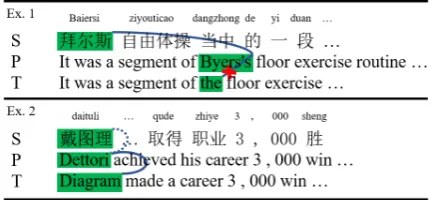
Figure 1: Examples of unsupervised annotation on WMT17. (S), (P) and (T) refer to source, post-edits and MT hypothesis respectively. Solid line indicates correct alignment. Solid line with a red cross refers to wrong alignment while dotted line refers to missing alignment. This convention applies to the whole paper.
To get empirical study, we perform unsuper-vised annotation on our WMT17 dataset using the above-mentioned method. Table 2 demonstrates its F1 score using the manual annotation as the gold standard. We investigate and summarize the causes in Figure1:
• The edit distance algorithm is not robust in
error class detection since it is purely based on symbolic comparison. (Ex. 1) illustrates a case where Byers’s is missing. However, TER tool tags it as a substitution of the in the MT hypothesis because there is a perfect symbolic alignment before and after the erroneous word. This intrinsic inability to detect missing and wrong translation is also discussed in (Popovi´c and Ney,2011).
• Giza++ cannot generate reliable alignments for low-frequency words (Riley and Gildea, 2010) and such low-frequency words con-tribute to a large extent of erroneous words. These misalignments propagate from the post-edits to the source sentence and lead to incorrect error tags. (Ex. 2) gives an exam-ple, the Dettori should be aligned to daituli
but was not aligned to any word by GIZA++. This leads to an incorrectOKtag in the source sentence.
As such, unsupervised error annotation presents many challenges even leveraging on post-edits. Hence a set of more reliable annotated data will be able to contribute much to the error detection task.
4 AlignDet Model
To revive fine-grained translation error detection, we propose AlignDet, a supervised feature-based solution using TransErrto set the benchmark for this task. We discuss ourAlignment Triangle ob-servation and briefly list the features we used. In the subsequent discussions, we denotesi,tjandrk as theith,jth andkth word in a source sequence S, MT hypothesisT and referenceRseparately.
4.1 Alignment Triangle Observation
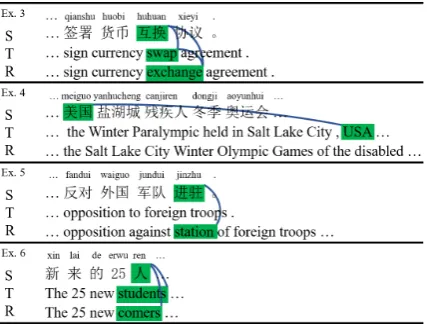
Figure 2: Four samples fromTransErr. For each exam-ple, we show the source (S), MT hypothesis (T), refer-ence (R).
in the MT hypothesis. As long as the MT hypoth-esis and the reference are semantically equivalent, such reproduction may not require the MT hypoth-esis and the reference to be exactly identical. This motivates us to analyze the translationtj inT and
rkinRfor the samesi inS5, in the following er-ror detection scenarios. We refertj andrkfor the samesi as translation correspondence.
Pattern1: si has translation correspondencetj andrk.It should be labeled asOKiftjandrkare semantically equivalent; otherwise, it should be la-beled asW. For example, in (Ex. 3) from Figure2, the two words,swapandexchange, are equivalent in the given context, which should be marked as
OK. However, compared to (Ex. 6),studentsand
comersare not equivalent in the given context, al-though they may be equivalent in higher abstrac-tion, hence it is annotated asW.
Pattern2: si does not have translation corre-spondence rk. Assuming R does not have any adequacy issue, this would imply thatsi does not need to be explicitly translated. In this case, the omission of tj is an OK translation. However, if it is explicitly translated in T astj, we will still accept it as anOKtranslation though it may cause minor redundancy issue and we assume that it will not harm adequacy. For example, either explicitly translationmeiguotoUSAor not in (Ex. 4) should be fine.
Pattern3: sihas translation correspondencerk but not tj. This implies that translation of si is missing and should be translated. AM label will
5Generally,t
j, rkandsican be multi-word expression. For the ease of explanation for our feature extraction method, we describe each of them as a single word.
be giveninthiscase. (Ex. 5)shows an example ofthis. jinzhudoesnothavetj butitisnecessary forittobetranslatedasthetranslation correspon-denceispresenceinRasrk.
The same rationale also applies to terminolo-gies, except that theyare markedwith MTor WT
andhavetobeunerringlytranslatedforthemtobe markedasOK. For theothercasesnot illustrated above,weassumethattheyareeithernot happen-ingordonotaffecttheadequacyofthetranslation.
4.2 FeaturesandModel
To capture the above observation, we build two sets of features, one for findingt he correspond-ingtranslationtj andrk foreachsi,theotherfor checkingthe equivalence oftj andrk. Here,we onlybrieflylistthefeaturesadoptedinourmodel astheyare all commonlyused standardfeatures. Wegivedetaileddescriptionofallfeaturesin Ap-pendix A.1.
Giza++(Och and Ney,2000)isusedtofindthe corresponding translation tj and rk for each si. However, as Giza++ generates noisy alignments especially for low-frequency words, we propose a set of features to complement Giza++ results. ThesamefeaturesareappliedonT andR,hence weonlydescribethefeatureforthealignment be-tweenSandT. Supposethatsi isalignedtotj6. Thesefeaturesare: si’sPOStag;abinaryfeature ofwhetherNERtagsofsiandtj arethesame;the corpusfrequencyandGiza++translation probabil-ityofsiandtj;thesimilaritybetweentj andsi’s mostfrequenttranslation;thenumberof aligned-pairsamongwordslinking tosi andtj in depen-dencytree.
Weleverageonthestate-of-the-artmonolingual alignment tool Sultan et al. (2014) to check the equivalence of tj and rk. The tool leverages on paraphrase lexicon(Pavlicketal., 2015) and de-pendency relations to finde quivalentexpression betweentwosentencesinthesamelanguage. The followingfeaturesareused: abinaryfeature indi-catingwhethertj andrkare alignedbytool pro-posed by (Sultan et al., 2014); A binary feature indicating whether theNER tag oftj and rk are thesame.
Whilethiserrordetectionproblemcanbe mod-eledassequentiallabellingtask,wechoosesimple classificationmodelastheb enchmark.Therefore,
6FollowingHu et al.(2018), we make adjustment by
we use an Mutilayer Perceptron (MLP) as the de-tection model which takes all above features in for each source wordsi to choose one of the labels in
{OK, W, WT, M, MT}as the prediction.
5 Experiments
We conduct empirical experiments to evaluate the effectiveness of our error detection model, per-form error analysis and discuss the challenges of this task. We split our TransErr dataset into training and developing sets in a ratio of 9:1 and adopt the whole WMT DA dataset as the testing set. Error detection results are reported in single-class F1. All Chinese sentences are tokenized by THULAC (Li and Sun, 2009).The rest of the pre-processings like POS, NER, parsing for both English and Chinese are performed by Stanford Corenlp (Manning et al.,2014).
5.1 Baselines
We build a naive baseline, random model, to test the worst performance. It randomly assigns a label to each source word according to the distribution of each class in the training set. We then evalu-ate the performance of our proposed MLP model (AlignDet) and two recent models under WMT word-level QE shared-task:
·CEQE(Hu et al.,2018) Using a three-part neural network model, which encodes semantic factors, local context and global context successively.
· SHEF-bRNN (Ive et al., 2018) Adopting bi-directional recurrent neural network to learn a rep-resentation for <source, MT hypothesis> sen-tence pairs.
We replicate these two models utilizing origi-nal implementations but modify them to work in our 5-label setting.7 We also analyze our proposed model and its variant by ablating or substituting its components
·Raw alignmentUsing only the raw results from the monolingual and bilingual alignment systems and NER on the source to examine the effect of alignment on the model.
· No reference We remove all features derived from the reference, for example, bilingual align-ment features betweenS andR, and monolingual alignment features between T andR. This is to test the efficacy of using only source information for translation performance evaluation.
7We also tried QEBrain (Fan et al., 2018;Wang et al.,
2018) using the released code. However, it did not converge to any meaningful predictions.
5.2 Error Detection Results
Table 3 shows our error detection results on the developing set and test set. Our random baseline (Row (1)) provides a preliminary insight for this error detection problem, with extremely low F1 scores (nearly 0) except for theOKclass. It is be-cause errors are scarcely distributed (see Table 1). In addition, the QE models (Row 2, 3) do not per-form well in error classification. This is reason-able because they are not designed for error detec-tion in our setting. The overall better performance of ourAlignDetmodel supports that ourAlignment TriangleObservation and its contribution to the er-ror detection task.
However, with raw alignment (Row 4 vs Row 5), the performance of AlignDet drops sharply. It is because the alignment model, especially Giza++, generates noisy results. This demon-strates the efficacy of other features in rectifying Giza++ results. The comparison between Row (4) and Row (6) also demonstrates the importance of reference, especially for detectingWlabel. It is be-cause wrong translation is also likely to get aligned with the source as it can be the translation of the source words in some other contexts. However, reference gives us a pointer to the correct word choice in the given context, hence helping deter-miningWlabel. Without reference, we may need to rely on more contextual modeling effort to de-tect a wrong translation.
[image:6.595.310.524.514.646.2]5.3 Error Analysis
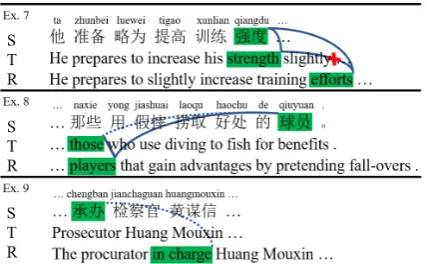
Figure 3: Representative examples of the confusion cases forAlignDet.
Developing Testing
OK W WT M MT OK W WT M MT
(1) Random baseline 0.959 0.009 0.013 0.020 0.027 0.947 0.025 0.029 0.041 0.017
(2) CEQE 0.944 0.134 0.180 0.245 0.161 0.914 0.161 0.147 0.206 0.094
(3) SHEF-bRNN 0.916 0.140 0.212 0.127 0.262 0.884 0.153 0.123 0.098 0.114
(4) AlignDet 0.973 0.275 0.480 0.416 0.365 0.964 0.212 0.293 0.400 0.429
[image:7.595.72.528.61.171.2](5) Raw alignment 0.762 0.051 0.049 0.168 0.114 0.781 0.131 0.131 0.263 0.328 (6) No reference 0.977 0.040 0.448 0.289 0.289 0.962 0.075 0.213 0.360 0.378
Table 3: F1 score for each class produced by different error detection models.
Gold Pred.
OK W WT M MT
OK 12635 203 68 106 13
W 279 83 3 40 5
WT 109 28 54 9 6
M 121 54 12 122 11
MT 26 12 31 16 44
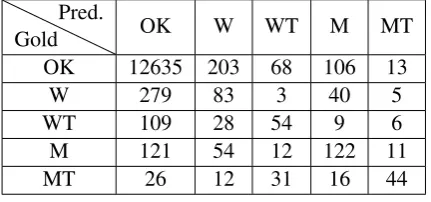
Table 4: Confusion matrix on test set.
(b) PredictOKasM(c) PredictMasOK. We illus-trate the wrong prediction in Figure 3.
(Ex. 7) demonstrates a case for “W as OK”. Both strength (the wrong translation in T) and
efforts (the correct translation in R) are aligned to the source word qiangduby Giza++. Though both of them are possible translations forqiangdu, they are not semantically equivalent in this con-text. Unfortunately, monolingual alignment tool aligns them as a pair, hence a more contextual and semantically-sensitive monolingual alignment is required. (Ex. 8) demonstrates a case for “OK
as M”. In T, qiuyuan is translated to those and is not detected by our bilingual alignment. This leads the model to treat it as not been translated. This example demonstrates the constraint of bilin-gual alignment in finding the translation corre-spondence, which would require contextual-level understanding. (Ex. 9) demonstrates a case for “M
asOK”. Similar to (Ex. 8), the mis-prediction is caused by the failure of bilingual alignment (be-tween chengban in S andin charge in R). Our model regardschengbanas omittable as bilingual alignment fails to align it toin chargeinR. As a result, thoughchengbanis translated in R but not translated inT, we classify it as OK instead of M. This example again demonstrates the important of alignment in error detection task.
Our qualitative error analyses highlight the bot-tleneck ofAlignDetmodel on the proposed
align-ment features. In a broader context, both bilin-gual alignment and monolinbilin-gual alignment are still having open issues in the realm of NLP (Sul-tan et al.,2014). An intuitive solution is turning to soft alignment (e.g., attention) using neural tech-niques (Liu and Sun,2015;Tamura et al.,2014). This raises interesting and challenging questions on how to leverage on such approaches to capture our observations in finding corresponding transla-tions tj and rk for each si and comparing their equivalence? Neural models usually require large data and how to leverage on limited error anno-tation data (say, 15000 sentence pairs) and large parallel corpus for such purpose?
6 Discussion: How Does Error Class Affect Existing MT Evaluation Metrics?
This paper proposes an adequacy translation error detection model with the aim to study its contri-bution to MT. We presume that fine grained MT evaluation is useful for assessing different proper-ties of MT models. Hence, we go one step further to discuss how fine-grained error detection bene-fits existing MT evaluation metrics using DA as the base for our evaluation.
To explore further, we define a Weight Ade-quacy Error Rate (WAER) following TER (Snover et al.,2006):
WAER=w1#W+w2#WT+w3#M+w4#MT
Len(S) (1)
where#W,#WT,#M,#MTare the number of wrong words, wrong terminologies, missing words, miss-ing terminologies respectively;w1,w2,w3,w4are
corresponding weight for each error class, indicat-ing its importance. Len(S)is the source sentence length.
With only missing and wrong error class,WAER
[image:7.595.74.290.213.314.2]eval-Base + pred. + gold.
BLEU 0.482 0.524 0.541
METEOR 0.638 0.673 0.709
ROUGE-L 0.582 0.645 0.699
BEER 0.582 0.640 0.681
CUNI-TreeAggreg 0.535 0.625 0.670
MEANT 2.0 0.639 0.641 0.680
MEANT 2.0-nosrl 0.630 0.633 0.672
UHH TSKM 0.477 0.600 0.657
BLEU2VEC sep 0.526 0.588 0.620
CHRF 0.591 0.641 0.685
CHRF++ 0.593 0.644 0.690
NGRAM2VEC 0.520 0.576 0.607
[image:8.595.72.292.60.255.2]Ave 0.573 0.622 0.662
Table 5: Segment-level Pearson correlation of various metrics and their enhancements with ourW AER mea-sure through (Eq. 2). + pred./+gold meansW AERis calculated by our error detection model predicted re-sults/gold standard as per se.
uation metric. As a common practice in BLEU and METEOR, we viewWAERas a penalty to base metrics, which we refer as Score, and calculate the penalized score as follow:
g
Score=Score∗(1−WAER) (2)
To determine w1, w2, w3, w4, we build a
de-velopment set of 300 instances, sampled from our
TransErr, with overall translation quality scored by multiple judges who are professional at both English and Chinese. To avoid bias, our error an-notators ofTransErrare excluded from this scor-ing. We adjustw1,w2,w3,w4in this development
set based on our gold annotation, such that the en-hanced metrics achieves highest correlation with the average human score.
We examine three benchmark metrics (BLEU, METEOR, ROUGE) and the recent metrics sub-mitted to WMT17: BEER (Stanojevi´c and Sima’an, 2015), CUNI-TreeAggreg (Mareˇcek et al., 2017), MEANT 2.0, MEANT 2.0-nosrl (Lo, 2017), UHH TSKM (Duma and Menzel, 2017), NGRAM2VEC, BLEU2VEC sep (T¨attar and Fishel, 2017), CHRF (Popovi´c, 2015), CHRF++ (Popovi´c, 2017). We test their perfor-mance on WMT 17 DA dataset. The results are in Table 5. WAER is calculated by both system pre-diction results and the gold standard. We observe that, with our error prediction,WAERis able to en-hance almost all metrics substantially (+0.049 on
average). When calculating WAER using the gold standard, the performance is even higher (+0.089 on average). This demonstrates the efficacy of er-ror detection for enhancing existing direct assess-ment metrics. Note that, we do not conclude that ourWAER(Eq.1) and the way of enhancing
exist-ingScore (Eq.2) is optimal in terms of
achiev-ing better correlations with human judgment. We also want to find out which error class affects the overall translation quality more. Therefore, we study how the enhanced metrics correlate to hu-man judgment when the weight of a single class of error changes. The trend is shown in Fig-ure 4 where y-axis is the average correlation of all metrics enhanced by WAER on gold standard. X-axis is the weight of the observed error class. To eliminate the contribution made by other error classes, weights of other error classes are set to 0. From Figure 4, one can observe that wrong related error (W and WT) can help existing met-rics achieve higher correlation to human judgment than missing-related error (MandMT). This sug-gests wrong translation is more severe than miss-ing word. This provides valuable feedback on the advancement of evaluation metric towards human evaluation. Similarly, one can also observe that adequacy issue on terminologies is more severe than normal words and term-related errors need higher weights to achieve highest correlation. Ac-curate translation of terminology is an issue in neural machine translation if its occurrence is low in the training data. Accurate translation of termi-nology may be an area that warrens more work.
0.55 0.56 0.57 0.58 0.59 0.6 0.61
0 1 2 3 4 5 6 7 8 9
A
ve
ra
ge
c
orre
la
ti
on
Penalty weight W WT
[image:8.595.315.518.523.670.2]M MT
Figure 4: Correlation with respect to each error class.
7 Conclusion
evaluation purpose. We contribute a high-quality dataset TransErr with Missing andWrong lation manually annotated by professional trans-lators to enable the development of supervised methods. Based onTransErr, we benchmark this task by proposing a strong baseline, i.e., Align-Detmodel, based on our Alignment Triangle ob-servation. We also conduct various discussions about this task such as the challenges of unsuper-vised methods for error annotation, the bottleneck of AlignDet model and the potential benefits of the error detection task for existing MT evaluation metrics task.
This work represents the preliminary work for more multi-faceted machine translation evalua-tion, focusing on multiple aspects instead of only a score or ranking, with the goal of push MT tech-niques to a higher standard. However, there are areas for further exploration. In the future, we will explore more advanced techniques such as neural networks for error detection. We will also inves-tigate how to make better evaluation metrics with the help of error detection. We will also study how to improve machine translation model through er-ror detection. For example, how to improve MT models according to different class of errors.
8 Acknowledgements
NExT++ research is supported by the National Research Foundation, Prime Minister’s Office, Singapore under its IRC@SG Funding Initiative. The work is also supported by The Translational RD Grant (TRANS Grant) initiative managed by the Government Technology Agency of Singapore (GovTech) and the National Research Foundation (NRF), Singapore.
References
Ondˇrej Bojar, Yvette Graham, and Amir Kamran. 2017. Results of the wmt17 metrics shared task. In Proceedings of the Second Conference on Ma-chine Translation, Volume 2: Shared Task Papers, pages 489–513, Copenhagen, Denmark. Association for Computational Linguistics.
Chris Callison-Burch, Philipp Koehn, Christof Monz, Matt Post, Radu Soricut, and Lucia Specia. 2012.
Findings of the 2012 workshop on statistical ma-chine translation. In Proceedings of the Seventh Workshop on Statistical Machine Translation, pages 10–51, Montr´eal, Canada. Association for Compu-tational Linguistics.
Jacob Cohen. 1960. A coefficient of agreement for nominal scales. Educational and psychological measurement, 20(1):37–46.
Melania Duma and Wolfgang Menzel. 2017. Uhh submission to the wmt17 metrics shared task. In Proceedings of the Second Conference on Machine Translation, Volume 2: Shared Task Papers, pages 582–588, Copenhagen, Denmark. Association for Computational Linguistics.
Kai Fan, Bo Li, Fengming Zhou, and Jiayi Wang. 2018. ” bilingual expert” can find translation errors. arXiv preprint arXiv:1807.09433.
Mark Fishel, Ondrej Bojar, and Maja Popovic. 2012. Terra: a collection of translation error-annotated cor-pora. InLREC, pages 7–14.
Francisco Guzm´an, Shafiq Joty, Llu´ıs M`arquez, and Preslav Nakov. 2014. Using discourse structure im-proves machine translation evaluation. In Proceed-ings of the 52nd Annual Meeting of the Association for Computational Linguistics (Volume 1: Long Pa-pers), volume 1, pages 687–698.
Aaron Li-Feng Han, Yi Lu, Derek F. Wong, Lidia S. Chao, Liangye He, and Junwen Xing. 2013. Qual-ity estimation for machine translation using the joint method of evaluation criteria and statistical model-ing. InProceedings of the Eighth Workshop on Sta-tistical Machine Translation, pages 365–372, Sofia, Bulgaria. Association for Computational Linguis-tics.
Junjie Hu, Wei-Cheng Chang, Yuexin Wu, and Graham Neubig. 2018. Contextual encoding for translation quality estimation. InProceedings of the Third Con-ference on Machine Translation: Shared Task Pa-pers, pages 788–793, Belgium, Brussels. Associa-tion for ComputaAssocia-tional Linguistics.
Julia Ive, Fr´ed´eric Blain, and Lucia Specia. 2018. Deepquest: a framework for neural-based quality estimation. In the Proceedings of COLING 2018, the 27th International Conference on Computational Linguistics, Sante Fe, New Mexico, USA.
Hyun Kim, Jong-Hyeok Lee, and Seung-Hoon Na. 2017. Predictor-estimator using multilevel task learning with stack propagation for neural quality estimation. pages 562–568.
Vladimir I Levenshtein. 1966. Binary codes capable of correcting deletions, insertions, and reversals. In Soviet physics doklady, volume 10, pages 707–710.
Zhongguo Li and Maosong Sun. 2009. Punctuation as implicit annotations for chinese word segmentation. Computational Linguistics, 35(4):505–512.
Yang Liu and Maosong Sun. 2015. Contrastive unsu-pervised word alignment with non-local features. In Twenty-Ninth AAAI Conference on Artificial Intelli-gence.
Chi-kiu Lo. 2017. Meant 2.0: Accurate semantic mt evaluation for any output language. InProceedings of the second conference on machine translation, pages 589–597.
Ngoc Quang Luong, Benjamin Lecouteux, and Lau-rent Besacier. 2013. LIG system for WMT13 QE task: Investigating the usefulness of features in word confidence estimation for MT. In Proceedings of the Eighth Workshop on Statistical Machine Trans-lation, pages 386–391, Sofia, Bulgaria. Association for Computational Linguistics.
Christopher D. Manning, Mihai Surdeanu, John Bauer, Jenny Finkel, Steven J. Bethard, and David Mc-Closky. 2014. The Stanford CoreNLP natural lan-guage processing toolkit. InAssociation for Compu-tational Linguistics (ACL) System Demonstrations, pages 55–60.
David Mareˇcek, Ondˇrej Bojar, Ondˇrej H¨ubsch, Rudolf Rosa, and Dusan Varis. 2017. Cuni experiments for wmt17 metrics task. In Proceedings of the Second Conference on Machine Translation, pages 604– 611.
F. J. Och and H. Ney. 2000. Improved statistical align-ment models. pages 440–447, Hongkong, China.
Karolina Owczarzak, Josef van Genabith, and Andy Way. 2007. Evaluating machine translation with lfg dependencies. Machine Translation, 21(2):95–119.
Kishore Papineni, Salim Roukos, Todd Ward, and Wei-Jing Zhu. 2002. Bleu: a method for automatic eval-uation of machine translation. InProceedings of the 40th Annual Meeting of the Association for Compu-tational Linguistics.
Ellie Pavlick, Pushpendre Rastogi, Juri Ganitkevitch, Benjamin Van Durme, and Chris Callison-Burch. 2015. Ppdb 2.0: Better paraphrase ranking, fine-grained entailment relations, word embeddings, and style classification. InProceedings of the 53rd An-nual Meeting of the Association for Computational Linguistics and the 7th International Joint Confer-ence on Natural Language Processing (Volume 2: Short Papers), volume 2, pages 425–430.
Maja Popovi´c. 2011b. Hjerson: An open source tool for automatic error classification of machine trans-lation output. The Prague Bulletin of Mathematical Linguistics, 96:59–67.
Maja Popovi´c. 2015. chrf: character n-gram f-score for automatic mt evaluation. InProceedings of the Tenth Workshop on Statistical Machine Translation, pages 392–395.
Maja Popovi´c. 2017. chrf++: words helping character n-grams. InProceedings of the Second Conference on Machine Translation, Volume 2: Shared Task Pa-pers, pages 612–618, Copenhagen, Denmark. Asso-ciation for Computational Linguistics.
Maja Popovi´c and Mihael Arcan. 2016. Pe2rr cor-pus: manual error annotation of automatically pre-annotated mt post-edits. InProceedings of the tenth international conference on Language Resources and Evaluation (LREC 2016), pages 27–32.
Maja Popovi´c, Aljoscha Burchardt, et al. 2011a. From human to automatic error classification for machine translation output. In15th International Conference of the European Association for Machine Transla-tion (EAMT 11).
Maja Popovi´c and Hermann Ney. 2011. Towards au-tomatic error analysis of machine translation output. Computational Linguistics, 37(4):657–688.
Darcey Riley and Daniel Gildea. 2010. Improving the performance of giza++ using variational bayes. The University of Rochester, Computer Science Depart-ment, Tech. Rep, 963.
Hiroki Shimanaka, Tomoyuki Kajiwara, and Mamoru Komachi. 2018. Ruse: Regressor using sentence embeddings for automatic machine translation eval-uation. InProceedings of the Third Conference on Machine Translation, Volume 2: Shared Task Pa-pers, pages 764–771, Belgium, Brussels. Associa-tion for ComputaAssocia-tional Linguistics.
Matthew Snover, Bonnie Dorr, Richard Schwartz, Lin-nea Micciulla, and John Makhoul. 2006. A study of translation edit rate with targeted human annotation. In Proceedings of association for machine transla-tion in the Americas, volume 200.
Matthew Snover, Nitin Madnani, Bonnie J Dorr, and Richard Schwartz. 2009. Fluency, adequacy, or hter?: exploring different human judgments with a tunable mt metric. In Proceedings of the Fourth Workshop on Statistical Machine Translation, pages 259–268. Association for Computational Linguis-tics.
Lucia Specia, Fr´ed´eric Blain, Varvara Logacheva, Ram´on Astudillo, and Andr´e FT Martins. 2018. Findings of the wmt 2018 shared task on quality es-timation. In Proceedings of the Third Conference on Machine Translation: Shared Task Papers, pages 689–709.
Lucia Specia, Dhwaj Raj, and Marco Turchi. 2010.
Machine translation evaluation versus quality esti-mation.Machine Translation, 24(1):39–50.
Md Arafat Sultan, Steven Bethard, and Tamara Sum-ner. 2014. Back to basics for monolingual align-ment: Exploiting word similarity and contextual ev-idence. Transactions of the Association for Compu-tational Linguistics, 2:219–230.
Akihiro Tamura, Taro Watanabe, and Eiichiro Sumita. 2014. Recurrent neural networks for word align-ment model. In Proceedings of the 52nd Annual Meeting of the Association for Computational Lin-guistics (Volume 1: Long Papers), volume 1, pages 1470–1480.
Andre T¨attar and Mark Fishel. 2017. bleu2vec: the painfully familiar metric on continuous vector space steroids. InProceedings of the Second Conference on Machine Translation, Volume 2: Shared Task Pa-pers, pages 619–622, Copenhagen, Denmark. Asso-ciation for Computational Linguistics.
Christoph Tillmann, Stephan Vogel, Hermann Ney, Arkaitz Zubiaga, and Hassan Sawaf. 1997. Accel-erated dp based search for statistical translation. In Fifth European Conference on Speech Communica-tion and Technology.
Ashish Vaswani, Noam Shazeer, Niki Parmar, Jakob Uszkoreit, Llion Jones, Aidan N Gomez, Łukasz Kaiser, and Illia Polosukhin. 2017. Attention is all you need. InAdvances in Neural Information Pro-cessing Systems, pages 5998–6008.
David Vilar, Jia Xu, D’Haro Luis Fernando, and Her-mann Ney. 2006. Error analysis of statistical ma-chine translation output. InLREC, pages 697–702.
Stephan Vogel, Hermann Ney, and Christoph Tillmann. 1996. Hmm-based word alignment in statistical translation. In Proceedings of the 16th conference on Computational linguistics-Volume 2, pages 836– 841. Association for Computational Linguistics.
Jiayi Wang, Kai Fan, Bo Li, Fengming Zhou, Boxing Chen, Yangbin Shi, and Luo Si. 2018. Alibaba sub-mission for wmt18 quality estimation task. In Pro-ceedings of the Third Conference on Machine Trans-lation: Shared Task Papers, pages 809–815.
Guillaume Wisniewski, Natalie K¨ubler, and Franc¸ois Yvon. 2014. A corpus of machine translation er-rors extracted from translation students exercises. In LREC, pages 3585–3588.
Daniel Zeman, Mark Fishel, Jan Berka, and Ondˇrej Bo-jar. 2011. Addicter: what is wrong with my transla-tions? The Prague Bulletin of Mathematical Lin-guistics, 96:79–88.