380
Utilizing BERT for Aspect-Based Sentiment Analysis
via Constructing Auxiliary Sentence
Chi Sun, Luyao Huang, Xipeng Qiu∗
Shanghai Key Laboratory of Intelligent Information Processing, Fudan University School of Computer Science, Fudan University
825 Zhangheng Road, Shanghai, China
{sunc17,lyhuang18,xpqiu}@fudan.edu.cn
Abstract
Aspect-based sentiment analysis (ABSA), which aims to identify fine-grained opinion polarity towards a specific aspect, is a chal-lenging subtask of sentiment analysis (SA). In this paper, we construct an auxiliary sen-tence from the aspect and convert ABSA to a sentence-pair classification task, such as ques-tion answering (QA) and natural language in-ference (NLI). We fine-tune the pre-trained model from BERT and achieve new state-of-the-art results on SentiHood and SemEval-2014 Task 4 datasets. The source codes are available at https://github.com/ HSLCY/ABSA-BERT-pair.
1 Introduction
Sentiment analysis (SA) is an important task in natural language processing. It solves the com-putational processing of opinions, emotions, and subjectivity - sentiment is collected, analyzed and summarized. It has received much attention not only in academia but also in industry, provid-ing real-time feedback through online reviews on websites such as Amazon, which can take advan-tage of customers’ opinions on specific products or services. The underlying assumption of this task is that the entire text has an overall polarity.
However, the users’ comments may contain dif-ferent aspects, such as: “This book is a hardcover version, but the price is a bit high.” The polarity in ‘appearance’ is positive, and the polarity regarding ‘price’ is negative. Aspect-based sentiment analy-sis (ABSA) (Jo and Oh,2011;Pontiki et al.,2014, 2015,2016) aims to identify fine-grained polarity towards a specific aspect. This task allows users to evaluate aggregated sentiments for each aspect of a given product or service and gain a more granu-lar understanding of their quality.
∗
Corresponding author.
Both SA and ABSA are sentence-level or document-level tasks, but one comment may re-fer to more than one object, and sentence-level tasks cannot handle sentences with multiple tar-gets. Therefore, Saeidi et al. (2016) introduce the task of targeted aspect-based sentiment analy-sis (TABSA), which aims to identify fine-grained opinion polarity towards a specific aspect associ-ated with a given target. The task can be divided into two steps: (1) the first step is to determine the aspects associated with each target; (2) the second step is to resolve the polarity of aspects to a given target.
The earliest work on (T)ABSA relied heav-ily on feature engineering (Wagner et al., 2014; Kiritchenko et al., 2014), and subsequent neu-ral network-based methods (Nguyen and Shirai, 2015;Wang et al.,2016;Tang et al.,2015,2016; Wang et al.,2017) achieved higher accuracy. Re-cently, Ma et al.(2018) incorporate useful com-monsense knowledge into a deep neural network to further enhance the result of the model. Liu et al. (2018) optimize the memory network and apply it to their model to better capture linguistic structure.
More recently, the pre-trained language models, such as ELMo (Peters et al.,2018), OpenAI GPT (Radford et al., 2018), and BERT (Devlin et al., 2018), have shown their effectiveness to allevi-ate the effort of feature engineering. Especially, BERT has achieved excellent results in QA and NLI. However, there is not much improvement in (T)ABSA task with the direct use of the pre-trained BERT model (see Table3). We think this is due to the inappropriate use of the pre-trained BERT model.
pre-trained BERT.
In this paper, we investigate several methods of constructing an auxiliary sentence and trans-form (T)ABSA into a sentence-pair classification task. We fine-tune the pre-trained model from BERT and achieve new state-of-the-art results on (T)ABSA task. We also conduct a comparative ex-periment to verify that the classification based on a sentence-pair is better than the single-sentence classification with fine-tuned BERT, which means that the improvement is not only from BERT but also from our method. In particular, our contribu-tion is two-fold:
1. We propose a new solution of (T)ABSA by converting it to a sentence-pair classification task. 2. We fine-tune the pre-trained BERT model and achieve new state-of-the-art results on Senti-Hood and SemEval-2014 Task 4 datasets.
2 Methodology
In this section, we describe our method in detail.
2.1 Task description
TABSA In TABSA, a sentence s usually con-sists of a series of words: {w1,· · ·, wm}, and some of the words {wi1,· · ·, wik} are
pre-identified targets {t1,· · · , tk}, following Saeidi et al. (2016), we set the task as a 3-class 3-classification problem: given the sen-tence s, a set of target entities T and a fixed aspect set A = {general, price, transit-location, saf ety}, predict the sentiment polarity y ∈ {positive, negative, none} over the full set of the target-aspect pairs{(t, a) :t∈ T, a∈ A}. As we can see in Table1, the gold standard polar-ity of (LOCATION2, price) is negative, while the polarity of (LOCATION1, price) is none.
ABSA In ABSA, the target-aspect pairs{(t, a)} become only aspects a. This setting is equiva-lent to learning subtask 3 (Aspect Category De-tection) and subtask 4 (Aspect Category Polarity) of SemEval-2014 Task 41at the same time.
2.2 Construction of the auxiliary sentence
For simplicity, we mainly describe our method with TABSA as an example.
We consider the following four methods to con-vert the TABSA task into a sentence pair classifi-cation task:
1http://alt.qcri.org/semeval2014/task4/
Example:
LOCATION2is central London so extremely expensive,LOCATION1is often considered the coolest area of London.
Target Aspect Sentiment
LOC1 general Positive
LOC1 price None
LOC1 safety None
LOC1 transit-location None
LOC2 general None
LOC2 price Negative
LOC2 safety None
[image:2.595.310.523.124.254.2]LOC2 transit-location Positive
Table 1: An example of SentiHood dataset.
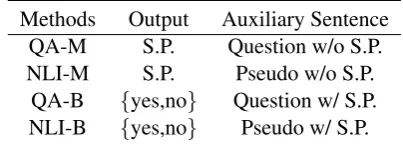
Methods Output Auxiliary Sentence QA-M S.P. Question w/o S.P. NLI-M S.P. Pseudo w/o S.P.
QA-B {yes,no} Question w/ S.P. NLI-B {yes,no} Pseudo w/ S.P.
Table 2: The construction methods. Due to limited space, we use the following abbreviations:S.P.for sen-timent polarity,w/oforwithout, andw/forwith.
Sentences for QA-M The sentence we want to generate from the target-aspect pair is a question, and the format needs to be the same. For example, for the set of a target-aspect pair (LOCATION1, safety), the sentence we generate is “what do you think of the safety of location - 1 ?”
Sentences for NLI-M For the NLI task, the con-ditions we set when generating sentences are less strict, and the form is much simpler. The tence created at this time is not a standard sen-tence, but a simple pseudo-sensen-tence, with (LOCA-TION1, safety) pair as an example: the auxiliary sentence is: “location - 1 - safety”.
[image:2.595.314.516.290.363.2]probabil-ity value of yes as the matching score. For a target-aspect pair which generates three sequences (positive, negative, none), we take the class of the sequence with the highest matching score for the predicted category.
Sentences for NLI-B The difference between NLI-B and QA-B is that the auxiliary sentence changes from a question to a pseudo-sentence. The auxiliary sentences are: “location - 1 - safety - positive”, “location - 1 - safety - negative”, and “location - 1 - safety - none”.
After we construct the auxiliary sentence, we can transform the TABSA task from a single sen-tence classification task to a sensen-tence pair classi-fication task. As shown in Table 3, this is a nec-essary operation that can significantly improve the experimental results of the TABSA task.
2.3 Fine-tuning pre-trained BERT
BERT (Devlin et al.,2018) is a new language rep-resentation model, which uses bidirectional trans-formers to pre-train a large corpus, and fine-tunes the pre-trained model on other tasks. We fine-tune the pre-trained BERT model on TABSA task. Let’s take a brief look at the input representation and the fine-tuning procedure.
2.3.1 Input representation
The input representation of the BERT can explic-itly represent a pair of text sentences in a sequence of tokens. For a given token, its input represen-tation is constructed by summing the correspond-ing token, segment, and position embeddcorrespond-ings. For classification tasks, the first word of each sequence is a unique classification embedding ([CLS]).
2.3.2 Fine-tuning procedure
BERT fine-tuning is straightforward. To obtain a fixed-dimensional pooled representation of the in-put sequence, we use the final hidden state (i.e., the output of the transformer) of the first token as the input. We denote the vector as C ∈ RH.
Then we add a classification layer whose param-eter matrix isW ∈ RK×H, whereK is the num-ber of categories. Finally, the probability of each categoryP is calculated by the softmax function P =softmax(CWT).
2.3.3 BERT-single and BERT-pair
BERT-single for (T)ABSA BERT for single sentence classification tasks. Suppose the number of target categories are nt and aspect categories
are na. We consider TABSA as a combination ofnt·natarget-aspect-related sentiment classifi-cation problems, first classifying each sentiment classification problem, and then summarizing the results obtained. For ABSA, We fine-tune pre-trained BERT model to trainnaclassifiers for all aspects and then summarize the results.
BERT-pair for (T)ABSA BERT for sentence pair classification tasks. Based on the auxil-iary sentence constructed in Section 2.2, we use the sentence-pair classification approach to solve (T)ABSA. Corresponding to the four ways of con-structing sentences, we name the models: M, BERT-pair-NLI-M, BERT-pair-QA-B, and BERT-pair-NLI-B.
3 Experiments
3.1 Datasets
We evaluate our method on the SentiHood (Saeidi et al.,2016) dataset2, which consists of 5,215 sen-tences, 3,862 of which contain a single target, and the remainder multiple targets. Each sentence con-tains a list of target-aspect pairs {t, a} with the sentiment polarityy. Ultimately, given a sentence sand the targettin the sentence, we need to:
(1) detect the mention of an aspectafor the tar-gett;
(2) determine the positive or negative sentiment polarityyfor detected target-aspect pairs.
We also evaluate our method on SemEval-2014 Task 4 (Pontiki et al., 2014) dataset3 for aspect-based sentiment analysis. The only difference from the SentiHood is that the target-aspect pairs {t, a}become only aspectsa. This setting allows us to jointly evaluate subtask 3 (Aspect Category Detection) and subtask 4 (Aspect Category Polar-ity).
3.2 Hyperparameters
We use the pre-trained uncased BERT-base model4 for fine-tuning. The number of Trans-former blocks is 12, the hidden layer size is 768, the number of self-attention heads is 12, and the total number of parameters for the pre-trained model is 110M. When fine-tuning, we keep the dropout probability at 0.1, set the number of
2
Dataset mirror: https://github.com/uclmr/jack/tree/master /data/sentihood
3
http://alt.qcri.org/semeval2014/task4/
4https://storage.googleapis.com/bert models/2018 10 18/
Model Aspect Sentiment Acc. F1 AUC Acc. AUC
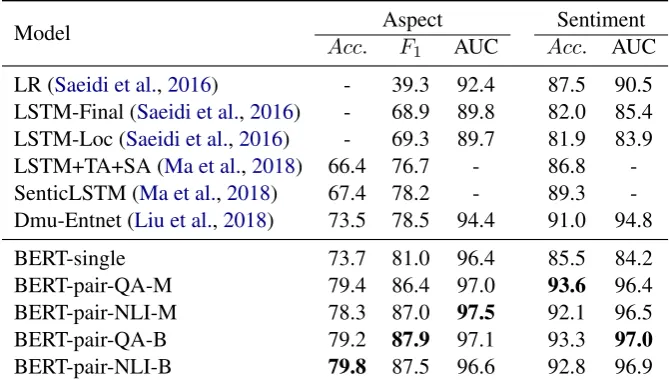
LR (Saeidi et al.,2016) - 39.3 92.4 87.5 90.5 LSTM-Final (Saeidi et al.,2016) - 68.9 89.8 82.0 85.4 LSTM-Loc (Saeidi et al.,2016) - 69.3 89.7 81.9 83.9 LSTM+TA+SA (Ma et al.,2018) 66.4 76.7 - 86.8 -SenticLSTM (Ma et al.,2018) 67.4 78.2 - 89.3 -Dmu-Entnet (Liu et al.,2018) 73.5 78.5 94.4 91.0 94.8
BERT-single 73.7 81.0 96.4 85.5 84.2
BERT-pair-QA-M 79.4 86.4 97.0 93.6 96.4
BERT-pair-NLI-M 78.3 87.0 97.5 92.1 96.5
BERT-pair-QA-B 79.2 87.9 97.1 93.3 97.0
[image:4.595.131.466.63.255.2]BERT-pair-NLI-B 79.8 87.5 96.6 92.8 96.9
Table 3: Performance on SentiHood dataset. We boldface the score with the best performance across all models. We use the results reported inSaeidi et al.(2016),Ma et al.(2018) andLiu et al.(2018). “-” means not reported.
epochs to 4. The initial learning rate is 2e-5, and the batch size is 24.
3.3 Exp-I: TABSA
We compare our model with the following models:
• LR (Saeidi et al.,2016): a logistic regression classifier with n-gram and pos-tag features.
• LSTM-Final (Saeidi et al.,2016): a biLSTM model with the final state as a representation.
• LSTM-Loc (Saeidi et al., 2016): a biLSTM model with the state associated with the tar-get position as a representation.
• LSTM+TA+SA (Ma et al.,2018): a biLSTM model which introduces complex target-level and sentence-level attention mechanisms.
• SenticLSTM (Ma et al.,2018): an upgraded version of the LSTM+TA+SA model which introduces external information from Sentic-Net (Cambria et al.,2016).
• Dmu-Entnet (Liu et al., 2018): a bi-directional EntNet (Henaff et al.,2016) with external “memory chains” with a delayed memory update mechanism to track entities.
During the evaluation of SentiHood, following Saeidi et al.(2016), we only consider the four most frequently seen aspects (general, price, transit-location, safety). When evaluating the aspect de-tection, followingMa et al.(2018), we use strict accuracy and Macro-F1, and we also report AUC.
In sentiment classification, we use accuracy and macro-average AUC as the evaluation indices.
3.3.1 Results
Results on SentiHood are presented in Table 3. The results of the BERT-single model on aspect detection are better than Dmu-Entnet, but the ac-curacy of sentiment classification is much lower than that of both SenticLstm and Dmu-Entnet, with a difference of 3.8 and 5.5 respectively.
However, BERT-pair outperforms other models on aspect detection and sentiment analysis by a substantial margin, obtaining 9.4 macro-average F1 and 2.6 accuracies improvement over Dmu-Entnet. Overall, the performance of the four BERT-pair models is close. It is worth noting that BERT-pair-NLI models perform relatively better on aspect detection, while BERT-pair-QA models perform better on sentiment classification. Also, the BERT-pair-QA-B and BERT-pair-NLI-B mod-els can achieve better AUC values on sentiment classification than the other models.
3.4 Exp-II: ABSA
The benchmarks for SemEval-2014 Task 4 are the two best performing systems inPontiki et al. (2014) and ATAE-LSTM (Wang et al., 2016). When evaluating SemEval-2014 Task 4 subtask 3 and subtask 4, followingPontiki et al.(2014), we use Micro-F1 and accuracy respectively.
3.4.1 Results
Models P R F1
XRCE 83.23 81.37 82.29
NRC-Canada 91.04 86.24 88.58
[image:5.595.78.284.63.188.2]BERT-single 92.78 89.07 90.89 BERT-pair-QA-M 92.87 90.24 91.54 BERT-pair-NLI-M 93.15 90.24 91.67 BERT-pair-QA-B 93.04 89.95 91.47 BERT-pair-NLI-B 93.57 90.83 92.18
Table 4: Test set results for Semeval-2014 task 4 Sub-task 3: Aspect Category Detection. We use the results reported in XRCE (Brun et al.,2014) and NRC-Canada (Kiritchenko et al.,2014).
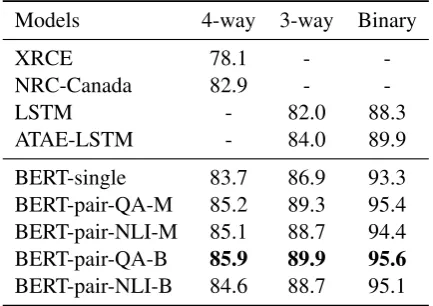
Models 4-way 3-way Binary
XRCE 78.1 -
-NRC-Canada 82.9 -
-LSTM - 82.0 88.3
ATAE-LSTM - 84.0 89.9
BERT-single 83.7 86.9 93.3
BERT-pair-QA-M 85.2 89.3 95.4
BERT-pair-NLI-M 85.1 88.7 94.4
BERT-pair-QA-B 85.9 89.9 95.6
BERT-pair-NLI-B 84.6 88.7 95.1
Table 5: Test set accuracy (%) for Semeval-2014 task 4 Subtask 4: Aspect Category Polarity. We use the results reported in XRCE (Brun et al.,2014), NRC-Canada (Kiritchenko et al., 2014) and ATAE-LSTM (Wang et al.,2016). “-” means not reported.
has achieved better results on these two subtasks, and BERT-pair has achieved further improvements over BERT-single. The BERT-pair-NLI-B model achieves the best performance for aspect category detection. For aspect category polarity, BERT-pair-QA-B performs best on all 4-way, 3-way, and binary settings.
4 Discussion
Why is the experimental result of the BERT-pair model so much better? On the one hand, we convert the target and aspect information into an auxiliary sentence, which is equivalent to expo-nentially expanding the corpus. A sentence si in the original data set will be expanded into
(si, t1, a1),· · · ,(si, t1, ana),· · · ,(si, tnt, ana) in
the sentence pair classification task. On the other hand, it can be seen from the amazing improve-ment of the BERT model on the QA and NLI tasks
(Devlin et al.,2018) that the BERT model has an advantage in dealing with sentence pair classifica-tion tasks. This advantage comes from both un-supervised masked language model and next sen-tence prediction tasks.
TABSA is more complicated than SA due to ad-ditional target and aspect information. Directly fine-tuning the pre-trained BERT on TABSA does not achieve performance growth. However, when we separate the target and the aspect to form an auxiliary sentence and transform the TABSA into a sentence pair classification task, the scenario is similar to QA and NLI, and then the advantage of the pre-trained BERT model can be fully utilized. Our approach is not limited to TABSA, and this construction method can be used for other similar tasks. For ABSA, we can use the same approach to construct the auxiliary sentence with only aspects. In BERT-pair models, BERT-pair-QA-B and BERT-pair-NLI-B achieve better AUC values on sentiment classification, probably because of the modeling of label information.
5 Conclusion
In this paper, we constructed an auxiliary tence to transform (T)ABSA from a single sen-tence classification task to a sensen-tence pair clas-sification task. We fine-tuned the pre-trained BERT model on the sentence pair classification task and obtained the new state-of-the-art results. We compared the experimental results of single sentence classification and sentence pair classifi-cation based on BERT fine-tuning, analyzed the advantages of sentence pair classification, and ver-ified the validity of our conversion method. In the future, we will apply this conversion method to other similar tasks.
Acknowledgments
[image:5.595.73.290.259.412.2]References
Caroline Brun, Diana Nicoleta Popa, and Claude Roux. 2014. Xrce: Hybrid classification for aspect-based sentiment analysis. In Proceedings of the 8th In-ternational Workshop on Semantic Evaluation (Se-mEval 2014), pages 838–842.
Erik Cambria, Soujanya Poria, Rajiv Bajpai, and Bj¨orn Schuller. 2016. Senticnet 4: A semantic resource for sentiment analysis based on conceptual primitives. In Proceedings of COLING 2016, the 26th Inter-national Conference on Computational Linguistics: Technical Papers, pages 2666–2677.
Jacob Devlin, Ming-Wei Chang, Kenton Lee, and Kristina Toutanova. 2018. Bert: Pre-training of deep bidirectional transformers for language understand-ing. arXiv preprint arXiv:1810.04805.
Mikael Henaff, Jason Weston, Arthur Szlam, Antoine Bordes, and Yann LeCun. 2016. Tracking the world state with recurrent entity networks. arXiv preprint arXiv:1612.03969.
Yohan Jo and Alice H Oh. 2011. Aspect and senti-ment unification model for online review analysis. InProceedings of the fourth ACM international con-ference on Web search and data mining, pages 815– 824. ACM.
Svetlana Kiritchenko, Xiaodan Zhu, Colin Cherry, and Saif Mohammad. 2014. Nrc-canada-2014: Detect-ing aspects and sentiment in customer reviews. In
Proceedings of the 8th International Workshop on Semantic Evaluation (SemEval 2014), pages 437– 442.
Fei Liu, Trevor Cohn, and Timothy Baldwin. 2018. Re-current entity networks with delayed memory update for targeted aspect-based sentiment analysis. arXiv preprint arXiv:1804.11019.
Yukun Ma, Haiyun Peng, and Erik Cambria. 2018. Targeted aspect-based sentiment analysis via em-bedding commonsense knowledge into an attentive lstm. InProceedings of AAAI.
Thien Hai Nguyen and Kiyoaki Shirai. 2015. Phrasernn: Phrase recursive neural network for aspect-based sentiment analysis. InProceedings of the 2015 Conference on Empirical Methods in Nat-ural Language Processing, pages 2509–2514.
Matthew E Peters, Mark Neumann, Mohit Iyyer, Matt Gardner, Christopher Clark, Kenton Lee, and Luke Zettlemoyer. 2018. Deep contextualized word rep-resentations. arXiv preprint arXiv:1802.05365.
Maria Pontiki, Dimitris Galanis, Haris Papageor-giou, Ion Androutsopoulos, Suresh Manandhar, AL-Smadi Mohammad, Mahmoud Al-Ayyoub, Yanyan Zhao, Bing Qin, Orph´ee De Clercq, et al. 2016. Semeval-2016 task 5: Aspect based sentiment anal-ysis. InProceedings of the 10th international work-shop on semantic evaluation (SemEval-2016), pages 19–30.
Maria Pontiki, Dimitris Galanis, Haris Papageorgiou, Suresh Manandhar, and Ion Androutsopoulos. 2015. Semeval-2015 task 12: Aspect based sentiment anal-ysis. InProceedings of the 9th International Work-shop on Semantic Evaluation (SemEval 2015), pages 486–495.
Maria Pontiki, Dimitris Galanis, John Pavlopoulos, Harris Papageorgiou, Ion Androutsopoulos, and Suresh Manandhar. 2014. Semeval-2014 task 4: As-pect based sentiment analysis. InProceedings of the 8th International Workshop on Semantic Evaluation (SemEval 2014), pages 27–35. Association for Com-putational Linguistics.
Alec Radford, Karthik Narasimhan, Tim Sali-mans, and Ilya Sutskever. 2018. Improv-ing language understandImprov-ing by generative pre-training. URL https://s3-us-west-2. amazon-aws. com/openai-assets/research-covers/language-unsupervised/language understanding paper. pdf.
Marzieh Saeidi, Guillaume Bouchard, Maria Liakata, and Sebastian Riedel. 2016. Sentihood: targeted aspect based sentiment analysis dataset for urban neighbourhoods. arXiv preprint arXiv:1610.03771.
Duyu Tang, Bing Qin, Xiaocheng Feng, and Ting Liu. 2015. Effective lstms for target-dependent sentiment classification. arXiv preprint arXiv:1512.01100.
Duyu Tang, Bing Qin, and Ting Liu. 2016. Aspect level sentiment classification with deep memory net-work. arXiv preprint arXiv:1605.08900.
Joachim Wagner, Piyush Arora, Santiago Cortes, Utsab Barman, Dasha Bogdanova, Jennifer Foster, and Lamia Tounsi. 2014. Dcu: Aspect-based polarity classification for semeval task 4. InProceedings of the 8th international workshop on semantic evalua-tion (SemEval 2014), pages 223–229.
Bo Wang, Maria Liakata, Arkaitz Zubiaga, and Rob Procter. 2017. Tdparse: Multi-target-specific sen-timent recognition on twitter. InProceedings of the 15th Conference of the European Chapter of the As-sociation for Computational Linguistics: Volume 1, Long Papers, volume 1, pages 483–493.