1724
An Empirical Investigation of Global and Local Normalization for
Recurrent Neural Sequence Models Using a Continuous Relaxation to
Beam Search
Kartik Goyal
School of Computer Science Carnegie Mellon University
Chris Dyer Deepmind
Taylor Berg-Kirkpatrick University of California, San Diego
Abstract
Globally normalized neural sequence models are considered superior to their locally normal-ized equivalents because they may ameliorate the effects of label bias. However, when con-sidering high-capacity neural parametrizations that condition on the whole input sequence, both model classes are theoretically equiva-lent in terms of the distributions they are ca-pable of representing. Thus, the practical ad-vantage of global normalization in the con-text of modern neural methods remains un-clear. In this paper, we attempt to shed light on this problem through an empirical study. We extend an approach for search-aware train-ing via a continuous relaxation of beam search (Goyal et al., 2017b) in order to enable train-ing ofglobally normalizedrecurrent sequence models through simple backpropagation. We then use this technique to conduct an empir-ical study of the interaction between global normalization, high-capacity encoders, and search-aware optimization. We observe that in the context of inexact search, globally nor-malized neural models are still more effec-tive than their locally normalized counterparts. Further, since our training approach is sen-sitive to warm-starting with pre-trained mod-els, we also propose a novel initialization strategy based on self-normalization for pre-training globally normalized models. We per-form analysis of our approach on two tasks: CCG supertagging and Machine Translation, and demonstrate the importance of global nor-malization under different conditions while us-ing search-aware trainus-ing.
1 Introduction
Neural encoder-decoder models have been tremendously successful at a variety of NLP tasks, such as machine translation (Sutskever et al., 2014; Bahdanau et al., 2015), parsing (Dyer et al., 2016, 2015), summarization (Rush et al., 2015),
dialog generation (Serban et al., 2015), and image captioning (Xu et al., 2015). With these models, the target sequence is generated in a left-to-right step-wise manner with the predictions at every step being conditioned on the input sequence and the whole prediction history. This long-distance memory precludes exact search for the maximally scoring sequence according to the model and therefore, approximate algorithms like greedy search or beam search are necessary in practice during decoding. In this scenario, it is natural to resort to search-aware learning techniques for these models which makes the optimization objective sensitive to any potential errors that could occur due to inexact search in these models. This work focuses on comparison between search-aware locally normalized sequence mod-els that involve projecting the scores of items in the vocabulary onto a probability simplex at each step and globally normalized/unnormalized sequence models that involve scoring sequences without explicit normalization at each step. When conditioned on the the full input sequence and the entire prediction history, both locally normal-ized and globally normalnormal-ized conditional models should have same expressive power under a high-capacity neural parametrization in theory, as they can both model same set of distributions over all fi-nite length output sequences (Smith and Johnson, 2007). However, locally normalized models are constrained in how they respond to search errors during training since the scores at each decoding step must sum to one. To let a search-aware train-ing setup have the most flexibility, abandontrain-ing this constraint may be useful for easier optimization.
the more common locally normalized parametriza-tion. We posit that this difference is due to
la-bel bias (Bottou, 1991) arising from the
interac-tion of approximate search and search-aware op-timization in locally normalized models. A com-monly understood source of label bias in locally
normalizedsequence models is an effect of
condi-tioning only on partial input (for example, only the history of the input) at each step during decoding (Andor et al., 2016; Lafferty et al., 2001; Wise-man and Rush, 2016). We discus another poten-tial source of label bias arising from approximate search with locally normalized models that may be present even with access to the full input at each step. To this end, we train search-aware globally and locally normalized models in an end-to-end (sub)-differentiable manner using a continuous re-laxation to the discontinuous beam search proce-dure introduced by Goyal et al. (2017b). This ap-proach requires initialization with a suitable glob-ally normalized model to work in practice. Hence, we also propose an initialization strategy based upon self-normalization for pre-training globally normalized models.
We demonstrate the effect of both sources of label bias through our experiments on two com-mon sequence tasks: CCG supertagging and ma-chine translation. We find that label bias can be eliminated by both, using a powerful encoder, and using a globally normalized model. We observe that global normalization yields perfor-mance gains over local normalization and is able to ameliorate label bias especially in scenarios that involve a very large hypothesis space.
2 Recurrent Sequence Models and Effects of Normalization
We now introduce the notation that we will use in the remainder of the paper for describing lo-cally and globally normalized neural sequence-to-sequence models. We are interested in the proba-bility of output sequence,y, conditioned on input sequence,x. Lets(x, y1:i−1, yi)be a non negative
score of output labelyat time-stepifor the input
x and the prediction history y1:i−1, let V be the
label space, and let Yx be the space of all finite
sequences forx.1 A neural encoder (e.g. a bidi-rectional LSTM) encodes information aboutxand a recurrent neural decoder generates the outputy
1For notational convenience we suppress the dependence of the scoreson model parametersθ.
(typically step-by-step from left-to-right) condi-tioned on the encoder.
2.1 Locally normalized models
Under a locally normalized modelML, the
prob-ability ofygivenxis:
pML(y|x) =
n Y
i=1
p(yi|x, y1:i−1) =
n Y
i=1
s(x, y1:i−1, yi)
ZL,i(x, y1:i−1)
whereZL,i(x, y1:i−1) = Py∈V s(x, y1:i−1, y), is
the local normalizer at each time step andnis the number of prediction steps. Since, the local nor-malizer is easy to compute, likelihood maximiza-tion based training is a standard approach for train-ing these models.
2.2 Globally normalized models
In contrast, under a globally normalized model
MG, the probability ofygivenxis:
pMG(y|x) =
Qn
i=1s(x, y1:i−1, yi) ZG(x)
where ZG(x) = Py∈Y Qn
i=1s(x, y1:i−1, yi), is
the global log-normalizer. ZG(x)is intractable to estimate for most problems of interest due to the large search space therefore, an exact likelihood maximization training approach is intractable for these models.
2.3 Label Bias with partial input
It was shown in Andor et al. (2016); Lafferty et al. (2001), locally normalized conditional mod-elswith access to only partial input,x1:i−1, at each
decoding step are biased towards labeling deci-sions with low-entropy transition probabilities at each decoding step and, as a result, suffer from a weakened ability to revise previous decisions based upon future input observations. This phe-nomenon has been referred to as label bias, and presents itself as an arbitrary allocation of prob-ability mass to unlikely or undesirable label quences despite the presence of well-formed se-quences in training data. Andor et al. (2016) prove that this class of locally normalized models that re-lies on the structural assumption of access to only left-to-right partial input at each step,
n Y
i=1
p(yi|x, y1:i−1) =
n Y
i=1
is strictly less expressive than its globally normal-ized counterpart.
However, the standard sequence-to-sequence models used most often in practice and presented in this paper actually condition the decoder on a summary representation of the entire input
se-quence,x, computed by a neural encoder. Hence,
depending on the power of the encoder, it is com-monly thought that such models avoid this type of label bias. For these models, both locally normal-ized and globally normalnormal-ized conditional models are equally expressive, in principle, with a suffi-ciently powerful encoder.
However, as we suggest in the next section and show empirically in experiments, this does not necessarily mean that both parametrizations are equally amenable to gradient-based training in practice, particularly when the search space is large and search-aware training techniques are used. We will argue that they suffer from a related, but distinct, form of bias introduced by inexact de-coding.
2.4 Search-aware training
To improve performance with inexact decoding methods (e.g. beam search), search-aware train-ing techniques take into account the decodtrain-ing pro-cedure that will be used at test time and adjust the parameters of the model to maximize prediction accuracy under the decoder. Because of the pop-ularity of beam search as a decoding procedure for sequence models, in this paper we focus on beam search-aware training. While many options are available, including beam-search optimization (BSO) (Wiseman and Rush, 2016), in Section 3.1 we will describe the particular search-aware train-ing strategy we use in experiments (Goyal et al., 2017b), chosen for its simplicity.
2.5 Label Bias due to approximate search
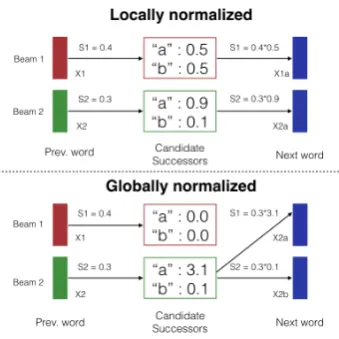
[image:3.595.337.507.64.234.2]We illustrate via example how optimization of lo-cally normalized models may suffer from a new kind of label bias when using beam search-aware training, and point to reasons why this issue might be mitigated by the use of globally normalized models. While the scores of successors of a sin-gle candidate under a locally normalized model are constrained to sum to one, scores of succes-sors under a globally normalized model need only be positive. Intuitively, during training, this gives the globally normalized model more freedom to
Figure 1: Illustrative example of bias arising in locally normalized models due to beam search. Red indicates the candidate that optimization should learn to discard and green indicates the candidate that should be prop-agated. Locally normalized models are constrained to return normalized scores for the successors of each can-didate, while globally normalized models are uncon-strained and can more easily learn to drop successors of the red candidate.
downweight undesirable intermediate candidates in order avoid search errors.
In the example beam search decoding problem in Figure 1, we compare the behavior of locally and globally normalized models at a single time step for a beam size of two. In this example, we as-sume that the score for beams in both the models is exactly the same until the step shown in Figure 1. Suppose that the lower item on the beam(X2) is correct, and thus, for more effective search, we would prefer the models scores to be such that only successors of the lower beam item are present on the beam at the next step. However, since, the scores at each step for a locally normalized model are constrained to sum to one, the upper beam item(X1) generates successors with scores com-parable to those of the lower beam item. As we see in the example, due to the normalization con-straint, search-aware training of the locally nor-malized model might find it difficult to set the pa-rameters to prevent extension of the poorer candi-date. In contrast, because the scores of aglobally
normalized model are not constrained to sum to
Soft Beam Recurrence Row-sum
Col-sum
Weighted Linear Combination Soft Beam Recurrence
Soft-k-argmax Candidate
successor scores
a
b c
Embedding ⇥
Soft Backpointers
hnext 2 hnext
1 hcur
1
hcur 2
˜
hcur 1 pmax
1
pmax 2 D
w1 cur= “a”
w2 cur= “b”
w1 next
a
b
c
d
peaked-softmax↵( (s m1·1)2)
m1
m2
s
peaked-softmax↵( (s m2·1)2)
[image:4.595.95.501.66.227.2]Soft Beam Computation Soft-k-argmax
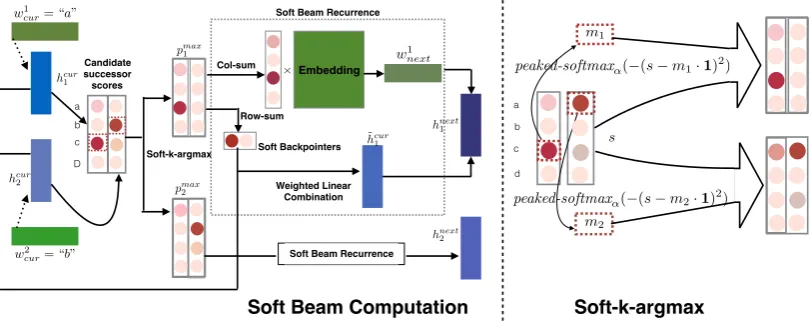
Figure 2: Left:Computing LSTM hidden states at a subsequent step using continuous relaxation to beam search for beam size of 2. Right: Illustration of top-k-argmax. m1 andm2 are the maximum and second maximum
candidate scores.
be more effective. However as discussed earlier, if we can performexact search then this label bias
ceases to exist because both the models have the same expressive power with a search-agnostic op-timization scheme. In experiments, we will ex-plore this trade-off empirically.
3 Search-aware Training for Globally Normalized Models
In order to conduct an empirical study with mean-ingful comparisons, we devise an extension of the relaxed beam-search based optimization proposed by Goyal et al. (2017b) that allows us to train both the search-aware globally and locally normalized models in a similar manner with the same under-lying architecture.
3.1 Continuous Relaxation to Beam Search
Following Goyal et al. (2017b), we train a beam-search aware model by optimizing a continuous surrogate approximation to adirect lossobjective,
J, defined as a function of the output of beam search and the ground truth sequencey∗:
min
θ J(x, θ,y
∗) = min
θ `(Beam(x,M(θ)),y ∗)
Here`is a function that computes the loss of the model’s prediction produced by beam search , and
Mrefers to the model parametrized byθ. While this objective is search-aware, it is discontinuous and difficult to optimize because beam search in-volves discrete k-argmax operations. Therefore, Goyal et al. (2017b) propose a continuous surro-gate, J˜, by defining a continuous approximation
(soft-k-argmax) of the discretek-argmaxand using
this to compute an approximation to a composition of the loss function and the beam search function.
min θ
˜
J(x, θ,y∗)≈min
θ (`◦Beam)(x,M(θ),y ∗)
The soft-k-argmaxprocedure involves computing
distances between the scores of the successors and thekth-max score and using the temperature based
argmax operation (Maddison et al., 2017; Jang et al., 2016; Goyal et al., 2017a) to get an out-put peaked on thekth-max value as shown in the
right panel of Figure 2. The temperature is a hy-perparameter which is typically annealed toward producing low entropy distributions during opti-mization. As shown in the left panel of Figure 2,
thesoft candidate vectorsand thesoft
backpoint-ers are computed at every decoding step using
thissoft-k-argmax operation in order to generate
the embeddings and recurrent hidden states of the LSTM at each step of thesoft beam search proce-dure. With a locally decomposable loss like Ham-ming loss, both soft loss and soft scores for the relaxed procedure are iteratively computed so that the end-to-end objective computation can be de-scribed by a computation graph that is amenable to backpropagation.
Using this relaxation, point-wise convergence of the surrogate objective to the original objective can be established (αis the inverse temperature):
˜
Jα(x, θ,y∗) α→∞
−−−→p J(x, θ,y∗)
In experiments, for training locally normalized models, we use log-normalizedsuccessor scores. However, for training globally normalized models, we will directly use unnormalized scores, which are∈R+.
3.2 Initialization for training globally normalized models
Goyal et al. (2017b) reported that initialization
with a locally normalized model pre-trained with teacher-forcing was important for their continu-ous beam search based approach to be stable and hence they used the locally normalized log-scores for their search-aware training model. In this work, we experimented with the unnormalized candidate successor scores and found that initial-izing the optimization for a globally normalized objective with a cross-entropy trained locally nor-malized model resulted in unstable training. This is expected because the locally normalized mod-els are parametrized in a way such that using the scores before the softmax normalization results in a very different outcome than using scores after local normalization. For example, the locally nor-malized Machine Translation model in Table 1, that gives a BLEU score of27.62 when decoded with beam search using locally normalized scores, results in BLEU of4.30when beam search decod-ing is performed with unnormalized scores. Pre-training a truly globally normalized model for ini-tialization is not straghtforward because no exact likelihood maximization techniques exist for glob-ally normalized models as the global normalizer is intractable to compute.
Therefore, we propose a new approach to ini-tialization for search-aware training of globally normalized models: we pre-train a locally nor-malized model that is parametrized like a glob-ally normalized model. More specifically, we train a locally normalized model with its distribu-tion over the output sequences denoted bypL(Y)
such that we can easily find a globally normal-ized model with a distributionpG(Y)that matches
pL(Y). Following the notation in Section 2, for a locally normalized model, the log-probability of a sequence is:
n X
i=1
[logs(x, y1:i−1, yi)−logZL,i(x, y1:i−1)]
and for a globally normalized model it is:
" n X
i=1
logs(x, y1:i−1, yi) #
−logZG(x)
3.2.1 Self Normalization
One way to find a locally normalized model that is parametrized like a globally normalized model is to ensure that the local normalizer at each step,
log ZL,i(x, y1:i−1), is0. With the local
normal-izer being zero it is straightforward to see that the log probability of a sequence under a locally normalized model can easily be interpreted as log probability of the sequence under a globally normalized model with the global log-normalizer,
log ZG(x) = 0. This training technique is called
self-normalization(Andreas and Klein, 2015)
be-cause the resulting models’ unnormalized score at each step lies on a probability simplex. A common technique for training self-normalized models is L2-regularization of local log normalizer which encourages learning a model with log Z = 0
and was found to be effective for learning a lan-guage model by Devlin et al. (2014)2. The L2-regularized cross entropy objective is given by:
min θ
X
x,y∗∈D −
n X
i=1
log p(yi∗ |x, y1:i−1)
+λ·(log ZL,i(x, y1:i−1))2
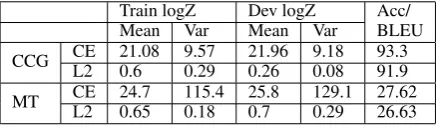
In Table 1, we report the mean and variance of the local log normalizer on the two different tasks using L2-regularization (L2) based self normal-ization and no self normalnormal-ization (CE). We ob-serve thatL2models are competitive performance-wise to the cross-entropy trained locally normal-ized models while resulting in a much smaller local log-normalizer on average. Although, we couldn’t minimizelog Z exactly to 0, we observe in Section 4 that this is sufficient to train a rea-sonable initializer for the search-aware optimiza-tion of globally normalized models. It is impor-tant to note that these approaches yield a
glob-ally normalized model that is equivalent to a
lo-cally normalized model trained via teacher-forcing and hence these are only used towarm-start the search-aware optimization of globally normalized models. Our search-aware training approach is
free to adjust the parameters of the models such that the final globally normalized model has a non-zero log-normalizerZGover the data.
Train logZ Dev logZ Acc/ BLEU Mean Var Mean Var
CCG CE 21.08 9.57 21.96 9.18 93.3 L2 0.6 0.29 0.26 0.08 91.9
MT CE 24.7 115.4 25.8 129.1 27.62 L2 0.65 0.18 0.7 0.29 26.63
Table 1: Comparison of logZ between cross entropy trained models (CE) and self normalized models (L2) for CCG supertagging and Machine Translation tasks.
Other possible approaches to project locally normalized models onto globally normalized mod-els include distribution matching via knowledge distillation (Hinton et al., 2015). We leave explo-ration of warm-starting of search aware optimiza-tion with this approach to future work.
4 Experiments and Empirical Analysis
To empirically analyze the interaction between la-bel bias arising from different sources, search-aware training, and global normalization, we con-ducted experiments on two tasks with vastly dif-ferent sizes of output space: CCG supertagging and Machine Translation. As described in the next section, the task of tagging allows us to perform controlled experiments which explicitly study the effect of amount of input information available to the decoder at each step, we analyze the scenarios in which search aware training and global normal-ization are expected to improve the model perfor-mance.
In all our experiments, we report results on training with standard teacher forcing optimiza-tion and self-normalizaoptimiza-tion as our baselines. We report results with both search-aware locally and globally normalized models (Section 3.1) after warm starting with both cross entropy trained models and self-normalized models to study the effects of search-aware optimization and global normalization. We follow Goyal et al. (2017b) and use the decomposable Hamming loss approx-imation with search-aware optimization for both the tasks and decode via soft beam search
de-coding method which involves continuous beam
search with soft backpointers for the LSTM Beam search dynamics as described in Section 3, but using identifiable backpointers and labels (using MAP estimates of soft backpointers and labels) to decode.
We tune hyperparameters like learning rate and annealing schedule by observing performance on development sets for both the tasks. We performed at least three random restarts for each class and report results based on best development perfor-mance.
4.1 CCG supertagging
We used the standard splits of CCG bank (Hock-enmaier and Steedman, 2002) for training, devel-opment, and testing. The label space of supertags is 1,284 and the labels are correlated with each other based on their syntactic relations. The dis-tribution of supertag labels in the training data ex-hibits a long tail distribution. This task is sensitive to the long range sequential decisions because it encodes rich syntactic information about the sen-tence. Hence, this task is ideal to analyze the ef-fects of label bias and search efef-fects. We perform minor preprocessing on the data similar to the pre-processing in Vaswani et al. (2016). For experi-ments related to search aware optimization, we re-port results with beam size of 5.3
4.1.1 Tagging model for ablation study
We changed the standard sequence-to-sequence model to be more suitable for the tagging task. This change also lets us perform controlled exper-iments pertaining to the amount of input sequence information available to the decoder at each time step.
In a standard encoder-decoder model with at-tention, the initial hidden state of the decoder is often some function of the final encoder state so that the decoder’s predictions can be conditioned on the full input. For our tagging experiments, in-stead of influencing the initial decoder state with the encoder, we set it to a vector of zeros. Thus the information about input for prediction isonly
available via the attention mechanism. In addition to the change above, we also forced the model to attend to only the ith input representation while
predicting the ith label. This is enforceable
be-cause the output length is equal to the input length and it is also a more suitable structure for a tag-ging model. With these changes in the decoder, we can precisely control the amount of informa-tion about the input available to the decoder at each prediction step. For example, with a unidi-rectional LSTM encoder, the decoder at ith step
[image:6.595.72.292.114.178.2]only has access to input till the ith token and the
prediction history:
p(yi |x, y1:i−1) =p(yi |x1:i, y1:i−1)
This setting lets us clearly explore the classical no-tion of label bias arising out of access to partial input at each prediction step (Section 2.3). A bidi-rectional LSTM encoder, however provides access to all of the input information to the decoder at all the prediction steps.
Unidirectional Bidirectional pretrain-greedy 76.54 92.59
pretrain-beam 77.76 93.29
locally normalized 83.9 93.76
[image:7.595.318.513.61.115.2]globally normalized 83.93 93.73
Table 2: Accuracy results on CCG supertag-ging when initialized with a regular teacher-forcing model. Reported using Unidirectional and Bidirec-tional encoders respectively with fixed attention tag-ging decoder. pretrain-greedyandpretrain-beamrefer to the output of decoding the initializer model. locally normalized and globally normalized refer to search-aware soft-beam models
Unidirectional Bidirectional pretrain-greedy 73.12 91.23
pretrain-beam 73.83 91.94
locally normalized 83.35 92.78
[image:7.595.78.285.221.275.2]globally normalized 85.50 92.63
Table 3: Accuracy results on CCG supertagging when initialized with a self normalized model.
4.2 Machine Translation
We use the same dataset (the German-English por-tion of the IWSLT 2014 machine translapor-tion evalu-ation campaign (Cettolo et al., 2014)), preprocess-ing and data splits as Ranzato et al. (2016) for our Machine Translation experiments. The output la-bel/vocabulary size is 32000 and unlike tagging, the length of output sequences cannot be determin-istically determined from the length of the input sequence. Moreover, the output sequence does not necessarily align monotonically with the input se-quence. Hence the output sequence space for MT is much larger than that for tagging and the effects of inexact search on optimization are expected to be even more apparent for MT. We use a standard LSTM-based encoder/decoder model with a stan-dard attention mechanism (Bahdanau et al., 2016) for our MT experiments. For search-aware
opti-Init-scheme→ Regular Self-normalized pretrain-greedy 26.24 25.42
pretrain-beam 27.62 26.63 locally-normalized 29.28 27.71 globally-normalized 26.24 29.27
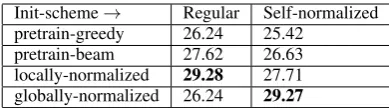
Table 4: BLEU results on de-en Machine Transla-tion. RegularandSelf-normalizedrefer to the initiza-tion scheme for soft beam search training. pretrain-greedyandpretrain-beamrefer to the output of decod-ing the initializer model. locally normalizedand glob-ally normalizedrefer to search-aware soft-beam mod-els
mization experiments, we report results with beam size 3.4
4.3 Results and Analysis
The results reported in Tables 2, 3 and 4 allow us to analyze the effect of interaction of label bias, inexact search and global normalization in detail.
4.3.1 Label bias with partial input
First, we analyze the effect of label bias that arises from conditioning on partial input (Section 2.3) during decoding on optimization of the models. The unidirectional encoder based tagging experiments suggest that conditioning on partial input during decoding results in poor models when trained with cross entropy based methods. Interestingly, all techniques improve upon this: (i) search-aware locally and globally normalized models are able to train for accuracy directly and eliminate exposure bias that arises out of the mismatch between train-time and test-time prediction methods, and, (ii) the bidirectional tagging model which provides access to all of the input is powerful enough to learn a complex relationship between the decoder and the input representations for the search space of the CCG supertagging task and results in a much better performance.
4.3.2 Initialization of search-aware training
Next, we analyze the importance of appropriate initialization of search-aware optimization with pretrained models. Across all the results in Tables 2, 3 and 4, we observe that search-aware optimization for locally normalized models always improves upon the pre-trained locally
[image:7.595.79.285.406.458.2]normalized models used for initialization. But when the search-aware optimization for globally normalized models is initialized with locally normalized CE models, the improvement is not as pronounced and in the case of MT, the performance is actually hurt by the improper initialization for training globally normalized models – probably a consequence of large search space associated with MT and incompatibility between unnormalized scores for search-aware optimization and locally normalized scores of the CE model used for pre-training. When the
self-normalizedmodels are used for initialization,
optimization for globally normalized models always improves upon the pre-trained self-normalized model. It is interesting to note that we see improvements for the globally normalized models even whenlogZis not exactly reduced to
0indicating that the scores used for search-aware training initially are comparable to the scores of the pre-trained self-normalized model. We also observe that self-normalized models perform slightly worse than CE-trained models but search aware training for globally normalized models improves the performance significantly.
4.3.3 Search-aware training
Next, we analyze the effect of search-aware optimization on the performance of the models. Search-aware training with locally normalized models improves the performance significantly in all our experiments which indicates that accounting for exposure bias and optimizing for predictive performance directly is important. We also observe that the bidirectional model for tagging is quite powerful and seems to account for both exposure bias and label bias to a large extent. We reckon that this may be because the greedy decoding itself is very close to exact
search for this well-trained tagging model over
a search space that is much simpler than that associated with MT. Therefore, the impact of search-aware optimization on the bidirectional tagger is marginal. However, it is much more pronounced on the task of MT.
4.3.4 Global normalization and label bias
We analyze the importance of training globally normalized models. In the specific setup for tagging with the unidirectional encoder, globally
normalized models are actually more expressive
than the locally normalized models (Andor et al., 2016) as described in Section 2.3 and this is reflected in our experiments (table 3) with tagging. The globally normalized model (warm started with a self-normalized model) performs the best among all the models in the unidirectional tagger case which indicates that it is ameliorating something beyond exposure bias which is fixed by the search-aware locally normalized model. For MT (table 4), both globally normalized and locally normalized models are equally expressive in theory because the decoder is conditioned on the full input information at each step, but we still observe that the globally normalized model improves significantly over the self-normalized pre-trained model and the search-aware locally normalized model. This indicates that it might be ameliorating the label bias associated with inexact search (discussed in Section 2.5). As discussed in Section 3.2, the globally normalized model, when initialized with a CE trained model, performs worse because of improper initialization of the search aware training. The self-normalized model starts off 1 BLEU point worse than the CE model point but global normalization, initial-ized with the self-normalinitial-ized model improves the performance and is competitive with the best model for MT. This suggests that a better technique for initializing the optimization for globally normalized models should be helpful in improving the performance.
4.3.5 Global normalization and sentence length
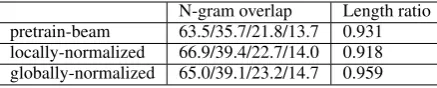
In tables 5 and 6, we analyze the source of im-provement from global normalization for MT. In table 5, we report the ngram overlap scores and ratio of length of the predictions to length of hy-pothesis for the case when the search-aware train-ing is initialized with a self-normalized model. We observe that the globally normalized model pro-duces longer predictions than the locally normal-ized model. More interestingly, it seems to have better 3 and 4-gram overlap and slightly worse un-igram and bun-igram overlap score than the locally normalized model. These observations suggest that globally normalized models are better able to take longer range effects into account and are also cautious about predicting theend-of-sentence
N-gram overlap Length ratio pretrain-beam 63.5/35.7/21.8/13.7 0.931 locally-normalized 66.9/39.4/22.7/14.0 0.918 globally-normalized 65.0/39.1/23.2/14.7 0.959
Table 5: Breakdown of BLEU results on de-en Machine Translation dev set. Reported on Self-normalized initialization
Src sent-length→ 0-20 20-30 30-40 40+
pretrain-beam 29.36 25.73 24.71 24.50 locally-normalized 32.35 26.95 25.39 25.2 globally-normalized 33.21 28.08 26.75 26.41
Table 6: BLEU scores with different length inputs on dev setReported on Self-normalized initialization. The header specifies the range of length of the input sentences
that globally normalized models perform better on all the length ranges but especially so on long sen-tences.
5 Related Work
Much of the existing work on search-aware train-ing of globally normalized neural sequence mod-els uses some mechanism like early updates (Collins and Roark, 2004) that relies on explicitly tracking if the gold sequence falls off the beam and is not end-to-end continuous. Andor et al. (2016) describe a method for training globally normal-ized neural feedforward models, which involves optimizing a CRF-based likelihood where the nor-malizer is approximated by the sum of the scores of the final beam elements. They describe label bias arising out of conditioning on partial input and hence focused on the scenario in which lo-cally normalized models can be less expressive than globally normalized models, whereas we also consider another source of label bias which might be affecting the optimization of equally expres-sive locally and globally normalized conditional models. Wiseman and Rush (2016) also propose a beam search based training procedure that uses un-normalized scores similar to our approach. Their models achieve good performance over CE base-lines – a pattern that we observe in our results as well. In this work, we attempt to empirically ana-lyze the factors affecting this boost in performance with end-to-end continuous search-aware training (Goyal et al., 2017b) for globally normalized mod-els.
Smith and Johnson (2007) proved that locally normalized conditional PCFGs and unnormalized
conditional WCFGs are equally expressive for fi-nite length sequences and posit that Maximum En-tropy Markov Models (MEMMs) are weaker than CRFs because of the structural assumptions in-volved with MEMMs that result in label bias.
Recently, energy based neural structured pre-diction models (Amos et al., 2016; Belanger and McCallum, 2016; Belanger et al., 2017) were pro-posed that define an energy function over can-didate structured output space and use gradient based optimization to form predictions making the overall optimization search aware. These mod-els are designed to model global interactions be-tween the output random variables without speci-fying strong structural assumptions.
6 Conclusion
We performed empirical analysis to analyze the interaction between label bias, search-aware opti-mization and global normalization in various sce-narios. We proposed an extension to the continu-ous relaxation to beam search proposed by Goyal et al. (2017b) to train search-aware globally nor-malized models and comparable locally normal-ized models. We find that in the context of inex-act search over large output spaces, globally nor-malized models are more effective than the locally normalized models in spite of them being equiva-lent in terms of their expressive power.
Acknowledgement
This project is funded in part by the NSF under grant 1618044. We thank the three anonymous re-viewers for their helpful feedback.
References
Brandon Amos, Lei Xu, and J Zico Kolter. 2016. Input convex neural networks. arXiv preprint arXiv:1609.07152.
Daniel Andor, Chris Alberti, David Weiss, Aliaksei Severyn, Alessandro Presta, Kuzman Ganchev, Slav Petrov, and Michael Collins. 2016. Globally nor-malized transition-based neural networks. In Asso-ciation for Computational Linguistics.
Dzmitry Bahdanau, Kyunghyun Cho, and Yoshua Ben-gio. 2015. Neural machine translation by jointly learning to align and translate. InInternational Con-ference on Learning Representations.
Dzmitry Bahdanau, Dmiriy Serdyuk, Phil´emon Brakel, Nan Rosemary Ke, Jan Chorowski, Aaron Courville, and Yoshua Bengio. 2016. Task loss estimation for structured prediction.
David Belanger and Andrew McCallum. 2016. Struc-tured prediction energy networks. In International Conference on Machine Learning, pages 983–992. David Belanger, Bishan Yang, and Andrew McCallum.
2017. End-to-end learning for structured prediction energy networks.arXiv preprint arXiv:1703.05667. L´eon Bottou. 1991. Une Approche th´eorique de l’Apprentissage Connexionniste: Applications `a la Reconnaissance de la Parole. Ph.D. thesis, Univer-sit´e de Paris XI, Orsay, France.
Mauro Cettolo, Jan Niehues, Sebastian St¨uker, Luisa Bentivogli, and Marcello Federico. 2014. Report on the 11th iwslt evaluation campaign, iwslt 2014. In Proceedings of the International Workshop on Spo-ken Language Translation, Hanoi, Vietnam. Michael Collins and Brian Roark. 2004. Incremental
parsing with the perceptron algorithm. In Proceed-ings of the 42nd Annual Meeting on Association for Computational Linguistics, page 111. Association for Computational Linguistics.
Jacob Devlin, Rabih Zbib, Zhongqiang Huang, Thomas Lamar, Richard Schwartz, and John Makhoul. 2014. Fast and robust neural network joint models for sta-tistical machine translation. In Proceedings of the 52nd Annual Meeting of the Association for Compu-tational Linguistics (Volume 1: Long Papers), vol-ume 1, pages 1370–1380.
Chris Dyer, Miguel Ballesteros, Wang Ling, Austin Matthews, and Noah A Smith. 2015. Transition-based dependency parsing with stack long short-term memory.arXiv preprint arXiv:1505.08075. Chris Dyer, Adhiguna Kuncoro, Miguel Ballesteros,
and Noah A Smith. 2016. Recurrent neural network grammars. arXiv preprint arXiv:1602.07776. Kartik Goyal, Chris Dyer, and Taylor
Berg-Kirkpatrick. 2017a. Differentiable scheduled sampling for credit assignment. arXiv preprint arXiv:1704.06970.
Kartik Goyal, Graham Neubig, Chris Dyer, and Taylor Berg-Kirkpatrick. 2017b. A continuous relaxation of beam search for end-to-end training of neural se-quence models. arXiv preprint arXiv:1708.00111. Michael Gutmann and Aapo Hyv¨arinen. 2010.
Noise-contrastive estimation: A new estimation principle for unnormalized statistical models. InProceedings of the Thirteenth International Conference on Artifi-cial Intelligence and Statistics, pages 297–304.
Geoffrey Hinton, Oriol Vinyals, and Jeff Dean. 2015. Distilling the knowledge in a neural network. arXiv preprint arXiv:1503.02531.
Julia Hockenmaier and Mark Steedman. 2002. Acquir-ing compact lexicalized grammars from a cleaner treebank. InLREC.
Eric Jang, Shixiang Gu, and Ben Poole. 2016. Cate-gorical reparameterization with gumbel-softmax. In International Conference on Learning Representa-tions.
John Lafferty, Andrew McCallum, and Fernando CN Pereira. 2001. Conditional random fields: Prob-abilistic models for segmenting and labeling se-quence data.
Chris J Maddison, Andriy Mnih, and Yee Whye Teh. 2017. The concrete distribution: A continuous re-laxation of discrete random variables. In Interna-tional Conference on Learning Representations. Andriy Mnih and Yee Whye Teh. 2012. A fast and
sim-ple algorithm for training neural probabilistic lan-guage models. arXiv preprint arXiv:1206.6426. Marc’Aurelio Ranzato, Sumit Chopra, Michael Auli,
and Wojciech Zaremba. 2016. Sequence level train-ing with recurrent neural networks. InInternational Conference on Learning Representations.
Alexander M Rush, Sumit Chopra, and Jason Weston. 2015. A neural attention model for abstractive sen-tence summarization. InEmpirical Methods in Nat-ural Language Processing.
Iulian V Serban, Alessandro Sordoni, Yoshua Bengio, Aaron Courville, and Joelle Pineau. 2015. Building end-to-end dialogue systems using generative hier-archical neural network models. In AAAI’16 Pro-ceedings of the Thirtieth AAAI Conference on Artifi-cial Intelligence.
Noah A Smith and Mark Johnson. 2007. Weighted and probabilistic context-free grammars are equally expressive. Computational Linguistics, 33(4):477– 491.
Ilya Sutskever, Oriol Vinyals, and Quoc V Le. 2014. Sequence to sequence learning with neural net-works. InAdvances in neural information process-ing systems, pages 3104–3112.
Ashish Vaswani, Yonatan Bisk, Kenji Sagae, and Ryan Musa. 2016. Supertagging with lstms. In Proceed-ings of NAACL-HLT, pages 232–237.
Sam Wiseman and Alexander M Rush. 2016. Sequence-to-sequence learning as beam-search op-timization. In Empirical Methods in Natural Lan-guage Processing.