Dialog state tracking,
a machine reading approach using Memory Network
Julien Perez
Xerox Research Centre Europe Grenoble, France
Fei Liu∗
The University of Melbourne Victoria, Australia
Abstract
In an end-to-end dialog system, the aim of dialog state tracking is to accurately estimate a compact representation of the current dialog status from a sequence of noisy observations produced by the speech recognition and the natural language un-derstanding modules. This paper intro-duces a novel method of dialog state track-ing based on the general paradigm of machine reading and proposes to solve it using an End-to-End Memory Net-work,MemN2N, a memory-enhanced neu-ral network architecture. We evaluate the proposed approach on the second Dia-log State Tracking Challenge (DSTC-2) dataset. The corpus has been converted for the occasion in order to frame the hid-den state variable inference as a question-answering task based on a sequence of ut-terances extracted from a dialog. We show that the proposed tracker gives encourag-ing results. Then, we propose to extend the DSTC-2 dataset and the definition of this dialog state task with specific reason-ing capabilities like countreason-ing, list mainte-nance, yes-no question answering and in-definite knowledge management. Finally, we present encouraging results using our proposedMemN2Nbased tracking model.
1 Introduction
One of the core components of state-of-the-art and industrially deployed dialog systems is a dialog state tracker. Its purpose is to provide a compact representation of a dialog produced from past user inputs and system outputs which is called the di-alog state. The didi-alog state summarizes the
infor-∗Work carried out as an intern at XRCE
mation needed to successfully maintain and finish a dialog, such as users’ goals or requests. In the simplest case of a so-calledslot-filling schema, the state is composed of a predefined set of variables with a predefined domain of expression for each of them. As a matter of fact, in the recent con-text of end-to-end trainable machine learnt dialog systems, state tracking remains a central element of such architectures (Wen et al., 2016). Current models, mainly based on the principle of discrim-inative learning, tend to share three common lim-itations. First, the tracking task is perform using a fixed window of the past dialog utterances as support for decision. Second, the possible cor-relations between the set of tracked variables are not leveraged and individual trackers tend to be learnt independently. Third, the tracking task is summarized as the capability of inferring values for a predefined set of latent variables. Starting from these observations, we propose to formalize the task of state tracking as a particular instance of machine reading problem. Indeed, these formal-ization and the proposed resolution model called MemN2N (Weston et al., 2015) allow to define a tracker that is be able to decide at the utterance level on the basis on the current entire dialog. In-deed, the model learns to focus its attention on the meaningful parts of the dialog regarding the cur-rently asked slot and can eventually capture possi-ble correlation between slots. As far as our knowl-edge goes, it is the first attempt to explicitly frame the task of dialog state tracking as a machine read-ing problem. Finally, such formalization allows for the implementation of approximate reasoning capability that has been shown to be crucial for any machine reading tasks (Weston et al., 2015) while extending the task from slot instantiation to question answering. This paper is structured as follows, Section 2 recalls the main definitions associated to transactional dialogs and describes
the associated problem of statistical dialog state tracking with both the generative and discrimina-tive approaches. At the end of this section, the limitations of the current models in terms of nec-essary annotations and reasoning capabilities are addressed. Then, Section 3 depicts the proposed machine reading model for dialog state tracking and proposes to extend a state of the art dialog state tracking dataset, DSTC-2, to several simple reasoning capabilities. Section 4 illustrates the ap-proach with experimental results obtained using a state of the art benchmark for dialog state track-ing.
2 Dialog state tracking 2.1 Main Definitions
A dialog state tracking task is formalized as fol-lows: at each turn of a dyadic dialog, the dialog agent chooses a dialog act d to express and the user answers with an utteranceu. In the simplest case, the dialog state at each turn is defined as a distribution over a set of predefined variables, which define the structure of the state (Williams et al., 2005). This classic state structure is com-monly called slot filling or semantic frame. In this context, the state tracking task consists of estimating the value of a set of predefined vari-ables in order to perform a procedure or trans-action which is the purpose of the dialog. Typ-ically, a natural language understanding module processes the user utterance and generates an N-best listo={(d1,f1),...,(dn,fn)}, wherediis the
hypothesized user dialog act and fi is its
confi-dence score. Various approaches have been pro-posed to define dialog state trackers. The tradi-tional methods used in most commercial imple-mentations use hand-crafted rules that typically rely on the most likely result from an NLU module (Yeh et al., 2014) and hardly models uncertainty. However, these rule-based systems are prone to frequent errors as the most likely result is not al-ways the correct one (Williams, 2014).
More recent methods employ statistical ap-proaches to estimate the posterior distribution over the dialog states allowing them to leverage the un-certainty of the results of the NLU module. In the simplest case where no ASR and NLU mod-ules are employed, as in a text based dialog system (Henderson et al., 2013), the utterance is taken as the observation using a so-called bag of words rep-resentation. If an NLU module is available,
stan-dardized dialog act schemes can be considered as observations (Bunt et al., 2010). Furthermore, if prosodic information is available from the ASR component of the dialog system (Milone and Ru-bio, 2003), it can also be considered as part of the observation definition. A statistical dialog state tracker maintains, at each discrete time stept, the probability distribution over states, b(st), which
is the system’s belief over the state. The actual slot filling process is composed of the cyclic tasks ofinformation gatheringand integration, in other words –dialog state tracking. In such framework, the purpose is to estimate as early as possible in the course of a given dialog the correct instantia-tion of each variable. In the following, we will as-sume the state is represented as a set of variables with a set of known possible values associated to each of them. Furthermore, in the context of this paper, only the bag of words has been considered as an observation at a given turn but dialog acts or detected named entity provided by an SLU mod-ule could have also been incorporated.
Two statistical approaches have been consid-ered for maintaining the distribution over a state given sequential NLU output. First, the discrimi-native approach aims to model the posterior prob-ability distribution of the state at timet+1 with regard to state at timetand observationsz1:t.
Sec-ond, the generative approach attempts to model the transition probability and the observation proba-bility in order to exploit possible interdependen-cies between hidden variables that comprise the dialog state.
2.2 Generative Dialog State Tracking
A generative approach to dialog state tracking computes the belief over the state using Bayes’ rule, using the belief from the last turn b(st−1)
as a prior and the likelihood given the user ut-terance hypotheses p(zt|st), with zt the
observa-tion gathered at timet. In prior works (Williams et al., 2005), the likelihood is factored and some independence assumptions are made: bt ∝
approaches to cope with the scalability problem in dialog state tracking is to adopt a factored dynamic Bayesian network by making conditional inde-pendence assumptions among dialog state compo-nents, and then using approximate inference algo-rithms such as loopy belief propagation (Thom-son and Young, 2010) or a blocked Gibbs sam-pling as (Raux and Ma, 2011). To cope with such limitations, discriminative methods of state track-ing presented in the next part of this section aim at directly model the posterior distribution of the tracked state using a chosen parametric form.
2.3 Discriminative Dialog State Tracking
The discriminative approach of dialog state track-ing computes the belief over a state via a para-metric model that directly represents the belief
b(st+1) =p(ss+1|st,zt). For example, Maximum
Entropy has been widely used in the discrimina-tive approach (Metallinou et al., 2013). It for-mulates the belief as follows: b(s) =P(s|x) =
η.ewTφ(x,s)
, where η is the normalizing constant,
x= (du
1,d1m,s1,...,dtu,dtm,st)is the history of user
dialog acts, du
i,i∈ {1,...,t}, the system dialog
acts,dm
i ,i∈ {1,...,t}, and the sequence of states
leading to the current dialog turn at timet. Then,
φ(.) is a vector of feature functions on x and s. Finally, w is the set of model parameters to be learned from annotated dialog data. Finally, deep neural models, performing on a sliding window of features extracted from previous user turns, have also been proposed in (Henderson et al., 2014c; Mrksic et al., 2016). Of the current literature, this family of approaches have proven to be the most efficient for publicly available state tracking datasets. Recently, deep learning based models implementing this strategy (Mrksic et al., 2016; Henderson et al., 2014a; Williams et al., 2016) have shown state of the art results. This ap-proaches tends to leverage unsupervised training word representation (Mikolov et al., 2013).
2.4 Current Limitations
[image:3.595.324.515.75.222.2]Using error analysis (Henderson et al., 2014b), three limitations can be observed in the application of these inference approaches. First, current mod-els tend to fail at considering long-tail dependen-cies that occurs on dialogs. For example, coref-erences, inter-utterances informations and correla-tions between slots have been shown to be difficult to handle even with the usage of recurrent network models (Henderson et al., 2014a). To illustrate the
Figure 1: T-SNE transformation of the final state of DSTC-2 train set.
inter-slot correlation, Figure 1 depicted the t-SNE (van der Maaten and Hinton, 2008) projected fi-nal state of the dialog of the DSTC-2 training set. On the other hand, reasoning capabilities, as re-quired in machine reading applications (Poon and Domingos, 2010; Etzioni et al., 2007; Berant et al., 2014; Weston et al., 2015) remain absent in these classic formalizations of dialog state track-ing. Finally, tracking definition is limited to the capability to instantiate a predefined set of slots. In the next section, we present a model of dialog state tracking that aims at leveraging the current advances ofMemN2N, a memory-enhanced neural networks and their approximate reasoning capabil-ities that seems particularly adapted to the sequen-tial, long range dependency equipped and sparse nature of complex dialog state tracking tasks. Fur-thermore, this model allows to relax the hypothe-sis of strict utterance-level annotation that does not corresponds to common practices in industrial ap-plications of transactional conversational user in-terfaces where annotations tend to be placed at a multi-utterance level or full-dialog level only.
3 Machine Reading Formulation of Dialog State Tracking
solve it using a memory-enhanced neural architec-ture of inference.
3.1 Machine Reading
The task of textual understanding has recently been formulated as a supervised learning problem (Kumar et al., 2015; Hermann et al., 2015). This task consists in estimating the conditional prob-ability p(a|d,q) of an answer a to a question q
wheredis a document. Such an approach requires a large training corpus of {Document Query -Answer}triples and until now such corpora have been limited to hundreds of examples (Richard-son et al., 2013). In the context of dialog state tracking, it can be understood as the capability of inferring a set of latent values l associated with a set of variables v related to a given dyadic or multi-party conversationd, from direct correlation and/or reasoning, using the course of exchanges of utterances, p(l|d,v).
State updates at an utterance-level are rarely provided off-the-shelf from a production environ-ment. In these environments, annotation is of-ten performed afterhand for the purpose of log-ging, monitoring or quality assessment. In the limit cases, as in human-to-human dialog sys-tems, dialog-level annotations remains a common practice of annotation especially in personal assis-tance, customer care dialogs and, in a more gen-eral sense, industrial application of transactional conversational user interfaces. Another frequent setting consist of informing the state after a given number of utterance exchange between the locu-tors. So an additional effort of specific annota-tion is often needed in order to train a state of the art statistical state tracking model (Henderson et al., 2014b). In that sense, formalizing dialog state tracking at a sub-dialog level in order to in-fer hidden state variables with respect to a list of utterances started from the first one to any given utterance of a given dialog seems particularly ap-propriate. In the context of dialog state tracking challenges, the DSTC-4dialog corpus have been designed in such purpose but only consists of 22 dialogs. Concerning theDSTC-2corpus, the train-ing data contains 2207 dialogs (15611 turns) and the test set consists of 1117 dialogs (Williams et al., 2016). This dataset is more suitable for our experiments.
For these reasons, the machine reading paradigm becomes a promising formulation for
the general problem of dialog state tracking. Furthermore, current approaches and available datasets for state tracking do not explicitly cover reasoning capabilities such as temporal and spatial reasoning, counting, sorting and deduction. We suggest that in the future dataset dialogs express-ing such specific abilities should be developed. In this last part, several reasoning enhancements are suggested to theDSTC-2dataset.
3.2 End-to-End Memory Networks
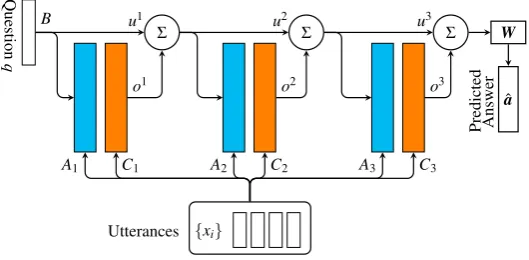
TheMemN2Narchitecture, introduced by (Weston et al., 2015), consists of two main components: supporting memories and final answer prediction. Supporting memories are in turn comprised of a set of input and output memory representations with memory cells. The input and output memory cells, denoted bymi andci, are obtained by trans-forming the input contextx1,...,xn(i.e a set of
ut-terances) using two embedding matricesA andC
(both of sized×|V|wheredis the embedding size and|V|the vocabulary size) such thatmi=AΦ(xi)
andci=CΦ(xi)whereΦ(·)is a function that maps
the input into a bag of dimension|V|.
Similarly, the question q is encoded using an-other embedding matrixB∈Rd×|V|, resulting in a
question embeddingu=BΦ(q). The input mem-ories {mi}, together with the embedding of the questionu, are utilized to determine the relevance of each of the stories in the context, yielding in a vector of attention weights
pi=softmax(u>mi) (1)
where softmax(ai) = e ai
∑ieai. Subsequently, the
re-sponseo from the output memory is constructed by the weighted sum:
o=
∑
i pici (2)
Other models of parametric encoding for the ques-tion and the document have been proposed in (Ku-mar et al., 2015). For the purpose of this presenta-tion, we will keep with definition ofΦ.
For more difficult tasks requiring multiple sup-porting memories, the model can be extended to include more than one set of input/output memo-ries by stacking a number of memory layers. In this setting, each memory layer is named a hop and the(k+1)th hop takes as input the output of
thekthhop:
Lastly, the final step, the prediction of the an-swer to the questionq, is performed by
ˆ
a=softmax(W(oK+uK)) (4)
where ˆa is the predicted answer distribution,W ∈
R|V|×dis a parameter matrix for the model to learn
andKthe total number of hops.
Two weight tying schemes of the embedding matrices have been introduced in (Weston et al., 2015):
1. Adjacent: the output embedding matrix in the kth hop is shared with the input
embed-ding matrix in the(k+1)th hop, i.e.,Ak+1=
Ck fork∈ {1,K−1}. Also, the weight
ma-trixW in Equation (4) is shared with the out-put embedding matrix in the last memory hop such thatW>=CK.
2. Layer-wise: all the weight matrices Ak and Ckare shared across different hops, i.e.,A1=
A2=...=AKandC1=C2=...=CK.
In the next section, we show how the task of di-alog state tracking can be formalized as machine reading task and solved using such memory en-hanced model.
3.3 Dialog Reading Model for State Tracking
In this section, we formalize dialog state tracking using the paradigm of machine reading. As far as our knowledge goes, it is the first attempt to ap-ply this approach and develop a specific dataset format, detailed in Section 4, from an existing and publicly available dialog state tracking chal-lenge dataset to fulfill this task. Assuming (1) a dyadic dialog d composed of a list of utter-ances, (2) a state composed with (2a) a set of variables vi with i={1,...,n}and (2b) a set of
corresponding assigned values li. One can
de-fine a questionqv that corresponds to the specific
querying of a variable in the context of a dialog
p(li|qvi,d). In such context, a dialog state track-ing task consists in determintrack-ing for each variable v, l∗=argmax
li∈Lp(li|qvi,d), withL the specific domain of expression of a variablevi.
In addition to the actual dataset, we propose to investigate four general reasoning tasks using
DSTC-2dataset as a starting point. In such way, we leverage the dataset ofDSTC-2to create more complex reasoning task than the ones present in the original dialogs of the dataset by performing rule-based modification over the corpus. Obvi-ously, the goal is to develop resolution algorithms
that are not dedicated to a specific reasoning task but inference models that will be as generic as pos-sible. In the rest of the section, each of the reason-ing tasks associated with dialog state trackreason-ing are described and the generation protocol is explained with examples.
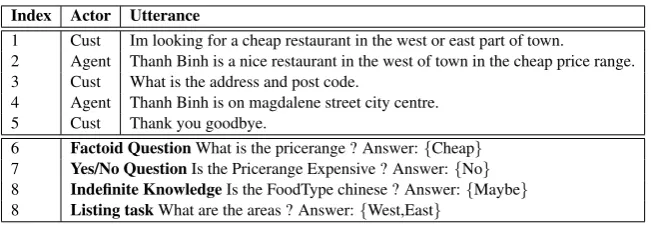
Factoid Questions: This first task corresponds to the current formulation of dialog state tracking. It consists of questions where a previously given a set of supporting facts, potentially amongst a set of other irrelevant facts, provides the answer. This kind of task was already employed in (Weston et al., 2014) in the context of a virtual world. In that sense, the result obtained to such task are compa-rable with the state of the art approaches.
Yes/No Questions : This task tests the ability of a model to answer true/false type questions like
“Is the food italian ?”. The conversion of a dialog to such format is deterministic regarding the fact that the utterances and corresponding true states are known at each utterance of a given dialog.
Indefinite Knowledge: This task tests a more complex natural language construction. It tests if statements can be models in order to describe possibilities rather than certainties, as proposed in (Weston et al., 2014). In our case, the answer will be “maybe” to the question“Is the price-range re-quired moderate ?” if the slot hasn’t been men-tioned yet throughout the current dialog. In the case of state tracking, it will allow to seamlessly deal with unknown information about the dialog state. Concretely, this set of questions and an-swers are generated has a super-set of the Yes-No Questions set. First, sub-dialog starting from the first utterance of a given dialog are extracted un-der the condition that a given slot is not informed in the corresponding annotation. Then, a question-answering question is generated.
Counting and Lists/Sets : This last task tests the capacity of the model to perform simple count-ing operations, by askcount-ing about the number of ob-jects with a certain property, e.g.“How many area are requested ?”. Similarly, the ability to produce a set of single word answers in the form of a list, e.g. “What are the area requested ?” is inves-tigated. Table 1 give an example of each of the question type presented below on a dialog sample ofDSTC-2corpus.
{xi}
Utterances
Question
q
Σ B
A1 C1
u1
o1
Σ
A2 C2
u2
o2
Σ
A3 C3
u3
o3
W
[image:6.595.167.432.66.196.2]ˆ a Predicted Answer
Figure 2: Illustration of the proposedMemN2Nbased state dialog tracker model with 3 hops.
question will be encoded as the controller state at
t=1. The answer will be produced using a soft-max operation over the answer vocabulary that is supposed fixed. We consider this hypothesis valid in the case of factoid and list questions because the set of value for a given variable is often con-sidered known. In the cases of Yes/No and Indef-inite knowledge question, {Yes, No, Maybe}are added to the output vocabulary. Following (We-ston et al., 2014), a list-task answer will be consid-ered as a single element in the answer set and the count question. A possible alternative would be to change the activation function used at the output of theMemN2Nfrom softmax activation function to a logistic one and to use a categorical cross entropy loss. A drawback of such alternative would be the necessity of cross-validating a decision threshold in order to select a eligible answers. Concerning the individual numbers for the count question set, the numbers founded on the training set are added into the vocabulary.
We believe more reasoning capabilities need to be explore in the future, like spacial and tempo-ral reasoning or deduction as suggested in (We-ston et al., 2015). However, it will probably need the development of a new dedicated resource. An-other alternative could be to develop a question-answering annotation task based on a dialog cor-pus where reasoning task are present. The closest work to our proposal that can be cited is (Bordes and Weston, 2016). In this paper, the authors de-fines a so-called End-to-End learnable dialog sys-tem to infer an answer from a finite set of eligible answers w.r.t the current list of utterances of the di-alog. The authors generate 5 artificial tasks of dia-log. However the reasoning capabilities are not ex-plicitly addressed and the author exex-plicitly claim that the resulting dialog system is not satisfactory
yet. Indeed, we believe that having a proper di-alog state tracker where a policy is built on top can guarantee dialog achievement by properly op-timizing a reward function throughout a explicitly learnt dialog policy. In the case of proper end-to-end systems, the objective function is still not ex-plicitly defined (Serban et al., 2015) and the result-ing systems tend to be used in the context of chat-oriented and non-goal chat-oriented dialog systems. In the next section, we present experimental details and results obtained on the basis of the DSTC-2
dataset and its conversion to the four mentioned reasoning tasks.
4 Experiments
4.1 Dataset and Data Preprocessing
Index Actor Utterance
1 Cust Im looking for a cheap restaurant in the west or east part of town.
2 Agent Thanh Binh is a nice restaurant in the west of town in the cheap price range.
3 Cust What is the address and post code.
4 Agent Thanh Binh is on magdalene street city centre.
5 Cust Thank you goodbye.
6 Factoid QuestionWhat is the pricerange ? Answer:{Cheap}
7 Yes/No QuestionIs the Pricerange Expensive ? Answer:{No}
8 Indefinite KnowledgeIs the FoodType chinese ? Answer:{Maybe}
[image:7.595.137.463.60.173.2]8 Listing taskWhat are the areas ? Answer:{West,East}
Table 1: : Dialog state tracking question-answering examples fromDSTC2dataset
in finding the valuel∗as defined in Section 3.3. In
the overall dialog corpus, Area slot counts 5 pos-sible values, Food slot counts 91 pospos-sible values and Pricerange slot counts 3 possible values. In or-der to exhibit reasoning capability of the proposed model in the context of dialog state tracking, three other dataset have been automatically generated from the dialog corpus in order to support 3 capa-bilities of reasoning described in Section 3.3. Dia-log modification has been required for two reason-ing tasks,ListandCount. Two types of rules have been developed to automatically produce modified dialogs. On a first hand, string matching has been performed to determine the position of a slot val-ues in a given utterance and an alternative state-ment has been produced as a substitution. For ex-ample, the utterance “I’m looking for a chinese restaurant in the north”can be replaced by “I’m looking for a chinese restaurant in the north or the west of town”. A second type of modification has been performed in an inter-utterance fashion. For example, assuming a given value “north” has been informed in the current state of a given dialog, one can add lately in the dialog a remark like “I would also accept a place east side of town”. This kind of statement tends to not affect the overall flow of the dialog and allows to add richer semantic to the dialog. In the future, we plan to develop a richer set of generation procedures to augment the dataset. Nevertheless, we believe this simple dialog augmentation strategy allows to exhibit the competency of the proposed model beyond factoid questions.
4.2 Training Details
As suggested in (Sukhbaatar et al., 2015), 10% of the set was held-out to form a validation set for hyperparameter tuning. Concerning the utterance encoding, we use the so-called Temporal Encod-ingtechnique. In fact, reading tasks require some notion of temporal context. To enable the model
to address them, the memory vector is modified as such mi =∑jAxi j+TA(i), where TA(i) is the ithrow of a dedicated matrixT
A that encodes
tem-poral information. The output embedding is aug-mented in the same way with a matrix Tc (e.g. ci=∑jCxi j+TC(i)). BothTA andTC are learned
during training in an end-to-end fashion. They are also subject to the same sharing constraints asA
andC. The embedding matrix A and B are ini-tialized using GoogleNews word2vec embedding model (Mikolov et al., 2013). Also suggested on (Sukhbaatar et al., 2015), utterances are indexed in reverse order, reflecting their relative distance from the question so that x1 is the last sentence
of the dialog. Furthermore, adjacent weight tying schema has been adopted. Learning rateη is ini-tially assigned a value of 0.005 with exponential decay applied every 25 epochs by η/2 until 100 epochs are reached. Then,linear start is used in all our experiments as proposed by (Sukhbaatar et al., 2015). More precisely, the softmax function in each memory layer is removed and re-inserted af-ter 20 epochs. Batch size is set to 16 and gradients with an L2 norm larger than 40 are divided by a
scalar to have norm 40. All weights are initialized randomly from a Gaussian distribution with zero mean andσ=0.1. In all our experiments, we have tested a set of the embedding sized∈ {20,40,60}. After validation, each model uses a 5-hops depth configuration.
4.3 Experimental results
Locutor Utterance Hop 1 Hop 2 Hop 3 Hop 4 Hop 5
Cust Im looking for a cheap restaurant that serves chinese food 0.00 0.18 0.11 0.04 0.00 Agent What part of town do you have in mind 0.33 0.30 0.00 0.00 0.00
Cust I dont care 0.00 0.00 0.17 0.37 1.00
Agent Rice house serves chinese food in the cheap price range 0.01 0.00 0.00 0.00 0.00 Cust What is the address and telephone number 0.58 0.09 0.01 0.00 0.00 Agent Sure rice house is on mill road city centre 0.03 0.00 0.00 0.00 0.00
Cust Phone number 0.00 0.00 0.00 0.00 0.00
Agent The phone number of rice house is 765-239-09 0.02 0.01 0.00 0.00 0.00
Cust Thank you good bye 0.02 0.42 0.71 0.59 0.00
[image:8.595.77.525.61.177.2]What is the area ? Answer: dontcare
Table 2: Attention shifting example for theAreaslot fromDSTC2dataset, the values corresponds thepi
values affected to each memory blockmiat each hop of theMemN2N
the improved baseline uses a hand-crafted seman-tic dictionary designed for the DSTC2 ontology. In this context, a MemN2N model allows to ob-tain competitive results with the most close, non-memory enhanced, state of the art approach of re-current neural network with word embedding as prior knowledge.
Model Area Food Price Joint
RNN - no dict. 0.92 0.86 0.86 0.69
RNN + sem. dict. 0.91 0.86 0.93 0.73
NBT-DNN 0.90 0.84 0.94 0.72
NBT-CNN 0.90 0.83 0.93 0.72
MemN2N(d=40) 0.89 0.88 0.95 0.74
Table 3: One supporting fact task : Acc. ob-tained on DSTC2 test set
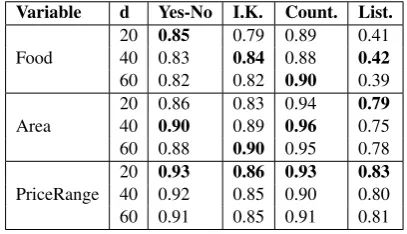
As a second result, Table 4 presents the perfor-mance obtained for the four reasoning tasks. The obtained results lead us to think thatMemN2Nare a competitive alternative for the task dialog state tracking but also increase the spectrum of def-inition of the general dialog state tracking task to machine reading and reasoning. In the future, we believe new reasoning capabilities like spacial and temporal reasoning and deduction should be exploited on the basis of a specifically designed dataset.
5 Conclusion and Further Work
This paper describes a novel method of dialog state tracking based on the paradigm of machine reading and solved using MemN2N, a memory-enhanced neural network architecture. In this con-text, a dataset format inspired from the current datasets of machine reading tasks has been devel-oped for this task. It is the first attempt to solve this classic sub-problem of dialog management in
Variable d Yes-No I.K. Count. List.
20 0.85 0.79 0.89 0.41
Food 40 0.83 0.84 0.88 0.42
60 0.82 0.82 0.90 0.39 20 0.86 0.83 0.94 0.79
Area 40 0.90 0.89 0.96 0.75
60 0.88 0.90 0.95 0.78
20 0.93 0.86 0.93 0.83
[image:8.595.314.518.244.361.2]PriceRange 40 0.92 0.85 0.90 0.80 60 0.91 0.85 0.91 0.81 Table 4: Reasoning tasks: Acc. on DSTC2 rea-soning datasets
such way. Beyond the experimental results pre-sented in the experimental section, the proposed approach offers several advantages compared to state of the art methods of tracking. First, the pro-posed method allows to perform tracking on the basis of segment-dialog-level annotation instead of utterance-level one that is commonly admitted in academic datasets but tedious to produce in a large scale industrial environment. Second, we propose to develop dialog corpus requiring rea-soning capabilities to exhibit the potential of the proposed model. In future work, we plan to ad-dress more complex tasks like spatial and tempo-ral reasoning, sorting or deduction and experiment with other memory enhanced inference models. Indeed, we plan to experiment and compare the same approach with Stacked-Augmented Recur-rent Neural Network (Joulin and Mikolov, 2015) and Neural Turing Machine (Graves et al., 2014) that sounds also promising for these family of rea-soning tasks.
References
[image:8.595.79.283.350.424.2]Huang, Peter Clark, and Christopher D. Manning. 2014. Modeling biological processes for reading comprehension. In Alessandro Moschitti, Bo Pang, and Walter Daelemans, editors, Proceedings of the 2014 Conference on Empirical Methods in Natural Language Processing, EMNLP 2014, October 25-29, 2014, Doha, Qatar, A meeting of SIGDAT, a Spe-cial Interest Group of the ACL. ACL.
Antoine Bordes and Jason Weston. 2016. Learning end-to-end goal-oriented dialog. CoRR.
Harry Bunt, Jan Alexandersson, Jean Carletta, Jae-Woong Choe, Alex Chengyu Fang, Koiti Hasida, Kiyong Lee, Volha Petukhova, Andrei Popescu-Belis, Laurent Romary, Claudia Soria, and David Traum. 2010. Towards an ISO standard for dia-logue act annotation. InProceedings of the Seventh International Conference on Language Resources and Evaluation (LREC’10). European Language Re-sources Association (ELRA), may.
Oren Etzioni, Michele Banko, and Michael J. Cafarella. 2007. Machine reading. In AAAI Spring Sympo-sium: Machine Reading. AAAI.
Milica Gasic and Steve Young. 2011. Effective handling of dialogue state in the hidden informa-tion state POMDP-based dialogue manager. TSLP, 7(3):4.
Zoubin Ghahramani and Michael I. Jordan. 1997. Fac-torial hidden Markov models. Machine Learning, 29(2-3):245–273.
Alex Graves, Greg Wayne, and Ivo Danihelka. 2014. Neural turing machines. CoRR.
Matthew Henderson, Blaise Thomson, and Steve Young, 2013. Proceedings of the SIGDIAL 2013 Conference, chapter Deep Neural Network Ap-proach for the Dialog State Tracking Challenge, pages 467–471. Association for Computational Lin-guistics.
M. Henderson, B. Thomson, and S. J. Young. 2014a. Robust dialosg state tracking using delexicalised re-current neural networks and unsupervised adapta-tion. In Proceedings of IEEE Spoken Language Technology.
Matthew Henderson, Blaise Thomson, and Jason D. Williams. 2014b. The third dialog state tracking challenge. InSLT, pages 324–329. IEEE.
Matthew Henderson, Blaise Thomson, and Steve Young. 2014c. Word-based dialog state tracking with recurrent neural networks. InProceedings of SIGDial.
Karl Moritz Hermann, Tom´as Kocisk´y, Edward Grefenstette, Lasse Espeholt, Will Kay, Mustafa Su-leyman, and Phil Blunsom. 2015. Teaching ma-chines to read and comprehend.CoRR.
Armand Joulin and Tomas Mikolov. 2015. Infer-ring algorithmic patterns with stack-augmented re-current nets. In Corinna Cortes, Neil D. Lawrence, Daniel D. Lee, Masashi Sugiyama, and Roman Gar-nett, editors, Advances in Neural Information Pro-cessing Systems 28: Annual Conference on Neural Information Processing Systems 2015, December 7-12, 2015, Montreal, Quebec, Canada, pages 190– 198.
Ankit Kumar, Ozan Irsoy, Jonathan Su, James Brad-bury, Robert English, Brian Pierce, Peter Ondruska, Ishaan Gulrajani, and Richard Socher. 2015. Ask me anything: Dynamic memory networks for natu-ral language processing.CoRR.
Angeliki Metallinou, Dan Bohus, and Jason Williams. 2013. Discriminative state tracking for spoken dia-log systems. InAssociation for Computer Linguis-tics, pages 466–475. The Association for Computer Linguistics.
Tomas Mikolov, Ilya Sutskever, Kai Chen, Gregory S. Corrado, and Jeffrey Dean. 2013. Distributed rep-resentations of words and phrases and their compo-sitionality. In Christopher J. C. Burges, L´eon Bot-tou, Zoubin Ghahramani, and Kilian Q. Weinberger, editors,Advances in Neural Information Processing Systems 26: 27th Annual Conference on Neural In-formation Processing Systems 2013. Proceedings of a meeting held December 5-8, 2013, Lake Tahoe, Nevada, United States, pages 3111–3119.
Diego H. Milone and Antonio J. Rubio. 2003. Prosodic and accentual information for automatic speech recognition. IEEE Transactions on Speech and Audio Processing, 11(4):321–333.
Nikola Mrksic, Diarmuid ´O S´eaghdha, Tsung-Hsien Wen, Blaise Thomson, and Steve J. Young. 2016. Neural belief tracker: Data-driven dialogue state tracking.CoRR, abs/1606.03777.
Hoifung Poon and Pedro M. Domingos. 2010. Ma-chine reading: A ”killer app” for statistical relational AI. InStatistical Relational Artificial Intelligence, volume WS-10-06 ofAAAI Workshops. AAAI. Antoine Raux and Yi Ma. 2011. Efficient probabilistic
tracking of user goal and dialog history for spoken dialog systems. InINTERSPEECH, pages 801–804. ISCA.
Matthew Richardson, Christopher J. C. Burges, and Erin Renshaw. 2013. MCTest: A challenge dataset for the open-domain machine comprehension of text. InEMNLP, pages 193–203. ACL.
Iulian Vlad Serban, Ryan Lowe, Laurent Charlin, and Joelle Pineau. 2015. A survey of available corpora for building data-driven dialogue systems. CoRR. Sainbayar Sukhbaatar, Arthur Szlam, Jason Weston,
Daniel D. Lee, Masashi Sugiyama, and Roman Gar-nett, editors, Advances in Neural Information Pro-cessing Systems 28: Annual Conference on Neural Information Processing Systems 2015, December 7-12, 2015, Montreal, Quebec, Canada, pages 2440– 2448.
Blaise Thomson and Steve Young. 2010. Bayesian update of dialogue state: A POMDP framework for spoken dialogue systems. Computer Speech & Lan-guage, 24(4):562–588.
Laurens van der Maaten and Geoffrey Hinton. 2008. Visualizing data using t-SNE. Journal of Machine Learning Research, 9:2579–2605, November. Tsung-Hsien Wen, Milica Gasic, Nikola Mrksic,
Lina Maria Rojas-Barahona, Pei-Hao Su, Stefan Ultes, David Vandyke, and Steve J. Young. 2016. A network-based end-to-end trainable task-oriented dialogue system. CoRR.
Jason Weston, Sumit Chopra, and Antoine Bordes. 2014. Memory networks.CoRR.
Jason Weston, Antoine Bordes, Sumit Chopra, and Tomas Mikolov. 2015. Towards AI-complete ques-tion answering: A set of prerequisite toy tasks.
CoRR.
Jason D. Williams, Pascal Poupart, and Steve Young. 2005. Factored partially observable markov deci-sion processes for dialogue management. InIn 4th Workshop on Knowledge and Reasoning in Practi-cal Dialog Systems, pages 76–82.
Jason D. Williams, Antoine Raux, and Matthew Hen-derson. 2016. The dialog state tracking challenge series: A review. D&D, 7(3):4–33.
Jason D. Williams. 2014. Web-style ranking and slu combination for dialog state tracking. In Proceed-ings of SIGDIAL. ACL Association for Computa-tional Linguistics, June.