GrASP: Rich Patterns for Argumentation Mining
Eyal Shnarch Ran Levy∗ Vikas Raykar‡ Noam Slonim IBM Research - Haifa, Israel
‡IBM Research - Bangalore, India
{eyals, ranl, noams}@il.ibm.com [email protected]
Abstract
We present the GrASP algorithm for au-tomatically extracting patterns that char-acterize subtle linguistic phenomena. To that end, GrASP augments each term of input text with multiple layers of linguis-tic information. These different facets of the text terms are systematically combined to reveal rich patterns. We report highly promising experimental results in several challenging text analysis tasks within the field of Argumentation Mining. We be-lieve that GrASP is general enough to be useful for other domains too.
1 Introduction
Many standard text analysis tasks can be ad-dressed relatively well while exploiting simple textual features, e.g., Bag-Of-Words representa-tion and Naive Bayes for document classificarepresenta-tion (McCallum and Nigam,1998). However, the iden-tification of more subtle linguistic phenomena, that are further reflected via relatively short texts – as opposed to whole documents – may require a wider spectrum of linguistic features.
The main contribution of this work is in out-lining a simple method to automatically extract rich linguistic features in the form of patterns, and demonstrate their utility on tasks related to Ar-gumentation Mining(Mochales Palau and Moens,
2009), although we believe that the proposed ap-proach is not limited to this domain.
Argumentation mining involves automatically identifying argumentative structures within a cor-pus – e.g., claims or conclusions, and evidence instances or premises – as well as their inter-relations. For instance, each of the following sen-tences includes aclaimfor a[topic].
∗First two authors contributed equally.
1. Opponents often argue thatthe open primary is unconstitutional.[Open Primaries]
2. Prof. Smith suggested that affirmative action devalues the accomplishments of the chosen. [Af-firmative Action]
3. The majority stated that the First Amend-ment does not guarantee the right to offend others. [Freedom of Speech]
These sentences share almost no words in com-mon, however, they are similar at a more abstract level. A human observer may notice the follow-ing underlyfollow-ing common structure, or pattern: [someone][argue/suggest/state][that] [topic term][sentiment term]
We present GrASP, standing for GReedy Aug-mented Sequential Patterns, an algorithm that aims to automatically capture such underlying struc-tures of the given data. Table 1 shows the pat-tern that GrASP may find for the above examples, along with its matches in those texts. Such pat-terns can then be used to detect the existence of the phenomenon in new texts.
The algorithm starts with augmenting the terms of the input with various layers ofattributes, such as hypernyms from WordNet (Fellbaum, 1998), named entity types, and domain knowledge (Sec-tion 3.1). This multi-layered representation en-ables GrASP to consider many facets of each term. Next, it finds the most indicative attributes (Sec-tion 3.2) and iteratively grows patterns by blend-ing information from different attributes (Sec-tion3.3). A greedy step is performed at the end of each iteration, when the algorithm only keeps the top k patterns, ranked by their predictive power. This results with a set of cross-layered patterns whose match in a given text instance suggests the appearance, or the non-appearance, of the target phenomenon.
Researchers can add layers of attributes of dif-ferent kinds without being worried about which of
[noun] [express] [that] [noun,topic] [sentiment] Opponents often argue that the open primary is unconstitutional .
Prof. Smith suggested that affirmative action devalues the ...
[image:2.595.74.527.64.114.2]The majority stated that the First Amendment does not guarantee ... to offend others.
Table 1: Claim sentences aligned by their common underlying pattern. [express] stands for all its (in)direct hyponyms, and [noun,topic] means a noun which is also related to the topic.
them are useful for the detection of the target phe-nomenon, and how to combine them. GrASP per-forms feature selection while generating complex patterns out of these attributes that best capture as-pects of the target phenomenon.1
In experiments over different argumentation mining tasks, we show that GrASP outperforms classical techniques, and boosts full argumenta-tion mining systems when added to them.
2 Background
While some aspects of GrASP were considered in the past, to the best of our knowledge, no prior work has presented a framework that allows users to: (i) easily add any type of attribute to the pat-tern alphabet, and (ii) considerallattributes when searching for patterns. GrASP provides a frame-work to integrate information from different lay-ers, choosing the best combination to produce highly expressive patterns.
The alphabet ofHearst(1992) patterns is mainly stop words and noun-phrase tags, while Snow et al. (2004) add syntactic relations. Yangarber et al. (2000) consider a larger set of attributes (e.g., named entities, numeric expressions), how-ever they commit to one generalization of each term. In contrast, we do not limit our alphabet and systematically consider all attributes of each term.
Riloff and Wiebe(2003) start with a small set of syntactic templates, composed of a single syntac-tic relation and a single POS tag, to learn a variety of lexicalized patterns that match these templates. RAPIER (Califf and Mooney, 2003) constraints are similar to our attributes, but are basic (surface form, POS tag, and hypernyms only), and expand-ing them will exponentially increase its complex-ity. In contrast, adding attributes to GrASP only increment runtime linearly (see Section3.2).
To summarize, prior works usually have a basic alphabet and commit to one rule to generalize each term. Commonly, they do not allow gaps between their elements, nor assigning several attributes to a
1Get GrASP cloud service athttp://ibm.biz/graspULP
single element of the pattern.
Such characteristics are presented insequential patterns (Agrawal and Srikant, 1995) which are mainly used for data mining and rarely for un-structured text (Jindal and Liu,2006). GrASP also has these characteristics, and in addition it can learnnegativepatterns, indicating that the exam-ined textdoes notcontain the target phenomenon. The phenomena we target are from the area of Argumentation Mining (see Lippi and Torroni
(2016) for a survey). We focus on open-domain argument extraction. In this context, Levy et al.
(2014) detect claims relevant to a debatable topic,
Lippi and Torroni (2015) defined the context-independentclaim detection task, andRinott et al.
(2015) introduced the context dependent evidence detection task (which is further split into differ-ent types of evidence, e.g., astudythat supports a claim or a relevantexperttestimony). These tasks aim to capture a subtle and rare linguistic phe-nomenon within large corpora, hence are suitable for demonstrating the potential of GrASP.
3 The GrASP Algorithm
The algorithm depicted in Algorithm1. Its input is a set of positive and negative examples for the target phenomenon. The output is a ranked list of patterns, aiming to indicate the presence – or ab-sence – of this phenomenon. In the following, a pattern is considered to bematchedin a text iff all its elements are found in it, in the specified order, possibly with gaps between them, within a win-dow of sizew.
3.1 Multi-Layered Term Representations Consider the verbs (argue/suggest/state) in the ex-amples in Section1. Using the POS tag verb to generalize them will end up with an overly gen-eral representation, while their hypernym,express, offers a better level of generalization.
syntac-Algorithm 1:The GrASP algorithm.
Input:positive/negative text examples,k1,k2,maxLen Output:a ranked list of patterns
1 (pos, neg)←augment(positives, negatives) 2 attributes←extractAttributes(pos, neg) 3 alphabet←chooseT opK(attributes, k1) 4 patterns←alphabet
5 last←patterns
6 forlength←2tomaxLendo 7 curr←θ
8 forp∈lastdo
9 fora∈alphabetdo
10 curr←curr∪ {growRight(p, a)} 11 curr←curr∪ {growInside(p, a)} 12 last←curr
13 patterns←
chooseT opK(patterns∪current, k2) 14 returnpatterns
tic relation in a parse tree, and semantic attributes such as its hypernyms, WordNet superclasses, in-dications whether it is a named entity, and whether it bears a sentiment.2 This attributes set can serve
as a starting point for many text analysis tasks. In addition, GrASP allows to add task-specific attributes. Thus, for context-dependent arguments detection we add boolean attributes indicating whether the term is related to the topic, whether it appears in a lexicon characterizing argumentative texts, or in a lexicon characterizing the topic.3
After augmentation, the representation of argue, from the first example, is: [argue, VB, hypernyms={present, state, express}, in claim lexicon, root node, supeclass = communication].
3.2 Defining the Patterns Alphabet
The augmented representation, described above, is the first step (line 1 in Algorithm 1). Next, we define the alphabet of attributes that will be used to compose longer patterns (lines 2–3). To that end, we first discard non-frequent attributes that are matched in less thant1of all input examples.
Then, we sort all remaining attributes by their information gain (Mitchell,1997) with the label, and select the top k1 attributes. We discard
re-dundant attributes whose correlation to some pre-viously selected attribute is above t2, measured
by the normalized mutual information (Cover and
2We usedOpneNLPPOS tagger,Stanford NER,McCord and Bernth(2010) parser,WordNet superclasses, and the lex-icon inHu and Liu(2004) for sentiment words.
3We utilize existing lexicons, learning them is out of the scope of this work.
Thomas,2006). The selectedk1 attributes
consti-tute the alphabet of the algorithm, or “patterns” of length 1. Note that considering additional at-tributes only affects this first iteration, and only increases it linearly.
3.3 Growing Patterns
Learning longer patterns is done by iteratively growing patterns selected in previous iterations, keeping only the most indicative ones (lines 6–13). We apply two methods for growing a pattern, p
(e.g., [noun]) w.r.t. an attribute a(e.g.,obj): (i) grow right – addaas another term in the pattern (i.e., [noun][obj]); (ii) grow inside – addaas an-other attribute to the last term ofp, making it more specific (i.e., [noun,obj]). After each iteration (line 13), the topk2 patterns are kept (after
sort-ing by information gain and discardsort-ing redundant ones). Iterations continue till reachingmaxLen.
Since GrASP relies on information gain for sorting, it can identify indicativenegativepatterns, implying that the target phenomenon isless likely to be presented in the examined example if such patterns were matched in it.
GrASP can be seen as a simple formal interface, allowing the user to examine a wide range of infor-mation sources letting the algorithm to select and combine them all and come up with the most use-ful patterns.
4 Evaluation and Results
In the following experiments we used a logistic re-gression classifier on top of the extracted patterns. Each pattern is used as a binary feature, which re-ceives value of 1 iff it is matched in the candidate. To demonstrate the robustness of the this ap-proach, in all experiments we report the results of a single configuration of GrASP parameters, selected based on a quick analysis over a small portion of the claim-sentence detection data (task (a) below).4 Specifically, we used minimal
fre-quency thresholdt1=0.005, correlation threshold
t2= 0.5, size of the alphabetk1= 100, number of
patterns in the outputk2 = 100, maximal pattern
lengthmaxLen=5, and window sizew=10. This configuration is by no means the optimal one, and we saw that by carefully tuning the pa-rameters per task, results were improved.
(a) Claim sentence (b) Expert evidence (c) Study evidence
system P@5 P@10 P@20 P@5 P@10 P@20 P@5 P@10 P@20
Naive Bayes 13.8 10.2 8.1 8.4 9.6 8.0 13.1 11.6 9.3
Basic patterns 21.4 15.5 12.7 16.5 15.2 12.2 18.3 16.1 12.8
CNN 25.5 21.2 16.9 18.2 16.3 14.6 26.5 22.2 18.4
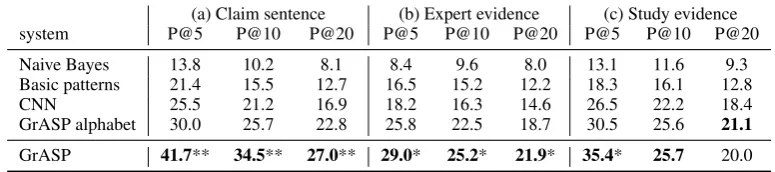
[image:4.595.104.492.64.150.2]GrASP alphabet 30.0 25.7 22.8 25.8 22.5 18.7 30.5 25.6 21.1 GrASP 41.7** 34.5** 27.0** 29.0* 25.2* 21.9* 35.4* 25.7 20.0
Table 2:Macro-averaged precision results for GrASP over three argumentation mining tasks. Significant results in compari-son to GrASP alphabet/CNN are marked with **/* respectively (paired t-test withp<0.01/0.02respectively).
4.1 Direct Evaluation
We consider three context-dependent argumenta-tion mining tasks: (a) Claim sentence detecargumenta-tion (Levy et al.,2014), (b) Expert evidence detection, and (c) Study evidence detection. The latter two tasks are described inRinott et al. (2015), where the goal is to detect sentences that can be used as an evidence to support/contest the topic.5
The benchmark data for these tasks was ex-tracted from the data released by Rinott et al.
(2015), consisting of 547 Wikipedia articles in which claims and evidence instances were manu-ally annotated, in the context of 58 debatable top-ics. In all tasks the data is highly skewed towards negative examples (only 2.5% of 80.5K instances are positives in task (a), 4% of 55.6K in task (b), and 3.7% of 31.8K in task (c)), making these tasks especially challenging.
As (Levy et al., 2014; Rinott et al., 2015) we use a leave-one-topic-out schema; training over 57 topics, testing over the left out topic.
Our group develops debate supportive technolo-gies which can assist humans to reason, make de-cisions, or persuade others.6 Since in this scenario
humans mainly consider top results (similar to information retrieval), precision is more relevant than recall. Thus, we report the macro-averaged Precision@K, whereK∈{5,10,20}.
We considered the following baselines:
Naive Bayes: over BOW representation, dis-carding unigrams which appear less than10times. Basic Patterns: a baseline that reflects com-mon practices in the literature where a pattern is a consecutive ordered list of stop words or POS tags. We add a symbol for topic match (for the context-dependent tasks). A brute force process generates all possible patterns up to size maxLen and selects topkby the same procedure as GrASP. 5We did not examine the Anecdotal type due to the small size of the available benchmark data.
6for more details seeIBM Debating Technologies.
For each task we report the best results obtained withk∈{50,100, ..,400}.
Convolutional Neural Network (CNN): fol-lowing (Kim, 2014; Vinyals and Le, 2015) we used CNN whose input is a concatenation of the topic and the candidate.7 The final state
vec-tor is fed to a LR soft-max layer. Cross-entropy loss function was used for training. The embed-ding layer was initialized using word2vec vectors (Mikolov et al., 2013). Hyper-parameters were tuned on the same portion of the dataset as used by GrASP for tuning.
For these baselines, we are not aware of avail-able methods to incorporate GrASP multi-layered representation.
GrASP alphabet: a simplified version of GrASP which uses the chosen alphabet, or “pat-terns” of length 1. This baseline does utilize all the information available for GrASP.
Table2shows thatNaive Bayesperformance is the lowest, demonstrating that a simple represen-tation is not sufficient for such complex tasks. Us-ingBasic patternsyields better performance, and CNN performs even better. GrASP alphabet out-performs CNN, indicating the potential of explic-itly incorporating linguistic information. Finally, using the patterns extracted by GrASP outper-forms all other methods, emphasizing the added value of constructing patterns over the initial con-tribution of the multi-layered representation.
system P@5 P@10 P@20 P@50 R@50
Levy14 – – – 18 40
Levy14-rep 30.9 27.3 23.5 17.6 38.4
GrASP 32.7 30 23.9 17.5 36.2
Combined 40* 32.4* 28* 20.2* 43.2*
Table 3: Adding GrASP to a full claim detection system. Significant results in comparison to Levy14-rep are marked by * (paired t-test withp<0.02).
ties were not selected as part of the alphabet for Claim sentences (task a) – reflecting the impor-tance ofPERCENT in sentences describing stud-ies and their numeric results, and the importance of authoritative source (either Person or Organi-zation) in evidence based on expert testimonies.
For task (a) we performed two ablation tests, each of them yielded a decrease in performance: (i) not limiting the match of a pattern in a window (a decrease of 10.3 for P@5 and 2.8 for P@20), and (ii) not enforcing the order defined by the pat-tern (a decrease of 7.6 for P@5 and 2.8 for P@20).
4.2 Indirect Evaluation
In this evaluation we add GrASP patterns as ad-ditional features to the full claim detection system ofLevy et al.(2014) to inspect their contribution. This evaluation is performed on a second claim de-tection benchmark (on which they have reported results), released by Aharoni et al.(2014) (1,387 annotated claims associated with 33 topics).
The system ofLevy et al.(2014) is comprised of a cascade of three components; (i) detecting sen-tences which contain claims, (ii) identifying the exact boundaries of the claim part within the sen-tence, and (iii) ranking the claim candidates. Each of these components applies a classifier over ded-icated features. Results were reported for the full cascade and for the first component, which is our task (a). For an idea on how to adapt GrASP for the claim boundaries detection task, see Section5. Table 3 presents measures reported in Levy et al.(2014) (right hand side) as well as additional measures which reflect the focus of this work on the precision of the top ranked candidates (perfor-mance of all systems on P@200 and R@200 were comparable and were omitted due to space lim-itations). The system of Levy et al. (2014), de-notedLevy14, and our reproduction of it, denoted Levy14-rep, obtained comparable results.8
8We reproduced their work to perform significant test and report the additional measures.
Evidently, utilizing GrASP patterns alone achieve similar performance as Levy14-rep. Con-sidering the fact that Levy14-rep is a full sys-tem, tailored for claim detection via a lengthy feature engineering process, these results, ob-tained using only GrASP patterns, are promising. Adding GrASP features to Levy14-rep, denoted Combined, we observe a significant improvement, demonstrating their complementary value.
5 Discussion
GrASP extracts rich patterns that characterize sub-tle linguistic phenomena. It exploits a wide variety of information layers in a unified manner, iden-tifying the most discriminative attributes for the given task, and greedily composes them into pat-terns. We demonstrated GrASP significant impact on several argumentation mining tasks.
As this was not the focus of this work, we chose standard statistical criteria to sort the candidate patterns and to filter redundant ones. Considering other criteria, and also more sophisticated search strategies to explore the huge space of possible patterns, is left for future work.
In addition to their value in classification tasks, the patterns revealed by GrASP are easy to in-terpret, in contrast to alternative techniques, like Deep Learning. Thus, these patterns can provide researchers with additional insights regarding the target phenomenon. These insights can be inte-grated back to by considering additional attributes to be explored in subsequent runs. Thus, GrASP can significantly expedite the research process, es-pecially when addressing novel tasks.
Finally, we would like to hint on a sequel work that demonstrates how GrASP can be easily mod-ified to address another important task – detecting the claim boundaries within its surrounding sen-tence (see italic text in the examples in Section1). To cope with this unique task, we enhance the term representation (Section 3.1), by tripling each at-tributeato distinguish between its appearance be-fore (PRE-a), within (IN-a), or after (POST-a) the candidate claim boundaries. With this change only, GrASP was able to identify patterns for this new task, that were used to indicate the boundaries of a claim with promising preliminary results.
Acknowledgments
References
Rakesh Agrawal and Ramakrishnan Srikant. 1995. Mining sequential patterns. In International Con-ference on Data Engineering, pages 3–14.
Ehud Aharoni, Anatoly Polnarov, Tamar Lavee, Daniel Hershcovich, Ran Levy, Ruty Rinott, Dan Gutfre-und, and Noam Slonim. 2014.A benchmark dataset for automatic detection of claims and evidence in the context of controversial topics. InFirst Workshop on Argumentation Mining, pages 64–68.
Mary Elaine Califf and Raymond J. Mooney. 2003.
Bottom-up relational learning of pattern matching rules for information extraction.Journal of Machine Learning Research, pages 177–210.
Kyunghyun Cho, Bart van Merrienboer, Caglar Gul-cehre, Dzmitry Bahdanau, Fethi Bougares, Holger Schwenk, and Yoshua Bengio. 2014. Learning phrase representations using rnn encoder–decoder for statistical machine translation. InEMNLP, pages 1724–1734.
Thomas M. Cover and Joy A. Thomas. 2006. Elements of Information Theory (Wiley Series in Telecom-munications and Signal Processing). Wiley-Interscience.
Christiane Fellbaum, editor. 1998. WordNet: An Elec-tronic Lexical Database. MIT Press, Cambridge, Massachusetts.
Marti A. Hearst. 1992. Automatic acquisition of hy-ponyms from large text corpora. InCOLING, pages 539–545.
Sepp Hochreiter and J¨urgen Schmidhuber. 1997.
Long short-term memory. Neural Computation, 9(8):1735–1780.
Minqing Hu and Bing Liu. 2004. Mining and sum-marizing customer reviews. InInternational Con-ference on Knowledge Discovery and Data Mining, KDD ’04, pages 168–177.
Nitin Jindal and Bing Liu. 2006. Mining comparative sentences and relations. InAAAI, pages 1331–1336. Yoon Kim. 2014. Convolutional neural networks for sentence classification. In EMNLP, pages 1746– 1751.
Ran Levy, Yonatan Bilu, Daniel Hershcovich, Ehud Aharoni, and Noam Slonim. 2014. Context depen-dent claim detection. In COLING, pages 1489– 1500, Dublin, Ireland. Dublin City University and Association for Computational Linguistics.
Marco Lippi and Paolo Torroni. 2015. Context-independent claim detection for argument mining. InIJCAI, pages 185–191.
Marco Lippi and Paolo Torroni. 2016. Argumenta-tion mining: State of the art and emerging trends. ACM Transactions on Internet Technology (TOIT), 16(2):10.
Andrew McCallum and Kamal Nigam. 1998. A com-parison of event models for naive bayes text clas-sification. In AAAI workshop on learning for text categorization, pages 41–48. AAAI Press.
Michael C McCord and Arendse Bernth. 2010. Using slot grammar. IBM TJ Watson Res. Center, Yorktown Heights, NY, IBM Res. Rep. RC23978.
Tomas Mikolov, Ilya Sutskever, Kai Chen, Greg S Cor-rado, and Jeff Dean. 2013. Distributed representa-tions of words and phrases and their compositional-ity. InNIPS, pages 3111–3119.
Thomas M. Mitchell. 1997. Machine Learning. McGraw-Hill, Inc.
Raquel Mochales Palau and Marie-Francine Moens. 2009. Argumentation mining: the detection, clas-sification and structure of arguments in text. In Arti-ficial Intelligence and Law, pages 98–109.
Ellen Riloff and Janyce Wiebe. 2003.Learning extrac-tion patterns for subjective expressions. InEMNLP, pages 105–112.
Ruty Rinott, Lena Dankin, Carlos Alzate Perez, Mitesh M. Khapra, Ehud Aharoni, and Noam Slonim. 2015. Show me your evidence - an auto-matic method for context dependent evidence detec-tion. InEMNLP, pages 440–450, Lisbon, Portugal. Association for Computational Linguistics.
Rion Snow, Daniel Jurafsky, and Andrew Y. Ng. 2004. Learning syntactic patterns for automatic hypernym discovery. InNIPS.
Oriol Vinyals and Quoc V. Le. 2015. A neural conver-sational model.CoRR, abs/1506.05869.
![Table 1: Claim sentences aligned by their common underlying pattern. [express] stands for all its (in)direct hyponyms,and [noun,topic] means a noun which is also related to the topic.](https://thumb-us.123doks.com/thumbv2/123dok_us/1354355.667745/2.595.74.527.64.114/table-sentences-aligned-underlying-pattern-express-hyponyms-related.webp)