Agent-Aware Dropout DQN for Safe and Efficient
On-line Dialogue Policy Learning
Lu Chen and Xiang Zhou and Cheng Chang and Runzhe Yang and Kai Yu Key Lab. of Shanghai Education Commission for Intelligent Interaction and Cognitive Eng.
SpeechLab, Department of Computer Science and Engineering Brain Science and Technology Research Center
Shanghai Jiao Tong University, Shanghai, China
{chenlusz,owenzx,cheng.chang,yang runzhe,kai.yu}@sjtu.edu.cn
Abstract
Hand-crafted rules and reinforcement learning (RL) are two popular choices to obtain dialogue policy. The rule-based policy is often reliable within predefined scope but not self-adaptable, whereas RL is evolvable with data but often suffers from a bad initial performance. We em-ploy acompanion learningframework to integrate the two approaches for on-line
dialogue policy learning, in which a pre-defined rule-based policy acts as a teacher and guides a data-driven RL system by giving example actions as well as ad-ditional rewards. A novel agent-aware dropoutDeep Q-Network (AAD-DQN) is proposed to address the problem of when to consult the teacher and how to learn from the teacher’s experiences. AAD-DQN, as a data-driven student policy, pro-vides (1) two separate experience memo-ries for student and teacher, (2) an uncer-tainty estimated by dropout to control the timing of consultation and learning. Sim-ulation experiments showed that the pro-posed approach can significantly improve both safety and efficiency of on-line pol-icy optimization compared to other com-panion learning approaches as well as su-pervised pre-training using static dialogue corpus.
1 Introduction
A task-oriented spoken dialogue system (SDS) is a system that can continuously interact with a human to accomplish a predefined task through speech. Dialogue manager, which maintains the dialogue state and decides how to respond, is the
core of an SDS. In this paper, we focus on the dia-logue policy.
At the early research, the spoken dialogue sys-tems assume observable dialogue states. Dialogue policy is simply a set of hand-crafted mapping rules from state to machine action. This is referred to as rule-based policy, which often has acceptable performance but has no ability of self-adaption. Nowadays rule-based policy is popular in com-mercial dialogue systems.
However, in real world scenarios, unpredictable user behavior, inevitable automatic speech recog-nition, and spoken language understanding errors make it difficult to maintain the true dialogue state and make the decision. Hence, in recent years, there is a research trend towards statistical dia-logue management. A well-founded theory for this is the partially observable Markov decision process (POMDP) (Kaelbling et al.,1998), which can provide robustness to errors from the input module and automatic policy optimization by re-inforcement learning. Most POMDP based policy learning research is usually carried out using ei-ther user simulator or employed users (Williams and Young,2007;Young et al.,2010). The trained policy is not guaranteed to work well in real world scenarios. Therefore, on-line policy training has been of great interest (Gaˇsi´c et al., 2011). Re-cently, Chen et al. (2017) proposed two qualita-tive metrics1 to measure on-line policy learning: safety andefficiency. Safety reflects whether the initial policy can satisfy the quality-of-service re-quirement in real-world scenarios during the on-line policy learning period. Efficiency reflects how long it takes for the on-line policy training algo-rithm to reach a satisfactory performance level.
Most traditional RL-based policy training
suf-1The quantitative evaluation metrics of safety and effi-ciency are proposed in section 4.
fers poor initial performance, i.e. causes the safety problem. In light of above,Chen et al.(2017) pro-posed a safe and efficient on-line policy optimiza-tion framework, i.e. companion teaching (CT), in which a human teacher is added in the classic POMDP. The teacher has two missions: one is to show example actions, another is to act as a critic to give the student extra reward which can make the learning of policy more efficient. The example actions not only make the learning safer but also can be directly used by the training of the student policy. However, there are costs to the teaching of a human teacher.
Based on CT,companion learning(CL) frame-work is proposed to integrate rule-based policy and RL-based policy, resulting insafeandefficient
on-line policy learning. Here, the rule-based pol-icy acts as a virtual teacher which replaces the hu-man teacher in CT. There are a few differences be-tween these two kinds of teachers. First, because it has no marginal cost when it’s deployed, the rule teacher can be consulted at any time if needed. On the other hand, the rule policy is not as good as the human teacher, therefore it’s important to determine when and how much the student pol-icy depends on the rule teacher. Here, we propose anagent-aware dropoutDeep Q-Network (AAD-DQN) as the student statistical policy, which pro-vides (1) two separate experience replay pools for student and teacher, (2) an uncertainty estimated by dropout which can be used to control the tim-ing of consultation and learntim-ing.
In summary, our main contributions are three-folds: (1) Companion learning (CL) framework was proposed to integrate rule-based policy and RL-based policy. (2) An agent-aware dropout
Deep Q-Network (AAD-DQN) was proposed as the statistical student policy. (3) Compared with other companion teaching approaches (Chen et al.,
2017) as well as supervised pre-training using static dialogue corpus (Fatemi et al., 2016), CL with AAD-DQN can achieve better performance.
2 Related Work
Most previous studies of on-line policy learn-ing have been focused on the efficiency issue, such as Gaussian Process Reinforcement Learning (GPRL) (Gaˇsi´c et al.,2010). In GPRL, the kernel function defines prior correlations of the objective function given different belief states, which can significantly speed up the policy learning (Gaˇsi´c
and Young, 2014). Alternative methods include Kalman temporal difference reinforcement learn-ing (Pietquin et al.,2011).
More recently, deep reinforcement learning (DRL) (Mnih et al., 2015) is applied in dialogue policy optimization, including deep Q-Network (DQN) (Cuay´ahuitl et al., 2015; Fatemi et al.,
2016; Zhao and Eskenazi, 2016; Lipton et al.,
2016) and policy gradient (PG) methods, e.g. RE-INFORCE (Williams and Zweig,2016;Su et al.,
2016; Williams et al., 2017), Advantage Actor-Critic (A2C) (Fatemi et al., 2016). In order to speed up the learning of DQN, Lipton et al.
(2016) proposed an efficient exploration technique based on Thompson sample from a Bayesian neu-ral network. Furthermore, they showed that using a few successful dialogues generated by a rule-based policy to pre-fill the replay buffer can ben-efit the learning at the beginning. To improve the efficiency of PG methods, policy network is initialized with supervised learning (SL) before RL training (Williams and Zweig,2016;Williams et al., 2017;Su et al., 2016, 2017; Fatemi et al.,
2016), which is similar to the idea in (Silver et al.,
2016). However, combining RL with SL for dia-logue policy optimization is not new. Henderson et al.(2008) were among the first to prove the ben-efits of combining supervised and reinforcement learning. In the experiments, we will compare CL with these pre-training methods.
Although the improvement of efficiency can benefit the safety of learning process, no matter how efficient the algorithm is, an unsafe on-line learned policy can lead to bad user experience at the beginning of learning period and consequently fail to attract sufficient real users to continuously improve the policy. Therefore, it is important to address the safety issue. There are few works about the safety issue of on-line dialogue policy optimization.Williams(2008) proposed a method for integrating business rules and POMDPs. The rules act as the action mask, i.e. the rules nomi-nate a set of one or more actions, and the POMDP chooses the optimal action.
3 Proposed Framework
3.1 Companion Learning for On-line Policy Optimization
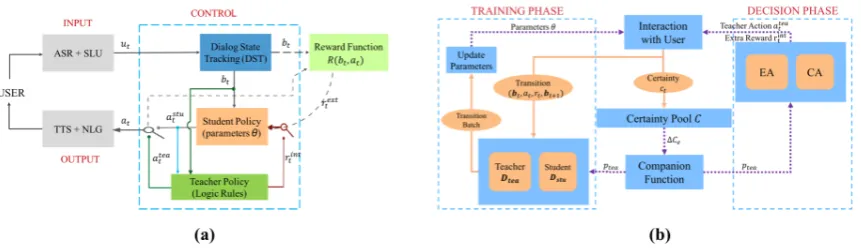
com-Figure 1: (a) RL-based Companion Learning(CL) Framework with Logic Rules in an SDS. (b) Agent-Aware Dropout DQN (AAD-DQN) for CL.
pared with the classic statistical dialogue manager architecture (Young et al.,2013). The goal of on-line policy training is to optimize the student pol-icy from data via interaction with users in real sce-narios. The teacher guides the policy learning at each turn as a companion of the dialogue policy, hence, referred to as companion learning2. The
CL framework is described in Figure1(a).
At each turn, the input module (ASR and SLU) receives an acoustic input signal from the human user and the dialogue state tracker keeps the di-alogue state up-to-date. The didi-alogue state is then transmitted to both the student policy and the teacher policy. The student policy first generates a candidate actionastu
t and when it needs help from
the teacher policy, it sendsastu
t with some
auxil-iary information which will be transmitted to the teacher. The teacher policy can then help the stu-dent policy with one of the following ways or both:
• Example Action (EA): The teacher gener-ates an actionatea
t instead of astut according
to its policy. It corresponds to the left switch in Figure1(a).
• Critic Advice (CA): The teacher will not ex-plicitly show an action. Instead, it gives an extra rewardrint
t to the student policy. It
cor-responds to the right switch in Figure1(a).
The action from control module is then transmitted to the output module, which generates the nature text and audio. At each turn, an extrinsic reward signalrext
t will be given to the student policy by 2The name companion learning has another potential meaning that the agents can learn from each other, i.e. the rules guide the RL training, and the optimised RL policy can provide some intuition for the revision of rules. We will give some preliminary discussions about this point in section 5.3.
the environment, i.e. the user. The extrinsic re-wardrext
t with the extra intrinsic rewardrtintwill
be used to update the policy parameters θ using reinforcement learning algorithms.
In the CL framework, there are two things that matter: one is when to consult the teacher, another is how to use the teacher’s experiences. In this pa-per, anagent-aware dropoutDQN (AAD-DQN) is proposed. As shown in Figure1(b), the certainty information during the interaction is used to define acompanion function, which controls how often to sample the teacher’s experiences for updating pa-rameters during the training phase (left), and when to use EA or CA teaching method during decision phase (right).
The rest of this section is organized as fol-lows. The next subsection introduces the agent-aware experience replay in DQN. The definition of certainty in DQN and the companion function are presented in subsection 3.3. The rule-based teacher policy is described in subsection3.4.
3.2 Agent-Aware Experience Replay in DQN A Deep Q-Network (DQN) is a multi-layer neu-ral network which maps a belief state bt to the
Q values of the possible actions at at that state,
Q(bt, at;θ), where θ is the weight vector of the
neural network. Neural networks for the approxi-mation of value functions have long been investi-gated (Lin,1993). However, these methods were previously quite unstable (Mnih et al., 2013). In DQN,Mnih et al.(2013,2015) proposed two tech-niques to overcome this instability, namely expe-rience replay and the use of a target network.
At every turn, the transition including the pre-vious belief state bt, previous action at,
[image:3.595.84.515.63.187.2]pa-per, two pools Dstu and Dtea are used to store
the student’s experiences and the teacher’s experi-ences respectively as shown in Figure1(b). When the teaching method EA is used in the t-th turn, at = ateat and the transition is put inDtea,
other-wise at = astut and the transition is put in Dstu
. When CA is used, rt = rtext+rtint, otherwise
rt = rtext. Once any of the pool has reached its
predefined maximum size, adding a new transition results in deleting the oldest transition in the pool. During training, a pool is first selected fromDtea
andDstu. The probability of selectingDteaisptea,
i.e. D ∼ Ber(Dtea,Dstu;ptea) 3.Then a
mini-batch of transitions is uniformly sampled from the selected pool, i.e. (bt, at, rt,bt+1) ∼U(D). We call thisagent-awareexperience replay.
Except for the experience replay, a target net-work with weight vector θ− is used. This target
network is similar to the Q-network except that its weights are only copied every K steps from the Q-network, and remain fixed during all the other steps. The loss function for the Q-network at each iteration takes the following form:
L(θ) = ED∼Ber(Dtea,Dstu;ptea),(bt,at,rt,bt+1)∼U(D)
"
rt+γmaxa
t+1 Q(bt+1, at+1;θ
−)−Q(b t, at;θ)
2#
(1) whereγ ∈[0,1]is the discount factor.
The probabilitypteacontrols how often the
stu-dent learns from the teacher’s experiences. As the learning goes on, the probability will decrease. More details will be described in the next section.
3.3 Companion Strategy
It’s important for the student to estimate an appro-priate point to end the reliance on the teacher. If the reliance is ended too early, the student itself may not reach an acceptable performance, result-ing in the sharp drop of performance, which is the
safetyproblem. However, if the student always re-lies on the teacher, it’s hard to improve its perfor-mance to surpass the teacher’s perforperfor-mance, which is theefficiencyproblem.
We get some inspirations from the studying pro-cess of a call center service agent. Consider how a new call center service agent gets started. At first, an experienced call center agent tells him some basicrulesand the new agent works by of-ten consulting these rules. His confidence about
3Ber is short for Bernoulli.
how to make decisions gradually increases during the continuous practice. Eventually, he is so con-fident about his own decisions that he no longer needs any consultation to these rules and even ex-plores some better response ways through inter-action with users which are not initially included in the rules. Similarly, we can use the uncer-tainty/certainty of the Q-network to determine the teaching time.
There are several methods to estimate the un-certainty/certainty in deep neural networks, e.g. Bayesian neural networks (Blundell et al.,2015), dropout (Gal and Ghahramani, 2016), bootstrap (Osband et al., 2016) . Here we use the dropout to estimate the certainty of Q-Network. We call this Q-networkDropoutQNetwork. Dropout is a technique used to avoid over-fitting in neural net-works. It was introduced several years ago by (Hinton et al.,2012) and studied more extensively in (Srivastava et al.,2014). When dropout is used in training, the elements of the output of each hid-den layerhis randomly set to zero with probabil-ityp, i.e. h0 = hz4 wherez is binary vector
and each elementzi∼Ber(1−p).h0is scaled by
1
1−p and then fed to the next layer. At test time the
dropout is disabled, i.e. the output of each hidden layerhis directly fed to the next layer. Although dropout was suggested as an ad-hoc technique, re-cently it was theoretically proven that the dropout training in deep neural networks is an approximate Bayesian inference in deep Gaussian processes (Gal and Ghahramani,2016). Therefore, a direct result of this theory gives us tools to model un-certainty with dropout neural networks. To obtain the uncertainty, similar with that at train phrase the dropout is enabled at test phrase. For each input instance (i.e. dialogue belief state)bt, performing
N stochastic forward passes through the network and averaging the output qi , [qi1,· · ·, qiM] to
get the mean and the variance. Generally, the vari-ance can be utilized to measure the uncertainty of output. However, it’s not a normalized criteria, and it’s hard to set a threshold below which we should be confident with the output.
Instead, we proposed a novel method to mea-sure the certainty of the decision of student policy at t-th turn. For each stochastic forward passes, the action ati = arg maxjqij is regarded as a
vote. After N passes 5, there is a committee
4Hereis the element-wise product.
{at1,· · ·, atN} consisting of N votes. The
ac-tion astu
t that should be taken in the belief state bt is the one with the largest percentage of the votes, and the corresponding percentage is defined as certaintyct. The process is described in
Algo-rithm1.
Algorithm 1 The Decision Procedure of Student Policyπstu(bt, N)
Require:
The repeat timesN and the belief statebt 1: Initial the probability vector p =
[p1,· · · , pM] with zero vector, where M
is the number of actions.
2: fori= 1,N do
3: qi←DropoutQNetwork(bt) 4: ati←arg maxjqij
5: p[ati]←p[ati] + 1/N 6: end for
7: ct←maxjpj 8: astut ←arg maxjpj 9: return astut ,ct
At the end of e-th dialogue, the average cer-tainty of all turns is computed, i.e. Ce =
1
Te PTe
t=0ct, where Te is the number of turns in e-th dialogue. Generally, the variance ofCe
be-tween successive dialogues is high. In order to the smooth the estimation, here we use the moving av-erage ofCe in previousW dialogues to represent
the certainty of student at current dialogue, i.e.
Ce= W1 e−1
X
i=e−W
Ci. (2)
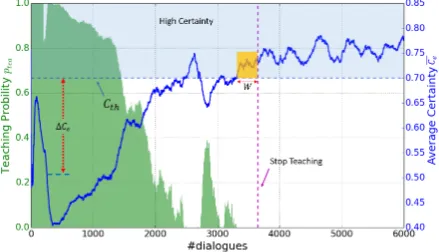
As the training goes on, Ce grows until it
con-verges. If Ce in all successive W dialogues are
greater then a threshold Cth as shown in Figure 2, it’s assumed that the student reaches a point where it is confident enough with its own decision steadily. Therefore, the teaching, both EA and CA, should be ended from now on.
Before the end of the teaching, CA is done in all turns. However, if EA is always done, the dis-appearance of the teacher may cause a dramatic change in the hybrid decision policy, which re-sults in a sharp drop of performance. To deal with this issue, a monotonically increasing func-tion of the relative certainty Ptea(∆Ce) is
pro-posed to control the frequency of EA teaching.
dialogue state can be repeatedNtimes to form a mini-batch, then one forward is executed to getNoutputs simultaneously.
∆Cerepresents the distance betweenCeandCth,
i.e. ∆Ce = max(0, Cth −Ce). The effect of
Ptea(∆Ce) is that the closer Ce is to Cth, the
more unlikely EA teaching is executed. Besides controlling how often the student directly consult the teacher, another mission of Ptea(∆Ce) is to
control how often the teacher’s experiences are re-played, i.e. the probabilityptea described in
sec-tion3.2. Implementation details ofPtea(∆Ce)are
[image:5.595.311.531.212.338.2]described in Appendix C.
Figure 2: Illustration of average certaintyCe and
the probabilityptea.
The full procedure of companion learning with logic rules is described in Algorithm2.
3.4 Teacher Policy: Logic Rules
Rule-based policy is popular in commercial dia-logue systems (Williams, 2008). The policy, i.e. the dialogue plan/flow, is designed by a domain expert. His knowledge of task domain and busi-ness rules is encoded in the rules. There are many methods to represent the decision rules, e.g. propositional logic, first-order logic, decision tree. Here, we use the ordered propositional logic rules, which can be easily translated intoIF-THENrules. When making the decision, these rules are exe-cuted in pre-defined order. If the conditions of any rule are satisfied, the decision process will be ter-minated and the output is the corresponding ac-tion. In this paper, three hand-crafted logic rules, R1, R2, and R3 , were used as the teacher:
• R1: confirm the most likely value in slots where the most likely value has probability between 0.1 and 0.66;
• R2: offer a restaurant if there is at least one slot in which the belief of most likely value is more than the belief of special value “none”;
Algorithm 2 Companion Learning with Logic Rules
Require:
The number of stochastic forward passN, the maximal extra rewardδ >0.
1: Initialize the parametersθof student policy 2: Initialize replay poolsDteaandDstuwith{},
certainty memory C with {}, teaching with T rue.
3: for e= 1,E do
4: Update the dialogue belief stateb0 5: Initialize the average certaintyCe←0 6: ifteachingisT rue then
7: teaching, ptea←Companion(C) 8: end if
9: for t= 0,Tedo
10: Set intrinsic rewardrintt ←0
11: Get system action and the corresponding certainty, i.e.astu
t , ct←πstu(bt, N) 12: Ce←Ce+ct
13: Get action from the rule-based policy, i.e. atea
t ←πtea(bt) 14: EA∼Ber(ptea)
15: if teaching is T rue and EA is T rue then
16: at←ateat
17: else
18: at←astut 19: end if
20: ifteachingisT ruethen
21: rtint←(2×1{at=ateat } −1)δ 22: end if
23: Ce← T1eCe, and storeCeinC
24: Give the action at to the environment,
observe the extrinsic rewardrext
t and
up-date the dialogue belief statebt+1
25: rt←rtint+rtext 26: ifEAisT ruethen
27: Store{bt, at, rt,bt+1}inDtea
28: else
29: Store{bt, at, rt,bt+1}inDstu 30: end if
31: Update the parameters θ of
DropoutQNetwork according to the equation (1).
32: end for 33: end for 34: return θ
Algorithm 3Companion FunctionCompanion(C)
Require:
The average certainty memory C ate-th dia-logue and the moving window sizeW.
1: InitializeteachingwithF alse,pteawith 0 2: fori= 0, W do
3: Compute the moving average certainty Ce−iin (e-i)-th dialogue with equation (2).
4: ifCe−i< Cththen
5: teaching ←T rue
6: break
7: end if 8: end for
9: ifteachingisT ruethen 10: ∆Ce ←max(0, Cth−Ce) 11: ptea ←Ptea(∆Ce)
12: end if
13: return teaching, ptea
• R3: request values for a slot which is uni-formly selected from a pre-defined slot list.
The corresponding pseudo-codes are presented in Appendix B.
4 Evaluation Metrics of On-line Policy Optimization
Most previous work on the evaluation of RL-based dialogue policy optimization focuses on the final performance (FP) when the system converges to a steady level. However, for on-line policy op-timization, it’s important to measure the learning process. Except for FP, we proposed two quantita-tive metrics: safety loss and efficiency loss. 4.1 Safety Loss
In the on-line training process, unless the mance of the system reaches the acceptable perfor-manceSa, the interaction between users and the
system will be unsafe and causes trouble to con-tinuing training. So the safety of the system is de-fined to be the system’s ability to maintain perfor-mance above the acceptable perforperfor-manceSa.
We quantify the safety loss of the system by summing up the performance gap between the acceptable performance and the system perfor-mance Se in every episode during the on-line
learning. Suppose there are E dialogues, then L1 =
E
P
intuitive interpretation as the area of the region be-low the threshold and above training curve. This metric is similar to the integral of absolute error (IAE) (Shinners,1998) metric commonly adopted in the evaluation of control systems (Gaing,2004;
Jesus and Tenreiro MacHado,2008).
4.2 Efficiency Loss
Another important issue of on-line learning is effi-ciency. The efficiency indicates the speed at which the system reaches a specific performance level. In reality, we can tolerate a system to make mistakes at the beginning but it should improve at a signif-icant speed until reaching the ideal performance Si. Therefore, later failures should weight more
than early failures to evaluate efficiency. Sim-ilar to the integral of time multiplied by abso-lute error (ITAE) (Shinners,1998) metric, we pro-pose a metric efficiency loss. We multiply the performance gap between ideal performance and current performance with the episode index, thus giving later failure greater penalty. Specifically, L2 =
E
P
e=1max(0, Si−Se)e.
More illustrations about safety loss and effi-ciency loss are given in Appendix D.
5 Experiments
Our experiments have three objectives: (1) Com-paring our proposeddropoutDQN in Algorithm1
with some baselines when there is no teacher. (2) Comparing CL with other two baselines when the teacher gets involved, and investigating the ben-efits of our proposedagent-aware experience re-play. (3) Visually analyzing the differences in be-haviors between the rule-based teacher policy and the optimized student policy.
An agenda-based user simulator (Schatzmann et al.,2007a) with error model (Schatzmann et al.,
2007b) was implemented to emulate the behav-ior of the human user, and a rule-based policy with 0.695 success rate described in section 3.2 was used as the teacher in our experiments. The purpose of the user’s interacting with SDS is to find restaurant information in the Cambridge (UK) area (Henderson and Thomson, 2014). This do-main has 7 slots of which 4 can be used by the system to constrain the database search. The sum-mary action space consists of 16 sumsum-mary actions. More details are described in Appendix A.
For reward, at each turn, an extrinsic reward of
−0.05is given to the student policy. At the end of the dialogue, a reward of+1is given for dialogue success. The maximal extra rewardδis 0.05.
For each set-up, 10000 dialogues are used for training, the moving dialogue success rate is recorded with a window size of 1000. The final results are the average of 40 runs.
5.1 Policy Learning without Teaching
In this section, four policies without teaching are compared:
• DQN: A vanilla deep Q-Network (Mnih et al.,
2015) which has two hidden layers, each with 128 nodes.
• A2C: An advantage actor-critic policy which consists of an actor network and a critic net-work (Fatemi et al.,2016).
• Dropout DQN 1 and Dropout DQN 32: They both have a dropout layer after each hidden layer. The dropout rate is 0.2. Their difference is that the number of stochas-tic forward pass N of Dropout DQN 32
in Algorithm 1 is 32, while that of
Dropout DQN 1 is 1. Dropout DQN 1
makes decision according to one output of Q-network similar to that of vanilla DQN.
[image:7.595.310.532.522.649.2]Dropout DQN 1was first proposed in (Gal and Ghahramani, 2016), and was confirmed thatDropout DQN 1can obtain more effi-cient exploration.
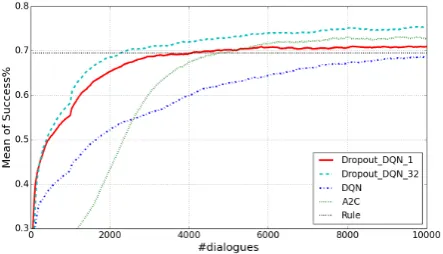
Figure 3: Comparison of four policies without teaching.
The learning curves are described in Figure 3
and the evaluation results are described in Table
Metrics DQN Dropout DQN 1No TeachingDropout DQN 32 A2C A2C PreTrain TeachingEA CL D CL AAD Safety 1043.3 321.4 258.0 1020.8 176.9 48.8 30.6 18.6 Efficiency(×104) 534.7 249.1 75.6 299.0 205.4 58.0 62.6 53.5
[image:8.595.73.547.62.114.2]FP 0.684 0.709 0.749 0.727 0.726 0.751 0.749 0.751
Table 1: The quantitative evaluation results of different methods. Here final performance (FP) is the success rate of last 2000 dialogues. The FP ofDropout DQN 320.749 is used as the ideal performance Si for computing efficiency loss, and the performance of the rules 0.695 is used as the acceptable
performanceSafor computing safety loss.
dropout can be observed as claimed in (Gal and Ghahramani,2016). However,Dropout DQN 1
seems to suffer premature and sub-optimal con-vergence, while our proposedDropout DQN 32, whose decision is based on multi votes (algo-rithm 1), can result in improvement of effi-ciency and better final performance. Moreover,
Dropout DQN 32 also performs much better than the policy gradient methodA2C.
For the following experiments, the times of stochastic forward pass N in Algorithm1is 32.
5.2 Policy Learning with Teaching
In this section, four methods of teaching by the rule-based policy are compared:
• EA: 500 dialogues are taught with EA at the beginning (Chen et al.,2017).
• A2C PreTrain: At the beginning, 500 di-alogue are collected with rule-based policy. These examples are used to pre-train the actor network with supervised learning. After the pre-training, the policy is continuously opti-mized with the A2C algorithm (Fatemi et al.,
2016).
• CL AAD: Full CL with AAD-DQN described in section3.
• CL D: CL without agent-aware experience repay, i.e. the teacher’s experiences and stu-dent’s experiences are put in one pool and are uniformly sampled for the experience replay in equation (1).
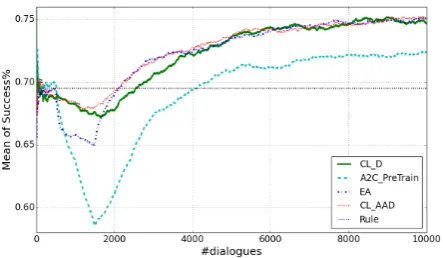
As can be seen in Figure4, there is a big dip in the performance ofA2C PreTrain. One possi-ble explanation is that because the rule-based pol-icy is sub-optimal, the pre-training makes the stu-dent policy reach a local minimum point. The rl-training should first make it escape from the local
Figure 4: Comparison of four methods with teach-ing by rule-based teacher.
minimum point, which results in a temporary loss in performance.
Comparing CL methods (CL D and CL AAD) withEAin Figure 4and in Table 1, we can con-clude that CL can significantly boost the safety of learning process. Moreover, except for safety,
CL AAD can boost the efficiency, which benefits from theagent-awareexperience replay.
5.3 Comparison of Optimized Student Policy and Rule-based Teacher Policy
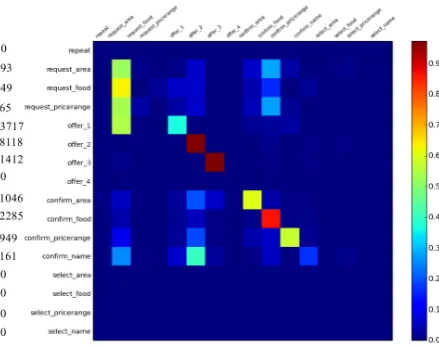
To interpret what the student has learnt, we fur-ther compare the rules and an optimized student policy with 76.7% success rate. The rule-based policy is used to collect 5000 dialogues, while in each turn the decision made by the student policy is also recorded. Figure5 is a confusion matrix. The x-axis denotes the student’s decision and the y-axis denotes the rules’ decision. The numbers on the left are the statistics for each action in 5000 dialogues. Each element in the matrix denotes the normalized number of turns when the rule chooses the action in the corresponding line, the student chooses the action in the corresponding column.
As is shown in Figure 5, offer and confirm
[image:8.595.310.532.202.331.2]pol-Figure 5: Confusion matrix between the decisions of rule-based policy and the decisions of the opti-mised student policy. The x-axis denotes the stu-dent’s decision and the y-axis denotes the rules’ decision.
icy choosesoffer 1, the student policy will choose a different action. Furthermore, from the element in line offer 1 and column request area, we can find that in this situation the student policy prefers the actionrequest area. Inspired by this disagree-ment, we designed a new rule:
• R4: request values for slot area when there is only one other slot constraint for the database query.
Similarly, as can be seen in Figure5, in a con-siderable proportion of turns when the rule-based policy choosesconfirm area, confirm pricerange, or confirm name, the student policy will choose the actionoffer 2, which may mean that for slots
area, pricerange, or name, when there are val-ues for database query, the system should offer a restaurant instead of confirming the slot-value constraints. Therefore, the rule R1 in section 3.2 was revised as follows:
• R1*: For slot food, confirm the most likely value has the probability between 0.1 and 0.6; For slot area, pricerange and name, confirm the most likely value, the belief of which is smaller than the belief of the special value “none” and is larger than 0.1.
Table2is the evaluation results of different or-dered rules. The rule R4 can significantly boost the success rate (comparing line 2 with line 1),
Ordered Rules Success Rate #Turn Reward
[image:9.595.76.296.61.234.2]R1, R2, R3 0.695 4.58 0.4657 R1, R4, R2, R3 0.749 5.16 0.4910 R1*, R2, R3 0.705 4.44 0.4824 R1*, R4, R2, R3 0.753 4.98 0.5042 Table 2: Evaluation results of different ordered rules. As a reference, the performance of opti-mised student policy is success rate 0.767, #turn 5.10 and reward 0.5124.
while the rule R1* can both boost the success rate and decrease the dialogue length (comparing line 3 with line 1). The combination of R4 and R1* takes respective advantages (comparing line 4 with line 1, line 2 and line 3). The performance of fi-nal order rules is comparable to the performance of optimized student policy.
It is worth noting that the primary rules R1, R2, and R3 in section 3.2 don’t distinguish between different slots. However, the new rules R4 and R1* are all slot-specific, which it is difficult to de-sign at the beginning.
6 Conclusion
This paper has proposed a companion learning
framework to unify rule-based policy and RL-based policy. Here, the rule-RL-based policy acts as a teacher, which either directly shows example ac-tion or gives an extra reward. Based on the un-certainty estimated using a dropout Q-Network, a companion strategy is proposed to control when the student policy directly consults rules and how often the student policy learns from the teacher’s experiences. Simulation experiments showed that our proposed framework can significantly improve both safety andefficiency of on-line policy opti-mization. Additionally, we visually analyzed the differences in behaviors between the rule-based teacher policy and the optimized student policy, which gave us some inspirations to refine the rules.
Acknowledgments
[image:9.595.305.523.63.114.2]References
Charles Blundell, Julien Cornebise, Koray Kavukcuoglu, and Daan Wierstra. 2015. Weight uncertainty in neural network. In International Conference on Machine Learning, pages 1613– 1622.
Lu Chen, Runzhe Yang, Cheng Chang, Zihao Ye, Xi-ang Zhou, and Kai Yu. 2017. On-line dialogue pol-icy learning with companion teaching. In Proceed-ings of the 15th Conference of the European Chap-ter of the Association for Computational Linguistics: Volume 2, Short Papers, pages 198–204.
Heriberto Cuay´ahuitl, Simon Keizer, and Oliver Lemon. 2015. Strategic dialogue management via deep reinforcement learning. NIPS Deep Reinforce-ment Learning Workshop.
Mehdi Fatemi, Layla El Asri, Hannes Schulz, Jing He, and Kaheer Suleman. 2016. Policy networks with two-stage training for dialogue systems. In17th An-nual Meeting of the Special Interest Group on Dis-course and Dialogue, pages 101–110.
Zwe-Lee L Gaing. 2004. A Particle Swarm Optimiza-tion Approach for Optimum Design of PID Con-troller in AVR System. IEEE Transactions on En-ergy Conversion, 19(2):384–391.
Yarin Gal and Zoubin Ghahramani. 2016. Dropout as a Bayesian approximation: Representing model un-certainty in deep learning. In Proceedings of the 33rd International Conference on Machine Learn-ing (ICML-16).
Milica Gaˇsi´c, Filip Jurˇc´ıˇcek, Simon Keizer, Franc¸ois Mairesse, Blaise Thomson, Kai Yu, and Steve Young. 2010. Gaussian processes for fast policy optimisation of POMDP-based dialogue managers. Association for Computational Linguistics.
Milica Gaˇsi´c, Filip Jurˇc´ıˇcek, Blaise Thomson, Kai Yu, and Steve Young. 2011. On-line policy optimisation of spoken dialogue systems via live interaction with human subjects. In Automatic Speech Recognition and Understanding (ASRU), 2011 IEEE Workshop on, pages 312–317. IEEE.
Milica Gaˇsi´c and Steve Young. 2014. Gaussian pro-cesses for pomdp-based dialogue manager optimiza-tion. IEEE/ACM Transactions on Audio, Speech, and Language Processing, 22(1):28–40.
James Henderson, Oliver Lemon, and Kallirroi Georgila. 2008. Hybrid reinforcement/supervised learning of dialogue policies from fixed data sets.
Computational Linguistics, 34(4):487–511.
Matthew Henderson and Blaise Thomson. 2014. The second dialog state tracking challenge. InSIGDIAL, volume 263, Stroudsburg, PA, USA. Association for Computational Linguistics.
Geoffrey E Hinton, Nitish Srivastava, Alex Krizhevsky, Ilya Sutskever, and Ruslan R Salakhutdinov. 2012. Improving neural networks by preventing co-adaptation of feature detectors. arXiv preprint arXiv:1207.0580.
Isabel S. Jesus and J. A. Tenreiro MacHado. 2008. Fractional control of heat diffusion systems. Non-linear Dynamics, 54(3):263–282.
Leslie Pack Kaelbling, Michael L Littman, and An-thony R Cassandra. 1998. Planning and acting in partially observable stochastic domains. Artificial Intelligence, 101(1-2):99–134.
Long-Ji Lin. 1993. Reinforcement learning for robots using neural networks. Ph.D. thesis, Fujitsu Labo-ratories Ltd.
Zachary C Lipton, Jianfeng Gao, Lihong Li, Xiujun Li, Faisal Ahmed, and Li Deng. 2016. Efficient exploration for dialogue policy learning with bbq networks & replay buffer spiking. arXiv preprint arXiv:1608.05081.
Volodymyr Mnih, Koray Kavukcuoglu, David Sil-ver, Alex Graves, Ioannis Antonoglou, Daan Wier-stra, and Martin Riedmiller. 2013. Playing atari with deep reinforcement learning. arXiv preprint arXiv:1312.5602.
Volodymyr Mnih, Koray Kavukcuoglu, David Silver, Andrei A Rusu, Joel Veness, Marc G Bellemare, Alex Graves, Martin Riedmiller, Andreas K Fidje-land, Georg Ostrovski, et al. 2015. Human-level control through deep reinforcement learning. Na-ture, 518(7540):529–533.
Ian Osband, Charles Blundell, Alexander Pritzel, and Benjamin Van Roy. 2016. Deep exploration via bootstrapped dqn. InAdvances in Neural Informa-tion Processing Systems, pages 4026–4034.
Olivier Pietquin, Matthieu Geist, and Senthilkumar Chandramohan. 2011. Sample Efficient On-line Learning of Optimal Dialogue Policies with Kalman Temporal Differences. InIJCAI, pages 1878–1883.
Jost Schatzmann, Blaise Thomson, Karl Weilhammer, Hui Ye, and Steve Young. 2007a. Agenda-based user simulation for bootstrapping a pomdp dialogue system. In NAACL, pages 149–152, Morristown, NJ, USA. Association for Computational Linguis-tics.
Jost Schatzmann, Blaise Thomson, and Steve Young. 2007b. Error simulation for training statistical di-alogue systems. InAutomatic Speech Recognition & Understanding, 2007. ASRU. IEEE Workshop on, pages 526–531. IEEE.
David Silver, Aja Huang, Chris J Maddison, Arthur Guez, Laurent Sifre, George Van Den Driessche, Ju-lian Schrittwieser, Ioannis Antonoglou, Veda Pan-neershelvam, Marc Lanctot, et al. 2016. Mastering the game of go with deep neural networks and tree search. Nature, 529(7587):484–489.
Nitish Srivastava, Geoffrey E Hinton, Alex Krizhevsky, Ilya Sutskever, and Ruslan Salakhutdinov. 2014. Dropout: a simple way to prevent neural networks from overfitting. Journal of Machine Learning Re-search, 15(1):1929–1958.
Pei-Hao Su, Pawel Budzianowski, Stefan Ultes, Mil-ica Gasic, and Steve Young. 2017. Sample-efficient actor-critic reinforcement learning with supervised data for dialogue management. In Proceedings of the 18th Annual Meeting of the Special Interest Group on Discourse and Dialogue (SIGDIAL). Pei-Hao Su, Milica Gasic, Nikola Mrksic, Lina
Rojas-Barahona, Stefan Ultes, David Vandyke, Tsung-Hsien Wen, and Steve Young. 2016. Continu-ously learning neural dialogue management. arXiv preprint arXiv:1606.02689.
Jason D Williams. 2008. The best of both worlds: uni-fying conventional dialog systems and pomdps. In
INTERSPEECH, pages 1173–1176.
Jason D Williams, Kavosh Asadi, and Geoffrey Zweig. 2017. Hybrid code networks: practical and efficient end-to-end dialog control with supervised and rein-forcement learning. InProceedings of the 55th An-nual Meeting of the Association for Computational Linguistics.
Jason D Williams and Steve Young. 2007. Partially observable markov decision processes for spoken dialog systems. Computer Speech and Language, 21(2):393–422.
Jason D Williams and Geoffrey Zweig. 2016. End-to-end LSTM-based dialog control optimized with su-pervised and reinforcement learning. CoRR. Steve Young, Milica Gaˇsi´c, Simon Keizer, Franc¸ois
Mairesse, Jost Schatzmann, Blaise Thomson, and Kai Yu. 2010. The hidden information state model: A practical framework for pomdp-based spoken di-alogue management. Computer Speech and Lan-guage, 24(2):150–174.
Steve Young, Milica Gaˇsi´c, Blaise Thomson, and Ja-son D Williams. 2013. Pomdp-based statistical spo-ken dialog systems: A review. Proceedings of the IEEE, 101(5):1160–1179.