Generating High-Quality and Informative Conversation Responses
with Sequence-to-Sequence Models
Louis Shao1∗, Stephan Gouws3∗, Denny Britz2†, Anna Goldie2, Brian Strope1, Ray Kurzweil1
{overmind,sgouws,dennybritz,agoldie,bps,raykurzweil}@google.com
1Google Research and 2Google Brain
Mountain View, CA, USA and
3Google Brain
London, UK
Abstract
Sequence-to-sequence models have been applied to the conversation response gen-eration problem where the source se-quence is the conversation history and the target sequence is the response. Un-like translation, conversation responding is inherently creative. The generation of long, informative, coherent, and diverse responses remains a hard task. In this work, we focus on the single turn set-ting. We add self-attention to the de-coder to maintain coherence in longer responses, and we propose a practical approach, called the glimpse-model, for scaling to large datasets. We introduce a stochastic beam-search algorithm with segment-by-segment reranking which lets us inject diversity earlier in the generation process. We trained on a combined data set of over 2.3B conversation messages mined from the web. In human evalua-tion studies, our method produces longer responses overall, with a higher proportion rated as acceptable and excellent as length increases, compared to baseline sequence-to-sequence models with explicit length-promotion. A back-off strategy produces better responses overall, in the full spec-trum of lengths.
1 Introduction
Building computer systems capable of general-purpose conversation is a challenging problem. However, it is a necessary step toward building in-telligent agents that can interact with humans via
∗Both authors contributed equally to this work. †Work done as a member of the Google Brain Residency program (g.co/brainresidency).
natural language, and for eventually passing the Turing test. The sequence-to-sequence (seq2seq) model has proven very popular as a purely data-driven approach in domains that can be cast as learning to map to and from variable-length se-quences, with state-of-the art results in many do-mains, including machine translation (Cho et al.,
2014; Sutskever et al., 2014; Wu et al., 2016). Neural conversation models are the latest devel-opment in the domain of conversation modeling, with the promise of training computers to converse in an end-to-end fashion (Vinyals and Le, 2015;
Shang et al.,2015;Sordoni et al.,2015;Wen et al.,
2016). Despite promising results, there are still many challenges with this approach. In particu-lar, these models produce short, generic responses that lack diversity (Sordoni et al.,2015;Li et al.,
2015). Even when longer responses are explicitly encouraged (e.g. via length normalization), they tend to be incoherent (“The sun is in the center of the sun.”), redundant (“i like cake and cake”), or contradictory (“I don’t own a gun, but I do own a gun.”).
In this paper, we provide two methods to ad-dress these issues with minimal modifications to the standard seq2seq model. First, we present a glimpse model that only trains on fixed-length segments of the target-side at a time, allowing us to scale up training to larger data sets. Sec-ond, we introduce asegment-based stochastic de-coding technique which injects diversity earlier in the generated responses. Together, we find that these two methods lead to both longer re-sponses and higher ratings, compared to a baseline seq2seq model with explicit length and diversity-promoting heuristics integrated into the generation procedure (see Table1for examples generated us-ing our model).
In Section2, we present a high-level overview of these two techniques. We then discuss each
technique in more detail in Sections 3and4. Fi-nally, we report small and large-scale experimen-tal evaluations of the proposed techniques in Sec-tion5.
2 Overview and Motivation
A major difference between translation and re-sponding to conversations is that, in the former, the high-level semantic content to generate in the tar-get sequenceyis completely given by the source sequence,i.e., given the sourcex, there is low con-ditional entropy in the target distributionP(y|x). In the seq2seq approach, the decoder network therefore only has to keep track of where it is in the output, and the content to generate can be trans-formed from the relevant parts in the source via the attention mechanism (Bahdanau et al.,2014). In contrast, in conversation response generation, the prompt turn may be short and general (e.g.,“what do you have planned tonight”), while an appropri-ate response may be long and informative.
The standard seq2seq model struggles with gen-erating long responses, since the decoder has to keep track of everything output so far in its fixed-length hidden state vector, which leads to incoher-ent or even contradictory outputs. To combat this, we propose to integrate target-side attentioninto the decoder network, so it can keep track of what has been output so far. This frees up capacity in the hidden state for modeling the higher-level se-mantics required during the generation of coherent longer responses. We were able to achieve small perplexity gains using this idea on the small Open-Subtitles 2009 data set (Tiedemann,2009). How-ever, we found it to be too memory-intensive when scaling up to larger data sets.
As a trade-off, we propose a technique (called the ‘glimpse model’) which interpolates between source-side-only attention on the encoder, and source and target-side attention on the encoder and decoder, respectively. Our solution simply trains the decoder on fixed-lengthglimpses from the target side, while having both the source se-quence and the part of the target sese-quence before the glimpse on the encoder, thereby sharing the at-tention mechanism on the encoder. This can be implemented as a simple data-preprocessing tech-nique with an unmodified standard seq2seq imple-mentation, and allows us to scale training to very large data sets without running into any memory issues. See Figure 1 for a graphical overview,
where we illustrate this idea with a glimpse-model of length 3.
Given such a trained model, the next chal-lenge is how to generate long, coherent, and di-verse responses with the model. As observed in the previous section and in other work, stan-dard maximum a posteriori (MAP) decoding us-ing beam search often yields short, uninforma-tive, and high-frequency responses. One ap-proach to produce longer outputs is to em-ploy promoting heuristics (such as length-normalization (Wu et al., 2016)) during decod-ing. We find this increases the length of the out-puts, however often at the expense of coherence. Another approach to explicitly create variation in the generated responses is to rerank the N-best MAP-decoded list of responses from the model us-ing diversity-promotus-ing heuristics (Li et al.,2015) or a backward RNN (Wen et al., 2015). We find this works for shorter responses, but not for long responses, primarily for two reasons: First, the method relies on the MAP-decoding to pro-duce the N-best list, and as mentioned above, MAP-decoding prefers short, generic responses. Second, it is too late to delay reranking in the beam search until the whole sequence has been generated, since beam-search decoding tends to yield beams with low diversity per given prompt, even when the number of beams is high. In-stead, our solution is to break up the reranking over shorter segments, and to rerank segment-by-segment, thereby injecting diversity earlier during the decoding process, where it has the most impact on the resulting diversity of the generated beams.
To further improve variation in the generated responses, we replace the deterministic MAP-decoding of the beam search procedure with sam-pling. If a model successfully captures the distri-bution of responses given targets, one can expect simple greedy sampling to produce reasonable re-sponses. However, due to model underfitting, the learned distributions are often not sharp enough, causing step-by-step sampling to accumulate er-rors along the way, manifesting as incoherent out-puts. We find that integrating sampling into the beam-search procedure yields responses that are more coherent and with more variation overall.
In summary, the contributions of this work are the following:
PROMPT: RESPONSE FROM BASELINE (A) vs OUR METHOD (B)
what do you have planned tonight A:B:I have no idea what I want to do with my life. I have no idea what I want to (Bad, Mediocre, Bad)I was planning on doing a few of these, but I’m not sure what to choose. I need to find a place to camp, and I don’t have a lot of time to make a plan. (Excellent, Good, Mediocre)
I’d like to read a good science fiction novel. Haven’t read scifi
in a while. A:B:If you like sci fi you should check out The Name of the Wind by Patrick Rothfuss (Excellent, Excellent, Excellent)If you want to know what sci-fi is, read the first book by Neil Gaiman. It’s a sci-fi sci-fi sci-fi novel. It is really good and I recommend it to all of you. It has a great premise. (Acceptable, Excellent, Acceptable)
Got any big weekend plans? A:B:I have plans for the weekend but I don’t know if I will be able to make it to the (Bad, Mediocre, Bad)I don’t really have much to do on Saturday. But I plan on going to the movies at the mall and going to the show. (Good, Good, Bad)
Sometimes flying messes my ears, because of the air pressure. Especially if I have a cold or something, flying gets me messed up.
A:I don’t know why, but when I was a kid I used to do this all the time when I was younger. (Good, Bad, Bad)
B:I have no idea why, but I feel exactly the same way. I don’t know why, but my brain is so sensitive to air that it makes my nose twitch. (Excellent, Mediocre, Good)
Yeah. I have this friend, and we get bored just hanging out here sometimes, so we take little trips to places. We went to Seattle a couple of months ago.
A:What kind of things do you like to do? (Excellent, Excellent, Excellent)
B:That sounds like a great time. I have a lot of friends that go to Seattle, so I was wondering if you could share any of the locations? (Excellent, Excellent, Excellent)
have you seen Suicide Squad? A:B:I have not, but I will check it out. (Good, Good, Good)I saw it in a theater once and it was great. It was very... I don’t know, a little dark. I like the psychological effects and the way it portrays the characters in the movie. (Excellent, Excellent, Excellent)
Actually I like the snow too, except for today. It’s all slushy and
it’s all over the sidewalks and it’s gross. A:snow. (Acceptable, Good, Good)I hate the snow. I hate the snow. I hate the snow. I hate the snow. I hate the snow. I hate the snow. I hate the snow. I hate the
B:I’m in the same boat as you. I hate it when it’s snowy and I don’t like to shovel it all day. :( So this is a perfect excuse to not get out of bed and go somewhere else. (Excellent, Good, Acceptable)
What do you hope to see in the future? A:B:I want to see an actual movie where the characters have the ability to hide the fact that they are actually in the movie. (Good,I want to be able to go back in time to when I was born. I want to be (Mediocre, Bad, Mediocre) Acceptable, Acceptable)
what dangers could happen with the singularity? A:B:I don’t think it would be that big of a deal. (Acceptable, Mediocre, Acceptable)If you look at it from the perspective of an alien, you can’t say that there aren’t any alternative ways to deal with it. (Accept-able, Mediocre, Acceptable)
[image:3.595.69.571.61.285.2]I think you’re a little crazy. A:B:I don’t think you know what that word means. (Acceptable, Good, Good)I am, actually. I don’t think I’m crazy though. I certainly am. (Acceptable, Mediocre, Acceptable)
Table 1: Some example responses generated from the baseline (A) compared to our model (B), with human ratings in parentheses. These were selected for quality. See the appendix for an unbiased sample.
practical approach, referred to as theglimpse model, which scales well and is easy to im-plement on top of the standard sequence-to-sequence model.
2. We introduce astochastic beam-search pro-cedure with segment-by-segment reranking which improves the diversity of the generated responses.
3. We present large-scale experiments with hu-man evaluations showing the proposed tech-niques improve over strong baselines. 4. We release our collection of context-free
con-versation prompts used in our evaluations as a benchmark for future open-domain conver-sation response research.
3 Seq2Seq Model with Attention on Target
We discuss conversation response generation in the sequence-to-sequence problem setting. In this setting, there is a source sequence x = (x1, x2, ..., xM), and a target sequence y =
(y0, y1, y2, ..., yN). We assume y0 is always the
start-of-sequence token and yN is the
end-of-sequence token. In a typical end-of-sequence-to-end-of-sequence model, the encoder gets its input from the source sequence x and the decoder models the condi-tional language model P(y|x) of the target se-quencey, givenx.
Seq2seq models with attention (Bahdanau et al.,
2014) parameterize the per-symbol conditional probability as:
P yi|y[0:i−1];x= DecoderRNN ((hi) yi−1, hi−1,Attention (hi−1,x)) (1)
for1 ≤ i ≤ N, where DecoderRNN() is a re-current neural network that map the sequence of decoder symbols into fixed-length vectors, and At-tention() is a function that yields a fixed-size vec-tor summary of the encoder symbols x (the ‘fo-cus’) most relevant to predictingyi, given the
pre-vious recurrent state of the networkhi−1(the
‘con-text’). The full conditional probability follows from the product rule, as:
P(y|x) =YN
i=1
P yi|y[0:i−1];x (2)
We propose to implementtarget-side attention by augmenting the attention mechanism to include the part of the target sequence already generated, i.e., we includey[0:i−2]in the arguments to the at-tention function: Atat-tention(hi−1,y[0:i−2],x). We
implemented this in TensorFlow (Abadi et al.,
Encoder A B C D E
a b c d e f g h a b c d e f g h
<
>
<
Decoder Attention
(a) The vanilla sequence-to-sequence model.
Encoder
Decoder A B C D E b <
c d e d e f
> a
Attention
[image:4.595.84.515.69.138.2](b) Length-3 Target-glimpse Model
Figure 1: The vanilla seq2seq with attention on the left, and our proposed target-glimpse model on the right. The symbol “>” and “<” are start-of-sequence and end-of-sequence, respectively.
and the majority of its response sequences are shorter than 10 tokens. This may prevent us from seeing bigger gains, since our method is designed to help with longer outputs. In order to train on the much larger Reddit data set, we implemented this method on top of the GNMT model (Wu et al.,
2016). Unfortunately, we met with frequent out-of-memory issues, as the 8-layer GNMT model is already very memory-intensive, and adding target-side attention made it even more so. Ideally, we would like to retain the model’s capacity in or-der to train a rich response model, and therefore a more efficient approach is necessary.
To this end, we propose the target-glimpse model which has a fixed-length decoder. The target-glimpse model is implemented as a stan-dard sequence-to-sequence model with attention, where the decoder has a fixed length K. Dur-ing trainDur-ing, we split the target sequence into non-overlapping, contiguous segments (glimpses) with fixed length K, starting from the beginning. We then train on each of these glimpses, one at a time on the decoder, while putting all target-side sym-bols before the glimpse on the encoder. For ex-ample, if a sequencey is split into two glimpses
y1andy2, each with lengthK(y2may be shorter
thanK), then we will train the model with two ex-amples, (x→y1), and(x,y1 →y2). Each time
the concatenated sequence on the left of the arrow is put on the encoder and the sequence on the right is put on the decoder. Figure 1(b) illustrates the training of(x,y1 →y2)whenK = 3. In our
im-plementation, we always put the source-side end-of-sequence token at the end of the whole encoder sequence, and we split the glimpses according to the decoder time steps. For example, if the se-quenceyisy0, y1, y2, ..., y10, andK= 3, the first
example will havey0, y1, y2 on the input layer of
the decoder, and y1, y2, y3 on the output layer of
the decoder. The second example hasy3, y4, y5 as
input of the decoder andy4, y5, y6as the output of
the decoder, and so on. In our experiments, we use
K = 10.
While decoding each glimpse, the decoder therefore attends to both the source sequence and the part of the target sequence that precedes the glimpse, thereby benefiting from the GNMT en-coder’s bidirectional RNN. Through generaliza-tion, the decoder should learn to decode a glimpse of lengthK in any arbitrary position of the target sequence (which we will exploit in our decoding technique discussed in Section4). One drawback of this model, however, is that the context inputs to the attention mechanism only include the words that have been generated so far in this glimpse, rather than the words from the full target side. The workaround that we use is to simply connect the last hidden state of the GNMT-encoder to the ini-tial hidden state of the decoder1, thereby giving the
decoder access to all previous symbols regardless of the starting position of the glimpse.
4 Stochastic Decoding with
Segment-by-Segment Reranking
We now turn our attention from training to in-ference (decoding). Our strategy is to perform reranking with a normalized score at the ment level, where we generate the candidate seg-ments using a trained glimpse-model and using a stochastic beam search procedure, which we dis-cuss next. The full decoding algorithm proceeds segment by segment.
The standard beam search algorithm generates symbols step-by-step by keeping a set of the B
highest-scoring beams generated so far at each step2. The algorithm adds all possible single-token
extensions to every existing beam, and then selects 1This is the default in standard seq2seq models, but not in the GNMT model.
the topB beams. In our stochastic beam search algorithm, we replace this deterministic top-B se-lection by a stochastic sampling operation in order to encourage variation. Further, to discourage a single beam from dominating the search and de-creasing the final response diversity, we perform a two-step sampling procedure: 1) For each single-token extension of an individual beam we don’t enumerate all possibilities, but instead sample a fixed number ofDcandidate tokens to be added to the beam. This yields a total ofB×Dbeams, each with one additional symbol. 2) We then compute the accumulated conditional log-probabilities for each beam (normalized across allB×Dbeams), and treat these as the logits for sub-sampling B
beams for the next step. We repeat this procedure until we reach the desired segment-length H, or until a segment ends with the end-of-sequence to-ken.
For a given source sequence, we can use this stochastic beam search algorithm to generate B
candidateH-length segments as the beginning of the target sequence. We then perform a rerank-ing step (described below), and keep one of these. The concatenation of the source and the first tar-get segment is then used as the input for generat-ing the nextBcandidate segments. The algorithm continues until the segment selected ends with an end-of-sequence token.
This algorithm behaves similarly to standard beam search when the categorical distribution used during the process is sharp (‘peaked’), since the samples are likely to be the top categories (words) . However, when the distribution is smooth, many of the choices are likely. In con-versation response generation we are dealing with a conditional probability model with high entropy, so this is what often happens in practice.
For the reranking, we normalize the scores using random prompts. In particular, suppose
yk = y1, ..., yk−1 is a candidate segment, and
(x,y1:k−1) is the input to the stochastic beam
search. The normalized score is then computed as follows:
S(yk|x,y1:k−1) = P P(yk|x,y1:k−1)
x0∈ΦP(yk|x0,y1:k−1)
(3) In this equation, the set Φis a collection of ran-domly sampled source sequences (prompts). In our experiments, we randomly select Q prompts from the context-free evaluation set (introduced in
the Experiments section).
It is worth noting that when Φ is an unbi-ased sample from P(x), the summation in the denominator is a Monte-Carlo approximation of
P(yk|y1:k−1). In the case of reranking whole
target sequences y, this becomes the marginal
P(y), which corresponds to the same diversity-promoting objective used in (Li et al., 2015). However, we found that our approximation works better in terms of N-choose-1 accuracy (see Sec-tion 5.2), which suggests that its value may be closer to the true conditional probability.
In our experiments, we set number of random promptsQto 15, segment length H to 10, num-ber of beams B to 2, and samples per beam D
to 10. We select a small value for B, since we find that larger values makes the algorithm behave more like standard beam search.
5 Experimental Results
In this section we present experimental results for evaluating the target-glimpse model and the stochastic decoding method that we presented. We train the model using the Google neural machine translation model (GNMT, (Wu et al., 2016)), on a data set that combines multiple sources mined from the Web:
1. The full Reddit data3that contains 1.7 billion
messages (221 million conversations).
2. The 2009 Open Subtitles data (0.5 million conversations, (Tiedemann,2009)).
3. The Stack Exchange data (0.8 million conver-sations).
4. Dialogue-like texts that we recognized and extracted from the web (17 million conver-sations).
For all these data sets, we extract pairs of mes-sages where one can be considered as a response to the other. For example, in the Reddit data set, the messages belonging to the same post are or-ganized as a tree. A child node is a message that replies to its parent. This may not necessarily be true as people may be replying to other messages that are also visually close. However, for our cur-rent single-turn experiments, we treat these as a single exchange.
In this setting, the GNMT model trained on prompt-to-response pairs works surprisingly well without modification when generating short re-sponses with beam search. Similar to previous work on neural conversation models, we find that the generated responses are almost always gram-matical, and sometimes even interesting. They are also usually on topic. In addition, we found that even greedy sampling from the 8-layer GNMT model produces grammatical responses most of the time, although these responses are more likely to be semantically-broken than responses gener-ated using standard beam search. We would like to leverage the benefits of greedy sampling, because the induced variation generates more surprises and may potentially help improve user-engagement, and we found that our proposed segment-based beam sampling procedure accomplishes this to some extent.
5.1 Evaluation Metric
It is difficult to come up with an objective eval-uation metric for conversation response genera-tion that can be computed automatically. The con-ditional distribution P(y|x) is supposed to have high entropy in order to be interesting (many pos-sible valid responses to a given prompt). Therefore BLEU scores used in translation are not a good fit (also see (Liu et al., 2016)). Other than looking at the evaluation set perplexity, we use two met-rics, the N-choose-1 accuracy and5-scale side-by-side human evaluation. In the N-choose-K metric, we use the model as a retriever. Given a prompt, we ask the model to rank N candidate responses, where one is the ground truth and the otherN −1are random responses from the same data set. We then calculate the N-choose-K ac-curacy as the proportion of trials where the true response is in the top K. The prompts used for evaluation are selected randomly from the same data set. This metric isn’t necessarily correlated well with the true response quality, but provides a useful first diagnostic for faster experimental itera-tion. It takes about a day to train a small model on a single GPU that reaches 2-choose-1 accuracies of around 70% or 80%, but it is much harder to make progress on the 50-choose-1 accuracy. As a reference, human performance on the 10-choose-1 task is around 45% accuracy.
In the 5-scale human evaluation, we use a
collection of 200 context-free prompts4. These
prompts are collected from the following sources, and filtered to prompts that are context-free (i.e. do not depend on previous turns in the conversa-tion), general enough, and by eliminating near du-plicates:
1. The questions and statements that users asked an internal testing bot.
2. The Fisher corpus (David et al.,2004). 3. User inputs to the Jabberwacky chatbot5.
These can be either generic or specific. Some example prompts from this collection are shown in Table1. These prompts are open-domain (not about any specific topic), and include a wide range of topics. Many require some creativity for an-swering, such as“Tell me a story about a bear.” Our evaluation set is therefore not from the same distribution as our training set. However, since our goal is to produce good general conversation re-sponses, we found it to be a good general purpose evaluation set.
The evaluation itself is done by human raters. They are well-trained for the purpose of ensuring rating quality, and they are native English speak-ers. The A 5-scale rating is produced for each prompt-response pair: Excellent, Good, Accept-able, Mediocre, and Bad. For example, the in-structions for ratingExcellentis “On topic, inter-esting, shows understanding, moves the conver-sation forward. It answers the question.” The instruction for Acceptable is “On topic but with flaws that make it seem like it didnt come from a human. It implies an answer.” The instruction for Bad is “A completely off-topic statement or question, nonsensical, or grammatically broken. It does not provide an answer.”
In our experiments, we perform the evaluations side-by-side, each time using responses generated from two methods. Every prompt-response pair is rated by three raters. We rate 200 pairs in total for every method, garnering 600 ratings overall. After the evaluation, we report aggregated results from each method individually.
5.2 Motivating Experiments
To see whether generating long responses is in-deed a challenging problem, we trained the plain
seq2seq with the GNMT model where the encoder holds the source sequence and the decoder holds the target sequence. We experimented with the standard beam search and the beam search with length normalizationα= 0.8similar to (Wu et al.,
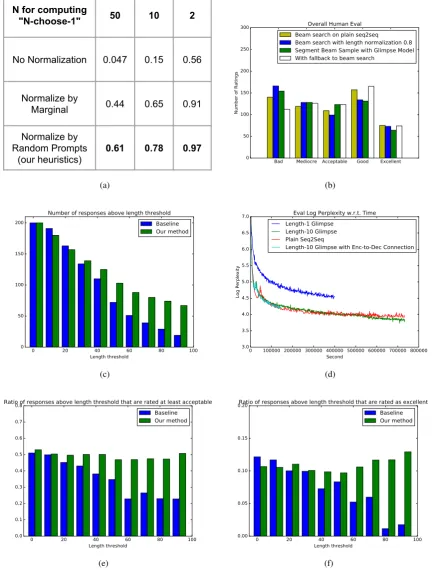
2016). With this length normalization the gener-ated responses are indeed longer. However, they are more often semantically incoherent. It pro-duces“I have no idea what you are talking about.” more often, similarly observed in (Li et al.,2016). The human evaluation results are summarized in Figure 2(b). Methods that generate longer re-sponses have moreBadand lessExcellent/Good ratings.
We also performed the N-choose-1 evaluation on the baseline model using different normal-ization schemes. The results are shown in Ta-ble 2(a). No Normalization means that we use
P(y|x) for scoring,Normalize by Marginaluses
P(y|x)/P(y), as suggested in (Li et al., 2015), andNormalize by Random Promptsis our scoring objective described in Section4. The significant boost when using both normalization schemes in-dicates that the conditional log probability pre-dicted by the model may be biased towards the language model probability ofP(y). After adding the normalization, the score may be closer to the true conditional log probability.
Overall, thisrerankingevaluation indicates that our heuristic is preferred to scoring using the marginal. However, it is unfortunately hard to di-rectly make use of this score during beam search decoding (i.e., generation), since the resulting se-quences are usually ungrammatical, as also ob-served by (Li et al.,2015). This is the motivation for using a segment-by-segment reranking proce-dure, as described in Section4.
5.3 Large-Scale Experiments
For our large-scale experiments, we train our target-glimpse model on the full combined data set. Figure2(d)shows the training progress curve. In this figure, we also include the curve forK = 1, that is, the glimpse model with decoder-length 1. It is clear enough that this model progresses much slower, so we terminated it early. How-ever, it is surprising that the glimpse model with
K = 10progresses faster than the baseline model with only source-side attention, because the model is trained on examples with decoder-length fixed at 10, while the average response length is 38 in
our data set. This means it takes on average 3.8x training steps for the glimpse model to train on the same number of raw training-pairs as the baseline model. Despite this, the faster progress indicates that target-side attention indeed helps the model generalize better.
The human evaluation results shown in Figure2
compare our proposed method with the baseline seq2seq model. For this, we trained a length-10 target-glimpse model and decoded with stochastic beam-search using segment-by-segment rerank-ing. In our experiments, we were unable to gen-erate better long, coherent responses using the whole-sequence level reranking method from (Li et al., 2015) compared to using standard beam search with length-normalization6. We therefore
choose the latter as our baseline, because it is the only method which generates responses that are long enough that we can compare to.
Figure2shows that our proposed method gen-erates more long responses overall. One third of all responses are longer than 100 characters, while the baseline model produces only a neg-ligible fraction. Although we do not employ any length-promoting objectives in our method, length-normalization is used for the baseline. For responses generated by our method, the proportion of Acceptable and Excellent responses remains constant or even increases as the responses grow longer. Conversely, human ratings decline sharply with length for the baseline model.
The percentage of test cases with major agree-ment is high for both methods. We consider a test to have major agreement if two ratings out of the three are the same. For the baseline method, 80% of the responses have major agreements, and for our method it is 70%.
However, shorter responses have a much smaller search space, and we find that standard beam search tends to generate better (“safer”) short responses. To maximize cumulative re-sponse quality, we therefore implemented a back-off strategy that combines the strengths of the two methods. We choose to fallback to the baseline model without length normalization when the lat-ter produces a response shorlat-ter than 40 characlat-ters, otherwise we use the response from our method. This corresponds to the white histogram in Fig-ure2(b). Compared to the other methods in the fig-6This is because the method reranks the responses in the
ure, the combined strategy results in more ratings of Excellent, Good, Acceptable, and Mediocre, and fewerBad ratings. With this strategy, among the responses generated for the same 200 prompts, 133 were from the standard beam search and 67 were from our model. Out of the 67 long re-sponses, two thirds were longer than 60 characters and half were longer than 75 characters. To com-pare the combined model’s performance with the baseline, we generated responses from both mod-els using the same 200 prompts. For 20 of the re-sponse pairs, human raters had no preference, but for the remaining 180, human raters preferred the combined model’s response in 103 cases and the baseline’s in only 77, indicating a significant win.
6 Conclusion
The research of building end-to-end systems that can engage in general-purpose conversation is still in its infancy. More significant progress is ex-pected to be made with more advanced neural ar-chitectures. However, our results reported in this paper show that minimal modeling change and a slightly more advanced decoding technique, com-bined with training over very large data sets, can still lead to noticeable improvements in the quality of responses generated using neural conversation models. Overall, we found using fixed-lengths in the decoder to make it easier to train on large data sets, as well as to allow us to improve the diversity and coherence of the generated responses earlier during generation, when it has most impact. While the focus of this work has been on conversation modeling, we expect some of these results to carry over to other sequence-to-sequence settings, such as machine translation or image-captioning. Acknowledgments
We would like to thank Quoc Le, Oriol Vinyals and Jakob Uszkoreit for many helpful discussions, and Scott Benson, Fuchun Peng for collecting the context-free prompt set, and Amin Ahmad for setting up the human evaluation, and Rami Eid, Daniel Cer for collecting training data sets, and Yonghui Wu, Zhifeng Chen, Mike Schuster for help on training the GNMT model.
References
Mart´ın Abadi, Ashish Agarwal, Paul Barham, Eugene Brevdo, Zhifeng Chen, Craig Citro, Greg S. Cor-rado, Andy Davis, Jeffrey Dean, Matthieu Devin,
Sanjay Ghemawat, Ian Goodfellow, Andrew Harp, Geoffrey Irving, Michael Isard, Yangqing Jia, Rafal Jozefowicz, Lukasz Kaiser, Manjunath Kudlur, Josh Levenberg, Dan Man´e, Rajat Monga, Sherry Moore, Derek Murray, Chris Olah, Mike Schuster, Jonathon Shlens, Benoit Steiner, Ilya Sutskever, Kunal Tal-war, Paul Tucker, Vincent Vanhoucke, Vijay Va-sudevan, Fernanda Vi´egas, Oriol Vinyals, Pete Warden, Martin Wattenberg, Martin Wicke, Yuan Yu, and Xiaoqiang Zheng. 2015. TensorFlow: Large-scale machine learning on heterogeneous sys-tems. Software available from tensorflow.org.
http://tensorflow.org/.
Dzmitry Bahdanau, Kyunghyun Cho, and Yoshua Ben-gio. 2014. Neural machine translation by jointly learning to align and translate. arXiv preprint arXiv:1409.0473.
Kyunghyun Cho, Bart Van Merri¨enboer, C¸alar G¨ulc¸ehre, Dzmitry Bahdanau, Fethi Bougares, Hol-ger Schwenk, and Yoshua Bengio. 2014. Learning phrase representations using rnn encoder–decoder for statistical machine translation. InProceedings of the 2014 Conference on Empirical Methods in Nat-ural Language Processing (EMNLP). Association for Computational Linguistics, Doha, Qatar, pages 1724–1734.
Christopher Cieri David, David Miller, and Kevin Walker. 2004. The fisher corpus: a resource for the next generations of speech-to-text. In in Proceed-ings 4th International Conference on Language Re-sources and Evaluation. pages 69–71.
Jiwei Li, Michel Galley, Chris Brockett, Jianfeng Gao, and Bill Dolan. 2015. A diversity-promoting objec-tive function for neural conversation models. arXiv preprint arXiv:1510.03055.
Jiwei Li, Will Monroe, Alan Ritter, Michel Galley, Jianfeng Gao, and Dan Jurafsky. 2016. Deep rein-forcement learning for dialogue generation. CoRR
abs/1606.01541.
Chia-Wei Liu, Ryan Lowe, Iulian Vlad Serban, Michael Noseworthy, Laurent Charlin, and Joelle Pineau. 2016. How NOT to evaluate your dia-logue system: An empirical study of unsupervised evaluation metrics for dialogue response generation. In EMNLP. ACL, Austin, Texas, page 21222132.
https://aclweb.org/anthology/D16-1230.
Lifeng Shang, Zhengdong Lu, and Hang Li. 2015. Neural responding machine for short-text conversa-tion. arXiv preprint arXiv:1503.02364.
Ilya Sutskever, Oriol Vinyals, and Quoc V Le. 2014. Sequence to sequence learning with neural net-works. In Z. Ghahramani, M. Welling, C. Cortes, N. D. Lawrence, and K. Q. Weinberger, editors, Ad-vances in Neural Information Processing Systems 27, Curran Associates, Inc., pages 3104–3112. J¨org Tiedemann. 2009. News from OPUS - A
Col-lection of Multilingual Parallel Corpora with Tools and Interfaces. In N. Nicolov, K. Bontcheva, G. An-gelova, and R. Mitkov, editors,Recent Advances in Natural Language Processing (vol V), John Ben-jamins, Amsterdam/Philadelphia, pages 237–248. Oriol Vinyals and Quoc Le. 2015. A neural
conversa-tional model. arXiv preprint arXiv:1506.05869. Tsung-Hsien Wen, Milica Gasic, Dongho Kim, Nikola
Mrksic, Pei-hao Su, David Vandyke, and Steve J. Young. 2015. Stochastic language generation in di-alogue using recurrent neural networks with convo-lutional sentence reranking.CoRRabs/1508.01755. Tsung-Hsien Wen, Milica Gasic, Nikola Mrkˇsi´c, Lina M. Rojas Barahona, Pei-Hao Su, Ste-fan Ultes, David Vandyke, and Steve Young. 2016. Conditional generation and snap-shot learning in neural dialogue systems. In
EMNLP. ACL, Austin, Texas, pages 2153–2162.
https://aclweb.org/anthology/D16-1233.
N for computing
"N-choose-1" 50 10 2
No Normalization 0.047 0.15 0.56
Normalize by
Marginal 0.44 0.65 0.91
Normalize by Random Prompts
(our heuristics)
0.61 0.78 0.97
(a)
Bad Mediocre Acceptable Good Excellent 0
50 100 150 200 250 300
Nu
mb
er
of
Ra
tin
gs
Overall Human Eval Beam search on plain seq2seq
Beam search with length normalization 0.8 Segment Beam Sample with Glimpse Model With fallback to beam search
(b)
0 20 40 60 80 100
Length threshold 0
50 100 150
200 Number of responses above length thresholdBaseline Our method
(c)
0 100000 200000 300000 400000 500000 600000 700000 800000 Second
3.0 3.5 4.0 4.5 5.0 5.5 6.0 6.5 7.0
Lo
g Pe
rpl
ex
ity
Eval Log Perplexity w.r.t. Time Length-1 Glimpse
Length-10 Glimpse Plain Seq2Seq
Length-10 Glimpse with Enc-to-Dec Connection
(d)
0 20 40 60 80 100
Length threshold 0.0
0.1 0.2 0.3 0.4 0.5 0.6 0.7 0.8
Ratio of responses above length threshold that are rated at least acceptable Baseline
Our method
(e)
0 20 40 60 80 100
Length threshold 0.00
0.05 0.10 0.15
0.20Ratio of responses above length threshold that are rated as excellent Baseline Our method
(f)
[image:10.595.79.520.75.646.2]