NITE: A Neural Inductive Teaching Framework for Domain-Specific NER
Siliang Tang, Ning Zhang, Jinjian Zhang, Fei Wu and Yueting Zhuang
College of Computer Science, Zhejiang University, China
{siliang, aning, jibjianzhang, wufei, yzhuang}@zju.edu.cn
Abstract
In domain-specific NER, due to insuffi-cient labeled training data, deep models usually fail to behave normally. In this pa-per, we proposed a novel Neural Inductive TEaching framework (NITE) to transfer knowledge from existing domain-specific NER models into an arbitrary deep neu-ral network in a teacher-student training manner. NITE is a general framework that builds upon transfer learning and multiple instance learning, which collaboratively not only transfers knowledge to a deep stu-dent network but also reduces the noise from teachers. NITE can help deep learn-ing methods to effectively utilize existlearn-ing resources (i.e., models, labeled and unla-beled data) in a small domain. The experi-ment resulted on Disease NER proved that without using any labeled data, NITE can significantly boost the performance of a CNN-bidirectional LSTM-CRF NER neu-ral network nearly over 30% in terms of F1-score.
1 Introduction
Domain-specific Named Entity Recognition (DNER), which aims to identify domain specific entity mentions and their categories, plays an important role in domain document classification, retrieval and content analysis. It is also a foun-dation for further level of complex information extraction tasks, serves as cornerstone in the knowledge computing process of transforming data into machine readable knowledge (Zhuang et al.,2017). Domain-specific NER is a challeng-ing problem. For example, in biomedical domain, the number of unseen biomedical entity mentions (such as disease names, chemical names), their
abbreviations or acronyms, as well as multiple names of the same entity is growing fast with the rapid increase of biomedical literatures and clinical records. However, the performance of a learning based NER system relies heavily on data annotation, which is quite expensive. The situation is even worse in domain-specific NER systems, since their data annotation requires the engage of domain experts. Therefore, in many special domains, only trained models or APIs are available, while their training data are private and inaccessible. On the other hand, due to insufficient labeled training data, deep models usually fail to behave normally in such domain, and state-of-the-art methods in these domains are usually dominated by rule based deductive methods or shallow model with hand-crafted features. However, the way of pre-defining useful domain specific hand-crafted features or rules are usually unavailable to the public.
In this paper, we proposed a novel Neural In-ductive TEaching framework (NITE) to transfer knowledge from existing models into an arbitrary deep neural network. The idea of NITE is mainly borrowed from Transfer learning (Pan and Yang,
2010) where previously learned knowledge can aid current situation and solve problems with bet-ter solutions. In NITE, existing NER models be-have like inefficient teachers to teach a deep neu-ral network (we called student network) to iden-tify named entities by giving it concrete exam-ples. The knowledge transferred from these mod-els is their posterior distributions on unlabeled data. These teachers are inefficient because they transfer not only useful information, but also er-rors to the student. The inputs of student network can be twofold, one is a small proportion from human labeled ground truth data (optional, like text book), and another is a large proportion from teachers, which is always noisy and less trustable.
In such case, a student is overwhelmed and often inferior to the teachers, therefore in NITE, we in-troduced Multiple Instance Learning (MIL) trick (Dietterich et al.,1997;Babenko,2008) to reduce the input noise during the model training.
In summary, NITE is a general framework that can help deep learning methods to make the best use of existing resources (i.e., models, labeled and unlabeled data). The experiment results on Disease NER (DNER) proved that without using any labeled data, NITE can significantly boost the performance of a CNN-bidirectional LSTM-CRF NER neural network (Ma and Hovy,2016), which trained on NCBI training dataset nearly over 30% in terms of F1-score. It also outperformed the teacher model, which proved the correctness of our hypothesis.
2 Neural Inductive Teaching Framework
In this section we will define our NITE framework step by step, and apply it to Disease NER.
2.1 Inductive Teaching
Inductive teaching means teaching student by ex-amples, our inductive teaching method builds upon teacher-student models (Ba and Caruana,
2014) and knowledge distillation (Hinton et al.,
2015). The main idea of our method is to transfer discriminative knowledge from well-trained exist-ing models (teachers) to a new and more capable model (student). The student learns by imitating the teachers’ behaviors, and the teaching process can be defined as follows:
Let x = {w1, w2, . . . , w|x|} be an input sen-tence of |x|words, where wk is the kth word in
x. If lk is the corresponding 3-dimensional one hot IOB (In-Out-Begin) vector for wk, then the NER labeling sequence of x can be defined as
y={l1, l2, . . . , l|x|}.
For a given sentence xi, we further define the posterior distribution of a teacher as yift = ft(yi|xi), while the posterior distribution of a stu-dent network can be defined asyifs =fs(yi|xi;θ), whereθis the parameters of the student network. During training, we measure the similarity be-tweenyft andyfs with KL-divergence, and min-imize their difference. Therefore, for a given xi, we optimize:
min
θ n X
i=1
DKL(ft(yi|xi)||fs(yi|xi;θ)) (1)
, where DKL(P||Q) = PjPjlogQjPj is the KL-divergence. This equation can be optimized through stochastic gradient descent over shuffled mini-batches with the Adadelta (Zeiler,2012) up-date rule.
2.2 Multiple Instance Learning
Multiple Instance Learning is an effective train-ing method that can help to train a supervised model to alleviate the wrong label problem (Riedel et al.,2010;Hoffmann et al.,2011;Surdeanu et al.,
2012). Instead of predicting labels for each indi-vidual training sample, the objective of MIL is to predict the labels (positive or negative) of the un-seen bags, where each bag contains a fixed number of instances (samples). The standard MIL assump-tion assumes that a bag is positively labeled if at least one instance in a bag is positive, and is nega-tively labeled if all instances in a bag are negative. MIL is generally used in training a binary classi-fier, to apply MIL in NITE, we redefine the label of a bag as the quality (correctness) of its contain-ing samples. Thus, in NITE, a bag is positively labeled if at least one instance in it is labeled cor-rectly. Furthermore, it is inappropriate to evaluate the correctness of IOB label (i.e.,lk) of each word (i.e.,wk), since the IOB sequenceyiof a sentence
xiis generated dependently. Therefore, we choose sentencexi as our MIL instance, and the correct-ness ofxi is evaluated by the likelihood probabil-ity of all words with correct BIO tags. In general, our MIL can be formally defined as follows:
Randomly allocate training samples in a mini-batchBintoMbags, i.e.,B={B1, B2, . . . , BM} with their corresponding labels{z1, z2, . . . , zM}, wherezm ∈ {−1,1}. For bagBm, it containsK instances, i.e.,Bm ={x1, x2, . . . , xK}, wherexi is a sentence with its posterior evaluationyifs.
During the training, given a bagBm, ifzm = 1, which means Bm is a positive bag. In order to reduce the noise, our MIL learner will select the most correct instanceyfsi∗, which has the maximum likelihood among all other instances (i.e., sen-tence) in the bagBm. That isP(zm = 1|Bm) =
P(yifs∗) = arg max
i {P(y fs
i |xi)}, where1 ≤ i ≤
correctly or incorrectly) is actually integrated out, since no matter what the value z is, MIL in NITE will always select the instance with the highest likelihood probability. Finally the MIL in NITE can be summarized as:
P(zm|Bm) =P(yfsi∗) = arg maxi=1:K{P(yfsi |xi)} (2) In summary, MIL in NITE can be regarded as a mechanism for posterior selection, or regulariza-tion on posterior distriburegulariza-tion of a student network. Therefore, MIL only affects the model training, and it will not affect the testing process.
2.3 Teacher Model & Student Network
Theoretically, the teacher model of NITE can be any existing well-trained model, while the student network can be an arbitrary deep neural network. In this paper, we focus on domain-specific NER, and more specifically on Disease NER, which is a small but typical domain that is suffering from insufficient labeled training data.
There are many existing DNER systems, and the most well-known systems are BANNER ( Lea-man et al., 2008), and DNorm (Leaman et al.,
2013). BANNER is an open-source biomedical NER system implemented using conditional ran-dom fields (CRFs) (Lafferty et al.,2001). While, DNorm uses supervised semantic indexing, is trained with pairwise learning to rank, to score the mentions returned by BANNER. Therefore, DNorm can be regarded as an extension of BAN-NER, and the whole system depends on hand-crafted features such as word spelling features and orthographic features. DNorm is the state-of-the-art DNER system, and therefore we adopt DNorm as our teacher model.
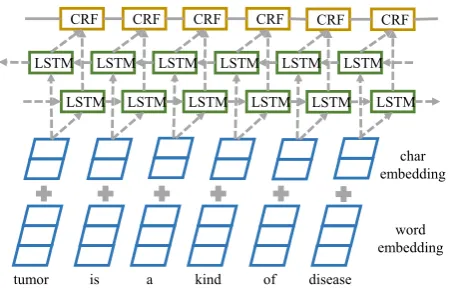
For the student network, we are looking for state-of-the-art solutions in general NER. There are many studies on applying complex deep learn-ing models on general NER or other sequence labeling tasks. Without any feature engineering trick, deep models have achieved comparable or better performances than many other traditional methods. More recently, Ma and Hovy (2016) proposed a method that concatenated CNN, bidi-rectional LSTM, and CRF successively to form an end to end deep NER model (CLC for short). CLC achieved state-of-the-art performance in general NER, and therefore we take the CLC as our stu-dent network, Fig.1shows the overall architecture of our student network.
tumor is a kind of disease
word embedding
char embedding
LSTM LSTM LSTM LSTM LSTM LSTM
LSTM LSTM LSTM LSTM LSTM LSTM
[image:3.595.308.533.61.205.2]CRF CRF CRF CRF CRF CRF
Figure 1: the Flowchart of the Student Network
As shown in Fig.1, the character-level embed-dings are generated by CNN layers, then are con-catenated with pre-trained word embeddings, and finally fed into the bidirectional LSTM layer. The bidirectional LSTM is efficient to capture syntac-tic and semansyntac-tic information both preceding and following simultaneously. Its output vectors are fed into the CRFs layer for IOB sequence label-ing. It uses maximum conditional likelihood es-timation to choose parameters during the finally CRFs training process, and its likelihood can be given as follows:
P(yifs|xi) = arg max
y∈Y(xi)P(y|xi) (3)
, whereY(xi)denotes the set of possible label se-quences forxi. Eq.3can be solved efficiently by adopting the Viterbi algorithm.
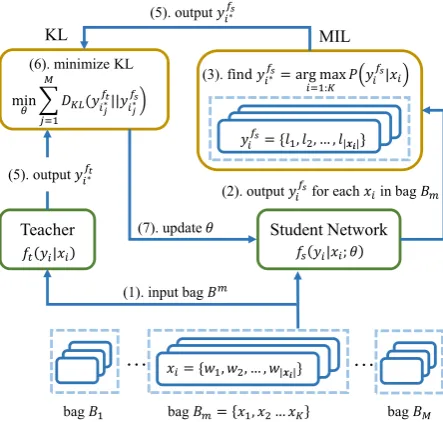
Fig.2shows the whole NITE-NER training pro-cess. For each training iteration, training sam-ples in a mini-batch are randomly allocated into M bags, and then fed into the student network
fs. For bagBm, the student network will gener-ate posterior evaluationyifsfor each input instance
xi ∈Bmrespectively. Then the MIL module will select the best sampleyfti∗ from allKinstances ac-cording to Eq.3and2. Finally, NITE will retrieve posterior evaluationyift∗ from the teacher, and up-dateθbased on Eq.1.
3 Experiments
In this section we designed several experiments to testify our hypothesis of inductive teaching as well as evaluate our NITE framework.
3.1 Training Corpus
net-Student Network Teacher
MIL KL
… …
bag bag , … bag
, , … , | |
, , … ,| |
(2). output for each in bag (3). find ∗ arg max
: |
(5). output ∗
(5). output ∗
| ;
(1). input bag (7). update
min ∗|| ∗
(6). minimize KL
[image:4.595.74.296.62.273.2]|
Figure 2: The training process of NITE-NER.
work is learned indirectly from the teacher mod-els, therefore NITE can be trained without any la-beled data.
To evaluate the efficiency of the NITE frame-work, we trained two DNER models on NCBI dis-ease corpus (Do˘gan et al., 2014; Islamaj Dogan and Lu, 2012). One is the well-known DNorm model, which is the state-of-the-art method in disease NER. Another one is the bi-directional LSTM-CNN-CRF NER neural network i.e., CLC (Ma and Hovy,2016), which has the state-of-the-art performance in general NER task. The CLC architecture also serves as our student network.
The NCBI disease corpus is a widely used data corpus with disease name and related concept an-notations in biomedical research field. The cor-pus is an extension of the AZDC corcor-pus (Leaman et al., 2009) which was annotated only with dis-ease mentions. The detailed characteristics of the NCBI disease corpus as well as how we partition the data are shown in Table1.
3.2 Experiment Setup
The experiment’s setup is as follows:
Our NITE-DNER is trained without any labeled data, we randomly sampled 2,000 unlabeled ab-stracts of biomedical literature from PubMed as our training data. The DNorm model is served as the teacher model in the NITE framework.
In student network, we initialized charac-ter embeddings with uniform samples from
[−q3
d,+ q
3
d], where we set the dimension d =
NCBI Train Validate Test
# of documents 593 100 100
# of sentences 5661 791 961
# of disease 5148 791 961
Specific Disease 2959 409 556
Disease Class 781 127 121
Modifier 1292 218 264
Composite Mention 116 37 20
Table 1: The description of the NCBI corpus as training, validating and testing sets for the recog-nition of disease named entity
30. We use 30 filters with window length 3 in CNN and 200 hidden states in bi-directional LSTM. In training procedure we set initial learn-ing rateη0 = 0.015with decay rateρ = 0.05, the
learning rate is updated as ηt = η0/(1.0 +ρn),
wherenis the number of epochs. We use a fixed dropout rate 0.5 at CNN and both input and output vectors of bi-directional LSTM to mitigate over-fitting. For MIL we set the bag sizeK = 5with mini-batch size 30. We implemented neural net-works on a GeForce GTX 1080 using Theano.
3.3 Results and Discussion
We evaluated all three DNER methods on the NCBI test set in terms of precision, recall and F1-score. All the measurements are based on exact location of extracted disease mentions in the given test sentences.
Method CLC-DNER DNorm NITE
Labels NCBI NCBI
-Remark Student only Teacher only S+T+MIL
Precision 79.20 80.50 85.40
Recall 51.73 75.70 75.07
[image:4.595.319.520.63.164.2]F1-score 62.58 78.06 79.91
Table 2: Performance comparisons.
3.4 Conclusion
In this paper, we proposed a general framework, NITE, and demonstrated its efficiency in transfer-ring DNER knowledge into an end to end deep NER model. Although we only proposed a so-lution for DNER, it could be easily applied to other domain-specific NER problems (e.g., chem-ical, gene, and protein) or even applications other than NER. The experiment results suggested that NITE can be very helpful on training a deep model when other resources are available. For future work, a NITE architecture with more than one teacher could be considered. Moreover, as men-tioned in (Zhou et al., 2017), crowd knowledge can be used to reshape deep learning features. Our framework can also incorporate crowd knowledge easily, in which the teachers can be human crowds, and then the NITE can employs active learning (Olsson,2009) or lifelong machine learning (Chen and Liu,2016) to progressively polishing the stu-dent model.
Acknowledgments
This work was supported in part by the 973 program (No. 2015CB352302), NSFC (No. 61625107, U1611461, 61402401), Chinese Knowledge Center of Engineering Science and Technology (CKCEST), Qianjiang Talents Pro-gram of Zhejiang Province 2015 and Key proPro-gram of Zhejiang Province (2015C01027).
References
Jimmy Ba and Rich Caruana. 2014. Do deep nets really
need to be deep? InAdvances in neural information
processing systems, pages 2654–2662.
Boris Babenko. 2008. Multiple instance
learn-ing: algorithms and applications. View Article
PubMed/NCBI Google Scholar.
Zhiyuan Chen and Bing Liu. 2016. Lifelong machine
learning. Synthesis Lectures on Artificial
Intelli-gence and Machine Learning, 10(3):1–145.
Thomas G Dietterich, Richard H Lathrop, and Tom´as Lozano-P´erez. 1997. Solving the multiple instance
problem with axis-parallel rectangles. Artificial
in-telligence, 89(1):31–71.
Rezarta Islamaj Do˘gan, Robert Leaman, and Zhiyong Lu. 2014. Ncbi disease corpus: a resource for dis-ease name recognition and concept normalization.
Journal of biomedical informatics, 47:1–10.
Geoffrey Hinton, Oriol Vinyals, and Jeff Dean. 2015.
Distilling the knowledge in a neural network. arXiv
preprint arXiv:1503.02531.
Raphael Hoffmann, Congle Zhang, Xiao Ling, Luke Zettlemoyer, and Daniel S Weld. 2011. Knowledge-based weak supervision for information extraction
of overlapping relations. InProceedings of the 49th
Annual Meeting of the Association for Computa-tional Linguistics: Human Language Technologies-Volume 1, pages 541–550. Association for Compu-tational Linguistics.
Rezarta Islamaj Dogan and Zhiyong Lu. 2012.
BioNLP: Proceedings of the 2012 Workshop on Biomedical Natural Language Processing, chapter An improved corpus of disease mentions in PubMed citations. Association for Computational Linguis-tics.
John Lafferty, Andrew McCallum, and Fernando Pereira. 2001. Conditional random fields: Prob-abilistic models for segmenting and labeling
se-quence data. In Proceedings of the eighteenth
in-ternational conference on machine learning, ICML, volume 1, pages 282–289.
Robert Leaman, Rezarta Islamaj Do˘gan, and Zhiyong Lu. 2013. Dnorm: disease name normalization
with pairwise learning to rank. Bioinformatics, page
btt474.
Robert Leaman, Graciela Gonzalez, et al. 2008. Ban-ner: an executable survey of advances in biomedical
named entity recognition. InPacific symposium on
biocomputing, volume 13, pages 652–663.
Robert Leaman, Christopher Miller, and G Gonzalez. 2009. Enabling recognition of diseases in biomed-ical text with machine learning: corpus and
bench-mark. In Proceedings of the 2009 Symposium on
Languages in Biology and Medicine, volume 82.
Xuezhe Ma and Eduard Hovy. 2016. End-to-end
se-quence labeling via bi-directional lstm-cnns-crf. In
Proceedings of the 54th Annual Meeting of the As-sociation for Computational Linguistics (Volume 1: Long Papers), pages 1064–1074, Berlin, Germany. Association for Computational Linguistics.
Fredrik Olsson. 2009. A literature survey of active ma-chine learning in the context of natural language pro-cessing.
Sinno Jialin Pan and Qiang Yang. 2010. A survey on
transfer learning. IEEE Transactions on knowledge
and data engineering, 22(10):1345–1359.
Sebastian Riedel, Limin Yao, and Andrew McCallum. 2010. Modeling relations and their mentions
with-out labeled text. In Joint European Conference
Mihai Surdeanu, Julie Tibshirani, Ramesh Nallapati, and Christopher D Manning. 2012. Multi-instance
multi-label learning for relation extraction. In
Pro-ceedings of the 2012 Joint Conference on Empirical Methods in Natural Language Processing and Com-putational Natural Language Learning, pages 455– 465. Association for Computational Linguistics. Matthew D Zeiler. 2012. Adadelta: an adaptive
learn-ing rate method.arXiv preprint arXiv:1212.5701.
Le-kui Zhou, Si-liang Tang, Jun Xiao, Fei Wu, and Yue-ting Zhuang. 2017. Disambiguating named en-titieswith deep supervised learning via crowd labels.
Frontiers of Information Technology & Electronic Engineering, 18(1):97–106.
Yue-ting Zhuang, Fei Wu, Chun Chen, and Yun-he Pan. 2017. Challenges and opportunities: from big
data to knowledge inai 2.0.Frontiers of Information