Morphological Disambiguation of Hebrew:
A Case Study in Classifier Combination
Danny Shacham
Department of Computer Science University of Haifa
Haifa, Israel
Shuly Wintner
Department of Computer Science University of Haifa
Haifa, Israel
Abstract
Morphological analysis and disambiguation are crucial stages in a variety of natural language processing applications, especially when languages with complex morphology are concerned. We present a system which disambiguates the output of a morphologi-cal analyzer for Hebrew. It consists of sev-eral simple classifiers and a module which combines them under linguistically moti-vated constraints. We investigate a number of techniques for combining the predictions of the classifiers. Our best result, 91.44% ac-curacy, reflects a 25% reduction in error rate compared with the previous state of the art.
1 Introduction
Morphological analysis and disambiguation are cru-cial pre-processing steps for a variety of natural lan-guage processing applications, from search and in-formation extraction to machine translation. For languages with complex morphology these are non-trivial processes. This paper presents a morphologi-cal disambiguation module for Hebrew which uses a sophisticated combination of classifiers to rank the analyses produced by a morphological analyzer. This work has a twofold contribution: first, our sys-tem achieves over 91% accuracy on the full disam-biguation task, reducing the error rate of the pre-vious state of the art by 25%. More generally, we explore several ways for combining the predictions of simple classifiers under constraints; the insight gained from these experiments will be useful for other applications of machine learning to complex (morphological and other) problems.
In the remainder of this section we discuss the complexity of Hebrew morphology, the challenge of morphological disambiguation and related work. We describe our methodology in Section 2: we use basic, na¨ıve classifiers (Section 3) to predict some components of the analysis, and then combine them in several ways (Section 4) to predict a consistent re-sult. We analyze the errors of the system in Section 5 and conclude with suggestions for future work.
1.1 Linguistic background
Hebrew morphology is rich and complex.1 The ma-jor word formation machinery is root-and-pattern, and inflectional morphology is highly productive and consists of prefixes, suffixes and circumfixes. Nouns, adjectives and numerals inflect for number (singular, plural and, in rare cases, also dual) and gender (masculine or feminine). In addition, all these three types of nominals have two phonologi-cally and morphologiphonologi-cally distinct forms, known as the absolute and construct states. In the standard orthography approximately half of the nominals ap-pear to have identical forms in both states, a fact which substantially increases the ambiguity. In ad-dition, nominals take possessive pronominal suffixes which inflect for number, gender and person.
Verbs inflect for number, gender and person (first, second and third) and also for a combination of tense and aspect/mood, referred to simply as ‘tense’ be-low. Verbs can also take pronominal suffixes, which are interpreted as direct objects, and in some cases can also take nominative pronominal suffixes. A pe-culiarity of Hebrew verbs is that the participle form
1
To facilitate readability we use a straight-forward translit-eration of Hebrew using ASCII characters, where the characters (in Hebrew alphabetic order) are: abgdhwzxviklmnsypcqr$t.
can be used as present tense, but also as a noun or an adjective.
These matters are complicated further due to two sources: first, the standard Hebrew orthography leaves most of the vowels unspecified. On top of that, the script dictates that many particles, includ-ing four of the most frequent prepositions, the def-inite article, the coordinating conjunction and some subordinating conjunctions, all attach to the words which immediately follow them. When the definite articleh is prefixed by one of the prepositionsb, k or l, it is assimilated with the preposition and the resulting form becomes ambiguous as to whether or not it is definite. For example, bth can be read either as b+th “in tea” or as b+h+th “in the tea”. Thus, the form$bthcan be read as an inflected stem (the verb “capture”, third person singular feminine past), as$+bth “that+field”, $+b+th “that+in+tea”, $+b+h+th “that in the tea”, $bt+h “her sitting” or even as$+bt+h“that her daughter”.
An added complexity stems from the fact that there are two main standards for the Hebrew script: one in which vocalization diacritics, known as niqqud “dots”, decorate the words, and another in which the dots are missing, and other characters rep-resent some, but not all of the vowels. Most of the texts in Hebrew are of the latter kind; unfortunately, different authors use different conventions for the undotted script. Thus, the same word can be writ-ten in more than one way, sometimes even within the same document. This fact adds significantly to the degree of ambiguity.
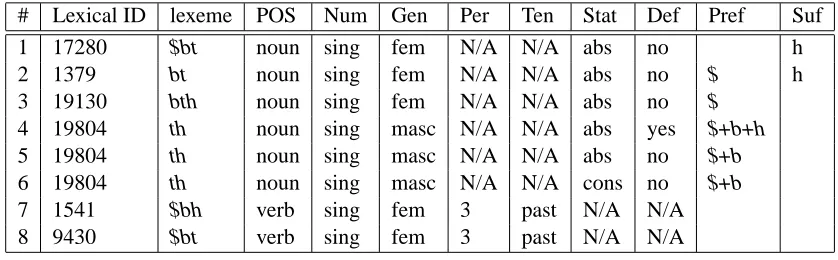
Our departure point in this work is HAMSAH (Yona and Wintner, 2007), a wide coverage, lin-guistically motivated morphological analyzer of He-brew, which was recently re-implemented in Java and made available from the Knowledge Cen-ter for Processing Hebrew (http://mila.cs. technion.ac.il/). The output that HAMSAH produces for the form$bth is illustrated in Table 1. In general, it includes the part of speech (POS) as well as sub-category, where applicable, along with several POS-dependent features such as num-ber, gender, tense, nominal state, definitness, etc.
1.2 The challenge of disambiguation
Identifying the correct morphological analysis of a given word in a given context is an important and
non-trivial task. Unlike POS tagging, the task does not involve assigning an analysis to words which the analyzer does not recognize. However, selecting an analysis immediately induces a POS tagging for the target word (by projecting the analysis on the POS coordinate). Our main contribution in this work is a system that solves this problem with high accuracy.
Compared with POS tagging of English, morpho-logical disambiguation of Hebrew is a much more complex endeavor due to the following factors:
Segmentation A single token in Hebrew can ac-tually be a sequence of more than one lexi-cal item. For example, analysis 4 of Table 1 ($+b+h+th “that+in+the+tea”) corresponds to the tag sequence IN+IN+DT+NN.
Large tagset The number of different tags in a lan-guage such as Hebrew (where the POS, mor-phological features and prefix and suffix parti-cles are considered) is huge. HAMSAH pro-duces 22 different parts of speech, some with subcategories; 6 values for the number feature (including disjunctions of values), 4 for gender, 5 for person, 7 for tense and 3 for nominal state. Possessive pronominal suffixes can have 15 dif-ferent values, and prefix particle sequences can theoretically have hundreds of different forms. While not all the combinations of these values are possible, we estimate the number of possi-ble analyses to be in the thousands.
Ambiguity Hebrew is highly ambiguous: HAM-SAH outputs on average approximately 2.64 analyses per word token. Oftentimes two or more alternative analyses share the same part of speech, and in some cases two or more anal-yses are completely identical, except for their lexeme (see analyses 7 and 8 in Table 1). Mor-phological disambiguation of Hebrew is hence closer to the problem of word sense disam-biguation than to standard POS tagging.
# Lexical ID lexeme POS Num Gen Per Ten Stat Def Pref Suf
1 17280 $bt noun sing fem N/A N/A abs no h
2 1379 bt noun sing fem N/A N/A abs no $ h
3 19130 bth noun sing fem N/A N/A abs no $
4 19804 th noun sing masc N/A N/A abs yes $+b+h
5 19804 th noun sing masc N/A N/A abs no $+b
6 19804 th noun sing masc N/A N/A cons no $+b
7 1541 $bh verb sing fem 3 past N/A N/A
[image:3.612.93.512.60.190.2]8 9430 $bt verb sing fem 3 past N/A N/A
Table 1: The analyses of the form$bth
Word order in Hebrew is freer than in English.
1.3 Related work
The idea of using short context for morphological disambiguation dates back to Choueka and Lusig-nan (1985). Levinger et al. (1995) were the first to apply it to Hebrew, but their work was ham-pered by the lack of annotated corpora for training and evaluation. The first work which uses stochas-tic contextual information for morphological disam-biguation in Hebrew is Segal (1999): texts are an-alyzed using the morphological analyzer of Segal (1997); then, each word in a text is assigned its most likely analysis, defined by probabilities com-puted from a small tagged corpus. In the next phase the system corrects its own decisions by using short context (one word to the left and one to the right of the target word). The corrections are also au-tomatically learned from the tagged corpus (using transformation-based learning). In the last phase, the analysis is corrected by the results of a syntac-tic analysis of the sentence. The reported results are excellent: 96.2% accuracy. More reliable tests, however, reveal accuracy of 85.5% only (Lember-ski, 2003, page 85). Furthermore, the performance of the program is unacceptable (the reported running time on “two papers” is thirty minutes).
Bar-Haim et al. (2005) use Hidden Markov Mod-els (HMMs) to implement a segmenter and a tag-ger for Hebrew. The main innovation of this work is that it models word-segments (morphemes: prefixes, stem and suffixes), rather than full words. The accu-racy of this system is 90.51% for POS tagging (a tagset of 21 POS tags is used) and 96.74% for seg-mentation (which is defined as identifying all pre-fixes, including a possibly assimilated definite
arti-cle). As noted above, POS tagging does not amount to full morphological disambiguation.
Recently, Adler and Elhadad (2006) presented an unsupervised, HMM-based model for Hebrew mor-phological disambiguation, using a mormor-phological analyzer as the only resource. A morpheme-based model learns both segmentation and tagging in par-allel from a large (6M words) un-annotated corpus. Reported results are 92.32% for POS tagging and 88.5% for full morphological disambiguation. We refer to this result as the state of the art and use the same data for evaluation.
A supervised approach to morphological disam-biguation of Arabic is given by Habash and Rambow (2005), who use two corpora of 120K words each to train several classifiers. Each morphological fea-ture is predicted separately and then combined into a full disambiguation result. The accuracy of the dis-ambiguator is 94.8%-96.2% (depending on the test corpus). Note, however, the high baseline of each classifier (96.6%-99.9%, depending on the classi-fier) and the full disambiguation task (87.3%-92.1%, depending on the corpus). We use a very similar ap-proach below, but we experiment with more sophis-ticated methods for combining simple classifiers to induce a coherent prediction.
2 Methodology
ex-ists. When the analyzer does not produce the cor-rect analysis, it is added manually. This is the exact setup of the experiments reported by Adler and El-hadad (2006).
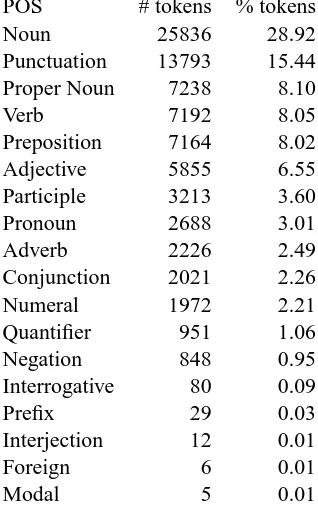
Table 2 lists some statistics of the corpus, and a histogram of analyses is given in Table 3. Table 4 lists the distribution of POS in the corpus.
Tokens 89347
Types 23947
[image:4.612.344.503.64.318.2]Tokens with no correct analysis 8218 Tokens with no analysis 130 Degree of ambiguity 2.64
Table 2: Statistics of training corpus
# analyses # tokens # analyses # tokens
1 38468 7 1977
2 15480 8 1309
3 11194 9 785
4 9934 10 622
5 5341 11 238
6 3472 >12 397
Table 3: Histogram of analyses
In all the experiments described in this paper we use SNoW (Roth, 1998) as the learning environ-ment, with winnow as the update rule (using
per-ceptron yielded very similar results). SNoW is a
multi-class classifier that is specifically tailored for learning in domains in which the potential number of information sources (features) taking part in de-cisions is very large, of which NLP is a principal example. It works by learning a sparse network of linear functions over the feature space. SNoW has already been used successfully as the learning vehi-cle in a large collection of natural language related tasks and compared favorably with other classifiers (Punyakanok and Roth, 2001; Florian, 2002). Typi-cally, SNoW is used as a classifier, and predicts us-ing a winner-take-all mechanism over the activation values of the target classes. However, in addition to the prediction, it provides a reliable confidence level in the prediction, which enables its use in an infer-ence algorithm that combines predictors to produce a coherent inference.
Following Daya et al. (2004) and Habash and
POS # tokens % tokens
Noun 25836 28.92
Punctuation 13793 15.44 Proper Noun 7238 8.10
Verb 7192 8.05
Preposition 7164 8.02
Adjective 5855 6.55
Participle 3213 3.60
Pronoun 2688 3.01
Adverb 2226 2.49
Conjunction 2021 2.26
Numeral 1972 2.21
Quantifier 951 1.06
Negation 848 0.95
Interrogative 80 0.09
Prefix 29 0.03
Interjection 12 0.01
Foreign 6 0.01
Modal 5 0.01
Table 4: POS frequencies
Rambow (2005), we approach the problem of mor-phological disambiguation as a complex classifica-tion task. We train a classifier for each of the at-tributes that can contribute to the disambiguation of the analyses produced by HAMSAH (e.g., POS, tense, state). Each classifier predicts a small set of possible values and hence can be highly accurate. In particular, the basic classifiers do not suffer from problems of data sparseness. Of course, each sim-ple classifier cannot fully disambiguate the output of HAMSAH, but it does induce a ranking on the analyses (see Table 6 below for the level of ambigu-ity which remains after each simple classifier is ap-plied). Then, we combine the outcomes of the sim-ple classifiers to produce a consistent ranking which induces a linear order on the analyses.
[image:4.612.81.282.281.377.2]classifiers, where more than one analysis can have the same tag. In all the experiments we perform 10-fold cross-validation runs and report the average of the 10 runs, both on the entire corpus and on a subset of the corpus in which we only test on words which do not occur in the training corpus.
The baseline tag of the token wi is the most prominent tag of all the occurrences of wi in the corpus. The baseline for the combination is the most prominent analysis of all the occurrences ofwiin the corpus. Ifwidoes not occur in the corpus, we back off and select the most prominent tag in the corpus independently of the wordwi. For the combination baseline, we select the analysis of the most promi-nent lexical ID, chosen from the list of all possible lexical IDs ofwi. If there is more than one possible value, one top-ranking value is chosen at random.
3 Basic Classifiers
The simple classifiers are all built in the same way. They are trained on feature vectors that are gener-ated from the output of the morphological analyzer, and tested on a clean output of the same analyzer. We defined several classifiers for the attributes of the morphological analyses. Since some attributes do not apply to all the analyses, we add a value of ‘N/A’ for the inapplicable attributes. An annotated corpus was needed in all those classifiers for train-ing. We list the basic classifiers below.
POS 22 values (only 18 in our corpus), see Table 4.
Gender ‘Masculine’, ‘Feminine’, ‘Masculine and feminine’, ‘N/A’.
Number ‘Singular’, ‘Plural’, ‘Dual’, ‘N/A’.
Person ‘First’, ‘Second’, ‘Third’, ‘N/A’.
Tense ‘Past’, ‘Present’, ‘Participle’, ‘Future’, ‘Im-perative’, ‘Infinitive’, ‘Bare Infinitive’, ‘N/A’.
Definite Article ‘Def’, ‘indef’, ‘N/A’. Identifies also implicit (assimilated) definiteness.
Status ‘Absolute’, ‘Construct’ and ‘N/A’.
Segmentation Predicts the number of letters which are prefix particles. Possible values are [0-6], 6 being the length of longest possible prefix se-quence. Does not identify implicit definiteness.
Has properties A binary classifier which distin-guishes between atomic POS categories (e.g., conjunction or negation) and categories whose words have attributes (such as nouns or verbs).
Each word in the training corpus induces features that are generated for itself and its immediate neigh-bors, using the output of the morphological ana-lyzer. For each word in the window, we generate the following features: POS, number, gender, per-son, tense, state, definiteness, prefixes (where each possible prefix is a binary feature), suffix (binary: is there word suffixed?), number/gender/person of suf-fix, surface form, lemma, conjunction of the surface form and the POS, conjunction of the POS and the POS of prefixes and suffixes, and some disjunctions of POS. The total number of features for each exam-ple is huge (millions), but feature vectors are very sparse.
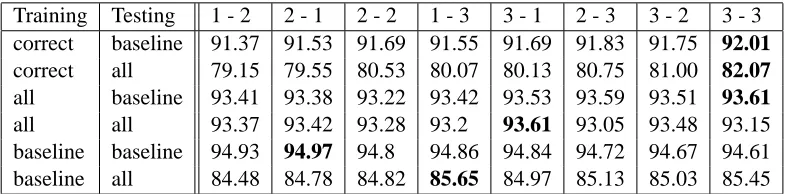
The simple classifiers can be configured in several ways. First, the size of the window around the target word had to be determined, and we experimented with several sizes, up to ±3 words. Another issue is feature generation. It is straight-forward during training, but during evaluation and testing the fea-ture extractor is presented only with the set of anal-yses produced by HAMSAH for each word, and has no access to the correct analysis. We experimented with two methods for tackling this problem: produce the union of all possible values for each feature; or select a single analysis, the baseline one, for each word, and generate only the features induced by this analysis. While this problem is manifested only dur-ing testdur-ing, it impacts also the traindur-ing procedure, and so we experimented with feature generation at training using the correct analysis, the union of the analyses or the baseline analysis. The results of the experiments for the POS classifier are shown in Ta-ble 5. The best configuration uses a window of two words before and one word after the target word. For both testing and training we generate features using the baseline analysis.
com-Training Testing 1 - 2 2 - 1 2 - 2 1 - 3 3 - 1 2 - 3 3 - 2 3 - 3 correct baseline 91.37 91.53 91.69 91.55 91.69 91.83 91.75 92.01 correct all 79.15 79.55 80.53 80.07 80.13 80.75 81.00 82.07 all baseline 93.41 93.38 93.22 93.42 93.53 93.59 93.51 93.61 all all 93.37 93.42 93.28 93.2 93.61 93.05 93.48 93.15 baseline baseline 94.93 94.97 94.8 94.86 94.84 94.72 94.67 94.61 baseline all 84.48 84.78 84.82 85.65 84.97 85.13 85.03 85.45
Table 5: Architectural configurations of the POS classifier: columns reflect the window size, rows refer to training and testing feature generation
All words Unseen words
baseline classifier baseline classifier accuracy accuracy ambiguity ERR accuracy accuracy ERR
POS 93.01 94.97 1.46 28.04 84.67 88.65 25.96
Gender 96.34 96.74 1.86 10.93 92.15 94.38 28.41
Number 96.79 97.92 1.91 35.20 92.35 95.91 46.54
Person 98.14 98.62 2.25 25.81 94.04 96.50 41.28
Tense 98.40 98.69 2.21 18.12 94.80 96.37 30.19
Definite Article 93.90 95.76 1.83 30.49 85.38 91.77 43.71
Status 92.73 95.06 1.57 32.05 84.46 89.85 34.68
Segmentation 99.12 97.80 2.25 — 97.67 97.66 —
Has properties 97.63 98.11 2.26 20.25 95.91 95.97 1.47
Table 6: Accuracy of the simple classifiers: ERR is reduction in error rate, compared with the baseline
pared with the baseline.
4 Combination of Classifiers
Given a set of simple classifiers, we now investi-gate various ways for combining their predictions. These predictions may be contradicting (for exam-ple, the POS classifier can predict ‘noun’ while the tense classifier predicts ‘past’), and we use the con-straints imposed by the morphological analyzer to enforce a consistent analysis.
First, we define a na¨ıve combination along the lines of Habash and Rambow (2005). The scores assigned by the simple classifiers (except segmenta-tion, for which we use the baseline) to each analysis are accumulated, and the score of the complete anal-ysis is their sum (experiments with different weights to the various classifiers proved futile). Even after the combination, the remaining level of ambiguity is 1.05; in ambiguous cases back off to the baseline analysis, and then choose at random one of the top-ranking analyses. The result of the combination is shown in Table 7.
[image:6.612.107.500.60.157.2]baseline classifier ERR All words 86.11 90.26 29.88 Unseen words 67.53 78.52 33.85
Table 7: Results of the na¨ıve combination
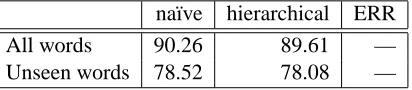
Next, we define a hierarchical combination in which we try to incorporate more linguistic knowl-edge pertaining to the dependencies between the classifiers. As a pre-processing step we classify the target word to one of two groups, using the has
prop-erties classifier. Then, we predict the main POS of
the target word, and take this prediction to be true; we then apply only the subset of the other classifiers that are relevant to the main POS.
na¨ıve hierarchical ERR
All words 90.26 89.61 —
Unseen words 78.52 78.08 —
Table 8: Results of the hierarchial combination
The combination of independent classifiers un-der the constraints imposed by the possible mor-phological analyses is intended to capture context-dependent constraints on possible sequences of anal-yses. Such constraints are stochastic in nature, but linguistic theory tells us that several hard (determin-istic) constraints also exist which rule out certain se-quences of otherwise possible analyses. We now ex-plore the utility of implementing such constraints to filter out linguistically impossible sequences.
Using several linguistic sources, we defined a set of constraints, each of which is a linguistically im-possible sequence of analyses (all sequences are of length 2, although in principle longer ones could have been defined). We then checked the annotated corpus for violations of these constraints; we used the corpus to either verify the correctness of a con-straint or further refine it (or abandon it altogether, in some cases). We then re-iterated the process with the new set of constraints.
The result was a small set of six constraints which are not violated in our annotated corpus. We used the constraints to rule out some of the paths de-fined by the possible outcomes of the morphologi-cal analyzer on a sequence of words. Each of the constraints below contributes a non-zero reduction in the error rate of the disambiguation module.The (slightly simplified) constraints are:
1. A verb in any tense but present cannot be fol-lowed by the genitive preposition ‘$l’ (of).
2. A preposition with no attached pronomial suf-fix must be followed by a nominal phrase. This rule is relaxed for some prepositions which can be followed by the prefix ‘$’.
3. The preposition ‘at’ must be followed by a def-inite nominal phrase.
4. Construct-state words must be followed by a nominal phrase.
5. A sequence of two verbs is only allowed if: one of them is the verb ‘hih’ (be); one of them has a prefix; the second is infinitival; or the first is imperative and the second is in future tense.
6. A non-numeral quantifier must be followed by either a nominal phrase or a punctuation.
Imposing the linguistically motivated constraints on the classifier combination improved the results to some extent, as depicted in Table 9. The best results are obtained when the constraints are applied to the hierarchical combination.
5 Error analysis
We conducted extensive error analysis of both the simple classifiers and the combination module. The analysis was performed over one fold of the anno-tated corpus (8933 tokens). Table 10 depicts, for some classifiers, a subset of the confusion matrix: it lists the correct tag, the chosen, or predicted, tag, the number of occurrences of the specific error and the total number of errors made by the classifier.
classifier correct chosen # total
has props yes no 110 167
no yes 57
segmentation 1 0 160 176
state const abs 154 412
[image:7.612.82.288.61.106.2]definiteness def indef 98 300
Table 10: Simple classifiers, confusion matrix
Several patterns can be observed in Table 10. The ‘has properties’ classifier is biased towards predict-ing ‘yes’ instead of ‘no’. The ‘segmentation’ clas-sifier, which predicts the length of the prefix, also displays a clear bias. In almost 90% of its errors it predicts no prefix instead of a prefix of length one. ‘Status’ and ‘definiteness’ are among the weakest classifiers, biased towards the default.
na¨ıve na¨ıve+consts ERR hier. hier.+cons ERR
All words 90.26 90.90 6.57 89.61 91.44 17.61
[image:8.612.120.488.61.106.2]Unseen words 78.52 79.56 4.84 78.08 81.74 16.70
Table 9: Accuracy results of various combination architectures. ERR is reduction in error rate due to the hard constraints. The best results are obtained using the hierarchical combination with hard constraints.
or adjectives, probably resulting from present-tense verbs in the training corpus which, in Hebrew, have similar distribution to nouns and adjectives.
The analysis of errors in the combination is more interesting. On the entire corpus, the disambigua-tor makes 7927 errors. Of those, 1476 (19%) are errors in which the correct analysis differs from the chosen one only in the value of the ‘state’ feature. Furthermore, in 1341 of the errors (17%) the system picks the correct analysis up to the value of ‘definite-ness’; of those, 1275 (16% of the errors) are words in which the definite article is assimilated in a prepo-sition. In sum, many of the errors seem to be in the real tough cases.
6 Conclusions
Morphological disambiguation of Hebrew is a dif-ficult task which involves, in theory, thousands of possible tags. We reconfirm the results of Daya et al. (2004) and Habash and Rambow (2005), which show that decoupling complex morphologi-cal tasks into several simple tasks improves the ac-curacy of classification. Our best result, 91.44% accuracy, reflects a reduction of 25% in error rate compared to the previous state of the art (Adler and Elhadad, 2006), and almost 40% compared to the baseline. We also show that imposing few context-dependent constraints on possible se-quences of analyses improves the accuracy of the disambiguation. The disambiguation module will be made available through the Knowledge Cen-ter for Processing Hebrew (http://mila.cs. technion.ac.il/).
We believe that these results can be further im-proved in various ways. The basic classifiers can benefit from more detailed feature engineering and careful tuning of the parameters of the learning en-vironment. There are various ways in which inter-related classifiers can be combined; we only ex-plored three here. Using other techniques, such as
inference-based training, in which the feature gen-eration for training is done step by step, using infor-mation inferred in the previous step, is likely to yield better accuracy. We also believe that further linguis-tic exploration, based on deeper error analysis, will result in more hard constraints which can reduce the error rate of the combination module. Finally, we are puzzled by the differences between Hebrew and Arabic (for which the baseline and the current state of the art are significantly higher) on this task. We intend to investigate the linguistic sources for this puzzle in the future.
Acknowledgements
We are extremely grateful to Dan Roth for his con-tinuing support and advise; to Meni Adler for pro-viding the annotated corpus; to Dalia Bojan and Alon Itai for the implementation of the morpholog-ical analyzer; to Yariv Louck for the implementa-tion of the deterministic constraints; to Nurit Melnik for help with error analysis; and to Yuval Nardi his help with statistical analysis. Thanks are due to Ido Dagan, Alon Lavie and Michael Elhadad for useful comments and advise. This research was supported by THE ISRAEL SCIENCE FOUNDATION (grant No. 137/06); by the Israel Internet Association; by the Knowledge Center for Processing Hebrew; and by the Caesarea Rothschild Institute for Interdisci-plinary Application of Computer Science at the Uni-versity of Haifa.
References
Meni Adler and Michael Elhadad. 2006. An unsuper-vised morpheme-based hmm for hebrew morpholog-ical disambiguation. In Proceedings of the 21st
In-ternational Conference on Computational Linguistics and 44th Annual Meeting of the Association for Com-putational Linguistics, pages 665–672, Sydney,
Aus-tralia, July. Association for Computational Linguistics.
POS-tagging of Modern Hebrew. In Proceedings of
the ACL Workshop on Computational Approaches to Semitic Languages, pages 39–46, Ann Arbor,
Michi-gan, June. Association for Computational Linguistics.
Yaacov Choueka and Serge Lusignan. 1985. Disam-biguation by short context. Computers and the
Hu-manities, 19:147–157.
Ezra Daya, Dan Roth, and Shuly Wintner. 2004. Learn-ing Hebrew roots: Machine learnLearn-ing with lLearn-inguistic constraints. In Proceedings of EMNLP’04, pages 357– 364, Barcelona, Spain, July.
Michael Elhadad, Yael Netzer, David Gabay, and Meni Adler. 2005. Hebrew morphological tagging guide-lines. Technical report, Department of Computer Sci-ence, Ben Gurion University.
Radu Florian. 2002. Named entity recognition as a
house of cards: Classifier stacking. In Proceedings
of CoNLL-2002, pages 175–178. Taiwan.
Nizar Habash and Owen Rambow. 2005. Arabic tok-enization, part-of-speech tagging and morphological disambiguation in one fell swoop. In Proceedings of
the 43rd Annual Meeting of the Association for Com-putational Linguistics (ACL’05), pages 573–580, Ann
Arbor, Michigan, June. Association for Computational Linguistics.
Gennadiy Lemberski. 2003. Named entity recognition in Hebrew. Master’s thesis, Department of Computer Science, Ben Gurion University, Beer Sheva, Israel, March. In Hebrew.
Moshe Levinger, Uzzi Ornan, and Alon Itai. 1995.
Learning morpho-lexical probabilities from an un-tagged corpus with an application to Hebrew.
Com-putational Linguistics, 21(3):383–404, September.
Vasin Punyakanok and Dan Roth. 2001. The use of clas-sifiers in sequential inference. In NIPS-13; The 2000
Conference on Advances in Neural Information Pro-cessing Systems 13, pages 995–1001. MIT Press.
Dan Roth. 1998. Learning to resolve natural language ambiguities: A unified approach. In Proceedings of
AAAI-98 and IAAI-98, pages 806–813, Madison,
Wis-consin.
Erel Segal. 1997. Morphological analyzer for unvocal-ized Hebrew words. Unpublished work.
Erel Segal. 1999. Hebrew morphological analyzer for Hebrew undotted texts. Master’s thesis, Technion, Is-rael Institute of Technology, Haifa, October. In He-brew.
Shlomo Yona and Shuly Wintner. 2007. A finite-state
morphological grammar of Hebrew. Natural