Bilingual Cluster Based Models for Statistical Machine Translation
Hirofumi Yamamoto
National Institute of Information and Communications Technology
/ 2-2-2 Hikaridai Seika-cho Soraku-gun Kyoto Japan and ATR Spoken Language Communication Research Labs.
Eiichiro Sumita
National Institute of Information and Communications Technology
/ 2-2-2 Hikaridai Seika-cho Soraku-gun Kyoto Japan and ATR Spoken Language Communication Research Labs.
Abstract
We propose a domain specific model for statistical machine translation. It is well-known that domain specific language mod-els perform well in automatic speech recog-nition. We show that domain specific lan-guage and translation models also benefit statistical machine translation. However, there are two problems with using domain specific models. The first is the data sparse-ness problem. We employ an adaptation technique to overcome this problem. The second issue is domain prediction. In or-der to perform adaptation, the domain must be provided, however in many cases, the domain is not known or changes dynami-cally. For these cases, not only the trans-lation target sentence but also the domain must be predicted. This paper focuses on the domain prediction problem for statisti-cal machine translation. In the proposed method, a bilingual training corpus, is au-tomatically clustered into sub-corpora. Each sub-corpus is deemed to be a domain. The domain of a source sentence is predicted by using its similarity to the sub-corpora. The predicted domain (sub-corpus) specific lan-guage and translation models are then used for the translation decoding. This approach gave an improvement of 2.7 in BLEU (Pa-pineni et al., 2002) score on the IWSLT05 Japanese to English evaluation corpus (im-proving the score from 52.4 to 55.1). This is a substantial gain and indicates the validity of the proposed bilingual cluster based mod-els.
1 Introduction
Statistical models, such as n-gram models, are widely used in natural language processing, for ex-ample in speech recognition and statistical machine translation (SMT). The performance of a statistical model has been shown to improve when domain spe-cific models are used, since similarity of statistical characteristics between model and target is higher. For utilize of domain specific models, a training data sparseness and target domain estimation prob-lems must be resolved. In this paper, we try to es-timate target domain sentence by sentence, consid-ering cases where the domain changes dynamically. After sentence by sentence domain estimation, do-main specific models are used for translation using the adaptation technique(Seymore et al., 1997).
In order to train a classifier to predict the domain, we used an unsupervised clustering technique on an unlabelled bilingual training corpus. We regarded each cluster (sub-corpus) as a domain. Prior to trans-lation, the domain of the source sentence is first pre-dicted and this prediction is then used for model se-lection. The most similar sub-corpus to the transla-tion source sentence is used to represent its domain. After the prediction is made, domain specific lan-guage and translation models are used for the trans-lation.
In Section 2 we present the formal basis for our domain specific translation method. In Section 3 we provide a general overview of the two sub-tasks of domain specific translation: domain prediction, and domain specific decoding. Section 4 presents the domain prediction task in depth. Section 5 offers a more detailed description of the details of domain specific decoding. Section 6 gives details of the ex-periments and presents the results. Finally, Section
7 offers a summary and some concluding remarks.
2 Domain Specific Models in SMT
The purpose of statistical machine translation is to find the most probable translation in the target lan-guageeof a given source language sentencef. This search process can be expressed formally by:
argmax
e
P(e|f) (1)
In this formula, the target word sequence (sentence)
eis determined only by the source language word sequence f. However, e is heavily dependent on not only onf but also on the domainD. When the domainD is given, formula (1) can be rewritten as the following formula with the introduction of a new probabilistic variableD.
argmax
e P(e|f, D) (2)
This formula can be re-expressed using Bayes’ Law.
argmax
e
P(e|D)P(f|e, D) (3)
Here, P(f|e, D) represents the domainD specific translation model andP(e|D)represents the domain
Dspecific language model.
When the domain D is known, domain specific models can be created and used in the translation de-coding process. However, in many cases, domainD
is unknown or changes dynamically. In these cases, both the translation target language sentence eand the domainDmust be dynamically predicted at the same time. The following equation represents the process of domain specific translation when the do-mainDis being dynamically predicted.
argmax
e,D P(e, D|f)
= argmax
e,D P(D|f)P(e|f, D) (4) The major difference between this equation and for-mula (3) is that the probabilistic variableD is the prediction target in equation (4). In this equa-tion, P(D|f) represents the domain prediction and
P(e|f, D) represents the domain specific transla-tion.
3 Outline of the Proposed Method
Our method can be analysed into two processes: an off-line process and an on-line process. The cesses are depicted in figure 1. In the off-line pro-cess, bilingual sub-corpora are created by clustering and these clusters represent domains. Domain spe-cific models are then created from the data contained in the sub-corpora in a batch process. In the on-line process, the domain of the source sentence is first predicted and following this the sentence is trans-lated using models built on data from the appropriate domain.
3.1 Off-line process
In this process, the training corpus is clustered to sub-corpora, which are regarded as domains. In SMT, a bilingual corpus is used to create the trans-lation model, and typically, bilingual data together with additional monolingual corpora are used to create the language model. In our method, both the bilingual and monolingual corpora are clustered. After clustering, cluster dependent (domain specific) language and translation models are created from the data in the clusters.
1. A bilingual corpus which is comprised of the training data for the translation model, or equivalently the bilingual part of the training data for the language model is clustered (see Section 4.2).
2. Each sentence of the additional monolingual corpora (if any) is assigned to a bilingual clus-ter (see Section 4.3).
3. For each cluster, the domain specific (cluster dependent) language models are created.
4. The domain specific translation model is cre-ated using only the clusters formed from clus-tering bilingual data.
3.2 On-line process
This process is comprised of domain prediction and the domain specific translation components. The following steps are taken for each source sentence.
2. Translate the source sentence using the appro-priate domain specific language and translation models.
4 Domain Prediction
This section details the domain prediction process. To satisfy equation (4), both the domain D and the translation target word sequencee, which max-imizes both P(D|f) and P(e|f, D) must be cal-culated at the same time. However, it is difficult to make the calculations without an approximation. Therefore, in the first step, we find the best candi-dates forD given the input sentencef. In the next step, P(e|f, D) is maximized over the candidates forDusing the following formula.
argmax
e P(e|f, argmaxD P(D|f)) (5) Equation (5) is approximation of following equa-tion in that canDis regarded as a hidden variable.
argmax
e
X
D
P(D|f)P(e|D)P(f|e, D)) (6)
When the following assumptions are introduced to equation (6), equation (5) is obtained as an approxi-mation. For only one domainDi,P(Di|f)is nearly
equal to one. For other domains,P(D|f)are almost zero. P(D|f) can be re-written as following equa-tion.
P(D|f) = P(D, f)/P(f)
= P(f, D)/P(D)×P(D)/P(f)
= P(f|D)P(D)/P(f) (7)
Therefore, we can confirm reasonability of this as-sumption by calculatingP(f|D)P(D)all domains (P(f)is constant).
4.1 Domain Definition
When the domain is known in advance, it is usu-ally expressible, for example it could be a topic that matches a human-defined category like “sport”. On the other hand, when the domain is delimited in an unsupervised manner, it is used only as a probabilistic variable and does not need to be ex-pressed. Equation (4) illustrates that a good model will provide high probabilities toP(D|f)P(e|f, D)
for bilingual sentence pairs (f, e). For the same reason, a good domain definition will lead to a higher probability for the term: P(D|f)P(e|f, D). Therefore, we define the domain D as that which maximizes P(D|f)P(e|D) (an approximation of
P(D|f)P(e|f, D)). This approximation ensures that the domain definition is optimal for only the language model rather than both the language and translation models. P(D|f)P(e|D) can be re-written as the following equation using Bayes’ Law.
P(D|f)P(e|D)
= P(e|D)P(f|D)P(D)/P(f) (8)
Here,P(f) is independent of domain D. Further-more, we assumeP(D)to be constant. The follow-ing formula embodies the search for the optimal do-main.
argmax
D P(e|D)P(f|D) (9)
This formula ensures that the search for the domain maximizes the domain specific probabilities of both
eandf simultaneously.
4.2 Clustering of the bilingual corpus
As mentioned above, we maximize the domain spe-cific probabilities ofeandfto ascertain the domain. We define our domains as sub-corpora of the bilin-gual corpus, and these sub-corpora are formed by clustering bilingually by entropy reduction. For this clustering, the following extension of monolingual corpus clustering is employed (Carter 1994).
1. The total number of clusters (domains) is given by the user.
2. Each bilingual sentence pair is randomly as-signed to a cluster.
3. For each cluster, language models foreandf
are created using the bilingual sentence pairs that belong to the cluster.
Translation models
Target language models
Source language models
Off-line process Bilingual corpus On-line process
Input source sentence
Decoding Translation result
Source language
Domain selection
Monolingual corpus Target
language
Domain Specific Models General Models
[image:4.612.105.503.63.309.2]Bilingual cluster
Figure 1: Outline of the Proposed Method
5. Each bilingual sentence pair is re-assigned to a cluster such that the assignment minimizes the total entropy.
6. The process is repeated from step (3) until the entropy reduction is smaller than a given threshold.
4.3 Clustering the monolingual corpus
Any additional monolingual corpora used to train the language model are also clustered. For this clus-tering, the following process is used.
1. First, bilingual clusters are created using the above process.
2. For each monolingual sentence its entropy is calculated using all the bilingual cluster depen-dent language models and also the general lan-guage model (see Figure 1 for a description of the general language model).
3. If the entropy of the general language model is the lowest, this sentence is not used in the cluster dependent language models.
4. Otherwise, the monolingual sentence is added
to the bilingual cluster that results in the lowest entropy.
4.4 Domain prediction
In the process described in the previous section we describe how clusters are created, and we define our domains in terms of these clusters. In this step, do-mainDis predicted using the given source sentence
f. This prediction is equivalent to finding theDthat maximizesP(D|f). P(D|f) can be re-written as
P(f|D)P(D)/P(f)using Bayes’ law. Here,P(f)
is a constant, and ifP(D)is assumed to be constant (this approximation is also used in the clustering of the bilingual corpus), maximizing the target is re-duced to the maximization ofP(f|D). To maximize
P(f|D) we simply select the clusterD, that gives the highest likelihood of a given source sentencef.
5 Domain specific decoding
After domain prediction, domain specific decoding to maximize P(e|f, D), is conducted. P(e|f, D)
can be re-written as the following equation using Bayes’ law.
P(e|f, D)
= P(f|e, D)P(e|D)P(D)/P(f, D) (10)
Here, f is a given constant and D has already been selected by the domain prediction process. Therefore, maximizingP(f|e, D)P(e|D) is equiv-alent to maximizing the above equation. In
P(f|e, D)P(e|D),P(f|e, D)is the domain specific translation model andP(e|D)is the domain specific language model. Equation (10) represents the whole process of translation of f into e using domain D
specific modelsP(f|e, D)andP(e|D).
5.1 Differences from previous methods
5.1.1 Cluster language model
Hasan et al. (2005) proposed a cluster language model for finding the domain D. This method has three steps. In the first step, the translation target language corpus is clustered using human-defined regular expressions. In the second step, a regular expression is created from the source sentencef. In the last step, the cluster that corresponds to the ex-tracted regular expression is selected, and the cluster specific language model built from the data in this cluster is used for the translation. The points of dif-ference are:
• In the cluster language model, clusters are de-fined by human-dede-fined regular expressions. On the other hand, with the proposed method, clusters are automatically (without human knowledge) defined and created by the entropy reduction based method.
• In the cluster language model, only the trans-lation target language corpus is clustered. In the proposed method, both the translation source and target language corpora are clus-tered (bilingual clusters).
• In the cluster language model, only a domain (cluster) specific language model is used. In the proposed method, both a domain specific language model and a domain specific transla-tion model are used.
5.1.2 Sentence mixture language model
In equation (6), D is regarded as a hidden vari-able. Furthermore, when P(D|f) is approximated as P(D) = Dλ, and the general translation model
P(f|e)is used instead of the domain specific trans-lation modelP(f|e, D), this equation represents the process of translation using sentence mixture lan-guage models (Iyer et al., 1993) as follows:
argmax
e
X
D
DλP(e|D)P(f|e) (11)
The points that differ from the proposed method are as follows:
• In the sentence mixture model, the mixture weight parameters Dλ are constant. On the
other hand, in the proposed method, weight pa-rameters P(D|f) are estimated separately for each sentence.
• In the sentence mixture model, the probabili-ties of all cluster dependent language models are summed. In the proposed model, only the cluster that gives the highest probability is con-sidered as approximation.
• In the proposed method, a domain specific translation model is also used.
6 Experiments
6.1 Japanese to English translation
6.1.1 Experimental corpus
To evaluate the proposed model, we conducted experiments based on a travel conversation task cor-pus. The experimental corpus was the travel ar-rangements task of the BTEC corpus (Takezawa et al., 2002),(Kikui et al., 2003) and the language pair was Japanese and English. The training, develop-ment, and evaluation corpora are shown in Table 1. The development and evaluation corpora each had sixteen reference translations for each sentence. This training corpus was also used for the IWSLT06 Evaluation Campaign on Spoken Language Transla-tion (Paul 2006) J-E open track, and the evaluaTransla-tion corpus was used as the IWSLT05 evaluation set. 6.1.2 Experimental conditions
Table 1: Japanese to English experimental corpus
# of sentence Total words # of word entry
Japanese Training 40K 355K 12.5K
English Training 40K 315K 9.2K
Japanese Development 510 3,525 918
English Development 510×16 57,388 2,118
Japanese Evaluation 506 3,647 951
backoff (Katz 1987). Ten cluster specific source lan-guage models and a general lanlan-guage model were used for the domain prediction. If the general lan-guage model provided the lowest perplexity for an input sentence, the domain specific models were not used for this sentence. The SRI language model-ing toolkit (Stolcke) was used for the creation of all language models. The PHARAOH phrase-based coder (Koehn 2004) was used for the translation de-coding.
For tuning of the decoder’s parameters, including the language model weight, minimum error train-ing (Och 2003) with respect to the BLEU score us-ing was conducted usus-ing the development corpus. These parameters were used for the baseline condi-tions. During translation decoding, the domain spe-cific language model was used as an additional fea-ture in the log-linear combination according to the PHARAOH decoder’s option. That is, the general and domain specific language models are combined by log-linear rather than linear interpolation. The weight parameters for the general and domain spe-cific language models were manually tuned using the development corpus. The sum of these language model weights was equal to the language model weight in the baseline. For the translation model, the general translation model (phrase table) and do-main specific translation model were linearly com-bined. The interpolation parameter was again man-ually tuned using the development corpus.
6.1.3 Experimental results
In our bilingual clustering, the number of clus-ters must be fixed in advance. Based on the results of preliminary experiments to estimate model order, ten clusters were used. If less than ten clusters were used, domain specific characteristics cannot be rep-resented. If more than ten clusters were used, data
sparseness problems are severe, especially in trans-lation models. The amount of sentences in each cluster is not so different, therefore the approxima-tion thatP(D)is reasonable. Two samples of bilin-gual clusters are recorded in the appendix ”Sample of Cluster”. The cluster A.1 includes many interrog-ative sentences. The reason is that special words ”
(desu ka)” or ”
(masu ka)” are used at the end of Japanese sentence with no correspond-ing word used in English. The cluster A.2 includes numeric expressions in both English and Japanese.
Next, we confirm the reasonability of the assump-tion used in equaassump-tion(5). For this confirmaassump-tion, we calculateP(D|f) for allD for eachf (P(D) is ap-proximated as constant). For almost f, only one domain Di has a vary large value compared with
other domains. Therefore, this approximation is confirmed to be reasonable.
2.7 point BLEU score gain over the baseline. It is a very respectable improvement. Appendix ”Sample of Different Translation Results” recodes samples of different translation results with and without the do-main specific language and translation models. In many cases, better word order is obtained in with the domain specific models.
6.2 Translation of ASR output
In this experiment, the source sentence used as in-put to the machine translation system was the direct textual output from an automatic speech recognition (ASR) decoder that was a component of a speech-to-speech translation system. The input to our sys-tem therefore contained the kinds of recognition er-rors and disfluencies typically found in ASR output. This experiment serves to determine the robustness of the domain prediction to real-world speech input. The speech recognition process in this experiment had a word accuracy of 88.4% and a sentence ac-curacy of 67.2% . The results shown in Table 3 clearly demonstrate that the proposed method is able to improve the translation performance, even when speech recognition errors are present in the input sentence.
6.3 Comparison with previous methods
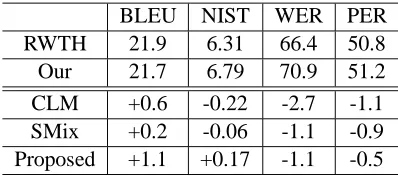
In this section we compare the proposed method to other comtemporary methods: the cluster lan-guage model (CLM) and the sentence mixture model (SMix). The experimental results for these meth-ods were reported by RWTH Aachen University in IWSLT06 (Mauser et al., 2006). We evaluated our method using the same training and evaluation cor-pora. These corpora were used as the training and development corpora in the IWSLT06 Chinese to English open track, the details are given in Table 4. The English side of the training corpus was the same as that used in the earlier Japanese to English experiments reported in this paper. Each sentence in the evaluation corpus had seven reference trans-lations. Our baseline performance was slightly dif-ferent from that reported in the RWTH experiments (21.9 BLEU socre for RWTH’s system and 21.7 for our system). Therefore, their improved baseline is shown for comparison. The results are shown in Table 5. The improvements over the baseline of our method in both BLEU and NIST (Doddington
[image:7.612.322.521.178.267.2]2002) score were greater than those for both CLM and SMix. In particular, our method showed im-provent in both the BLEU and NIST scores, this is in contrast to the CLM and SMix methods which both degraded the translation performance in terms of the NIST score.
Table 5: Comparison results with previous methods
BLEU NIST WER PER
RWTH 21.9 6.31 66.4 50.8
Our 21.7 6.79 70.9 51.2
CLM +0.6 -0.22 -2.7 -1.1
SMix +0.2 -0.06 -1.1 -0.9
Proposed +1.1 +0.17 -1.1 -0.5
6.4 Clustering of the monolingual corpus
Table 2: Japanese to English translation evaluation scores
BLEU NIST WER PER Meteor TER
Baseline 52.38 9.316 42.87 33.21 70.63 35.46
Domain Specific LM 53.66 9.349 41.73 32,27 71.39 34.17 Domain Specific TM 54.30 9.333 41.64 32.50 71.77 33.80 Domain Specific LM+TM 55.09 9.451 41.05 31.63 72.09 33.20
Table 3: Evaluation using ASR output
BLEU NIST WER PER Meteor TER
Baseline 48.17 8.892 47.05 36.86 67.40 39.36
Domain Specific LM 48.94 8.900 46.26 36.37 67.98 38.42 Domain Specific TM 49.11 8.842 45.78 36.55 68.01 37.88 Domain Specific LM+TM 50.12 9.001 45.26 35.80 68.05 37.22
7 Conclusion
We have proposed a technique that utilizes domain specific models based on bilingual clustering for sta-tistical machine translation. It is well-known that domain specific modeling can result in better perfor-mance. However, in many cases, the target domain is not known or can change dynamically. In such cases, domain determination and domain specific translation must be performed simultaneously dur-ing the translation process. In the proposed method, a bilingual corpus was clustered using an entropy re-duction based method. The resulting bilingual clus-ters are regarded as domains. Domain specific lan-guage and translation models are created from the data within each bilingual cluster. When a source sentence is to be translated, its domain is first pre-dicted. The domain prediction method selects the cluster that assigns the lowest language model per-plexity to the given source sentence. Translation then proceeds using a language model and transla-tion model that are specific to the domain predicted for the source sentence.
In our experiments we used a corpus from the travel domain (the subset of the BTEC corpus that was used in IWSLT06). Our experimental results clearly demonstrate the effectiveness of our method. In the Japanese to English translation experiments, the use of our proposed method improved the BLEU score by 2.7 points (from 52.4 to 55.1). We com-pared our approach to two previous methods, the
cluster language model and sentence mixture model. In our experiments the proposed method yielded higher scores than either of the competitive meth-ods in terms of both BLEU and NIST. Moreover, our method may also be augmented when an additional monolingual corpus is avaliable for building the lan-guage model. Using this approach we were able to further improve translation performance on the data from the NIST MT06 evaluation task.
A Sample of Cluster
A.1 Cluster 1
• E: do you do alterations
J:
(naoshi wa shi tei masu ka)
• E: what’s the newest color in this season
J:
(kotoshi no shinshoku wa dore desu ka)
• E: are there any baseball games today
J:
(kyou yakyu no shiai wa ari masu ka)
• E: where’s the nearest perfumery J:!#"$% &'()+*
(moyori no kousui ten wa doko desu ka)
• E: how much is the breakfast J:, -./ 021
[image:8.612.121.482.204.277.2]
Table 4: Training and evaluation corpora used for comparison with previous methods # of sentence Total words Vocabulary size
English Training 40K 315K 9.2K
Chinese Training 40K 304K 18.7K
Chinese Evaluation 489 5,110 1.3K
Table 6: Experimental results with monolingual corpus
BLEU NIST WER PER Meteor TER
Baseline 24.39 7.918 86.51 61.65 53.36 68.21 Proposed 24.95 8.030 85.89 61.27 53.86 67.48
A.2 Cluster 2
• E: mr. aoki yes a single room for two nights
J:
(aoki san desu ne ee shingu-rurumu de 2 haku desu ne)
• E: may i have the key to room two fifteen J:
! "
$# %$&' (2 1 5 gou shitsu no kagi o kudasai)
• E: i’d like extension twenty four please J:(*)
,+.-%0/21
(naisen 24 o o begai shi masu)
• E: the flight number is se one o three to tokyo on the second of april
J:354687:9 <;=
?>@BA0C0D5E6 F
GIH'JLK
-M
K
(furaitonanba wa tokyo iki s e 1 0 3 bin 4 gatsu futsuka no bin desu)
• E: delta airlines flight one one two boarding is delayed
J:N
OQPSRTU$
K
0VXWY?Z
(derutakouku 1 1 2 bin wa tojo ga okure tei masu)
B Sample of Different Translation Results
1. Ref: your room is number two ten Base: your room this is room two o one LM: your room is this is room two one zero TM: your room is room two o one
LM+TM: your room is this is room two one zero
2. Ref: where is a spot where there are a lot of fish Base: i’m spot where is the lot of fish
LM: where is the spot are a lot of fish TM: i’m spot where is the lot of fish LM+TM: where is the spot are a lot of fish
3. Ref: i don’t like the design Base: design i don’t like it LM: i don’t like it design TM: i don’t like the design LM+TM: i don’t like the design
4. Ref: where can i contact you Base: where contact if i may LM: where contact if i can TM: where can i contact LM+TM: where can i contact
5. Ref: where is a police station where japanese is understood
Base: japanese where’s the police station LM: japanese where’s the police station TM: where’s the police station where someone understands japanese
[image:9.612.159.440.187.235.2]References
K. Seymore, R. Rosenfeld, ”Using Story Topics for Lan-guage Model Adaptation,” Proc. EUROSPEECH, pp. 1987-1990, 1997.
David Carter, ”Improving Language Models by Cluster-ing TrainCluster-ing Sentences,” Proc. ACL, pp. 59-64, 1994.
S. Hasan, H. Ney, ”Clustered Language Models Based on Regular Expressions for SMT,” Proc. EAMT, Bu-dapest, Hungary, May 2005.
R. M. Iyer and M. Ostendorf, ”Modeling Long Distance Dependence in Language: Topic mixture versus dy-namic cache models,” IEEE Transactions on Speech and Audio Processing, 1994.
T. Takezawa, E. Sumita, F. Sugaya, H. Yamamoto, S. Ya-mamoto, ”Toward a broad-coverage bilingual corpus for speech translation of travel conversations in the real world,” Proc. Conference on Language Resource and Evaluation, May 2002.
Genichiro Kikui, Eiichiro Sumita, Toshiyuki Takezawa, Seiichi Yamamoto, ”Creating Corpora for Speech-to-Speech Translation,” Proc. EUROSPEECH, pp. 381-384, 2003.
M. Paul, ”Overview of the IWSLT 2006 Evaluation Cam-paign,” IWSLT 2006, Nov. 2006.
R. Zens, F. J. Och, H. Ney, ”Phrase-based statistical ma-chine translation,” 25th German Conference on Artifi-cial Inteligence, Sep 2002.
F. J. Och, H. Ney, ”A Systematic Comparison of Various Statistical Alignment Models,” Computational Lin-guistics, No. 1, Vol. 29, pp. 19-51, 2003.
S. M. Katz, ”Estimation of Probabilities from Sparse Data for Language Model Component of a Speech Recognizer,” IEEE Trans. on Acoustics, Speech, and Signal Processing, pp. 400-401, 1987.
A. Stolcke, ”SRILM - An Extensible Language Model Toolkit,” http://www.speech.sri.com/projects/srilm/
P. Koehn, ”PHARAOH: A beam search decoder for phrase-based statistical machine translation models,” http://www.isi.edu/publications/licensed-sw/pharaoh/
F. J. Och, ”Minimum error rate training for statistical ma-chine trainslation,” Proc. ACL, 2003.
K. Papineni, S. Roukos, T. Ward, W.-J. Zhu, ”Bleu: a method for automatic evaluation of machine transla-tion,” Proc. ACL, 2002.
A. Mauser, R. Zens, E. Matusov, S. Hasan, H. Ney, ”The RWTH Statistical Machine Translation System for IWSLT 2006 Evaluation,” IWSLT 2006, Nov. 2006.
G. Doddington, ”Automatic evaluation of machine trans-lation quality using n-gram co-occurrence statistics,” Proc. ARPA Workshop on Human Language Technol-ogy, 2002.
NIST 2006 Machine Translation Evaluation,