Proceedings of the 2011 Conference on Empirical Methods in Natural Language Processing, pages 1426–1436,
Relation Extraction with Relation Topics
Chang Wang James Fan Aditya Kalyanpur David Gondek IBM T. J. Watson Research Lab
19 Skyline Drive, Hawthorne, New York 10532
{wangchan, fanj, adityakal, dgondek}@us.ibm.com
Abstract
This paper describes a novel approach to the semantic relation detection problem. Instead of relying only on the training instances for a new relation, we leverage the knowledge learned from previously trained relation detec-tors. Specifically, we detect a new semantic relation by projecting the new relation’s train-ing instances onto a lower dimension topic space constructed from existing relation de-tectors through a three step process. First, we construct a large relation repository of more than 7,000 relations from Wikipedia. Second, we construct a set of non-redundant relation topics defined at multiple scales from the re-lation repository to characterize the existing relations. Similar to the topics defined over words, each relation topic is an interpretable multinomial distribution over the existing re-lations. Third, we integrate the relation topics in a kernel function, and use it together with SVM to construct detectors for new relations. The experimental results on Wikipedia and ACE data have confirmed that background-knowledge-based topics generated from the Wikipedia relation repository can significantly improve the performance over the state-of-the-art relation detection approaches.
1 Introduction
Detecting semantic relations in text is very useful in both information retrieval and question answer-ing because it enables knowledge bases to be lever-aged to score passages and retrieve candidate an-swers. To extract semantic relations from text, three types of approaches have been applied. Rule-based
methods (Miller et al., 2000) employ a number of linguistic rules to capture relation patterns. Feature-based methods (Kambhatla, 2004; Zhao and Grish-man, 2005) transform relation instances into a large amount of linguistic features like lexical, syntactic and semantic features, and capture the similarity be-tween these feature vectors. Recent results mainly rely on kernel-based approaches. Many of them fo-cus on using tree kernels to learn parse tree struc-ture related feastruc-tures (Collins and Duffy, 2001; Cu-lotta and Sorensen, 2004; Bunescu and Mooney, 2005). Other researchers study how different ap-proaches can be combined to improve the extraction performance. For example, by combining tree ker-nels and convolution string kerker-nels, (Zhang et al., 2006) achieved the state of the art performance on ACE (ACE, 2004), which is a benchmark dataset for relation extraction.
Although a large set of relations have been iden-tified, adapting the knowledge extracted from these relations for new semantic relations is still a chal-lenging task. Most of the work on domain adapta-tion of relaadapta-tion detecadapta-tion has focused on how to cre-ate detectors from ground up with as little training data as possible through techniques such as boot-strapping (Etzioni et al., 2005). We take a differ-ent approach, focusing on how the knowledge ex-tracted from the existing relations can be reused to help build detectors for new relations. We believe by reusing knowledge one can build a more cost effec-tive relation detector, but there are several challenges associated with reusing knowledge.
cient coverage. In this paper, we introduce a method that automatically extracts the knowledge charac-terizing more than 7,000 relations from Wikipedia. Wikipedia is comprehensive, containing a diverse body of content with significant depth and grows rapidly. Wikipedia’s infoboxes are particularly in-teresting for relation extraction. They are short, manually-created, and often have a relational sum-mary of an article: a set of attribute/value pairs de-scribing the article’s subject.
Another challenge is how to deal with overlap of relations in the repository. For example, Wikipedia authors may make up a name when a new relation is needed without checking if a similar relation has already been created. This leads to relation duplica-tion. We refine the relation repository based on an unsupervised multiscale analysis of the correlations between existing relations. This method is parame-ter free, and able to produce a set of non-redundant
relation topicsdefined at multiple scales. Similar to the topics defined over words (Blei et al., 2003), we define relation topics as multinomial distributions over the existing relations. The relation topics ex-tracted in our approach are interpretable, orthonor-mal to each other, and can be used as basis relations to re-represent the new relation instances.
The third challenge is how to use the relation top-ics for a relation detector. We map relation instances in the new domains to the relation topic space, re-sulting in a set of new features characterizing the relationship between the relation instances and ex-isting relations. By doing so, background knowl-edge from the existing relations can be introduced into the new relations, which overcomes the limi-tations of the existing approaches when the training data is not sufficient. Our work fits in to a class of re-lation extraction research based on “distant supervi-sion”, which studies how knowledge and resources external to the target domain can be used to im-prove relation extraction. (Mintz et al., 2009; Jiang, 2009; Chan and Roth, 2010). One distinction be-tween our approach and other existing approaches is that we represent the knowledge from distant super-vision using automatically constructed topics. When we test on new instances, we do not need to search against the knowledge base. In addition, our top-ics also model the indirect relationship between re-lations. Such information cannot be directly found
from the knowledge base.
The contributions of this paper are three-fold. Firstly, we extract a large amount of training data for more than 7,000 semantic relations from Wikipedia (Wikipedia, 2011) and DBpedia (Auer et al., 2007). A key part of this step is how we handle noisy data with little human effort. Sec-ondly, we present an unsupervised way to con-struct a set of relation topics at multiple scales. This step is parameter free, and results in a non-redundant, multiscale relation topic space. Thirdly, we design a new kernel for relation detection by integrating the relation topics into the relation de-tector construction. The experimental results on Wikipedia and ACE data (ACE, 2004) have con-firmed that background-knowledge-based features generated from the Wikipedia relation repository can significantly improve the performance over the state-of-the-art relation detection approaches.
2 Extracting Relations from Wikipedia
Our training data is from two parts: relation in-stances from DBpedia (extracted from Wikipedia infoboxes), and sentences describing the relations from the corresponding Wikipedia pages.
2.1 Collecting the Training Data
DBpe-dia relations.
To get precise type information for the argu-ments of a DBpedia relation, we use the DBpedia knowledge base (Auer et al., 2007) and the asso-ciated YAGO type system (Suchanek et al., 2007). Note that for every Wikipedia page, there is a cor-responding DBpedia entry which has captured the infobox-properties as RDF triples. Some of the triples include type information, where the subject of the triple is a Wikipedia entity, and the object is a YAGO type for the entity. For example, the DBpedia entry for the entity “Albert Einstein” in-cludes YAGO types such as Scientist, Philosopher, Violinist etc. These YAGO types are also linked to appropriate WordNet concepts, providing for ac-curate sense disambiguation. Thus, for any en-tity argument of a relation we are learning, we ob-tain sense-disambiguated type information (includ-ing super-types, sub-types, sibl(includ-ings etc.), which be-come useful generalization features in the relation detection model. Given a common noun, we can also retrieve its type information by checking against WordNet (Fellbaum, 1998).
2.2 Extracting Rules from the Training Data
We use a set of rules together with their popular-ities (occurrence count) to characterize a relation. A rule representing the relations between two ar-guments has five components (ordered): argument1 type, argument2type, noun, preposition and verb. A rule example ofActiveYearsEndDaterelation (about the year that a person retired) is:
person100007846|year115203791|-|in|retire.
In this example, argument1 type is
per-son100007846, argument2 type is year115203791, both of which are from YAGO type system. The key words connecting these two arguments are in
(preposition) and retire (verb). This rule does not have a noun, so we use a ‘-’ to take the position of noun. The same relation can be represented in many different ways. Another rule example characterizing the same relation is
person100007846|year115203791|retirement|-|announce. This paper only considers three types of words:
[image:3.612.315.548.70.226.2]noun,verbandpreposition. It is straightforward to expand or simplify the rules by including more or removing some word types. The keywords are ex-tracted from the shortest path on the dependency
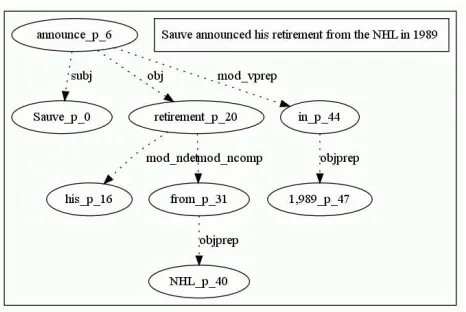
Figure 1: A dependency tree example.
tree between the two arguments. A dependency tree (Figure 1) represents grammatical relations be-tween words in a sentence. We used a slot grammar parser (McCord, 1995) to generate the parse tree of each sentence. Note that there could be multiple paths between two arguments in the tree. We only take the shortest path into consideration. The pop-ularity value corresponding to each rule represents how many times this rule applies to the given rela-tion in the given data. Multiple rules can be con-structed from one relation instance, if multiple argu-ment types are associated with the instance, or mul-tiple nouns, prepositions or verbs are in the depen-dency path.
2.3 Cleaning the Training Data
check each rule against the training data to see if that rule really exists in the training data or not. If it does not exist, we filter it out. If a sentence does not have a single rule passing the above procedure, that sen-tence will be removed. Using the above techniques, we collect examples characterizing 7,628 DBpedia relations.
3 Learning Multiscale Relation Topics
An extra step extracting knowledge from the raw data is needed for two reasons: Firstly, many DB-pedia relations are inter-related. For example, some DBpedia relations have a subclass relationship, e.g. “AcademyAward” and “Award”; others overlap in their scope and use, e.g., “Composer” and “Artist”; while some are equivalent, e.g., “DateOfBirth” and “BirthDate”. Secondly, a fairly large amount of the noisy labels are still in the training data.
To reveal the intrinsic structure of the current DB-pedia relation space and filter out noise, we car-ried out a correlation analysis of relations in the training data, resulting in a relation topic space. Each relation topic is a multinomial distribution over the existing relations. We adapted diffusion wavelets (Coifman and Maggioni, 2006) for this task. Compared to the other well-known topic ex-traction methods like LDA (Blei et al., 2003) and LSI (Deerwester et al., 1990), diffusion wavelets can efficiently extract a hierarchy of interpretable topics without any user input parameter (Wang and Ma-hadevan, 2009).
3.1 An Overview of Diffusion Wavelets
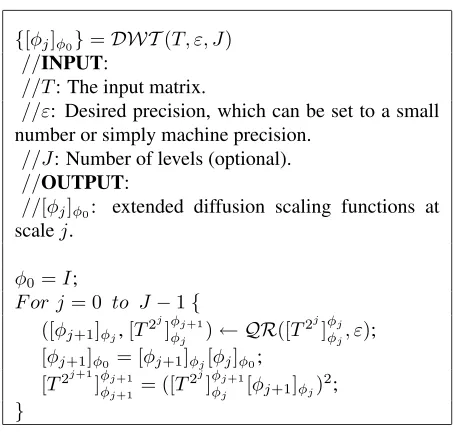
The diffusion wavelets algorithm constructs a com-pressed representation of the dyadic powers of a square matrix by representing the associated matri-ces at each scale not in terms of the original (unit vector) basis, but rather using a set of custom gener-ated bases (Coifman and Maggioni, 2006). Figure 2 summarizes the procedure to generate diffusion wavelets. Given a matrix T, the QR (a modified
QR decomposition) subroutine decomposesT into
an orthogonal matrix Q and a triangular matrix R
such that T ≈ QR, where |Ti,k −(QR)i,k| < ε for anyiandk. Columns inQare orthonormal
ba-sis functions spanning the column space ofT at the finest scale.RQis the new representation ofT with
{[φj]φ0}=DWT(T, ε, J)
//INPUT:
//T: The input matrix.
//ε: Desired precision, which can be set to a small number or simply machine precision.
//J: Number of levels (optional).
//OUTPUT:
//[φj]φ0: extended diffusion scaling functions at
scalej.
φ0=I;
F or j = 0 to J−1{
([φj+1]φj,[T 2j
]φj+1
φj )← QR([T 2j
]φj
φj, ε);
[φj+1]φ0 = [φj+1]φj[φj]φ0;
[T2j+1
]φj+1
φj+1= ([T 2j
]φj+1
φj [φj+1]φj) 2;
[image:4.612.313.541.67.285.2]}
Figure 2: Diffusion Wavelets construct multiscale repre-sentations of the input matrix at different scales.QRis a
modifiedQRdecomposition. J is the max step number (this is optional, since the algorithm automatically ter-minates when it reaches a matrix of size 1 ×1). The notation[T]φb
φadenotes matrixT whose column space is
represented using basisφb at scale b, and row space is
represented using basisφaat scalea. The notation[φb]φa
denotes basisφbrepresented on the basisφa. At an
arbi-trary scalej, we have pj basis functions, and length of
each function islj. The number ofpj is determined by
the intrinsic structure of the given dataset inQRroutine.
[T]φb
φais apb×lamatrix, and[φb]φais anla×pbmatrix.
respect to the space spanned by the columns of Q
(this result is based on the matrix invariant subspace theory). At an arbitrary levelj,DWT learns the
ba-sis functions fromT2j
usingQR. Compared to the number of basis functions spanning T2j’s original
column space, we usually get fewer basis functions, since some high frequency information (correspond-ing to the “noise” at that level) can be filtered out.
DWT then computesT2j+1using the low frequency
representation ofT2j
and the procedure repeats.
3.2 Constructing Multiscale Relation Topics Learning Relation Correlations
Assume we haveMrelations, and theithof them is characterized bymi<rule, popularity>pairs. We use s(a, b) to represent the similarity between the
look for the rules that are shared by both relationa
and b. We use the product of corresponding pop-ularity values to represent the similarity score be-tween two relations with respect to each common rule. s(a, b) is set to the sum of such scores over all common rules. The relation-relation correlation matrixSis constructed as follows:
S = [
s(1,1) · · · s(1, M)
· · · ·
s(M,1) · · · s(M, M)
]
We have more than200,000argument types, tens of thousands of distinct nouns, prepositions, and verbs, so we potentially have trillions of distinct rules. One rule may appear in multiple relations. The more rules two relations share, the more related two relations should be. The rules shared across dif-ferent relations offer us a novel way to model the correlations between different relations, and further allow us to create relation topics. The rules can also be simplified. For example, we may treat argument1, argument2, noun, preposition and verb separately. This results in simple rules that only involve in one argument type or word. The correlations between relations are then computed only based on one par-ticular component like argument1, noun, etc.
Theoretical Analysis
Matrix S models the correlations between
rela-tions in the training data. OnceSis constructed, we
adapt diffusion wavelets (Coifman and Maggioni, 2006) to automatically extract the basis functions spanning the original column space of S at
multi-ple scales. The key strength of the approach is that it is data-driven, largely parameter-free and can au-tomatically determine the number of levels of the topical hierarchy, as well as the topics at each level. However, to apply diffusion wavelets toS, we first need to show thatS is a positive semi-definite
ma-trix. This property guarantees that all eigenvalues
of S are ≥ 0. Depending on the way we
formal-ize the rules, the methods to validate this property are slightly different. When we treat argument1, argument2, noun, preposition and verb separately, it is straightforward to see the property holds. In The-orem 1, we show the property also holds when we use more complicated rules (using the 5-tuple rule in Section 2.2 as an example in the proof).
Theorem 1. Sis a Positive Semi-Definite matrix. Proof: An arbitrary ruleriis uniquely characterized by a five tuple: argument1 type| argument2 type|
noun| preposition|verb. Since the number of dis-tinct argument types and words are constants, the number of all possible rules is also a constant:R.
If we treat each rule as a feature, then the set of rules characterizing an arbitrary relation ri can be represented as a point[p1i,· · · , pRi ]in a latentR
di-mensional rule space, wherepji represents the
popu-larity of rulejin relationriin the given data. We can verify that the way to computes(a, b) is the same as s(a, b) =< [p1a· · ·paR],[p1b· · ·pRb] >,
where< ·,· >is the cosine similarity (kernel). It
follows directly from the definition of positive semi-definite matrix (PSD) thatS is PSD (Sch¨olkopf and
Smola, 2002).
In our approach, we construct multiscale
re-lation topics by applying DWT to decompose
S/λmax(S), where λmax(S) represents the largest eigenvalue ofS. Theorem 2 shows that this
decom-position will converge, resulting in a relation topic hierarchy with one single topic at the top level.
Theorem 2. Let λmax(S) represent the largest
eigenvalue of matrixS, thenDWT(S/λmax(S), ε)
produces a set of nested subspaces of the column space ofS, and the highest level of the resulting sub-space hierarchy is spanned by one basis function. Proof: From Theorem 1, we know that Sis a PSD
matrix. This meansλmax(S) ∈[0,+∞)(all eigen-values ofS are non-negative). This further implies
thatΛ(S)/λmax(S)∈[0,1], whereΛ(S)represents any eigenvalue ofS.
The idea underlying diffusion wavelets is based on decomposing the spectrum of an input matrix into various spectral bands, spanned by basis
func-tions (Coifman and Maggioni, 2006). Let T =
S/λmax(S). In Figure 2, we construct spectral bands of eigenvalues, whose associated eigenvectors span the corresponding subspaces. Define dyadic spatial scalestjas
tj= j
X
t=0
2t= 2j+1−1, j≥0.
At each spatial scale, the spectral band is defined as:
whereΛ(T)represents any eigenvalue ofT, andε∈
(0,1)is a pre-defined threshold in Figure 2. We can now associate with each of the spectral bands a vec-tor subspace spanned by the corresponding eigen-vectors:
Vj=h{ξλ:λ∈Λ(T), λtj ≥ε}i, j ≥0.
In the limit, we obtain
lim
j→∞Vj=h{ξλ:λ= 1}i
That is, the highest level of the resulting subspace hierarchy is spanned by the eigenvector associated with the largest eigenvalue ofT.
This result shows that the multiscale analysis of the relation space will automatically terminate at the level spanned by one basis, which is the most popu-lar relation topic in the training data.
3.3 High Level Explanation
We first create a set of rules to characterize each in-put relation. Since these rules may occur in multi-ple relations, they provide a way to model the co-occurrence relationship between different relations. Our algorithm starts with the relation co-occurrence matrix and then repeatedly appliesQR
decomposi-tion to learn the topics at the current level while at the same time modifying the matrix to focus more on low-frequency indirect co-occurrences (between re-lations) for the next level. RunningDWT is
equiv-alent to running a Markov chain on the input data forward in time, integrating the local geometry and therefore revealing the relevant geometric structures of the whole data set at different scales. At scale
j, the representation ofT2j+1 is compressed based
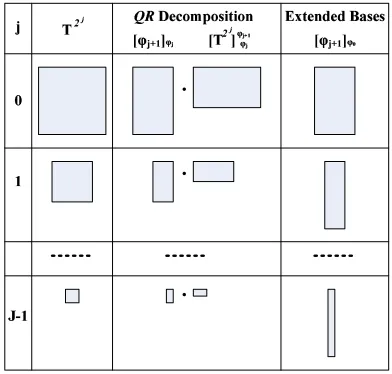
on the amount of remaining information and the de-sired precision. This procedure is illustrated in Fig-ure 3. In the resulting topic space, instances with related relations will be grouped together. This ap-proach may significantly help us detect new rela-tions, since it potentially expands the information brought in by new relation instances from making use of the knowledge extracted from the existing re-lation repository.
3.4 Benefits
As shown in Figure 3, the topic spaces at different levels are spanned by a different number of basis
! #" $%'&(*)+,- .563 ./'01*23,4
78 , -,-9:
;
<=;
.
.
[image:6.612.329.525.74.261.2].
Figure 3: Learning Relation Topics at Multiple Scales.
functions. These numbers reveal the dimensions of the relevant geometric structures of data at different levels. These numbers are completely data-driven: the diffusion wavelets approach can automatically find the number of levels and simultaneously gen-erate the topics at each level. Experiments show that most multiscale topics are interpretable (due to the sparsity of the scaling functions), such that we can interpret the topics at different scales and select the best scale for embedding. Compared to bootstrap-ping approach, our approach is accumulative; that is as the system learns more relations, it gets bet-ter at learning new relations. Because our approach takes advantage of the previously learned relations, and the topic space is enriched as we learn more and more relations.
4 Constructing Relation Detectors with Multiscale Relation Topics
4.1 Project Relation Instances onto Topics
When we design detectors for new relations, we treat arg1, arg2, noun, and verb separately to get stronger correlations between relations. We
do not directly use preposition. Any
DBpe-dia relation r ∈ {1,· · · , M} is represented with
4 vectors rt = [rt(1),· · · , rt(Nt)], where t ∈
{arg1, arg2, noun, verb},Ntrepresents the size of the vocabulary set of the type t component in the
Wikipedia training data, andrt(j)represents the oc-currence count of typetcomponent in relationr. For
example,Nverbis the size of the verb vocabulary set in the training data andrverb(j)represents the occur-rence count of thejthverb in relationr. When a new
relation instance x is given, we extract the
depen-dency path between two arguments, and create four vectors xt, where t ∈ {arg1, arg2, noun, verb}, following the same format asrt. The projection
re-sult ofxtonto the DBpedia relation spaceXt is as follows:
Xt = [< rt(1), xt(1) >,· · · , < rt(M), xt(M) >],
where< ·,· >is the cosine similarity of two vec-tors. At level k, the embedding of x is Exk = [EXargk
1, E
k
Xarg2, EXnounk , EXkverb], where E k Xt = ([φk]φ0)
TXt, and[φ
k]φ0 is defined in Figure 2.
4.2 Design New Kernel Using Topic Features
We combineExkwith 3 existing kernels (KArgument, KP ath andKBOW) to create a new kernel for rela-tion detecrela-tion.
(1)KArgumentmatches two arguments, it returns the number of common argument types that the input ar-guments share.
(2) KP ath matches two dependency paths. This kernel is formally defined in (Zhao and Grishman, 2005). We extended this kernel by also matching the common nouns, prepositions and verbs in the de-pendency paths. We assign weight 1 to verbs, 0.5 to nouns and prepositions.
(3) KBOW models the number of common nouns,
prepositions and verbs in the given sentences but not in the dependency paths. Since these words are not as important as the words inside the dependency path, we assign weight 0.25 to them.
(4)KT Fk(x, y) =< Exk, Eyk >, wherex,y are two input relation instances, and<·,·>models the co-sine similarity of two vectors. T F stands for topic
feature.
(5) The final kernel used in this paper is
α1KArgument+α2KP ath+α3KBOW +α4KT Fk,
whereαi can be tuned for each individual domain. In this paper, we setαi = 1fori∈ {1,2,3,4}.
4.3 Algorithm to Construct Relation Detectors 1. Construct a relation repository from Wikipedia.
(a) Collect training data from Wikipedia and DB-pedia (Section 2.1);
(b) Clean the data representing each input relation (Section 2.2 and 2.3);
(c) Create relation correlation matrixSfollowing the approach described in Section 3.2, result-ing in anM ×Mmatrix.
2. Create multiscale relation topics.
[φk]φ0 =DWT(S/λmax(S), ε), whereDWT()is
the diffusion wavelets implementation described in Section 3.1. [φk]φ0 are the scaling function bases
at levelk represented as anM ×pk matrix, k =
1,· · ·, hrepresents the level in the topic hierarchy. The value ofpkis determined inDWT()based on
the intrinsic structure of the given dataset. Columns of[φk]φ0 are used as relation topics at levelk.
3. Construct relation detectors for new relations.
Given the training data from a new relation, project the data onto levelkof the multiscale topic hierar-chy, wherekis chosen by users (Section 4.1). Ap-ply SVM classifiers together with our kernel (Sec-tion 4.2) to create detectors for new rela(Sec-tions.
5 Experimental Results
We used SVMLight (Joachims, 1999) together with the user defined kernel setting in our approach. The trade-off parameter between training error and mar-gin c is 1 for all experiments. Our approach to
learn multiscale relation topics is largely parameter free. The only parameter to be set is the precision
ε= 10−5, which is also the default value in the dif-fusion wavelets implementation.
5.1 Learning Multiscale Relation Topics
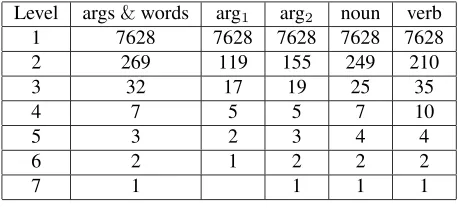
Table 1: Number of topics at different levels (DBpe-dia Relations) under 5 different settings: use args, noun, preposition and verb; arg1only; arg2only; noun only and
verb only.
Level args&words arg1 arg2 noun verb
1 7628 7628 7628 7628 7628
2 269 119 155 249 210
3 32 17 19 25 35
4 7 5 5 7 10
5 3 2 3 4 4
6 2 1 2 2 2
7 1 1 1 1
7,628 DBpedia relations. For any given topic vec-tor v, we know it is a column vector of length M, where M is the size of the DBpedia relation set
and kvk = 1. The entry v[i]represents the contri-bution of relation i to this topic. To explain the main concept of topic v, we sort the entries on v and print out the relations corresponding to the
top entries. These relations summarize the top-ics in the relation repository. One topic exam-ple is as follows: [doctoraladvisor (0.683366), doc-toralstudents (0.113201), candidate (0.014662), academ-icadvisors (0.008623), notablestudents (0.003829), col-lege (0.003021), operatingsystem (0.002964), combatant (0.002826), influences (0.002285), training (0.002148),
· · ·], wheredoctoraladvisor is a DBpedia relation
and 0.683366 is its contribution to the topic. The length of this relation vector is 7,628. We only list the top 10 relations here.
Our approach identifies 5 different topic hierar-chies under different settings (use args, noun, prepo-sition and verb; arg1only; arg2only; noun only and verb only). The number of the topics at each level is shown in Table 1. At the first level, each input rela-tion is treated as a topic. At the second level, num-bers of topics go down to reasonable numnum-bers like 269. Finally at the top level, the number of topic is down to 1 (Theorem 2 also proves this). We show some topic examples under the first setting. The 3 topics at level 5 are shown in Table 2. They represent the most popular DBpedia relation topics. Almost all 269 topics at level 5 look semantically meaning-ful. They nicely capture the related relations. Some examples are in Table 3.
Table 2: 3 topics at level 5 (all word types and args).
Top 4 Relations and Their Contributions starring86.6%, writer3.8%, producer3.2%, director1.6%
birthplace75.3%, clubs6.1%, deathplace5.1%, location4.1%
[image:8.612.71.300.127.236.2]clubs55.3%, teams9.3%, nationalteam6.3%college6.0%
Table 3: Some topics at level 2 (all word types and args). Top Relations
activeyearsenddate, careerend, finalyear, retired commands, partof, battles, notablecommanders occupation, shortdescription, profession, dates influenced, schooltradition, notableideas, maininterests
destinations, end, through, posttown prizes, award, academyawards, highlights
inflow, outflow, length, maxdepth after, successor, endingterminus
college, almamater, education
5.2 Relation Detection on Wikipedia Data
In previous experiment, 20,000 relation instances were held and not used to construct the topic space. These instances are randomly selected from 100 re-lations (200 instances from each relation). This set is used as a benchmark to compare different rela-tion detecrela-tion approaches. In this experiment, 100 instances from each relation are used for training, and the other 100 are for testing. In training, we try three different settings:n= 5, 20 and 100, wheren
is the size of the training set for each relation. When we train a model for one relation, we use the train-ing positive instances from the other 99 relations as training negatives. For example, we use 5 training positive instances and 5*99=495 training negatives to train a detector for each relation.
We compare our approach against the regular rule-based approach (Lin and Pantel, 2001) and two other kernel-based approaches (presented in Sec-tion 4.2) for relaSec-tion detecSec-tion task. The comparison results are summarized in Table 4. The approach using relation topics (level 2) consistently outper-forms the other three approaches in all three settings. When n = 5, it achieves the largest improvement
The users can select the level that is the most ap-propriate for their applications. In this example, we only have alignment results at 7 levels. Choosing the space at level 2 spanned by a couple of hundreds of basis functions is a natural choice, since the levels below and above this have too many or too few fea-tures, respectively. A user can also select the most appropriate level by checking if the related relation topics are meaningful for their applications.
5.3 Relation Detection on ACE Data
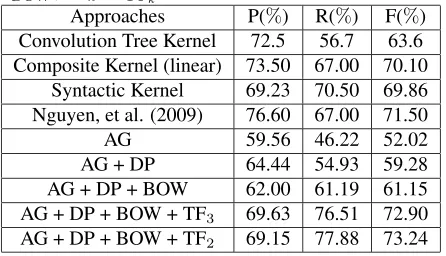
In this experiment, we use the news domain docu-ments of the ACE 2004 corpus (ACE, 2004) to com-pare our approaches against the state-of-the-art ap-proaches. This dataset includes 348 documents and around 4400 relation instances. 7 relation types, 7 entity types, numerous relation sub-types, entity sub-types, and mention types are defined on this set. The task is to classify the relation instances into one of the 7 relation types or “NONE”, which means there is no relation. For comparison, we use the same setting as (Zhang et al., 2006), by apply-ing a 5-fold cross-validation. The scores reported here are the average of all 5 folds. This is also how the other approaches are evaluated. In this test, we treat entity types, entity sub-types and mention types equally as argument types. Table 5 summarizes the performance after applying the kernels presented in Section 4.2 incrementally, showing the improve-ment from each individual kernel. We also com-pare our approaches to the other state-of-the-art ap-proaches including Convolution Tree kernel (Collins and Duffy, 2001), Syntactic kernel (Zhao and Grish-man, 2005), Composite kernel (linear) (Zhang et al., 2006) and the best kernel in (Nguyen et al., 2009). Our approach with relation topics at level 2 has the best performance, achieving a 73.24% F-measure. The impact of the relation topics is huge. They im-prove the F-measure from 61.15% to73.24%. We
also test our approach using the topics at level 3. The performance is slightly worse than using level 2, but still better than the others.
This paper studies how relation topics extracted from Wikipedia relation repository can help improve relation detection performance. We do not want to tune our approach to one particular relation detec-tion task, like ACE 2004. In our experiments, no parameter tuning was taken and no domain specific
heuristic rules were applied. We are aware of some methods that could stack on our approach to further improve the performance on ACE test. The Com-posite kernel result in Table 5 is based on a linear combination of the Argument kernel and Convolu-tion Tree kernel. (Zhang et al., 2006) showed that by carefully choosing the weight of each compo-nent and using a polynomial expansion, they could achieve the best performance on this data:72.1% F-measure. (Nguyen et al., 2009) further showed that the performance can be improved by taking syntac-tic and semansyntac-tic structures into consideration. They used several types of syntactic information includ-ing constituent and dependency syntactic parse trees to improve the state of the art approaches to71.5% on F-measure. Heuristic rules extracted from the target data can also help improve the performance. (Jiang and Zhai, 2007) reported that by taking sev-eral heuristic rules they can improve the F-measure of Composite Kernel to70.4%. They also showed
that using maximum entropy classifier rather than SVM achieved the best performance on this task: 72.9%F-measure. To the best of our knowledge, the most recent result was reported by (Zhou and Zhu, 2011), who extended their previous work in (Zhou et al., 2007). By using several heuristics to define an effective portion of constituent trees, and training the classifiers using ACE relation sub-types (rather than on types), they achieved an impressive75.8% F-measure. However, as pointed out in (Nguyen et al., 2009), such heuristics are tuned on the target re-lation extraction task and might not be appropriate to compare against the automatic learning approaches. Even though we have not done any domain specific parameter tuning or applied any heuristics, our ap-proach still achieve significant improvements over all approaches mentioned above except one, which is based on heuristics extracted from the target do-main. This also implies that by combining some of the above ideas with relation topics, the performance on ACE data may be further improved.
6 Conclusions
pro-Table 4: F-measure comparison of different approaches over 100 DBpedia relations with 5, 20 and 100 posi-tive examples per relation. AG:KArgument, DP:KP ath,
BOW:KBOW, TFk:KT Fk.
Approaches 100 20 5
[image:10.612.72.303.127.191.2]Rule Based 37.70% 27.45% 13.20% AG+ DP 73.64% 51.85% 22.95% AG+ DP+ BOW 78.74% 62.76% 31.98% AG+ DP+ BOW+ TF2 81.18% 68.03% 41.60%
Table 5: Performance comparison of different approaches with SVM over the ACE 2004 data. P: Precision, R: Re-call, F: F-measure, AG:KArgument, DP:KP ath, BOW:
KBOW, TFk:KT Fk.
Approaches P(%) R(%) F(%) Convolution Tree Kernel 72.5 56.7 63.6 Composite Kernel (linear) 73.50 67.00 70.10
Syntactic Kernel 69.23 70.50 69.86 Nguyen, et al. (2009) 76.60 67.00 71.50
AG 59.56 46.22 52.02
AG + DP 64.44 54.93 59.28 AG + DP + BOW 62.00 61.19 61.15 AG + DP + BOW + TF3 69.63 76.51 72.90
AG + DP + BOW + TF2 69.15 77.88 73.24
vide an automatic way to collect training data for more than 7,000 relations from Wikipedia and DB-pedia. Secondly, we present an unsupervised way to construct a set of relation topics at multiple scales. Different from the topics defined over words, rela-tion topics are defined over the existing relarela-tions. Thirdly, we design a new kernel for relation detec-tion by integrating the reladetec-tion topics in the repre-sentation of the relation instances. By leveraging the knowledge extracted from the Wikipedia rela-tion repository, our approach significantly improves the performance over the state-of-the-art approaches on ACE data. This paper makes use of all DBpedia relations to create relation topics. It is possible that using a subset of them (more related to the target relations) might improve the performance. We will explore this in future work.
Acknowledgments
We thank the reviewers for their helpful comments. This material is based upon work supported in part by the IBM DeepQA (Watson) project. We also gratefully acknowledge the support of Defense
Ad-vanced Research Projects Agency (DARPA) Ma-chine Reading Program under Air Force Research Laboratory (AFRL) prime contract no. FA8750-09-C-0172. Any opinions, findings, and conclusion or recommendations expressed in this material are those of the author(s) and do not necessarily reflect the view of the DARPA, AFRL, or the US govern-ment.
References
ACE. 2004. The automatic content extraction projects, http://projects.ldc.upenn.edu/ace/.
S¨oren Auer, Christian Bizer, Georgi Kobilarov, Jens Lehmann, Richard Cyganiak, and Zachary Ives. 2007. DBpedia: A nucleus for a web of open data. In Pro-ceedings of the 6th International Semantic Web Con-ference, Busan, Korea, pages 11–15. Springer. D. Blei, A. Ng, and M. Jordan. 2003. Latent
Dirich-let allocation. Journal of Machine Learning Research, 3:993–1022.
D. Blei, T. Griffiths, M. Jordan, and J. Tenenbaum. 2004. Hierarchical topic models and the nested Chinese restaurant process. InProceedings of the Advances in Neural Information Processing Systems (NIPS). Razvan Bunescu and Raymond Mooney. 2005. A
short-est path dependency kernel for relation extraction. In
Proceedings of the Conference on Human Language Technology and Empirical Methods in Natural Lan-guage Processing.
Yee Seng Chan and Dan Roth. 2010. Exploiting back-ground knowledge for relation extraction. In Proceed-ings of the 23rd International Conference on Compu-tational Linguistics, pages 152–160.
R. Coifman and M. Maggioni. 2006. Diffusion wavelets. Applied and Computational Harmonic Analysis, 21:53–94.
Michael Collins and Nigel Duffy. 2001. Convolution kernels for natural language. In Proceedings of the Advances in Neural Information Processing Systems (NIPS), pages 625–632.
Aron Culotta and Jeffrey Sorensen. 2004. Dependency tree kernels for relation extraction. InProceedings of the 42nd Annual Meeting of the Association for Com-putational Linguistics (ACL), pages 423–429.
S. Deerwester, S. T. Dumais, G. W. Furnas, T. K. Lan-dauer, and R. Harshman. 1990. Indexing by latent se-mantic analysis. Journal of the American Society for Information Science, 41(6):391–407.
[image:10.612.75.298.257.385.2]Daniel S. Weld, and Alexander Yates. 2005. Unsuper-vised named-entity extraction from the web: An ex-perimental study.Artificial Intelligence, 165:91–134. Christiane Fellbaum. 1998. WordNet: An Electronic
Lexical Database. MIT Press.
Raphael Hoffmann, Congle Zhang, and Daniel S. Weld. 2010. Learning 5000 relational extractors. In Pro-ceedings of the 48th Annual Meeting of the Association for Computational Linguistics (ACL), pages 286–295. Jing Jiang and Chengxiang Zhai. 2007. A systematic ex-ploration of the feature space for relation extraction. In
Proceedings of the Human Language Technology Con-ference of the North American Chapter of the Associ-ation for ComputAssoci-ational Linguistics, pages 113–120. Jing Jiang. 2009. Multi-task transfer learning for
weakly-supervised relation extraction. InProceedings of the Joint Conference of the 47th Annual Meeting of the Association for Computational Linguistics (ACL) and the 4th International Joint Conference on Natural Language Processing (IJCNLP), pages 1012–1020. T. Joachims. 1999. Making Large-Scale SVM Learning
Practical. MIT Press.
Nanda Kambhatla. 2004. Combining lexical, syntactic, and semantic features with maximum entropy mod-els for extracting relations. In Proceedings of the ACL 2004 on Interactive poster and demonstration sessions.
Dekang Lin and Patrick Pantel. 2001. DIRT - discov-ery of inference rules from text. InProceedings of the ACM SIGKDD Conference on Knowledge Discovery and Data Mining, pages 323–328.
Michael McCord. 1995. Slot grammar: A system for simpler construction of practical natural language grammars. Communications of the ACM, 38(11). Scott Miller, Heidi Fox, Lance Ramshaw, and Ralph
Weischedel. 2000. A novel use of statistical pars-ing to extract information from text. In Proceedings of the 1st North American Chapter of the Association for Computational Linguistics Conference.
Mike Mintz, Steven Bills, Rion Snow, and Dan Jurafsky. 2009. Distant supervision for relation extraction with-out labeled data. InProceedings of the Joint Confer-ence of the 47th Annual Meeting of the Association for Computational Linguistics (ACL) and the 4th Interna-tional Joint Conference on Natural Language Process-ing (IJCNLP), pages 1003–1011.
Truc-Vien T. Nguyen, Alessandro Moschitti, and Giuseppe Riccardi. 2009. Convolution kernels on constituent, dependency and sequential structures for relation extraction. In Proceedings of the 2009 Con-ference on Empirical Methods in Natural Language Processing (EMNLP).
B. Sch¨olkopf and A. J. Smola. 2002.Learning with Ker-nels: Support Vector Machines, Regularization, Opti-mization, and Beyond. MIT Press.
Fabian M. Suchanek, Gjergji Kasneci, and Gerhard Weikum. 2007. YAGO: A large ontology from Wikipedia and WordNet. Web Semantics: Science, Services and Agents on the World Wide Web, 6(3):203– 217.
C. Wang and S. Mahadevan. 2009. Multiscale analysis of document corpora based on diffusion models. In
Proceedings of the International Joint Conference on Artificial Intelligence (IJCAI), pages 1592–1597. Wikipedia. 2011. http://www.wikipedia.org/.
Min Zhang, Jie Zhang, Jian Su, and Guodong Zhou. 2006. A composite kernel to extract relations between entities with both flat and structured features. In Pro-ceedings of the 21st International Conference on Com-putational Linguistics and 44th Annual Meeting of the Association for Computational Linguistics (ACL). Shubin Zhao and Ralph Grishman. 2005. Extracting
re-lations with integrated information using kernel meth-ods. InProceedings of the 43rd Annual Meeting of the Association for Computational Linguistics (ACL), pages 419–426.
G. Zhou and Q. Zhu. 2011. Kernel-based semantic rela-tion detecrela-tion and classificarela-tion via enriched parse tree structure. Journal of Computer Science and Technol-ogy, 26:45–56.