Domain Adaptation of Rule-Based Annotators
for Named-Entity Recognition Tasks
Laura Chiticariu Rajasekar Krishnamurthy Yunyao Li Frederick Reiss Shivakumar Vaithyanathan
IBM Research – Almaden
650 Harry Road, San Jose, CA 95120, USA
{chiti, rajase, yunyaoli, frreiss}@us.ibm.com, [email protected]
Abstract
Named-entity recognition (NER) is an impor-tant task required in a wide variety of plications. While rule-based systems are ap-pealing due to their well-known “explainabil-ity,” most, if not all, state-of-the-art results for NER tasks are based on machine learning techniques. Motivated by these results, we ex-plore the following natural question in this pa-per: Are rule-based systems still a viable ap-proach to named-entity recognition? Specif-ically, we have designed and implemented a high-level language NERL on top of Sys-temT, a general-purpose algebraic informa-tion extracinforma-tion system. NERLis tuned to the needs of NER tasks and simplifies the pro-cess of building, understanding, and customiz-ing complex rule-based named-entity tors. We show that these customized annota-tors match or outperform the best published results achieved with machine learning tech-niques. These results confirm that we can reap the benefits of rule-based extractors’ ex-plainability without sacrificing accuracy. We conclude by discussing lessons learned while building and customizing complex rule-based annotators and outlining several research di-rections towards facilitating rule development.
1 Introduction
Named-entity recognition (NER) is the task of iden-tifying mentions of rigid designators from text be-longing to named-entity types such as persons, orga-nizations and locations (Nadeau and Sekine, 2007). While NER over formal text such as news articles and webpages is a well-studied problem (Bikel et
al., 1999; McCallum and Li, 2003; Etzioni et al., 2005), there has been recent work on NER over in-formal text such as emails and blogs (Huang et al., 2001; Poibeau and Kosseim, 2001; Jansche and Ab-ney, 2002; Minkov et al., 2005; Gruhl et al., 2009). The techniques proposed in the literature fall under three categories: rule-based (Krupka and Hausman, 2001; Sekine and Nobata, 2004), machine learning-based (O. Bender and Ney, 2003; Florian et al., 2003; McCallum and Li, 2003; Finkel and Manning, 2009; Singh et al., 2010) and hybrid solutions (Sri-hari et al., 2001; Jansche and Abney, 2002).
1.1 Motivation
Although there are well-established rule-based sys-tems to perform NER tasks, most, if not all, state-of-the-art results for NER tasks are based on machine learning techniques. However, the rule-based ap-proach is still extremely appealing due to the associ-ated transparency of the internal system state, which leads to better explainability of errors (Siniakov, 2010). Ideally, one would like to benefit from the transparency and explainability of rule-based tech-niques, while achieving state-of-the-art accuracy.
A particularly challenging aspect of rule-based NER in practice is domain customization — cus-tomizing existing annotators to produce accurate re-sults in new domains. In machine learning-based systems, adapting to a new domain has tradition-ally involved acquiring additional labeled data and learning a new model from scratch. However, recent work has proposed more sophisticated approaches that learn a domain-independent base model, which can later be adapted to specific domains (Florian et
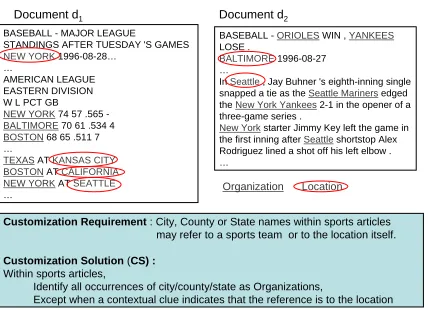
BASEBALL - MAJOR LEAGUE STANDINGS AFTER TUESDAY 'S GAMES
NEW YORK1996-08-28… …
AMERICAN LEAGUE EASTERN DIVISION W L PCT GB NEW YORK74 57 .565 -BALTIMORE70 61 .534 4 BOSTON68 65 .511 7 …
TEXASAT KANSAS CITY
BOSTONAT CALIFORNIA
NEW YORKAT SEATTLE
…
BASEBALL -ORIOLESWIN , YANKEES LOSE .
BALTIMORE1996-08-27 …
In Seattle, Jay Buhner 's eighth-inning single snapped a tie as the Seattle Marinersedged the New York Yankees2-1 in the opener of a three-game series .
New Yorkstarter Jimmy Key left the game in the first inning after Seattleshortstop Alex Rodriguez lined a shot off his left elbow . …
Document d1 Document d2
Customization Requirement : City, County or State names within sports articles
may refer to a sports team or to the location itself.
Customization Solution (CS) :
Within sports articles,
Identify all occurrences of city/county/state as Organizations, Except when a contextual clue indicates that the reference is to the location
[image:2.612.73.287.51.206.2]Organization Location
Figure 1: Example Customization Requirement
al., 2004; Blitzer et al., 2006; Jiang and Zhai, 2006; Arnold et al., 2008; Wu et al., 2009). Implement-ing a similar approach for rule-based NER typically requires a significant amount of manual effort to (a) identify the explicit semantic changes required for the new domain (e.g., differences in entity type def-inition), (b) identify the portions of the (complex) core annotator that should be modified for each dif-ference and (c) implement the required customiza-tion rules without compromising the extraccustomiza-tion qual-ity of the core annotator. Domain customization of rule-based NER has not received much attention in the recent literature with a few exceptions (Petasis et al., 2001; Maynard et al., 2003; Zhu et al., 2005).
1.2 Problem Statement
In this paper, we explore the following natural ques-tion: Are rule-based systems still a viable approach to named-entity recognition? Specifically, (a)Is it possible to build, maintain and customize rule-based NER annotators that match the state-of-the-art re-sults obtained using machine-learning techniques?
and (b) Can this be achieved with a reasonable amount of manual effort?
1.3 Contributions
In this paper, we address the challenges mentioned above by (i) defining a taxonomy of the different types of customizations that a rule developer may perform when adapting to a new domain (Sec. 2), (ii) identifying a set of high-level operations required for building and customizing NER annotators, and (iii) exposing these operations in a domain-specific NER rule language,NERL, developed on top of
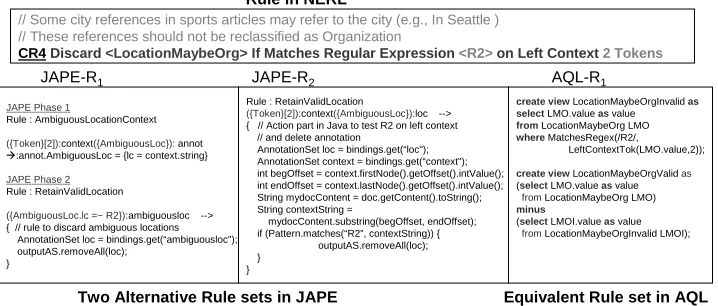
Sys-// Core rules identify Organization and Location candidates
// Begin customization
// Identify articles covering sports event from article title
CR1<SportsArticle>Evaluate Regular Expressions<R1>
// Identify locations in sports articles
CR2Retain<Location>As <LocationMaybeOrg>If ContainedWithin<SportsArticle>
// City/County/State references (e.g., New York) may refer to the sports team in that city
CR3Retain<LocationMaybeOrg>If Matches Dictionaries
<‘cities.dict’,’counties.dict’,’states.dict’>
// Some city references in sports articles may refer to the city (e.g., In Seattle ) // These references should not be reclassified as Organization
CR4Discard<LocationMaybeOrg>If Matches Regular Expression<R2>
on Left Context2 Tokens
// City references to sports teams are added to Organization and removed from Location
CR5Augment<Organization>With<LocationMaybeOrg>
// End customization
// Continuation of core rules
// Remove Locations that overlap with Organizations
Discard<Location>If Overlaps Concepts<Organization>
Figure 2: Example Customization Rules inNERL
temT (Chiticariu et al., 2010), a general-purpose algebraic information extraction system (Sec. 3).
NERL is specifically geared towards building and customizing complex NER annotators and makes it easy to understand a complex annotator that may comprise hundreds of rules. It simplifies the iden-tification of what portions need to be modified for a given customization requirement. It also makes individual customizations easier to implement, as il-lustrated by the following example.
Suppose we have to customize a domain-independent rule-based NER annotator for the CoNLL corpus (Tjong et al., 2003). Consider the two sports-related news articles in Fig. 1 from the corpus, where city names such as ‘New York’ or ‘Seattle’ can refer to either a Location or an Orga-nization (the sports team based in that city). In the domain-independent annotator, city names were al-ways identified as Location, as this subtle require-ment was not considered during rule developrequire-ment. A customization to address this issue is shown in Fig. 1, which can be implemented inNERLwith five rules (Fig. 2). This customization (explained in de-tail in Sec. 3) improved the Fβ=1 score for Organi-zation and Location by approximately 9% and 3%, respectively (Sec. 4).
We used NERL to customize a domain-independent rule-based NER annotator for three different domains –CoNLL03 (Tjong et al., 2003),
Affects Single Affects Multiple Entity Type Entity Types Identify New Instances CS,CDD,CDSD BR
[image:3.612.73.289.54.95.2]Modify Existing instances CEB,CDD CAT A,CG
Table 1: Categorizing NER Customizations
individual domains, which were achieved with machine learning techniques. The fact that we are able to achieve such results across multiple domains answers our earlier question and confirms that we can reap the benefits of rule-based extractors’ explainability without sacrificing accuracy.
However, we found that even using NERL, the amount of manual effort and expertise required in rule-based NER may still be significant. In Sec. 5, we report on the lessons learned and outline several interesting research directions towards simplifying rule development and facilitating the adoption of the rule-based approach towards NER.
2 Domain Customization for NER
We consider NER tasks following the broad defini-tion put forth by (Nadeau and Sekine, 2007), for-mally defined as follows:
Definition 1 Named entity recognition is the task of identifying and classifying mentions of entities with one or more rigid designators, as defined by (Kripke, 1982).
For instance, the identification of proper nouns representing persons, organizations, locations, prod-uct names, proteins, drugs and chemicals are consid-ered as NER tasks.
Based on our experience of customizing NER an-notators for multiple domains, we categorize the customizations involved into two main categories as listed below. This categorization motivates the de-sign ofNERL(Sec. 3).
Data-driven (CDD): The most commonNER
cus-tomization is data-driven, where the cuscus-tomizations mostly involve the addition of new patterns and dictionary entries, driven by observations from the training data in the new domain. An example is the addition of a new rule to identify locations from the beginning of news articles (e.g., “BALTIMORE 1995-08-27” and “MURCIA , Spain 1996-09-10”).
Application-driven: What is considered a valid
named entity and its corresponding type can vary
across application domains. The most common di-mensions on which the definition of a named entity can vary are:
Entity Boundary (CEB): Different application
do-mains may have different definitions of where the same entity starts or ends. For example, a Person
may (CoNLL03) or may not (Enron) include gener-ational markers (e.g. “Jr.” in “Bush Jr.” or “IV” in “Henry IV”).
Ambiguous Type Assignment (CAT A): The exact
type of a given named entity can be ambiguous. Different applications may assign different types for the same named entity. For instance, all in-stances of “White House” may be considered as Lo-cation (CoNLL03), or be assigned asFacility or Or-ganizationbased on their context (ACE05). In fact, even within the same application domain, entities typically considered as of the same type may be as-signed differently. For example, given “New York beat Seattle” and “Ethiopia beat Uganda”, both ‘New York’ and ‘Ethiopia’ are teams referred by their locations. However, (Tjong et al., 2003) considers the former, which corresponds to a city, as an Orga-nization, and the latter, which corresponds to a coun-try, as aLocation.
Domain-Specific Definition (CDSD): Whether a
given term is even considered a named entity may depend on the specific domain. As an example, con-sider the text “Commercialization Meeting - SBeck, BHall, BSuperty, TBusby, SGandhi-Gupta”. Infor-mal names such as ‘SBeck’ and ‘BHall’ may be con-sidered as valid person names (Enron).
Scope(CS): Each type of named entity usually con-tains several subtypes. For the same named en-tity task, different applications may choose to in-clude different sets of subtypes. For instance, roads and buildings are considered part ofLocation
inCoNLL03, while they are not included inACE05.
Granularity(CG): Name entity types are hierarchi-cal. Different applications may define NER tasks at different granularities. For instance, in ACE05,
Organization and Location entity types were split into four entity types (Organization, Location, Geo-Political EntityandFacility).
customization affects single or multiple entities. For instance,CSidentifies new instances for a single en-tity type, as it adds instances of a new subtype for an existing entity type. Note that BR in the table
de-notes the rules used to build the core annotator.
3 Named Entity Rule Language
3.1 Grammar vs. Algebraic NER
Traditionally, rule-based NER systems were based on the popular CPSL cascading grammar specifi-cation (Appelt and Onyshkevych, 1998). CPSL is designed so that rules that adhere to the standard can be executed efficiently with finite state transduc-ers. Accordingly, the standard defines a rigid left-to-right execution model where a region of text can be matched by at most one rule according to a fixed rule priority, and where overlapping annotations are dis-allowed in the output of each grammar phase.
While it simplifies the design of CPSL engines, the rigidity of the rule matching semantics makes it difficult to express operations frequently used in rule-based information extraction. These limitations have been recognized in the literature, and several extensions have been proposed to allow more flex-ible matching semantics, and to allow overlapping annotations (Cunningham et al., 2000; Boguraev, 2003; Drozdzynski et al., 2004). However, even with these extensions, common operations such as filtering annotations (e.g. CR4 in Fig. 2), are
dif-ficult to express in grammars and often require an escape to custom procedural code.
Recently, several declarative algebraic languages have been proposed for rule-based IE systems, no-tably AQL (Chiticariu et al., 2010) and Xlog (Shen et al., 2007). These languages are not constrained by the requirement that all rules map onto finite state transducers, and therefore can express a significantly richer semantics than grammar-based languages. In particular, the AQL rule language as implemented in SystemT (Chiticariu et al., 2010) can express many common operations used in rule-based information extraction without requiring custom code. In addi-tion, the separation of extraction semantics from ex-ecution enables SystemT’s rule optimizer and effi-cient runtime engine. Indeed, as shown in (Chiti-cariu et al., 2010), SystemT can deliver an order of magitude higher annotation throughput compared to
a state-of-the-art CPSL-based IE system.
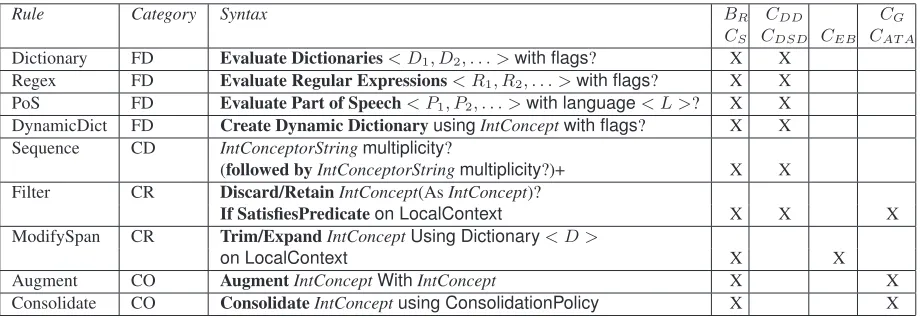
Since AQL is a general purpose information ex-traction rule language, similar to CPSL and JAPE, it exposes an expressive set of capabilities that go beyond what is required for NER tasks. These ad-ditional capabilities can make AQL rules more ver-bose than is necessary for implementing rules in the NER domain. For example, Fig. 3 shows how the same customization rule CR4 from Fig. 2 can be
implemented in JAPE or in AQL. Notice how im-plementing even a single customization may lead to defining complex rules (e.g. JAPE-R1, AQL-R1)
and sometimes even using custom code (e.g.
JAPE-R2). As illustrated by this example, the rules in AQL
and JAPE tend to be complex since some operations — e.g., filtering the outputs of one rule based on the outputs of another rule — that are common in NER rule sets require multiple rules in AQL or multiple grammar phases in JAPE.
To make NER rules easier to develop and to understand, we designed and implemented Named Entity Rule Language (NERL) on top of SystemT.
NERLis a declarative rule language designed specif-ically for named entity recognition. The design of
NERL draws on our experience with building and customizing multiple complex NER annotators. In particular, we have identified the operations required in practice for such tasks, and expose these opera-tions as built-in constructs inNERL. In doing so, we ensure that frequently performed operations can be expressed succinctly, so as not to complicate the rule set unnecessarily. As a result,NERLrules for named entity recognition tasks are significantly more com-pact and easy to understand than the equivalent AQL rules. At the same time,NERL rules can easily be compiled to AQL, allowing our NER rule develop-ment framework to take advantage of the capabilities of the SystemT rule optimizer and efficient runtime execution engine.
3.2 NERL
For the rest of this section, we focus on describ-ing the types of rules supported inNERL. In Sec. 4, we shall demonstrate empirically thatNERLcan be successfully employed in building and customizing complex NER annotators.
ANERLrule has the following form:
// Some city references in sports articles may refer to the city (e.g., In Seattle ) // These references should not be reclassified as Organization
CR4Discard<LocationMaybeOrg>If Matches Regular Expression<R2>on Left Context2 Tokens Rule in NERL
JAPE Phase 1
Rule : AmbiguousLocationContext
({Token}[2]):context({AmbiguousLoc}): annot :annot.AmbiguousLoc = {lc = context.string}
JAPE Phase 2 Rule : RetainValidLocation
({AmbiguousLoc.lc =~ R2}):ambiguousloc --> { // rule to discard ambiguous locations
AnnotationSet loc = bindings.get(“ambiguousloc"); outputAS.removeAll(loc);
}
Rule : RetainValidLocation
({Token}[2]):context({AmbiguousLoc}):loc --> { // Action part in Java to test R2 on left context
// and delete annotation
AnnotationSet loc = bindings.get(“loc"); AnnotationSet context = bindings.get(“context"); int begOffset = context.firstNode().getOffset().intValue(); int endOffset = context.lastNode().getOffset().intValue(); String mydocContent = doc.getContent().toString(); String contextString =
mydocContent.substring(begOffset, endOffset); if (Pattern.matches(“R2”, contextString)) {
outputAS.removeAll(loc); }
}
create viewLocationMaybeOrgInvalidas selectLMO.valueasvalue
fromLocationMaybeOrg LMO
whereMatchesRegex(/R2/, LeftContextTok(LMO.value,2));
create viewLocationMaybeOrgValidas
(selectLMO.valueasvalue
fromLocationMaybeOrg LMO)
minus
(selectLMOI.valueasvalue
fromLocationMaybeOrgInvalid LMOI);
Two Alternative Rule sets in JAPE Equivalent Rule set in AQL
[image:5.612.127.486.52.205.2]JAPE-R1 JAPE-R2 AQL-R1
Figure 3: Single Customization Rule expressed inNERL, JAPE and AQL
Intuitively, aNERLrule creates an intermediate con-cept or named entity (IntConcept for short) by ap-plying a NERL rule on the input text and zero or more previously defined intermediate concepts.
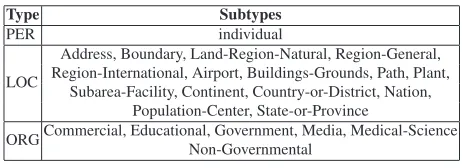
NERL Rule TypesThe types of rules supported in
NERL are summarized in Tab. 2. In what follows, we illustrate these types by means of examples.
Feature definition (FD): FD rules identify basic
features from text (e.g., FirstName, LastName and
CapsWordfeatures for identifying person names).
Candidate definition (CD): CD rules identify
com-plete occurrences of the target entity. For instance, the Sequence rule “LastName followed by ‘,’
fol-lowed by FirstName” identifies person annotations
as a sequence of three tokens, where the first and third tokens occur in dictionaries containing last and first names.
Candidate Refinement (CR): CR rules are used to
refine candidates generated for different annotation types. E.g., theFilterruleCR3in Fig. 2 retains Loca-tionMaybeOrgannotations that appear in one of sev-eral dictionaries.
Consolidation (CO): CO rules are used to resolve
overlapping candidates generated by multiple CD rules. For instance, consider the text “Please see the following request from Dr. Kenneth Lim of the BAAQMD.”. A CD rule may identify ‘Dr. Kenneth Lim’ as a person, while another CD rule may identify ‘Kenneth Lim’ as a candidate person. A consolidation rule is then used to merge these two annotations to produce a single annotation for ‘Dr. Kenneth Lim’.
NERL Examples Within these categories, three
types of rules deserve special attention, as they
cor-respond to frequently used operations and are specif-ically designed to ensure compactness of the rule-set. In contrast, as discussed earlier (Fig. 3), each of these operations require several rules and possibly custom code in existing rule-based IE systems.
DynamicDict: TheDynamicDictrule is used to create customized gazetteers on the fly. The following ex-ample shows the need for such a rule: While ‘ Clin-ton’ does not always refer to a person’s last name (Clinton is the name of several cities in USA), in documents containing a full person name with ‘ Clin-ton’ as a last name (e.g., ‘Hillary Clinton’) it is rea-sonable to annotate all references to the (possibly) ambiguous word ‘Clinton’ as a person. This goal can be accomplished using the rule<Create Dynamic Dictionary using Person with length 1 to 2 tokens>, which creates a gazetteer on a per-document basis.
Filter: TheFilter rule is used to discard/retain cer-tain intermediate annotations based on predicates on the annotation text and its local context. Example filtering predicates include
• DiscardCIf Matches Regular ExpressionR
• RetainCIf Contains DictionaryDon Local ContextLC • DiscardCIf Overlaps ConceptsC1, C2, . . .
ModifySpan: TheModifySpanrule is used to expand
or trim the span of a candidate annotation. For instance, an Entity Boundary customization to in-clude generational markers as part of aPerson anno-tation can be implemented using a ModifySpan rule
<Expand Person Using Dictionary ‘generation.dict’ on RightContext 2 Tokens>.
Using NERL Tab. 2 shows how different types of
Rule Category Syntax BR CDD CG
CS CDSD CEB CAT A Dictionary FD Evaluate Dictionaries< D1, D2, . . . >with flags? X X
Regex FD Evaluate Regular Expressions< R1, R2, . . . >with flags? X X
PoS FD Evaluate Part of Speech< P1, P2, . . . >with language< L >? X X
DynamicDict FD Create Dynamic DictionaryusingIntConceptwith flags? X X Sequence CD IntConceptorStringmultiplicity?
(followed byIntConceptorStringmultiplicity?)+ X X Filter CR Discard/RetainIntConcept(AsIntConcept)?
If SatisfiesPredicateon LocalContext X X X
ModifySpan CR Trim/ExpandIntConceptUsing Dictionary< D >
on LocalContext X X
Augment CO AugmentIntConceptWithIntConcept X X
[image:6.612.77.537.54.213.2]Consolidate CO ConsolidateIntConceptusing ConsolidationPolicy X X
Table 2: Description of rules supported inNERL
or more entity (sub)types from scratch, all types of rules are used. CDD and CDSD identify
addi-tional instances for an existing type and therefore mainly rely on FD and CD rules. On the other hand, the customizations that modify existing instances (CEB,CAT A,CG) require CR and CO rules.
Revisiting the example in Fig. 2, CR rules were used to implement a fairly sophisticated customiza-tion in a compact fashion, as follows. Rule CR1
first identifies sports articles using a regular expres-sion based on the article title. Rule CR2 marks
Locations within these articles asLocationMaybeOrg
and Rule CR3 only retains those occurrences that match a city, county or state name (e.g., ‘Seattle’). RuleCR4identifies occurrences that have a
contex-tual clue confirming that the mention was to a lo-cation (e.g., ‘In’ or ‘At’). These occurrences are al-ready classified correctly asLocationand do not need to be changed. Finally,CR5adds the remaining am-biguous mentions toOrganization, which would be deleted fromLocationby a subsequent core rule.
4 Development and Customization of NER
extractors withNERL
Using NERL, we have developed CoreNER, a domain-independent generic library for multiple NER extraction tasks commonly encountered in practice, including Person, Organization, Location,
EmailAddress,PhoneNumber,URL, andDateTime, but we shall focus the discussion on the first three tasks (see Tab. 3 for entity definitions), since they are the most challenging. In this section, we first overview the process of developingCoreNER(Sec. 4.1). We
then describe how we have customized CoreNER
for three different domains (Sec. 4.2), and present a quality comparison with best published results ob-tained with state-of-the-art machine learning tech-niques (Sec. 4.3). The tasks we consider are not re-stricted to documents in a particular language, but due to limited availability of non-English corpora and extractors for comparison, our evaluation uses English-language text. In Sec. 5 we shall elaborate on the difficulties encountered while building and customizingCoreNERusingNERLand the lessons we learned in the process.
4.1 DevelopingCoreNER
We have built our domain independentCoreNER li-brary using a variety of formal and informal text (e.g. web pages, emails, blogs, etc.), and informa-tion from public data sources such as the US Census Bureau (Census, 2007) and Wikipedia.
The development process proceeded as follows. We first collected dictionaries for each entity type from different resources, followed by man-ual cleanup when needed to categorize entries col-lected into “strong” and “weak” dictionaries. For instance, we used US Census data to create several name dictionaries, placing ambiguous entries such as ‘White’ and ‘Price’ in a dictionary of
ambigu-ous last names, while unambiguous entries such as
‘Johnson’ and ‘Williams’ went to the dictionary for
strict last names. Second, we developed FD and
CD rules to identify candidate entities based on the way named entities generally occur in text. E.g.,
Type Subtypes
PER individual
LOC
Address, Boundary, Land-Region-Natural, Region-General, Region-International, Airport, Buildings-Grounds, Path, Plant,
Subarea-Facility, Continent, Country-or-District, Nation, Population-Center, State-or-Province
[image:7.612.70.301.54.138.2]ORGCommercial, Educational, Government, Media, Medical-Science Non-Governmental
Table 3: NER Task Types and Subtypes
LastName>forPerson, and<CapsWord{1,3} OrgSuf-fix>and<CapsWord{1,2}Industry>forOrganization. We then added CR and CO rules to account for contextual clues and overlapping annotations (e.g., DeletePersonannotations appearing within an Orga-nizationannotation).
The finalCoreNERlibrary consists of104FD (in-volving68 dictionaries, 33 regexes and3 dynamic dictionaries),74CD,123CR and102CO rules.
4.2 CustomizingCoreNER
In this section we describe the process of customiz-ing our domain-independent CoreNER library for several different datasets. We start by discussing our choice of datasets to use for customization.
Datasets For a rigorous evaluation of CoreNER’s
customizability, we require multiple datasets satis-fying the following criteria: First, the datasets must cover diverse sources and styles of text. Second, the set of the most challenging NER tasksPerson,
OrganizationandLocation (see Tab. 3) considered
inCoreNERshould be applicable to them. Finally, they should be publicly available and preferably have associated published results, against which we can compare our experimental results. Towards this end, we chose the following public datasets.
• CoNLL03 (Tjong et al., 2003): a collection of Reuters news stories. Consists of formal text.
• Enron (Minkov et al., 2005): a collection of emails with meeting information from the Enron dataset. Contains predominantly informal text.
• ACE05(NIST, 2005)1 a collection of broadcast news, broadcast conversations and newswire re-ports. Consists of both formal and informal text.
Customization ProcessThe goal of customization
1The evaluation test set is not publicly available. Thus,
fol-lowing the example of (Florian et al., 2006), the publicly avail-able set is split into a 80%/20% data split, with the last 20% of the data in chronological order selected as test data.
is to refine the original CoreNER (hence referred to as CoreNERorig) in order to improve its
extrac-tion quality on the training set (in terms of Fβ=1)
for each dataset individually. In addition, a devel-opment set is available forCoNLL03(referred to as
CoNLL03dev), therefore we seek to improve Fβ=1on CoNLL03devas well.
The customization process for each dataset pro-ceeded as follows. First, we studied the entity defini-tions and identified their differences when compared with the definitions used forCoreNERorig(Tab. 3).
We then added rules to account for the differences. For example, the definition of Organizationin the
CoNLL03 dataset contained a sports organization subtype, which was not considered when develop-ingCoreNER. Therefore, we have used public data sources (e.g., Wikipedia) to collect and curate dic-tionaries of major sports associations and sport clubs from around the world. The new dictionaries, along with regular expressions identifying sports teams in sports articles were used for defining FD and CD rules such asCR1(Fig. 2). Finally, CR and CO rules
were added to filter invalid candidates and augment
theOrganization type with the new sports subtype
(similar in spirit to rulesCR4 andCR5in Fig. 2).
In addition to the train and development sets, the customization process for CoNLL03 also involved unlabeled data from the corpus as follows. 1) Since data-driven rules (CDD) are often created based on a
few instances from the training data, testing them on the unlabeled data helped fine tune the rules for pre-cision. 2)CoNLL03 is largely dominated by sports news, but only a subset of all sports were represented in the train dataset. Using the unlabeled data, we were able to addCDDrules for five additional types
of sports, resulting in0.31%improvement in Fβ=1 score on CoNLL03dev. 3) Unlabeled data was also
useful in identifying domain-specific gazetteers by using simple extraction rules followed by a man-ual cleanup phase. For instance, for CoNLL03 we collected five gazetteers of organization and person names from the unlabeled data, resulting in0.45%
improvement in recall forCoNLL03dev.
FD CD CR CO
CoreNERorig 104 74 123 102
CoreNERconll 179 56 284 71
CoreNERenron 13 10 9 1
[image:8.612.106.268.55.107.2]CoreNERace 83 35 117 26
Table 4: Rules added during customization
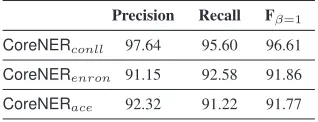
Precision Recall Fβ=1
CoreNERconll 97.64 95.60 96.61
CoreNERenron 91.15 92.58 91.86
[image:8.612.321.531.60.228.2]CoreNERace 92.32 91.22 91.77
Table 5: Quality of customization on train datasets (%)
of the domain independent NER annotator, and dur-ing customizations for different domains. A total of 8 person weeks were spent on customizations, and we believe this effort is quite reasonable by rule-based extraction standards. For example, (Maynard et al., 2003) reports that customizing the ANNIE domain independent NER annotator developed us-ing the JAPE grammar-based rule language for the
ACE05 dataset required 6 weeks (and subsequent tuning over the next 6 months), resulting in im-proving the quality to 82% for this dataset. As we shall discuss shortly,with similar manual effort, we were able to achieve results outperforming state-of-art published results on three different datasets,
in-cluding ACE05. However, one may rightfully
ar-gue that the process is still too lengthy impeding the widespread deployment of rule-based NER extrac-tion. We elaborate on the effort involved and the lessons learned in the process in Sec. 5.
4.3 Evaluation of Customization
We now present an experimental evaluation of the customizability of CoreNER. The main goals are to investigate: (i) the feasibility of CoreNER cus-tomization for different application domains; (ii) the effectiveness of such customization compared to state-of-the-art results; (iii) the impact of different types of customization (Tab. 1); and (iv) how often different categories ofNERLrules (Tab. 2) are used during customization.
We measured the effectiveness of customization using the improvement in extraction quality of the customizedCoreNERoverCoreNERorig. As shown
in Tab. 6, customization significantly improved
Precision Recall Fβ=1
CoNLL03dev
CoreNERorig 83.81 61.77 71.12
CoreNERconll 96.49 93.76 95.11
Improvement 12.68 31.99 13.99
CoNLL03test
CoreNERorig 77.21 54.87 64.15
CoreNERconll 93.89 89.75 91.77
Improvement 15.68 34.88 27.62
Enron
CoreNERorig 85.06 69.55 76.53
CoreNERenron 88.41 82.39 85.29
Improvement 3.35 12.84 8.76
ACE2005
CoreNERorig 57.23 57.41 57.32
CoreNERace 90.11 87.82 88.95
Improvement 32.88 30.41 31.63
Table 6: Overall Improvement due to Customization (%)
Precision Recall Fβ=1
LOC CoreNERconll 97.17 95.37 96.26
CoNLL03dev
Florian 96.59 95.65 96.12
ORG CoreNERconll 93.70 88.67 91.11
Florian 90.85 89.63 90.24
PER CoreNERconll 97.79 95.87 96.82
Florian 96.08 97.12 96.60
LOC CoreNERconll 93.11 91.61 92.35
CoNLL03test
Florian 90.59 91.73 91.15
ORG CoreNERFlorianconll 92.2585.93 85.3183.44 88.6584.67
PER CoreNERconll 96.32 92.39 94.32
Florian 92.49 95.24 93.85
Enron PER CoreNERenron 87.27 81.82 84.46
Minkov 81.1 74.9 77.9
Table 7: Comparison with state-of-the-art results(%)
Fβ=1score forCoreNERorigacross all datasets.2
We note that the extraction quality of
CoreNERorig was low on CoNLL03 and ACE05
mainly due to differences in entity type definitions. In particular, sports organizations, which occurred frequently in the CoNLL03 collection, were not considered during the development ofCoreNERorig,
while in ACE05, ORG and LOC entity types were split into four entity types (Organization, Location,
Geo-Political Entity and Facility). Customizations such as CS and CG address the above changes
in named-entity type definition and substantially improve the extraction quality ofCoreNERorig.
Next, we compare the extraction quality of the
2CoNLL03
[image:8.612.105.264.133.194.2] [image:8.612.316.536.258.432.2]customizedCoreNERforCoNLL03andEnron3with the corresponding best published results by (Florian et al., 2003) and (Minkov et al., 2005). Tab. 7 shows that our customizedCoreNERoutperforms the cor-responding state-of-the-art numbers for all the NER
taskson bothCoNLL03andEnron.4 These results
demonstrate that high-quality annotators can be built by customizingCoreNERorigusing NERL, with the
final extraction quality matching that of state-of-the-art machine learning-based extractors.
It is worthwhile noting that the best pub-lished results for CoNLL03 (Florian et al., 2003) were obtained by using four different classifiers (Robust Risk Minimization, Maximum Entropy, Transformation-based learning, and Hidden Markov Model) and trying six different classifier combi-nation methods. Compared to the best published result obtained by combining the four classifiers, the individual classifiers performed between 2.5-7.6% worse for Location, 5.6-15.2% for Organiza-tion and 3.9-14.0% for Person5. Taking this into account, the extraction quality advantage of cus-tomized CoreNER is significant when compared with the individual state-of-the-art classifiers.
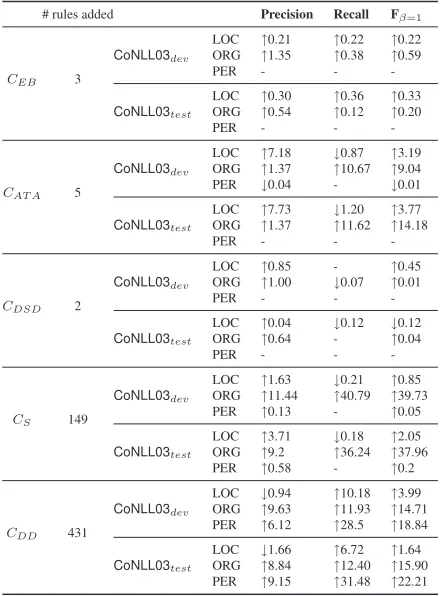
Impact of Customizations by Type. While
cus-tomizing CoreNERfor the three datasets, all types of changes described in Sec. 2 were performed. We measured the impact of each type of customization by comparing the extraction quality ofCoreNERorig
withCoreNERorigenhanced with all the
customiza-tions of that type. From the results for CoNLL03
(Tab. 8), we make the following observations.
• Customizations that identify additional subtypes of entities (CS) or modify existing instances for multiple types (CAT A) have significant impact.
This effect can be especially high when the miss-ing subtype appears very often in the new do-main (E.g., over 50% of the organizations in
CoNLL03are sports teams).
• Data-driven customizations (CDD) rely on the
aggregated impact of many rules. While individ-ual rules may have considerable impact on their
3We cannot meaningfully compare our results against
previ-ously published results forACE05, which is originally used for mention detection whileCoreNERconsiders only NER tasks.
4ForEnronthe comparison is reported only forPerson, as
labeled data is available only for that type.
5Extended version obtained via private communication.
# rules added Precision Recall Fβ=1
CEB 3
CoNLL03dev
LOC ↑0.21 ↑0.22 ↑0.22
ORG ↑1.35 ↑0.38 ↑0.59
PER - -
-CoNLL03test
LOC ↑0.30 ↑0.36 ↑0.33
ORG ↑0.54 ↑0.12 ↑0.20
PER - -
-CAT A 5
CoNLL03dev
LOC ↑7.18 ↓0.87 ↑3.19
ORG ↑1.37 ↑10.67 ↑9.04
PER ↓0.04 - ↓0.01
CoNLL03test
LOC ↑7.73 ↓1.20 ↑3.77
ORG ↑1.37 ↑11.62 ↑14.18
PER - -
-CDSD 2
CoNLL03dev
LOC ↑0.85 - ↑0.45
ORG ↑1.00 ↓0.07 ↑0.01
PER - -
-CoNLL03test
LOC ↑0.04 ↓0.12 ↓0.12
ORG ↑0.64 - ↑0.04
PER - -
-CS 149
CoNLL03dev
LOC ↑1.63 ↓0.21 ↑0.85
ORG ↑11.44 ↑40.79 ↑39.73
PER ↑0.13 - ↑0.05
CoNLL03test
LOC ↑3.71 ↓0.18 ↑2.05
ORG ↑9.2 ↑36.24 ↑37.96
PER ↑0.58 - ↑0.2
CDD 431
CoNLL03dev
LOC ↓0.94 ↑10.18 ↑3.99
ORG ↑9.63 ↑11.93 ↑14.71
PER ↑6.12 ↑28.5 ↑18.84
CoNLL03test
LOC ↓1.66 ↑6.72 ↑1.64
ORG ↑8.84 ↑12.40 ↑15.90
[image:9.612.316.536.56.354.2]PER ↑9.15 ↑31.48 ↑22.21
Table 8: Impact by customization type onCoNLL03(%)
own (e.g., identifying all names that appear as part of a player list increases the recall of PER by over 6% on bothCoNLL03devandCoNLL03test),
the overall impact relies on the accumulative ef-fect of many small improvements.
• Certain customizations (CEB and CDSD)
pro-vide smaller quality improvements, both per rule and in aggregate.
5 Lessons Learned
Our experimental evaluation shows that rule-based annotators can achieve quality comparable to that of state-of-the-art machine learning techniques. In this section we discuss three important lessons learned regarding the human effort involved in developing such rule-based extractors.
Usefulness ofNERLWe foundNERLvery helpful
listed in Tab. 2. (We have shown empirically that our choice of NERL rules is sufficient to achieve high accuracy for NER tasks.) Therefore,NERL simpli-fies development and maintenance of complex NER extractors, since one does not need to worry about multiple AQL statements or JAPE grammar phases for implementing a single conceptual operation such as filtering (see Fig. 3).
Is NERL Sufficient? Even using NERL, building
and customizing NER rules remains a labor inten-sive process. Consider the example of designing the filter ruleCR4 from Fig. 3. First, one must
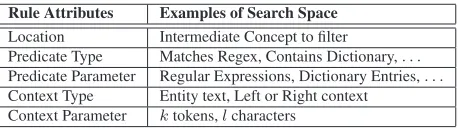
exam-ine multiple false positive Locationentities to even decide that a filter rule is appropriate. Second, one must understand how those false positives were pro-duced, and decide accordingly on the particular con-cept to be used as filter (LocationMaybeOrg in this case). Finally, one needs to decide how to build the filter. Tab. 9 lists all the attributes that need to be specified for a Filter rule, along with examples of the search space for each rule attribute.
Rule Attributes Examples of Search Space Location Intermediate Concept to filter
Predicate Type Matches Regex, Contains Dictionary,. . .
Predicate Parameter Regular Expressions, Dictionary Entries,. . .
[image:10.612.74.303.351.416.2]Context Type Entity text, Left or Right context Context Parameter ktokens,lcharacters
Table 9: Search space explored while adding aFilterrule
This search space problem is not unique to filter rules. In fact, most rules in Tab. 2 have two or more rule attributes. Therefore, designing an individual
NERLrule remains a time-consuming “trial and er-ror” process, in which multiple “promising” combi-nations are implemented and evaluated individually before deciding on a satisfactory final rule.
Tooling for NERL The fact that NERL is a
high-level language exposing a restricted set of operators can be exploited to reduce the human effort involved in building NER annotators by enabling the follow-ing tools:
Annotation Provenance Tools tracking
prove-nance (Cheney et al., 2009) for NERL rules can help in explaining exactly which sequence of rules is responsible for producing a given false positive, thereby enabling one to quickly identify “misbe-haved” rules. For instance, one can quickly narrow down the choices for the location where the filter
rule CR4 (Fig. 2) should be applied based on the
provenance of the false positives. Similarly, tools for explaining false positives in the spirit of (Huang et al., 2008), are also conceivable.
Automatic Parameter Learning The most
time-consuming part in building a rule often is to decide the value of its parameters, especially for FD and CR rules. For instance, while defining a CR rule, one has to choose values for the Predicate parame-ter and the Context parameparame-ter (see Tab. 9). Some parameter values can be learned – for example, dic-tionaries (Riloff, 1993) and regular expressions (Li et al., 2008).
Automatic Rule Refinement Tools automatically
suggesting entire customization rules to a complex
NERLprogram in the spirit of (Liu et al., 2010) can further reduce human effort in building NER anno-tators. With the help of such tools, one only needs to consider good candidate NERL rules suggested by the system without having to go through the conventional manual “trial and error” process.
6 Conclusion
In this paper, we describedNERL, a high-level rule language for building and customizing NER tors. We demonstrated that a complex NER annota-tor built usingNERLcan be effectively customized for different domains, achieving extraction quality superior to the state-of-the-art numbers. However, our experience also indicates that the process of de-signing the rules themselves is still manual and time-consuming. Finally, we discuss how NERL opens up several interesting research directions towards the development of sophisticated tooling for automating some of the rule development tasks.
References
D. E. Appelt and B. Onyshkevych. 1998. The common pattern specification language. InTIPSTER workshop. A. Arnold, R. Nallapati, and W. W. Cohen. 2008. Exploiting feature hierarchy for transfer learning in named entity recognition. InACL.
D. M. Bikel, R. L. Schwartz, and R. M. Weischedel. 1999. An algorithm that learns what’s in a name. In
Machine Learning, volume 34, pages 211–231. J. Blitzer, R. Mcdonald, and F. Pereira. 2006. Domain
adaptation with structural correspondence learning. In
B. Boguraev. 2003. Annotation-based finite state pro-cessing in a large-scale nlp arhitecture. InRANLP. Census. 2007. U.S. Census Bureau.
http://www.census.gov.
J. Cheney, L. Chiticariu, and W. Tan. 2009. Provenance in databases: Why, how, and where. Foundations and Trends in Databases, 1(4):379–474.
L. Chiticariu, R. Krishnamurthy, Y. Li, S. Raghavan, F. Reiss, and S. Vaithyanathan. 2010. SystemT: An algebraic approach to declarative information extrac-tion. InACL.
H. Cunningham, D. Maynard, and V. Tablan. 2000. JAPE: a Java Annotation Patterns Engine (Second Edi-tion). Research Memorandum CS–00–10, Department of Computer Science, University of Sheffield.
W. Drozdzynski, H. Krieger, J. Piskorski, U. Sch¨afer, and F. Xu. 2004. Shallow processing with unification and typed feature structures — foundations and applica-tions. K¨unstliche Intelligenz, 1:17–23.
O. Etzioni, M. Cafarella, D. Downey, A. Popescu, T. Shaked, S. Soderland, D. Weld, and A. Yates. 2005. Unsupervised named-entity extraction from the web: an experimental study.Artif. Intell., 165(1):91–134. J. R. Finkel and C. D. Manning. 2009. Nested named
entity recognition. InEMNLP.
R. Florian, A. Ittycheriah, H. Jing, and T. Zhang. 2003. Named entity recognition through classifier combina-tion. InCoNLL.
R. Florian, H. Hassan, A. Ittycheriah, H. Jing, N. Kamb-hatla, X. Luo, N. Nicolov, and S. Roukos. 2004. A statistical model for multilingual entity detection and tracking. InNAACL-HLT.
R. Florian, H. Jing, N. Kambhatla, and I. Zitouni. 2006. Factorizing complex models: A case study in mention detection. InACL.
D. Gruhl, M. Nagarajan, J. Pieper, C. Robson, and A. Sheth. 2009. Context and domain knowledge en-hanced entity spotting in informal text. InISWC. J. Huang, G. Zweig, and M. Padmanabhan. 2001.
Infor-mation extraction from voicemail. InACL.
Jiansheng Huang, Ting Chen, AnHai Doan, and Jeffrey F. Naughton. 2008. On the Provenance of Non-Answers to Queries over Extracted Data. PVLDB, 1(1):736– 747.
M. Jansche and S. Abney. 2002. Information extraction from voicemail transcripts. InEMNLP.
J. Jiang and C. Zhai. 2006. Exploiting domain structure for named entity recognition. InNAACL-HLT. Saul Kripke. 1982.Naming and Necessity. Harvard
Uni-versity Press.
G. R. Krupka and K. Hausman. 2001. IsoQuest Inc.: De-scription of the NetOwlTM extractor system as used for MUC-7. InMUC-7.
Y. Li, R. Krishnamurthy, S. Raghavan, S. Vaithyanathan, and H. V. Jagadish. 2008. Regular expression learning for information extraction. InEMNLP.
B. Liu, L. Chiticariu, V. Chu, H. V. Jagadish, and F. Reiss. 2010. Automatic Rule Refinement for Information Extraction. PVLDB, 3.
D. Maynard, K. Bontcheva, and H. Cunningham. 2003. Towards a semantic extraction of named entities. In
RANLP.
A. McCallum and W. Li. 2003. Early results for named entity recognition with conditional random fields, fea-ture induction and web-enhanced lexicons. InCoNLL. E. Minkov, R. C. Wang, and W. W. Cohen. 2005. Ex-tracting personal names from emails: Applying named entity recognition to informal text. InHLT/EMNLP. D. Nadeau and S. Sekine. 2007. A survey of named
entity recognition and classification. Linguisticae In-vestigationes, 30(1):3–26.
NIST. 2005. The ace evaluation plan.
F. J. Och O. Bender and H. Ney. 2003. Maximum en-tropy models for named entity recognition. InCoNLL. G. Petasis, F. Vichot, F. Wolinski, G. Paliouras, V. Karkaletsis, and C. Spyropoulos. 2001. Using machine learning to maintain rule-based named-entity recognition and classification systems. InACL. T. Poibeau and L. Kosseim. 2001. Proper name
ex-traction from non-journalistic texts. InComputational Linguistics in the Netherlands, pages 144–157. E. Riloff. 1993. Automatically constructing a dictionary
for information extraction tasks. InKDD.
S. Sekine and C. Nobata. 2004. Definition, dictionaries and tagger for extended named entity hierarchy. In
Conference on Language Resources and Evaluation. W. Shen, A. Doan, J. F. Naughton, and R. Ramakrishnan.
2007. Declarative information extraction using data-log with embedded extraction predicates. InVLDB. S. Singh, D. Hillard, and C. Leggeteer. 2010.
Minimally-supervised extraction of entities from text advertise-ments. InNAACL-HLT.
P. Siniakov. 2010. GROPUS - an adaptive rule-based al-gorithm for information extraction. Ph.D. thesis, Freie Universitat Berlin.
R. Srihari, C. Niu, and W. Li. 2001. A hybrid approach for named entity and sub-type tagging. InANLP. E. F. Tjong, K. Sang, and F. De Meulder. 2003.
Intro-duction to the CoNLL-2003 shared task: Language-independent named entity recognition. InCoNLL. D. Wu, W. S. Lee, N. Ye, and H. L. Chieu. 2009. Domain
adaptive bootstrapping for named entity recognition. InEMNLP.