Automatic Comma Insertion for Japanese Text Generation
Masaki Murata
Graduate School of
Information Science,
Nagoya University, Japan
[email protected]Tomohiro Ohno
Graduate School of
International Development,
Nagoya University, Japan
[email protected]Shigeki Matsubara
Graduate School of
Information Science,
Nagoya University, Japan
Abstract
This paper proposes a method for automat-ically inserting commas into Japanese texts. In Japanese sentences, commas play an im-portant role in explicitly separating the con-stituents, such as words and phrases, of a sen-tence. The method can be used as an ele-mental technology for natural language gen-eration such as speech recognition and ma-chine translation, or in writing-support tools for non-native speakers. We categorized the usages of commas and investigated the ap-pearance tendency of each category. In this method, the positions where commas should be inserted are decided based on a machine learning approach. We conducted a comma insertion experiment using a text corpus and confirmed the effectiveness of our method.
1 Introduction
In Japanese sentences, commas are inserted to mark word boundaries that might be otherwise unclear be-cause Japanese is a non-segmented language. They are also inserted at sharp semantic boundaries to im-prove the readability of a sentence. While there is a tendency about the positions where commas should be inserted in a Japanese sentence, there is no clear standard for these positions. Therefore, it is hard for non-natives of Japanese such as foreign students to insert commas properly, and the method for au-tomatic comma insertion is required to support sen-tence generation by such people. In addition, this method is expected to be useful for improving read-ability of texts generated by automatic speech recog-nition or machine translation.
This paper proposes a method for automatically inserting commas into Japanese texts. There are
several usages of commas, and the positions to in-sert commas depend on these usages. Therefore, we grouped the usages of commas into nine cate-gories, and investigated the appearance tendency for each category to find the effective features of ma-chine learning by using Japanese newspaper arti-cles. Based on the analysis of comma positions, our method decides whether or not to insert a comma at eachbunsetsu1boundary in an input sentence by machine learning.
We conducted an experiment on comma insertion using the Kyoto Text Corpus (Kurohashi and Nagao, 1998), and obtained higher recall and precision than those of the baseline, leading us to confirm the ef-fectiveness of our method.
This paper is organized as follows: The next sec-tion presents related works. Secsec-tion 3 gives prelim-inary analyses. Section 4 explains how our comma insertion method works. An experiment and discus-sions are presented in Sections 5 and 6, respectively.
2 Related Works
There have been many investigations on comma in-sertion into output texts of speech recognition sys-tems to improve the readability (Christensen et al., 2001; Kim and Woodland, 2001; Liu et al., 2006; Shimizu et al., 2008). Their methods insert commas using pause information of speakers, based on the idea that a point at which a speaker takes a breath partly corresponds to a point where a comma is in-serted. However, since pause information cannot be obtained from texts, we cannot use this approach be-cause our targets are written texts.
In addition, there have been some investigations
1Bunsetsuis a linguistic unit in Japanese that roughly
corre-sponds to a basic phrase in English. A bunsetsu consists of one independent word and zero or more ancillary words.
on comma insertion into non-Japanese written texts (White and Rajkumar, 2008; Guo et al., 2010). In Japanese, there are several usages of commas, and some usages are specific to Japanese due to its lin-guistic nature. Therefore, just adopting the above mentioned methods, which have been developed to process non-Japanese texts, is not sufficient to enable high-quality comma insertion into Japanese sentences. Development of a method based on the detailed analysis of Japanese commas is required.
Furthermore, there have been some investiga-tions on comma insertion into Japanese written texts (Hayashi, 1992; Suzuki et al., 1995). These investi-gations have adopted rule-based methods. However, the number of their rules is not necessarily sufficient, and no quantitative evaluation has been performed.
3 Analyses on Comma Usages
There have been several discussions on commas, including the draft of “Kutou-hou (punctuation)” made by Archives Division, Minister’s Secretariat, Japanese Ministry of Education, Science and Cul-ture in 1906. There are several usages of commas, and depending on the usage, the types of positions where commas are inserted are different. First, we examined some previous publications on commas (Honda, 1982; Inukai, 2002; Shogakukan’s editior-ial department, 2007). Based on the results of the ex-amination, we classified the usages of commas into nine categories shown in Table 1. Here, commas in Japanese sentences and commas in English tences have some common roles. In Japanese sen-tences, some commas have the same roles as com-mas in English sentences, but some comcom-mas have roles specific to Japanese due to its linguistic nature such as “Japanese is a non-segmented language” or “Japanese haskanjicharacters andkatakana charac-ters.”
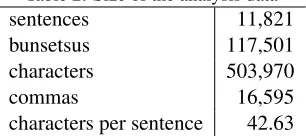
In our study, positions where a comma should be inserted are detected by using machine learning. We investigated the Kyoto Text Corpus version 4.0 (Kurohashi and Nagao, 1998) to find the effective features. The Kyoto Text Corpus is a collection of Japanese articles of Mainichi newspaper. We used the articles on January 1st and from January 3rd to 11th in 1995 as the analysis data. Table 2 shows the size of the data. The data had been manually
Table 1: Categorization of usages of commas
# usage of comma
1 commas between clauses
2 commas indicating clear dependency relations 3 commas for avoiding reading mistakes and
reading difficulty
4 commas indicating the subject
5 commas inserted after a conjunction or adverb at the beginning of a sentence 6 commas inserted between parallel words or
phrases
7 commas inserted after an adverbial phrase to indicate time
[image:2.612.334.487.318.386.2]8 commas emphasizing the adjacent word 9 other
Table 2: Size of the analysis data
sentences 11,821
bunsetsus 117,501
characters 503,970
commas 16,595
characters per sentence 42.63
annotated with information on morphological anal-ysis, bunsetsu segmentation and dependency2 anal-ysis. Clause boundaries were detected by the clause boundary detection program CBAP (Kashioka and Maruyama, 2004).
Out of all the inserted commas, only 1.43% were inserted at positions which were not bunsetsu boundaries. Therefore, we analyzed only commas inserted at bunsetsu boundaries. Of 105,680 bun-setsu boundaries, commas were inserted at 16,357 bunsetsu boundaries, that is, the rate of comma insertion was 15.48%. In the following sections, we focus on morphemes, clause boundaries, depen-dency relation and the number of characters between commas, and investigate their relations with com-mas.
3.1 Commas between Clauses
If a sentence consists of several clauses, inserting a comma between clauses makes clear the sentence
2A dependency in a Japanese sentence is a modification
Table 3: Rates of comma insertion according to the clause boundary type
type of clause boundary ratio of comma insertion (%) topicalized element-wa 16.94 (1,446/8,536) adnominal clause 0.72 (43/5,960) continuous clause 84.57 (2,685/3,175) compound clause-te 23.31 (394/1,690) quotational clause 4.40 (74/1,680) supplement clause 17.53 (245/1,398) discourse marker 60.13 (650/1,081) compound clause-ga 93.85 (946/1,008) compound clause-de 84.52 (606/717) condition clause-to 81.66 (423/518)
structure. Therefore, a clause boundary is consid-ered to be a strong candidate of a position where a comma is inserted. For example, in the following sentence3:
• !"#$%&'()*+,-#./012345
6#7839:;<=%3>?5@ABC%D
(Toward lifting the sanctions imposed on Iraq by United Nations, the aim seems to be to request fur-ther cooperation from France, which has close ties to Iraq.)
a comma is inserted at the clause boundary right af-ter the continuous clause “!"#$%&'()* +,-#./(Toward lifting the sanctions imposed on Iraq by United Nations).” Like this example, the same usage of commas is seen in English as well.
In the analysis data, there existed 29,278 clause boundaries excluding sentence breaks. Among them, commas were inserted at 8,805 positions (30.01%). The rate is higher than that of bunsetsu boundaries. This indicates that commas tend to be inserted at clause boundaries.
We investigated the rate of comma insertion about 114 types4of clause boundaries. Table 3 shows the top 10 clause boundary types according to the oc-currence frequency, and the rates of comma
inser-3We underlined commas which we mentioned in the
exam-ple and the corresponding positions in the translation of the ex-ample.
4In our research, we used the types of clause boundaries
de-fined by the Clause Boundary Annotation Program (Kashioka and Maruyama, 2004).
!"#$%&'()*+,-./.012345678#9:;1<=>?@ABC6*DE >1FG+HIJKLMBC6N
!"#$%&'() *+',+$-.,/0.&$($,.#1.2$/3$1+.$42/*1+$/3$1+.$*/256)$1+.$&12/#4$72.&.#,.$/3$8+'#($#/1$ /#59$-2'#4&$+/7.$-:1$(5&/$,(:&.&$6'33',:51$72/-5.0&;<
!!"#$%&$" !'%(%#'%#)*+ ,%-.&/0# !"
#
!"#$%&# '!()*
$%& '() *
+#,&-$&(# !"#$%&# .(!'$%
+,
-/&,!0&1 ./. 0
2-# 312+
123 45
1$(!-. 67 #
!"# 4%2-+
89 :
5(&1&-,& ;< =
%!5& >?@A B5*C D=
-!$#!-)6# /(2-.1
EF +
*2""2,7)$ GH I
5(!/)&01 JKL AB5
,+71&1
Figure 1: Commas making clear dependency relations
tion. In cases of “continuous clause” and “com-pound clause-de,” the rates were higher than 84%. On the other hand, in cases of “adnominal clause” and “quotational clause,” the rates were lower than 5%. This means that the likelihoods of comma inser-tion are different according to the clause boundary type.
3.2 Commas and Dependency Structure
Commas have a role to make dependency relations clearer. Commas tend to be inserted right after a bunsetsu that depends on a distant bunsetsu. In Fig-ure 1, although the bunsetsu “EFEG(in Asia)” depends on the bunsetsu “HIJK5%(causes),” if the comma right after the bunsetsu “EFEG(in Asia)” is not inserted, the readers might mistakenly understand that the bunsetsu “EFEG(in Asia)” depends on the next bunsetsu “LMNO%(strong).” To avoid the mistake, the comma is inserted.
In the analysis data, there existed 66,984 bunset-sus which depend on the next bunsetsu. Among the bunsetsu boundaries right after them, 2,302 (3.44%) were the positions where a comma was inserted. On the other hand, in the case of a bunsetsu bound-ary right after a bunsetsu which does not depend on the next bunsetsu, the rate of comma insertion was 36.32% (14,055/38,696).
[image:3.612.71.286.115.273.2]3.3 Commas for Avoiding Reading Mistakes and Reading Difficulty
Although, unlike English, Japanese is a non-segmented language, word boundaries are easy to detect because Japanese has three types of charac-ters; hiraganacharacters,katakanacharacters, and kanjicharacters. However, if the same types of char-acters appear sequentially, readers may make a read-ing mistake or feel difficulty in readread-ing them. To avoid such mistakes and difficulty, there is a usage of commas specific to Japanese.
In the following example, a comma is inserted between two sequentially appearing words “PQ (burned)” and “R(ashes)” both of which consist of onlykanjicharacters.
• STUV3WX;YZ[\]^_`abc3d
ef#gVGPQ0R;ha3Hi#jKkl@
;m=%no@5pD(He seemed to acknowledge
that he had carried the corpse of Mr. Kawasaki to an acquaintance in Hanasaki, Katashina-mura, Tone-gun, Gunma Prefecture, burned it and abandoned its ashes in the mountain forest in Katashina-mura.)
The comma was inserted because if there was no comma, the word boundary would become unclear and reading difficulty would be caused. Among 2,409 bunsetsu boundaries over whichkanji charac-ters appeared sequentially, commas were inserted at 2,188 (90.83%) bunsetsu boundaries. In the case of katakanacharacters, the rate was 97.69% (211/216). Commas tend to be inserted at most bunsetsu bound-aries ifkanji characters or katakanacharacters se-quentially appear over a boundary.
3.4 Commas Indicating the Subject
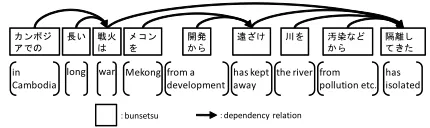
Commas are considered to be inserted right after a bunsetsu that represents the subject of a sentence. For example, in Figure 2, a comma is inserted right after the bunsetsu “qrs(war)” to indicate that the bunsetsu is the subject of the sentence. Here, we pay attention to the clause boundary of the type “topi-calized element-wa.” The rate that commas were in-serted at the clause boundaries “topicalized element -wa” was 16.94% (1,446/8,536). This rate is almost the same as that of bunsetsu boundaries. On the other hand, the commas inserted at the clause bound-aries “topicalized element-wa” accounted for 8.84% (1,446/16,357) of all the inserted commas.
!"#$%&'()*+,-./"01234567-809:;<34=>?@ABC
!"#$%&'#()*#+&#,)-.%/+) 0)1#2345#)()6#732%&'#8*%-#)#/393$%4-3&5:#)&/#0)1#+1%$)53/#
503#*+93*#8*%-#4%$$;5+%#<=>
!"#$ %&'
!"#
$%&'()!%
()
*("+
*+ ,
,%--." /
./0("+
01 23
1-(&#%
)/2/*(3&/"4
456
5%6#0/34#
%,%7
7/
45/#-!2/-89:; 23
1-(&#
3(**84!("#/49:
<=> ?@A
5%6#
!6(*%4/)
[image:4.612.302.517.83.147.2]!!"#$%&$" !'%(%#'%#)*+ ,%-.&/0#
Figure 2: Comma insertion at the clause boundary “topi-calized element-wa”
In the case of the clause boundary “topicalized element-wa” right after a bunsetsu which does not depend on the next bunsetsu (e.g., the bunsetsu “q rs(war)” in Figure 2), the rate of comma inser-tion was 20.71% (1,426/6,886). The rate is higher than that of all the clause boundaries “topicalized element-wa.” This shows that commas tend to be especially inserted at the “topicalized element-wa” right after bunsetsus which do not depend on the next bunsetsu.
3.5 Commas after Conjunction or Adverb Commas tend to be inserted right after a conjunc-tion or an adverb located at the beginning of a sen-tence. These commas correspond to English com-mas which are inserted right after a word such as “however” and “furthermore” located at the begin-ning of a sentence.
• JtJ0usvC#hwO%xyz#{C{5D
(However, I do not feel like agreeing on it.)
In the analysis data, there existed 695 bunset-sus whose rightmost morpheme is a conjunction and which are located at the beginning of a sen-tence. Among them, commas were inserted right after 498 (71.65%) bunsetsus. In the case of bun-setsus whose rightmost morpheme is an adverb, the rate was 30.97% (140/452).
3.6 Commas Inserted between Parallel Words or Phrases
• |J}~•€•3‚ƒ0e„0…†{‡ˆ‰#!
"3ŠkU{/C‹{B{5Œ•sŽ•5D(The
United Nations should play a lot of roles in a broad range of fields, such as the global environment, population, and food.)
In this example, commas are inserted to separate parallel nouns “‚ƒ(environment),” “e„ (popula-tion)” and “…†(food)”. In English, there are com-mas which perform the same role. In fact, comcom-mas were inserted between “environment” and “popula-tion” and between “popula“popula-tion” and “food” in the translation of the above example. When bunsetsus whose rightmost morpheme is a noun appear se-quentially, the rate of comma insertion between such bunsetsus is 59.39% (3,330/5,607).
Also, commas are inserted to separate parallel phrases. In the following example,
• •‘’“s”•0–—>˜;…™kt;š™Kh
›œ•;ž/kŸ0 …@¡…3¢(£¤;¥¦
kŸJK§=%D(The menu is decided by
avoid-ing the menu the Prime Minister ate on the previous night, and by considering the balance between the Japanese food and the European food.)
a comma is inserted right after the bunsetsu “ž/k Ÿ(avoiding)” to make clear separation between the parallel phrases “h›œ•;ž/kŸ (by avoid-ing the menu)” and “ …@¡…3¢(£¤;¥¦ kŸJK(by considering the balance between the Japanese food and the European food).” The rate of comma insertion between two parallel phrases is 79.89% (751/940). This is much higher than that of bunsetsu boundaries, indicating that commas tend to be inserted when phrases are paralleled.
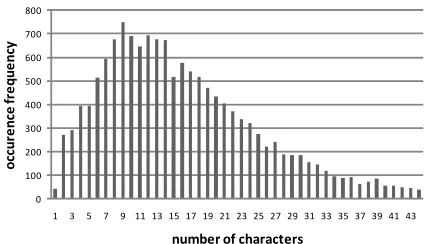
3.7 Number of Characters between Commas If there are too many commas at a short distance, the sentence becomes hard to read. Therefore, the number of characters between commas is expected to be not too small. Also, because a long sequence of characters without a comma is generated if the distance between commas is very long, the occur-rence frequency of such sequences of characters is considered to be low.
We investigated the number of characters between commas and its occurrence frequency. Figure 3
! "! ! #! ! $! ! %! ! &! ! '! ! (! ! )! !
" $ & ( * """$"&"("*#"#$#&# (# *$ "$ $$ &$ ($ *% "%$
!
""
#
$
%
&
"
%
'($
%
)
#
%
&
"*
[image:5.612.308.520.85.207.2]!"#$%&'()'*+,&,*-%&.
Figure 3: Number of characters between commas and its occurrence frequency
shows the results of investigation. When the num-ber of characters between commas is either large or small, the occurrence frequency is low.
4 Comma Insertion Method
In our method, a sentence, on which morphologi-cal analysis, bunsetsu segmentation, clause bound-ary analysis and dependency analysis have been per-formed, is considered the input. Our method de-cides whether or not to insert a comma at each bun-setsu boundary in an input sentence. Based on the analysis results in Section 3, our method adopts the bunsetsu boundaries as candidate positions where a comma is inserted. Our method identifies the most appropriate combination among all combinations of positions where a comma can be inserted, by using the probabilistic model. In this paper, input sen-tences which consist ofnbunsetsus are represented
byB = b1· · ·bn, and the results of comma
inser-tion by R = r1· · ·rn. Here, ri is 1 if a comma is inserted right after bunsetsu bi, and 0 otherwise. We indicate thej-th sequence of bunsetsus created by dividing an input sentence into msequences as
Lj = bj1· · ·bnjj(1 ≤ j ≤ m), and then,r
j k = 0if
1≤k < nj, andrkj = 1ifk=nj.
4.1 Probabilistic Model for Comma Insertion When an input sentenceBis provided, our method
identifies the comma insertion R that maximizes the conditional probabilityP(R|B). Assuming that
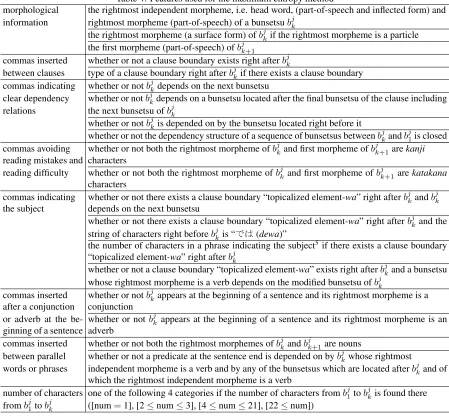
Table 4: Features used for the maximum entropy method
morphological the rightmost independent morpheme, i.e. head word, (part-of-speech and inflected form) and information rightmost morpheme (part-of-speech) of a bunsetsubjk
the rightmost morpheme (a surface form) ofbjkif the rightmost morpheme is a particle the first morpheme (part-of-speech) ofbjk+1
commas inserted whether or not a clause boundary exists right afterbjk
between clauses type of a clause boundary right afterbjkif there exists a clause boundary commas indicating whether or notbjkdepends on the next bunsetsu
clear dependency whether or notbjkdepends on a bunsetsu located after the final bunsetsu of the clause including relations the next bunsetsu ofbjk
whether or notbjkis depended on by the bunsetsu located right before it
whether or not the dependency structure of a sequence of bunsetsus betweenbjkandbj1is closed commas avoiding whether or not both the rightmost morpheme ofbjkand first morpheme ofbjk+1arekanji reading mistakes and characters
reading difficulty whether or not both the rightmost morpheme ofbjkand first morpheme ofbjk+1arekatakana characters
commas indicating whether or not there exists a clause boundary “topicalized element-wa” right afterbjkandbjk the subject depends on the next bunsetsu
whether or not there exists a clause boundary “topicalized element-wa” right afterbjkand the string of characters right beforebjkis “Gs(dewa)”
the number of characters in a phrase indicating the subject5if there exists a clause boundary
“topicalized element-wa” right afterbjk
whether or not a clause boundary “topicalized element-wa” exists right afterbjkand a bunsetsu whose rightmost morpheme is a verb depends on the modified bunsetsu ofbjk
commas inserted whether or notbjkappears at the beginning of a sentence and its rightmost morpheme is a after a conjunction conjunction
or adverb at the
be-ginning of a sentence whether or not
bjk appears at the beginning of a sentence and its rightmost morpheme is an adverb
commas inserted whether or not both the rightmost morphemes ofbjkandbjk+1are nouns
between parallel whether or not a predicate at the sentence end is depended on bybjkwhose rightmost
words or phrases independent morpheme is a verb and by any of the bunsetsus which are located afterbjkand of which the rightmost independent morpheme is a verb
number of characters one of the following 4 categories if the number of characters frombj1tobjkis found there frombj1tobjk ([num=1], [2≤num≤3], [4≤num≤21], [22≤num])
one appearing immediately before that bunsetsu,
P(R|B)can be calculated as follows:
P(R|B) (1)
=P(r11= 0,· · ·, r1n1−1= 0, r1n1= 1,· · ·, rm
1 = 0,· · ·, rmnm−1= 0, r
m
nm= 1|B)
∼
=P(r11= 0|B)× · · ·
×P(r1n1−1= 0|rn11−2= 0,· · ·, r11= 0, B)
×P(r1 n1= 1|r
1
n1−1= 0,· · ·, r
1
1= 0, B)× · · ·
×P(rm
1 = 0|rmnm−−11= 1, B)× · · ·
×P(rmnm−1= 0|r
m
nm−2= 0,· · ·, r
m
1 = 0, rmnm−−11= 1, B)
×P(rmnm= 1|rmnm−1= 0,· · ·, rm1 = 0, rnmm−−11= 1, B)
whereP(rjk = 1|rkj−1 = 0,· · ·, rj1 = 0, rj−1
nj−1 = 1, B)is the probability that a comma is inserted right
after a bunsetsu bjk when the sequence of bunset-susBis provided and the position ofj-th comma is
identified. Similarly,P(rkj = 0|rkj−1= 0,· · ·, r1j = 0, rnj−j−11 = 1, B) is the probability that a comma
is not inserted right after a bunsetsu bjk. These
probabilities are estimated by the maximum entropy method. The resultRwhich maximizes the
4.2 Features on Maximum Entropy Method To estimate P(rkj = 1|rkj−1 = 0,· · ·, r1j =
0, rjn−j−11 = 1, B)andP(r
j k = 0|r
j
k−1= 0,· · ·, r
j
1= 0, rjn−j−11 = 1, B)by the maximum entropy method,
we used the features in Table 4 based on the analysis described in Section 3.
5 Experiment
To evaluate the effectiveness of our method, we con-ducted an experiment using a Japanese text corpus. 5.1 Outline of Experiment
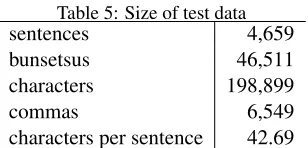
As the experimental data, we used the newspaper ar-ticles in the Kyoto Text Corpus version 4.0 (Kuro-hashi and Nagao, 1998). We used the articles from January 14th to 17th as the test data. The training data is same as the analysis data. Table 5 shows the size of the test data. Here, we used the maximum entropy method tool (Le, 2008) with the default op-tions except “-i 2000.”
In the evaluation, we obtained the recall, the pre-cision and their harmonic mean, i.e., F-measure. The recall and precision are respectively defined as follows.
recall=#of correctly inserted commas
#of commas in the correct data
precision=#of correctly inserted commas
#of inserted commas
In our research, to realize automatic comma in-sertion with high quality, we analyzed each usage of commas and decided the features for the ME method based on the analysis. To confirm the effectiveness of our features, we established the baseline method as a comparative method whereby commas are in-serted by the ME method in which only simple mor-phological information is used. The baseline method uses the morphological information in Table 4 and the information of the rightmost morpheme (a sur-face form) of a bunsetsu as features.
5.2 Experimental Results
[image:7.612.334.488.90.164.2]Table 6 shows the experimental results of the base-line and our method. The recall and precision were 69.13% and 84.13% respectively, and we con-firmed that our method had higher performance than
Table 5: Size of test data
sentences 4,659
bunsetsus 46,511
characters 198,899
commas 6,549
characters per sentence 42.69
Table 6: Experimental results
recall precision F-measure
our 69.13% 84.13% 75.90
method (4,527/6,549) (4,527/5,381)
baseline 51.38% 70.90% 59.58 (3,365/6,549) (3,365/4,746)
the baseline method. The percentage of sentences wherein all commas were correctly inserted was 55.81%.
Figure 4 shows the comparison between the re-sults of our method and the baseline method. The baseline method was not able to insert commas right after the bunsetsu “MtVG5%>(are floated)” or “§¨B{5k=(not decided)” but inserted com-mas at unnatural positions such as between “©ª% (calling himself)” and “«¬-®>(the vice com-mander).” On the other hand, our method was able to insert commas properly at such bunsetsu bound-aries.
6 Discussion
6.1 Error Analysis
Among positions where commas existed in the test data, there existed 2,022 positions where our method did not insert commas. Among them, 862 were clause boundaries, and the clause boundary “topical-ized element-wa” accounted for 53.36% (460/862) of them. There were a lot of clause boundaries of the type “topicalized element-wa,” and the number of commas inserted at such boundaries was large. But, the rate of comma insertion itself was not very high. We can say that the four features about “topi-calized element-wa” did not always work well.
Ta-5Phrases indicating the subject is a sequence of bunsetsus
consisting ofbj
kand all bunsetsus that are connected tob
j kwhen
!"#$%&'()*+,-./0-12345678 9:;<0=>?@ABCD=EFGHIJKLMGN BOPQRSTUO=BV$WUXYGZ[\O]^M WT_`=abcdef
!"#$%#&'()*)+,+-&.)/&0/1%.2&3)*/4&3+$*5/.&(/3,/.+,2-&6/.(%50#
'7+8%5*-&.)/&9+2#,&':%9# 3*.2&*5&;)*9+5/- <%5*# =+.#2+9+-&
.)/&4#,9/,& >+$#,&9*5*(./,&+50&.)/&7,*./,&6+*3)* ;+8+*2+ +,/&
4>#+./0&+(&.)/&3+50*0+./- )#7/?/,-&(*53/&.)/&4,+9/7#,8&
.)/&1,/0*3+./0&1#>*.*3+>&1+,.2&*(&5#.&0/3*0/0- .)/&3##,0*5+.*#5&
9+8/(&>*..>/&)/+07+2@&A
!"#$%&'(!)*
!"#$%&'()*+,-./0-12345678 9:;<0>?@ABCD=EFGHIJKLMGNB OPQRSTUOBV$WUXYGZ[\O]^MWT _`abcdef
!"#$%#&'()*)+,+-&.)/&0/1%.2&3)*/4&3+$*5/.&(/3,/.+,2-&6/.(%50#
'7+8%5*-&.)/&9+2#,&':%9# 3*.2&*5&;)*9+5/ <%5*# =+.#2+9+-&
.)/&4#,9/,& >+$#,&9*5*(./,&+50&.)/&7,*./,&6+*3)* ;+8+*2+ +,/&
4>#+./0&+(&.)/&3+50*0+./ )#7/?/,-&(*53/&.)/&4,+9/7#,8&
.)/&1,/0*3+./0&1#>*.*3+>&1+,.2&*(&5#.&0/3*0/0 .)/&3##,0*5+.*#5&
9+8/(&>*..>/&)/+07+2@&A
+,-&./0&*
ghij$NkU/lm-Ono:&pUO=qrGl m-cstf
!B)*>/&.)/&?*3/&3#99+50/, 3+>>*5C&)*9(/>4&D+,3#(&+11/+,(&
*5&1%$>*3-&+5&+3.%+>&3#99+50/,&*(&%53/,.+*5@A
!"#$%&'(!)*
ghij$NkU=/lm-Ono:&pUO=qrG lm-cstf
!B)*>/&.)/&?*3/&3#99+50/,- 3+>>*5C&)*9(/>4&D+,3#(&+11/+,(&*5&
1%$>*3-&+5&+3.%+>&3#99+50/,&*(&%53/,.+*5@A
+,-&./0&*
Figure 4: Comparison of the results of our method and baseline method
ble 7 shows the results of comma insertion at the clause boundaries “topicalized element-wa.” While there existed 601 commas at such boundaries in the test data, only 141 commas were inserted correctly. We need to consider more effective features about “topicalized element-wa.”
As for other cases, there existed 130 bunsetsu boundaries between parallel words where commas were not inserted. One example of such case is shown below.
• correct data:
[image:8.612.74.283.80.422.2]¯°±#²3³´0‘£‘)0µ¶°·0¸¹3 A›VºŸ;»C0¼Ÿ3½¾“¿£ÀÁ¦¨ OD(Put pork backfat, garlic, ginger and shredded green onion in a bowl, and add red bell peppers for color.)
Table 7: Result of comma insertion at the clause bound-aries “topicalized element-wa.”
recall precision F-measure 23.46% 59.49% 33.65 (141/601) (141/237)
• our method:
¯°±#²3³´‘£‘)0µ¶°·0¸¹3A ›VºŸ;»C0¼Ÿ3½¾“¿£ÀÁ¦¨OD
(Put pork backfat garlic, ginger and shredded green onion in a bowl, and add red bell peppers for color.)
In the correct data, a comma was inserted between the bunsetsu “³´(backfat)” and “‘£‘) (gar-lic).”
If a comma should be inserted right after the bun-setsu ‘‘³´(backfat),” the number of characters be-tween commas would become too small to be judged as appropriate by the proposed method. So, the fea-ture about the number of characters between com-mas may have had harmful effects there. On the other hand, a comma was inserted properly between the bunsetsu “‘£‘) (garlic)” and “µ¶°· (ginger).” This is because katakanacharacters ap-peared sequentially in addition to appearing as par-allel nouns.
6.2 Unnatural Comma Insertion
When commas are inserted at obviously unnatural positions, they have a major impact on the under-standing of a sentence by readers. Here, we inves-tigated how many commas had been inserted at ob-viously unnatural positions by our method. For the article on January 14th (217 sentences, 2,349 bun-setsus) in the test data, we examined 47 commas in-serted incorrectly. Three persons decided whether or not the inserted commas were obviously unnat-ural through consultations. Concretely, when all of the three persons felt that an inserted comma would make readers understand wrongly the meaning of the sentence, the comma was judged to be obviously unnatural.
Table 8: Comparison with human judgement
recall precision F-measure by human 78.30% 80.58% 79.42
(249/318) (249/309)
our method 71.07% 82.78% 76.48 (226/318) (226/273)
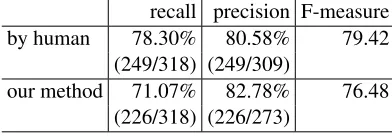
6.3 Comparison with Human Judgement
In our experiment, we evaluated the results of comma insertion of our method by comparing them with the correct data. However, the sufficient level to be reached by automatic comma insertion is un-certain. Here, we evaluated our method by com-paring them with the results of comma insertion by another person. By using the same data as used in the subsection 6.2, we conducted an experiment on comma insertion by an annotator who was familiar with writing Japanese documents. Table 8 shows the recall, the precision and the F-measure. The second row shows the results of our method for the same data. As the F-measure of the annotator was 79.42, it turned out that comma insertion task was diffi-cult even for humans. For F-measure, our method achieved 96.30% (76.48/79.42) of the annotator’s re-sult. Also, the precision of our method was 82.78%. Although the comma insertion task is difficult, our method was able to properly insert commas.
7 Conclusion
This paper proposed a method for inserting commas into Japanese texts. Our method appropriately in-serts commas based on the machine learning method using such features as morphemes, dependencies and clause boundaries. An experiment by using the Kyoto Text Corpus (Kurohashi and Nagao, 1998) showed an F-measure of 75.90, and we confirmed the effectiveness of our method.
The analysis of the experimental results showed that our method cannot insert commas of the par-ticular usage. As a future work, it is necessary to find more useful features for commas of this usage and improve the recall of our method. Also, we will examine “commas emphasizing the adjacent word” which were not included in our targets.
Acknowledgments
This research was partially supported by the Grant-in-Aids for Scientific Research (B) (No. 22300051) and Young Scientists (B) (No. 21700157), and by the Continuation Grants for Young Researchers of The Asahi Glass Foundation.
References
Heidi Christensen, Yoshihiko Gotoh, and Steve Renals. 2001. Punctuation annotation using statistical prosody models. InProceedings of ISCA Workshop on Prosody in Speech Recognition and Understanding, pages 35– 40.
Yuqing Guo, Haifeng Wang, and Josef van Genabith. 2010. A linguistically inspired statistical model for Chinese punctuation generation. ACM Transactions on Asian Language Information Processing, 9(2):6:1– 6:27.
Yoshihiko Hayashi. 1992. A three-level revision model for improving Japanese bad-styled expressions. In
Proceeding of 14th International Conference on Com-putational Linguistics, pages 665–671.
Katsuichi Honda. 1982. Nihongo no sakubun gijutsu (Japanese writing skill). Asahi Shimbun Publications Inc. (In Japanese).
Takashi Inukai. 2002. Moji hyouki tankyuhou (Method of questioning characters and notations). Asakura Pul-ishing Co., Ltd. (In Japanese).
Hideki Kashioka and Takehiko Maruyama. 2004. Seg-mentation of semantic unit in Japanese monologue. InProceedings of International Conference on Speech Language Technology and Oriental COCOSDA, pages 87–92.
Ji-hwan Kim and P. C. Woodland. 2001. The use of prosody in a combined system for punctuation gener-ation and speech recognition. InProceedings of 7th European Conference on Speech Communication and Technology, pages 2757–2760.
Sadao Kurohashi and Makoto Nagao. 1998. Building a Japanese parsed corpus while improving the parsing system. InProceedings of 1st International Confer-ence on Language Resources and Evaluation, pages 719–724.
Zhang Le. 2008. Maximum entropy modeling toolkit for python and c++. http://homepages.inf.ed. ac.uk/s0450736/maxent toolkit.html. [Online; accessed 1-March-2008].
sentence boundaries and disfluencies. IEEE Trans-actions on Audio, Speech, and Language Processing, 14(5):1526–1540.
Tohru Shimizu, Satoshi Nakamura, and Tatsuya Kawa-hara. 2008. Effect of punctuation marks for speech translation unit boundary detection. IEICE technical report. Speech, 108(338):127–131. (In Japanese). Shogakukan’s editiorial department. 2007. kutoten,
kigou, hugou katuyoujiten (dictionary of punctuations and symbols ). Shogakukan. (In Japanese).
Eiji Suzuki, Shizuo Shimada, Kunio Kondo, and Hisashi Sato. 1995. Automatic recognition of optimal punc-tuation in Japanese documents. In Proceedings of 50th National Convention of IPSJ, 50(3):185–186. (In Japanese).