Parsing low-resource languages using Gibbs sampling
for PCFGs with latent annotations
Liang Sun
1Jason Mielens
21
Department of Mechanical Engineering
2Department of Linguistics
The University of Texas at Austin
The University of Texas at Austin
[email protected]
{
jmielens,jbaldrid
}
@utexas.edu
Jason Baldridge
2Abstract
PCFGs with latent annotations have been shown to be a very effective model for phrase structure parsing. We present a Bayesian model and algorithms based on a Gibbs sam-pler for parsing with a grammar with latent an-notations. For PCFG-LA, we present an ad-ditional Gibbs sampler algorithm to learn an-notations from training data, which are parse trees with coarse (unannotated) symbols. We show that a Gibbs sampling technique is ca-pable of parsing sentences in a wide variety of languages and producing results that are on-par with or surpass previous approaches. Our results for Kinyarwanda and Malagasy in particular demonstrate that low-resource lan-guage parsing can benefit substantially from a Bayesian approach.
1 Introduction
Despite great progress over the past two decades on parsing, relatively little work has considered the prob-lem of creating accurate parsers for low-resource lan-guages. Existing work in this area focuses primarily on approaches that use some form of cross-lingual boot-strapping to improve performance. For instance, Hwa et al. (2005) use a parallel Chinese/English corpus and an English dependency grammar to induce an anno-tated Chinese corpus in order to train a Chinese de-pendency grammar. Kuhn (2004b) also considers the benefits of using multiple languages to induce a mono-lingual grammar, making use of a measure for data re-liability in order to weight training data based on confi-dence of annotation. Bootstrapping approaches such as these achieve markedly improved results, but they are dependent on the existence of a parallel bilingual cor-pus. Very few such corpora are readily available, par-ticularly for low-resource languages, and creating such corpora obviously presents a challenge for many practi-cal applications. Kuhn (2004a) shows some of the diffi-culty in handling low-resource languages by examining various tasks using Q’anjob’al as an example. Another approach is that of Bender et al. (2002), who take a more linguistically-motivated approach by making use of linguistic universals to seed newly developed gram-mars. This substantially reduces the effort by making
it unnecessary to learn the basic parameters of a lan-guage, but it lacks the robustness of grammars learned from data.
Recent work on Probabilistic Context-Free Gram-mars with latent annotations (PCFG-LA) (Matsuzaki et al., 2005; Petrov et al., 2006) have shown them to be effective models for syntactic parsing, especially when less training material is available (Liang et al., 2009; Shindo et al., 2012). The coarse nonterminal symbols found in vanilla PCFGs are refined by latent variables; these latent annotations can model subtypes of gram-mar symbols that result in better gramgram-mars and enable better estimates of grammar productions. In this pa-per, we provide a Gibbs sampler for learning PCFG-LA models and show its effectiveness for parsing low-resource languages such as Malagasy and Kinyawanda. Previous PCFG-LA work focuses on the prob-lem of parameter estimation, including expectation-maximization (EM) (Matsuzaki et al., 2005; Petrov et al., 2006), spectral learning (Cohen et al., 2012; Co-hen et al., 2013), and variational inference (Liang et al., 2009; Wang and Blunsom, 2013). Regardless of inference method, previous work has used the same method to parse new sentences: a Viterbi parse un-der a new sentence-specific PCFG obtained from an approximation of the original grammar (Matsuzaki et al., 2005). Here, we provide an alternative approach to parsing new sentences: an extension of the Gibbs sam-pling algorithm of Johnson et al. (2007), which learns rule probabilities in an unsupervised PCFG.
We use a Gibbs sampler to collect sampled trees theoretically distributed from the true posterior distri-bution in order to parse. Priors in a Bayesian model can control the sparsity of grammars (which the inside-outside algorithm fails to do), while naturally incorpo-rating smoothing into the model (Johnson et al., 2007; Liang et al., 2009). We also build a Bayesian model for parsing with a treebank, and incorporate informa-tion from training data as a prior. Moreover, we ex-tend the Gibbs sampler to learn and parse PCFGs with latent annotations. Learning the latent annotations is a compute-intensive process. We show how a small amount of training data can be used to bootstrap: af-ter running a large number of sampling iaf-terations on a small set, the resulting parameters are used to seed a smaller number of iterations on the full training data.
This allows us to employ more latent annotations while maintaining reasonable training times and still making full use of the available training data.
To determine the cross-linguistic applicability of these methods, we evaluate on a wide variety of lan-guages with varying amounts of available training data. We use English and Chinese as examples of languages with high data availability, while Italian, Malagasy, and Kinyarwanda provide examples of languages with little available data.
We find that our technique comes near state of the art results on large datasets, such as those for Chinese and English, and it provides excellent results on limited datasets – both artificially limited in the case of En-glish, and naturally limited in the case of Italian, Mala-gasy, and Kinyarwanda. This, combined with its abil-ity to run off-the-shelf on new languages without any supporting materials such as parallel corpora, make it a valuable technique for the parsing of low-resource lan-guages.
2 Gibbs sampling for PCFGs
Our starting point is a Gibbs Sampling algorithm for vanilla PCFGs introduced by Johnson et al. (2007) for estimating rule probabilities in an unsupervised PCFG. We focus instead on using this algorithm for parsing new sentences and then extending it to learn PCFGs with latent annotations. We begin by summarizing the Bayesian PCFG and Gibbs sampler defined by Johnson et al. (2007).
Bayesian PCFG For a grammarG, each rulerin the set of rulesR has an associated probability θr. The
probabilities for all the rules that expand the same non-terminalAmust sum to one:PA→β∈RθA→β= 1.
Given an input corpusw=(w(1),· · ·,w(n)), we
in-troduce a latent variable t=(t(1),· · ·, t(n)) for trees
generated byGfor each sentence. The joint posterior distribution oftandθconditioned onwis:
p(t, θ|w)∝p(θ)p(w|t)p(t|θ) =p(θ)(Yn
i=1p(w
(i)|t(i))p(t(i)|θ))
=p(θ)(Yn
i=1p(w
(i)|t(i))Y
r∈Rθ fr(t(i)
r )) (1)
Herefr(t)is the number of occurrences of rulerin the
derivation oft;p(w(i)|t(i)) = 1if the yield oft(i)is
the sequencew(i), and 0 otherwise.
We use a Dirichlet distribution parametrized byαA:
Dir(αA)as the prior of the probability distribution for
all rules expanding non-terminalA(p(θA)). The prior
for all θ, p(θ), is the product of all Dirichlet distri-butions over all non-terminalsA ∈ N: p(θ | α) = Q
A∈Np(θA|αA).
Since the Dirichlet distribution is conjugate to the Multinomial distribution, which we use to model the likelihood of trees, the conditional posterior ofθAcan
be updated as follows:
pG(θ|t, α)∝pG(t|θ)p(θ|α)
∝(Y
r∈Rθ fr(t)
r )(
Y
r∈Rθ αr−1
r )
=Y
r∈Rθ
fr(t)+αr−1
r (2)
which is still a Dirichlet distribution with updated pa-rameterfr(t) +αrfor each ruler∈R.
Gibbs sampler The parameters of the PCFG model can be learned from an annotated corpus by simply counting rules. However, parsing cannot be done di-rectly with standard CKY as with standard PCFGs, so we use the Gibbs sampling algorithm presented in Johnson et al. (2007). An additional motivation for us-ing this algorithm is that Johnson et al. use it for learn-ing without annotated structures, and in future work we seek to learn from fewer, and at times partial, annota-tions.
An advantage of using Gibbs sampling for Bayesian inference, as opposed to other approximation algo-rithms such as Variational Bayesian inference (VB) and Collapsed Variational Bayesian inference (CVB), is that Markov Chain Monte Carlo (MCMC) algorithms are guaranteed to converge to a sample from the true posterior under appropriate conditions (Taddy, 2011). Both VB and CVB converge to inaccurate and locally optimal solutions, like EM. In some models, CVB can achieve more accurate results due to weaker assump-tions (Wang and Blunsom, 2013). Another advantage of Gibbs sampling is that the sampler allows for parallel computation by allowing each sentence to be sampled entirely independently of the others. After each paral-lel sampling stage, all model parameters are updated in a single step, and the process then repeats (see§2).
To sample the joint posteriorp(t, θ|w), we sample production probabilitiesθand then trees tfrom these conditional distributions:
p(t|θ,w, α) =Yn
i=1p(ti|wi, θ) (3) p(θ|t,w, α) =Y
A∈NDir(θA|fA(t) +αA) (4)
Step 1: Sample Rule Probabilities. Given treestand priorα, the production probabilitiesθA for each
non-terminalA∈N are sampled from a Dirichlet distribu-tion with parametersfA(t) +αA. fA(t)is a vector,
and each component offA(t), is the number of
occur-rences of one rule expanding nonterminalA.
Step 2: Sample Tree Structures. To sample trees from
p(ti | wi, θ), we use the efficient sampling scheme
Require: Ais parent node of binary rule; wi,k is a
span of words:i+ 1< k
functionTREESAMPLER(A, i, k)
for i < j < k and pair of child nodes of
A:B, C do
P(j, B, C)= θA→BC·pB,i,j·pC,j,k · pA,i,k
end for
Samplej∗, B∗, C∗from multinomial distribution for(j, B, C)with probabilities calculated above
returnj∗, B∗, C∗ end function
Algorithm 1: Sampling split position and rule to ex-pand parent node
Consider a sentence w, with sub-spans wi,k =
(wi+1,· · · , wk). Givenθ, we construct the inside
ta-ble with entriespA,i,k for each nonterminal and each
word spanwi,k : 0 ≤ i < k ≤ l, where pA,i,k =
PGA(wi,k|θ)is the probability that wordsithroughk
were produced by the non-terminal A. The table is computed recursively by
pA,k−1,k=θA→wk (5)
pA,i,k=
X
A→BC∈R
X
i<j<k
θA→BC·pB,i,j·pC,j,k (6)
for allA, B, C∈N and0≤i < j < k≤l.
The resulting inside probabilities are then used to generate trees from the distribution of all valid trees of the sentence. The tree is generated from top to bottom recursively with the functionT reeSamplerdefined in Algorithm 1.
In unsupervised PCFG learning, the rule probabil-ities can be resampled using the sampled trees, then used to reparse the corpus, and so on. We use this property to refine latent annotations for the PCFG-LA model described in the next section.
3 PCFG with latent annotations
When labeled trees are available, rule frequencies can be directly extracted and used as priors for a PCFG. However, when learning PCFG-LAs, we must learn the fine-grained rules from the coarse trees, so we extend the Gibbs sampler to assign latent annotations to unan-notated trees. The resulting learned PCFG-LA parser outputs samples of annotated trees so that we can ob-tain unannotated trees after marginalizing.
3.1 Model
With the PCFG-LA model (Matsuzaki et al., 2005; Petrov et al., 2006) fine-grained CFG rules are auto-matically induced from training, effectively providing a form of feature engineering without human interven-tion. GivenH ={1,· · ·, K}, a set of latent annotation symbols, andx∈H:
• θA[x]→U is the probability of rule A[x] → U,
whereU ∈N×N∪T. The probabilities for all
rules that expand the same annotated non-terminal must sum to one.
• βA[x],B,C→y,z is the probability of assigning
la-tent annotationy, z to child nodesB, C of A[x].
P
y,z∈H×HβA[x],B,C→y,z= 1.
The inputs to the PCFG-LA are a CFGGwith finite number of latent annotations for each non-terminal, an initial guess of probabilities of grammar ruleθ0, and a
priorαθis learned from training.
The joint posterior distribution oftandθ, β condi-tioned onwis:
p(t, θ, β|w)∝p(θ, β)p(w|t)p(t|θ, β) =p(θ)p(β)(Yn
i=1p(wi|ti)p(ti|θ, β)) (7)
We assume that θ and β are independent to get
P(θ, β) =P(θ)P(β).
To learn parametersθ,β, we use a Dirichlet distribu-tion as a prior for bothθandβ. The distribution for all rules expandingA[x]is:
P(θ|αθ) = Y A∈N,x∈H
P(θA[x]|αθA[x]) (8)
The distribution for latent annotations associated with child nodes ofA[x]→BCis:
P(β|αβ) = Y y,z∈H×H
P(βA[x],B,C |αAβ[x],B,C).
(9) With this setting, the conditional posterior ofθA[x]
andβA[x],B,C can be updated, as in§2. For all unary
and binary rulesrexpandingA[x]:
θA[x] |t, αθ∼Dir(fr(t) +αrθ) (10)
Here,fr(t)is the number of occurrence of annotated
rulerint. Also, for combination of latent annotations
y, z∈H×H assigned toB, Cin ruleA[x]→B, C:
βA[x],B,C |t, αβ∼Dir(fd(t) +αβd) (11)
Here,fd(t)is the number of occurrences of
combina-tiondint.
3.2 Learning PCFG-LAs from raw text
To learn from raw text, we extend the sampler in§2 to PCFG-LA. Given priorsαθ, αβand raw text, the
al-gorithm alternates between two steps. The first sam-ples trees for the entire corpus; the second samsam-plesθ
andβfrom Dirichlet distributions with updated param-eters, combining priors and counts from sampled trees. The algorithm then alternates between these steps un-til convergence. The outputs are samples ofθ,β and annotated trees.
Require: w1,· · ·, wn are raw sentences;θ0, β0 are
initial values;αθ, αβ are priors;M is the number
of iterations
functionPARSE(w1, .., wn, θ0, β0, αθ, αβ, M)
foriterationi= 1toM do forsentences= 1tondo
Calculate Inside Table
Sample tree nodes and associated latent annotations, get tree structuret(si)
end for
Sampleθ(i),β(i)
end for
forsentences= 1tondo
Marginalize the latent annotations to get unannotated treesTs(1),· · · , Ts(M)
Find the mode ofTs(1),· · ·, Ts(M):Ts
end for
returnT1,· · · , Tn
end function
Algorithm 2: Parsing new sentences
construct an inside table (see§2). Each entry in the ta-ble stores the probability that a word span is produced by a given annotated nonterminal. For root node S, withθ,βand inside tablepA[x],i,k, we sample one
an-notation based on all pS[x],0,l, x ∈ H. Assume that
we sampledxfor S, we further sample a rule to ex-pandS[x]and possible splits of the spanw0,l jointly.
Assume that we sampled nonterminalsB, Cto expand
S[x], whereBis responsible forw0,j andCis
respon-sible forwj,l. We further sample annotations forB, C
together, sayy, z. Then we sample rules and split po-sitions to expand B[y] and C[z], and continue until reaching the terminals.
This algorithm alone could be used for unsupervised learning of PCFG-LA if we input a non-informed or weakly-informed prior αθ and αβ. With access to
unannotated trees for training, we only need to assign latent annotations to them and then use the frequen-cies of these annotated rules as the prior when parsing. The details of training when trees are available are il-lustrated in§3.3.
Once we have trees (with latent annotations), the step of samplingθandβ from a Dirichlet distribution is direct. We need to count the number of occurrences
fr(t)for each rulerlikeA[x]→U, U ∈N ×N∪T
in updated annotated treest, and drawθA[x] from the
updated Dirichlet distributionDir(fA[x](t) +αθA[x]).
We also need to count the number of occurrences of
fd(t)for each combination ofyz∈H×Hassigned to
B, CgivenA[x]→B, Cint, and drawβA[x],B,Cfrom
the updated Dirichlet distributionDir(fA[x],B,C(t) +
αβA[x],B,C)similarly.
To parse a sentence, we first calculate the inside table and then sample the tree.
Calculate the inside table. Givenθ,βand a string
w=w0,l, we construct a table with entriespA[x],i,kfor
each A∈N, x ∈ H and 0 ≤ i < k ≤ l, where
pA[x],i,k = PGA[x](wi,k|θ, β) is the probability that
wordsithroughkwere produced by the annotated non-terminalA[x]. The table can be computed recursively, for allA∈N,x∈H, by
pA[x],k−1,k=θA[x]→wk (12) pA[x],i,k=
X
A[x]→BC:BC∈N×N
X
j:i<j<k
X
yz∈H×H
θA[x]→BCβA[x]BC→yzpB[y],i,jpC[z],j,k (13)
Sample the tree, top to bottom.First, from start sym-bolS, sample latent annotation from multinomial with probabilityπS[x]pS[x],0,lfor eachx∈H. Next, given
annotated non-terminalA[x]andi, k, sample possible child nodes and split positions from multinomial with probability:
p(B, C, j) = 1
pA[x],i,k·
X
y,z∈H
θA[x]→BCβA[x]BC→yzpB[y],i,jpC[z],j,k (14)
Here the probability is calculated by marginaliz-ing all possible latent annotations for B, C, and
θA[x]→BCβA[x]BC→yz is the probability of choosing
B[y], C[z]to expandA[x], andpB[y],i,jpC[z],j,kare the
probabilities for B[y] andC[z] to be responsible for word spanwi,j andwj,krespectively. AndpA[x],i,kis
the normalizing term.
Third, givenA[x], B, C, i, j, k, sample annotations forB, Cfrom multinomial with probability:
p(y, z) = PβA[x]BC→yzpB[y],i,jpC[z],j,k
y,zβA[x]BC→yzpB[y],i,jpC[z],j,k (15)
A crucial aspect of this procedure is that all trees can be sampled independently. This parallel process pro-duces a substantial speed gain that is important partic-ularly when using more latent annotations. After all trees have been sampled (independently), the counts from each individual tree are combined prior to the next sampling iteration.
3.3 Learning from coarse training trees
In training, we need to learn the probabilities of fine-grained rules given coarsely-labeled trees. We perform Gibbs sampling on the training data by first iteratively sampling probabilities and then assigning annotations to tree nodes. We use the average counts of anno-tated production rules from sampled trees to produce the priorαθandαβincorporated into parsing raw
sen-tences.
We first index the non-terminal nodes of each treeT
Require: T1,· · ·, Tn are fully parsed trees; θ0, β0
are initial values; αθ0, αβ0 are priors; M is the
number of iterations
functionANNO(T1,· · ·, Tn, θ0, β0, αθ0, αβ0, M)
foriterationi= 1toM do forsentences= 1tondo
Calculate inside probability
Sample latent annotations for each node in the tree, get tree with latent annotationst(si)
end for
Sampleθ(i),β(i)
end for
return Mean of number of occurrences of production rules and associated latent annotations from all sampled annotated trees
end function
Algorithm 3: Learning prior from training
in parsed trees, which also takes two steps. The first step is to, for each node in the tree, calculate and store the probability that the node is annotated by x. The second step is to jointly sample latent annotations for child nodes of root nodes, and then continue this pro-cess from top to bottom until reaching the pre-terminal nodes.
Step one: inside probabilities. Given tree T, com-putebi
T[x]for each non-terminalirecursively:
1. If nodeNi is a pre-terminal node above terminal
symbolw, then forx∈H bi
T[x] =θNi[x]→w (16)
2. Otherwise, let j, kbe two child nodes ofi, then forx∈H
bi T[x] =
X
y,z∈H
θNi[x]→NjNkβNi[x]NjNk→y,zbjT[y]bkT[z] (17)
Step two: outside sampling. Given inside probabil-itybi
T[x]for every non-terminaliand all latent
annota-tionsx∈H, we sample the latent annotations from top to bottom:
1. If nodeiis the root node (i= 1), then samplex∈
H from a multinomial distribution withfi T[x] =
π(Ni[x]).
2. For a parent node with sampled latent annotation
Ni[x]with childrenNj, Nk, sample latent
annota-tions for these two nodes from a multinomial dis-tribution with
fi
T[y, z] = bi1 T[x]
·
θNi[x]→NjNkβNi[x]NjNk→y,zb
j
T[y]bkT[z] (18)
After training, we take the average counts of sampled annotated rules and combinations of latent annotations as priors to parse raw sentences.
4 Experiments
1Our goal is to understand parsing efficacy using sam-pling and latent annotations for low-resource lan-guages, so we perform experiments on five languages with varying amount of training data. We compare our results to a number of previously established base-lines. First, for all languages, we use both a stan-dard unsmoothed PCFG and the Bikel parser, trained on the training corpus. Additionally, we compare to state-of-the-art results for both English and Chinese, which have an existing body of work in PCFGs using a Bayesian framework. For Chinese, we compare to Huang & Harper (2009), using their results that only use the Chinese Treebank (CTB). For English, we com-pare to Liang et al. (2009). Prior results for parsing the constituency version of the Italian data are avail-able from Alicante et al. (2012), but as they make use of a different version of the treebank including extra sentences, and additionally use the extensive functional tags present in the corpus, we do not directly compare our results to theirs.2
4.1 Data
English (ENG) and Chinese (CHI) are the two main languages used for this work; they are commonly used in parser evaluation and have previous examples of sta-tistical parsers using a Bayesian framework. And since we primarily are interested in parsing low-resource lan-guages, we include results for Kinyarwanda (KIN) and Malagasy (MLG) as examples of languages without substantial existing treebanks. Finally, as a middle-ground language, we use Italian (ITL).
For English, we use the Wall-Street Journal section of the Penn Treebank (WSJ) (Marcus et al., 1993). The data split is sections 02-21 for training, section 22 for development, and section 23 for testing. For Chinese, the Chinese Treebank (CTB5) (Xue et al., 2005) was used. The data split is files 81-899 for training, files 41-80 for development, and files 1-40/900-931 for testing. The ITL data is from the Turin University Treebank (TUT) (Bosco et al., 2000) and consists of 2,860 Italian sentences from a variety of domains. It was split into training, development, and test sets with a 70/15/15 percentage split.
The KIN texts are transcripts of testimonies by sur-vivors of the Rwandan genocide provided by the Ki-gali Genocide Memorial Center, along with a few BBC news articles. The MLG texts are articles from the websites Lakroa and La Gazette and Malagasy Global Voices. Both datasets are described in Garrette and Baldridge (2013). The KIN and MLG data is very small compared to ENG and CHI: the KIN dataset
con-1Code available at github.com/jmielens/gibbs-pcfg-2014,
along with instructions for replicating experiments when pos-sible
2As part of a standardized pre-processing step, we strip
tains 677 sentences, while the MLG dataset has only 113. Also, we simulated a small training set for ENG data by using only section 02 of the WSJ for training.
4.2 Experimental Setup
As a preprocessing step, all trees are converted into Chomsky Normal-Form such that all non-terminal pro-ductions are binary and all unary chains are removed.
Additional standard normalization is performed. Functional tags (e.g. theSBJpart of NP-SBJ), empty nodes (traces), and indices are removed. Our binariza-tion is simple: given a parent, select the rightmost child as the head and add a stand-in node that contains the remainder of the original children; the process then re-curses. This simple technique uses no explicit head-finding rules, which eases cross-linguistic applicability. From this normalized data, we train latent PCFGs with K=1,2,4,8,16,32 (where K=1 is equivalent to the plain PCFG described in section 2).
4.3 Practical refinements
Unknown word handling. We use a similar unknown word handling procedure to Liang et al. (2009). From our raw corpus we extract features associated with ev-ery word, these features include surrounding context words as well as substring suffix/prefix features. Using these features we produce fifty clusters using k-means. Then, as a pre-parsing step, we replace all words occurring less than five times with their cluster label -this simulates unknown words for training. Finally, during evaluation, any word not seen in training was also replaced with its corresponding cluster label. This final step is simple because there are no ‘unknown un-knowns’ in our corpus, as the clustering has been per-formed over the entire corpus prior to training. This approach is similar to methods for unsupervised POS-tag induction that also utilize clusters in this manner (Dasgupta & Ng, 2007).
We compare this unknown word handling method to one in which the clustering and a classifier is trained not on the corpus under consideration, but rather on a separate corpus of unrelated data. This comparison was made to understand the effects of including the eval-uation set in the training data (without labels) versus training on out-of-domain texts. This is a more real-istic measurement of out-of-the-box performance of a trained model.
Jump-starting sampling. In the basic setup, train-ing high K-value models takes a prohibitively long time, so we also consider a jump-start technique that allows larger annotation values (such as K=16) to be run in less time. We train these high-K value models first on a highly reduced training set (5% of the full training set) for a large number of iterations, and then use the foundθvalues as the starting point for training on the full training set for a small number of iterations. Although many of the estimated parameters on the re-duced set will be zero, the prior allows us to eventually
System K=1 K=2 K=4 K=8 K=16 Unsmoothed PCFG 40.2 — — — — Bikel Parser 57.9 — — — — Liang et al. 07 60.5 71.1 77.2 79.2 78.2 Berkeley Parser 60.8 74.4 78.4 79.1 78.7
[image:6.595.309.522.63.120.2]Gibbs PCFG 61.0 71.3 76.6 78.7 78.0
Table 1: F1 scores for small English training data ex-periments. ‘K’ is the number of latent annotations – K=1 represents a vanilla, unannotated PCFG.
recover this information in the full set. This allows us to train on the full training set, which is desirable rela-tive to training on a reduced set, while still allowing the model sufficient iterations to burn in. The fact that we are likely starting in a fairly good position within the search space (due to estimatingθfrom the corpus) also likely helps enable these lower iteration counts.
5 Results
We start with Tables 1 and 2, which show performance when training on section 02 of the WSJ (pretending En-glish is a “low-resource” language). The results show that the basic Gibbs PCFG (where K=1), with an F-score of 61.0, substantially outperforms not only an unsmoothed PCFG (the simplest baseline), but also the Bikel parser (Bikel, 2004b) trained on the same amount of data. Table 1 also shows further large gains are obtained from using latent annotations—from 60.5 for K=1 to 78.7 for K=8.
The Gibbs PCFG also compares quite favorably to the PCFG-LA of Liang et al. (2009)—slightly better for K=1 and K=2 and slightly worse for K=4 and K=8. Table 2 shows that the Gibbs PCFG is able to produce results with a smaller amount of variance relative to the Berkeley Parser, even at low training sizes. This trend is repeated in Table 3, which shows that the Gibbs PCFG also produces less variance when training on dif-ferent single sections of the WSJ relative to the Berke-ley Parser, although it again produces slightly lower F1 scores.
We also use the small English corpus to determine the effects of weighting the prior when sampling anno-tations, varyingαbetween 0.1 and 10.0. Though per-formance is not sensitive to varyingαfor larger cor-pora, Figure 1 shows it can make a substantial differ-ence for smaller corpora (with an optimal value was obtained with an αvalue of 5 for this small training set). This seems to indicate that the lower counts asso-ciated with the smaller training sets should be compen-sated for by weighting those counts more heavily when processing the evaluation set, as we had anticipated.
System WSJ Sec. 02 KIN MLG Berkeley Parser 78.3±0.93 60.6±1.1 52.2±2.0 Gibbs PCFG 76.7±0.63 67.2±0.92 57.5±1.1
System F1 / StDev Berkeley Parser 77.5±2.1 Gibbs PCFG 77.0±1.4
Table 3: F1 scores with standard deviations over twenty runs, training on individual WSJ sections (02-21).
Figure 1: Accuracy by varyingαlevels for small En-glish data.
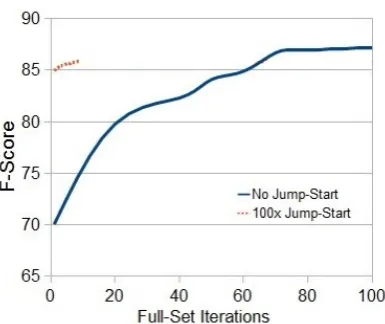
[image:7.595.313.506.75.237.2]To evaluate the effectiveness of the jump-start tech-nique, we ran the full ENG data set with K=4 to com-pare the results from the full training setup to jump-starting. For this, we performed 100 training iterations on the reduced training set (WSJ section 02) and then used the resultingθvalues to seed training on the full training set. Those training runs varied between three and nine iterations, and the results are shown in Figure 2. The full ENG K=4 F-score is 86.2, so these results represent a slight step back. Nonetheless, the technique is still valuable in that it allows for inferring latent an-notations for higher K-values than would typically be available to us in a reasonable timeframe.
Table 4 shows the results for the main experiments. Sampling a vanilla PCFG (K=1) produces results that are not state-of-the-art, but still good overall and al-ways better than an unsmoothed PCFG. The benefits of the latent annotations are further shown in the increase
Condition ENG CHI ITA KIN MLG Unsmoothed PCFG 69.9 66.8 62.1 45.9 49.2 Liang et al. 07 87.1 — — — — Huang & Harper09 — 84.1 — — — Bikel Parser 86.9 81.1 74.5 55.7 49.5 Berkeley Parser 90.1 83.4 71.6 61.4 51.8 Gibbs PCFG,K=1 79.3 75.4 66.3 58.5 55.1 Gibbs PCFG,K=2 82.6 79.8 69.3 65.0 57.0 Gibbs PCFG,K=4 86.0 82.3 71.9 67.2 57.8 Gibbs PCFG,K=16 87.2 83.2 72.4 68.1 58.2
Gibbs PCFG,K=32 87.4 83.4 71.0 66.8 55.3
[image:7.595.70.292.154.304.2]Table 4: F1 scores for experiments on sampled PCFGs. Note that Wang and Blunsom (2013) obtain an ENG F-score of 77.9% using collapsed VB for K=2. Though they do not give exact numbers, their Fig. 7 indicates an F-score of about 87% for K=16.
Figure 2: F-Score for K=4, varying full-set training it-erations (with and without 100x jump start).
of F1 score in all languages, as compared to the vanilla PCFG. Experiments were run up to K=32 primarily due to time constraint. Although previous literature results report increases up to the equivalent of K=64, it may be the case that higher K values with no merge step more easily lead to overfitting in our model – reduc-ing the effectiveness of those high values, as shown by the overall poorer performance on several languages at K=32 when compared to K=16 as well as the general levelling-off seen at the high K values.
For English and Chinese, the previous Bayesian framework parsers outperform our own, but only by around two points. Additionally, our parsing of Chi-nese improves on the Bikel parser (trained on our train-ing data) despite the fact that the Bikel parser makes use of language specific optimizations. Our parser needs no changes to switch languages.
The Gibbs PCFG with K=16 is superior to the strong Bikel and Berkeley Parser benchmarks for both KIN and MLG, a promising result for future work on pars-ing low-resource languages in general. Note also that our parser exhibits less variance than Berkeley Parser especially for KIN and MLG, which supports the fact that the variance of Berkeley Parser is higher for mod-els with few subcategories (Petrov et al., 2006).
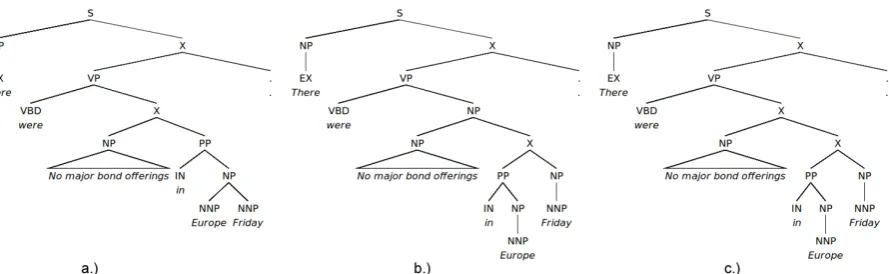
Examples of the improvement across latent annota-tions for a given tree are shown in Figure 3. The details of the noun phrase ‘no major bond offerings’ were the same for each tree, and are thus abstracted here. The low K-value tree (K=2) is shown in 3a, and primarily suffers from issues related to the prepositional phrase, ‘in Europe friday’. In particular, the low K-value tree incorrectly groups ‘Europe friday’ as a noun phrase ob-ject of ‘in’.
[image:7.595.72.289.587.695.2]Figure 3: Examples of tree progression in the Gibbs PCFG with a) K=2, b) K=8, and c) gold tree.
different mistake that the low K-value tree did not; it groups ‘no major bond offerings in Europe Friday’ as a noun phrase, when it should be three separate phrases (two noun phrases and a prepositional phrase). This er-ror may be related to the additional latent annotations. With more available noun phrase subtypes, it may be the case that a more unusual noun phrase could be per-mitted that would have been too low probability with only a few subtypes.
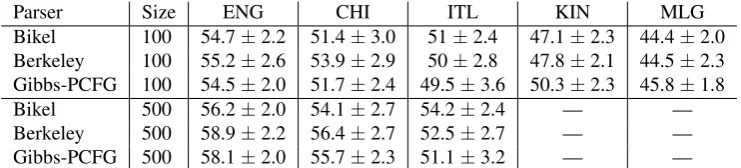
To determine whether the substantial range in F1 scores across languages are primarily the result of the much larger training corpora available for certain lan-guages, two extreme training set reduction experiments were conducted. The training sets for all languages were reduced to a total of either 100 or 500 sen-tences. This process was repeated 10 times in a cross-validation setup, where 10 separate sets of sentences were selected for each language. The results of these experiments are shown in Table 5.
We conclude that while data availability is a major factor in the higher performance of English and Chi-nese in our original experiments, it is not the only is-sue. Clearly, either the linguistic facts of particular languages or perhaps choices of formalism and annota-tion convenannota-tions in the corpora make some of the lan-guages more difficult to parse than others. The primary questions is why Gibbs-PCFG is able to achieve higher relative performance on the KIN/MLG datasets when compared to the other parsers, and why this advantage does not necessarily transfer to the extreme small-scale versions of the ENG/CHI/ITL data. Preliminary inves-tigation into the properties of the corpora have revealed a number of potential answers. For instance, the POS tagsets for KIN/MLG are substantially reduced com-pared to the other corpora, and there are differences in the branching factor of the native versions of the corpora as well: a typical maximum branching fac-tor for a tree in ENG/CHI/ITL is around 4-5, while for KIN/MLG it is almost always 2 (natively binary). Branching factors above 5 essentially never occur in KIN/MLG, while they are not rare in ENG/CHI/ITL. The question of exactly why the Gibbs-PCFG seems to perform well on these corpora remains an open ques-tion, but these differences could provide a starting point
Condition In-Domain Out-of-Domain Full English (K=4) 86.0 83.3 Small English (K=4) 76.6 75.7 Kinyarwanda (K=4) 67.2 65.1
[image:8.595.314.519.228.279.2]Malagasy (K=4) 57.8 55.4
Table 6: Effect of differing regimes for handling un-known words.
for future analysis.
In addition to the actual F1 scores, the relative uni-formity of the standard deviation results indicates that the individual parsers are not that much different in terms of their ability to provide consistent results at these small data extremes, as opposed to the slightly higher training levels where the Gibbs-PCFG generated smaller variances.
Considering the effects of unknown word handling, Table 6 shows that using the evaluation set when creat-ing the unknown word classifier does improve overall parsing accuracy when compared to an unknown word handler that is trained on out-of-domain texts. This shows that results reported in previous work somewhat overstate the accuracy of these parsers when used in the wild—which matters greatly in the low-resource set-ting.
6 Conclusion
sim-Parser Size ENG CHI ITL KIN MLG Bikel 100 54.7±2.2 51.4±3.0 51±2.4 47.1±2.3 44.4±2.0 Berkeley 100 55.2±2.6 53.9±2.9 50±2.8 47.8±2.1 44.5±2.3 Gibbs-PCFG 100 54.5±2.0 51.7±2.4 49.5±3.6 50.3±2.3 45.8±1.8 Bikel 500 56.2±2.0 54.1±2.7 54.2±2.4 — — Berkeley 500 58.9±2.2 56.4±2.7 52.5±2.7 — — Gibbs-PCFG 500 58.1±2.0 55.7±2.3 51.1±3.2 — —
Table 5: 100/500 sentence training set results, including st.dev over 10 runs. KIN/MLG did not have enough data to run the 500 sentence version.
ulated environment.
Having established this procedure and its relative tol-erance for low amounts of data, we would like to extend the model to make use of partial bracketing information instead of complete trees, perhaps in the form of Frag-mentary Unlabeled Dependency Grammar annotations (Schneider et al., 2013). This would allow the sam-pling procedure to potentially operate using corpora with lighter annotations than full trees, making initial annotation effort not quite as heavy and potentially in-creasing the amount of available data for low-resource languages. Additionally, using the expert partial anno-tations to help restrict the sample space could provide good gains in terms of training time.
Acknowledgments
Supported by the U.S. Army Research Office un-der grant number W911NF-10-1-0533. Any opin-ions, findings, and conclusions or recommendations expressed in this material are those of the author(s) and do not necessarily reflect the view of the U.S. Army Research Office.
References
Anita Alicante, Cristina Bosco, Anna Corazza, and Alberto Lavelli. 2012. A treebank-based study on the influence of Italian word order on pars-ing performance. In Nicoletta Calzolari (Con-ference Chair), Khalid Choukri, Thierry Declerck, Mehmet Uur Doan, Bente Maegaard, Joseph Mar-iani, Jan Odijk, and Stelios Piperidis, editors, Pro-ceedings of LREC’12, Istanbul, Turkey. European Language Resources Association (ELRA).
Emily M. Bender, Dan Flickinger, and Stephan Oepen. 2002. The Grammar Matrix: An Open-Source Starter-Kit for the Rapid Development of Cross-Linguistically Consistent Broad-Coverage Precision Grammars. In John Carroll, Nelleke Oostdijk, and Richard Sutcliffe, editors,Proceedings of the Work-shop on Grammar Engineering and Evaluation at the 19th International Conference on Computational Linguistics, pages 8–14, Taipei, Taiwan.
Dan Bikel. 2004a. On The Parameter Space of Gener-ative Lexicalized Statistical Parsing Models. Ph.D. thesis, University of Pennsylvania.
Daniel M Bikel. 2004b. Intricacies of Collins’ parsing model.Computational Linguistics, 30(4):479–511. Ezra Black, Fred Jelinek, John Lafferty, David M
Magerman, Robert Mercer, and Salim Roukos. 1992. Towards history-based grammars: Using richer models for probabilistic parsing. In Proceed-ings of the workshop on Speech and Natural Lan-guage, pages 134–139. Association for Computa-tional Linguistics.
Taylor L Booth and Richard A Thompson. 1973. Ap-plying probability measures to abstract languages.
Computers, IEEE Transactions on, 100(5):442–450. Cristina Bosco, Vincenzo Lombardo, Daniela Vassallo, and Leonardo Lesmo. 2000. Building a Treebank for Italian: a Data-driven Annotation Schema. InIn Proceedings of the Second International Conference on Language Resources and Evaluation LREC-2000 (pp. 99, pages 99–105.
Glenn Carroll and Eugene Charniak. 1992. Two exper-iments on learning probabilistic dependency gram-mars from corpora. Department of Computer Sci-ence, Univ.
Eugene Charniak. 1996. Tree-bank grammars. In Pro-ceedings of the National Conference on Artificial In-telligence, pages 1031–1036.
Eugene Charniak. 2000. A maximum-entropy-inspired parser. In Proceedings of the 1st North American chapter of the Association for Computa-tional Linguistics conference, pages 132–139. Asso-ciation for Computational Linguistics.
Noam Chomsky. 1956. Three models for the descrip-tion of language. Information Theory, IRE Transac-tions on, 2(3):113–124.
Shay B Cohen, Karl Stratos, Michael Collins, Dean P Foster, and Lyle Ungar. 2012. Spectral learning of latent-variable PCFGs. In Proceedings of the 50th Annual Meeting of the Association for Compu-tational Linguistics: Long Papers-Volume 1, pages 223–231. Association for Computational Linguis-tics.
Michael John Collins. 1996. A new statistical parser based on bigram lexical dependencies. In Proceed-ings of the 34th annual meeting on Association for Computational Linguistics, pages 184–191. Associ-ation for ComputAssoci-ational Linguistics.
Michael Collins. 1997. Three generative, lexicalised models for statistical parsing. InProceedings of the 35th Annual Meeting of the Association for Com-putational Linguistics and Eighth Conference of the European Chapter of the Association for Compu-tational Linguistics, pages 16–23. Association for Computational Linguistics.
Michael Collins. 2003. Head-driven statistical mod-els for natural language parsing.Computational lin-guistics, 29(4):589–637.
Jenny Rose Finkel, Christopher D Manning, and An-drew Y Ng. 2006. Solving the problem of cascading errors: Approximate Bayesian inference for linguis-tic annotation pipelines. InProceedings of the 2006 Conference on Empirical Methods in Natural Lan-guage Processing, pages 618–626. Association for Computational Linguistics.
Dan Garrette and Jason Baldridge. 2013. Learning a Part-of-Speech Tagger from Two Hours of Annota-tion. InProceedings of NAACL, Atlanta, Georgia. Dan Garrette, Jason Mielens, and Jason Baldridge.
2013. Real-World Semi-Supervised Learning of POS-Taggers for Low-Resource Languages. In Pro-ceedings of the 51th annual meeting on Associa-tion for ComputaAssocia-tional Linguistics. Association for Computational Linguistics.
Stuart Geman and Donald Geman. 1984. Stochas-tic relaxation, Gibbs distributions, and the Bayesian restoration of images.Pattern Analysis and Machine Intelligence, IEEE Transactions on, (6):721–741. Joshua T Goodman. 1998. Parsing Inside-Out.
Ph.D. thesis, Harvard University Cambridge, Mas-sachusetts.
Zhongqiang Huang and Mary Harper. 2009. Self-Training PCFG grammars with latent annotations across languages. InProceedings of the 2009 Con-ference on Empirical Methods in Natural Language Processing: Volume 2-Volume 2, pages 832–841. Association for Computational Linguistics.
Rebecca Hwa, Philip Resnik, and Amy Weinberg. Breaking the Resource Bottleneck for Multilingual Parsing. InThe Proceedings of the Workshop on Lin-guistic Knowledge Acquisition and Representation: Bootstrapping Annotated Language Data. Confer-ence on Language Resources and Evaluation. Mark Johnson, Thomas Griffiths, and Sharon
Gold-water. 2007. Bayesian inference for PCFGs via Markov Chain Monte Carlo. In Human Language Technologies 2007: The Conference of the North American Chapter of the Association for Computa-tional Linguistics; Proceedings of the Main Confer-ence, pages 139–146.
Mark Johnson. 1998. PCFG models of linguis-tic tree representations. Computational Linguistics, 24(4):613–632.
Dan Klein and Christopher D Manning. 2003. Ac-curate unlexicalized parsing. InProceedings of the 41st Annual Meeting on Association for Computa-tional Linguistics-Volume 1, pages 423–430. Asso-ciation for Computational Linguistics.
Jonas Kuhn. 2004a. Applying computational linguis-tic techniques in a documentary project for Qanjobal (Mayan, Guatemala). InIn Proceedings of LREC 2004. Citeseer.
Jonas Kuhn. 2004b. Experiments in parallel-text based grammar induction. InProceedings of the 42nd An-nual Meeting on Association for Computational Lin-guistics, page 470. Association for Computational Linguistics.
Karim Lary and Steve J Young. 1990. The estimation of stochastic context-free grammars using the inside-outside algrithm. Computer, Speech and Language, 4:35–56.
Percy Liang, Michael I Jordan, and Dan Klein. 2009. Probabilistic grammars and hierarchical Dirichlet processes. The handbook of applied Bayesian anal-ysis.
David M Magerman. 1995. Statistical decision-tree models for parsing. InProceedings of the 33rd an-nual meeting on Association for Computational Lin-guistics, pages 276–283. Association for Computa-tional Linguistics.
Mitchell P. Marcus, Beatrice Santorini, and Mary Ann Marcinkiewicz. 1993. Building a large annotated corpus of english: The penn treebank. COMPUTA-TIONAL LINGUISTICS, 19(2):313–330.
Takuya Matsuzaki, Yusuke Miyao, and Jun’ichi Tsu-jii. 2005. Probabilistic CFG with latent annotations. InProceedings of the 43rd Annual Meeting on Asso-ciation for Computational Linguistics, pages 75–82. Association for Computational Linguistics.
Fernando Pereira and Yves Schabes. 1992. Inside-outside reestimation from partially bracketed cor-pora. In Proceedings of the 30th annual meeting on Association for Computational Linguistics, pages 128–135. Association for Computational Linguis-tics.
Slav Petrov and Dan Klein. 2007. Improved Inference for Unlexicalized Parsing. In HLT-NAACL, pages 404–411.
Slav Petrov, Leon Barrett, Romain Thibaux, and Dan Klein. 2006. Learning accurate, compact, and interpretable tree annotation. In Proceedings of the 21st International Conference on Computational Linguistics and the 44th annual meeting of the As-sociation for Computational Linguistics, pages 433– 440. Association for Computational Linguistics. Elias Ponvert, Jason Baldridge, and Katrin Erk. 2011.
Simple Unsupervised Grammar Induction from Raw Text with Cascaded Finite State Models. In ACL, pages 1077–1086.
Nathan Schneider, Brendan O’Connor, Naomi Saphra, David Bamman, Manaal Faruqui, Noah A Smith, Chris Dyer, and Jason Baldridge. 2013. A framework for (under) specifying dependency syn-tax without overloading annotators. arXiv preprint arXiv:1306.2091.
Hiroyuki Shindo, Yusuke Miyao, Akinori Fujino, and Masaaki Nagata. 2012. Bayesian symbol-refined tree substitution grammars for syntactic parsing. In
Proceedings of the 50th Annual Meeting of the Asso-ciation for Computational Linguistics: Long Papers-Volume 1, pages 440–448. Association for Computa-tional Linguistics.
Matthew A Taddy. 2011. On estimation and selection for topic models.arXiv preprint arXiv:1109.4518. Pengyu Wang and Phil Blunsom. 2013. Collapsed
Variational Bayesian Inference for PCFGs. In Pro-ceedings of the Seventeenth Conference on Com-putational Natural Language Learning, pages 173– 182, Sofia, Bulgaria, August. Association for Com-putational Linguistics.