Limbic: Author-Based Sentiment Aspect Modeling Regularized with
Word Embeddings and Discourse Relations
Zhe Zhang
Watson Group IBM Corporation
Research Triangle Park, NC 27703-9141
Munindar P. Singh
Department of Computer Science North Carolina State University
Raleigh, NC 27695-8206
Abstract
We propose Limbic, an unsupervised proba-bilistic model that addresses the problem of discovering aspects and sentiments and asso-ciating them with authors of opinionated texts. Limbic combines three ideas, incorporating authors, discourse relations, and word embed-dings. For discourse relations, Limbic adopts a generative process regularized by a Markov Random Field. To promote words with high semantic similarity into the same topic, Lim-bic captures semantic regularities from word embeddings via a generalized P´olya Urn pro-cess. We demonstrate that Limbic (1) dis-covers aspects associated with sentiments with high lexical diversity; (2) outperforms state-of-the-art models by a substantial margin in topic cohesion and sentiment classification.
1 Introduction
How can we understand opinionated texts, e.g., so-cial media postings, expressing sentiments about various entities? Three phenomena are key. First, even for similar entities, authors may differ both on aspects and sentiments about those aspects. For example, when reviewing a hotel, Alice may consider aspects such as Concierge and Room, whereas Bob may consider aspects such asNearby
andRoom. Capturing similarities and differences among authors can help produce recommenda-tions for services that are better aligned with a user’s expectations (Wang et al., 2013). Second, reviews exhibit discourse structure, i.e., relations between propositions, which carries valuable in-formation about sentiment. Third, crucial relation-ships between rare words are lost because each re-view may be short and use distinct rare words.
Probabilistic topic models (Hofmann, 1999;
Blei et al.,2003) provide an unsupervised means to learn latent constructs from texts. Author-specific topic discovery associates texts with their
authors (Rosen-Zvi et al.,2004;Kim et al.,2012;
Diao and Jiang, 2013) but ignores sentiments. Sentiment analysis methods jointly model aspects and sentiments but exclude either authors ( Lazari-dou et al., 2013), discourse relations (Mukherjee et al.,2014;Poddar et al.,2017), or both (Jo and Oh,2011;Lin et al.,2012;Kim et al.,2013).
Word co-occurrence sparsity plagues existing approaches, which model documents as distribu-tions over latent topics and estimate them from word co-occurrence. Since word frequency fol-lows a power law, most words are rare and rep-resentative words of a topic rarely co-occur, es-pecially in short opinionated texts, despite seman-tic proximity. For example, a reviewer would not use bothspotlessandimmaculateto express a pos-itive sentiment toward the cleanliness of a hotel room. Losing information about word relatedness impedes learning effectiveness, producing topics that are not semantically cohesive.
We contribute Limbic, an unsupervised prob-abilistic model for discovering author-based as-pects and sentiments from opinionated texts that incorporates discourse-level topic modeling and semantic cohesion. (1) It associates authors and sentiment-aspect pairs by generating a mixture over sentiments and aspects for each author. (2) It captures discourse relations by applying a Markov Random Field over Sentiment Expression Units (SEUs), i.e., text elements describing sentiment-aspect pairs. (3) It promotes words with high semantic similarity into the same topic by incor-porating semantic regularities from word embed-dings using a generalized P´olya Urn process.
2 Model and Inference in Limbic
We now introduce our proposed model.
2.1 Sentiment Expression Unit (SEU)
Existing topic models represent documents as bags of words or as sentences. Bag-of-words mod-els, e.g., LDA (Blei et al., 2003), AT ( Rosen-Zvi et al., 2004), JST (Lin et al., 2012), JAST (Mukherjee et al.,2014), and AATS (Poddar et al.,
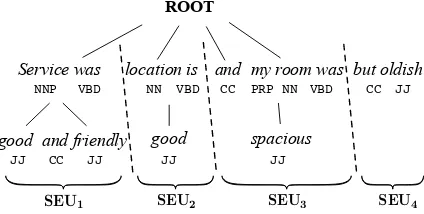
2017), rely on word co-occurrence at the docu-ment level, which is problematic when applied to opinionated texts. Sentence-based models, e.g., ASUM (Jo and Oh,2011), assume that words ap-pearing in a sentence belong to the same aspect and sentiment, which often fails to hold in real text. For instance, the TripAdvisor review sen-tence Service was good and friendly, location is good and my room was spacious but oldish, ex-hibits three aspects,Service,Location, andRoom, and two sentiments. Zhang and Singh’s (2014) segmentation algorithm leverages transition cues to convert sentences into segments. Although tran-sition cues are good indicators for capturing senti-ment change, their algorithm disregards syntactic information in sentences, which also helps reveal changes of aspects and sentiments.
ROOT
Service was
good and friendly
location is
good
and my room was
spacious
but oldish
NNP VBD
JJ CC JJ JJ
NN VBD CC PRP NN VBD
JJ
CC JJ
[image:2.595.76.288.447.554.2]SEU1 SEU2 SEU3 SEU4
Figure 1: Generate SEUs from a sentence.
We propose a concept of sentiment expression unit (SEU). Each SEU contains either a sentiment, or an aspect, or both. We extract SEUs by incor-porating both discourse and syntactic information. We first split sentences in reviews into snippets based on contradiction transition cues, such asbut. Then we apply a grammar parser on each snip-pet. We extract phrases from snippets by using two syntactic patterns commonly observed in opinion-ated texts including (1) existential (EX) with verb (VB) and adjective (JJ) and (2) noun (NN) with verb (VB) and adjective (JJ). If a phrase matches a pattern, we identify it as an SEU. Otherwise, the
phrase joins its following phrases iteratively un-til the combination matches a pattern. Figure 1
demonstrates the process of generating SEUs from the above hotel review sentence.
2.2 Discourse Relation
Markov Random Field (MRF) is a probabilistic framework to model statistical dependencies be-tween variables. Limbic applies an MRF to cap-ture the discourse relations between SEUs. Given a document containingN SEUs, let ai andsi be
the aspect and sentiment assignments of SEUi, respectively. Limbic creates an undirected edge
hsi,sjibetween the sentiment assignments of this
SEU and its preceding SEU. Letrbe the discourse relation between SEUs, Limbic imposes a binary potential on the edge.
Limbic focuses on two discourse relations fre-quently observed in opinionated texts: Compari-sonandExpansion. Comparison highlights promi-nent differences between two SEUs and often signals a change of sentiment regardless of the change of aspect. For example, in SEU1: {The location was great}and SEU2:{but it was just too noisy}, we see thatbutindicates a sentiment dif-ference. Other transition cues for Comparison in-cludehowever,in contrast, and such.
Expansion extends the discourse and indicates a continuation of sentiment across SEUs. For ex-ample, in SEU3:{There are no safes here which is unfortunate}and SEU4:{And speaking of un-fortunate, the breakfast is hardly impressive}, we see thatandandunfortunateindicate the negative sentiment in SEU3continues toward aspect Break-fastin SEU4. Other transition cues for Expansion includealso,moreover, and such.
Formally,Rr,i,j asserts discourse relationr be-tween SEUi and SEUj. For Comparison, Rc,i,j
holds ifsi 6=sj, SEUj contains Comparison cues,
and (1) SEUjcontains syntactic patterns described
in Section2.1 andai 6= aj or (2) SEUj contains
incomplete syntactic patterns andai =aj.
For Expansion, Re,i,j holds if si = sj, SEUj
contains Expansion cues, and (1) SEUj contains
syntactic patterns andai = aj or (2) SEUj
con-tains incomplete syntactic patterns andai 6=aj.
p(s|θd) = Y
i
p(si|θd)
exp{λ
R X
r=1
(I(Rr,i−1,i))},
(1)
whereRis the number of discourse relation types; θdis the sentiment distribution ofd;I is an
iden-tity function that returns1 if its argument is true; λcontrols reinforcing the effects of discourse re-lations.
Take the expansion relation, for example. Dur-ing the samplDur-ing process, Equation 1generates a large value if two SEUs share an expansion rela-tion and have the same sentiments and yields a small value if the two SEUs have different senti-ments. Therefore, SEUs in an expansion relation have a high probability to be associated with the same sentiment.
2.3 Generative Process
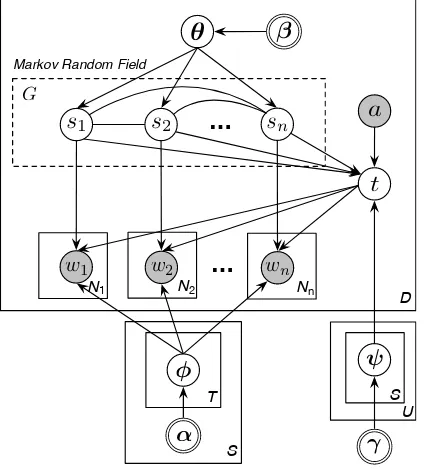
Figure2shows Limbic’s model. WithDir(·)and Mul(·)as Dirichlet and multinomial distributions, hyperparameterαis the Dirichlet prior of the word distributionφ,β is the Dirichlet prior of the senti-ment distributionθ, andγ is the Dirichlet prior of the aspect distributionψ. Given a set of reviews D written by a set of authors U with regards to a set of aspects T and a set of sentimentsS, the generative process in Limbic is as follows.
S n N 2 N 1 N D
✓
t a w1 … U S T ↵s
1s
2s
nw2 … wn
Markov Random Field
G
Figure 2: Generative process of Limbic.
First, for each pair of aspecttand sentiments,
draw a word distributionφt,s ∼Dir(α). Second,
for each author aand each sentiment s, draw an aspect distributionψs,a ∼ Dir(γ). Third, given
a review dwritten by a, draw a sentiment distri-bution θd ∼ Dir(β), and for each SEU in d, (a)
choose a sentimentsusing Equation1; (b) given s, choose an aspectt∼Mul(ψs,a); (c) giventand
s, sample wordw∼Mul(φt,s).
2.4 Model Inference
Limbic estimatesp(s,t|w,a), the posterior distri-bution of latent variables, sentimentssand aspects
t, given all words used in reviews written by au-thor a. We factor the joint probability of the as-signments of sentiments, aspects, and words fora:
p(s,t,w|a,α,β,γ)
=p(w|s,t,α)p(t|s,a,γ)p(s|β). (2)
By integrating overΦ = {φi}Si=1×T, we calculate
the first term of Equation2as follows.
p(w|s,t,α)=
Z
p(w|s,t,Φ)p(Φ|α)dΦ
= Γ(
PW w=1αw) QW
w=1Γ(αw) !S×T
× S Y s=1 T Y t=1 QW
w=1Γ(nws,t+αw)
ΓPWw=1(nw s,t+αw)
,
(3)
where W is the size of the vocabulary; nw s,t
equals the number of occurrences of the wordw that are assigned to sentimentsand aspectt; and Γ(·)is the Gamma function.
Next, by integrating over Ψa = {ψi}Si=1, we
calculate the second term in Equation2as follows.
p(t|s,γ,a)=
Z
p(t|s,Ψa,a)p(Ψa|γ)dΨa
= Γ(
PT t=1γt)
QT
t=1Γ(γt)
!S × S Y s=1 QT
t=1Γ(nts,a+γt)
ΓPTt=1(nt s,a+γt)
,
(4)
wherent
s,aequals the number of SEUs in author
a’s reviews associated with sentimentsand aspect t.
Similarly, for the third term in Equation 2, by integrating overΘ ={θi}Di=1, we obtain
p(s|β)=
Z
p(s|Θ)p(Θ|β)dΘ
= Γ(
PS s=1βs)
QS
s=1Γ(βs)
!D × D Y d=1 QS
s=1Γ(nsd+βs)
ΓPSs=1(ns d+βs)
× L Y
l=1
exp{λ
R X
r=1
(I(Rr,i−1,i))},
[image:3.595.77.289.484.719.2]where D is the number of reviews; ns d is the
number of times that an SEU from reviewdis as-sociated with sentiments; andndis the number of
SEUs in reviewd;Lis the number of SEUs. We obtain the conditional probability for avia Gibbs sampling (Liu,1994)
p(si =s,ti =t|s−i,t−i,w,a)
∝ n
t
s,a,−i+γt PT
t=1(nts,a,−i+γt)
× n
s
d,−i+βs PS
s=1(nsd,−i+βs)
× Q
v
QCvi−1
c=0 (nvt,s,−i+αv+c) QCi−1
c=0 (nt,s,−i+
PW
w=1αw+c)
×exp{λ
R X
r=1
(I(Rr,i−1,i))}
(6)
where nt
s,a, as in Equation 4, is the number of
SEUs associated with sentiment s and aspect t from reviews written by authora;ns
dis the number
of SEUs from reviewdassociated with sentiment s;Ci is the number of words in SEUi; Cvi is the
number of words v in SEUi; nvt,s is the number
of wordsvassigned sentimentsand aspectt;nt,s
is the number of words assigned sentimentsand aspecttin all reviews; an index of −imeans we exclude SEUi from the count;R,I, andRare as
in Equation1.
Equations7,8, and9, respectively, approximate the probabilities of wordwoccurring given senti-mentsand aspectt; of aspecttof an SEU occur-ring given sentimentsand authora; of sentiment soccurring given documentd.
φs,t,w =
nw s,t+αw PW
w=1(nws,t+αw)
. (7)
ψs,t,a=
nt s,a+γt PT
t=1(nts,a+γt)
. (8)
θd,s =
ns d+βs PS
s=1(nsd+βs)
. (9)
Incorporating Word Embeddings. Word em-bedding approaches (Mikolov et al., 2013; Pen-nington et al.,2014) leverage local contextual in-formation surrounding words to map the words into continuous vector representations. Word em-beddings are known to effectively capture seman-tic and syntacseman-tic regularities among words. Based on word embeddings trained using Word2Vec on
a hotel review dataset, we observe that the gen-erated word embeddings correctly link opinion-ated words that are semantically correlopinion-ated even though they do not co-occur frequently. For ex-ample, the three closest words ofspotlessare im-maculate,clean, andwell appointed.
A Generalized P´olya Urn Process. To promote words with high semantic similarity into the same topic, Limbic incorporates semantic regularities from word embeddings using a generalized P´olya Urn process (Mimno et al.,2011). Start with an urn containing colored balls. At each time step, randomly choose a ball from the urn, observe its color, and return it to the urn with one replicated ball of the same color. A P´olya Urn model de-scribes a random sampling process with reinforce-ment. In a generalized P´olya Urn process, given a sampled ball with a color, we put back that ball along with a certain number of balls of similar col-ors. When applied to document generation, balls of different colors represent distinct words. The similarity of colors represents semantic similarity of the words.
Given wordsvandwin vocabularyW, we com-pute their semantic similaritysim(v,w)based on the cosine similarity between their word embed-dings. For wordv, we create its similarity word set Sv by adding all words w ∈ W for which
sim(v,w)is higher than a predefined threshold. During sampling, if wordvis drawn, we reinforce w ∈ Sv via a predefined weightρ which controls
the reinforcement of semantically similar words.
3 Evaluation
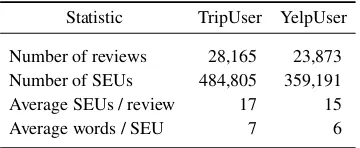
[image:5.595.91.271.267.341.2]To assess Limbic’s effectiveness, we prepare on-line review datasets from two domains. User is a collection of hotel reviews from Trip-Advisor. It contains 28,165 reviews posted by 202 randomly selected reviewers, each of whom contributes at least 100 hotel reviews. YelpUser is a set of restaurant reviews from Yelp Dataset Challenge (2017). It contains 23,873 restaurant reviews posted by 144 users, each of whom con-tributes at least 100 reviews. Table1reports statis-tics on the datasets.
Table 1: Summary of the evaluation datasets.
Statistic TripUser YelpUser
Number of reviews 28,165 23,873
Number of SEUs 484,805 359,191
Average SEUs / review 17 15
Average words / SEU 7 6
We remove stop words and HTML tags, expand typical abbreviations, and mark special named entities using a rule-based algorithm (e.g., re-place a monetary amount by #MONEY#) and the Stanford Named Entity Recognizer (Finkel et al., 2005). To handle negation, we employ the Stanford Dependency Parser to detect nega-tions. For any word in a negation relation, we add the negated term as a prefix of the word, e.g.,
not work. Finally, we split each review into SEUs. Datasets and source code are publicly available for research purposes (Limbic,2018).
3.1 Parameter Settings
Limbic includes three hand-tuned hyperparame-ters that influence its sampling via a smoothing ef-fect on the associated multinomial distribution. It uses a short list of sentiment words shown in Ta-ble2as prior knowledge to set asymmetric priors. Consider hyperparameterα, the Dirichlet prior of the word distribution. For any word in the pos-itive list, α = 0 if the word appears in an SEU assigned a negative sentiment, and α = 5 if the word appears in an SEU assigned a positive sen-timent, and conversely for words in the negative list. For all remaining words, we set α = 0.05. And, hyperparameter β = 5 for both sentiments is the Dirichlet prior of the sentiment distribution. UsingT as the number of aspects, hyperparame-terγ = 50T is the Dirichlet prior of the aspect
dis-Table 2: Sentiment words used as prior knowledge.
Positive
good, nice, excellent, positive, fortunate, correct, free, love attractive, awesome, perfect, comfortable, enjoy, amazing fun, glad, great, happy, impressive, superior, thank, best satisfied, worth, not bad, recommend, fantastic, favorite
Negative
bad, nasty, poor, negative, unfortunate, wrong, inferior slow, junk, mess, not good, not like, not recommend unacceptable, upset, waste, small, worthless, problem complain, terrible, trouble, regret, annoying, not worth sorry, disappointed, worst, hate
tribution. We set the number of sentiments,S, to two (positive and negative), although our approach generalizes to additional sentiment categories.
For each fold in cross validation, we pretrain two sets of Word2Vec (Mikolov et al.,2013) word embeddings with 300 dimensions and a window size of five using the training split in TripUser (hotels) and YelpUser (restaurants). We exclude words with frequency lower than three. We set the reinforcement weightρto 0.3 and 0.1 for hotel and restaurant reviews, respectively, and set the simi-larity thresholdto 0.6. For all models, we per-form 1,000 Gibbs iterations with a burn-in phase of 200 and a sampling gap of 50 iterations.
3.2 Sentiment Aspect Discovery
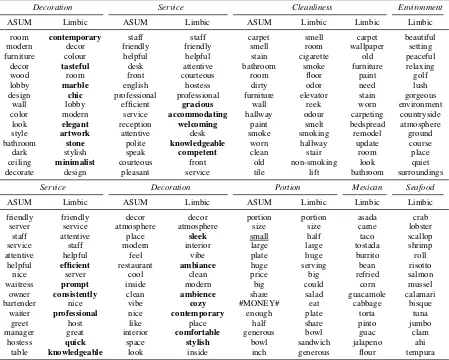
Our first experiment shows how Limbic discovers sentiment-aspect pairs. We apply Limbic and all baseline models (AT, JST, ASUM, and AATS) to TripUser and YelpUser with the number of aspects set to 30. We manually assign an aspect for each cluster of words. ASUM generates the best results among baseline models. For brevity, we show only some aspects identified by Limbic and ASUM.
Table3(top) shows the results on hotel reviews. We see that Limbic discovers word clusters with higher lexical diversity than ASUM. For example, for aspectDecoration, in addition to words,decor,
modernanddesign, Limbic discovers words con-temporary, minimalist, chic, and so on. For as-pectService, comparing with ASUM, Limbic ex-tracts an expanded list of sentiment words includ-ingcompetent,knowledgeable, and so on.
Limbic discovers finer and more distinctive word clusters than ASUM. For example, for aspect
Table 3: Top words discovered from hotel (top section) and restaurant (bottom section) reviews.
Decoration Service Cleanliness Environment
ASUM Limbic ASUM Limbic ASUM Limbic Limbic Limbic
room contemporary staff staff carpet smell carpet beautiful
modern decor friendly friendly smell room wallpaper setting
furniture colour helpful helpful stain cigarette old peaceful
decor tasteful desk attentive bathroom smoke furniture relaxing
wood room front courteous room floor paint golf
lobby marble english hostess dirty odor need lush
design chic professional professional furniture elevator stain gorgeous
wall lobby efficient gracious wall reek worn environment
color modern service accommodating hallway odour carpeting countryside
look elegant reception welcoming paint smelt bedspread atmosphere
style artwork attentive desk smoke smoking remodel ground
bathroom stone polite knowledgeable worn hallway update course
dark stylish speak competent clean stair room place
ceiling minimalist courteous front old non-smoking look quiet
decorate design pleasant service tile lift bathroom surroundings
Service Decoration Portion Mexican Seafood
ASUM Limbic ASUM Limbic ASUM Limbic Limbic Limbic
friendly friendly decor decor portion portion asada crab
server service atmosphere atmosphere size size carne lobster
staff attentive place sleek small half taco scallop
service staff modern interior large large tostada shrimp
attentive helpful feel vibe plate huge burrito roll
helpful efficient restaurant ambiance huge serving bean risotto
nice server cool clean price big refried salmon
waitress prompt inside modern big could corn mussel
owner consistently clean ambience share salad guacamole calamari
bartender nice vibe cozy #MONEY# eat cabbage bisque
waiter professional nice contemporary enough plate torta tuna
greet host like place half share pinto jumbo
manager great interior comfortable generous bowl guac clam
hostess quick space stylish bowl sandwich jalapeno ahi
table knowledgeable look inside inch generous flour tempura
Cleanliness. One cluster contains words, such as
smokeandreek, which describe bad odor in room and hallway. The other cluster contains words such as,wornandstain, describes negative senti-ments toward carpets. By capturing word semantic relatedness, Limbic discovers highly diverse as-pects, including those that arise rarely in reviews, such as peaceful, relaxing, and lush, as positive words describing aspectEnvironment.
Limbic yields promising results for restaurant reviews. In Table3(bottom), we see that Limbic yields more specific sentiment words than ASUM. AspectServicein Limbic contains additional pos-itive words,efficient,prompt,knowledgeable, and so on. For aspect Decoration, Limbic produces
sleek,ambiance, and so on. By incorporating con-straints from discourse relations, Limbic yields as-pects that are more sentiment coherent. For exam-ple, we see that positive aspectPortionin ASUM contains the negative wordsmallwhereas words in aspectPortionin Limbic are all positive.
We observe that restaurants associate more
complex aspects than hotels—presumably, be-cause of the large variety of cuisines and thus, on average, smaller data relevant to a cuisine. Titov and McDonald’s (2008b) Multi-Grain LDA (MG-LDA) model performs well for hotel reviews but discovers only few ratable aspects from restaurant reviews, which they ascribe to the relatively small occurrences of words describing aspects for spe-cific cuisines (e.g.,Italian) and general categories (e.g.,Meat), compared with the words describing major aspects, such asService. In contrast, Limbic discovers words describing specific cuisines, such asMexicanandSeafood.
3.3 Quantitative Evaluation
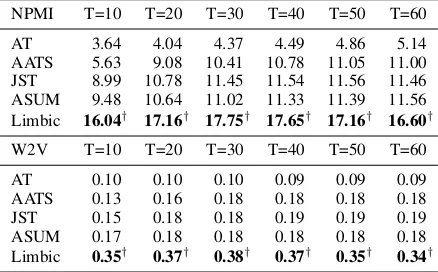
Table 4: Topic coherence: Hotel reviews.
NPMI T=10 T=20 T=30 T=40 T=50 T=60
AT 3.64 4.04 4.37 4.49 4.86 5.14 AATS 5.63 9.08 10.41 10.78 11.05 11.00 JST 8.99 10.78 11.45 11.54 11.56 11.46 ASUM 9.48 10.64 11.02 11.33 11.39 11.56 Limbic 16.04† 17.16† 17.75† 17.65† 17.16† 16.60†
W2V T=10 T=20 T=30 T=40 T=50 T=60
[image:7.595.71.292.275.481.2]AT 0.10 0.10 0.10 0.09 0.09 0.09 AATS 0.13 0.16 0.18 0.18 0.18 0.18 JST 0.15 0.18 0.18 0.19 0.19 0.19 ASUM 0.17 0.18 0.18 0.18 0.18 0.18 Limbic 0.35† 0.37† 0.38† 0.37† 0.35† 0.34†
Table 5: Topic coherence: Restaurant reviews.
NPMI T=10 T=20 T=30 T=40 T=50 T=60
AT 5.64 5.21 5.30 5.65 6.54 7.94 AATS 6.05 8.02 9.03 9.35 9.90 9.95 JST 9.46 11.13 11.73 11.92 12.14 12.31
ASUM 8.81 9.7 9.92 10.09 10.07 10.04 Limbic 11.72† 13.41† 13.77† 13.06† 12.08 11.30
W2V T=10 T=20 T=30 T=40 T=50 T=60
AT 0.16 0.15 0.14 0.13 0.13 0.14 AATS 0.11 0.14 0.16 0.17 0.18 0.18 JST 0.21 0.21 0.20 0.20 0.20 0.19 ASUM 0.20 0.19 0.18 0.18 0.17 0.17 Limbic 0.28† 0.29† 0.27† 0.25† 0.25† 0.25†
Yang et al., 2017). More recently, O’Callaghan et al. (2015) propose a topic coherence measure, W2V, based on word embeddings. For complete-ness, we adopt both metrics. Topics with higher scores of NPMI and W2V are semantically more coherent. We compare Limbic with four baselines: AT, JST, ASUM, and AATS, using both TripUser and YelpUser based on the top 15 words in each sentiment-aspect pair. For each number of aspects, we perform five-fold cross-validation. We perform the two-tailed exact permutation test (Good,2005) on the improvement of Limbic over the best per-forming baseline. (Throughout, ∗ and † indicate significance at 0.05 and 0.001, respectively.)
Table4 shows average NPMI and W2V scores of each model on hotel reviews for different num-bers of aspects. We observe that Limbic statisti-cally outperforms the other models for both met-rics in all settings. Limbic yields substantial im-provements, with average gains over the second best models of 6.00 and 0.18 in NPMI and W2V, respectively, which validates that the incorpora-tion of semantic regularities helps Limbic promote semantically equivalent and related words into the same aspect-sentiment pair. Of the baseline mod-els, AT yields the lowest topic coherence. AATS outperforms AT but does not perform well when
the number of aspects is small, possibly due to the undesirable mixture of words with different aspects, topics, and sentiments in individual sen-tences. ASUM, and JST yield comparable results that are consistently better than AATS. Table 5
shows similar conclusions for restaurant reviews.
3.4 Sentiment Classification
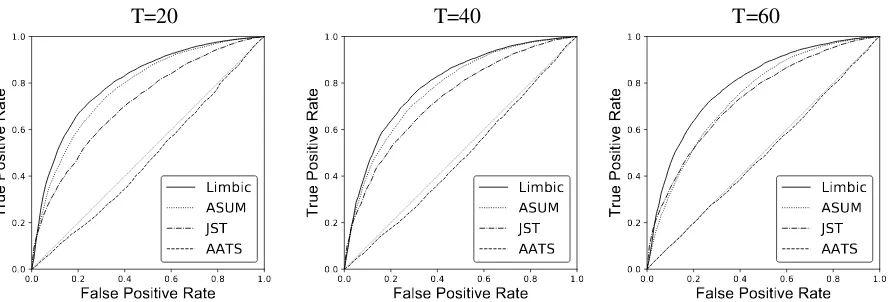
We now evaluate Limbic for document-level sen-timent classification vis `a vis JST, ASUM, and AATS. For comparison purposes, we add a super-vised baseline, BiLSTM, using the bidirectional LSTM model (Schuster and Paliwal, 1997). Bi-LSTM uses 100 as hidden state size and 0.2 as both the recurrent dropout rate and the dropout rate in the last layer. For training, we run 20 epochs with a minibatch size of 1,000. We use two datasets, TripUser and YelpUser. To collect ground-truth labels, we use integer ratings (three and above as positive and rest as negative). Note that our review datasets are imbalanced. Our re-sults are based on five-fold cross-validation (80% of each author’s reviews for training and 20% for testing) with the two-tailed exact permuta-tion test. As our principal evaluation metrics, we adopt accuracy; the receiver operating char-acteristic (ROC) curve; and area under the curve (AUC). ROC and AUC are standard metrics used for evaluating classifiers on data with class imbal-ance (Bradley,1997;Hoens and Chawla,2013).
Lim-Table 6: Accuracy and AUC of sentiment classification on hotel reviews.
T=10 T=20 T=30 T=40 T=50 T=60
Accuracy AUC Accuracy AUC Accuracy AUC Accuracy AUC Accuracy AUC Accuracy AUC
BiLSTM 0.907 0.820 0.907 0.820 0.907 0.820 0.907 0.820 0.907 0.820 0.907 0.820
AATS 0.729 0.485 0.794 0.454 0.809 0.443 0.824 0.475 0.835 0.468 0.839 0.482
JST 0.601 0.813 0.609 0.818 0.634 0.826 0.641 0.830 0.654 0.835 0.665 0.836
ASUM 0.793 0.828 0.804 0.832 0.819 0.829 0.835 0.838 0.850 0.835 0.872 0.829
[image:8.595.74.526.85.170.2]Limbic 0.838† 0.849* 0.859† 0.853* 0.868† 0.857* 0.870† 0.859* 0.885† 0.858* 0.890 0.858*
Table 7: Accuracy and AUC of sentiment classification on restaurant reviews.
T=10 T=20 T=30 T=40 T=50 T=60
Accuracy AUC Accuracy AUC Accuracy AUC Accuracy AUC Accuracy AUC Accuracy AUC
BiLSTM 0.876 0.841 0.876 0.841 0.876 0.841 0.876 0.841 0.876 0.841 0.876 0.841
AATS 0.763 0.500 0.789 0.472 0.785 0.474 0.804 0.477 0.813 0.499 0.816 0.492
JST 0.579 0.708 0.589 0.713 0.595 0.724 0.606 0.731 0.629 0.727 0.642 0.733
ASUM 0.773 0.775 0.799 0.778 0.811 0.778 0.836 0.775 0.859 0.752 0.867 0.744
Limbic 0.872† 0.797* 0.873†
0.803† 0.874† 0.795† 0.876† 0.795† 0.877† 0.798‡ 0.876† 0.794†
bic achieves the best tradeoff between positive and negative sentiment classes.
3.5 Model Analysis
To understand the contributions of incorporating authors, discourse relations, and word embed-dings, we evaluate variants of Limbic for SEU-level sentiment classification on two datasets: tSEU and tSEU(D). We create tSEU by randomly selecting 200 hotel reviews by seven authors. We manually annotate the sentiments of each SEU, obtaining 2,692 SEUs. We create tSEU(D) by se-lecting reviews in tSEU containing at least one Comparison or Expansion. We define three vari-ants of Limbic (L): LAwith just authors, no dis-course relations or word embeddings; LAD with authors and discourse relations but no word em-beddings; LAWwith authors and word embeddings but no discourse relations. Table8compares Lim-bic with LA LAD, and LAW. We observe that for both datasets, incorporating discourse relations improves accuracy. By incorporating word em-beddings, LAW yields better accuracy than LAD, showing that word embeddings add more value to Limbic than discourse relations do.
Table8(lower part) reports p-values (two-tailed test using aχ2distribution) from McNemar’s Test
on pairwise comparisons (Alpaydin,2010, p. 501). We see that Limbic is significantly different from each variant, including LA(omitted for space).
3.6 Related Work
[image:8.595.71.527.206.287.2]Sentiment and aspect discovery are often based on Latent Dirichlet Allocation (LDA) (Blei et al.,
Table 8: SEU sentiment classification accuracy.
Accuracy LA LAD LAW L
tSEU 0.702 0.723 0.733 0.750
tSEU(D) 0.692 0.715 0.716 0.735
p value LAD:LA LAW:LA LAD:LAW L:LAD L:LAW
tSEU 0.015 0.003 0.331 0.005 0.002
tSEU(D) 0.017 0.042 0.934 0.055 0.003
2003). LDA represents a document (for us, a re-view) as a mixture of topics, each topic being a multinomial distribution over words. The learn-ing process approximates the topic and word dis-tributions based on their co-occurrence in docu-ments. Titov and McDonald’s (2008b) model han-dles global and local topics involved in documents, and their (2008a) framework discovers topics us-ing aspect ratus-ings provided by reviewers. JST (Lin et al.,2012) and ASUM (Jo and Oh,2011) model a review via multinomial distributions of topics and sentiments and use them to condition the proba-bility of generating words. Kim et al. (2013) ex-tend ASUM by allowing its probabilistic model to discover a hierarchical structure of aspect-based sentiments. Lazaridou et al. (2013) introduce dis-course transitions into the document generating process as aspect and sentiment shifters. Although the above models produce good results, they omit author information, which is an intrinsic attribute of opinionated texts.
[image:8.595.314.518.330.427.2]T=20 T=40 T=60
0.0 0.2 0.4 0.6 0.8 1.0
False Positive Rate
0.0 0.2 0.4 0.6 0.8 1.0
True Positive Rate
Limbic ASUM JST AATS
0.0 0.2 0.4 0.6 0.8 1.0
False Positive Rate
0.0 0.2 0.4 0.6 0.8 1.0
True Positive Rate
Limbic ASUM JST AATS
0.0 0.2 0.4 0.6 0.8 1.0
False Positive Rate
0.0 0.2 0.4 0.6 0.8 1.0
True Positive Rate
[image:9.595.76.521.62.211.2]Limbic ASUM JST AATS
Figure 3: ROC curves comparing the performance of three models on hotel reviews.
T=20 T=40 T=60
0.0 0.2 0.4 0.6 0.8 1.0
False Positive Rate
0.0 0.2 0.4 0.6 0.8 1.0
True Positive Rate
Limbic ASUM JST AATS
0.0 0.2 0.4 0.6 0.8 1.0
False Positive Rate
0.0 0.2 0.4 0.6 0.8 1.0
True Positive Rate
Limbic ASUM JST AATS
0.0 0.2 0.4 0.6 0.8 1.0
False Positive Rate
0.0 0.2 0.4 0.6 0.8 1.0
True Positive Rate
Limbic ASUM JST AATS
Figure 4: ROC curves comparing the performance of three models on restaurant reviews.
in a document, AT conditions the probability of the topic assignment on the author of the document. Kim et al.’s (2012) topic model captures entities mentioned in documents and models the probabil-ity of generating a word as conditioned on both entity and topic. Diao and Jiang’s (2013) jointly model topics, events, and users on Twitter. Al-though these models capture the author associated with a text, they do not handle sentiments.
Mukherjee et al.’s (2014) JAST model jointly considers authors, sentiments, topics, and ratings. JAST does not consider discourse relations and word semantic similarity in its generative process. Poddar et al. (2017) propose a model that jointly considers author, aspect, sentiment, and the non-repetitive generation of aspect sequences. The model uses a Bernoulli process to capture the non-repetitive nature of aspect sequences. This mecha-nism does not consider discourse relations or syn-tactic information.
4 Conclusion and Discussion
Limbic provides an unsupervised method to dis-cover aspects and sentiments from opinionated
texts. By incorporating authors as a factor, Limbic allows for reviews written by the same or similar authors to exhibit an idiosyncratic preference to-ward certain aspects and sentiments. It assigns as-pects of SEUs by sampling author-specific aspect distributions. This makes the model more suitable for opinionated texts in which aspects and sen-timents are tightly bound to authors who follow their specific criteria and preferences when writ-ing reviews. By incorporatwrit-ing a Markov Random Field and word embeddings into its sampling pro-cess, Limbic imposes constraints associated with discourse relations, effectively captures word se-mantic relatedness, and generates word clusters with high topic cohesion and lexical diversity. In future work, we plan to extend Limbic to capture long-distance discourse relations and the influence decay of discourse relations between SEUs as their distance increases.
5 Acknowledgments
[image:9.595.77.521.243.394.2]References
Ethem Alpaydin. 2010. Introduction to Machine Learning, 2nd edition. MIT Press, Cambridge, Mas-sachusetts.
David M. Blei, Andrew Y. Ng, and Michael I. Jordan. 2003. Latent Dirichlet allocation. Journal of Ma-chine Learning Research, 3:993–1022.
Piotr Bojanowski, Edouard Grave, Armand Joulin, and Tomas Mikolov. 2017. Enriching word vectors with subword information. Transactions of the Associa-tion for ComputaAssocia-tional Linguistics, 5:135–146.
Andrew P. Bradley. 1997. The use of the area under the ROC curve in the evaluation of machine learning algorithms.Pattern Recognition, 30(7):1145–1159.
Qiming Diao and Jing Jiang. 2013. A unified model for topics, events and users on Twitter. In Proceed-ings of the18thConference on Empirical Methods in Natural Language Processing (EMNLP), pages 1869–1879, Seattle.
Jenny Rose Finkel, Trond Grenager, and Christo-pher D. Manning. 2005. Incorporating non-local information into information extraction systems by Gibbs sampling. InProceedings of the43rdAnnual Meeting of the Association for Computational Lin-guistics (ACL), pages 363–370, Ann Arbor.
Phillip I. Good, editor. 2005. Permutation, Paramet-ric, and Bootstrap Tests of Hypotheses, 3rd edition. Springer Series in Statistics. Springer-Verlag, New York.
T. Ryan Hoens and Nitesh V. Chawla. 2013. Imbal-anced datasets: From sampling to classifiers. In Haibo He and Yunqian Ma, editors, Imbalanced Learning: Foundations, Algorithms, and Applica-tions, pages 43–59. John Wiley & Sons, Hoboken, New Jersey.
Thomas Hofmann. 1999. Probabilistic latent semantic analysis. InProceedings of15thConference on Un-certainty in Artificial Intelligence (UAI), pages 289– 296, Stockholm.
Yohan Jo and Alice Haeyun Oh. 2011. Aspect and sen-timent unification model for online review analysis. In Proceedings of the4th ACM International Con-ference on Web Search and Data Mining (WSDM), pages 815–824, Hong Kong.
Hyungsul Kim, Yizhou Sun, Julia Hockenmaier, and Jiawei Han. 2012. ETM: Entity topic models for mining documents associated with entities. In Pro-ceedings of the12thIEEE International Conference on Data Mining (ICDM), pages 349–358, Brussels.
Suin Kim, Jianwen Zhang, Zheng Chen, Alice H. Oh, and Shixia Liu. 2013. A hierarchical aspect-sentiment model for online reviews. In Proceed-ings of the 27th AAAI Conference on Artificial In-telligence (AAAI), pages 804–812, Bellevue.
Jey Han Lau, David Newman, and Timothy Baldwin. 2014. Machine reading tea leaves: Automatically evaluating topic coherence and topic model quality. InProceedings of the14thConference of the Euro-pean Chapter of the Association for Computational Linguistics (EACL), pages 530–539, Gothenburg.
Angeliki Lazaridou, Ivan Titov, and Caroline Sporleder. 2013. A Bayesian model for joint unsupervised induction of sentiment, aspect and discourse representations. In Proceedings of the
51stAnnual Meeting of the Association for Compu-tational Linguistics (ACL), pages 1630–1639, Sofia, Bulgaria.
Limbic. 2018. https://research.csc.ncsu.edu/mas/code/ limbic/. Accessed: 08/23/2018.
Chenghua Lin, Yulan He, Richard Everson, and Ste-fan M. R¨uger. 2012. Weakly supervised joint sentiment-topic detection from text. IEEE Trans-actions on Knowledge and Data Engineering, 24(6):1134–1145.
Jun S. Liu. 1994. The collapsed Gibbs sampler in Bayesian computations with applications to a gene regulation problem. Journal of the American Statis-tical Association, 89(427):958–966.
Tomas Mikolov, Ilya Sutskever, Kai Chen, Gregory S. Corrado, and Jeffrey Dean. 2013. Distributed rep-resentations of words and phrases and their compo-sitionality. InProceedings of the27thAnnual Con-ference on Neural Information Processing Systems (NIPS), pages 3111–3119, Lake Tahoe.
David M. Mimno, Hanna M. Wallach, Edmund M. Talley, Miriam Leenders, and Andrew McCallum. 2011. Optimizing semantic coherence in topic mod-els. InProceedings of the16thConference on Em-pirical Methods in Natural Language Processing (EMNLP), pages 262–272, Edinburgh.
Subhabrata Mukherjee, Gaurab Basu, and Sachindra Joshi. 2014. Joint author sentiment topic model. In
Proceedings of the14thInternational Conference on Data Mining (SDM), pages 370–378, Philadelphia.
Dat Quoc Nguyen, Richard Billingsley, Lan Du, and Mark Johnson. 2015a. Improving topic models with latent feature word representations. Transac-tions of the Association for Computational Linguis-tics (TACL), 3:299–313.
Thang Nguyen, Jordan L. Boyd-Graber, Jeffrey Lund, Kevin D. Seppi, and Eric K. Ringger. 2015b. Is your anchor going up or down? Fast and accurate super-vised topic models. InProceedings of the16th An-nual Conference of the North American Chapter of the Association for Computational Linguistics: Hu-man Language Technologies (NAACL-HLT), pages 746–755, Denver.
Jeffrey Pennington, Richard Socher, and Christo-pher D. Manning. 2014. GloVe: Global vectors for word representation. In Proceedings of the
19th Conference on Empirical Methods in Natural Language Processing (EMNLP), pages 1532–1543, Doha.
Lahari Poddar, Wynne Hsu, and Mong-Li Lee. 2017.
Author-aware aspect topic sentiment model to re-trieve supporting opinions from reviews. In Pro-ceedings of the22ndConference on Empirical Meth-ods in Natural Language Processing (EMNLP), pages 472–481, Copenhagen.
Michal Rosen-Zvi, Thomas L. Griffiths, Mark Steyvers, and Padhraic Smyth. 2004. The author-topic model for authors and documents. In Pro-ceedings of the 20th Conference in Uncertainty in Artificial Intelligence (UAI), pages 487–494, Banff, Canada.
Mike Schuster and Kuldip K. Paliwal. 1997. Bidirec-tional recurrent neural networks.IEEE Transactions on Signal Processing, 45(11):2673–2681.
Ivan Titov and Ryan T. McDonald. 2008a. A joint model of text and aspect ratings for sentiment sum-marization. In Proceedings of the 46th Annual Meeting on Association for Computational Linguis-tics (ACL), pages 308–316, Columbus, Ohio.
Ivan Titov and Ryan T. McDonald. 2008b. Modeling online reviews with multi-grain topic models. In
Proceedings of the17thInternational Conference on World Wide Web (WWW), pages 308–316, Beijing.
Feng Wang, Weike Pan, and Li Chen. 2013. Rec-ommendation for new users with partial preferences by integrating product reviews with static specifica-tions. InProceedings of the21stInternational Con-ference on User Modeling, Adaptation, and Person-alization (UMAP), pages 281–288, Rome.
Weiwei Yang, Jordan L. Boyd-Graber, and Philip Resnik. 2017. Adapting topic models using lexical associations with tree priors. InProceedings of the
22nd Conference on Empirical Methods in Natural Language Processing (EMNLP), pages 1901–1906, Copenhagen.
Yelp. 2017. Yelp dataset challenge. https: //www.yelp.com/dataset challenge/. Accessed: 05/20/2018.