Proceedings of the 2019 Conference on Empirical Methods in Natural Language Processing 5758
Minimally Supervised Learning of Affective Events
Using Discourse Relations
Jun Saito Yugo Murawaki
Graduate School of Informatics, Kyoto University Yoshida-honmachi, Sakyo-ku, Kyoto, 606-8501, Japan
{saito, murawaki, kuro}@nlp.ist.i.kyoto-u.ac.jp Sadao Kurohashi
Abstract
Recognizing affective events that trigger pos-itive or negative sentiment has a wide range of natural language processing applications but remains a challenging problem mainly be-cause the polarity of an event is not neces-sarily predictable from its constituent words. In this paper, we propose to propagate affec-tive polarity using discourse relations. Our method is simple and only requires a very small seed lexicon and a large raw corpus. Our experiments using Japanese data show that our method learns affective events effec-tively without manually labeled data. It also improves supervised learning results when la-beled data are small.
1 Introduction
Affective events (Ding and Riloff, 2018) are events that typically affect people in positive or negative ways. For example, getting money and playing sports are usually positive to the experi-encers; catching cold and losing one’s wallet are negative. Understanding affective events is impor-tant to various natural language processing (NLP) applications such as dialogue systems (Shi and Yu,2018), question-answering systems (Oh et al.,
2012), and humor recognition (Liu et al., 2018). In this paper, we work on recognizing the polarity of an affective event that is represented by a score ranging from−1(negative) to1(positive).
Learning affective events is challenging be-cause, as the examples above suggest, the po-larity of an event is not necessarily predictable from its constituent words. Combined with the unbounded combinatorial nature of language, the non-compositionality of affective polarity entails the need for large amounts of world knowledge, which can hardly be learned from small annotated data.
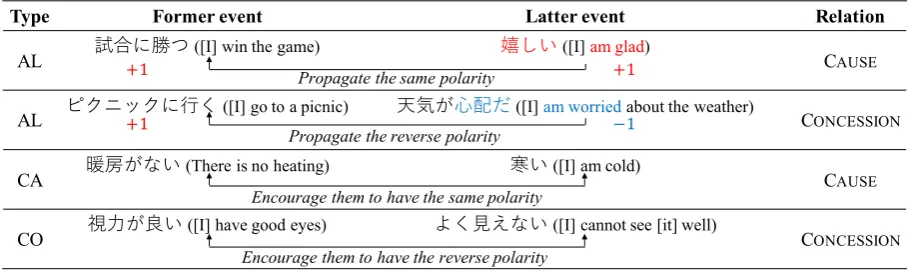
In this paper, we propose a simple and effective method for learning affective events that only re-quires a very small seed lexicon and a large raw corpus. As illustrated in Figure 1, our key idea is that we can exploit discourse relations (Prasad et al.,2008) to efficiently propagate polarity from seed predicates that directly report one’s emotions (e.g., “to be glad” is positive). Suppose that events
x1 arex2 are in the discourse relation of CAUSE
(i.e.,x1causesx2). If the seed lexicon suggestsx2
is positive,x1 is also likely to be positive because
it triggers the positive emotion. The fact that x2
is known to be negative indicates the negative po-larity ofx1. Similarly, ifx1 andx2 are in the
dis-course relation of CONCESSION (i.e.,x2 in spite
of x1), the reverse of x2’s polarity can be prop-agated tox1. Even if x2’s polarity is not known
in advance, we can exploit the tendency ofx1 and x2 to be of the same polarity (for CAUSE) or of the reverse polarity (for CONCESSION) although the heuristic is not exempt from counterexamples. We transform this idea into objective functions and train neural network models that predict the polar-ity of a given event.
We trained the models using a Japanese web corpus. Given the minimum amount of supervi-sion, they performed well. In addition, the combi-nation of annotated and unannotated data yielded a gain over a purely supervised baseline when la-beled data were small.
2 Related Work
Type Former event Latter event Relation
AL 試合に勝つ([I] win the game) 嬉しい([I] am glad) CAUSE
AL ピクニックに⾏く([I] go to a picnic) 天気が⼼配だ([I] am worriedabout the weather) CONCESSION
CA 暖房がない(There is no heating) 寒い([I] am cold) CAUSE
CO 視⼒が良い([I] have good eyes) よく⾒えない([I] cannot see [it] well) CONCESSION
−1 Propagate the same polarity
Propagate the reverse polarity
Encourage them to have the same polarity
+1
Encourage them to have the reverse polarity
+1
[image:2.595.71.531.64.200.2]+1
Figure 1: An overview of our method. We focus on pairs of events, theformer eventsand thelatter events, which are connected with a discourserelation, CAUSEor CONCESSION. Dropped pronouns are indicated by brackets in English translations. We divide the event pairs into threetypes: AL,CA, andCO. In AL, the polarity of a latter event is automatically identified as either positive or negative, according to the seed lexicon (the positive word is colored red and the negative word blue). We propagate the latter event’s polarity to the former event. The same polarity as the latter event is used for the discourse relation CAUSE, and the reversed polarity for CONCESSION. In CA and CO, the latter event’s polarity is not known. Depending on the discourse relation, we encourage the two events’ polarities to be the same (CA) or reversed (CO). Details are given in Section3.2.
Wilson et al.,2005;Baccianella et al.,2010) and the roles of negation and intensification (Reitan et al.,2015;Wilson et al.,2005;Zhu et al.,2014) are among the most important topics. In contrast, we are more interested in recognizing the senti-ment polarity of an event that pertains to common-sense knowledge (e.g., getting money and catch-ing cold).
Label propagation from seed instances is a com-mon approach to inducing sentiment polarities. WhileTakamura et al. (2005) and Turney (2002) worked on word- and phrase-level polarities,Ding and Riloff(2018) dealt with event-level polarities.
Takamura et al. (2005) andTurney (2002) linked instances using co-occurrence information and/or phrase-level coordinations (e.g., “A and B” and “A but B”). We shift our scope to event pairs that are more complex than phrase pairs, and con-sequently exploit discourse connectives as event-level counterparts of phrase-event-level conjunctions.
Ding and Riloff (2018) constructed a network of events using word embedding-derived similar-ities. Compared with this method, our discourse relation-based linking of events is much simpler and more intuitive.
Some previous studies made use of document structure to understand the sentiment. Shimizu et al. (2018) proposed a sentiment-specific pre-training strategy using unlabeled dialog data (tweet-reply pairs). Kaji and Kitsuregawa(2006) proposed a method of building a polarity-tagged corpus (ACP Corpus). They automatically
gath-ered sentences that had positive or negative opin-ions utilizing HTML layout structures in addition to linguistic patterns. Our method depends only on raw texts and thus has wider applicability.
3 Proposed Method
3.1 Polarity Function
Our goal is to learn the polarity function p(x), which predicts the sentiment polarity score of an event x. We approximate p(x) by a neural net-work with the following form:
p(x) = tanh(Linear(Encoder(x))). (1)
Encoder outputs a vector representation of the event x. Linear is a fully-connected layer and transforms the representation into a scalar. tanh is the hyperbolic tangent and transforms the scalar into a score ranging from −1 to 1. In Sec-tion4.2, we consider two specific implementations ofEncoder.
3.2 Discourse Relation-Based Event Pairs
Our method requires a very small seed lexicon and a large raw corpus. We assume that we can au-tomatically extract discourse-tagged event pairs, (xi1, xi2) (i = 1,· · ·) from the raw corpus. We refer to xi1 and xi2 as former andlatter events,
respectively. As shown in Figure 1, we limit our scope to two discourse relations: CAUSE and CONCESSION.
event is in the seed lexicon and does not in-volve complex phenomena like negation, we as-sign the corresponding polarity score (+1for pos-itive events and −1 for negative events) to the event. We expect the model to automatically learn complex phenomena through label propagation. Based on the availability of scores and the types of discourse relations, we classify the extracted event pairs into the following three types.
AL (Automatically Labeled Pairs) The seed lexicon matches (1) the latter event but (2) not the former event, and (3) their discourse relation type is CAUSEor CONCESSION. If the discourse rela-tion type is CAUSE, the former event is given the same score as the latter. Likewise, if the discourse relation type is CONCESSION, the former event is given the opposite of the latter’s score. They are used as reference scores during training.
CA (CAUSE Pairs) The seed lexicon matches neither the former nor the latter event, and their discourse relation type is CAUSE. We assume the two events have the same polarities.
CO (CONCESSION Pairs) The seed lexicon matches neither the former nor the latter event, and their discourse relation type is CONCESSION. We assume the two events have the reversed polarities.
3.3 Loss Functions
Using AL, CA, and CO data, we optimize the pa-rameters of the polarity functionp(x). We define a loss function for each of the three types of event pairs and sum up the multiple loss functions.
We use mean squared error to construct loss functions. For the AL data, the loss function is defined as:
LAL=
1
NAL NAL X
i=1
(ri2−p(xi2))2
+λAL 1 NAL
NAL X
i=1
(ri1−p(xi1))2, (2)
wherexi1andxi2are thei-th pair of the AL data. ri1 andri2 are the automatically-assigned scores
ofxi1andxi2, respectively.NALis the total num-ber of AL pairs, andλALis a hyperparameter.
For the CA data, the loss function is defined as:
LCA=λCA
1
NCA NCA
X
i=1
(p(yi1)−p(yi2))2
+µ 1 NCA
NCA X
i=1
X
u∈{yi1,yi2}
(1−p(u)2).
(3)
yi1 andyi2 are thei-th pair of the CA pairs. NCA
is the total number of CA pairs. λCA and µare hyperparameters. The first term makes the scores of the two events closer while the second term pre-vents the scores from shrinking to zero.
The loss function for the CO data is defined analogously:
LCO=λCO
1
NCO NCO
X
i=1
(p(zi1) +p(zi2))2
+µ 1 NCO
NCO X
i=1
X
u∈{zi1,zi2}
(1−p(u)2).
(4)
The difference is that the first term makes the scores of the two events distant from each other.
4 Experiments
4.1 Dataset
4.1.1 AL, CA, and CO
As a raw corpus, we used a Japanese web cor-pus that was compiled through the procedures pro-posed byKawahara and Kurohashi(2006). To ex-tract event pairs tagged with discourse relations, we used the Japanese dependency parser KNP1 and in-house postprocessing scripts (Saito et al.,
2018). KNP used hand-written rules to segment each sentence into what we conventionally called clauses(mostly consecutive text chunks), each of which contained one main predicate. KNP also identified the discourse relations of event pairs if explicit discourse connectives (Prasad et al.,2008) such as “の で” (because) and “の に” (in spite of) were present. We treated Cause/Reason (原
因・理由) and Condition (条件) in the original tagset (Kawahara et al.,2014) as CAUSEand Con-cession (逆接)2 as CONCESSION, respectively. Here is an example of event pair extraction.
1
http://nlp.ist.i.kyoto-u.ac.jp/EN/ index.php?KNP
2To be precise, this discourse type is semantically broader
Type of pairs # of pairs AL (Automatically Labeled Pairs) 1,000,000
CA (CAUSEPairs) 5,000,000
CO (CONCESSIONPairs) 5,000,000
Table 1: Statistics of the AL, CA, and CO datasets.
(1) 重大な失敗を犯したので、仕事をクビ
になった。
Because [I] made a serious mistake, [I] got fired.
From this sentence, we extracted the event pair of “重大な失敗を犯す” ([I] make a serious mis-take) and “仕事をクビになる” ([I] get fired), and tagged it with CAUSE.
We constructed our seed lexicon consisting of 15 positive words and 15 negative words, as shown in Section A.1. From the corpus of about 100 million sentences, we obtained 1.4 millions event pairs for AL, 41 millions for CA, and 6 millions for CO. We randomly selected subsets of AL event pairs such that positive and negative latter events were equal in size. We also sampled event pairs for each of CA and CO such that it was five times larger than AL. The results are shown in Table1.
4.1.2 ACP (ACP Corpus)
We used the latest version3 of the ACP Cor-pus (Kaji and Kitsuregawa, 2006) for evaluation. It was used for (semi-)supervised training as well. Extracted from Japanese websites using HTML layouts and linguistic patterns, the dataset covered various genres. For example, the following two sentences were labeled positive and negative, re-spectively:
(2) 作業が楽だ。
The work is easy.
(3) 駐車場がない。
There is no parking lot.
Although the ACP corpus was originally con-structed in the context of sentiment analysis, we found that it could roughly be regarded as a col-lection of affective events. We parsed each sen-tence and extracted the last clause in it. The train/dev/test split of the data is shown in Table2. The objective function for supervised training is:
LACP= 1
NACP NACP
X
i=1
(Ri−p(vi))2, (5)
3The dataset was obtained from Nobuhiro Kaji via
per-sonal communication.
Dataset Event polarity # of events
Train Positive 299,834
Negative 300,164
Dev Positive 50,118
Negative 49,882
Test Positive 50,046
[image:4.595.322.510.68.161.2]Negative 49,954
Table 2: Details of the ACP dataset.
whereviis thei-th event,Riis the reference score ofvi, andNACPis the number of the events of the ACP Corpus.
To optimize the hyperparameters, we used the dev set of the ACP Corpus. For the evaluation, we used the test set of the ACP Corpus. The model output was classified as positive ifp(x) > 0 and negative ifp(x)≤0.
4.2 Model Configurations
As for Encoder, we compared two types of neu-ral networks: BiGRU and BERT. GRU (Cho et al.,
2014) is a recurrent neural network sequence en-coder. BiGRU reads an input sequence forward and backward and the output is the concatenation of the final forward and backward hidden states.
BERT (Devlin et al., 2019) is a pre-trained multi-layer bidirectional Transformer (Vaswani et al., 2017) encoder. Its output is the final hid-den state corresponding to the special classifica-tion tag ([CLS]). For the details ofEncoder, see SectionsA.2.
We trained the model with the following four combinations of the datasets: AL, AL+CA+CO (two proposed models), ACP (supervised), and ACP+AL+CA+CO (semi-supervised). The corre-sponding objective functions were: LAL, LAL +
LCA+LCO,LACP, andLACP+LAL +LCA+ LCO.
4.3 Results and Discussion
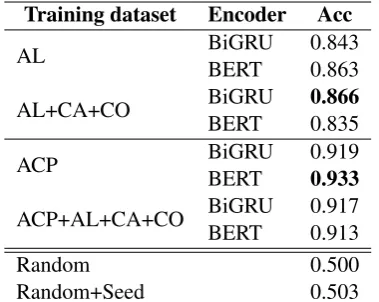
Table3shows accuracy. As the Random baseline suggests, positive and negative labels were dis-tributed evenly. The Random+Seed baseline made use of the seed lexicon and output the correspond-ing label (or the reverse of it for negation) if the event’s predicate is in the seed lexicon. We can see that the seed lexicon itself had practically no impact on prediction.
Training dataset Encoder Acc
AL BiGRU 0.843
BERT 0.863
AL+CA+CO BiGRU 0.866
BERT 0.835
ACP BiGRU 0.919
BERT 0.933
ACP+AL+CA+CO BiGRU 0.917
BERT 0.913
Random 0.500
[image:5.595.87.277.62.213.2]Random+Seed 0.503
Table 3: Performance of various models on the ACP test set.
Training dataset Encoder Acc ACP (6K)
BERT 0.876
+AL 0.886
ACP (6K)
BiGRU 0.830
+AL+CA+CO 0.879
Table 4: Results for small labeled training data. Given the performance with the full dataset, we show BERT trained only with the AL data.
7%. This demonstrates the effectiveness of dis-course relation-based label propagation.
Comparing the model variants, we obtained the highest score with the BiGRU encoder trained with the AL+CA+CO dataset. BERT was compet-itive but its performance went down if CA and CO were used in addition to AL. We conjecture that BERT was more sensitive to noises found more frequently in CA and CO.
Contrary to our expectations, supervised mod-els (ACP) outperformed semi-supervised modmod-els (ACP+AL+CA+CO). This suggests that the train-ing set of 0.6 million events is sufficiently large for training the models. For comparison, we trained the models with a subset (6,000 events) of the ACP dataset. As the results shown in Table 4 demon-strate, our method is effective when labeled data are small.
The result of hyperparameter optimization for the BiGRU encoder was as follows:
λAL = 1, λCA= 0.35, λCO= 1, µ= 0.5.
As the CA and CO pairs were equal in size (Table
1), λCA andλCO were comparable values. λCA
was about one-third ofλCO, and this indicated that
the CA pairs were noisier than the CO pairs. A major type of CA pairs that violates our assump-tion was in the form of “problemnegative causes
Input event Polarity
道に迷う([I] get lost) -0.771
道に迷わない([I] don’t get lost) 0.835
笑う([I] laugh) 0.624
笑われる([I] am laughed at) -0.687
脂肪を落とす([I] lose body fat) 0.452
肩を落とす([I] feel disappointed) -0.653
Table 5: Examples of polarity scores predicted by the BiGRU model trained with AL+CA+CO.
solutionpositive”:
(4) (悪いところがある,よくなるように努力
する)
(there is a bad point, [I] try to improve [it])
The polarities of the two events were reversed in spite of the CAUSErelation, and this lowered the value ofλCA.
Some examples of model outputs are shown in Table5. The first two examples suggest that our model successfully learned negation without ex-plicit supervision. Similarly, the next two exam-ples differ only in voice but the model correctly recognized that they had opposite polarities. The last two examples share the predicate “落とす” (drop) and only the objects are different. The sec-ond event “肩を落とす” (lit. drop one’s shoul-ders) is an idiom that expresses a disappointed feeling. The examples demonstrate that our model correctly learned non-compositional expressions.
5 Conclusion
In this paper, we proposed to use discourse rela-tions to effectively propagate polarities of affec-tive events from seeds. Experiments show that, even with a minimal amount of supervision, the proposed method performed well.
Although event pairs linked by discourse analy-sis are shown to be useful, they nevertheless con-tain noises. Adding linguistically-motivated filter-ing rules would help improve the performance.
Acknowledgments
[image:5.595.307.525.62.159.2]References
Stefano Baccianella, Andrea Esuli, and Fabrizio Sebas-tiani. 2010. Sentiwordnet 3.0: An enhanced lexical resource for sentiment analysis and opinion mining. In Proceedings of the seventh edition of the Lan-guage Resources and Evaluation Conference.
Kyunghyun Cho, Bart van Merrienboer, Caglar Gul-cehre, Dzmitry Bahdanau, Fethi Bougares, Holger Schwenk, and Yoshua Bengio. 2014. Learning phrase representations using RNN encoder–decoder for statistical machine translation. InProceedings of the 2014 Conference on Empirical Methods in Nat-ural Language Processing (EMNLP), pages 1724– 1734, Doha, Qatar. Association for Computational Linguistics.
Jacob Devlin, Ming-Wei Chang, Kenton Lee, and Kristina Toutanova. 2019. BERT: Pre-training of deep bidirectional transformers for language under-standing. In Proceedings of the 2019 Conference of the North American Chapter of the Association for Computational Linguistics: Human Language Technologies, Volume 1 (Long and Short Papers), pages 4171–4186, Minneapolis, Minnesota. Associ-ation for ComputAssoci-ational Linguistics.
Haibo Ding and Ellen Riloff. 2018. Weakly supervised induction of affective events by optimizing semantic consistency. InProceedings of the 32nd AAAI Con-ference on Artificial Intelligence.
Nobuhiro Kaji and Masaru Kitsuregawa. 2006. Auto-matic construction of polarity-tagged corpus from html documents. In Proceedings of the COL-ING/ACL on Main Conference Poster Sessions, COLING-ACL ’06, pages 452–459, Stroudsburg, PA, USA. Association for Computational Linguis-tics.
Daisuke Kawahara and Sadao Kurohashi. 2006. Case frame compilation from the web using high-performance computing. InProceedings of the Fifth International Conference on Language Resources and Evaluation (LREC’06), Genoa, Italy. European Language Resources Association (ELRA).
Daisuke Kawahara, Yuichiro Machida, Tomohide Shi-bata, Sadao Kurohashi, Hayato Kobayashi, and Manabu Sassano. 2014. Rapid development of a corpus with discourse annotations using two-stage crowdsourcing. InProceedings of COLING 2014, the 25th International Conference on Computa-tional Linguistics: Technical Papers, pages 269– 278, Dublin, Ireland. Dublin City University and As-sociation for Computational Linguistics.
Diederik Kingma and Jimmy Ba. 2014. Adam: A method for stochastic optimization. International Conference on Learning Representations.
Lizhen Liu, Donghai Zhang, and Wei Song. 2018. Modeling sentiment association in discourse for hu-mor recognition. InProceedings of the 56th An-nual Meeting of the Association for Computational
Linguistics (Volume 2: Short Papers), pages 586– 591, Melbourne, Australia. Association for Compu-tational Linguistics.
Jong-Hoon Oh, Kentaro Torisawa, Chikara Hashimoto, Takuya Kawada, Stijn De Saeger, Jun’ichi Kazama, and Yiou Wang. 2012. Why question answering us-ing sentiment analysis and word classes. In Pro-ceedings of the 2012 Conference on Empirical Meth-ods on Natural Language Processing and Computa-tional Natural Language Learning.
Rashmi Prasad, Nikhil Dinesh, Alan Lee, Eleni Milt-sakaki, Livio Robaldo, Aravind Joshi, and Bonnie Webber. 2008. The Penn discourse TreeBank 2.0. In Proceedings of the 2012 Conference on Empiri-cal Methods on Natural Language Processing and Computational Natural Language Learning.
Johan Reitan, Jørgen Faret, Bj¨orn Gamb¨ack, and Lars Bungum. 2015. Negation scope detection for twitter sentiment analysis. InProceedings of the 9th Work-shop on Computational Approaches to Subjectivity, Sentiment and Social Media Analysis.
Jun Saito, Tomohiro Sakaguchi, Tomohide Shibata, Daisuke Kawahara, and Sadao Kurohashi. 2018. Design and visualization of linguistic information unit based on predicate-argument structure. In Pro-ceedings of the 24th Annual Meeting of Natural Lan-guage Processing (in Japanese).
Rico Sennrich, Barry Haddow, and Alexandra Birch. 2016. Neural machine translation of rare words with subword units. InProceedings of the 54th An-nual Meeting of the Association for Computational Linguistics (Volume 1: Long Papers), pages 1715– 1725, Berlin, Germany. Association for Computa-tional Linguistics.
Weiyan Shi and Zhou Yu. 2018. Sentiment adaptive end-to-end dialog systems. In Proceedings of the 56th Annual Meeting of the Association for Compu-tational Linguistics (Volume 1: Long Papers), pages 1509–1519, Melbourne, Australia. Association for Computational Linguistics.
Toru Shimizu, Nobuyuki Shimizu, and Hayato Kobayashi. 2018. Pretraining sentiment classifiers with unlabeled dialog data. InProceedings of the 56th Annual Meeting of the Association for Com-putational Linguistics (Volume 2: Short Papers), pages 764–770, Melbourne, Australia. Association for Computational Linguistics.
Ilya Sutskever, James Martens, George Dahl, and Ge-offrey Hinton. 2013. On the importance of initial-ization and momentum in deep learning. In Pro-ceedings of the 30th International Conference on Machine Learning, volume 28 of Proceedings of Machine Learning Research, pages 1139–1147, At-lanta, Georgia, USA. PMLR.
us-ing spin model. In Proceedings of the 43rd An-nual Meeting on Association for Computational Lin-guistics, ACL ’05, pages 133–140, Stroudsburg, PA, USA. Association for Computational Linguistics.
Peter D. Turney. 2002. Thumbs up or thumbs down?: Semantic orientation applied to unsupervised classi-fication of reviews. InProceedings of the 40th An-nual Meeting on Association for Computational Lin-guistics, ACL ’02, pages 417–424, Stroudsburg, PA, USA. Association for Computational Linguistics.
Ashish Vaswani, Noam Shazeer, Niki Parmar, Jakob Uszkoreit, Llion Jones, Aidan N Gomez, Ł ukasz Kaiser, and Illia Polosukhin. 2017. Attention is all you need. In I. Guyon, U. V. Luxburg, S. Bengio, H. Wallach, R. Fergus, S. Vishwanathan, and R. Gar-nett, editors, Advances in Neural Information Pro-cessing Systems 30, pages 5998–6008. Curran As-sociates, Inc.
Theresa Wilson, Janyce Wiebe, and Paul Hoffmann. 2005. Recognizing contextual polarity in phrase-level sentiment analysis. InProceedings of the Con-ference on Human Language Technology and Em-pirical Methods in Natural Language Processing, HLT ’05, pages 347–354, Stroudsburg, PA, USA. Association for Computational Linguistics.
A Appendices
A.1 Seed Lexicon
Positive Words 喜ぶ (rejoice), 嬉し い (be glad),楽しい(be pleasant),幸せ (be happy),感
動 (be impressed), 興奮 (be excited), 懐かしい
(feel nostalgic),好き(like),尊敬(respect),安心 (be relieved),感心(admire),落ち着く(be calm),
満足 (be satisfied), 癒さ れ る (be healed), and
スッキリ(be refreshed).
Negative Words 怒る (get angry),悲しい(be sad), 寂しい(be lonely),怖い (be scared),不安
(feel anxious),恥ずかしい(be embarrassed),嫌
(hate), 落ち込む (feel down), 退屈 (be bored),
絶望(feel hopeless),辛い(have a hard time),困 る (have trouble),憂鬱(be depressed), 心配 (be worried), and情けない(be sorry).
A.2 Settings of Encoder
BiGRU The dimension of the embedding layer was 256. The embedding layer was initialized with the word embeddings pretrained using the Web corpus. The input sentences were segmented into words by the morphological analyzer Ju-man++.4 The vocabulary size was 100,000. The number of hidden layers was 2. The dimension of hidden units was 256. The optimizer was Momen-tum SGD (Sutskever et al.,2013). The mini-batch size was 1024. We ran 100 epochs and selected the snapshot that achieved the highest score for the dev set.
BERT We used a Japanese BERT model5
pre-trained with Japanese Wikipedia. The input sen-tences were segmented into words by Juman++, and words were broken into subwords by apply-ing BPE (Sennrich et al.,2016). The vocabulary size was 32,000. The maximum length of an input sequence was 128. The number of hidden layers was 12. The dimension of hidden units was 768. The number of self-attention heads was 12. The optimizer was Adam (Kingma and Ba,2014). The mini-batch size was 32. We ran 1 epoch.
4http://nlp.ist.i.kyoto-u.ac.jp/EN/ index.php?JUMAN++