Proceedings of the 2019 Conference on Empirical Methods in Natural Language Processing 2474
NumNet: Machine Reading Comprehension with Numerical Reasoning
Qiu Ran1∗, Yankai Lin1∗, Peng Li1, Jie Zhou1, Zhiyuan Liu2 1Pattern Recognition Center, WeChat AI, Tencent Inc, China
2Department of Computer Science and Technology, Tsinghua University, Beijing, China
Institute for Artificial Intelligence, Tsinghua University, Beijing, China
State Key Lab on Intelligent Technology and Systems, Tsinghua University, Beijing, China {soulcaptran,yankailin,patrickpli,withtomzhou}@tencent.com
Abstract
Numerical reasoning, such as addition, sub-traction, sorting and counting is a critical skill in human’s reading comprehension, which has not been well considered in existing machine reading comprehension (MRC) systems. To address this issue, we propose a numerical MRC model named as NumNet, which uti-lizes a numerically-aware graph neural net-work to consider the comparing information and performs numerical reasoning over num-bers in the question and passage. Our sys-tem achieves an EM-score of64.56% on the DROP dataset, outperforming all existing ma-chine reading comprehension models by con-sidering the numerical relations among num-bers.
1 Introduction
Machine reading comprehension (MRC) aims to infer the answer to a question given the docu-ment. In recent years, researchers have proposed lots of MRC models (Chen et al., 2016;Dhingra et al.,2017;Cui et al.,2017;Seo et al.,2017) and these models have achieved remarkable results in various public benchmarks such as SQuAD ( Ra-jpurkar et al.,2016) and RACE (Lai et al.,2017). The success of these models is due to two rea-sons: (1) Multi-layer architectures which allow these models to read the document and the ques-tion iteratively for reasoning; (2) Attenques-tion mech-anisms which would enable these models to focus on the part related to the question in the document. However, most of existing MRC models are still weak in numerical reasoning such as addi-tion, subtracaddi-tion, sorting and counting (Dua et al.,
2019), which are naturally required when read-ing financial news, scientific articles, etc. Dua et al.(2019) proposed a numerically-aware QANet
∗
indicates equal contribution
(NAQANet) model, which divides the answer gen-eration for numerical MRC into three types: (1) extracting spans; (2) counting; (3) addition or sub-traction over numbers. NAQANet makes a pio-neering attempt to answer numerical questions but still does not explicitly consider numerical reason-ing.
To tackle this problem, we introduce a novel model NumNet that integrates numerical reason-ing into existreason-ing MRC models. A key problem to answer questions requiring numerical reasoning is how to perform numerical comparison in MRC systems, which is crucial for two common types of questions:
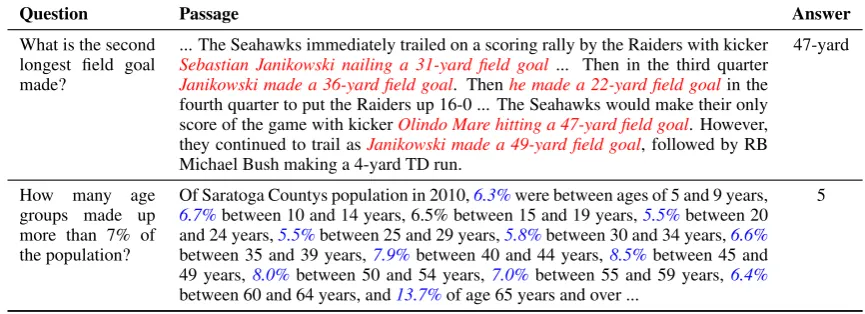
(1) Numerical Comparison: The answers of the questions can be directly obtained via perform-ing numerical comparison, such as sortperform-ing and comparison, in the documents. For example, in Table1, for the first question, if the MRC system knows the fact that “49 > 47 >36 >31 > 22”, it could easily extract that the second longest field goal is 47-yard.
(2)Numerical Condition: The answers of the questions cannot be directly obtained through sim-ple numerical comparison in the documents, but often require numerical comparison for under-standing the text. For example, for the second question in Table 1, an MRC system needs to know which age group made up more than 7% of the population to count the group number.
Question Passage Answer
What is the second longest field goal made?
... The Seahawks immediately trailed on a scoring rally by the Raiders with kicker Sebastian Janikowski nailing a 31-yard field goal ... Then in the third quarter Janikowski made a 36-yard field goal. Thenhe made a 22-yard field goalin the fourth quarter to put the Raiders up 16-0 ... The Seahawks would make their only score of the game with kickerOlindo Mare hitting a 47-yard field goal. However, they continued to trail asJanikowski made a 49-yard field goal, followed by RB Michael Bush making a 4-yard TD run.
47-yard
How many age groups made up more than 7% of the population?
Of Saratoga Countys population in 2010,6.3%were between ages of 5 and 9 years,
6.7%between 10 and 14 years, 6.5% between 15 and 19 years,5.5%between 20 and 24 years,5.5%between 25 and 29 years,5.8%between 30 and 34 years,6.6%
between 35 and 39 years,7.9%between 40 and 44 years,8.5%between 45 and 49 years,8.0%between 50 and 54 years,7.0%between 55 and 59 years,6.4%
between 60 and 64 years, and13.7%of age 65 years and over ...
[image:2.595.81.514.64.221.2]5
Table 1: Example questions from the DROP dataset which require numerical comparison. We highlight the relevant parts in the passage to infer the answer.
integrate the comparison information among num-bers into their representations. Finally, we utilize the numerically-aware representation of passages to infer the answer to the question.
The experimental results on a public numerical MRC dataset DROP (Dua et al.,2019) show that our NumNet model achieves significant and con-sistent improvement as compared to all baseline methods by explicitly performing numerical rea-soning over numbers in the question and passage. In particular, we show that our model could effec-tively deal with questions requiring sorting with multi-layer NumGNN. The source code of our paper is available at https://github.com/ ranqiu92/NumNet.
2 Related Work
2.1 Machine Reading Comprehension
Machine reading comprehension (MRC) has be-come an important research area in NLP. In recent years, researchers have published a large number of annotated MRC datasets such as CNN/Daily Mail (Hermann et al.,2015), SQuAD (Rajpurkar et al., 2016), RACE (Lai et al., 2017), Trivi-aQA (Joshi et al., 2017) and so on. With the blooming of available large-scale MRC datasets, a great number of neural network-based MRC models have been proposed to answer ques-tions for a given document including Attentive Reader (Kadlec et al., 2016), BiDAF (Seo et al.,
2017), Interactive AoA Reader (Cui et al.,2017), Gated Attention Reader (Dhingra et al., 2017), R-Net (Wang et al., 2017a), DCN (Xiong et al.,
2017), QANet (Yu et al., 2018), and achieve promising results in most existing public MRC
datasets.
Despite the success of neural network-based MRC models, researchers began to analyze the data and rethink to what extent we have solved the problem of MRC. Some works (Chen et al.,2016;
Sugawara et al.,2018;Kaushik and Lipton,2018) classify the reasoning skills required to answer the questions into the following types: (1) Exact matching/Paraphrasing; (2) Summary; (3) Logic reasoning; (4) Utilizing external knowledge; (5) Numerical reasoning. They found that most ex-isting MRC models are focusing on dealing with the first three types of questions. However, all these models suffer from problems when answer-ing the questions requiranswer-ing numerical reasonanswer-ing. To the best of our knowledge, our work is the first one thatexplicitlyincorporates numerical reason-ing into the MRC system. The most relevant work to ours is NAQANet (Dua et al., 2019), which adapts the output layer of QANet (Yu et al.,2018) to support predicting answers based on counting and addition/subtraction over numbers. However, it does not consider numerical reasoning explicitly during encoding or inference.
2.2 Arithmetic Word Problem Solving
E
nc
odi
ng M
odul
e
5
Q
ue
sti
on
6
2
P
as
sa
ge
2
6 Reasoning Module
5
2 6
>
≤ 5
2 6
> ≤
6 6
2
2
P
re
di
cti
on M
odul
e
A
ns
w
er
[image:3.595.77.524.63.201.2]5
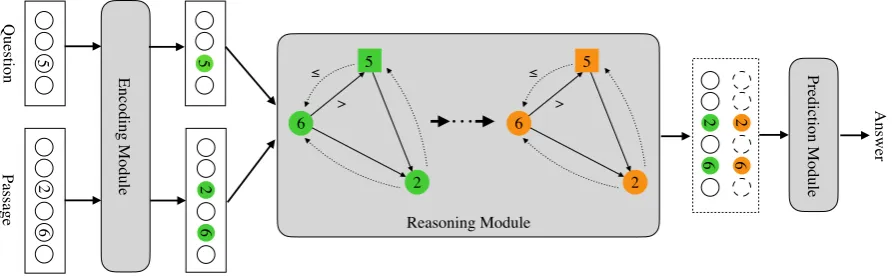
Figure 1: The framework of our NumNet model. Our model consists of an encoding module, a reasoning module and a prediction module. The numerical relations between numbers are encoded with the topology of the graph. For example, the edge pointing from “6” to “5” denotes “6” is greater than “5”. And the reasoning module leverages a numerically-aware graph neural network to perform numerical reasoning on the graph. As numerical comparison is modeled explicitly in our model, it is more effective for answering questions requiring numerical reasoning such as addition, counting, or sorting over numbers.
formalized the AWP problem as that of generating and scoring equation trees via integer linear pro-gramming. Wang et al. (2017b) and Ling et al.
(2017) proposed sequence to sequence solvers for the AWP problems, which are capable of gener-ating unseen expressions and do not rely on so-phisticated manual features. Wang et al. (2018) leveraged deep Q-network to solve the AWP prob-lems, achieving a good balance between effec-tiveness and efficiency. However, all the exist-ing AWP systems are only trained and validated on small benchmark datasets.Huang et al.(2016) found that the performance of these AWP systems sharply degrades on larger datasets. Moreover, from the perspective of NLP, MRC problems are more challenging than AWP since the passages in MRC are mostly real-world texts which require more complex skills to be understood. Above all, it is nontrivial to adapt most existing AWP mod-els to the MRC scenario. Therefore, we focus on enhancing MRC models with numerical reasoning abilities in this work.
3 Methodology
In this section, we will introduce the framework of our model NumNet and provide the details of the proposed numerically-aware graph neural network (NumGNN) for numerical reasoning.
3.1 Framework
An overview of our model NumNet is shown in Figure1. We compose our model with encoding module, reasoning module and prediction module. Our major contribution is the reasoning module,
which leverages a NumGNN between the encod-ing module and prediction module to explicitly consider the numerical comparison information and perform numerical reasoning. As NAQANet has been shown effective for handling numerical MRC problem (Dua et al., 2019), we leverage it as our base model and mainly focus on the design and integration of the NumGNN in this work.
Encoding Module Without loss of generality, we use the encoding components of QANet and NAQANet to encode the question and passage into vector-space representations. Formally, the ques-tionQand passageP are first encoded as:
Q = QANet-Emb-Enc(Q), (1)
P = QANet-Emb-Enc(P), (2)
and then the passage-aware question tion and the question-aware passage representa-tion are computed as:
¯
Q = QANet-Att(P,Q), (3)
¯
P = QANet-Att(Q,P), (4)
whereQANet-Emb-Enc(·)andQANet-Att(·)
denote the “stacked embedding encoder layer” and “context-query attention layer” of QANet respec-tively. The former consists of convolution, self-attention and feed-forward layers. The latter is a passage-question attention layer. Q¯ andP¯ are used by the following components.
(V) are corresponding to the numbers in the ques-tion and passage, and edges (E) are used to encode numerical relationships among the numbers. The details will be explained in Sec.3.2.
Then we perform reasoning on the graph based on a graph neural network, which can be formally denoted as:
MQ = QANet-Mod-Enc(WMQ¯), (5)
MP = QANet-Mod-Enc(WMP¯), (6)
U = Reasoning(G;MQ,MP), (7)
where WM is a shared weight matrix, U is the representations of the nodes corresponding to the numbers,QANet-Mod-Enc(·)is the “model en-coder layer” defined in QANet which is simi-lar toQANet-Emb-Enc(·), and the definition of Reasoning(·)will be given in Sec.3.3.
Finally, as U only contains the representations of numbers, to tackle span-style answers contain-ing non-numerical words, we concatenateU with
MP to produce numerically-aware passage repre-sentationM0. Formally,
M0num[i] =
U[I(i)] ifwpi is a number
0 ,
M00 = W0[MP;Mnum] +b0, (8)
M0 = QANet-Mod-Enc(M00), (9)
where [·;·] denotes matrix concatenation, W[k]
denotes thek-th column of a matrixW,0is a zero vector,I(i)denotes the node index corresponding to the passage wordwipwhich is a number,W0is a weight matrix, andb0is a bias vector.
Prediction Module Following NAQANet (Dua et al.,2019), we divide the answers into four types and use a unique output layer to calculate the con-ditional answer probability Pr(answer|type) for each type :
• Passage span: The answer is a span of the passage, and the answer probability is de-fined as the product of the probabilities of the start and end positions.
• Question span: The answer is a span of the question, and the answer probability is also defined as the product of the probabilities of the start and end positions.
• Count: The answer is obtained by counting, and it is treated as a multi-class classifica-tion problem over ten numbers (0-9), which
covers most of theCounttype answers in the DROP dataset.
• Arithmetic expression: The answer is the re-sult of an arithmetic expression. The expres-sion is obtained in three steps: (1) extract all numbers from the passage; (2) assign a sign (plus, minus or zero) for each number; (3) sum the signed numbers1.
Meanwhile, an extra output layer is also used to predict the probability Pr(type) of each an-swer type. At training time, the final an-swer probability is defined as the joint prob-ability over all feasible answer types, i.e.,
P
typePr(type) Pr(answer|type). Here, the
an-swer type annotation is not required and the proba-bilityPr(type)is learnt by the model. At test time, the model first selects the most probable answer type greedily and then predicts the best answer ac-cordingly.
Without loss of generality, we leverage the defi-nition of the five output layers in (Dua et al.,2019), withM0andQas inputs. Please refer to the paper for more details due to space limitation.
Comparison with NAQANet The major differ-ence between our model and NAQANet is that NAQANet does not have the reasoning module, i.e.,M0 is simply set asMP. As a result, num-bers are treated as common words in NAQANet except in the prediction module, thus NAQANet may struggle to learn the numerical relationships between numbers, and potentially cannot well generalize to unseen numbers. However, as dis-cussed in Sec.1, the numerical comparison is es-sential for answering questions requiring numeri-cal reasoning. In our model, the numerinumeri-cal rela-tionships are explicitly represented with the topol-ogy of the graph and a NumGNN is used to per-form numerical reasoning. Therefore, our Num-Net model can handle questions requiring numer-ical reasoning more effectively, which is verified by the experiments in Sec.4.
3.2 Numerically-aware Graph Construction
We regard all numbers from the question and pas-sage as nodes in the graph for reasoning 2 . The
1As few samples require multiplication/division
expres-sion in the DROP dataset, we simply adapt the module pro-posed (Dua et al.,2019) and leave multiplication/division ex-pression handling as future work.
2As a number in the question may serve as a critical
set of nodes corresponding to the numbers occur-ring in question and passage are denoted asVQ
andVP respectively. And we denote all the nodes asV =VQ∪VP, and the number corresponding to a nodev∈V asn(v).
Two sets of edges are considered in this work:
• Greater Relation Edge (−→E): For two nodes vi, vj ∈ V, a directed edge →−eij = (vi, vj)
pointing fromvi tovj will be added to the
graph ifn(vi) > n(vj), which is denoted as
solid arrow in Figure1.
• Lower or Equal Relation Edge (←E−): For two nodesvi, vj ∈V, a directed edge←−eij =
(vj, vi)will be added to the graph ifn(vi) ≤
n(vj), which is denoted as dashed arrow in
Figure1.
Theoretically, −→E and←E−are complement to each other . However, as a number may occur several times and represent different facts in a document, we add a distinct node for each occurrence in the graph to prevent potential ambiguity. Therefore, it is more reasonable to use both−→E and←E−in order to encode the equal information among nodes.
3.3 Numerical Reasoning
As we built the graphG = (V,E), we leverage NumGNN to perform reasoning, which is corre-sponding to the functionReasoning(·)in Eq.7. The reasoning process is as follows:
Initialization For each nodevP
i ∈VP, its
rep-resentation is initialized as the corresponding col-umn vector ofMP. Formally, the initial represen-tation is vP
i = MP[IP(viP)], whereIP(vPi )
de-notes the word index corresponding toviP. Simi-larly, the initial representationvjQfor a nodevQj ∈ VQ is set as the corresponding column vector of
MQ. We denote all the initial node representa-tions asv0={vP
i } ∪ {v
Q j }.
One-step Reasoning Given the graphGand the node representationsv, we use a GNN to perform reasoning in three steps:
(1) Node Relatedness Measure: As only a few numbers are relevant for answering a ques-tion generally, we compute a weight for each node to by-pass irrelevant numbers in reasoning. For-mally, the weight for nodeviis computed as:
αi = sigmoid(Wvv[i] +bv), (10)
we also add nodes for them in the graph.
whereWvis a weight matrix, andbvis a bias.
(2)Message Propagation: As the role a num-ber plays in reasoning is not only decided by it-self, but also related to the context, we propagate messages from each node to its neighbors to help to perform reasoning. As numbers in question and passage may play different roles in reasoning and edges corresponding to different numerical re-lations should be distinguished, we use relation-specific transform matrices in the message agation. Formally, we define the following prop-agation function for calculating the forward-pass update of a node:
e
vi0 = 1
|Ni|
X
j∈Ni
αjWrjiv[j]
, (11)
where ve
0
i is the message representation of node
vi, rji is the relation assigned to edgeeji, Wrji
are relation-specific transform matrices, andNi = {j|(vj, vi)∈E}is the neighbors of nodevi.
For each edgeeji,rjiis determined by the
fol-lowing two attributes:
• Number relation:>or≤;
• Node types: the two nodes of the edge corre-sponding to two numbers that: (1) both from the question (q-q); (2) both from the passage (p-p); (3) from the question and the passage respectively (q-p); (4) from the passage and the question respectively (p-q).
Formally,rij ∈ {>,≤} × {q-q,p-p,q-p,p-q}.
(3)Node Representation Update: As the mes-sage representation obtained in the previous step only contains information from the neighbors, it needs to be fused with the node representation to combine with the information carried by the node itself, which is performed as:
v0i= ReLU(Wfvi+ve
0
i+bf), (12)
whereWf is a weight matrix, andbfis a bias
vec-tor.
We denote the entire one-step reasoning process (Eq.10-12) as a single function
v0=Reasoning-Step(G,v). (13)
Multi-step Reasoning By single-step reason-ing, we can only infer relations between adjacent nodes. However, relations between multiple nodes may be required for certain tasks, e.g., sorting. Therefore, it is essential to perform multi-step rea-soning, which can be done as follows
vt=Reasoning-Step(vt−1), (14) where t ≥ 1. Suppose we perform K steps of reasoning,vKis used asU in Eq.7.
4 Experiments
4.1 Dataset and Evaluation Metrics
We evaluate our proposed model on DROP dataset (Dua et al., 2019), which is a public nu-merical MRC dataset. The DROP dataset is con-structed by crowd-sourcing, which asks the anno-tators to generate question-answer pairs according to the given Wikipedia passages, which require nu-merical reasoning such as addition, counting, or sorting over numbers in the passages. There are
77,409training samples,9,536development sam-ples and9,622testing samples in the dataset.
In this paper, we adopt two metrics including Exact Match (EM) and numerically-focused F1 scores to evaluate our model followingDua et al.
(2019). The numerically-focused F1 is set to be
0 when the predicted answer is mismatched for those questions with the numeric golden answer.
4.2 Baselines
For comparison, we select several public models as baselines includingsemantic parsing models:
• Syn Dep (Dua et al.,2019), the neural seman-tic parsing model (KDG) (Krishnamurthy et al., 2017) with Stanford dependencies based sentence representations;
• OpenIE (Dua et al., 2019), KDG with open information extraction based sentence repre-sentations;
• SRL (Dua et al.,2019), KDG with semantic role labeling based sentence representations; andtraditional MRC models:
• BiDAF (Seo et al., 2017), an MRC model which utilizes a bi-directional attention flow network to encode the question and passage;
• QANet (Yu et al.,2018), which utilizes con-volutions and self-attentions as the building blocks of encoders to represent the question and passage;
• BERT (Devlin et al., 2019), a pre-trained bidirectional Transformer-based language model which achieves state-of-the-art perfor-mance on lots of public MRC datasets re-cently;
andnumerical MRC models:
• NAQANet (Dua et al., 2019), a numerical version of QANet model.
• NAQANet+, an enhanced version of NAQANet implemented by ourselves, which further considers real number (e.g. “2.5”), richer arithmetic expression, data augmenta-tion, etc. The enhancements are also used in our NumNet model and the details are given in the supplemental material.
4.3 Experimental Settings
In this paper, we tune our model on the develop-ment set and use a grid search to determine the optimal parameters. The dimensions of all the rep-resentations (e.g.,Q,P,MQ,MP,U,M00,M0 and v) are set to 128. If not specified, the rea-soning stepK is set to3. Since other parameters have little effect on the results, we simply follow the settings used in (Dua et al.,2019).
We use the Adam optimizer (Kingma and Ba,
2015) with β1 = 0.8, β2 = 0.999, = 10−7 to minimize the objective function. The learn-ing rate is5×10−4, L2 weight decay λis10−7
and the maximum norm value of gradient clipping is 5. We also apply exponential moving average with a decay rate0.9999on all trainable variables. The model is trained with a batch size of 16 for
40 epochs. Passages and questions are trimmed to400and50tokens respectively during training, and trimmed to1,000and100tokens respectively during prediction3.
4.4 Overall Results
The performance of our NumNet model and other baselines on DROP dataset are shown in Table2. From the results, we can observe that:
(1) Our NumNet model achieves better results on both the development and testing sets on DROP dataset as compared to semantic parsing-based models, traditional MRC models and even numeri-cal MRC models NAQANet and NAQANet+. The reason is that our NumNet model can make full use of the numerical comparison information over
3Trimming passages/questions introduces little impact
Method Dev Test
EM F1 EM F1
Semantic Parsing
Syn Dep 9.38 11.64 8.51 10.84
OpenIE 8.80 11.31 8.53 10.77
SRL 9.28 11.72 8.98 11.45
Traditional MRC
BiDAF 26.06 28.85 24.75 27.49
QANet 27.50 30.44 25.50 28.36
BERT 30.10 33.36 29.45 32.70
Numerical MRC
NAQANet 46.20 49.24 44.07 47.01 NAQANet+ 61.47 64.85 60.82 64.29
[image:7.595.307.527.64.149.2]NumNet 64.92 68.31 64.56 67.97 Human Performance - - 94.09 96.42
Table 2: Overall results on the development and test set. The evaluation metrics are calculated as the max-imum over a golden answer set. All the results except “NAQANet+” and “NumNet” are obtained from (Dua et al.,2019).
numbers in both question and passage via the pro-posed NumGNN module.
(2) Our implemented NAQANet+ has a much better performance compared to the original ver-sion of NAQANet. It verifies the effectiveness of our proposed enhancements for baseline.
4.5 Effect of GNN Structure
In this part, we investigate the effect of different GNN structures on the DROP development set. The results are shown in Table 3. The “Com-parison”, “Number” and “ALL” are corresponding to the comparing question subset 4, the number-type answer subset, and the entire development set, respectively 5. If we replace the proposed numerically-aware graph (Sec. 3.2) with a fully connected graph, our model fallbacks to a tra-ditional GNN, denoted as “GNN” in the table. Moreover, “- question num” denotes the numbers in the question is not included in the graph, and
“-≤type edge” and “->type edge” denote edges of
≤and>types are not adopted respectively.
4
We find that many comparing questions in the DROP dataset are biased, of which the answers are the former can-didates in the questions. Hence, we employ crowdsourced workers to identify and rewrite all comparing questions to construct an enhanced development set. Specially, for those comparing questions containing answer candidates, we also ask the crowdsourced workers to swap the candidates manu-ally to enlarge the dataset.
5Note that the “ALL” result is not the average of
“Com-parison” and “Number”. It is the performance on the entire development set which also includes questions of selection type, coreference resolution type, etc.
Method Comparison Number ALL
EM F1 EM F1 EM F1
[image:7.595.76.285.64.245.2]GNN 69.86 75.91 67.77 67.78 61.90 65.16 NumGNN 74.53 80.36 69.74 69.75 64.54 68.02 - question num 74.84 80.24 68.42 68.43 63.78 67.17 -≤type edge 74.89 80.51 68.48 68.50 63.66 67.06 ->type edge 74.86 80.19 68.77 68.78 63.64 66.96
Table 3: Performance with different GNN structure. “Comparison”, “Number” and “ALL” denote the com-paring question subset, the number-type answer subset, and the entire development set, respectively.
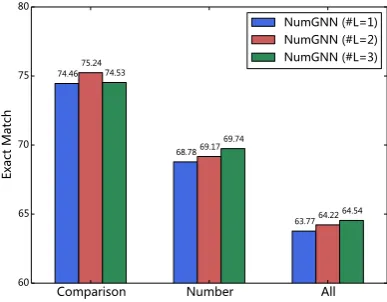
Figure 2: Effect of GNN layer numbers (# L).
As shown in Table 3, our proposed NumGNN leads to statistically significant improvements compared to traditional GNN on both EM and F1 scores especially for comparing questions. It indi-cates that considering the comparing information over numbers could effectively help the numerical reasoning for comparing questions. Moreover, we find that the numbers in the question are often re-lated to the numerical reasoning for answering the question, thus considering numbers in questions in NumGNN achieves better performance. And the results also justify that encoding “greater rela-tion” and “lower or equal relarela-tion” simultaneously in the graph also benefits our model.
4.6 Effect of GNN Layer Number
The number of NumGNN layers represents the nu-merical reasoning ability of our models. A K -layer version has the ability forK-step numerical inference. In this part, we additionally perform ex-periments to understand the values of the numbers of NumGNN layers. From Figure2, we could ob-serve that:
[image:7.595.319.513.220.371.2]compar-Question & Answer Passage NAQANet+ NumNet Q:Which age group is
larger: under the age of 18 or 18 and 24?
The median age in the city was 22.1 years.10.1%of residents were under the age of 18;56.2%were between the ages of 18 and 24; 16.1% were from 25 to 44; 10.5% were from 45 to 64; and 7% were 65 years of age or older. The gender makeup of the city was 64.3% male and 35.7% female.
under the age of 18
18 and 24
A:18 and 24
Q: How many more yards was Longwell’s longest field goal over his second longest one?
... The Vikings would draw first blood with a26-yard field goalby kicker Ryan Longwell. In the second quarter, Carolina got a field goal with opposing kicker John Kasay. The Vikings would respond with another Longwell field goal (a 22-yard FG) ... In OT, Longwell booted the game-winning19-yard field goalto give Minnesota the win. It was the first time in Vikings history that a coach ...
26-19 = 7 26-22 = 4
[image:8.595.73.529.241.356.2]A:26-22=4
Table 4: Cases from the DROP dataset. We demonstrate the predictions of NAQANet+ and our NumNet model. Note that the two models only output the arithmetic expressions but we also provide their results for clarity.
Question Passage Answer NumNet
Which ancestral groups are at least 10%?
As of the census of 2000, there were 7,791 people, 3,155 households, and 2,240 families residing in the county. ... 33.7% were ofGermans, 13.9%Swedishpeople, 10.1%Irishpeople, 8.8% United States, 7.0% English people and 5.4% Danish people ancestry ...
German; Swedish; Irish
Irish
Were more people 40 and older or 19 and younger?
Of Saratoga Countys population in 2010,6.3%were between ages of 5 and 9 years,6.7%between 10 and 14 years,6.5%between 15 and 19 years, ... ,7.9%between 40 and 44 years,8.5%between 45 and 49 years,8.0%between 50 and 54 years,7.0%between 55 and 59 years,
6.4%between 60 and 64 years, and13.7%of age 65 years and over ...
40 and older
19 and younger
Table 5: Typical error examples. Row 1: the answer is multiple nonadjacent spans; Row 2: Intermediate numbers are involved in reasoning.
ing questions only require at most2-step reason-ing (e.g., “Who was the second oldest player in the MLB, Clemens or Franco?”), and therefore the
3-layer version of NumNet is more complex but brings no gains for these questions.
(2) The performance of our NumNet model on the overall development set is improved consis-tently as the number of GNN layers increases. The reason is that some of the numerical questions re-quire reasoning over many numbers in the pas-sage, which could benefit from the multi-step rea-soning ability of multi-layer GNN. However, fur-ther investigation shows that the performance gain is not stable whenK ≥4. We believe it is due to the intrinsic over smoothing problem of GNNs (Li et al.,2018).
4.7 Case Study
We further give some examples to show why in-corporating comparing information over numbers in the passage could help numerical reasoning in MRC in Table 4. For the first case, we observe that NAQANet+ gives a wrong prediction, and we find that NAQANet+ will give the same prediction for the question “Which age group is smaller: un-der the age of 18 or 18 and 24?”. The reason is
that NAQANet+ cannot distinguish which one is larger for10.1%and56.2%. For the second case, NAQANet+ cannot recognize the second longest field goal is22-yard and also gives a wrong pre-diction. For these two cases, our NumNet model could give the correct answer through the numeric reasoning, which indicates the effectiveness of our NumNet model.
4.8 Error Analysis
To investigate how well our NumNet model han-dles sorting/comparison questions and better un-derstand the remaining challenges, we perform an error analysis on a random sample of NumNet pre-dictions. We find that:
(1) Our NumNet model can answer about 76% of sorting/comparison questions correctly, which indicates that our NumNet model has achieved nu-merical reasoning ability to some extend.
de-rived from counting or arithmetic operation (row 1 in Table5).
4.9 Discussion
By combining the numerically-aware graph and the NumGNN together, our NumNet model achieves the numerical reasoning ability. On one hand, the numerically-aware graph encodes num-bers as nodes and relationships between them as the edges, which is required for numerical com-parison. On the other hand, through one-step reasoning, our NumGNN could perform compar-ison and identify the numerical condition. After multiple-step reasoning, our NumGNN could fur-ther perform sorting.
However, since the numerically-aware graph is pre-defined, our NumNet is not applicable to the case where an intermediate number has to be de-rived (e.g., from arithmetic operation) in the rea-soning process, which is a major limitation of our model.
5 Conclusion and Future Work
Numerical reasoning skills such as addition, sub-traction, sorting and counting are naturally re-quired by machine reading comprehension (MRC) problems in practice. Nevertheless, these skills are not taken into account explicitly for most existing MRC models. In this work, we propose a numeri-cal MRC model named NumNet which performs explicit numerical reasoning while reading the passages. To be specific, NumNet encodes the nu-merical relations among numbers in the question and passage into a graph as its topology, and lever-ages a numerically-aware graph neural network to perform numerical reasoning on the graph. Our NumNet model outperforms strong baselines with a large margin on the DROP dataset.
In the future, we will explore the following di-rections: (1)As we use a pre-defined reasoning graph in our model, it is incapable of handling rea-soning process which involves intermediate num-bers that not presented in the graph. How to corporate dynamic graph into our model is an in-teresting problem. (2) Compared with methods proposed for arithmetic word problems (AWPs), our model has better natural language understand-ing ability. However, the methods for AWPs can handle much richer arithmetic expressions. There-fore, how to combine both of their abilities to de-velop a more powerful numerical MRC model is
an interesting future direction. (3) Symbolic rea-soning plays a crucial role in human reading com-prehension. Our work integrates numerical soning, which is a special case of symbolic rea-soning, into traditional MRC systems. How to in-corporate more sophisticated symbolic reasoning abilities into MRC systems is also a valuable fu-ture direction.
Acknowledgments
We would like to thank all anonymous review-ers for their insightful comments, and thank Yan Zhang for her help on improving the presentation of Figure1.
References
Danqi Chen, Jason Bolton, and Christopher D. Man-ning. 2016. A thorough examination of the CNN/Daily Mail reading comprehension task. In Proceedings of the 54th Annual Meeting of the As-sociation for Computational Linguistics (Volume 1: Long Papers), pages 2358–2367, Berlin, Germany.
Yiming Cui, Zhipeng Chen, Si Wei, Shijin Wang, Ting Liu, and Guoping Hu. 2017. Attention-over-attention neural networks for reading comprehen-sion. InProceedings of the 55th Annual Meeting of the Association for Computational Linguistics (Vol-ume 1: Long Papers), pages 593–602, Vancouver, Canada.
Jacob Devlin, Ming-Wei Chang, Kenton Lee, and Kristina Toutanova. 2019. BERT: Pre-training of deep bidirectional transformers for language under-standing. InProceedings of the 2019 Conference of the North American Chapter of the Association for Computational Linguistics: Human Language Tech-nologies, Volume 1 (Long and Short Papers), pages 4171–4186, Minneapolis, Minnesota.
Bhuwan Dhingra, Hanxiao Liu, Zhilin Yang, William Cohen, and Ruslan Salakhutdinov. 2017. Gated-attention readers for text comprehension. In Pro-ceedings of the 55th Annual Meeting of the Associa-tion for ComputaAssocia-tional Linguistics (Volume 1: Long Papers), pages 1832–1846, Vancouver, Canada.
Dheeru Dua, Yizhong Wang, Pradeep Dasigi, Gabriel Stanovsky, Sameer Singh, and Matt Gardner. 2019.
DROP: A reading comprehension benchmark re-quiring discrete reasoning over paragraphs. In Pro-ceedings of the 2019 Conference of the North Amer-ican Chapter of the Association for Computational Linguistics: Human Language Technologies, Vol-ume 1 (Long and Short Papers), pages 2368–2378, Minneapolis, Minnesota.
Su-leyman, and Phil Blunsom. 2015. Teaching ma-chines to read and comprehend. In Proceedings of Advances in Neural Information Processing Sys-tems, pages 1693–1701.
Mohammad Javad Hosseini, Hannaneh Hajishirzi, Oren Etzioni, and Nate Kushman. 2014. Learning to solve arithmetic word problems with verb catego-rization. InProceedings of the 2014 Conference on Empirical Methods in Natural Language Processing (EMNLP), pages 523–533, Doha, Qatar.
Danqing Huang, Shuming Shi, Chin-Yew Lin, Jian Yin, and Wei-Ying Ma. 2016. How well do comput-ers solve math word problems? Large-scale dataset construction and evaluation. In Proceedings of the 54th Annual Meeting of the Association for Compu-tational Linguistics (Volume 1: Long Papers), pages 887–896, Berlin, Germany.
Mandar Joshi, Eunsol Choi, Daniel Weld, and Luke Zettlemoyer. 2017. TriviaQA: A large scale dis-tantly supervised challenge dataset for reading com-prehension. In Proceedings of the 55th Annual Meeting of the Association for Computational Lin-guistics (Volume 1: Long Papers), pages 1601– 1611, Vancouver, Canada.
Rudolf Kadlec, Martin Schmid, Ondˇrej Bajgar, and Jan Kleindienst. 2016. Text understanding with the at-tention sum reader network. InProceedings of the 54th Annual Meeting of the Association for Compu-tational Linguistics (Volume 1: Long Papers), pages 908–918, Berlin, Germany.
Divyansh Kaushik and Zachary C. Lipton. 2018. How much reading does reading comprehension require? A critical investigation of popular benchmarks. In Proceedings of the 2018 Conference on Empirical Methods in Natural Language Processing, pages 5010–5015, Brussels, Belgium.
Diederik P Kingma and Jimmy Ba. 2015. Adam: A method for stochastic optimization. InProceedings of ICLR 2015 : International Conference on Learn-ing Representations 2015.
Rik Koncel-Kedziorski, Hannaneh Hajishirzi, Ashish Sabharwal, Oren Etzioni, and Siena Dumas Ang. 2015. Parsing algebraic word problems into equa-tions. Transactions of the Association for Computa-tional Linguistics, 3:585–597.
Jayant Krishnamurthy, Pradeep Dasigi, and Matt Gard-ner. 2017. Neural semantic parsing with type con-straints for semi-structured tables. InProceedings of the 2017 Conference on Empirical Methods in Natu-ral Language Processing, pages 1516–1526, Copen-hagen, Denmark.
Guokun Lai, Qizhe Xie, Hanxiao Liu, Yiming Yang, and Eduard Hovy. 2017. RACE: Large-scale ReAd-ing comprehension dataset from examinations. In Proceedings of the 2017 Conference on Empirical Methods in Natural Language Processing, pages 785–794, Copenhagen, Denmark.
Qimai Li, Zhichao Han, and Xiao-Ming Wu. 2018. Deeper insights into graph convolutional networks for semi-supervised learning. InProceedings of the Thirty-Second AAAI Conference on Artificial Intelli-gence, pages 3538–3545.
Wang Ling, Dani Yogatama, Chris Dyer, and Phil Blun-som. 2017. Program induction by rationale genera-tion: Learning to solve and explain algebraic word problems. arXiv preprint arXiv:1705.04146.
Pranav Rajpurkar, Jian Zhang, Konstantin Lopyrev, and Percy Liang. 2016.SQuAD: 100,000+ questions for machine comprehension of text. InProceedings of the 2016 Conference on Empirical Methods in Natu-ral Language Processing, pages 2383–2392, Austin, Texas.
Subhro Roy and Dan Roth. 2015. Solving general arithmetic word problems. In Proceedings of the 2015 Conference on Empirical Methods in Natu-ral Language Processing, pages 1743–1752, Lisbon, Portugal.
Minjoon Seo, Aniruddha Kembhavi, Ali Farhadi, and Hannaneh Hajishirzi. 2017. Bidirectional attention flow for machine comprehension. In Proceedings of ICLR 2017: the 5th International Conference on Learning Representations.
Saku Sugawara, Kentaro Inui, Satoshi Sekine, and Akiko Aizawa. 2018. What makes reading com-prehension questions easier? InProceedings of the 2018 Conference on Empirical Methods in Natural Language Processing, pages 4208–4219, Brussels, Belgium.
Lei Wang, Dongxiang Zhang, Lianli Gao, Jingkuan Song, Long Guo, and Heng Tao Shen. 2018. Math-DQN: Solving arithmetic word problems via deep reinforcement learning. In Proceedings of the Thirty-Second AAAI Conference on Artificial Intel-ligence (AAAI-18).
Wenhui Wang, Nan Yang, Furu Wei, Baobao Chang, and Ming Zhou. 2017a. Gated self-matching net-works for reading comprehension and question an-swering. InProceedings of the 55th Annual Meet-ing of the Association for Computational LMeet-inguistics (Volume 1: Long Papers), pages 189–198, Vancou-ver, Canada.
Yan Wang, Xiaojiang Liu, and Shuming Shi. 2017b.
Deep neural solver for math word problems. In Pro-ceedings of the 2017 Conference on Empirical Meth-ods in Natural Language Processing, pages 845– 854, Copenhagen, Denmark.