The CoNLL-2014 Shared Task on Grammatical Error Correction
Hwee Tou Ng1 Siew Mei Wu2 Ted Briscoe3
Christian Hadiwinoto1 Raymond Hendy Susanto1 Christopher Bryant1 1Department of Computer Science, National University of Singapore
{nght,chrhad,raymondhs,bryant}@comp.nus.edu.sg
2Centre for English Language Communication, National University of Singapore
3Computer Laboratory, University of Cambridge
Abstract
The CoNLL-2014 shared task was devoted to grammatical error correction of all error types. In this paper, we give the task defi-nition, present the data sets, and describe the evaluation metric and scorer used in the shared task. We also give an overview of the various approaches adopted by the participating teams, and present the eval-uation results. Compared to the CoNLL-2013 shared task, we have introduced the following changes in CoNLL-2014: (1) A participating system is expected to de-tect and correct grammatical errors ofall
types, instead of just the five error types in CoNLL-2013; (2) The evaluation metric was changed from F1 toF0.5, to
empha-size precision over recall; and (3) We have two human annotators who independently annotated the test essays, compared to just one human annotator in CoNLL-2013.
1 Introduction
Grammatical error correction is the shared task of the Eighteenth Conference on Computational Nat-ural Language Learning in 2014 (CoNLL-2014). In this task, given an English essay written by a learner of English as a second language, the goal is to detect and correct the grammatical errors of all error types present in the essay, and return the corrected essay.
This task has attracted much recent research in-terest, with two shared tasks Helping Our Own (HOO) organized in 2011 and 2012 (Dale and Kil-garriff, 2011; Dale et al., 2012), and a CoNLL
shared task on grammatical error correction orga-nized in 2013 (Ng et al., 2013). In contrast to previous CoNLL shared tasks which focused on particular subtasks of natural language process-ing, such as named entity recognition, semantic role labeling, dependency parsing, or coreference resolution, grammatical error correction aims at building a complete end-to-end application. This task is challenging since for many error types, current grammatical error correction systems do not achieve high performance and much research is still needed. Also, tackling this task has far-reaching impact, since it is estimated that hun-dreds of millions of people worldwide are learn-ing English and they benefit directly from an auto-mated grammar checker.
The CoNLL-2014 shared task provides a forum for participating teams to work on the same gram-matical error correction task, with evaluation on the same blind test set using the same evaluation metric and scorer. This overview paper contains a detailed description of the shared task, and is orga-nized as follows. Section 2 provides the task def-inition. Section 3 describes the annotated training data provided and the blind test data. Section 4 de-scribes the evaluation metric and the scorer. Sec-tion 5 lists the participating teams and outlines the approaches to grammatical error correction used by the teams. Section 6 presents the results of the shared task, including a discussion on cross anno-tator comparison. Section 7 concludes the paper. 2 Task Definition
The goal of the CoNLL-2014 shared task is to evaluate algorithms and systems for automati-cally detecting and correcting grammatical errors
present in English essays written by second lan-guage learners of English. Each participating team is given training data manually annotated with corrections of grammatical errors. The test data consists of new, blind test essays. Prepro-cessed test essays, which have been sentence-segmented and tokenized, are also made available to the participating teams. Each team is to submit its system output consisting of the automatically corrected essays, in sentence-segmented and tok-enized form.
Grammatical errors consist of many different types, including articles or determiners, preposi-tions, noun form, verb form, subject-verb agree-ment, pronouns, word choice, sentence structure, punctuation, capitalization, etc. However, most prior published research on grammatical error cor-rection only focuses on a small number of fre-quently occurring error types, such as article and preposition errors (Han et al., 2006; Gamon, 2010; Rozovskaya and Roth, 2010; Tetreault et al., 2010; Dahlmeier and Ng, 2011b). Article and preposi-tion errors were also the only error types featured in the HOO 2012 shared task. Likewise, although all error types were included in the HOO 2011 shared task, almost all participating teams dealt with article and preposition errors only (besides spelling and punctuation errors). In the CoNLL-2013 shared task, the error types were extended to include five error types, comprising article or determiner, preposition, noun number, verb form, and subject-verb agreement. Other error types such as word choice errors (Dahlmeier and Ng, 2011a) were not dealt with.
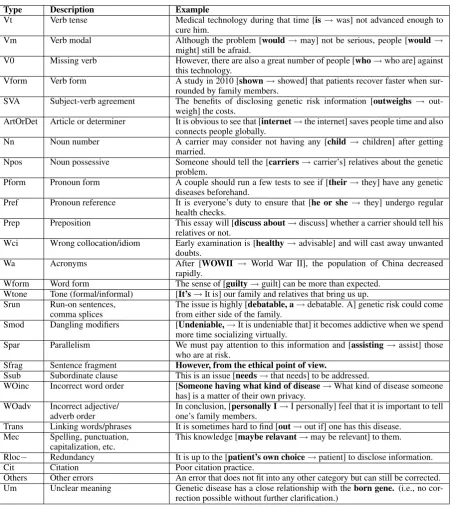
In the CoNLL-2014 shared task, it was felt that the community is now ready to deal with all er-ror types. Table 1 shows examples of the 28 erer-ror types in the CoNLL-2014 shared task.
Since there are 28 error types in our shared task compared to two in HOO 2012 and five in CoNLL-2013, there is a greater chance of encountering multiple, interacting errors in a sentence in our shared task. This increases the complexity of our shared task. To illustrate, consider the following sentence:
Socialnetwork playsa role in providing and also filtering information.
The noun number errornetworksneeds to be cor-rected (network → networks). This necessitates the correction of a subject-verb agreement error
(plays→ play). A pipeline system in which cor-rections for subject-verb agreement errors occur strictly before corrections for noun number errors would not be able to arrive at a fully corrected sentence for this example. The ability to correct multiple, interacting errors is thus necessary in our shared task. The recent work of Dahlmeier and Ng (2012a) and Wu and Ng (2013), for example, is designed to deal with multiple, interacting errors.
3 Data
This section describes the training and test data released to each participating team in our shared task.
3.1 Training Data
The training data provided in our shared task is the NUCLE corpus, the NUS Corpus of Learner English (Dahlmeier et al., 2013). As noted by (Leacock et al., 2010), the lack of a manually an-notated and corrected corpus of English learner texts has been an impediment to progress in gram-matical error correction, since it prevents com-parative evaluations on a common benchmark test data set. NUCLE was created precisely to fill this void. It is a collection of 1,414 essays written by students at the National University of Singa-pore (NUS) who are non-native speakers of En-glish. The essays were written in response to some prompts, and they cover a wide range of topics, such as environmental pollution, health care, etc. The grammatical errors in these essays have been hand-corrected by professional English instructors at NUS. For each grammatical error instance, the start and end character offsets of the erroneous text span are marked, and the error type and the cor-rection string are provided. Manual annotation is carried out using a graphical user interface specif-ically built for this purpose. The error annotations are saved as stand-off annotations, in SGML for-mat.
To illustrate, consider the following sentence at the start of the sixth paragraph of an essay:
Nothing isabsoluteright or wrong.
There is a word form error (absolute→absolutely) in this sentence. The error annotation, also called
Type Description Example
Vt Verb tense Medical technology during that time [is→was] not advanced enough to
cure him.
Vm Verb modal Although the problem [would→may] not be serious, people [would→
might] still be afraid.
V0 Missing verb However, there are also a great number of people [who→who are] against
this technology.
Vform Verb form A study in 2010 [shown→showed] that patients recover faster when
sur-rounded by family members.
SVA Subject-verb agreement The benefits of disclosing genetic risk information [outweighs→
out-weigh] the costs.
ArtOrDet Article or determiner It is obvious to see that [internet→the internet] saves people time and also
connects people globally.
Nn Noun number A carrier may consider not having any [child→children] after getting
married.
Npos Noun possessive Someone should tell the [carriers→carrier’s] relatives about the genetic
problem.
Pform Pronoun form A couple should run a few tests to see if [their→they] have any genetic
diseases beforehand.
Pref Pronoun reference It is everyone’s duty to ensure that [he or she→they] undergo regular
health checks.
Prep Preposition This essay will [discuss about→discuss] whether a carrier should tell his
relatives or not.
Wci Wrong collocation/idiom Early examination is [healthy→advisable] and will cast away unwanted
doubts.
Wa Acronyms After [WOWII → World War II], the population of China decreased
rapidly.
Wform Word form The sense of [guilty→guilt] can be more than expected.
Wtone Tone (formal/informal) [It’s→It is] our family and relatives that bring us up.
Srun Run-on sentences,
comma splices The issue is highly [from either side of the family.debatable, a→debatable. A] genetic risk could come
Smod Dangling modifiers [Undeniable,→It is undeniable that] it becomes addictive when we spend
more time socializing virtually.
Spar Parallelism We must pay attention to this information and [assisting→assist] those
who are at risk.
Sfrag Sentence fragment However, from the ethical point of view.
Ssub Subordinate clause This is an issue [needs→that needs] to be addressed.
WOinc Incorrect word order [Someone having what kind of disease→What kind of disease someone
has] is a matter of their own privacy.
WOadv Incorrect adjective/
adverb order In conclusion, [one’s family members.personally I→I personally] feel that it is important to tell
Trans Linking words/phrases It is sometimes hard to find [out→out if] one has this disease.
Mec Spelling, punctuation,
capitalization, etc. This knowledge [maybe relavant→may be relevant] to them.
Rloc− Redundancy It is up to the [patient’s own choice→patient] to disclose information.
Cit Citation Poor citation practice.
Others Other errors An error that does not fit into any other category but can still be corrected.
Um Unclear meaning Genetic disease has a close relationship with theborn gene. (i.e., no
[image:3.595.75.528.146.654.2]cor-rection possible without further clarification.)
text span (paragraph ID starts from 0 by conven-tion). start off (end off) denotes the char-acter offset of the start (end) of the erroneous text span (again, character offset starts from 0 by con-vention). The error tag isWform, and the correc-tion string isabsolutely.
The NUCLE corpus was first used in (Dahlmeier and Ng, 2011b), and has been publicly available for research purposes since June 20111. All instances of grammatical errors are annotated in NUCLE.
To help participating teams in their prepara-tion for the shared task, we also performed au-tomatic preprocessing of the NUCLE corpus and released the preprocessed form of NUCLE. The preprocessing operations performed on the NU-CLE essays include sentence segmentation and word tokenization using the NLTK toolkit (Bird et al., 2009), and part-of-speech (POS) tagging, constituency and dependency tree parsing using the Stanford parser (Klein and Manning, 2003; de Marneffe et al., 2006). The error annotations, which are originally at the character level, are then mapped to error annotations at the word to-ken level. Error annotations at the word toto-ken level also facilitate scoring, as we will see in Sec-tion 4, since our scorer operates by matching to-kens. Note that although we released our own preprocessed version of NUCLE, the participating teams were however free to perform their own pre-processing if they so preferred.
NUCLE release version 3.2 was used in the CoNLL-2014 shared task. In this version, 17 es-says were removed from the first release of NU-CLE since these essays were duplicates with mul-tiple annotations. In addition, in order to facilitate the detection and correction of article/determiner errors and preposition errors, we performed some automatic mapping of error types in the original NUCLE corpus to arrive at release version 3.2. Ng et al. (2013) gives more details of how the map-ping was carried out.
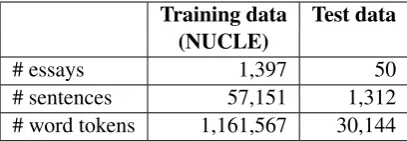
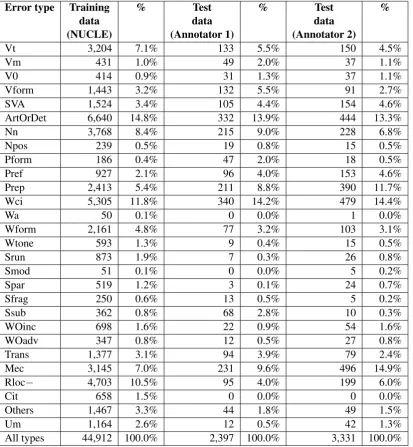
The statistics of the NUCLE corpus (release 3.2 version) are shown in Table 2. The distribution of errors among all error types is shown in Table 3.
While the NUCLE corpus is provided in our shared task, participating teams are free to not use NUCLE, or to use additional resources and tools in building their grammatical error correction sys-tems, as long as these resources and tools are
pub-1http://www.comp.nus.edu.sg/∼nlp/corpora.html
Training data Test data (NUCLE)
# essays 1,397 50
# sentences 57,151 1,312
[image:4.595.314.518.62.133.2]# word tokens 1,161,567 30,144
Table 2: Statistics of training and test data.
licly available and not proprietary. For example, participating teams are free to use the Cambridge FCE corpus (Yannakoudakis et al., 2011; Nicholls, 2003) (the training data provided in HOO 2012 (Dale et al., 2012)) as additional training data.
3.2 Test Data
Similar to CoNLL-2013, 25 NUS students, who are non-native speakers of English, were recruited to write new essays to be used as blind test data in the shared task. Each student wrote two essays in response to the two prompts shown in Table 4, one essay per prompt. The first prompt was also used in the NUCLE training data, but the second prompt is entirely new and not used previously. As a result, 50 new test essays were collected. The statistics of the test essays are also shown in Ta-ble 2.
Error annotation on the test essays was carried out independently by two native speakers of En-glish. One of them is a lecturer at the NUS Cen-tre for English Language Communication, and the other is a freelance English linguist with exten-sive prior experience in error annotation of English learners’ essays. The distribution of errors in the test essays among the error types is shown in Ta-ble 3. The test essays were then preprocessed in the same manner as the NUCLE corpus. The pre-processed test essays were released to the partic-ipating teams. Similar to CoNLL-2013, the test essays and their error annotations in the CoNLL-2014 shared task will be made freely available af-ter the shared task.
4 Evaluation Metric and Scorer
<MISTAKE start par="5" start off="11" end par="5" end off="19"> <TYPE>Wform</TYPE>
<CORRECTION>absolutely</CORRECTION> </MISTAKE>
Figure 1: An example error annotation.
Error type Training % Test % Test %
data data data
(NUCLE) (Annotator 1) (Annotator 2)
Vt 3,204 7.1% 133 5.5% 150 4.5%
Vm 431 1.0% 49 2.0% 37 1.1%
V0 414 0.9% 31 1.3% 37 1.1%
Vform 1,443 3.2% 132 5.5% 91 2.7%
SVA 1,524 3.4% 105 4.4% 154 4.6%
ArtOrDet 6,640 14.8% 332 13.9% 444 13.3%
Nn 3,768 8.4% 215 9.0% 228 6.8%
Npos 239 0.5% 19 0.8% 15 0.5%
Pform 186 0.4% 47 2.0% 18 0.5%
Pref 927 2.1% 96 4.0% 153 4.6%
Prep 2,413 5.4% 211 8.8% 390 11.7%
Wci 5,305 11.8% 340 14.2% 479 14.4%
Wa 50 0.1% 0 0.0% 1 0.0%
Wform 2,161 4.8% 77 3.2% 103 3.1%
Wtone 593 1.3% 9 0.4% 15 0.5%
Srun 873 1.9% 7 0.3% 26 0.8%
Smod 51 0.1% 0 0.0% 5 0.2%
Spar 519 1.2% 3 0.1% 24 0.7%
Sfrag 250 0.6% 13 0.5% 5 0.2%
Ssub 362 0.8% 68 2.8% 10 0.3%
WOinc 698 1.6% 22 0.9% 54 1.6%
WOadv 347 0.8% 12 0.5% 27 0.8%
Trans 1,377 3.1% 94 3.9% 79 2.4%
Mec 3,145 7.0% 231 9.6% 496 14.9%
Rloc− 4,703 10.5% 95 4.0% 199 6.0%
Cit 658 1.5% 0 0.0% 0 0.0%
Others 1,467 3.3% 44 1.8% 49 1.5%
Um 1,164 2.6% 12 0.5% 42 1.3%
[image:5.595.95.509.241.689.2]All types 44,912 100.0% 2,397 100.0% 3,331 100.0%
ID Prompt
1 “The decision to undergo genetic testing can only be made by the individual at risk for a disor-der. Once a test has been conducted and the results are known, however, a new, family-related ethical dilemma is born: Should a carrier of a known genetic risk be obligated to tell his or her relatives?” Respond to the question above, supporting your argument with concrete examples. 2 While social media sites such as Twitter and Facebook can connect us closely to people in
[image:6.595.120.291.575.671.2]many parts of the world, some argue that the reduction in face-to-face human contact affects interpersonal skills. Explain the advantages and disadvantages of using social media in your daily life/society.
Table 4: The two prompts used for the test essays.
There is no a doubt , tracking system hasbrought many benefits in this infor-mation age .
The set of gold-standard edits of a human annota-tor isg ={a doubt→ doubt, system→systems, has→have}. Suppose the tokenized output sen-tenceH of a grammatical error correction system given the above sentence is:
There is no doubt , tracking system has brought many benefits in this informa-tion age .
That is, the set of system edits is e= {a doubt → doubt}. The performance of the grammatical error correction system is measured by how well the two sets g andematch, in the form of recall R, precisionP, andF0.5measure:R = 1/3, P = 1/1, F0.5 = (1 + 0.52)×RP/(R+ 0.52×P) = 5/7.
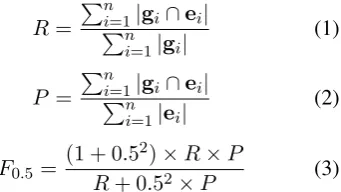
More generally, given a set of n sentences, wheregi is the set of gold-standard edits for
sen-tencei, andei is the set of system edits for
sen-tencei, recall, precision, andF0.5 are defined as
follows:
R= Pn
i=1|gi∩ei| Pn
i=1|gi| (1)
P = Pn
i=1|gi∩ei| Pn
i=1|ei| (2)
F0.5= (1 + 0.5
2)×R×P
R+ 0.52×P (3)
where the intersection betweengi andei for
sen-tenceiis defined as
gi∩ei ={e∈ei|∃g∈gi, match(g, e)} (4)
Note that we have adoptedF0.5as the evaluation
metric in the CoNLL-2014 shared task instead of
the standard F1 used in CoNLL-2013. F0.5
em-phasizes precision twice as much as recall, while F1 weighs precision and recall equally. When a
grammar checker is put into actual use, it is im-portant that its proposed corrections are highly ac-curate in order to gain user acceptance. Neglecting to propose a correction is not as bad as proposing an erroneous correction.
Similar to CoNLL-2013, we use theMaxMatch
(M2) scorer2(Dahlmeier and Ng, 2012b) as the of-ficial scorer in CoNLL-2014. The M2scorer3 effi-ciently searches for a set of system edits that max-imally matches the set of gold-standard edits spec-ified by an annotator. It overcomes a limitation of the scorer used in HOO shared tasks, which can return an erroneous score since the system edits are computed deterministically by the HOO scorer without regard to the gold-standard edits.
5 Approaches
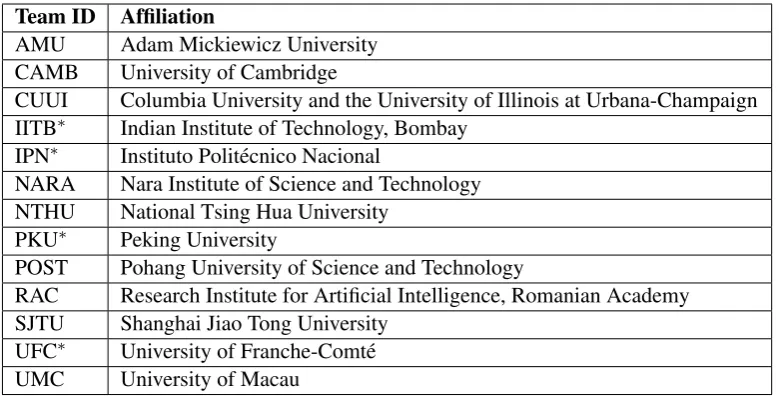
45 teams registered to participate in the shared task, out of which 13 teams submitted the out-put of their grammatical error correction systems. These teams are listed in Table 5. Each team is as-signed a 3 to 4-letter team ID. In the remainder of this paper, we will use the assigned team ID to re-fer to a participating team. Every team submitted a system description paper (the only exception is the NARA team). Four of the 13 teams submitted their system output only after the deadline (they were given up to one week of extension). These four teams (IITB, IPN, PKU, and UFC) have an asterisk affixed after their team names in Table 5.
Each participating team in the CoNLL-2014 shared task tackled the error correction problem in a different way. A full list summarizing each
2http://www.comp.nus.edu.sg/∼nlp/software.html
3A few minor bugs were fixed in the M2 scorer before it
Team ID Affiliation
AMU Adam Mickiewicz University
CAMB University of Cambridge
CUUI Columbia University and the University of Illinois at Urbana-Champaign IITB∗ Indian Institute of Technology, Bombay
IPN∗ Instituto Polit´ecnico Nacional
NARA Nara Institute of Science and Technology NTHU National Tsing Hua University
PKU∗ Peking University
POST Pohang University of Science and Technology
RAC Research Institute for Artificial Intelligence, Romanian Academy SJTU Shanghai Jiao Tong University
UFC∗ University of Franche-Comt´e
UMC University of Macau
Table 5: The list of 13 participating teams. The teams that submitted their system output after the deadline have an asterisk affixed after their team names. NARA did not submit any system description paper.
team’s approach can be found in Table 6. While machine-learnt classifiers for specific error types proved popular in last year’s CoNLL-2013 shared task, since this year’s task required the correction of all 28 error types, teams tended to prefer meth-ods that could deal with all error types simultane-ously. In fact, most teams built hybrid systems that made use of a combination of different approaches to identify and correct errors.
One of the most popular approaches to non-specific error type correction, incorporated to var-ious extents in many teams’ systems, was the Lan-guage Model (LM) based approach. Specifically, the probability of a learner n-gram is compared with the probability of a candidate corrected n-gram, and if the difference is greater than some threshold, an error was perceived to have been de-tected and a higher scoring replacement n-gram could be suggested. Some teams used this ap-proach only to detect errors, e.g., IPN (Hernandez and Calvo, 2014), which could then be corrected by other methods, whilst other teams used other methods to detect errors first, and then made cor-rections based on the alternative highest n-gram probability score, e.g., RAC (Boros¸ et al., 2014). No single team used a uniquely LM-based solution and the LM approach was always a component in a hybrid system.
An alternative solution to correcting all er-rors was to use a phrase-based statistical machine translation (MT) system to “translate” learner En-glish into correct EnEn-glish. Teams that followed the
MT approach mainly differed in terms of their at-titude toward tuning; CAMB (Felice et al., 2014) performed no tuning at all, IITB (Kunchukut-tan et al., 2014) and UMC (Wang et al., 2014b) tuned F0.5 using MERT, while AMU
(Junczys-Dowmunt and Grundkiewicz, 2014) explored a va-riety of tuning options, ultimately tuningF0.5
us-ing a combination of kb-MIRA and MERT. No team used a syntax-based translation model, al-though UMC did include POS tags and morphol-ogy in a factored translation model.
With regard to correcting single error types, rule-based (RB) approaches were also common in most teams’ systems. A possible reason for this is that some error types are more regular than oth-ers, and so in order to boost accuracy, simple rules can be written to make sure that, for example, the number of a subject agrees with the number of a verb. In contrast, it is a lot harder to write a rule to consistently correct Wci (wrong colloca-tion/idiom) errors. As such, RB methods were of-ten, but not always, used as a preliminary or sup-plementary stage in a larger hybrid system.
[image:7.595.105.495.61.259.2]errors might be subcategorized into present, past, or future tense etc.) and then built a single max-imum entropy classifier to correct all error types. See Table 6 to find out which teams tackled which error types.
[image:8.595.322.509.62.259.2]While every effort has been made to make clear which team used which approach to correct which set of error types, as there were more error types than last year, it was sometimes impractical to fit all this information into Table 6. For more infor-mation on the specific methods used to correct a specific error type, we must refer the reader to that team’s CoNLL-2014 system description paper.
Table 6 also shows the linguistic features used by the participating teams, which include lexical features (i.e., words, collocations, n-grams), parts-of-speech (POS), constituency parses, and depen-dency parses.
While all teams in the shared task used the NU-CLE corpus, they were also allowed to use addi-tional external resources (both corpora and tools) so long as they were publicly available and not proprietary. Three teams also used last year’s CoNLL-2013 test set as a development set in this year’s CoNLL-2014 shared task. The external re-sources used by the teams are also listed in Ta-ble 6.
6 Results
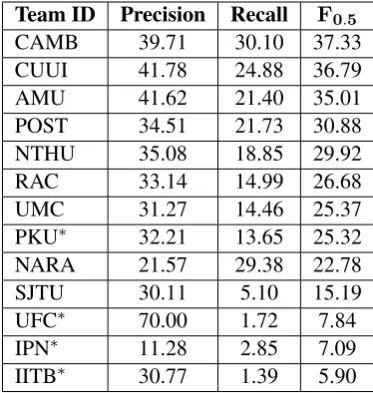
All submitted system output was evaluated using the M2scorer, based on the error annotations
pro-vided by our annotators. The recall (R), pre-cision (P), and F0.5 measure of all teams are
shown in Table 7. The performance of the teams varies greatly, from little more than five per cent to 37.33% for the top team.
The nature of grammatical error correction is such that multiple, different corrections are of-ten acceptable. In order to allow the participating teams to raise their disagreement with the origi-nal gold-standard annotations provided by the an-notators, and not understate the performance of the teams, we allow the teams to submit their proposed alternative answers. This was also the practice adopted in HOO 2011, HOO 2012, and CoNLL-2013. Specifically, after the teams sub-mitted their system output and the error annota-tions on the test essays were released, we allowed the teams to propose alternative answers (gold-standard edits), to be submitted within four days after the initial error annotations were released.
Team ID Precision Recall F0.5
CAMB 39.71 30.10 37.33
CUUI 41.78 24.88 36.79
AMU 41.62 21.40 35.01
POST 34.51 21.73 30.88
NTHU 35.08 18.85 29.92
RAC 33.14 14.99 26.68
UMC 31.27 14.46 25.37
PKU∗ 32.21 13.65 25.32
NARA 21.57 29.38 22.78
SJTU 30.11 5.10 15.19
UFC∗ 70.00 1.72 7.84
IPN∗ 11.28 2.85 7.09
IITB∗ 30.77 1.39 5.90
Table 7: Scores (in %) without alternative an-swers. The teams that submitted their system out-put after the deadline have an asterisk affixed after their team names.
The same annotators who provided the error an-notations on the test essays also judged the alter-native answers proposed by the teams, to ensure consistency. In all, three teams (CAMB, CUUI, UMC) submitted alternative answers.
The same submitted system output was then evaluated using the M2 scorer, with the original
annotations augmented with the alternative an-swers. Table 8 shows the recall (R), precision (P), andF0.5measure of all teams under this new
eval-uation setting.
TheF0.5measure of every team improves when
evaluated with alternative answers. Not surpris-ingly, the teams which submitted alternative an-swers tend to show the greatest improvements in theirF0.5 measure. Overall, the CUUI team
(Ro-zovskaya et al., 2014) achieves the bestF0.5
mea-sure when evaluated with alternative answers, and the CAMB team (Felice et al., 2014) achieves the bestF0.5measure when evaluated without
alterna-tive answers.
For future research which uses the test data of the CoNLL-2014 shared task, we recommend that evaluation be carried out in the setting that does
notuse alternative answers, to ensure a fairer eval-uation. This is because the scores of the teams which submitted alternative answers tend to be higher in a biased way when evaluated with alter-native answers.
Team ID Precision Recall F0.5
CUUI 52.44 29.89 45.57
CAMB 46.70 34.30 43.55
AMU 45.68 23.78 38.58
POST 41.28 25.59 36.77
UMC 43.17 19.72 34.88
NTHU 38.34 21.12 32.97
PKU∗ 36.64 15.96 29.10
RAC 35.63 16.73 29.06
NARA 23.83 31.95 25.11
SJTU 32.95 5.95 17.28
UFC∗ 72.00 1.90 8.60
IPN∗ 11.66 3.17 7.59
[image:12.595.87.278.62.260.2]IITB∗ 34.07 1.66 6.94
Table 8: Scores (in %)with alternative answers. The teams that submitted their system output af-ter the deadline have an asaf-terisk affixed afaf-ter their team names.
Computing the recall of an error type is straight-forward as the error type of each gold-standard edit is provided. Conversely, computing the pre-cision of each of the 28 error types is difficult as the error type of each system edit is not available since the submitted system output only contains corrected sentences with no indication of the er-ror type of the system edits. Predicting the erer-ror type out of the 28 types for a particular system edit not found in gold-standard annotation can be tricky and error-prone. Therefore, we decided to compute the per-type performance based on recall. The recall scores when distinguished by error type are shown in Tables 9 and 10.
6.1 Cross Annotator Comparison
To measure the agreement between our two an-notators, we computed Cohen’s Kappa coefficient (Cohen, 1960) for identification, which measures the extent to which annotators agreed which words needed correction and which did not, regardless of the error type or correction. We obtained a Kappa coefficient value of 0.43, indicating mod-erate agreement (since it falls between 0.40 and 0.60). While this may seem low, it is worth point-ing out that the Kappa coefficient does not take into account the fact that there is often more than one valid way to correct a sentence.
In addition to computing the performance of each team against the gold standard annotations of both annotators with and without alternative
anno-tations, we also had an opportunity to compare the performance of each team’s system against each annotator individually.
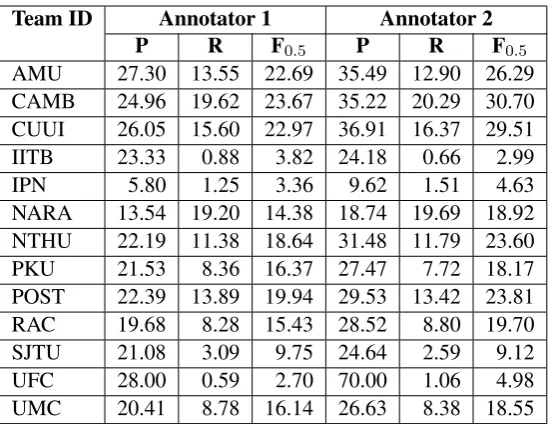
A recent concern is that there can be a high degree of variability between individual annota-tors which can dramatically affect a system’s out-put score. For example, in a much simplified er-ror correction task concerning only the correction of prepositions, Tetreault and Chodorow (2008) showed an actual difference of 10% precision and 5% recall between two annotators. Table 11 hence shows the precision (P), recall (R), and F0.5
scores forallerror types against the gold standard annotations of each CoNLL-2014 annotator indi-vidually.
The results show that there can indeed be a high amount of disagreement between two annotators, the most noticeable being precision in the UFC system: precision was 70% for Annotator 2 but only 28% for Annotator 1. This 42% difference is, however, likely to be an extreme case, and most teams show little more than 10% variation in pre-cision and 5% variation inF0.5. Recall remained
fairly constant between annotators. 10% is still a large margin however, and these results rein-force the idea that error correction systems should be judged against the gold-standard annotations of multiple annotators.
Table 12 additionally shows how each annotator compares against each other; i.e., what score An-notator 1 gets if AnAn-notator 2 was the gold standard (part (a) of Table 12) and vice versa (part (b)).
The lowF0.5scores of 45.36% and 38.54%
rep-resent an upper bound for system performance on this data set and again emphasize the difficulty of the task. The low human F0.5 scores imply that
there are many ways to correct a sentence.
7 Conclusions
The CoNLL-2014 shared task saw the participa-tion of 13 teams worldwide to evaluate their gram-matical error correction systems on a common test set, using a common evaluation metric and scorer. The best systems in the shared task achieve an F0.5 score of 37.33% when it is scored without
Team ID Annotator 1 Annotator 2 P R F0.5 P R F0.5
AMU 27.30 13.55 22.69 35.49 12.90 26.29
CAMB 24.96 19.62 23.67 35.22 20.29 30.70
CUUI 26.05 15.60 22.97 36.91 16.37 29.51
IITB 23.33 0.88 3.82 24.18 0.66 2.99
IPN 5.80 1.25 3.36 9.62 1.51 4.63
NARA 13.54 19.20 14.38 18.74 19.69 18.92
NTHU 22.19 11.38 18.64 31.48 11.79 23.60
PKU 21.53 8.36 16.37 27.47 7.72 18.17
POST 22.39 13.89 19.94 29.53 13.42 23.81
RAC 19.68 8.28 15.43 28.52 8.80 19.70
SJTU 21.08 3.09 9.75 24.64 2.59 9.12
UFC 28.00 0.59 2.70 70.00 1.06 4.98
[image:13.595.162.439.60.272.2]UMC 20.41 8.78 16.14 26.63 8.38 18.55
Table 11: Performance (in %) for each team’s output scored against the annotations of a single annotator.
P R F0.5
50.47 32.29 45.36
(a)
P R F0.5
37.14 45.38 38.54
(b)
Table 12: Performance (in %) for output of one gold standard annotation scored against the other gold standard annotation: (a) The score of Annotator 1 if Annotator 2 was the gold standard, (b) The score of Annotator 2 if Annotator 1 was the gold standard.
future research on grammatical error correction4. Acknowledgments
This research is supported by the Singapore Na-tional Research Foundation under its InternaNa-tional Research Centre @ Singapore Funding Initiative and administered by the IDM Programme Office. We thank our two annotators Mark Brooke and Di-ane Nicholls who provided the gold-standard an-notations.
References
Steven Bird, Ewan Klein, and Edward Loper.
2009. Natural Language Processing with Python.
O’Reilly Media.
Tiberiu Boros¸, Stefan Daniel Dumitrescu, Adrian Zafiu, Dan Tufis¸, Verginica Mititelu Barbu, and Paul Ionut¸ V˘aduva. 2014. RACAI GEC – a hybrid
approach to grammatical error correction. In
Pro-ceedings of the Eighteenth Conference on Computa-tional Natural Language Learning: Shared Task. Jacob Cohen. 1960. A coefficient of agreement
for nominal scales. Educational and Psychological
Measurement, 20(1):37–46.
4http://www.comp.nus.edu.sg/∼nlp/conll14st.html
Daniel Dahlmeier and Hwee Tou Ng. 2011a. Cor-recting semantic collocation errors with L1-induced
paraphrases. InProceedings of the 2011 Conference
on Empirical Methods in Natural Language Pro-cessing, pages 107–117.
Daniel Dahlmeier and Hwee Tou Ng. 2011b. Gram-matical error correction with alternating structure
optimization. In Proceedings of the 49th Annual
Meeting of the Association for Computational Lin-guistics, pages 915–923.
Daniel Dahlmeier and Hwee Tou Ng. 2012a. A beam-search decoder for grammatical error correction. In Proceedings of the 2012 Joint Conference on Empir-ical Methods in Natural Language Processing and Computational Natural Language Learning, pages 568–578.
Daniel Dahlmeier and Hwee Tou Ng. 2012b. Better
evaluation for grammatical error correction. In
Pro-ceedings of the 2012 Conference of the North Amer-ican Chapter of the Association for Computational Linguistics: Human Language Technologies, pages 568–572.
Robert Dale and Adam Kilgarriff. 2011. Helping Our
Own: The HOO 2011 pilot shared task. In
Proceed-ings of the 13th European Workshop on Natural Lan-guage Generation, pages 242–249.
Robert Dale, Ilya Anisimoff, and George Narroway. 2012. HOO 2012: A report on the preposition and
determiner error correction shared task. In
Proceed-ings of the 7th Workshop on the Innovative Use of NLP for Building Educational Applications, pages 54–62.
Marie-Catherine de Marneffe, Bill MacCartney, and Christopher D. Manning. 2006. Generating typed dependency parses from phrase structure parses. In Proceedings of the Fifth Conference on Language Resources and Evaluation, pages 449–454.
Mariano Felice, Zheng Yuan, Øistein E. Andersen, He-len Yannakoudakis, and Ekaterina Kochmar. 2014. Grammatical error correction using hybrid systems
and type filtering. In Proceedings of the
Eigh-teenth Conference on Computational Natural Lan-guage Learning: Shared Task.
Michael Gamon. 2010. Using mostly native data to correct errors in learners’ writing: A meta-classifier
approach. InProceedings of the Annual Meeting of
the North American Chapter of the Association for Computational Linguistics, pages 163–171.
Na-Rae Han, Martin Chodorow, and Claudia Leacock. 2006. Detecting errors in English article usage by
non-native speakers. Natural Language
Engineer-ing, 12(2):115–129.
S. David Hernandez and Hiram Calvo. 2014. CoNLL 2014 shared task: Grammatical error correction with a syntactic n-gram language model from a big
cor-pora. In Proceedings of the Eighteenth
Confer-ence on Computational Natural Language Learn-ing: Shared Task.
Marcin Junczys-Dowmunt and Roman Grundkiewicz.
2014. The AMU system in the CoNLL-2014
shared task: Grammatical error correction by data-intensive and feature-rich statistical machine
trans-lation. In Proceedings of the Eighteenth
Confer-ence on Computational Natural Language Learn-ing: Shared Task.
Dan Klein and Christopher D. Manning. 2003.
Ac-curate unlexicalized parsing. InProceedings of the
41st Annual Meeting of the Association for Compu-tational Linguistics, pages 423–430.
Anoop Kunchukuttan, Sriram Chaudhury, and Pushpak Bhattacharyya. 2014. Tuning a grammar correction
system for increased precision. In Proceedings of
the Eighteenth Conference on Computational Natu-ral Language Learning: Shared Task.
Claudia Leacock, Martin Chodorow, Michael Gamon,
and Joel Tetreault. 2010. Automated Grammatical
Error Detection for Language Learners. Morgan & Claypool Publishers.
Hwee Tou Ng, Siew Mei Wu, Yuanbin Wu, Christian Hadiwinoto, and Joel Tetreault. 2013. The CoNLL-2013 shared task on grammatical error correction. In Proceedings of the Seventeenth Conference on Computational Natural Language Learning: Shared Task, pages 1–12.
Diane Nicholls. 2003. The Cambridge Learner Cor-pus: Error coding and analysis for lexicography and
ELT. InProceedings of the Corpus Linguistics 2003
Conference, pages 572–581.
Alla Rozovskaya and Dan Roth. 2010. Generating confusion sets for context-sensitive error correction. In Proceedings of the 2010 Conference on Empiri-cal Methods in Natural Language Processing, pages 961–970.
Alla Rozovskaya, Kai-Wei Chang, Mark Sammons, Dan Roth, and Nizar Habash. 2014. The Illinois-Columbia system in the CoNLL-2014 shared task. In Proceedings of the Eighteenth Conference on Computational Natural Language Learning: Shared Task.
Joel R. Tetreault and Martin Chodorow. 2008. Na-tive judgments of non-naNa-tive usage: Experiments in
preposition error detection. InCOLING Workshop
on Human Judgments in Computational Linguistics, Manchester, UK.
Joel Tetreault, Jennifer Foster, and Martin Chodorow. 2010. Using parse features for preposition selection
and error detection. InProceedings of the ACL 2010
Conference Short Papers, pages 353–358.
Peilu Wang, Zhongye Jia, and Hai Zhao. 2014a. Grammatical error detection and correction using a
single maximum entropy model. InProceedings of
the Eighteenth Conference on Computational Natu-ral Language Learning: Shared Task.
Yiming Wang, Longyue Wang, Derek F. Wong, Lidia S. Chao, Xiaodong Zeng, and Yi Lu. 2014b. Factored statistical machine translation for
gram-matical error correction. InProceedings of the
Eigh-teenth Conference on Computational Natural Lan-guage Learning: Shared Task.
Yuanbin Wu and Hwee Tou Ng. 2013. Grammat-ical error correction using integer linear
program-ming. InProceedings of the 51st Annual Meeting
of the Association for Computational Linguistics, pages 1456–1465.
Helen Yannakoudakis, Ted Briscoe, and Ben Medlock. 2011. A new dataset and method for automatically
grading ESOL texts. InProceedings of the 49th