Bilingually-Constrained (Monolingual) Shift-Reduce Parsing
Liang Huang Google Research 1350 Charleston Rd. Mountain View, CA 94043, USA
[email protected] [email protected]
Wenbin Jiang and Qun Liu
Key Lab. of Intelligent Information Processing Institute of Computing Technology
Chinese Academy of Sciences P.O. Box 2704, Beijing 100190, China
Abstract
Jointly parsing two languages has been shown to improve accuracies on either or both sides. However, its search space is much bigger than the monolingual case, forcing existing approaches to employ complicated modeling and crude approxi-mations. Here we propose a much simpler alternative, bilingually-constrained mono-lingual parsing, where a source-language parser learns to exploit reorderings as ad-ditional observation, but not bothering to build the target-side tree as well. We show specifically how to enhance a shift-reduce dependency parser with alignment fea-tures to resolve shift-reduce conflicts. Ex-periments on the bilingual portion of Chi-nese Treebank show that, with just 3 bilin-gual features, we can improve parsing ac-curacies by 0.6% (absolute) for both En-glish and Chinese over a state-of-the-art baseline, with negligible (∼6%) efficiency overhead, thus much faster than biparsing.
1 Introduction
Ambiguity resolution is a central task in Natu-ral Language Processing. Interestingly, not all lan-guages are ambiguous in the same way. For exam-ple, prepositional phrase (PP) attachment is (no-toriously) ambiguous in English (and related Eu-ropean languages), but is strictly unambiguous in Chinese and largely unambiguous Japanese; see
(1a) I [ saw Bill ] [ with a telescope ].
wo [ yong wangyuanjin] [kandao le Bi’er].
“I used a telescope to see Bill.”
(1b) I saw [ Bill [ with a telescope ] ].
wo kandao le [ [ na wangyuanjin ] de Bi’er].
“I saw Bill who had a telescope at hand.”
Figure 1: PP-attachment is unambiguous in Chi-nese, which can help English parsing.
Figure 1 for an example.1It is thus intuitive to use two languages for better disambiguation, which has been applied not only to this PP-attachment problem (Fossum and Knight, 2008; Schwartz et al., 2003), but also to the more fundamental prob-lem of syntactic parsing which subsumes the for-mer as a subproblem. For example, Smith and Smith (2004) and Burkett and Klein (2008) show that joint parsing (or reranking) on a bitext im-proves accuracies on either or both sides by lever-aging bilingual constraints, which is very promis-ing for syntax-based machine translation which re-quires (good-quality) parse trees for rule extrac-tion (Galley et al., 2004; Mi and Huang, 2008).
However, the search space of joint parsing is in-evitably much bigger than the monolingual case,
1Chinese uses word-order to disambiguate the attachment
forcing existing approaches to employ compli-cated modeling and crude approximations. Joint parsing with a simplest synchronous context-free grammar (Wu, 1997) isO(n6)as opposed to the monolingual O(n3) time. To make things worse, languages are non-isomorphic, i.e., there is no 1-to-1 mapping between tree nodes, thus in practice one has to use more expressive formalisms such as synchronous tree-substitution grammars (Eis-ner, 2003; Galley et al., 2004). In fact, rather than joint parsing per se, Burkett and Klein (2008) re-sort to separate monolingual parsing and bilingual reranking overk2 tree pairs, which covers a tiny fraction of the whole space (Huang, 2008).
We instead propose a much simpler alterna-tive, bilingually-constrained monolingual parsing, where a source-language parser is extended to ex-ploit the reorderings between languages as addi-tional observation, but not bothering to build a tree for the target side simultaneously. To illustrate the idea, suppose we are parsing the sentence
(1) I saw Bill [PPwith a telescope ].
which has 2 parses based on the attachment of PP:
(1a) I [ saw Bill ] [PPwith a telescope ].
(1b) I saw [ Bill [PPwith a telescope ]].
Both are possible, but with a Chinese translation the choice becomes clear (see Figure 1), because a Chinese PP always immediately precedes the phrase it is modifying, thus making PP-attachment strictly unambiguous.2We can thus use Chinese to help parse English, i.e., whenever we have a PP-attachment ambiguity, we will consult the Chinese translation (from a bitext), and based on the align-ment information, decide where to attach the En-glish PP. On the other hand, EnEn-glish can help Chi-nese parsing as well, for example in deciding the scope of relative clauses which is unambiguous in English but ambiguous in Chinese.
This method is much simpler than joint pars-ing because it remains monolpars-ingual in the back-bone, with alignment information merely as soft evidence, rather than hard constraints since auto-matic word alignment is far from perfect. It is thus
2to be precise, in Fig. 1(b), the English PP is translated
into a Chinese relative clause, but nevertheless all phrasal modifiers attach to the immediate right in Mandarin Chinese.
straightforward to implement within a monolin-gual parsing algorithm. In this work we choose shift-reduce dependency parsing for its simplicity and efficiency. Specifically, we make the following contributions:
• we develop a baseline shift-reduce depen-dency parser using the less popular, but clas-sical, “arc-standard” style (Section 2), and achieve similar state-of-the-art performance with the the dominant but complicated “arc-eager” style of Nivre and Scholz (2004);
• we propose bilingual features based on word-alignment information to prefer “target-side contiguity” in resolving shift-reduce conflicts (Section 3);
• we verify empirically that shift-reduce con-flicts are the major source of errors, and cor-rect shift-reduce decisions strongly correlate with the above bilingual contiguity condi-tions even with automatic alignments (Sec-tion 5.3);
• finally, with just three bilingual features, we improve dependency parsing accuracy by 0.6% for both English and Chinese over the state-of-the-art baseline with negligible (∼6%) efficiency overhead (Section 5.4).
2 Simpler Shift-Reduce Dependency Parsing with Three Actions
The basic idea of classical shift-reduce parsing from compiler theory (Aho and Ullman, 1972) is to perform a left-to-right scan of the input sen-tence, and at each step, choose one of the two ac-tions: either shift the current word onto the stack, or reduce the top two (or more) items on the stack, replacing them with their combination. This idea has been applied to constituency parsing, for ex-ample in Sagae and Lavie (2006), and we describe below a simple variant for dependency parsing similar to Yamada and Matsumoto (2003) and the “arc-standard” version of Nivre (2004).
2.1 The Three Actions
Basically, we just need to split the reduce ac-tion into two symmetric (sub-)acac-tions, reduceL
stack queue arcs previous S wi|Q A
shift S|wi Q A
previous S|st−1|st Q A
reduceL S|st Q A∪ {(st, st−1)}
[image:3.595.307.533.87.247.2]reduceR S|st−1 Q A∪ {(st−1, st)}
Table 1: Formal description of the three actions. Note that shift requires non-empty queue while reduce requires at least two elements on the stack.
items becomes the head after reduction. More for-mally, we describe a parser configuration by a tu-plehS, Q, AiwhereS is the stack,Qis the queue of remaining words of the input, andAis the set of dependency arcs accumulated so far.3 At each step, we can choose one of the three actions:
1. shift: move the head of (a non-empty) queue
Qonto stackS;
2. reduceL: combine the top two items on the
stack, st and st−1 (t ≥ 2), and replace them withst(as the head), and add a left arc
(st, st−1)toA;
3. reduceR: combine the top two items on the
stack,standst−1 (t≥2), and replace them with st−1 (as the head), and add a right arc
(st−1, st)toA.
These actions are summarized in Table 1. The initial configuration is always h∅, w1. . . wn,∅i with empty stack and no arcs, and the final con-figuration ishwj,∅, Aiwherewj is recognized as the root of the whole sentence, and A encodes a spanning tree rooted at wj. For a sentence of n words, there are exactly 2n−1 actions: nshifts and n−1 reductions, since every word must be pushed onto stack once, and every word except the root will eventually be popped in a reduction. The time complexity, as other shift-reduce instances, is clearlyO(n).
2.2 Example of Shift-Reduce Conflict
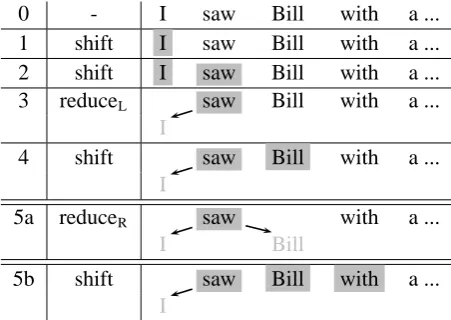
Figure 2 shows the trace of this paradigm on the example sentence. For the first two configurations
3a “configuration” is sometimes called a “state” (Zhang
and Clark, 2008), but that term is confusing with the states in shift-reduce LR/LL parsing, which are quite different.
0 - I saw Bill with a ... 1 shift I saw Bill with a ... 2 shift I saw Bill with a ... 3 reduceL saw Bill with a ...
I
4 shift saw Bill with a ... I
5a reduceR saw with a ...
I Bill
[image:3.595.74.297.88.173.2]5b shift saw Bill with a ... I
Figure 2: A trace of 3-action shift-reduce on the example sentence. Shaded words are on stack, while gray words have been popped from stack. After step (4), the process can take either (5a) or (5b), which correspond to the two attachments (1a) and (1b) in Figure 1, respectively.
(0) and (1), only shift is possible since there are not enough items on the stack for reduction. At step (3), we perform a reduceL, making word “I”
a modifier of “saw”; after that the stack contains a single word and we have to shift the next word “Bill” (step 4). Now we face a shift-reduce con-flict: we can either combine “saw” and “Bill” in a reduceR action (5a), or shift “Bill” (5b). We will
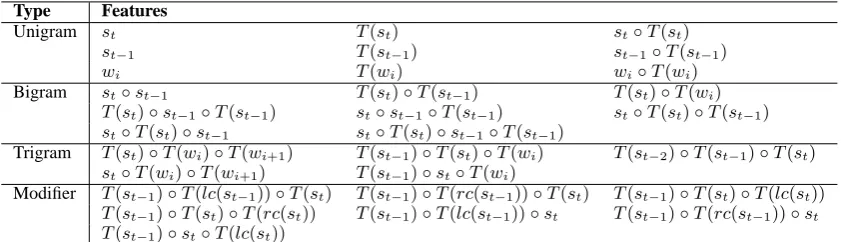
use features extracted from the configuration to re-solve the conflict. For example, one such feature could be a bigramst◦st−1, capturing how likely these two words are combined; see Table 2 for the complete list of feature templates we use in this baseline parser.
Type Features
Unigram st T(st) st◦T(st)
st−1 T(st−1) st−1◦T(st−1)
wi T(wi) wi◦T(wi)
Bigram st◦st−1 T(st)◦T(st−1) T(st)◦T(wi) T(st)◦st−1◦T(st−1) st◦st−1◦T(st−1) st◦T(st)◦T(st−1) st◦T(st)◦st−1 st◦T(st)◦st−1◦T(st−1)
Trigram T(st)◦T(wi)◦T(wi+1) T(st−1)◦T(st)◦T(wi) T(st−2)◦T(st−1)◦T(st)
st◦T(wi)◦T(wi+1) T(st−1)◦st◦T(wi)
Modifier T(st−1)◦T(lc(st−1))◦T(st) T(st−1)◦T(rc(st−1))◦T(st) T(st−1)◦T(st)◦T(lc(st)) T(st−1)◦T(st)◦T(rc(st)) T(st−1)◦T(lc(st−1))◦st T(st−1)◦T(rc(st−1))◦st
[image:4.595.89.510.87.208.2]T(st−1)◦st◦T(lc(st))
Table 2: Feature templates of the baseline parser.st,st−1 denote the top and next to top words on the stack; wi andwi+1 denote the current and next words on the queue. T(·) denotes the POS tag of a given word, and lc(·) andrc(·) represent the leftmost and rightmost child. Symbol ◦ denotes feature conjunction. Each of these templates is further conjoined with the 3 actions shift, reduceL, and reduceR.
to vastly incompatible tree shapes with crossing brackets (for example, [saw Bill] vs. [Bill with a telescope]). We will see in Section 5.3 that this is indeed the case in practice, thus suggesting us to focus on shift-reduce resolution, which we will return to with the help of bilingual constraints in Section 3.
2.3 Comparison with Arc-Eager
The three action system was originally described by Yamada and Matsumoto (2003) (although their methods require multiple passes over the input), and then appeared as “arc-standard” in Nivre (2004), but was argued against in comparison to the four-action “arc-eager” variant. Most subse-quent works on shift-reduce or “transition-based” dependency parsing followed “arc-eager” (Nivre and Scholz, 2004; Zhang and Clark, 2008), which now becomes the dominant style. But we argue that “arc-standard” is preferable because:
1. in the three action “arc-standard” system, the stack always contains a list of unrelated sub-trees recognized so far, with no arcs between any of them, e.g. (I←saw) and (Bill) in step 4 of Figure 2), whereas the four action “arc-eager” style can have left or right arrows be-tween items on the stack;
2. the semantics of the three actions are atomic and disjoint, whereas the semantics of 4 ac-tions are not completely disjoint. For exam-ple, their Left action assumes an implicit Re-duce of the left item, and their Right ac-tion assumes an implicit Shift. Furthermore,
these two actions have non-trivial precondi-tions which also causes the next problem (see below). We argue that this is rather compli-cated to implement.
3. the “arc-standard” scan always succeeds, since at the end we can always reduce with empty queue, whereas the “arc-eager” style sometimes goes into deadends where no ac-tion can perform (prevented by precondi-tions, otherwise the result will not be a well-formed tree). This becomes parsing failures in practice (Nivre and Scholz, 2004), leaving more than one fragments on stack.
As we will see in Section 5.1, this simpler arc-standard system performs equally well with a state-of-the-art arc-eager system (Zhang and Clark, 2008) on standard English Treebank pars-ing (which is never shown before). We argue that all things being equal, this simpler paradigm should be preferred in practice.4
2.4 Beam Search Extension
We also enhance deterministic shift-reduce pars-ing with beam search, similar to Zhang and Clark (2008), wherek configurations develop in paral-lel. Pseudocode 1 illustrates the algorithm, where we keep an agenda V of the current active con-figurations, and at each step try to extend them by applying one of the three actions. We then dump the bestknew configurations from the buffer back
4On the other hand, there are also arguments for
Pseudocode 1 beam-search shift-reduce parsing. 1: Input: POS-tagged word sequencew1. . . wn
2: start← h∅, w1. . . wn,∅i ⊲initial config: empty stack, no arcs
3: V← {start} ⊲initial agenda
4: forstep←1. . .2n−1do
5: BUF← ∅ ⊲buffer for new configs
6: for eachconfigin agendaVdo
7: foract∈ {shift,reduceL,reduceR}do 8: ifactis applicable toconfigthen 9: next←applyacttoconfig 10: insertnextinto bufferBUF 11: V←topkconfigurations ofBUF 12: Output: the tree of the best config inV
into the agenda for the next step. The complexity of this algorithm is O(nk), which subsumes the determinstic mode as a special case (k= 1).
2.5 Online Training
To train the parser we need an “oracle” or gold-standard action sequence for gold-gold-standard depen-dency trees. This oracle turns out to be non-unique for the three-action system (also non-unique for the four-action system), because left dependents of a head can be reduced either before or after all right dependents are reduced. For example, in Fig-ure 2, “I” is a left dependent of “saw”, and can in principle wait until “Bill” and “with” are reduced, and then finally combine with “saw”. We choose to use the heuristic of “shortest stack” that always prefers reduceLover shift, which has the effect that
all left dependents are first recognized inside-out, followed by all right dependents, also inside-out, which coincides with the head-driven constituency parsing model of Collins (1999).
We use the popular online learning algorithm of structured perceptron with parameter averag-ing (Collins, 2002). Followaverag-ing Collins and Roark (2004) we also use the “early-update” strategy, where an update happens whenever the gold-standard action-sequence falls off the beam, with the rest of the sequence neglected. As a special case, for the deterministic mode, updates always co-occur with the first mistake made. The intuition behind this strategy is that future mistakes are of-ten caused by previous ones, so with the parser on the wrong track, future actions become irrelevant for learning. See Section 5.3 for more discussions.
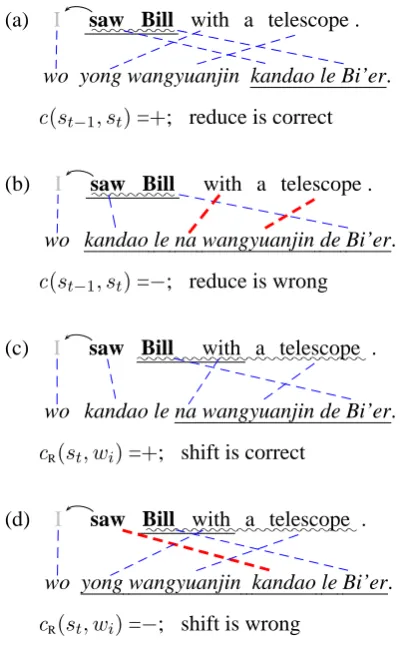
(a) I saw Bill with a telescope .:::::::::
wo yong wangyuanjin kandao le Bi’er.
c(st−1, st)=+; reduce is correct
(b) I saw Bill::::::::: with a telescope .
wo kandao le na wangyuanjin de Bi’er.
c(st−1, st)=−; reduce is wrong
(c) I saw :::::::::::Bill with:::a::::::::::telescope:.
wo kandao le na wangyuanjin de Bi’er.
cR(st, wi)=+; shift is correct
(d) I saw Bill with::::::::::::a::::::::::telescope:.
wo yong wangyuanjin kandao le Bi’er.
[image:5.595.305.508.82.406.2]cR(st, wi)=−; shift is wrong
Figure 3: Bilingual contiguity featuresc(st−1, st) andcR(st, wi)at step (4) in Fig. 2 (facing a
shift-reduce decision). Bold words are currently on stack while gray ones have been popped. Here the stack tops arest= Bill,st−1= saw, and the queue head iswi= with; underlined texts mark the source and target spans being considered, and wavy un-derlines mark the allowed spans (Tab. 3). Red bold alignment links violate contiguity constraints.
3 Soft Bilingual Constraints as Features
As suggested in Section 2.2, shift-reduce con-flicts are the central problem we need to address here. Our intuition is, whenever we face a deci-sion whether to combine the stack tops st−1 and
[image:5.595.73.291.97.240.2]3.1 A Pro-Reduce Featurec(st−1, st)
Informally, if the correct decision is a reduction, then it is likely that the corresponding words of
st−1 andst on the target-side should also form a contiguous span. For example, in Figure 3(a), the source span of a reduction is [saw .. Bill], which maps onto [kandao . . . Bi’er] on the Chinese side. This target span is contiguous, because no word within this span is aligned to a source word out-side of the source span. In this case we say feature
c(st−1, st)=+, which encourages “reduce”. However, in Figure 3(b), the source span is still [saw .. Bill], but this time maps onto a much longer span on the Chinese side. This target span is discontiguous, since the Chinese words na and wangyuanjin are alinged to English “with” and “telescope”, both of which fall outside of the source span. In this case we say featurec(st−1, st) =−, which discourages “reduce” .
3.2 A Pro-Shift FeaturecR(st, wi)
Similarly, we can develop another feature
cR(st, wi) for the shift action. In Figure 3(c),
when considering shifting “with”, the source span becomes [Bill .. with] which maps to [na .. Bi’er] on the Chinese side. This target span looks like discontiguous in the above definition with wangyuanjin aligned to “telescope”, but we tolerate this case for the following reasons. There is a crucial difference between shift and reduce: in a shift, we do not know yet the subtree spans (unlike in a reduce we are always combining two well-formed subtrees). The only thing we are sure of in a shift action is that st and wi will be combined before st−1 andst are combined (Aho and Ullman, 1972), so we can tolerate any target word aligned to source word still in the queue, but do not allow any target word aligned to an already recognized source word. This explains the notational difference between cR(st, wi) and c(st−1, st), where subscript “R” means “right contiguity”.
As a final example, in Figure 3(d), Chinese word kandao aligns to “saw”, which is already recognized, and this violates the right contiguity. SocR(st, wi)=−, suggesting that shift is probably
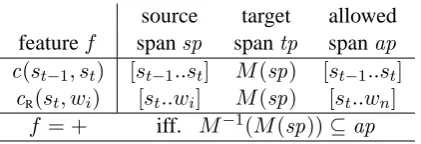
wrong. To be more precise, Table 3 shows the for-mal definitions of the two features. We basically
source target allowed featuref spansp spantp spanap
c(st−1, st) [st−1..st] M(sp) [st−1..st]
[image:6.595.308.519.86.158.2]cR(st, wi) [st..wi] M(sp) [st..wn] f = + iff. M−1(M(sp))⊆ap
Table 3: Formal definition of bilingual features.
M(·)is maps a source span to the target language, andM−1(·)is the reverse operation mapping back to the source language.
map a source span sp to its target span M(sp), and check whether its reverse image back onto the source languageM−1(M(sp))falls inside the al-lowed span ap. For cR(st, wi), the allowed span
extends to the right end of the sentence.5
3.3 Variations and Implementation
To conclude so far, we have got two alignment-based features,c(st−1, st)correlating with reduce, and cR(st, wi) correlating with shift. In fact, the
conjunction of these two features,
c(st−1, st)◦cR(st, wi)
is another feature with even stronger discrimina-tion power. If
c(st−1, st)◦cR(st, wi) = +◦ −
it is strongly recommending reduce, while
c(st−1, st)◦cR(st, wi) =− ◦+
is a very strong signal for shift. So in total we got three bilingual feature (templates), which in prac-tice amounts to 24 instances (after cross-product with {−,+} and the three actions). We show in Section 5.3 that these features do correlate with the correct shift/reduce actions in practice.
The naive implemention of bilingual feature computation would be of O(kn2) complexity in the worse case because when combining the largest spans one has to scan over the whole sen-tence. We envision the use of a clever datastructure would reduce the complexity, but leave this to fu-ture work, as the experiments (Table 8) show that
5Our definition implies that we only consider faithful
the parser is only marginally (∼6%) slower with the new bilingual features. This is because the ex-tra work, with just 3 bilingual features, is not the bottleneck in practice, since the extraction of the vast amount of other features in Table 2 dominates the computation.
4 Related Work in Grammar Induction
Besides those cited in Section 1, there are some other related work on using bilingual constraints for grammar induction (rather than parsing). For example, Hwa et al. (2005) use simple heuris-tics to project English trees to Spanish and Chi-nese, but get discouraging accuracy results learned from those projected trees. Following this idea, Ganchev et al. (2009) and Smith and Eisner (2009) use constrained EM and parser adaptation tech-niques, respectively, to perform more principled projection, and both achieve encouraging results.
Our work, by constrast, never uses bilingual tree pairs not tree projections, and only uses word alignment alone to enhance a monolingual gram-mar, which learns to prefer target-side contiguity.
5 Experiments
5.1 Baseline Parser
We implement our baseline monolingual parser (in C++) based on the shift-reduce algorithm in Sec-tion 2, with feature templates from Table 2. We evaluate its performance on the standard Penn En-glish Treebank (PTB) dependency parsing task, i.e., train on sections 02-21 and test on section 23 with automatically assigned POS tags (at 97.2% accuracy) using a tagger similar to Collins (2002), and using the headrules of Yamada and Mat-sumoto (2003) for conversion into dependency trees. We use section 22 as dev set to deter-mine the optimal number of iterations in per-ceptron training. Table 4 compares our baseline against the state-of-the-art graph-based (McDon-ald et al., 2005) and transition-based (Zhang and Clark, 2008) approaches, and confirms that our system performs at the same level with those state-of-the-art, and runs extremely fast in the determin-istic mode (k=1), and still quite fast in the beam-search mode (k=16).
parser accuracy secs/sent McDonald et al. (2005) 90.7 0.150 Zhang and Clark (2008) 91.4 0.195 our baseline atk=1 90.2 0.009 our baseline atk=16 91.3 0.125
Table 4: Baseline parser performance on standard Penn English Treebank dependency parsing task. The speed numbers are not exactly comparable since they are reported on different machines.
Training Dev Test CTB Articles 1-270 301-325 271-300 Bilingual Paris 2745 273 290
Table 5: Training, dev, and test sets from bilingual Chinese Treebank `a la Burkett and Klein (2008).
5.2 Bilingual Data
The bilingual data we use is the translated por-tion of the Penn Chinese Treebank (CTB) (Xue et al., 2002), corresponding to articles 1-325 of PTB, which have English translations with gold-standard parse trees (Bies et al., 2007). Table 5 shows the split of this data into training, devel-opment, and test subsets according to Burkett and Klein (2008). Note that not all sentence pairs could be included, since many of them are not one-to-one aligned at the sentence level. Our word-alignments are generated from the HMM aligner of Liang et al. (2006) trained on approximately 1.7M sentence pairs (provided to us by David Bur-kett, p.c.). This aligner outputs “soft alignments”, i.e., posterior probabilities for each source-target word pair. We use a pruning threshold of 0.535 to remove low-confidence alignment links,6 and use the remaining links as hard alignments; we leave the use of alignment probabilities to future work.
For simplicity reasons, in the following exper-iments we always supply gold-standard POS tags as part of the input to the parser.
5.3 Testing our Hypotheses
Before evaluating our bilingual approach, we need to verify empirically the two assumptions we made about the parser in Sections 2 and 3:
sh⊲re re⊲sh sh-re re-re
# 92 98 190 7
% 46.7% 49.7% 96.4% 3.6%
Table 6: [Hypothesis 1] Error distribution in the baseline model (k = 1) on English dev set. “sh⊲re” means “should shift, but reduced”. Shift-reduce conflicts overwhelmingly dominate.
1. (monolingual) shift-reduce conflict is the ma-jor source of errors while reduce-reduce con-flict is a minor issue;
2. (bilingual) the gold-standard decisions of shift or reduce should correlate with contigu-ities ofc(st−1, st), and ofcR(st, wi).
Hypothesis 1 is verified in Table 6, where we count all the first mistakes the baseline parser makes (in the deterministic mode) on the En-glish dev set (273 sentences). In shift-reduce pars-ing, further mistakes are often caused by previ-ous ones, so only the first mistake in each sen-tence (if there is one) is easily identifiable;7 this is also the argument for “early update” in apply-ing perceptron learnapply-ing to these incremental pars-ing algorithms (Collins and Roark, 2004) (see also Section 2). Among the 197 first mistakes (other 76 sentences have perfect output), the vast ma-jority, 190 of them (96.4%), are shift-reduce er-rors (equally distributed between shift-becomes-reduce and shift-becomes-reduce-becomes-shift), and only 7 (3.6%) are due to reduce-reduce conflicts.8 These statistics confirm our intuition that shift-reduce de-cisions are much harder to make during parsing, and contribute to the overwhelming majority of er-rors, which is studied in the next hypothesis.
Hypothesis 2 is verified in Table 7. We take the gold-standard shift-reduce sequence on the En-glish dev set, and classify them into the four cat-egories based on bilingual contiguity features: (a)
c(st−1, st), i.e. whether the top 2 spans on stack is contiguous, and (b) cR(st, wi), i.e. whether the
7to be really precise one can define “independent
mis-takes” as those not affected by previous ones, i.e., errors
made after the parser recovers from previous mistakes; but this is much more involved and we leave it to future work.
8Note that shift-reduce errors include those due to the
non-uniqueness of oracle, i.e., between some reduceL and shift. Currently we are unable to identify “genuine” errors that would result in an incorrect parse. See also Section 2.5.
c(st−1, st) cR(st, wi) shift reduce
+ − 172 ≪ 1,209
− + 1,432 > 805
+ + 4,430 ∼ 3,696
− − 525 ∼ 576
total 6,559 = 6,286
Table 7: [Hyp. 2] Correlation of gold-standard shift/reduce decisions with bilingual contiguity conditions (on English dev set). Note there is al-ways one more shift than reduce in each sentence.
stack top is contiguous with the current word wi. According to discussions in Section 3, when (a) is contiguous and (b) is not, it is a clear signal for reduce (to combine the top two elements on the stack) rather than shift, and is strongly supported by the data (first line: 1209 reduces vs. 172 shifts); and while when (b) is contiguous and (a) is not, it should suggest shift (combining st andwi be-forest−1andstare combined) rather than reduce, and is mildly supported by the data (second line: 1432 shifts vs. 805 reduces). When (a) and (b) are both contiguous or both discontiguous, it should be considered a neutral signal, and is also consis-tent with the data (next two lines). So to conclude, this bilingual hypothesis is empirically justified.
On the other hand, we would like to note that these correlations are done with automatic word alignments (in our case, from the Berkeley aligner) which can be quite noisy. We suspect (and will fin-ish in the future work) that using manual align-ments would result in a better correlation, though for the main parsing results (see below) we can only afford automatic alignments in order for our approach to be widely applicable to any bitext.
5.4 Results
[image:8.595.88.277.86.129.2] [image:8.595.308.526.86.171.2]baseline +bilingual
[image:9.595.71.291.85.183.2]k accuracy time (s) accuracy time (s) 1 84.58 0.011 84.67 0.012 2 85.30 0.025 85.62 0.028 4 85.42 0.040 85.81 0.044 8 85.50 0.081 85.95 0.085 16 85.57 0.158 86.07 0.168
Table 8: Effects of beam size kon efficiency and accuracy (on English dev set). Time is average per sentence (in secs). Bilingual constraints show more improvement with larger beams, with a frac-tional efficiency overhead over the baseline.
English Chinese monolingual baseline 86.9 85.7
+bilingual features 87.5 86.3
improvement +0.6 +0.6 signficance level p <0.05 p <0.08
Berkeley parser 86.1 87.9
Table 9: Final results of dependency accuracy (%) on the test set (290 sentences, beam sizek=16).
bilingual features misled the parser into a mistake, there is no chance of getting back, while in the former multiple configurations are being pursued in parallel. In terms of speed, both parsers run pro-portionally slower with larger beams, as the time complexity is linear to the beam-size. Computing the bilingual features further slows it down, but only fractionally so (just 1.06 times as slow as the baseline at k=16), which is appealing in practice. By contrast, Burkett and Klein (2008) reported their approach of “monolingualk-best parsing fol-lowed by bilingual k2-best reranking” to be “3.8 times slower” than monolingual parsing.
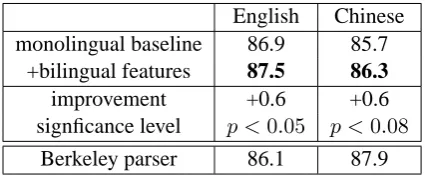
Our final results on the test set (290 sentences) are summarized in Table 9. On both English and Chinese, the addition of bilingual features improves dependency arc accuracies by +0.6%, which is mildly significant using the Z-test of Collins et al. (2005). We also compare our results against the Berkeley parser (Petrov and Klein, 2007) as a reference system, with the exact same setting (i.e., trained on the bilingual data, and test-ing ustest-ing gold-standard POS tags), and the result-ing trees are converted into dependency via the same headrules. We use 5 iterations of split-merge
grammar induction as the 6th iteration overfits the small training set. The result is worse than our baseline on English, but better than our bilingual parser on Chinese. The discrepancy between En-glish and Chinese is probably due to the fact that our baseline feature templates (Table 2) are engi-neered on English not Chinese.
6 Conclusion and Future Work
We have presented a novel parsing paradigm, bilingually-constrained monolingual parsing, which is much simpler than joint (bi-)parsing, yet still yields mild improvements in parsing accuracy in our preliminary experiments. Specifically, we showed a simple method of incorporating alignment features as soft evidence on top of a state-of-the-art shift-reduce dependency parser, which helped better resolve shift-reduce conflicts with fractional efficiency overhead.
The fact that we managed to do this with only three alignment features is on one hand encour-aging, but on the other hand leaving the bilingual feature space largely unexplored. So we will en-gineer more such features, especially with lexical-ization and soft alignments (Liang et al., 2006), and study the impact of alignment quality on pars-ing improvement. From a lpars-inguistics point of view, we would like to see how linguistics distance affects this approach, e.g., we suspect English-French would not help each other as much as English-Chinese do; and it would be very interest-ing to see what types of syntactic ambiguities can be resolved across different language pairs. Fur-thermore, we believe this bilingual-monolingual approach can easily transfer to shift-reduce con-stituency parsing (Sagae and Lavie, 2006).
Acknowledgments
[image:9.595.75.288.270.365.2]References
Alfred V. Aho and Jeffrey D. Ullman. 1972. The Theory of Parsing, Translation, and Compiling,
vol-ume I: Parsing of Series in Automatic Computation. Prentice Hall, Englewood Cliffs, New Jersey.
Ann Bies, Martha Palmer, Justin Mott, and Colin Warner. 2007. English chinese translation treebank v1.0. LDC2007T02.
David Burkett and Dan Klein. 2008. Two languages are better than one (for syntactic parsing). In
Pro-ceedings of EMNLP.
Michael Collins and Brian Roark. 2004. Incremental parsing with the perceptron algorithm. In
Proceed-ings of ACL.
Michael Collins, Philipp Koehn, and Ivona Kucerova. 2005. Clause restructuring for statistical machine translation. In Proceedings of ACL, pages 531–540, Ann Arbor, Michigan, June.
Michael Collins. 1999. Head-Driven Statistical
Mod-els for Natural Language Parsing. Ph.D. thesis, University of Pennsylvania.
Michael Collins. 2002. Discriminative training meth-ods for hidden markov models: Theory and experi-ments with perceptron algorithms. In Proceedings
of EMNLP.
Jason Eisner. 2003. Learning non-isomorphic tree mappings for machine translation. In Proceedings
of ACL (poster), pages 205–208.
Victoria Fossum and Kevin Knight. 2008. Using bilin-gual chinese-english word alignments to resolve pp-attachment ambiguity in english. In Proceedings of
AMTA Student Workshop.
Michel Galley, Mark Hopkins, Kevin Knight, and Daniel Marcu. 2004. What’s in a translation rule? In Proceedings of HLT-NAACL, pages 273–280.
Kuzman Ganchev, Jennifer Gillenwater, and Ben Taskar. 2009. Dependency grammar induction via bitext projection constraints. In Proceedings of
ACL-IJCNLP.
Liang Huang. 2008. Forest reranking: Discriminative parsing with non-local features. In Proceedings of
the ACL: HLT, Columbus, OH, June.
Rebecca Hwa, Philip Resnik, Amy Weinberg, Clara Cabezas, and Okan Kolak. 2005. Bootstrapping parsers via syntactic projection across parallel texts.
Natural Language Engineering.
Percy Liang, Alexandre Bouchard-Cˆot´e, Dan Klein, and Ben Taskar. 2006. An end-to-end discrimina-tive approach to machine translation. In
Proceed-ings of COLING-ACL, Sydney, Australia, July.
Ryan McDonald, Koby Crammer, and Fernando Pereira. 2005. Online large-margin training of de-pendency parsers. In Proceedings of the 43rd ACL.
Haitao Mi and Liang Huang. 2008. Forest-based trans-lation rule extraction. In Proceedings of EMNLP, Honolulu, Haiwaii.
Joakim Nivre and Mario Scholz. 2004. Deterministic dependency parsing of english text. In Proceedings
of COLING, Geneva.
Joakim Nivre. 2004. Incrementality in deterministic dependency parsing. In Incremental Parsing:
Bring-ing EngineerBring-ing and Cognition Together. Workshop at ACL-2004, Barcelona.
Joakim Nivre. 2008. Algorithms for deterministic in-cremental dependency parsing. Computational
Lin-guistics, 34(4):513–553.
Slav Petrov and Dan Klein. 2007. Improved inference for unlexicalized parsing. In Proceedings of
HLT-NAACL.
Kenji Sagae and Alon Lavie. 2006. A best-first prob-abilistic shift-reduce parser. In Proceedings of ACL
(poster).
Lee Schwartz, Takako Aikawa, and Chris Quirk. 2003. Disambiguation of english pp attachment using mul-tilingual aligned data. In Proceedings of MT Summit
IX.
David A. Smith and Jason Eisner. 2009. Parser adapta-tion and projecadapta-tion with quasi-synchronous features. In Proceedings of EMNLP.
David A. Smith and Noah A. Smith. 2004. Bilingual parsing with factored estimation: Using english to parse korean. In Proceedings of EMNLP.
Dekai Wu. 1997. Stochastic inversion transduction grammars and bilingual parsing of parallel corpora.
Computational Linguistics, 23(3):377–404.
Nianwen Xue, Fu-Dong Chiou, and Martha Palmer. 2002. Building a large-scale annotated chinese cor-pus. In Proceedings of COLING.
H. Yamada and Y. Matsumoto. 2003. Statistical de-pendency analysis with support vector machines. In
Proceedings of IWPT.
![Table 6: [Hypothesis 1] Error distribution in thebaseline model (“shk=1) on English dev set](https://thumb-us.123doks.com/thumbv2/123dok_us/1374894.671093/8.595.88.277.86.129/table-hypothesis-error-distribution-thebaseline-model-shk-english.webp)