Probabilistic Inference for Machine Translation
Phil Blunsom and Miles Osborne
School of Informatics, University of Edinburgh 10 Crichton Street, Edinburgh, EH8 9AB, UK
{pblunsom,miles}@inf.ed.ac.uk
Abstract
We advance the state-of-the-art for discrimi-natively trained machine translation systems by presenting novel probabilistic inference and search methods for synchronous gram-mars. By approximating the intractable space of all candidate translations produced by inter-secting an ngram language model with a synchronous grammar, we are able to train and decode models incorporating millions of sparse, heterogeneous features. Further, we demonstrate the power of the discriminative training paradigm by extracting structured syntactic features, and achieving increases in translation performance.
1 Introduction
The goal of creating statistical machine translation (SMT) systems incorporating rich, sparse, features over syntax and morphology has consumed much recent research attention. Discriminative approaches are widely seen as a promising technique, poten-tially allowing us to further the state-of-the-art. Most work on discriminative training for SMT has focussed on linear models, often with margin based algorithms (Liang et al., 2006; Watanabe et al., 2006), or rescaling a product of sub-models (Och, 2003; Ittycheriah and Roukos, 2007).
Recent work by Blunsom et al. (2008) has shown how translation can be framed as a probabilistic log-linear model, where the distribution over trans-lations is modelled in terms of a latent variable on derivations. Their approach was globally opti-mised and discriminative trained. However, a lan-guage model, an information source known to be
crucial for obtaining good performance in SMT, was notably omitted. This was because adding a lan-guage model would mean that the normalising parti-tion funcparti-tion could no longer be exactly calculated, thereby preventing efficient parameter estimation.
Here, we show how language models can be incorporated into large-scale discriminative transla-tion models, without losing the probabilistic inter-pretation of the model. The key insight is that we can use Monte-Carlo methods to approximate the partition function, thereby allowing us to tackle the extra computational burden associated with adding the language model. This approach is theoreti-cally justified and means that the model contin-ues to be both probabilistic and globally optimised. As expected, using a language model dramatically increases translation performance.
Our second major contribution is an exploita-tion of syntactic features. By encoding source syn-tax as features allows the model to use, or ignore, this information as it sees fit, thereby avoiding the problems of coverage and sparsity associated with directly incorporating the syntax into the grammar (Huang et al., 2006; Mi et al., 2008). We report on translation gains using this approach.
We begin by introducing the synchronous gram-mar approach to SMT in Section 2. In Section 3 we define the parametric form of our model and describe techniques for approximating the intractable space of all translations for a given source sentence. In Section 4 we evaluate the abil-ity of our model to effectively estimate the highly dependent weights for the sparse features and real-valued language model. In addition we describe how
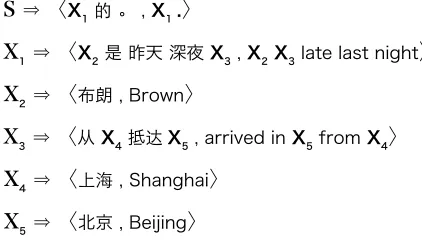
X₂ 〈布朗 , Brown〉
X₃ 〈从 X₄ 抵达 X₅ , arrived in X₅ from X₄〉
X₄ 〈上海 , Shanghai〉
X₅ 〈北京 , Beijing〉
X₁ 〈X₂ 是 昨天 深夜 X₃ , X₂ X₃ late last night〉
[image:2.612.72.283.59.180.2]S 〈X₁ 的。 , X₁.〉
Figure 1. An example SCFG derivation from a Chi-nese source sentence which yields the English sentence: “Brown arrived in Shanghai from Beijing late last night.”
our model can easily integrate rich features over source syntax trees and compare our training meth-ods to a state-of-the-art benchmark.
2 Synchronous context free grammar
A synchronous context free grammar (SCFG, (Lewis II and Stearns, 1968)) describes the gener-ation of pairs of strings. A string pair is generated by applying a series of paired context-free rewrite rules of the form,X → hα, γ,∼i, whereXis a non-terminal,αandγ are strings of terminals and non-terminals and ∼ specifies a one-to-one alignment between non-terminals inαandγ. In the context of SMT, by assigning the source and target languages to the respective sides of a SCFG it is possible to describe translation as the process of parsing the source sentence, while generating the target trans-lation (Chiang, 2007).
In this paper we only consider grammars extracted using the heuristics described for the Hiero SMT system (Chiang, 2007). Note however that our approach is general and could be used with other synchronous grammar transducers (e.g., (Galley et al., 2006)). SCFG productions can specify that the order of the child non-terminals is the same in both languages (amonotoneproduction), or is reversed (a reorderingproduction). Without loss of generality, here we add the restriction that non-terminals on the source and target sides of the grammar must have the same category. Figure 1 shows an example deriva-tion for Chinese to English transladeriva-tion.
3 Model
We start by defining a log-linear model for the con-ditional probability distribution over target transla-tions of a given source sentence. A sequence of SCFG rule applications which produce a translation from a source sentence is referred to as aderivation, and each translation may be produced by many dif-ferent derivations. As the training data only provides source and target sentences, the derivations are mod-elled as a latent variable.
The conditional probability of a derivation,d, for a target translation,e, conditioned on the source,f, is given by:
pΛ(d,e|f) =
expP
kλkHk(d,e,f)
ZΛ(f) (1)
where Hk(d,e,f) =
X
r∈d
hk(f, r, q(r,d)) (2)
Using Equation (1), the conditional probability of a target translation given the source is the sum over all of its derivations:
pΛ(e|f) = X d∈∆(e,f)
pΛ(d,e|f)
where ∆(e,f) is the set of all derivations of the target sentenceefrom the sourcef.
Here k ranges over the model’s features, and
Λ ={λk} are the model parameters (weights for
their corresponding features). The functionq(r,d)
returns the target ngram context, for a language model with order m, of rule r in derivation d. For a rule which spans the target words (i, j) and
target yield(d) ={t0,· · ·, tl}:
q(r,d) =
ti···ti+m−2?tj−m+2···tj ifj−i > m
ti···tj otherwise
The feature functionshkare real-valued functions
over the source and target sentences, and can include overlapping and non-independent features of the data. The features must decompose with the deriva-tion and the ngram context defined by the funcderiva-tionq, as shown in Equation (2). The features can reference the entire source sentence coupled with each rule,r, and its target context, in a derivation.
be able to exactly compute the partition function
ZΛ(f), which sums over all possible derivations. Even though a dynamic program over this space would still run in polynomial time, as shown by Chi-ang (2007), a packed chart representation of the par-tition function for the binary Hiero grammars used in this work would requireO(n3|T|4(m−1))space,1
which is far too large to be practical.
Instead we approximate the partition function using a sum over a large subset of the possible derivations (∆(e,f)):
ZΛ(f)≈ X
e
X
d∈{⊂∆(e,f)}
expX
k
λkHk(d,e,f)
= ˜ZΛ(f)
This model formulation raises the questions of what an appropriatelarge subset of derivations for training is, and how to efficiently calculate the sum over all derivations in decoding. In the following sections we elucidate and evaluate our solutions to these problems.
3.1 Sampling Derivations
The training and decoding algorithms presented in the following sections rely upon Monte-Carlo tech-niques, which in turn require the ability to draw derivation samples from the probability distribution defined by our log-linear model. Here we adapt previously presented algorithms for sampling from a PCFG (Goodman, 1998) for use with our syn-chronous grammar model. Algorithm 1 describes the algorithm for sampling derivations. The sampling algorithm assumes the pre-existance of a packed chart representation of all derivations for a given source sentence. Theinside algorithm is then used to calculate the scores needed to define a multino-mial distribution over all partial derivations associ-ated with expanding a given child rule. These ini-tial steps are performed once and then an unlim-ited number of samples can be drawn by calling the recursiveSAMPLEprocedure.MULTIdraws a sample from the distribution over rules for a given chart cell,
CHILDREN enumerates the chart cells connected to a rule as variables, and DERIVATION is a recursive tree data structure for derivations. The algorithm is
1where|T|is the size of the terminal alphabet, i.e. the
num-ber of unique English words.
Algorithm 1 Top-down recursive derivation sam-pling algorithm.
1: procedureSAMPLE(X, i, k)
2: rule←MULTI(inside chart(X, i, k))
3: c=φ
4: for (child category, x, y) ∈ CHILDREN(rule) do
5: c←c∪SAMPLE(child category, x, y)
6: end for
7: returnDERIVATION(X, children) 8: end procedure
first called on a category and chart cell spanning the entire chart, and then proceeds top down by using the functionMULTI to draw the next rule to expand from the distribution defined by the inside scores.
3.2 Approximate Inference
Approximating the partition function with Z˜Λ(f)
could introduce biases into inference and in the fol-lowing discussion we describe measures taken to minimise the effects of the approximation bias.
An obvious approach to approximating the parti-tion funcparti-tion, and the feature expectaparti-tions required for calculating the derivative in training, is to use the packed chart of derivations produced by running the cube pruning beam search algorithm of Chiang (2007) on the source sentence. In this case Z˜Λ(f)
includes all the derivations that fall within the cube pruning beam, hopefully representing the majority of the probability mass. We denote the partition function estimated with this cube beam approxima-tion asZ˜Λcb(f). This approach has the advantage of using the same beam search dynamic program dur-ing traindur-ing as is used for decoddur-ing. As the approxi-mated partition function does not contain all tions, it is possible that some, or all, of the deriva-tions of the reference translation from the parallel corpus may be excluded. We must therefore intersect the packed chart built from the cube beam with that of the reference derivations to ensure consistency.
Alles / Everything
und / and
jedes / anything
ist / is
vorstellbar / possible X
X X
S
Alles / Everything
und / and
jedes / everyone
ist / is
vorstellbar / conceivable X
X X
S
X[1,2] Everything
X[3,4] anything X[1,4]
Everything and
s
X[4,5] is
X[5,6] possible X[1,5] Everything *
is S[1,6] Everything *
possible
X[5,6] conceivable X[2,3]
and
X[1,3] Everything *
anything X[1,3] Everything *
everyone
X[3,4] everyone
S[1,6] Everything * conceivable
Alles / Everything
und / and
jedes / anything
ist / is
vorstellbar / conceivable X
X X
S (a)
(c)
(b)
2
1 3 4 5 6
2
1 3 4 5 6
2
[image:4.612.77.534.61.275.2]1 3 4 5 6
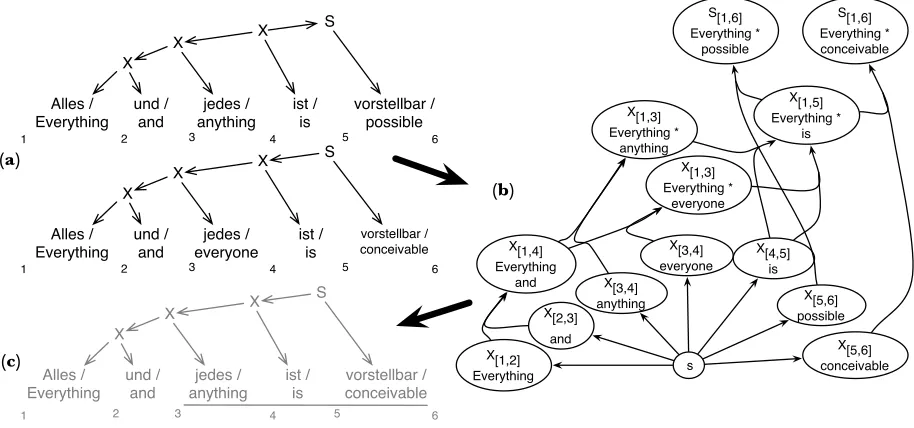
Figure 2.A German-English translation example of building Z˜Λsam(f)from samples. (a) Two sample derivations are
drawn from the model, (b) these samples are then combined into a packed representation, here represented by a hypergraph with target translations elided for a bigram language model. The derivation in (c) is contained within the hypergraph even though it was never explicitly inserted.
part of the overall distribution, possibly leading it astray. Consider the example of a language model feature: as this is a very strong indicator of transla-tion quality, we would expect all derivatransla-tions within the beam to have a similar (high) language model score, thereby robbing this feature of its discriminat-ing power. However if our model could also see the low probability derivations it would be clear that this feature is indeed very strongly correlated with good translations. Thus a good approximation of the space of derivations is one that includes both good and bad examples, not just a cluster around the maximum.
A principled solution to the problem of approx-imating the partition function would be to use a Markov Chain Monte Carlo (MCMC) sampler to estimate the sum with a large number of samples. Most of the sampled derivations would be in the high probability region of the distribution, however there would also be a number of samples drawn from the rest of the space, giving the model a more global view of the distribution, avoiding the pit-falls of the narrow view obtained by a beam search. Although effective, the computational cost of such an approach is prohibitive as we would need to draw hundreds of thousands of samples to obtain conver-gence, for every training iteration.
and we believe it to be advantageous to keep the distributions between the partition function and ref-erence charts consistent.
Both of the approximations proposed above,
˜
ZΛcb(f)andZ˜Λsam(f), rely on the pre-existence of a trained translation model in order to either guide the cube-pruning beam, or define the probability distri-bution from which we draw samples. We solve this chicken and egg problem by first training an exact translation model without a language model, and then use this model to create the partition function approximations for trainingwitha language model. We denote the distribution without a language model asp−ΛLM(e|f)and that with asp+ΛLM(e|f).
A final training problem that we need to address is the appropriate initialisation of the model param-eters. In theory we could simply randomly initialise
Λforp+ΛLM(e|f), however in practice we found that this resulted in poor performance on the develop-ment data. This is due to the complex non-convex optimisation function, and the fact that many fea-tures will fall outside the approximated charts result-ing in random, or zero, weights in testresult-ing. We intro-duce a novel solution in which we use the Gaus-sian prior over model weights to tie the exact model trained without a language model, which assigns sensible values to all rule features, with the approx-imated model. The prior over model parameters for
p+ΛLM(e|f)is defined as:
p+LM
(λk)∝e−
kλk−λ−LM k k
2 2σ2
Here we have set the mean parameters of the Gaus-sian distribution for the approximated model to those learnt for the exact one. This has the effect that any features that fall outside the approximated model will simply retain the weight assigned by the exact model. While for other feature weights the prior will penalise substantial deviations away from
Λ−LM, essentially encoding the intuition that the rule rule parameters should not change substantially with the inclusion of language model features.
This results in the following log-likelihood objec-tive and corresponding gradient:
L= X
(ei,fi)∈D
logp+LM
Λ (ei|fi) + X
k
logp+LM
0 (λk)
∂L ∂λk
=Ep+LM
Λ (d|ei,fi)
[hk]−Ep+LM
Λ (e|fi)
[hk]
−λ +LM
k −λ
−LM
k
σ2
3.3 Decoding
As stated in Equation 3 the probability of a given translation string is calculated as the sum of the probabilities of all the derivations that yield that string. In decoding, where the reference translation is not known, the exact calculation of this summa-tion is NP-Hard. This problem also arises in mono-lingual parsing with probabilistic tree substitution grammars and has been tackled in the literature using Monte-Carlo sampling methods (Chappelier and Rajman, 2000). Their approach is directly appli-cable to our SCFG decoding problem and we can use Algorithm 1 to draw sample translation derivations for the source sentence. The probability of a trans-lation can be calculated simply from the number of times a derivation that yields it was sampled, divided by the total number of samples. For thep−ΛLM(e|f)
model we can build the full chart of all possible derivations and thus sample from the true distribu-tion over derivadistribu-tions. For thep+ΛLM(e|f)model we suffer the same problem as in training and cannot build the full chart. Instead a chart is built using the cube-pruning algorithm with a wide beam and we then draw samples from this chart. Although sampling from a reduced chart will result in biased samples, in Section 4 we show this approach to be effective in practice.2 In Section 4 we compare our sampling approach to the heuristic beam search pro-posed by Blunsom et al. (2008).
It is of interest to compare our proposed decoding algorithms to minimum Bayes risk (MBR) decoding (Kumar and Byrne, 2004), a commonly used decod-ing method. From a theoretical standpoint, the sum-ming of derivations for a given translation is exactly
2
equivalent to performing MBR with a 0/1 loss func-tion over derivafunc-tions. From a practical perspective, MBR is normally performed withBLEU as the loss
and approximated using n-best lists. These n-best lists are produced using algorithms tuned to remove multiple derivations of the same translation (which have previously been seen as undesirable). However, it would be simple to extend our sampling based decoding algorithm to calculate the MBR estimate using BLEU, in theory providing a lower variance
estimate than attained with n-best lists.
4 Evaluation
We evaluate our model on the IWSLT 2005 Chinese to English translation task (Eck and Hori, 2005), using the 2004 test set as development data for tuning the hyperparameters and MERT training the benchmark systems. The statistics for this data are presented in Table 1.3The training data made avail-able for this task consisted of 40k pairs of tran-scribed utterances, drawn from the travel domain. The development and test data for this task are some-what unusual in that each sentence has a single human translated reference, and fifteen paraphrases of this reference, provided by monolingual anno-tators. Model performance is evaluated using the standardBLEUmetric (Papineni et al., 2002) which
measures averagen-gram precision,n ≤4, and we use the NIST definition of the brevity penalty for multiple reference test sets. We provide evaluation against both the entire multi-reference sets, and the single human translation.
Our translation grammar is induced using the standard alignment and rule extraction heuristics used in hierarchical translation models (Chiang, 2007).4As these heuristics aren’t based on a genera-tive model, and don’t guarantee that the target trans-lation will be reachable from the source, we discard those sentence pairs for which we cannot produce a derivation, leaving 38,405 sentences for training.
Our base model contains a single feature for each rule which counts the number of times it appeared in a particular derivation. For models which include a
3
Development and test set statistics are for the single human translation reference.
4With the exception that we allow unaligned words at the
boundary of rules. This improves training set coverage.
language model, we train a standard Kneser-Ney tri-gram model on the target side of the training corpus. We also include a word penalty feature to compen-sate for the shortening effect of the language model. In total our model contains 2.9M features.
The aims of our evaluation are: (1) to deter-mine that our proposed training regimes are able to realise performance increase when training sparse rule features and a real valued language model fea-ture together, (2) that the model is able to effectively use rich features over the source sentence, and (3) to confirm that our model obtains performance com-petitive with the current state-of-the-art.
4.1 Inference and Decoding
We have described a number of modelling choices which aim to compensate for the training biases introduced by incorporating a language model fea-ture through approximate inference. Our a priori knowledge from other SMT systems suggests that incorporating a language model should lead to large increases inBLEU score. In this evaluation we aim
to determine whether our training regimes are able to realises these expected gains.
Table 2 shows a matrix of development BLEU
scores achieved by varying the approximation of the partition function in training, and varying the decod-ing algorithm. If we consider the vertical axis we can see that the sampling method for approximat-ing the partition function has a small but consistent advantage over using the cube-pruning beam. The charts produced by the sampling approach occupy roughly half the disc space as those produced by the beam search, so in subsequent experiments we present results using theZ˜Λsam(f)approximation.
Training Development Test Chinese English Chinese English Chinese English
Utterances 38405 500 506
Segments/Words 317621 353116 3464 3752 3784 3823
Av. Utterances Length 8 9 6 7 7 7
[image:7.612.97.503.58.155.2]Longest Utterance 55 68 58 62 61 56
Table 1.IWSLT Chinese to English translation corpus statistics.
Model Max-derivation Max-translation(Beam) Max-translation(Sampling)
p−ΛLM(e|f) 31.0 32.5 32.6
pΛ+LM(e|f)(Z˜Λcb(f)) 39.1 39.8 39.8
pΛ+LM(e|f)(Z˜Λsam(f)) 39.9 40.5 40.6
Table 2.Development set results for varying the approximation of the partition function in training,Z˜cb
Λ(f)vs.Z˜Λsam(f),
and decoding using the Viterbi max-derivation algorithm, or the max-translation algorithm with either a beam approxi-mation or Monte-Carlo sampling.
we feeling the sampling approach is more theoreti-cally justified and adopt it for our later experiments. The most important result from this evaluation is that both our training regimes realise substantial gains from the introduction of the language model feature. Thus we can be confident that our model is capable of modelling the distribution over trans-lations even when the space over all derivations is intractable to dynamically program exactly.
4.2 A Discriminative Syntactic Translation Model
In the previous sections we’ve described and evalu-ated a statistical model of translation that is able to estimate a probability distribution over translations using millions of sparse features. A prime motiva-tion for such a model is the ability to define com-plex features over more than just the surface forms of the source and target strings. There are limit-less options for such features, and previous work has focused on defining token based features such as part-of-speech and morphology (Ittycheriah and Roukos, 2007). Although such features are applica-ble to our model, here we attempt to test the model’s ability to incorporate complex features over source-side syntax trees, essentially subsuming and extend-ing previous work on tree-to-strextend-ing translation mod-els (Huang et al., 2006; Mi et al., 2008).
We first parse the source side of our training, development and test corpora using the Stanford parser.5Next, while building the synchronous charts
5
http://nlp.stanford.edu/software/lex-parser.shtml
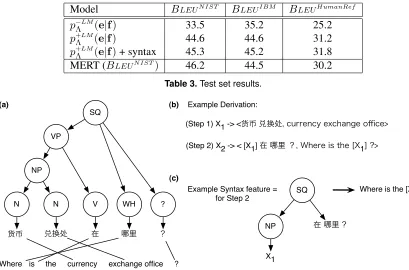
required for training, whenever a rule is used in a derivation a feature is activated which captures: (1) the constituent spanning the rule’s source side in the syntax tree (if any) (2) constituents spanning any variables in the rule, and (3) the rule’s target side surface form. Figure 3 illustrates this process.
These syntactic features are equivalent to the grammar rules extracted for tree-to-string translation systems. The key difference in our model is that the source syntax tree is treated as conditioning context and it’s information encoded as features, thus this information can be used or ignored as the model sees fit. This avoids the problems associated with explic-itly encoding the source syntax in the grammar, such as sparsity and overly constraining the model. In addition we could easily incorporate features over multiple source trees, for example mixing labelled syntax trees with dependency graphs.
We limit the extraction of syntactic features to those that appear in at least two training derivations, giving a total of 4.2M syntactic features, for an over-all total of 7.1M features.
4.3 Discussion
Model BLEUN IST BLEUIBM BLEUHumanRef
p−LM
Λ (e|f) 33.5 35.2 25.2
p+LM
Λ (e|f) 44.6 44.6 31.2
p+LM
Λ (e|f)+ syntax 45.3 45.2 31.8
[image:8.612.90.499.55.325.2]MERT (BLEUN IST) 46.2 44.5 30.2
Table 3.Test set results.
货币 兑换处 在 里 ? V WH ? N
N NP
VP
SQ
Where is the currency exchange office ?
(Step 2) X2 -> < [X1] 在 里 ?, Where is the [X 1] ?> (Step 1) X1 -> <货币 兑换处, currency exchange office>
NP SQ
在 里 ?
Where is the [X1] ? Example Syntax feature =
for Step 2 Example Derivation:
X1
(a) (b)
(c)
Figure 3.Syntax feature example: For the parsed source and candidate translation (a), with the derivation (b), we extract the syntax feature in (c) by combining the grammar rule with the source syntax of the constituents contained within that rule.
Source 我身上没有足够的钱去买 一张新的飞机票。 p−LM
Λ (e|f) don ’t have enough bag on me change please go purchase a new by plane . p+LM
Λ (e|f) i have enough money to buy a new one by air . p+LM
Λ (e|f)+ syntax i don ’t have enough money to buy a new airline ticket .
MERT (BLEUN IST) i don ’t have enough money to buy a new ticket .
Reference i do n’t have enough money with me to buy a new airplane ticket .
Table 4.Example test set output produced when: not using a language model, using a language model, also using syntax, output optimised using MERT and finally the reference
BLEUN IST (brevity penalty uses the shortest
ref-erence), we also include results from the IBM (BLEUIBM) metric (brevity penalty uses the closest
reference), and using only the actual human transla-tion in the test set, not the monolingual paraphrase multiple references (BLEUHumanRef).
The first result of interest is that we see an increase in performance through the incorporation of the source syntax features. This is an encourag-ing result as the transcribed speech source sentences are well out of the domain of the data on which the parser was trained, suggesting that our model is able to sift the good information from the noisy in the unreliable source syntax trees. Table 4 shows illus-trative system output on the test set.
On the BLEUN IST metric we see that our
references, we can see that the MERT training has optimised to the shortest paraphrase reference.
From these results it is difficult to draw any hard conclusions on the relative performance of the dif-ferent training regimes. However we feel confident in claiming that we have achieved our goal of train-ing a probabilistic model on millions of sparse fea-tures which obtains performance competitive with the current state-of-the-art training algorithm.
5 Conclusion
In this paper we have shown that statistical machine translation can be effectively modelled as a well posed machine learning task. In doing so we have described a model capable of estimating a probabil-ity distribution over translations using sparse com-plex features, and achieving performance compara-ble to the state-of-the-art on standard metrics. With further work on scaling these models to large data sets, and engineering high performance features, we believe this research has the potential to provide sig-nificant increases in translation quality.
Acknowledgements
The authors acknowledge the support of the EPSRC grant EP/D074959/1.
References
Phil Blunsom, Trevor Cohn, and Miles Osborne. 2008. A discriminative latent variable model for statistical machine translation. InProc. of the 46th Annual Con-ference of the Association for Computational Linguis-tics: Human Language Technologies (ACL-08:HLT), pages 200–208, Columbus, Ohio, June.
Jean-C´edric Chappelier and Martin Rajman. 2000. Monte-carlo sampling for np-hard maximization prob-lems in the framework of weighted parsing. In NLP ’00: Proceedings of the Second International Confer-ence on Natural Language Processing, pages 106– 117, London, UK.
David Chiang. 2007. Hierarchical phrase-based transla-tion.Computational Linguistics, 33(2):201–228. Matthias Eck and Chiori Hori. 2005. Overview of the
IWSLT 2005 evaluation campaign. In Proc. of the International Workshop on Spoken Language Trans-lation, Pittsburgh, October.
Michel Galley, Jonathan Graehl, Kevin Knight, Daniel Marcu, Steve DeNeefe, Wei Wang, and Ignacio Thayer. 2006. Scalable inference and training of
context-rich syntactic translation models. In Proc. of the 44th Annual Meeting of the ACL and 21st International Conference on Computational Linguis-tics (COLING/ACL-2006), pages 961–968, Sydney, Australia, July.
Joshua T. Goodman. 1998. Parsing inside-out. Ph.D. thesis, Cambridge, MA, USA. Adviser-Stuart Shieber. Liang Huang, Kevin Knight, and Aravind Joshi. 2006. Statistical syntax-directed translation with extended domain of locality. InIn Proceedings of the 7th Bien-nial Conference of the Association for Machine Trans-lation in the Americas (AMTA), Boston, MA.
Abraham Ittycheriah and Salim Roukos. 2007. Direct translation model 2. InProc. of the 7th International Conference on Human Language Technology Research and 8th Annual Meeting of the NAACL (HLT-NAACL 2007), pages 57–64, Rochester, USA.
Shankar Kumar and William Byrne. 2004. Minimum bayes-risk decoding for statistical machine translation. InProc. of the 4th International Conference on Human Language Technology Research and 5th Annual Meet-ing of the NAACL (HLT-NAACL 2004), pages 169– 176.
Philip M. Lewis II and Richard E. Stearns. 1968. Syntax-directed transduction. J. ACM, 15(3):465–488. Percy Liang, Alexandre Bouchard-Cˆot´e, Dan Klein, and
Ben Taskar. 2006. An end-to-end discriminative approach to machine translation. In Proc. of the 44th Annual Meeting of the ACL and 21st Inter-national Conference on Computational Linguistics (COLING/ACL-2006), pages 761–768, Sydney, Aus-tralia, July.
Haitao Mi, Liang Huang, and Qun Liu. 2008. Forest-based translation. InProc. of the 46th Annual Confer-ence of the Association for Computational Linguistics: Human Language Technologies (ACL-08:HLT), pages 192–199, Columbus, Ohio, June.
Franz Josef Och. 2003. Minimum error rate training in statistical machine translation. In Proc. of the 41st Annual Meeting of the ACL (ACL-2003), pages 160– 167, Sapporo, Japan.
Kishore Papineni, Salim Roukos, Todd Ward, and Wei-Jing Zhu. 2002. Bleu: a method for automatic eval-uation of machine translation. In Proc. of the 40th Annual Meeting of the ACL and 3rd Annual Meeting of the NAACL (ACL-2002), pages 311–318, Philadelphia, Pennsylvania.