Proceedings of the Third Conference on Machine Translation (WMT), Volume 2: Shared Task Papers, pages 928–933
The ILSP/ARC submission to the WMT 2018 Parallel Corpus Filtering
Shared Task
Vassilis Papavassiliou Sokratis Sofianopoulos
Prokopis Prokopidis Stelios Piperidis
Institute for Language and Speech Processing/Athena RC Athens, Greece
{vpapa, s sofian, prokopis, spip}@ilsp.gr
Abstract
This paper describes the submission of the Institute for Language and Speech Process-ing/Athena Research and Innovation Center (ILSP/ARC) for the WMT 2018 Parallel Cor-pus Filtering shared task. We explore several properties of sentences and sentence pairs that our system explored in the context of the task with the purpose of clustering sentence pairs according to their appropriateness in training MT systems. We also discuss alternative meth-ods for ranking the sentence pairs of the most appropriate clusters with the aim of generat-ing the two datasets (of 10 and 100 million words as required in the task) that were eval-uated. By summarizing the results of several experiments that were carried out by the or-ganizers during the evaluation phase, our sub-mission achieved an average BLEU score of 26.41, even though it does not make use of any language-specific resources like bilingual lex-ica, monolingual corpora, or MT output, while the average score of the best participant system was 27.91.
1 Introduction
There is a growing literature on using web-acquired data for constructing various types of language resources, including monolingual and parallel corpora. As shown in, among others,
Pecina et al. (2014) and Rubino et al. (2015), such resources can be exploited in training generic or domain-specific machine translation systems. Nevertheless, compared to the acquisition of monolingual data from the web, construction of parallel resources is more challenging. Apart from the identification of document pairs that are trans-lations of each other and can be crawled from mul-tilingual websites, the extraction of sentence pairs and, crucially, the selection of sentence pairs of good quality are far from straightforward.
Zarin¸a et al. (2015) exploit already available parallel corpora in order to get word alignments, which are then used to identify mistranslations.
Denkowski et al. (2012) use N-gram language models built from monolingual corpora to estimate probabilities of source and target sentences, in a manner of assigning high scores to grammatical sentences and lower scores to ungrammatical sen-tences and non-sensen-tences such as site maps, large lists of names, and blog comments. Aiming to select sentence pairs of good adequacy and flu-ency, Xu and Koehn (2017) generate probabilis-tic dictionaries and n-gram models from Europarl corpora. Taghipour et al. (2011) and Cui et al.
(2013) extract features based on translation and language models, and word alignments from the dataset under examination (i.e. this dataset is used to train models instead of using external language resources) and then apply unsupervised techniques such as outlier detection of estimated probability density and graph-based random walk algorithm to discard sentence pairs that are of limited or no importance. In the case of web acquired data, shal-low features like aligners’ scores, length ratio, and patterns in URLs from which the content was orig-inated, have been proposed (Espl`a-Gomis and For-cada,2010).
In a different manner, many researchers have approached data selection as a domain-matching issue. For instance, Duh et al. (2013) proposed the use of a neural language model trained on a domain-specific corpus to identify in-domain sen-tence pairs in a large corpus.
This paper describes the submission of IL-SP/ARC for the WMT 2018 Parallel Corpus Fil-tering shared task. The task consisted in cleaning a very noisy English-German parallel corpus of 104 million sentence pairs provided by the organizers, with each EN-DE sentence pair accompanied by a score generated by the Hunalign sentence aligner.
The participants were to assign a quality score for each sentence pair, with higher scores indicating sentence pairs of better quality. As reported in the shared task webpage1, “Evaluation of the qual-ity scores will be done by subsampling 10m and 100m [EN] word corpora based on these scores, training statistical and neural machine translation systems with these corpora, and evaluating trans-lation quality on blind test sets using the BLEU score.” Given that the organizers discouraged par-ticipants from subsampling the corpus for rele-vance to a specific domain (e.g. the news domain), domain adaptation approaches like the ones men-tioned above seem to not fit this task.
In the shared task webpage, the organizers also released a development environment with configu-ration files and scripts that allowed participants to subsample corpora based on quality scores and to replicate the testing procedure with a development test set.
2 System architecture
Our submission system is based on the cleaning module of the ILSP Focused Crawler ( Papavassil-iou et al.,2013), an open-source toolkit2 that in-tegrates all necessary software3for the creation of high-precision parallel resources from the web in a language-independent fashion.
The toolkit and its cleaning module have been used in research projects like the European Lan-guage Resource Coordination for the acquisition of high-precision parallel language resources ( Pa-pavassiliou et al.,2018).
2.1 Noise in Web acquired parallel corpora
In a pipeline for the construction of parallel cor-pora from the web, shortcomings of each pro-cessing step may introduce errors, usually called “noise”, that affect the quality of the final output. In this shared task, the data collection pipeline of the Paracrawl4 project was adopted for the con-struction of the input (i.e. the raw, very noisy par-allel corpus).
Many types of noise occur due to misses dur-ing parsdur-ing HTML pages and extractdur-ing their
tex-1http://www.statmt.org/wmt18/
parallel-corpus-filtering.html
2http://nlp.ilsp.gr/ilsp-fc/
3Including modules for metadata extraction, language
identification, boilerplate removal, document clean-up, text classification and sentence alignment
4https://paracrawl.eu/releases.html
tual content. Such errors are typically introduced when HTML code is considered text and/or page encoding is not successfully detected. Moreover, inaccurate identification of paragraph limits may lead to wrong sentence splitting and, eventually, in the alignment of incomplete sentences. False neg-atives in the detection of boilerplate text (i.e. nav-igation headers, disclaimers, etc.) may result in large numbers of (near-)duplicate sentence pairs, which are of only limited or no use for the produc-tion of good-quality language resources.
Other errors concern the accuracy of the guage identification process. Even when the lan-guage of a web page is correctly detected at doc-ument level, it is possible that small parts of the page are written in another language. Thus, ignor-ing language detection at paragraph or sentence level may lead to sentence pairs with the wrong language in the source and/or the target side. Fi-nally, misalignments at document and/or sentence level generate sentence pairs that are not transla-tions of each other.
2.2 Filter-based clustering
Given that the existence of the types of noise dis-cussed above is not strongly influenced by the tar-geted language pair, we developed a language ag-nostic method with the purpose of clustering sen-tence pairs in respect of their quality, i.e. of their correctness and usefulness for training MT en-gines.
The first cluster, C0, includes obviously noisy
sentence pairs. We assign to these pairs a 0 score in order to prohibit their participation in the sub-samples to be used for training. Sentence pairs in C0match one of the following patterns:
1. sentence pairs with too short or too long EN or DE sentences (after tokenization) that would have been excluded from the training phase according to the shared task configura-tion. By enforcing a sentence length between 1 and 80 tokens, and a sentence length ratio less than 9 tokens (i.e. by using the default values of the Moses SMT toolkit for cleaning a corpus before training an MT system), we remove 3.42% of the sentence pairs in the in-put corpus. Our intuition is that most of these sentence pairs are the result of wrong HTML parsing or encoding detection.
of Unicode character sets relevant to Latin scripts. This pattern discards sentence pairs (11.12% of the input corpus) that are either the result of wrong encoding detection, or contain only dates, prices, flight numbers, di-mensions, products’ IDs, etc.
3. sentence pairs with identical text in both languages (after removing non-Latin charac-ters mentioned above). These sentence pairs (9.94% of the input corpus) mainly contain boilerplate elements, dates, locations, etc.5
4. sentence pairs for which the EN or DE parts were not in the proper language as detected by the Cybozu language detection library.6 Sentences in these pairs (13.01% of the cor-pus) were often French or Spanish. As with most language detectors, the accuracy of the tool is lower during the examination of short sentences.
5. sentence pairs (1.71% of the corpus) with un-usual features (e.g. words with transitions from lowercase to uppercase and vice versa, consecutive identical letters, long sequences of very short words, etc.)
6. sentence pairs consisting mostly of URLs, and emails (1.42% of the corpus)
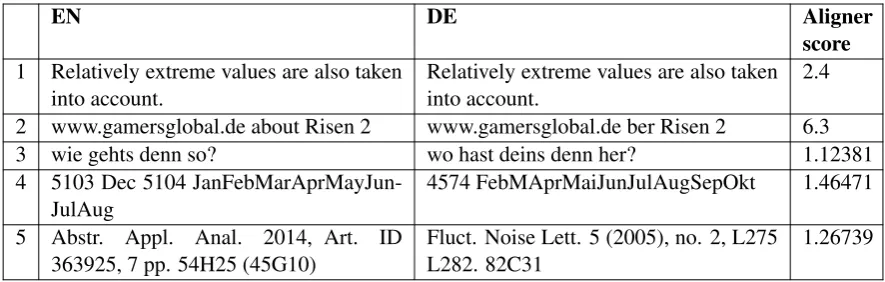
Table1provides examples of sentences grouped intoC0by some of the criteria described above.
In the next step of our language agnostic ap-proach, we clustered the remaining sentence pairs using shallow features that are likely to be related to correctness of sentence alignment. Specifically, we compared the sequences of digits and symbols (e.g. punctuation marks, % , $, etc.) on each side of the remaining sentence pairs. Depending on the results (i.e. same/different digits and same/differ-ent symbols), the following four clusters, ordered from worst to best, were constructed:
C1 Different digits and different symbols
C2 Different digits and same symbols
C3 Same digits and different symbols
C4 Same digits and same symbols
5In future work we plan to reconsider the usefulness of
this pattern in preparing parallel corpora for NMT engines.
6http://code.google.com/p/
language-detection/
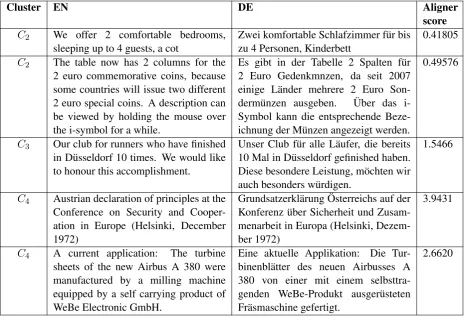
Table 2 contains examples of sentence pairs grouped into clusters according to this approach.
In a final step we focused on the identification of (near) duplicates. In more detail, we normal-ized sentence pairs by lowercasing and removing non-Latin characters, and we examined if a sen-tence pair was identical to or was included in an-other sentence pair. When a duplicate was de-tected, we kept the sentence pair that belonged to a better cluster. If both sentence pairs belonged to the same cluster, we kept the longer one in terms of tokens.
By assigning the corresponding cluster number to each sentence pair as a score (i.e. 4 to pairs of C4, 3 to pairs of C3, etc), the sentence pairs
in the provided noisy corpus were roughly ranked. We then ran the subsampling algorithm that was provided by the organizers in order to obtain the two datasets required from each participant. We noticed that the sizes of the resulting corpora ex-ceeded the 10M and 100M EN word thresholds. This is explained by the fact that we provided only 5 scores (as many as the clusters) and the algo-rithm selects all sentence pairs for a score (star-ing from the highest) iteratively until the size of the selected subcorpus reaches the threshold. For instance, clusters C4, C3 and C2 (i.e. sentence
pairs with scores 4, 3 and 2 respectively) includ-ing more than 14M English words, were sampled for the 10M corpus! To overcome this shortcom-ing, in our final rankings each cluster is initially assigned to an integer of different scale (e.g. C1
to score 10,C2 to score 1000, etc). The score of
each sentence pair is then calculated by adding the Hunalign score to the initial cluster score, with the purpose of ensuring the granularity of the scores and of keeping clusters well-separated. This rank-ing led to corpora of 626K and 5.7M pairs for the 10M and the 100M corpora, respectively.
For a submission based on an alternative rank-ing, we add the character length of each pair to the initial cluster score. Compared to the Hunalign-based scoring, this variant favors long sentences and thus results in significantly smaller corpora in terms of sentence pairs (221K pairs and 5.4M pairs for the 10M and 100M corpora, respectively).
3 Evaluation Results
EN DE Aligner score
1 Relatively extreme values are also taken
into account. Relatively extreme values are also takeninto account. 2.4 2 www.gamersglobal.de about Risen 2 www.gamersglobal.de ber Risen 2 6.3
3 wie gehts denn so? wo hast deins denn her? 1.12381
4 5103 Dec 5104 JanFebMarAprMayJun-JulAug
4574 FebMAprMaiJunJulAugSepOkt 1.46471
5 Abstr. Appl. Anal. 2014, Art. ID 363925, 7 pp. 54H25 (45G10)
Fluct. Noise Lett. 5 (2005), no. 2, L275 L282. 82C31
[image:4.595.77.520.61.202.2]1.26739
Table 1: Examples of sentence pairs grouped intoC0 by filters focusing on sentence pairs with 1)
iden-tical text in both languages 2) sentences consisting mainly of URLs/emails/dates 3) the sentence in the first/second column detected as non-EN/non-DE, respectively 4) unusual patterns like mixture of upper-and lowercase ; 5) long sequences of short words.
(Koehn et al.,2007) trained on the 10M EN word parallel corpus, (b) a Moses system trained on the 100M EN word parallel corpus, (c) a Marian neu-ral translation system (Junczys-Dowmunt et al.,
2018) trained on the 10M EN word parallel corpus and (d) a Marian system trained on the 100M EN word parallel corpus. For all systems the official WMT 2017 news translation test set was used as a development set. According to the shared task’s settings, the quality of the machine translation sys-tem is measured by BLEU score (Papineni et al.,
2002) on the (a) official WMT 2018 news trans-lation test set and (b) another undisclosed test set, which is the union of 5 test sets listed in Tables3
and4.
Table 3 summarizes the evaluation scores ob-tained using the ranking based on the combination of clusters and Hunalign scores on the various test sets. Our submission had an average BLEU score of 26.41 on the different test configurations (4 sys-tems evaluated over 6 test sets), while the average score of the best participant system was 27.91.
It can be seen that for all datasets the best results are obtained by the NMT systems over their equiv-alent SMT ones, with the top one being the NMT trained over the 100M English token German-English filtered corpus. For both the Moses SMT and the Marian NMT systems there is a significant increase of the BLEU score when increasing the size of the training corpus from 10M to 100M En-glish tokens. Specifically, for the Moses system the average increase is 16.6%, while for Marian the average increase is 21.5%.
Similarly, Table4lists the evaluation scores ob-tained with the alternative ranking scheme using
the sentence length information. This submis-sion had an average BLEU score of 24.98 on the different test configurations. Again, the best re-sults are obtained with the NMT system trained over the 100M corpus. When comparing the av-erage BLEU scores between the 10M and 100M systems, the SMT system shows an increase of 15.2%, while the NMT system shows a huge in-crease of 58.5%. Interestingly, the performance of the NMT system trained on the 10M corpus is lower than that of the SMT one. This can be at-tributed to the fact that the 10M corpus comprises 221K long sentence pairs, a relatively small num-ber of sentences for NMT systems, which evalu-ate fluency over entire sentences. The equivalent SMT system is rather unaffected, presumably be-cause SMT systems are based on n-gram models.
By comparing the results of the two alternative ranking schemes, we conclude that their perfor-mances are similar for the 100M corpora. This is explained by the fact that their intersection is ex-tremely high: 5.2M sentence pairs are included in the 5.7M and 5.4M sentence pairs selected with the two schemes. Regarding the 10M corpora which differ significantly in number of sentence pairs (626K vs 221K), the performance of both schemes is similar for the SMT systems but dif-fers for the NMT ones. In future work, we plan to carry out experiments that will provide evidence of how size and length of sentence pairs in a training corpus affect the performance of an NMT system.
4 Conclusions
Cluster EN DE Aligner score
C2 We offer 2 comfortable bedrooms,
sleeping up to 4 guests, a cot Zwei komfortable Schlafzimmer f¨ur biszu 4 Personen, Kinderbett 0.41805 C2 The table now has 2 columns for the
2 euro commemorative coins, because some countries will issue two different 2 euro special coins. A description can be viewed by holding the mouse over the i-symbol for a while.
Es gibt in der Tabelle 2 Spalten f¨ur 2 Euro Gedenkmnzen, da seit 2007 einige L¨ander mehrere 2 Euro Son-derm¨unzen ausgeben. ¨Uber das i-Symbol kann die entsprechende Beze-ichnung der M¨unzen angezeigt werden.
0.49576
C3 Our club for runners who have finished
in D¨usseldorf 10 times. We would like to honour this accomplishment.
Unser Club f¨ur alle L¨aufer, die bereits 10 Mal in D¨usseldorf gefinished haben. Diese besondere Leistung, m¨ochten wir auch besonders w¨urdigen.
1.5466
C4 Austrian declaration of principles at the
Conference on Security and Cooper-ation in Europe (Helsinki, December 1972)
Grundsatzerkl¨arung ¨Osterreichs auf der Konferenz ¨uber Sicherheit und Zusam-menarbeit in Europa (Helsinki, Dezem-ber 1972)
3.9431
C4 A current application: The turbine
sheets of the new Airbus A 380 were manufactured by a milling machine equipped by a self carrying product of WeBe Electronic GmbH.
Eine aktuelle Applikation: Die Tur-binenbl¨atter des neuen Airbusses A 380 von einer mit einem selbsttra-genden WeBe-Produkt ausger¨usteten Fr¨asmaschine gefertigt.
[image:5.595.72.537.62.384.2]2.6620
Table 2: Examples of sentence pairs grouped to different clusters based on the shallow features detailed in Section2.2.
SMT SMT NMT NMT 10M 100M 10M 100M news2017 20.49 25.28 26.09 31.46
news2018 26.30 30.58 31.32 38.99
iwslt2017 18.83 22.82 21.20 26.57
Acquis 18.71 22.27 22.94 27.63
EMEA 26.50 30.88 30.17 35.96
GlobalVoices 20.20 23.43 23.39 28.20
KDE 23.78 26.74 25.73 30.63
average 22.39 26.12 25.79 31.33
Table 3: BLEU evaluation scores (ranking was based on the combination of clusters and Hunalign scores)
Shared Task. We explored shallow features of sen-tences and sentence pairs and grouped the task data in 5 clusters according to their presumed use-fulness for training MT systems. Our language-pair independent submissions were not based on MT output or bilingual lexica, i.e. on resources which are often scarce or simply not available for many language pairs. Nevertheless, the results
ob-SMT SMT NMT NMT 10M 100M 10M 100M news2017 20.82 25.50 16.32 31.38
news2018 26.91 30.80 20.33 39.01
iwslt2017 18.91 22.70 11.40 26.60
Acquis 19.34 22.35 21.13 27.82
EMEA 27.24 30.86 27.43 35.89
GlobalVoices 20.38 23.49 14.67 28.32
KDE 23.32 26.59 23.68 30.37
[image:5.595.71.289.433.570.2]average 22.68 26.13 19.77 31.34
Table 4: BLEU evaluation scores (ranking was based on the combination of clusters’ scores and sentences’ length)
tained from the systems trained on our submis-sions indicate that this language-pair independent approach yields datasets on which competitive MT systems can be built.
Acknowledgments
[image:5.595.305.531.434.569.2]implements the acquisition of language resources for the EC’s Connecting Europe Facility (CEF) eTranslation platform.
References
Lei Cui, Dongdong Zhang, Shujie Liu, Mu Li, and Ming Zhou. 2013. Bilingual data cleaning for SMT using graph-based random walk. In Proceedings of the 51st Annual Meeting of the Association for Computational Linguistics (Volume 2: Short Pa-pers), pages 340–345, Sofia, Bulgaria. Association for Computational Linguistics.
Michael Denkowski, Greg Hanneman, and Alon Lavie. 2012. The CMU-Avenue French-English Transla-tion System. InProceedings of the Seventh Work-shop on Statistical Machine Translation, pages 261– 266, Montr´eal, Canada. Association for Computa-tional Linguistics.
Kevin Duh, Graham Neubig, Katsuhito Sudoh, and Ha-jime Tsukada. 2013. Adaptation data selection us-ing neural language models: Experiments in ma-chine translation. InProceedings of the 51st Annual Meeting of the Association for Computational Lin-guistics (Volume 2: Short Papers), pages 678–683. Association for Computational Linguistics.
Miquel Espl`a-Gomis and Mikel L. Forcada. 2010. Combining content-based and url-based heuristics to harvest aligned bitexts from multilingual sites with bitextor. The Prague Bulletin of Mathemathical Lin-gustics, 93:77–86.
Marcin Junczys-Dowmunt, Roman Grundkiewicz, Tomasz Dwojak, Hieu Hoang, Kenneth Heafield, Tom Neckermann, Frank Seide, Ulrich Germann, Alham Fikri Aji, Nikolay Bogoychev, Andr´e F. T. Martins, and Alexandra Birch. 2018. Marian: Fast neural machine translation in C++. InProceedings of ACL 2018, System Demonstrations, pages 116– 121, Melbourne, Australia. Association for Compu-tational Linguistics.
Philipp Koehn, Hieu Hoang, Alexandra Birch, Chris Callison-Burch, Marcello Federico, Nicola Bertoldi, Brooke Cowan, Wade Shen, Christine Moran, Richard Zens, Chris Dyer, Ondˇrej Bojar, Alexandra Constantin, and Evan Herbst. 2007. Moses: Open source toolkit for statistical machine translation. In
Proceedings of the 45th Annual Meeting of the ACL on Interactive Poster and Demonstration Sessions, ACL ’07, pages 177–180, Stroudsburg, PA, USA. Association for Computational Linguistics.
Vassilis Papavassiliou, Prokopis Prokopidis, and Ste-lios Piperidis. 2018. Discovering parallel language resources for training MT engines. In Proceed-ings of the Eleventh International Conference on Language Resources and Evaluation (LREC 2018), Miyazaki, Japan. European Language Resources Association (ELRA).
Vassilis Papavassiliou, Prokopis Prokopidis, and Gre-gor Thurmair. 2013. A modular open-source fo-cused crawler for mining monolingual and bilingual corpora from the web. In Proceedings of the Sixth Workshop on Building and Using Comparable Cor-pora, pages 43–51, Sofia, Bulgaria. Association for Computational Linguistics.
Kishore Papineni, Salim Roukos, Todd Ward, and Wei-Jing Zhu. 2002. BLEU: A Method for Automatic Evaluation of Machine Translation. InProceedings of the 40th Annual Meeting on Association for Com-putational Linguistics, ACL ’02, pages 311–318, Stroudsburg, PA, USA. Association for Computa-tional Linguistics.
Pavel Pecina, Antonio Toral, Vassilis Papavassiliou, Prokopis Prokopidis, Aleˇs Tamchyna, Andy Way, and Josef Genabith. 2014. Domain adaptation of statistical machine translation with domain-focused web crawling. Language Resources and Evaluation, 49(1):147–193.
Raphael Rubino, Tommi Pirinen, Miquel Espl`a-Gomis, Nikola Ljubeˇsi´c, Sergio Ortiz Rojas, Vassilis Papavassiliou, Prokopis Prokopidis, and Antonio Toral. 2015. Abu-MaTran at WMT 2015 Translation Task: Morphological Segmentation and Web Crawl-ing. InProceedings of the Tenth Workshop on Sta-tistical Machine Translation, pages 184–191, Lis-bon, Portugal. Association for Computational Lin-guistics.
Kaveh Taghipour, Shahram Khadivi, and Jia Xu. 2011. Parallel corpus refinement as an outlier detection al-gorithm. InProceedings of the 13th Machine Trans-lation Summit (MT Summit XIII), pages 414–421.
Hainan Xu and Philipp Koehn. 2017. Zipporah: a fast and scalable data cleaning system for noisy web-crawled parallel corpora. In EMNLP, pages 2945– 2950. Association for Computational Linguistics.