102
Enhancing Universal Dependency Treebanks: A Case Study
Joakim Nivre∗ Paola Marongiu† Filip Ginter‡ Jenna Kanerva‡
Simonetta Montemagni Sebastian Schuster? Maria Simi•
∗Uppsala University, Department of Linguistics and Philology
†
University of Pavia, Department of Linguistics ‡University of Turku, Department of Future Technologies
Institute for Computational Linguistics «A. Zampolli» – CNR, Italy
?Stanford University, Department of Linguistics
•University of Pisa, Department of Computer Science
Abstract
We evaluate two cross-lingual techniques for adding enhanced dependencies to existing treebanks in Universal Dependencies. We ap-ply a rule-based system developed for English and a data-driven system trained on Finnish to Swedish and Italian. We find that both systems are accurate enough to bootstrap enhanced de-pendencies in existing UD treebanks. In the case of Italian, results are even on par with those of a prototype language-specific system.
1 Introduction
Universal Dependencies (UD) is a framework for cross-linguistically consistent treebank annotation (Nivre et al., 2016). Its syntactic annotation layer exists in two versions: a basic representation, where words are connected by syntactic relations into a dependency tree, and an enhanced repre-sentation, which is a richer graph structure that adds external subject relations, shared dependents in coordination, and predicate-argument relations in elliptical constructions, among other things.
Despite the usefulness of enhanced representa-tions (see e.g., Reddy et al. 2017; Schuster et al. 2017), most UD treebanks still contain only ba-sic dependencies1and therefore cannot be used to train or evaluate systems that output enhanced UD graphs. In this paper, we explore cross-lingual methods for predicting enhanced dependencies given a basic dependencies treebank. If these pre-dictions are accurate enough, they can be used as a first approximation of enhanced representations for the nearly 100 UD treebanks that lack them,
1Out of 102 treebanks in UD release v2.1, only 5 contain
enhanced dependencies.
and as input to manual validation. Further, en-hanced UD graphs are in many respects very sim-ilar to semantic dependency representations that encode predicate-argument structures (e.g., Böh-mová et al. 2003; Miyao and Tsujii 2004; Oepen and Lønning 2006). While the latter exist only for a small number of languages and are typically ei-ther produced by complex hand-written grammars or by manual annotation, basic UD treebanks cur-rently exist for more than 60 languages. Hence, automatic methods capable of predicting enhanced dependencies from UD treebanks, have the poten-tial to drastically increase the availability of se-mantic dependency treebanks.
In this paper, we evaluate a rule-based system developed for English and a data-driven system trained on de-lexicalized Finnish data, for predict-ing enhanced dependencies on a sample of 1,000 sentences in two new languages, namely Swedish and Italian. For Italian, we also compare to a rule-based system developed specifically for that lan-guage using lanlan-guage-specific information. The results show that both cross-lingual methods give high precision, often on par with the language-specific system, and that recall can be improved by exploiting their complementary strengths.
2 Basic and Enhanced Dependencies
exten-(a)
Sam persuaded Kim to fix dinner
nsubj obj mark xcomp
obj
nsubj
(b)
Sam bought and fixed dinner
nsubj
conj cc
obj
nsubj obj
(c) Sam fixedi lunch and Kim ei dinner
nsubj obj conj
cc orphan
cc conj
[image:2.595.77.521.65.120.2]nsubj obj
Figure 1: UD basic (top) and enhanced (bottom) dependencies: (a) control, (b) coordination, (c) gapping. For clarity, we show only those enhanced dependencies that are not shared with the basic layer.
sion of the basic one, this does not hold in general (as shown by the treatment of ellipsis below). The current UD guidelines define five enhancements:
1. Added subject relations in control and raising 2. Null nodes for elided predicates (gapping) 3. Shared heads and dependents in coordination 4. Co-reference in relative clause constructions 5. Modifier relations typed by case markers
The last two enhancements can in most cases be predicted deterministically from the basic repre-sentation and are mainly a practical convenience. We therefore limit our attention to the first three types, illustrated in Figure 1 (a–c).
Added subject relations Basic dependencies do not specify whether the implicit subject offixin (a) is controlled bySam(subject) orKim(object), but enhanced dependencies do. Similar relations are added also in raising constructions.
Shared heads and dependents in coordination In coordinated structures, incoming and outgoing relations are connected only to the first conjunct in basic dependencies. Enhanced dependencies add explicit links from all conjuncts to shared depen-dents, like the subjectSamand the objectdinnerin (b), as well as from the shared head (not shown).
Null nodes for elided predicates Basic depen-dencies cannot represent predicate-argument rela-tions in gapping construcrela-tions like (c), because of the missing verb, and therefore connect arguments and modifiers using a specialorphanrelation. By adding a null node with lexical information copied from the verb in the first clause, enhanced depen-dencies can assign the real argument relations to the subjectKimand the objectdinner.
3 Adding Enhanced Dependencies
We describe three systems for predicting enhanced dependencies from basic dependencies. The first two systems have been adapted for cross-lingual use, while the third one uses language-specific in-formation and will be used only for comparison in
the evaluation in the next section. Other language-specific systems have been developed, such as the one by Candito et al. (2017) for French, but this is the first attempt to predict enhanced dependencies in a language-independent way.
3.1 The Rule-Based English System
The system is an adaptation of the work by Schus-ter and Manning (2016), developed for English. It relies on Semgrex (Chambers et al., 2007) pat-terns to find dependency structures that should be enhanced and applies heuristics-based processing steps corresponding to the five types of enhance-ment described in Section 2. We briefly discuss the three steps that are relevant to our study.
Added subject relations For any node attached to a higher predicate with anxcomprelation, the system adds a subject relation to the object of the higher predicate if an object is present (object con-trol) or to the subject of the higher predicate if no object is present (subject control or raising). This heuristic gives the right result in Figure 1 (a).
Shared heads and dependents in coordination For conjoined clauses and verb phrases, the sys-tem adds explicit dependencies to shared core ar-guments (i.e., (i)obj, n/csubj, x/ccomp). Thus, in Figure 1(b), the system adds thensubj
andobj relations fromfixedto Samanddinner, respectively. For other types of coordination, it only adds dependencies from the shared head.
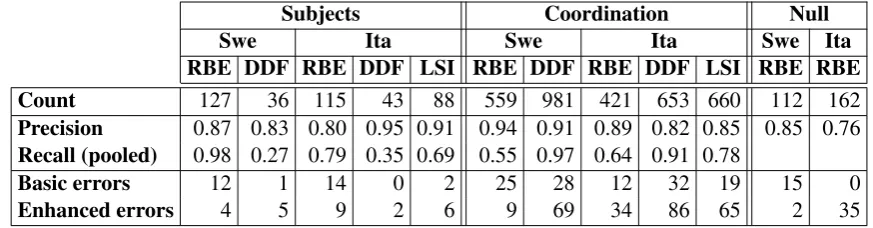
Subjects Coordination Null
Swe Ita Swe Ita Swe Ita
RBE DDF RBE DDF LSI RBE DDF RBE DDF LSI RBE RBE
Count 127 36 115 43 88 559 981 421 653 660 112 162
Precision 0.87 0.83 0.80 0.95 0.91 0.94 0.91 0.89 0.82 0.85 0.85 0.76 Recall (pooled) 0.98 0.27 0.79 0.35 0.69 0.55 0.97 0.64 0.91 0.78
Basic errors 12 1 14 0 2 25 28 12 32 19 15 0
[image:3.595.79.516.62.176.2]Enhanced errors 4 5 9 2 6 9 69 34 86 65 2 35
Table 1: Evaluation of predicted enhanced dependencies for Italian and Swedish (RBE = rule-based English sys-tem, DDF = data-driven Finnish syssys-tem, LSI = language-specific Italian system).
3.2 The Data-Driven Finnish System
This data-driven approach is adapted from the su-pervised method of Nyblom et al. (2013) origi-nally developed for Finnish. First, patterns iden-tify candidate relations, which are subsequently classified with a linear SVM, trained on gold stan-dard annotation. The original method does not predict null nodes, and therefore we only discuss added subject relations and coordination below.
Added subject relations A binary classifier is used to decide whether annsubjrelation should be added from anxcompdependent to the subject of its governor, accounting for subject control or raising (in the positive case). Object control is not handled by the original system, and we chose not to extend it for this initial case study.
Shared heads and dependents in coordination Candidate relations are created for all possible shared heads (incoming relation to the first con-junct) and dependents (outgoing relations from the first conjunct), striving for high recall. A classifier then predicts the relation type, or negative.
Feature representation To enable transfer from models trained on Finnish to other languages, we remove lexical and morphological features ex-cept universal POS tags and morphological cate-gories that we expect to generalize well:Number,
Mood, Tense, VerbForm, Voice.
Language-specific dependency type features are generalized to universal types (e.g., from nmod:tmod to
nmod).
3.3 The Language-Specific Italian System
The language-specific Italian system builds on the rule-based enhancer developed for the Italian Stanford Dependencies Treebank (Bosco et al., 2013, 2014). It has been adapted to predict en-hanced dependencies according to the UD
guide-lines but does not yet handle null nodes. It pro-vides an interesting point of comparison for the cross-lingual systems but cannot really be evalu-ated on the same conditions since it has been de-veloped using data from the Italian treebank.
Added subject relations For any infinitive verb attached to a higher predicate with anxcomp rela-tion, the system adds a subject relation to a core or (dative) oblique dependent of the governing verb. In contrast to the other systems, this system uses external language-specific resources that specify the control/raising properties of Italian verbs.
Shared heads and dependents in coordination For coordination, the system works similarly to the English rule-based system but includes addi-tional heuristics for different types of coordination (clausal, verbal, nominal, etc.) to prevent the addi-tion of multiple dependents of the same type (e.g., multiple subjects) if this leads to incorrect graphs.
4 Evaluation
Systems were evaluated on the Italian and Swedish UD treebanks. Since these lack enhanced depen-dencies annotation, the output is manually evalu-ated by native speakers with extensive experience with the UD guidelines. This allows us to report precision, while recall can only be measured rela-tive to the union of correct predictions. The data-driven system was trained on the training set of the UD Finnish-TDT treebank.
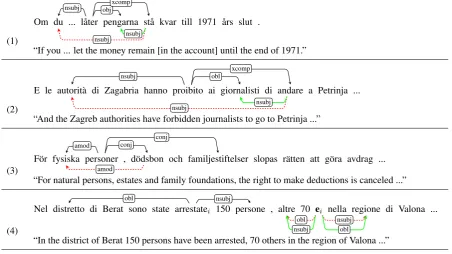
(1)
Om du ... låter pengarna stå kvar till 1971 års slut .
nsubj objxcomp
nsubj nsubj
“If you ... let the money remain [in the account] until the end of 1971.”
(2)
E le autorità di Zagabria hanno proibito ai giornalisti di andare a Petrinja ...
nsubj obl
xcomp
nsubj nsubj
“And the Zagreb authorities have forbidden journalists to go to Petrinja ...”
(3)
För fysiska personer , dödsbon och familjestiftelser slopas rätten att göra avdrag ...
amod conj
conj
amod
“For natural persons, estates and family foundations, the right to make deductions is canceled ...”
(4)
Nel distretto di Berat sono state arrestatei 150 persone , altre 70 ei nella regione di Valona ...
obl nsubj
obl nsubj
nsubj obl
[image:4.595.73.526.65.319.2]“In the district of Berat 150 persons have been arrested, 70 others in the region of Valona ...”
Figure 2: Error examples: added subjects (1–2), coordination (3), null nodes (4). Basic dependencies above, enhanced dependencies below; dotted red = incorrect; solid green = correct.
Added subject relations For Swedish, the rule-based English system (RBE) performs better than the data-driven Finnish system (DDF), especially on recall. The advantage in precision comes from object control, as illustrated in (1) in Figure 2 where DDF predicts subject control despite the presence of a direct object. The lower recall for DDF comes from only considering added sub-jects of infinitives (as opposed to allxcomp pred-icates). For Italian, the precision results are re-versed, which is in part due to non-core arguments occurring more frequently as controllers in Italian. In this case, RBE will always predict a core argu-ment (subject or object) as controller while DDF can abstain from predicting a dependency. The language-specific Italian system (LSI) correctly predicts most of the non-core controllers, thanks to lexical information, leading to higher preci-sion than RBE. This is exemplified in (2) in Fig-ure 2, where RBE predicts subject control while LSI finds the oblique controller and DDF makes no prediction at all. The lower recall for LSI is again caused by its restriction to infinitives.2
Shared heads and dependents in coordination The results for coordination are indicative of the different adopted strategies. RBE achieves high
2It is worth noting that the recall of both DDF and LSI
could easily be improved by lifting the restriction to infini-tives, since the non-infinitive cases are rarely ambiguous.
precision (0.94 for Swedish, 0.89 for Italian) by limiting shared dependent predictions to core ar-guments. DDF instead opts for high recall (0.97 for Swedish, 0.91 for Italian) by considering all dependents of the first conjunct as potential shared dependents. As a result, both systems outperform the language-specific system on one metric, but lose out on the other. The most common type of error, especially for the high-recall systems, is to treat a left-dependent of the first conjunct as shared by all conjuncts. This is exemplified by (3) in Figure 2, where DDF incorrectly predicts that the adjectival modifier infysiska personer(natural persons) also applies todödsbon(estates).
Null nodes for elided predicates The method developed to resolve gapping in English seems to generalize very well to Swedish, where almost all the observed errors are in fact due to errors in the basic annotation (mostly incorrect uses of
theorphanrelation). The results are somewhat
5 Conclusion
Our main conclusion is that both the rule-based English and the data-driven Finnish systems are accurate enough to be useful for enhancing tree-banks in other languages. Precision is often above 0.9 (and never below 0.8) and recall is comple-mentary, with the English system giving better coverage on added subjects and the Finnish one on coordination. The error analysis furthermore shows how both systems can be further improved. The results are especially encouraging given that one of the “source languages”, Finnish, is typo-logically quite different from the others, which in-dicates that UD does generalize across languages. For future research, it would be interesting to investigate how much language-specific training data would be needed for the data-driven system to exceed the cross-lingual results reported here. In addition, the same techniques can of course be used not only for treebank enhancement but also to post-process basic dependencies in parsing, which would potentially be useful for many downstream applications. An interesting question there is how much results would deteriorate because of parsing errors in the basic dependencies.
Acknowledgments
We are grateful to two reviewers for constructive comments on the first version of the paper. This work was supported in part by a gift from Google, Inc.
References
Alena Böhmová, Jan Hajiˇc, Eva Hajiˇcová, and Barbora Hladká. 2003. The Prague dependency treebank. In Treebanks, Springer, pages 103–127.
Cristina Bosco, Felice Dellâ ˘A ´ZOrletta, Simonetta Montemagni, Manuela Sanguinetti, and Maria Simi. 2014. The evalita 2014 dependency parsing task. In Proceedings of the First Italian Conference on Computational Linguistics CLiC-it 2014 and of the Fourth International Workshop EVALITA 2014. Pisa University Press, volume II, pages 1–8.
Cristina Bosco, Simonetta Montemagni, and Maria Simi. 2013. Converting italian treebanks: Towards an italian stanford dependency treebank. In Pro-ceedings of the 7th ACL Linguistic Annotation Work-shop and Interoperability with Discourse. pages 61– 69.
Marie Candito, Bruno Guillaume, Guy Perrie, and Djamé Seddah. 2017. Enhanced UD dependencies
with neutralized diathesis alternation. In Proceed-ings of the Fourth International Conference on De-pendency Linguistics (Depling 2017). pages 42–53.
Nathanael Chambers, Daniel Cer, Trond Grenager, David Hall, Chloe Kiddon, Bill MacCartney, Marie-Catherine de Marneffe, Daniel Ramage, Eric Yeh, and Christopher D. Manning. 2007. Learning align-ments and leveraging natural logic. InProceedings of the Workshop on Textual Entailment and Para-phrasing. pages 165–170.
Yusuke Miyao and Jun’ichi Tsujii. 2004. Deep lin-guistic analysis for the accurate identification of predicate-argument relations. In Proceedings of the 20th International Conference on Computational Linguistics (COLING 2004). pages 1392–1397.
Joakim Nivre, Marie-Catherine de Marneffe, Filip Gin-ter, Yoav Goldberg, Jan Hajiˇc, Christopher D. Man-ning, Ryan McDonald, Slav Petrov, Sampo Pyysalo, Natalia Silveira, Reut Tsarfaty, and Dan Zeman. 2016. Universal Dependencies v1: A multilingual treebank collection. InProceedings of the 10th In-ternational Conference on Language Resources and Evaluation (LREC).
Jenna Nyblom, Samuel Kohonen, Katri Haverinen, Tapio Salakoski, and Filip Ginter. 2013. Predict-ing conjunct propagation and other extended stan-ford dependencies. InProceedings of the Second In-ternational Conference on Dependency Linguistics (DepLing 2013). pages 252–261.
Stephan Oepen and Jan Tore Lønning. 2006. Discriminant-based MRS banking. InProceedings of the Fifth International Conference on Language Resources and Evaluation (LREC 2006).
Siva Reddy, Oscar Täckström, Slav Petrov, Mark Steedman, and Mirella Lapata. 2017. Universal se-mantic parsing. In Proceedings of the 2017 Con-ference on Empirical Methods in Natural Language Processing (EMNLP 2017). pages 89–101.
Sebastian Schuster and Christopher D. Manning. 2016. Enhanced english universal dependencies: An im-proved representation for natural language under-standing tasks. InProceedings of the 10th Interna-tional Conference on Language Resources and Eval-uation (LREC).
Sebastian Schuster, Joakim Nivre, and Christopher D. Manning. 2018. Sentences with gapping: Parsing and reconstructing elided predicates. In Proceed-ings of the 16th Annual Conference of the North American Chapter of the Association for Computa-tional Linguistics: Human Language Technologies (NAACL 2018).
of the 2017 Shared Task on Extrinsic Parser Evalu-ation (EPE 2017).