3233
Playing 20 Question Game with Policy-Based Reinforcement Learning
Huang Hu1∗, Xianchao Wu3, Bingfeng Luo1, Chongyang Tao1, Can Xu2, Wei Wu2 and Zhan Chen3
1Peking University, Beijing, China
2Microsoft Corporation, Beijing, China
3Microsoft Development Co., Ltd, Tokyo, Japan
1{tonyhu,bf luo,chongyangtao}@pku.edu.cn
2,3{xiancwu,can.xu,wuwei,zhanc}@microsoft.com
Abstract
The 20 Questions (Q20) game is a well known game which encourages deductive reasoning and creativity. In the game, the answerer first thinks of an object such as a famous person or a kind of animal. Then the questioner tries to guess the object by asking 20 questions. In a Q20 game system, the user is considered as the answerer while the system itself acts as the questioner which requires a good strategy of question selection to figure out the correct object and win the game. However, the op-timal policy of question selection is hard to be derived due to the complexity and volatil-ity of the game environment. In this paper, we propose a novel policy-based Reinforce-ment Learning (RL) method, which enables the questioner agent to learn the optimal pol-icy of question selection through continuous interactions with users. To facilitate training, we also propose to use a reward network to estimate the more informative reward. Com-pared to previous methods, our RL method is robust to noisy answers and does not rely on the Knowledge Base of objects. Experimental results show that our RL method clearly out-performs an entropy-based engineering system and has competitive performance in a noisy-free simulation environment.
1 Introduction
The 20 Question Game (Q20 Game) is a classic game that requires deductive reasoning and cre-ativity. At the beginning of the game, the an-swerer thinks of a target object and keeps it con-cealed. Then the questioner tries to figure out the target object by asking questions about it, and the answerer answers each question with a simple “Yes”, “No” or “Unknown”, honestly. The ques-tioner wins the game if the target object is found within 20 questions. In a Q20 game system, the
∗
The work was done when the first author was an intern in Microsoft XiaoIce team.
user is considered as the answerer while the sys-tem itself acts as the questioner which requires a good question selection strategy to win the game.
As a game with the hyperead your mind, Q20 has been played since the 19th century, and was brought to screen in the 1950s by the TV show Twenty Questions. Burgener’s program (Burgener,
2006) further popularized Q20 as an electronic game in 1988, and modern virtual assistants like Microsoft XiaoIce and Amazon Alexa also incor-porate this game into their system to demonstrate their intelligence.
However, it is not easy to design the algorithm to construct a Q20 game system. Although the de-cision tree based method seems like a natural fit to the Q20 game, it typically require a well de-fined Knowledge Base (KB) that contains enough information about each object, which is usually not available in practice. Burgener (2006) instead uses a object-question relevance table as the pivot for question and object selection, which does not depend on an existing KB. Wu et al. (2018) further improve the relevance table with a lot of engineer-ing tricks. Since these table-based methods greed-ily select questions and the model parameters are only updated by rules, their models are very sen-sitive to noisy answers from users, which is com-mon in the real-world Q20 games. Zhao and Max-ine (2016) utilizes a value-based Reinforcement Learning (RL) model to improve the generaliza-tion ability but still relies on the existing KB.
State
π(a|s)
Identify Activation
Masked Softmax
Q20 Game Environment
Next State
RewardNet
Take Action Mini-Batch Samples
Episodes
̻st, at, rt+1, st+1̼ Replay Memory
Policy-based Agent User
Mini-Batch Samples with Estimated Reward
ҁAsk Question҂ ҁAnswer the Question҂
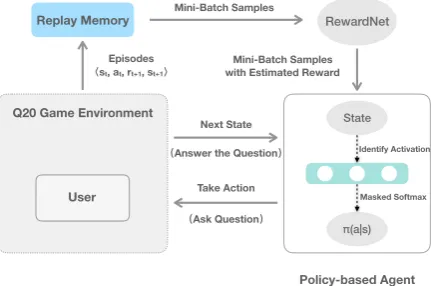
Figure 1: The overview of our RL framework.
the confidence vector and output a question dis-tribution for selecting the next question. To solve the problem that there is no immediate reward for each selected question, we also propose to employ a RewardNet to estimate the appropriate immedi-ate reward at each time-step, which is further used to calculate the long-term return to train our RL model. Our RL framework makes the agent robust to noisy answers since the model parameters are fully learnable and the question distribution from
πθ(a|s)provides us with a principled way to sam-ple questions, which enables the agent to jump out of the local optimum caused by incorrect answers and also introduces more randomness during train-ing to improve the model generalization ability. Furthermore, the ability to sample questions, com-pared to greedy selection, also improves the diver-sity of the questions asked by our agent, which is crucial for user experience.
Our contributions can be summarized as fol-lows: (1) We propose a novel RL framework to learn the optimal policy of question selection in the Q20 game without any dependencies on the existing KBs of target objects. Our trained agent is robust to noisy answers and has a good diver-sity in its selected questions. (2) To make the re-ward more meaningful, we also propose a novel neural network on reward function approximation to deliver the appropriate immediate rewards at each time-step. (3) Extensive experiments show that our RL method clearly outperforms a highly engineered baseline in the real-world Q20 games where noisy answers are common. Besides, our RL method is also competitive to that baseline on a noise-free simulation environment.
2 Method
In this section, we first describe our RL framework for playing the Q20 game, which is shown in the
Fig.1. The user in our system is the answerer who thinks of a target object otgt in the object set O at the beginning of the game. Our policy-based agent acts as the questioner that can ask 20 ques-tions to figure out what exactly otgt is. Specifi-cally, an internal state vector sis maintained by our agent, which describes the confidence about
otgt. At each time-step t, the agent picks up the promising action (select a question) according to the policyπθ(a|st), and transits from the statest
to the next state st+1 after receiving the answer
(“Yes”/“No”/“Unknown”) from the user. The his-torical trajectorieshst, at, rt+1, st+1iare stored in
a replay memory which enables the agent to be trained on previously observed data by sampling from it. Note that only when a guess is made about
otgtat the end of game can the agent receive a re-ward signal, which makes it unable to distinguish the importance of each selected question. There-fore, we design a RewardNet to learn the more in-formative reward at each time-step and thus lead the agent to achieve the better performance.
In the rest of this section, we first describe how to formulate the Q20 game into a RL framework, and then introduce the RewardNet. Finally, we will demonstrate our training procedure in detail.
2.1 Modeling of the Q20 Game
In the Q20 game, the goal of our agent is to figure out the objectotgtthat the user thinks of at the be-ginning of game by asking 20 questions. We for-mulate the process of question selection as a finite Markov Decision Process (MDP) which can be solved with RL. A tuplehS,A,P,R,γiis defined to represent the MDP, whereS is the continuous state space,A={a1, a2,· · ·, am}is the set of all available actions,P(St+1=s0|St=s, At=a)is the transition probability matrix,R(s, a)is the re-ward function andγ ∈[0,1]is the discount factor used to calculate the long-time return. In the RL framework, at each time-stept, the agent takes an actionatunder the statestaccording to the policy
πθ(a|st). After interacting with the environment, the agent receives a reward scalar rt+1 and
tran-sits to the next statest+1, then another time-step
begins. All these trajectorieshst, at, rt+1, st+1iin
a game constitute an episode which is an instance of the finite MDP. The long-time returnGtof the time-steptis calculated as follows:
Gt= T X
k=0
[image:2.595.74.290.65.208.2]In the following parts, we describe each compo-nent of RL corresponding to the Q20 game.
Environment. The major component of our
en-vironment is the user in the Q20 game who de-cides the target objectotgtand answers questions from the agent. Besides, the environment also needs to deliver the reward based on the outcome of the game and store historical data into the replay memory (see Fig.1).
Action. Since the agent interacts with the user by
asking questions, the actionat ∈ Ataken by our agent refers to selecting the question qat at
time-stept, andAis the set of the indices to all available questions in the Q20 game.
State. In our method, we use the statestto keep
track of the current confidence of target object
otgt. Specifically st ∈ R|O| and Pni=1st,i = 1,
where O = {o1, o2,· · ·, on} represents the set of all the objects that can be chosen by the user. Therefore, the statestis a probability distribution over all the objects andst,i is the confidence that the objectoiis the target objectotgtat time-stept. The initial states0can either be a uniform
dis-tribution or initialized by the prior knowledge. We observe that users typically prefer to choose popu-lar objects which are more concerned by the pub-lic. For example, the founder of Tesla Inc. and the designer of SpaceX, “Elon Musk”, is more likely to be chosen compared to a CEO of a new startup. Motivated by this, we could use the yearly retrieval frequencyC(oi) of object oi on a com-mercial search engine to calculate the initial state
s0, wheres0,i=C(oi)/Pnj=1C(oj).
Transition Dynamics. In our method, the
transi-tion dynamics is deterministic. Given the object setO and the question setA, we collect the nor-malized probabilities of the answer over “Yes”, “No” and “Unknown” for each object-question pair. And the rule of state transition is define as:
st+1=stα (2)
whereαdepends on the answerxtto the question
qat which is selected by the agent at the stept:
α=
[R(1, at), . . . , R(|O|, at)], xt=Y es
[W(1, at), . . . , W(|O|, at)], xt=N o
[U(1, at), . . . , U(|O|, at)], xt=U nk (3) where O is the object set and for each object-question pair(oi, qj),R(i, j)andW(i, j)are
cal-culated as follows:
R(i, j) = Cyes(i, j) +δ
Cyes(i, j) +Cno(i, j) +Cunk(i, j) +λ
W(i, j) = Cno(i, j) +δ
Cyes(i, j) +Cno(i, j) +Cunk(i, j) +λ (4)
R(i, j)andW(i, j)are probabilities of answering “Yes” and “No” to questionqj with respect to the object oi respectively. Cyes(i, j), Cno(i, j) and
Cunk(i, j) are frequencies of answering “Yes”, “No” and “Unknown” to questionqj with respect to the objectoi.δandλare smoothing parameters. Then the probability of answering “Unknown” to questionqjwith respect to the objectoiis:
U(i, j) = 1−R(i, j)−W(i, j) (5)
In this way, the confidence st,i that the object
oiis the target objectotgtis updated following the user’s answerxtto the selected questionqat at the
time-stept.
Policy Network. We directly parameterize the
policyπθ(a|st)with a neural network which maps the state st to a probability distribution over all
available actions: πθ(a|st) = P[a|st;θ]. The
pa-rametersθ are updated to maximize the expected return which is received from the environment. In-stead of learning a greedy policy in value-based methods like DQN, the policy network is able to learn a stochastic policy which can increase the di-versity of questions asked by our agent and poten-tially make the agent more robust to noisy answers in the real-world Q20 game. The policyπθ(a|s)is modeled by a Multi-Layer Perceptron (MLP) and the output layer is normalized by using a masked softmax function to avoid selecting the question that has been asked before. Because asking the same question twice does not provide extra infor-mation aboutotgtin a game.
2.2 Problem of Direct Reward
For most reinforcement learning applications, it is always a critical part to design reward functions, especially when the agent needs to precisely take actions in a complex task. A good reward function can improve the learning efficiency and help the agent achieve better performances.
In the Q20 game, however, the immediate re-wardrtof selecting questionqatis unknown at the
“Unknown” and there is no extra information pro-vided by user. Only when the game ends(t=T)
can the agent receive a reward signal of win or loss. So we intuitively consider thedirect reward:
rT = 30 and −30 for the win and loss respec-tively while rt = 0 for all t < T. Unfortu-nately, the direct reward is not discriminative be-cause the agent receives the same immediate re-wardrt = 0 (t < T)for selecting both good and bad questions. For example, if theotgtis “Donald Trump”, then selecting question (a) “Is your role the American president?” should receive more im-mediate rewardrtthan selecting question (b) “Has your role been married?”. The reason is that as for theotgt, question (a) is more relevant and can nar-row down the searching space to a greater extent.
Therefore, it is necessary to design a better re-ward function to estimate a non-zero immediate reward rt, and make the long-time return Gt = PT
k=0γkrt+k+1more informative.
2.3 Reward Function Approximation by
Neural Network
To solve the problem of the direct reward, we pro-pose a reward function which employs a neural network to estimate a non-zero immediate reward
rtat each time-step. So thatGtcan be more infor-mative, which thus leads to a better trained ques-tioner agent.
The reward function takes the state-action pair
(st, at)as input and outputs the corresponding im-mediate reward rt+1. In our method, we use a
MLP with sigmoid output to learn the appropri-ate immediappropri-ate reward during training, and this net-work is referred asRewardNet. In each episode, the long-term returnGt is used as a surrogate in-dicator of rt+1 to train our RewardNet with the
following loss function:
L1(σ) = (R(st, at;σ)−sigmoid(Gt))2 (6)
whereσ is the network parameters. Here we ap-ply the sigmoid function on Gt so as to prevent
Gtfrom growing too large. Besides, we also use the replay memory to store both old and recent ex-periences, and then train the network by sampling mini-batches from it. The training process based on the experience replay technique can decorrelate the sample data and thus make the training of the RewardNet more efficient.
Furthermore, since the target object otgt can be obtained at the end of each episode, we can
use the extra information provided by otgt to es-timate a better immediate reward rt. To capture the relevance between the selected questions and
otgt in an episode, we further propose a
object-aware RewardNetwhich takes thehst, at, otgti tu-ple as input and produces corresponding rt+1 as
output. The detailed training algorithm is shown in Algo.1.
Algorithm 1:Training Object-Aware
Reward-Net
1 Initialize replay memoryD1to capacityN1 2 Initialize RewardNet with random weightsσ 3 forepisode i←1toZ do
4 User chooses objectoifromO 5 Initialize temporary setS1 andS2 6 Play with policyπθ(at|st), and store
(st, at)inS1, wheret∈[0, T] 7 rT ←30or−30for a win or loss 8 for(st, at)inS1do
9 Getrt+1fromRewardNet
10 Store(st, at, rt+1)tuple inS2 11 for(st, at, rt+1)inS2do
12 Gt←PTk=0γkrt+k+1 13 r0t+1←sigmoid(Gt) 14 Store(st, at, oi, r0t+1)inD1 15 if len(D1)> K1then
16 Sample mini-batch fromD1
17 Updateσwith lossL1(σ)in Eq.6
2.4 Training the Policy-Based Agent
We train the policy network using REIN-FORCE (Williams, 1992) algorithm and the cor-responding loss function is defined as follows:
L2(θ) =−Eπθ[logπθ(at|st)(Gt−bt)] (7)
where the baselinebtis a estimated value of the ex-pected future reward at the statest, which is pro-duced by a value network Vη(st). Similarly, the value networkVη(st)is modeled as a MLP which takes the statestas input and outputs a real value as the expected return. By introducing the base-linebtfor the policy gradient, we can reduce the variance of gradients and thus make the training process of policy network more stable. The net-work parametersηare updated by minimizing the loss function below:
Note that, in our method, both the RewardNet and the value networkVη(st)approximate the re-ward during training. But the difference lies in that the RewardNet is designed to estimate a ap-propriate non-zero rewardrtand further derive the more informative returnGt while Vη(st)aims to learn a baselinebtto reduce the variance of policy gradients. We combine both of two networks to improve the gradients for our policy network and thus lead to a better agent. The training procedure is described in Algo.2.
Algorithm 2:Training the Agent
1 Initialize replay memoryD2to capacityN2 2 Initialize policy netπwith random weightsθ 3 Initialize value netVwith random weightsη 4 Initialize RewardNet with random weightsσ 5 forepisode i←1toZ do
6 Rollout, collect rewards, and save the
history inS2(4-10 in Algo.1) 7 for(st, at, rt+1)inS2do 8 Gt←PTk=0γkrt+k+1
9 UpdateRewardNet(13-17 in
Algo.1)
10 Store(st, at, Gt)inD2 11 if len(D2)> K2then
12 Sample mini-batch fromD2
13 Updateηwith lossL3in Eq.8
14 Updateθwith lossL2in Eq.7
3 Experimental Setup
We use a user simulator to train our questioner agent and test the agent with the simulated an-swerer and real users. Specifically, our experi-ments answer three questions: (1) Is our method more robust in real-world Q20 games, compared to the methods based on relevance table? (Sec-tion. 4.2) And how does it perform in the simu-lation environment? (Section. 4.1) (2) Does our RewardNet help in the training process? (Sec-tion.4.3) (3) How the winning rate grows with the number of questions, and whether it is possible to stop earlier? (Section.4.4)
3.1 User Simulator
Training the RL agent is challenging because the agent needs to continuously interact with the envi-ronment. To speed up the training process of the proposed RL model, we construct a user simulator
which has enough prior knowledge to choose ob-jects and answer questions selected by the agent.
We collect 1,000 famous people and 500 ques-tions for them. Besides, for every person-question pair in our dataset, a prior frequency distribution over “Yes”, “No” and “Unknown” is also collected from thousands of real users. For example, as for “Donald Trump”, question (a) “Is your role the American president?” is answered with “Yes” for 9,500 times, “No” for 50 times and “Unknown” for 450 times. We use Eq.4and5to construct three matricesR, W, U ∈R|O|∗|A|(|O|= 1000,|A| = 500) which are used for state transition in the Sec-tion.2.1. Then given the objectoiand questionqj, the user simulator answers “Yes”, “No” and “Un-known” whenR(i, j),W(i, j), andU(i, j)has the max value among them respectively.
Constructed by the prior knowledge, the sim-ulator can give noise-free answer in most cases. Because the prior frequency distribution for each person-question pair is collected from thousands of users with the assumption that most of them do not lie when answering questions in the Q20 game. In an episode, the simulator randomly samples a person following the object distributions0, which
is generated from the object popularity (see the state part of Section. 2.1), as the target object. Then the agent gives a guess when the number of selected questions reaches 20. After that, the simulator check the agent’s answer and return a reward signal of win or loss. There is only one chance for the agent to guess in an episode. The win and loss reward are 30 and -30 respectively.
3.2 Implementation Details
While the architectures of the policy network, Re-wardNet and value network can vary in different scenarios, in this paper, we simply use the MLP with one hidden layer of size 1,000 for all of them, but with different parameters. These networks take in the state vector directly, which is a prob-ability distribution over all objects. The Reward-Net further takes in the one-hot vector of action
at. Based on the input of RewardNet, the object-aware RewardNet takes one more target objectotgt as the feature which is also a one-hot vector.
We use the ADAM optimizer (Kingma and Ba,
0Q6TCKPI5VGRU ×
9KP4CVG
[image:6.595.72.289.60.223.2]'PVTQR[/QFGN 4.AWPKHQTO 4.ARQRWNCTKV[
Figure 2: Win Rate Curves in Simulation Environment.
to 2,000,000 steps (2,00,000 games) and the pol-icy network was evaluated every 5,000 steps. Each evaluation records the agent’s performance with a greedy policy for 2,000 independent episodes. The 2,000 target objects for these 2,000 episodes are randomly selected following the distribution s0,
which is generated from the object popularity and kept the same for all the training settings.
3.3 Competitor
We compare our RL method with the entropy-based model proposed by Wu et al. (2018), which utilizes the real-world answers to each object-question pair to calculate an object-object-question rele-vance matrix with the entropy-based method. The relevance matrix is then used for question ranking and object ranking via carefully designed formu-las and engineering tricks. Since this method is shown to be effective in their production environ-ment, we consider it to be a strong baseline to our proposed RL model.
4 Experimental Results
4.1 Simulated Evaluation
We first evaluate our agent and the entropy-based baseline (referred to as EntropyModel, see Section. 3.3) by using the simulated user (Sec-tion.3.1). To investigate which initialization strat-egy of the states0 is better (see the state part of
Section. 2.1), we further evaluate two variants of our model: the agent with uniform distributions0
(RL uniform) and the agent with the distribution
s0initialized by the prior knowledge on the object
popularity (RL popularity).
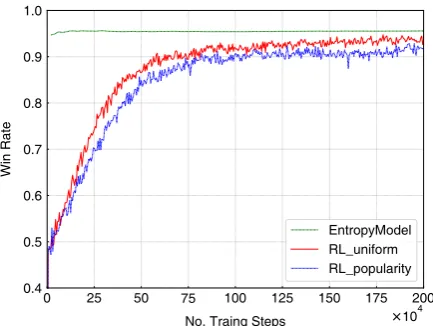
Fig.2shows the curves on the win rate of these methods evaluated on 2,000 independent episodes
with respect to the number of training steps. Note that, the EntropyModel only needs to update its statistics during training and has already accu-mulated a significant number of data since it has been run for over a year in their production envi-ronment. Therefore, only a small fraction of its statistics can be changed, which leads to a small rise at the beginning of training, and its win rate remains at around 95% afterwards.
On the other hand, both our RL models con-tinuously improve the win rate with the growing number of interactions with the user simulator, and they achieve 50% win rate after around 20,000 steps. As we can see, although the s0
initial-ized with the prior knowledge of object popular-ity keeps consistent with the object selection strat-egy of the simulator, the agent with uniform dis-tributions0 (RL uniform) still performs clearly
better than the agent with s0 based on the prior
knowledge (RL popularity). The reason is that the former can explore the Q20 game environ-ment more fully. The prior knowledge based s0
helps the agent narrow down the candidate space more quickly when the target object is a popu-lar object. However, it also becomes misleading when the target object is not popular and makes the agent even harder to correct the confidence of the target object. On the contrary, the uniform dis-tributions0makes the agent keep track of the
tar-get object only based on the user’s answers. And the superior performance of theRL uniform in-dicates that our question selection policy is highly effective, which means it is not necessary to use theRL popularityto increase the win rate of hot objects in the game.
As shown in Fig.2,RL uniformachieves win rate 94% which is very close toEntropyModel. Compared to our RL method, EntropyModel
needs more user data to calculate their entropy-based relevance matrix and involves many engi-neering tricks. The fact thatRL uniformis com-petitive toEntropyModelin the noise-free sim-ulation environment indicates that our RL method is very cost-effective: it makes use of user data more efficiently and is easier to implement.
4.2 Human Evaluation
Win Rate
EntropyModel 71.3%
RL uniform 75.9%
Table 1: Win Rate on Human Evaluation.
users to play the game withEntropyModeland
RL uniformfor 1,000 times respectively. In the real-world Q20 game, users sometimes make mis-takes when they answer the questions during the game. For example, as for the target object “Don-ald Trump”, question (a) “Is your role the Ameri-can president?” is sometimes answered with “No” or “Unknown” by real users. On the contrary, the simulator hardly makes such mistakes since we have provided it with enough prior knowl-edge. As shown in Table. 1, RL uniform out-performsEntropyModelby about 4.5% on win rate in the real-world Q20 games. It shows that our RL method is more robust to noisy answers than EntropyModel. Specifically, the robust-ness of our RL method to the noise is shown in the following two aspects. First, compared to the rule-based statistics update in EntropyModel, our RL model can be trained by modern neural net-work optimizers in a principled way, which results in the better generalization ability of our model. Secondly, different from theEntropyModel se-lecting the top-ranked question at each time-step,
RL uniform samples a question following its question probability distribution πθ(a|s), which enables our agent to jump out of the local optimum caused by incorrect answers from users. And since more randomness is introduced by sampling from the question probability distribution during train-ing, it also improves the tolerance of our model towards the unexpected question sequences.
Besides, we also find some interesting cases during human evaluation. Sometimes, the RL agent selects a few strange questions which seems to be not that much relevant to the chosen object, but it can still find the correct answer at the end of game. This situation is caused by the fact that our method samples questions based on the output of policy net, rather than greedy selection during training. We find that this phenomenon increases the user experience since it makes the agent more unpredictable to the users.
0Q6TCKPKPI5VGRU ×
9KP4CVG
[image:7.595.309.525.60.224.2]1DLGEV4GYCTF0GV 4GYCTF0GV &KTGEV4GYCTF
Figure 3: Effectiveness of RewardNet.
4.3 The Effectiveness of RewardNet
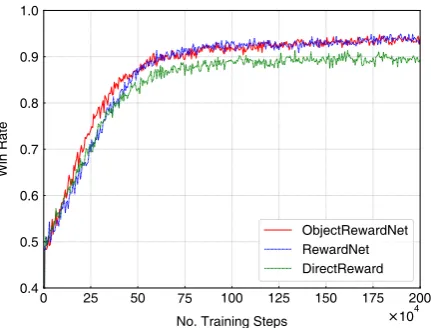
To investigate the effectiveness of our RewardNet (Section. 2.3), we further evaluate three variants of our model in the simulation environment: the model trained with with direct reward, Reward-Net, and object-aware RewardReward-Net, which are re-ferred to asDirectReward,RewardNet, and
ObjectRewardNet respectively. They are all trained with the uniform distributions0.
As shown in Fig. 3, DirectReward con-verges in the early steps and has a relatively poor performance with the win rate 89%. Both
RewardNet andObjectRewardNet achieve the better performance with a win rate of 94% af-ter convergence. This clear improvement shows that the more informative long-term return, calcu-lated with the immediate reward delivered by our RewardNet method, significantly helps the train-ing of the agent.
Furthermore, as shown in Fig. 3, we can also see that ObjectRewardNet learns faster than
RewardNetin the early steps. This indicates that
ObjectRewardNetcan estimate the immediate reward more quickly with the extra information provided by the target object, which leads to the faster convergence of the agent.
4.4 Win Rate Regarding Question Numbers
0Q3WGUVKQPU
9KP4CVG
[image:8.595.71.291.59.222.2]7PKH5KOWNCVQT 2QR5KOWNCVQT
Figure 4: Win Rate Regarding Numbers of Questions.
the prior object distribution based on the object popularity (PopSimulator). We perform 1,000 simulations for each number of questions, and the win rate curve is shown in Fig.4.
As we can see thatUnifSimulatorachieves the win rate of 80% with only 14 questions in both settings. And the flat curves in the region after 18 questions indicate that the game can be early stopped with the almost same win rate at step 18. Since a lower win rate is acceptable sometimes, other early-stop strategies can also be derived for the better user experience with the trade-off be-tween the win rate and game steps.
Besides, the fact that RL uniform performs similarly under both settings actually shows that our RL method is robust to different objects. It also performs well on infrequent objects where we may have the limited user data for constructing a well-tuned state transition dynamics.
4.5 Case Study
When our agent is playing the game with real users, we select two cases from records. In the first case, the person that the user chooses is Cris-tiano Ronaldo, the famous football player. As we can see in Tab.2, our agent can still figure out the target person while No.17 and No.19 questions are answered wrong by the user, which indicates our agent is robust to noisy answers. In the second case, the chosen person is Napoleon Bonaparte who was the French Emperor. Although there are some other candidates satisfied the constraints, the target person can be figured out because of the people popularity, which is shown in Tab.3.
5 Related Work
Q20. The Q20 game is popularized as an elec-tronic game by the program of Robin Burgener in 1988 (Burgener, 2006), which uses a object-question relevance table to rank object-questions and tar-get objects. Wu et al. (Wu et al.,2018) improves the relevance table with entropy-based metrics, and uses complicated engineering tricks to make it perform quite well in their production environ-ment. These table-based methods use rules to update parameters, which makes them easily af-fected by noisy answers. Besides, Zhao and Max-ine (2016) also explores Q20 in their dialogue state tracking research. However, they only use a small toy Q20 setting where the designed questions are about 6 person attributes in the Knowledge Base (KB). Since their method relies on the KB for nar-rowing down the scope of target object, it is not applicable to real-world Q20 games where a well-defined object KB is often unavailable. Compared to previous approaches, our RL method is robust to the answer noise and does not rely on the KB.
Deep Reinforcement Learning. DRL has
wit-nessed great success in playing complex games like Atari games (Mnih et al.,2015) , Go (Silver et al.,2016), and etc. In the natural language pro-cessing (NLP), DRL is also used to play text-based games (Narasimhan et al.,2015), and used to han-dle fundamental NLP tasks like machine transla-tion (He et al., 2016) and machine comprehen-sion (Hu et al.,2017) as well. Our Q20 game lies in the intersection of the field of game and NLP. In this work, we propose a policy-based RL model that acts as the questioner in the Q20 game, and it exhibits the superior performance in our human evaluation.
Natural Language Games.In the literature, there
are some works focusing on solving and generat-ing English riddles (De Palma and Weiner,1992;
Binsted,1996) and Chinese character riddles (Tan et al.,2016). Compared to riddles, the Q20 game is a sequential decision process which requires careful modeling of this property.
6 Conclusions
thus make the long-time return more informative. Compared to previous approaches, our RL method is more robust to the answer noise which is com-mon in the real-world Q20 game. Besides, our RL agent can also ask various questions and does not require the existing KB and complicated engineer-ing tricks. The experiments on a noisy-free sim-ulation environment show that our RL method is competitive to an entropy-based engineering sys-tem, and clearly outperforms it on the human eval-uation where noisy answers are common.
As for the future work, we plan to explore meth-ods to use machine reading to automatically con-struct the state transition dynamics from corpora like Wikipedia. In this way, we can further build an end-to-end framework for the large-scale Q20 games in the real world.
Acknowledgement
We gratefully thank the anonymous reviewers for their insightful comments and suggestions on the earlier version of this paper. The first author also thanks the Microsoft for providing resources for the research.
References
Kim Binsted. 1996. Machine humour: An imple-mented model of puns.
Robin Burgener. 2006. Artificial neural network guess-ing method and game.
Paul De Palma and E Judith Weiner. 1992. Riddles: accessibility and knowledge representation. In Pro-ceedings of the 14th conference on Computational linguistics-Volume 4, pages 1121–1125. Association for Computational Linguistics.
Di He, Yingce Xia, Tao Qin, Liwei Wang, Nenghai Yu, Tieyan Liu, and Wei-Ying Ma. 2016. Dual learn-ing for machine translation. InAdvances in Neural Information Processing Systems, pages 820–828.
Minghao Hu, Yuxing Peng, and Xipeng Qiu. 2017. Re-inforced mnemonic reader for machine comprehen-sion.CoRR, abs/1705.02798.
Diederik P Kingma and Jimmy Ba. 2014. Adam: A method for stochastic optimization. arXiv preprint arXiv:1412.6980.
V Mnih, K Kavukcuoglu, D Silver, A. A. Rusu, J Ve-ness, M. G. Bellemare, A Graves, M Riedmiller, A. K. Fidjeland, and G Ostrovski. 2015. Human-level control through deep reinforcement learning.
Nature, 518(7540):529.
Karthik Narasimhan, Tejas Kulkarni, and Regina Barzilay. 2015. Language understanding for text-based games using deep reinforcement learning. In
Proceedings of the 2015 Conference on Empirical Methods in Natural Language Processing, pages 1– 11.
David Silver, Aja Huang, Chris J Maddison, Arthur Guez, Laurent Sifre, George Van Den Driessche, Ju-lian Schrittwieser, Ioannis Antonoglou, Veda Pan-neershelvam, Marc Lanctot, et al. 2016. Mastering the game of go with deep neural networks and tree search. nature, 529(7587):484–489.
Chuanqi Tan, Furu Wei, Li Dong, Weifeng Lv, and Ming Zhou. 2016. Solving and generating chinese character riddles. InProceedings of the 2016 Con-ference on Empirical Methods in Natural Language Processing, pages 846–855.
Ronald J Williams. 1992. Simple statistical gradient-following algorithms for connectionist reinforce-ment learning. In Reinforcement Learning, pages 5–32. Springer.
Xianchao Wu, Huang Hu, Momo Klyen, Kyohei Tomita, and Zhan Chen. 2018. Q20: Rinna riddles your mind by asking 20 questions. InJapan NLP.
Tiancheng Zhao and Maxine Eskenazi. 2016. Towards end-to-end learning for dialog state tracking and management using deep reinforcement learning. In
No. Question User’s Answer
1 Was the person born in Asia? No
2 Is the person very famous? Yes
3 Is the person a actor or actress? No
4 Is the person still alive? Yes
5 Was the person born in the 1990s? No 6 Is the person the founder of a famous company? No 7 Did the person finish the college in USA? No
8 Is the person a famous singer? No
9 Is the person male? Yes
10 Is the person related to sports? Yes 11 Is the person a football player? Yes
12 Is the person a midfielder? No
[image:10.595.137.469.80.349.2]13 Is the person played for a European football club? Yes 14 Is the person playing in the Spanish Premier League? Yes 15 Is the person famous for the handsome or beautiful looks? Yes 16 Does the person have big muscles? Yes 17 Does the person have brown hair? No 18 Will you be happy when you see the person? Yes 19 Does the person have brothers or sisters in the family? No 20 Is the person engaged in many charity activities? Unknown
Table 2: The person that the user chooses is Cristiano Ronaldo, the famous football player. As we can see in table, our agent can still figure out the target person while No.17 and No.19 are answered wrong by the user, which indicates our agent is robust to noisy answers.
No. Question User’s Answer
1 Is the person female? No
2 Is the person still alive? No
3 Does the person have children? Yes 4 Does the person have brothers or sisters in the family? Yes
4 Is the person very smart? Yes
5 Was the person born in America? No
6 Is the person the white man? Yes
7 Is the person’s family very rich? No 8 Is the person a controversial figure in history? Yes 9 Is the person related to politics? Yes 10 Does the person have good looks? Unknown 11 Does the person have short hair? Yes
12 Is the person very famous? Yes
13 Has the person once been very powerful? Yes 14 Is the character of the person very aggressive? No 15 Has the person been the president of a country? Yes
16 Is the person a military? Yes
17 Has the person once killed men? No 18 Was the person born in Britain? No 19 Was the person one of famous leaders in the World War II? No 20 Has the person once been the emperor? Yes
[image:10.595.142.466.425.702.2]