Proceedings of NAACL-HLT 2019, pages 3912–3918 3912
Polyglot Contextual Representations Improve Crosslingual Transfer
Phoebe Mulcaire♥ Jungo Kasai♥ Noah A. Smith♥♦ ♥Paul G. Allen School of Computer Science & Engineering,
University of Washington, Seattle, WA, USA
♦Allen Institute for Artificial Intelligence, Seattle, WA, USA
{pmulc,jkasai,nasmith}@cs.washington.edu
Abstract
We introduce Rosita, a method to pro-duce multilingual contextual word represen-tations by training a single language model on text from multiple languages. Our method combines the advantages of contex-tual word representations with those of mul-tilingual representation learning. We produce language models from dissimilar language pairs (English/Arabic and English/Chinese) and use them in dependency parsing, seman-tic role labeling, and named entity recognition, with comparisons to monolingual and non-contextual variants. Our results provide fur-ther evidence for the benefits of polyglot learn-ing, in which representations are shared across multiple languages.
1 Introduction
State-of-the-art methods for crosslingual transfer make use of multilingual word embeddings, and much research has explored methods that align vector spaces for words in different languages (Faruqui and Dyer, 2014;Upadhyay et al.,2016;
Ruder et al.,2017). On the other hand,contextual
word representations (CWR) extracted from lan-guage models (LMs) have advanced the state of the art beyond what was achieved with word type representations on many monolingual NLP tasks (Peters et al., 2018). Thus, the question arises: cancontextual word representations benefit from
multilinguality?
We introduce a method to produce multilin-gual CWR by training a single “polyglot” lan-guage model on text in multiple lanlan-guages. As our work is a multilingual extension of ELMo ( Pe-ters et al., 2018), we call it Rosita (after a bilin-gual character fromSesame Street). Our hypothe-sis is that, although each language is unique, dif-ferent languages manifest similar characteristics (e.g., morphological, lexical, syntactic) which can
be exploited by training a single model with data from multiple languages (Ammar, 2016). Previ-ous work has shown this to be true to some de-gree in the context of syntactic dependency pars-ing (Ammar et al., 2016), semantic role label-ing (Mulcaire et al., 2018), named entity recog-nition (Xie et al.,2018), and language modeling for phonetic sequences (Tsvetkov et al.,2016) and for speech recognition (Ragni et al., 2016). Re-cently, de Lhoneux et al.(2018) showed that pa-rameter sharing between languages can improve performance in dependency parsing, but the ef-fect is variable, depending on the language pair and the parameter sharing strategy. Other recent work also reported that concatenating data from different languages can hurt performance in de-pendency parsing (Che et al.,2018). These mixed results suggest that while crosslingual transfer in neural network models is a promising direction, the best blend of polyglot and language-specific elements may depend on the task and architecture. However, we find overall contextual representa-tions from polyglot language models succeed in a range of settings, even where multilingual word type embeddings do not, and are a useful tech-nique for crosslingual transfer.
We explore crosslingual transfer between highly dissimilar languages (English→Chinese and English→Arabic) for three core tasks: Univer-sal Dependency (UD) parsing, semantic role label-ing (SRL), and named entity recognition (NER). We provide some of the first work using polyglot LMs to produce contextual representations,1 and the first analysis comparing them to monolingual LMs for this purpose. We also introduce an LM variant which takes multilingual word embedding input as well as character input, and explore its
1Contemporaneous work uses polyglot LMs for
applicability for producing contextual word rep-resentations. Our experiments focus on compar-isons in three dimensions: monolingual vs. poly-glot representations, contextual vs. word type em-beddings, and, within the contextual representa-tion paradigm, purely character-based language models vs. ones that include word-level input.
Previous work has shown that contextual rep-resentations offer a significant advantage over tra-ditional word embeddings (word type representa-tions). In this work, we show that, on these tasks, polyglot character-based language models can provide benefits on top of those offered by con-textualization. Specifically, even when crosslin-gual transfer with word type embeddings hurts target language performance relative to monolin-gual models, polyglot contextual representations can improve target language performance relative to monolingual versions, suggesting that polyglot language models tie dissimilar languages in an ef-fective way.
In this paper, we use the following terms:
crosslingual transferandpolyglot learning. While crosslingual transfer is often used in situations where target data are absent or scarce, we use it broadly to mean any method which uses one or more source languages to help process another tar-get language. We also draw a sharp distinction be-tween multilingual and polyglot models. Multilin-gual learning can happen independently for differ-ent languages, but a polyglot solution provides a single model for multiple languages, e.g., by pa-rameter sharing between languages in networks during training.
2 Polyglot Language Models
We first describe the language models we use to construct multilingual (and monolingual)CWR.
2.1 Data and Preprocessing
Because the Universal Dependencies treebanks we use for the parsing task predominantly use Tradi-tional Chinese characters and the Ontonotes data for SRL and NER consist of Simplified Chinese, we train separate language models for the two variants. For English we use text from the Billion Word Benchmark (Chelba et al.,2013), for Tradi-tional Chinese, wiki and web data provided for the CoNLL 2017 Shared Task (Ginter et al.,2017), for Simplified Chinese, newswire text from Xinhua,2
2catalog.ldc.upenn.edu/LDC95T13
and for Arabic, newswire text from AFP.3We use approximately 60 million tokens of news and web text for each language.
We tokenized the language model training data for English and Simplified Chinese using Stan-ford CoreNLP (Manning et al.,2014). The Tradi-tional Chinese corpus was already pre-segmented by UDPipe (Ginter et al., 2017; Straka et al.,
2016). We found that the Arabic vocabulary from AFP matched both the UD and Ontonotes data rea-sonably well without additional tokenization. We also processed all corpora to normalize punctua-tion and remove non-text.
2.2 Models and Training
We base our language models on the ELMo method (Peters et al.,2018), which encodes each word with a character CNN, then processes the word in context with a word-level LSTM.4 Fol-lowing Che et al. (2018), who used 20 million words per language to train monolingual language models for many languages, we use the same hy-perparameters used to train the monolingual En-glish language model fromPeters et al.(2018), ex-cept that we reduce the internal LSTM dimension from 4096 to 2048.
For each target language dataset (Traditional Chinese, Simplified Chinese, and Arabic), we pro-duce:
• a monolingual language model with charac-ter CNN (MONOCHAR) trained on that lan-guage’s data;
• a polyglot LM (ROSITACHAR) trained with the same code, on that language’s data with an additional, equal amount of English data;
• a modified polyglot LM (ROSITAWORD), de-scribed below.
The ROSITAWORD model concatenates a 300 dimensional word type embedding, initialized with multilingual word embeddings, to the char-acter CNN encoding of the word, before passing this combined vector to the bidirectional LSTM.
3catalog.ldc.upenn.edu/LDC2001T55
4
A possible alternative is BERT (Devlin et al., 2018), which uses a bidirectional objective and a transformer architecture in place of the LSTM. Notably, one of the provided BERT models was trained on several lan-guages in combination, in a simple polyglot approach
(see https://github.com/google-research/
The idea of this word-level initialization is to bias the model toward crosslingual sharing; because words with similar meanings have similar repre-sentations, the features that the model learns are expected to be at least partially language-agnostic. The word type embeddings used for these models, as well as elsewhere in the paper, are trained on our language model training set using the fastText method (Bojanowski et al.,2017), and target lan-guage vectors are aligned with the English ones using supervised MUSE5 (Conneau et al.,2018). See appendix for more LM training details.
3 Experiments
All of our task models (UD, SRL, and NER) are implemented in AllenNLP, version 0.7.2 (Gardner et al., 2018).6 We generally follow the default hyperparameters and training schemes provided in the AllenNLP library regardless of language. See appendix for the complete list of our hyperpa-rameters. For each task, we experiment with five types of word representations: in addition to the three language model types (MONOCHAR, ROSI -TACHAR, and ROSITAWORD) described above, we show results for the task models trained with monolingual and polyglot non-contextual word embeddings.
After pretraining, the word representations are fine-tuned to the specific task during task train-ing. In non-contextual cases, we fine-tune by up-dating word embeddings directly, while in contex-tual cases, we only update coefficients for a lin-ear combination of the internal representation lay-ers for efficiency (Peters et al.,2018). In order to properly evaluate our models’ generalization abil-ity, we ensure that sentences in the test data are excluded from the data used to train the language models.
3.1 Universal Dependency Parsing
We use a state-of-the-art graph-based dependency parser with BiLSTM and biaffine attention (Dozat and Manning, 2017). Specifically, the parser takes as input word representations and 100-dimensional fine-grained POS embeddings fol-lowing Dozat and Manning (2017). We use the same UD treebanks and train/dev./test splits as the
5For our English/Chinese and English/Arabic data, their
unsupervised method yielded substantially worse results in word translation.
6We make our multilingual fork available athttps://
github.com/pmulcaire/rosita
CoNLL 2018 shared task on multilingual depen-dency parsing (Zeman et al.,2018). In particular, we use the GUM treebank for English,7 GSD for Chinese, and PADT for Arabic. For training and validation, we use the provided gold POS tags and word segmentation.
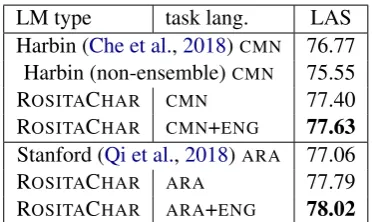
For each configuration, we run experiments five times with random initializations and report the mean and standard deviation. For testing, we use the CoNLL 2018 evaluation script and consider two scenarios: (1) gold POS tags and word seg-mentations and (2) predicted POS tags and word segmentations from the system outputs of Che et al.(2018) andQi et al.(2018).8 The former sce-nario enables us to purely assess parsing perfor-mance; see column 3 in Table1for these results on Chinese and Arabic. The latter allows for a direct comparison to the best previously reported parsers (Chinese,Che et al.,2018; Arabic,Qi et al.,2018). See Table2for these results.
As seen in Table1, the Universal Dependencies results generally show a significant improvement from the use of CWR. The best results for both languages come from the ROSITACHAR LM and polyglot task models, showing that polyglot train-ing helps, but that the word-embeddtrain-ing initializa-tion of the ROSITAWORD model does not neces-sarily lead to a better final model. The results also suggest that combining ROSITACHAR LM and polyglot task training is key to improve parsing performance. Table2 shows that we outperform the state-of-the-art systems from the shared task competition. In particular, our LMs even outper-form the Harbin system, which uses monolingual CWRand an ensemble of three biaffine parsers.
3.2 Semantic Role Labeling
We use a strong existing model based on BIO tagging on top of a deep interleaving BiLSTM with highway connections (He et al.,2017). The SRL model takes as input word representations and 100-dimensional predicate indicator embed-dings followingHe et al.(2017). We use a stan-dard PropBank-style, span-based SRL dataset for English, Chinese, and Arabic: Ontonotes (Pradhan et al.,2013). Note that Ontonotes provides annota-tions using a single shared annotation scheme for
7While there are several UD English corpora, we choose
the GUM corpus to minimize domain mismatch.
8System outputs for all systems are available at
vectors (lang.) task lang. UD LAS SRLF1 NERF1
fastText (CMN) CMN 85.15±0.12 69.79 76.31
fastText (CMN+ENG) CMN+ENG 84.92±0.28 70.82 76.05
MONOCHAR(CMN) CMN 87.55±0.25 74.14 78.18
ROSITACHAR(CMN+ENG) CMN 87.16±0.08 74.24 78.29 ROSITACHAR(CMN+ENG) CMN+ENG 87.75±0.16 74.69 77.68 ROSITAWORD(CMN+ENG) CMN 86.50±0.17 74.84 77.19 ROSITAWORD(CMN+ENG) CMN+ENG 86.37±0.35 74.69 77.16
Best prior work CMN – 62.83 75.63
fastText (ARA) ARA 82.58±0.51 50.50 71.60
fastText (ARA+ENG) ARA+ENG 82.67±0.46 54.82 71.45
MONOCHAR(ARA) ARA 84.98±0.18 59.55 75.02
ROSITACHAR(ARA+ENG) ARA 84.98±0.12 58.69 75.56 ROSITACHAR(ARA+ENG) ARA+ENG 85.24±0.13 59.29 76.19 ROSITAWORD(ARA+ENG) ARA 84.34±0.20 58.34 74.02 ROSITAWORD(ARA+ENG) ARA+ENG 84.24±0.13 59.47 72.79
[image:4.595.126.477.59.295.2]Best prior work ARA – 48.68 68.02
Table 1: LAS for UD parsing,F1 for SRL, andF1for NER, with different input representations. For UD, each
number is an average over five runs with different initialization, with standard deviation. SRL/NER results are from one run. The “task lang.” column indicates whether the UD/SRL/NER model was trained on annotated text in the target language alone, or a blend of English and the target language data. ROSITAWORDLMs use as word-level input the same multilingual word vectors as fastText models. The best prior result for Ontonotes Chinese NER is inShen et al.(2018); the others are fromPradhan et al.(2013).
LM type task lang. LAS
Harbin (Che et al.,2018)CMN 76.77 Harbin (non-ensemble)CMN 75.55
ROSITACHAR CMN 77.40
ROSITACHAR CMN+ENG 77.63 Stanford (Qi et al.,2018)ARA 77.06
ROSITACHAR ARA 77.79
ROSITACHAR ARA+ENG 78.02
Table 2: LAS (F1) comparison to the winning systems
for each language in the CoNLL 2018 shared task for UD. We use predicted POS and the segmentation of the winning system for that language. The ROSITACHAR
LM variant was selected based on development perfor-mance in the gold-segmentation condition.
English, Chinese, and Arabic, which can facilitate crosslingual transfer. For Chinese and English we simply use the provided surface form of the words. The Arabic text in Ontonotes has diacritics to in-dicate vocalization which do not appear (or only infrequently) in the original source or in our lan-guage modeling data. We remove these for better consistency with the language model vocabulary. We use gold predicates and the CoNLL 2005 eval-uation script for the experiments below to ensure our results are comparable to prior work. See
col-umn 4 in Table1 for results on the CoNLL-2012 Chinese and Arabic test sets.
The SRL results confirm the advantage ofCWR. Unlike the other two tasks, multilingual word type embeddings are better than monolingual versions in SRL. Perhaps relatedly, models using ROSITA -WORD are more successful here, providing the highest performance on Chinese. One unusual result is that the model using the MONOCHAR LM is most successful for Arabic. This may be linked to the poor results on Arabic SRL overall, which are likely due to the much smaller size of the corpus compared to Chinese (less than 20% as many annotated predicates) and higher propor-tion of language-specific tags. Such language-specific tags in Arabic could limit the effectiveness of shared English-Arabic representations. Still, polyglot methods’ performance is only slightly be-hind.
3.3 Named Entity Recognition
We use the state-of-the-art BiLSTM-CRF NER model with the BIO tagging scheme (Peters et al.,
[image:4.595.88.279.394.505.2]splits. See the last column in Table1 for results on the CoNLL-2012 Chinese and Arabic test sets. As with most other experiments, the NER results show a strong advantage from the use of contex-tual representations and a smaller additional ad-vantage from those produced by polyglot LMs.
4 Discussion
Overall, our results show that polyglot lan-guage models produce very useful representa-tions. While Universal Dependency parsing, Ara-bic SRL, and Chinese NER show models using contextual representations outperform those us-ing word type representations, the advantage from polyglot training in some cases is minor. How-ever, Chinese SRL and Arabic NER show strong improvement both from contextual word represen-tations and from polyglot training. Thus, while the benefit of crosslingual transfer appears to be somewhat variable and task dependent, polyglot training is helpful overall for contextual word rep-resentations. Notably, the ROSITACHARLM does not involve any direct supervision of tying two lan-guages together, such as bilingual dictionaries or parallel corpora, yet is still most often able to learn the most effective representations. One expla-nation is that it automatically learns crosslingual connections from unlabeled data alone. Another possibility, though, is that the additional data pro-vided in polyglot training produces a useful reg-ularization effect, improving the target language representations without crosslingual sharing (ex-cept that induced by shared vocabulary, e.g., bor-rowings, numbers, or punctuation). Nevertheless, the success of polyglot language models is worth further study.
5 Conclusion
We presented a method for using polyglot lan-guage models to produce multilingual, contextual word representations, and demonstrated their ben-efits, producing state-of-the-art results in multiple tasks. These results provide a foundation for fur-ther study of polyglot language models and their use as unsupervised components of multilingual models.
Acknowledgments
The authors thank Mark Neumann for assistance with the AllenNLP library and the anonymous re-viewers for their helpful feedback. This research
was funded in part by NSF grant IIS-1562364, the Funai Overseas Scholarship to JK, and the NVIDIA Corporation through the donation of a GeForce GPU.
References
Waleed Ammar. 2016. Towards a Universal Analyzer of Natural Languages. Ph.D. thesis, Carnegie Mel-lon University.
Waleed Ammar, George Mulcaire, Miguel Ballesteros, Chris Dyer, and Noah A. Smith. 2016. Many lan-guages, one parser.TACL, 4:431–444.
Piotr Bojanowski, Edouard Grave, Armand Joulin, and Tomas Mikolov. 2017. Enriching word vectors with subword information.TACL, 5:135–146.
Wanxiang Che, Yijia Liu, Yuxuan Wang, Bo Zheng, and Ting Liu. 2018. Towards better UD parsing: Deep contextualized word embeddings, ensemble, and treebank concatenation. InProc. of the CoNLL 2018 Shared Task: Multilingual Parsing from Raw Text to Universal Dependencies, pages 55–64.
Ciprian Chelba, Tomas Mikolov, Mike Schuster, Qi Ge, Thorsten Brants, Phillipp Koehn, and Tony Robin-son. 2013. One billion word benchmark for mea-suring progress in statistical language modeling. arXiv:1312.3005.
Alexis Conneau, Guillaume Lample, Marc’Aurelio Ranzato, Ludovic Denoyer, and Herv´e J´egou. 2018. Word translation without parallel data. InProc. of ICLR.
Jacob Devlin, Ming-Wei Chang, Kenton Lee, and Kristina Toutanova. 2018. Bert: Pre-training of deep bidirectional transformers for language understand-ing. arXiv:1810.04805.
Timothy Dozat and Christopher Manning. 2017. Deep biaffine attention for neural dependency parsing. In
Proc. of ICLR.
John C. Duchi, Elad Hazan, and Yoram Singer. 2011. Adaptive subgradient methods for online learning and stochastic optimization. JMLR, 12:2121–2159.
Manaal Faruqui and Chris Dyer. 2014.Improving vec-tor space word representations using multilingual correlation. InProc. of EACL, pages 462–471.
Matt Gardner, Joel Grus, Mark Neumann, Oyvind Tafjord, Pradeep Dasigi, Nelson Liu, Matthew Pe-ters, Michael Schmitz, and Luke Zettlemoyer. 2018. AllenNLP: A deep semantic natural language pro-cessing platform. arXiv:1803.07640.
word embeddings. LINDAT/CLARIN digital li-brary at the Institute of Formal and Applied Linguis-tics ( ´UFAL), Faculty of Mathematics and Physics, Charles University.
Luheng He, Kenton Lee, Mike Lewis, and Luke Zettle-moyer. 2017. Deep semantic role labeling: What works and what’s next. InProc. of ACL, pages 473– 483.
Diederik P. Kingma and Jimmy Lei Ba. 2015.ADAM: A method for stochastic optimization. InProc. of ICLR.
Guillaume Lample and Alexis Conneau. 2019. Cross-lingual language model pretraining. arxiv:1901.07291.
Miryam de Lhoneux, Johannes Bjerva, Isabelle Augen-stein, and Anders Sgaard. 2018. Parameter sharing between dependency parsers for related languages. InProc. of EMNLP, pages 4992–4997.
Christopher D. Manning, Mihai Surdeanu, John Bauer, Jenny Finkel, Steven J. Bethard, and David Mc-Closky. 2014. The Stanford CoreNLP natural lan-guage processing toolkit. InProc. of ACL, System Demonstrations, pages 55–60.
Phoebe Mulcaire, Swabha Swayamdipta, and Noah A Smith. 2018. Polyglot semantic role labeling. In
Proc. of ACL, volume 2, pages 667–672.
Matthew Peters, Waleed Ammar, Chandra Bhagavat-ula, and Russell Power. 2017. Semi-supervised se-quence tagging with bidirectional language models. InProc. of ACL, pages 1756–1765.
Matthew Peters, Mark Neumann, Mohit Iyyer, Matt Gardner, Christopher Clark, Kenton Lee, and Luke Zettlemoyer. 2018. Deep contextualized word rep-resentations. InProc. of NAACL-HLT, pages 2227– 2237.
Sameer Pradhan, Alessandro Moschitti, Nianwen Xue, Hwee Tou Ng, Anders Bj¨orkelund, Olga Uryupina, Yuchen Zhang, and Zhi Zhong. 2013. Towards ro-bust linguistic analysis using ontonotes. InProc. of CoNLL, pages 143–152.
Peng Qi, Timothy Dozat, Yuhao Zhang, and Christo-pher D. Manning. 2018. Universal dependency pars-ing from scratch. In Proc. of the CoNLL 2018 Shared Task: Multilingual Parsing from Raw Text to Universal Dependencies, pages 160–170.
Anton Ragni, Edgar Dakin, Xie Chen, Mark J. F. Gales, and Kate Knill. 2016. Multi-language neural net-work language models. InProc. of INTERSPEECH, volume 08-12-September-2016, pages 3042–3046.
Sebastian Ruder, Ivan Vuli´c, and Anders Søgaard. 2017. A survey of cross-lingual word embedding models. arXiv:1706.04902.
Yanyao Shen, Hyokun Yun, Zachary Lipton, Yakov Kronrod, and Animashree Anandkumar. 2018. Deep active learning for named entity recognition. InProc. ICLR.
Milan Straka, Jan Hajic, and Jana Strakov. 2016. UDPipe: Trainable pipeline for processing conll-u files performing tokenization, morphological anal-ysis, pos tagging and parsing. In Proc. of LREC, pages 4290–4297.
Yulia Tsvetkov, Sunayana Sitaram, Manaal Faruqui, Guillaume Lample, Patrick Littell, David Mortensen, Alan W Black, Lori Levin, and Chris Dyer. 2016. Polyglot neural language models: A case study in cross-lingual phonetic represen-tation learning. In Proc. of NAACL-HLT, pages 1357–1366.
Shyam Upadhyay, Manaal Faruqui, Chris Dyer, and Dan Roth. 2016. Cross-lingual models of word em-beddings: An empirical comparison. In Proc. of ACL, pages 1661–1670.
Jiateng Xie, Zhilin Yang, Graham Neubig, Noah A. Smith, and Jaime Carbonell. 2018. Neural cross-lingual named entity recognition with minimal re-sources. InProc. of EMNLP, pages 369–379.
Matthew D Zeiler. 2012. ADADELTA: an adaptive learning rate method. arxiv:1212.5701.
A Supplementary Material
In this supplementary material, we provide hyper-parameters used in our models for easy replication of our results.
A.1 Language Models
Character CNNs Char embedding size 16
(# Window Size, # Filters) (1, 32), (2, 32), (3, 68), (4, 128), (5, 256), 6, 512), (7, 1024)
Activation Relu
Word-level LSTM
LSTM size 2048
# LSTM layers 2
LSTM projection size 256 Use skip connections Yes Inter-layer dropout rate 0.1
Training
Batch size 128
Unroll steps (Window Size) 20
# Negative samples 64
# Epochs 10
[image:7.595.330.504.68.282.2]Adagrad (Duchi et al.,2011) lrate 0.2 Adagrad initial accumulator value 1.0
Table 3: Language Model Hyperparameters.
Seen in Table3is a list of hyperparameters for our language models. We generally follow Pe-ters et al.(2018) and use their publicly available code for training.9 For character only models, we halve the LSTM and projection sizes to expedite training and to compensate for the greatly reduced training data—their hyperparameters were tuned on around 30M sentences, while we used less than 3M sentences (60-70M tokens) per language.
A.2 UD Parsing
For UD parsing, we generally follow the hyper-parameters provided in AllenNLP (Gardner et al.,
2018). See a list of hyperparameters in Table4.
A.3 Semantic Role Labeling
For SRL, we again follow the hyperparameters given in AllenNLP (Table5). The one exception is that we used 4 layers of alternating BiLSTMs in-stead of 8 layers to expedite the training process.
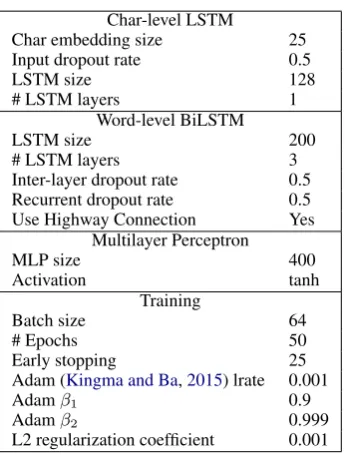
A.4 Named Entity Recognition
We again use the hyperparameter configurations provided in AllenNLP. See Table6for details.
9https://github.com/allenai/bilm-tf
Input
POS embedding size 100
Input dropout rate 0.3
Word-level BiLSTM
LSTM size 400
# LSTM layers 3
Recurrent dropout rate 0.3 Inter-layer dropout rate 0.3 Use Highway Connection Yes
Multilayer Perceptron, Attention
Arc MLP size 500
Label MLP size 100
# MLP layers 1
Activation Relu
Training
Batch size 80
# Epochs 80
Early stopping 50
Adam (Kingma and Ba,2015) lrate 0.001
Adamβ1 0.9
[image:7.595.74.289.150.364.2]Adamβ2 0.999
Table 4: UD Parsing Hyperparameters.
Input
Predicate indicator embedding size 100 Word-level Alternating BiLSTM
LSTM size 300
# LSTM layers 4
Recurrent dropout rate 0.1 Use Highway Connection Yes
Training
Batch size 80
# Epochs 80
Early stopping 20
Adadelta (Zeiler,2012) lrate 0.1
Adadeltaρ 0.95
Gradient clipping 1.0
Table 5: SRL Hyperparameters.
Char-level LSTM
Char embedding size 25
Input dropout rate 0.5
LSTM size 128
# LSTM layers 1
Word-level BiLSTM
LSTM size 200
# LSTM layers 3
Inter-layer dropout rate 0.5 Recurrent dropout rate 0.5 Use Highway Connection Yes
Multilayer Perceptron
MLP size 400
Activation tanh
Training
Batch size 64
# Epochs 50
Early stopping 25
Adam (Kingma and Ba,2015) lrate 0.001
Adamβ1 0.9
Adamβ2 0.999
[image:7.595.333.502.326.468.2]L2 regularization coefficient 0.001
[image:7.595.331.504.507.735.2]