Instance-Based Question Answering:
A Data-Driven Approach
Lucian Vlad Lita
Carnegie Mellon University [email protected]
Jaime Carbonell
Carnegie Mellon University [email protected]
Abstract
Anticipating the availability of large question-answer datasets, we propose a principled, data-driven Instance-Based approach to Question An-swering. Most question answering systems incor-porate three major steps: classify questions accord-ing to answer types, formulate queries for document retrieval, and extract actual answers. Under our ap-proach, strategies for answering new questions are directly learned from training data. We learn mod-els of answer type, query content, and answer ex-traction from clusters of similar questions. We view the answer type as a distribution, rather than a class in an ontology. In addition to query expansion, we learn general content features from training data and use them to enhance the queries. Finally, we treat answer extraction as a binary classification problem in which text snippets are labeled as correct or in-correct answers. We present a basic implementation of these concepts that achieves a good performance on TREC test data.
1 Introduction
Ever since Question Answering (QA) emerged as an active research field, the community has slowly diversified question types, increased question com-plexity, and refined evaluation metrics - as reflected by the TREC QA track (Voorhees, 2003). Starting from successful pipeline architectures (Moldovan et al., 2000; Hovy et al., 2000), QA systems have re-sponded to changes in the nature of the QA task by incorporating knowledge resources (Hermjakob et al., 2000; Hovy et al., 2002), handling additional types of questions, employing complex reasoning mechanisms (Moldovan et al., 2003; Nyberg et al., 2003), tapping into external data sources such as the Web, encyclopedias, databases (Dumais et al., 2002; Xu et al., 2003), and merging multiple agents and strategies into meta-systems (Chu-Carroll et al., 2003; Burger et al., 2002).
In recent years, learning components have started to permeate Question Answering (Clarke et al.,
2003; Ravichandran et al., 2003; Echihabi and Marcu, 2003). Although the field is still domi-nated by knowledge-intensive approaches, compo-nents such as question classification, answer extrac-tion, and answer verification are beginning to be ad-dressed through statistical methods. At the same time, research efforts in data acquisition promise to deliver increasingly larger question-answer datasets (Girju et al., 2003; Fleischman et al., 2003). More-over, Question Answering is expanding to different languages (Magnini et al., 2003) and domains other than news stories (Zweigenbaum, 2003). These trends suggest the need for principled, statisti-cally based, easily re-trainable, language indepen-dent QA systems that take full advantage of large amounts of training data.
We propose an instance-based, data-driven ap-proach to Question Answering. Instead of classify-ing questions accordclassify-ing to limited, predefined on-tologies, we allow training data to shape the strate-gies for answering new questions. Answer mod-els, query content modmod-els, and extraction models are also learned directly from training data. We present a basic implementation of these concepts and eval-uate the performance.
2 Motivation
Most existing Question Answering systems classify new questions according to static ontologies. These ontologies incorporate human knowledge about the expected answer (e.g. date, location, person), an-swer type granularity (e.g. date, year, century), and very often semantic information about the question type (e.g. birth date, discovery date, death date).
component evaluation very difficult and re-training for new domains time-consuming.
2.1 Answer Modeling
The task of determining the answer type of a ques-tion is usually considered a hard 1 decision
prob-lem: questions are classified according to an an-swer ontology. The classification (location, per-son’s name, etc) is usually made in the beginning of the QA process and all subsequent efforts are focused on finding answers of that particular type. Several existing QA systems implement feedback loops (Harabagiu et al., 2000) or full-fledged plning (Nyberg et al., 2003) to allow for potential an-swer type re-classification.
However, most questions can have multiple an-swer types as well as specific anan-swer type distribu-tions. The following questions can accommodate answers of types: full date, year, and decade.
Question Answer
When did Glen lift off in Friendship7? Feb. 20, 1962
When did Glen join NASA? 1959
When did Glen have long hair? the fifties
However, it can be argued that date is the most likely answer type to be observed for the first tion, year the most likely type for the second tion, and decade most likely for the third ques-tion. In fact, although the three questions can be answered by various temporal expressions, the dis-tributions over these expressions are quite different. Existing answer models do not usually account for these distributions, even though there is a clear po-tential for better answer extraction and more refined answer scoring.
2.2 Document Retrieval
When faced with a new question, QA systems usu-ally generate few, carefully expanded queries which produce ranked lists of documents. The retrieval step, which is very critical in the QA process, does not take full advantage of context information. However, similar questions with known answers do share context information in the form of lexical and structural features present in relevant documents. For example all questions of the type “When was
X born?” find their answers in documents which
often contain words such as “native” or “record”, phrases such as “gave birth to X”, and sometimes even specific parse trees.
Most IR research in Question Answering is fo-cused on improving query expansion and
structur-1the answer is classified into a single class instead of gener-ating a probability distribution over answers
ing queries in order to take advantage of specific document pre-processing. In addition to automatic query expansion for QA (Yang et al., 2003), queries are optimized to take advantage of expansion re-sources and document re-sources. Very often, these optimizations are performed offline, based on the type of question being asked.
Several QA systems associate this type of infor-mation with question ontologies: upon observing questions of a certain type, specific lexical features are sought in the retrieved documents. These fea-tures are not always automatically learned in order to be used in query generation. Moreover, systems are highly dependent on specific ontologies and be-come harder to re-train.
2.3 Answer Extraction
Given a set of relevant documents, the answer ex-traction step consists of identifying snippets of text or exact phrases that answer the question. Manual approaches to answer extraction have been mod-erately successful in the news domain. Regular expressions, rule and pattern-based extraction are among the most efficient techniques for information extraction. However, because of the difficulty in ex-tending them to additional types of questions, learn-ing methods are becomlearn-ing more prevalent.
Current systems (Ravichandran et al., 2003) al-ready employ traditional information extraction and machine learning for extracting answers from rel-evant documents. Boundary detection techniques, finite state transducers, and text passage classifica-tion are a few methods that are usually applied to this task.
The drawback shared by most statistical answer extractors is their reliance on predefined ontologies. They are often tailored to expected answer types and require type-specific resources. Gazetteers, ency-clopedias, and other resources are used to generate type specific features.
3 Related Work
Current efforts in data acquisition for Question An-swering are becoming more and more common. (Girju et al., 2003) propose a supervised algorithm for part-whole relations extraction. (Fleischman et al., 2003) also propose a supervised algorithm that uses part of speech patterns and a large corpus to ex-tract semantic relations for Who-is type questions. Such efforts promise to provide large and dense datasets required by instance based approaches.
Test Question:When did John Glen start working at NASA?
When did Jay Leno get a job at the NBC? When did Columbus arrive at his destination? …
When did <NNP+> <VB> … at … ? When did Jay Leno get a job at the NBC? When did Columbus arrive at his destination? …
When did <NNP+> <VB> … at … ?
When did Sony begin its VAIO campaign? When did Tom Ridge initiate the terror alert system? …
When did <NNP+> <SYNSET to_initiate> … ? When did Sony begin its VAIO campaign? When did Tom Ridge initiate the terror alert system? …
When did <NNP+> <SYNSET to_initiate> … ?
When did Beethoven die? When did Muhammad live? …
When did <NNP> <VB> ?
When did the Raiders win their last game? When did EMNLP celebrate its 5thanniversary?
…
When did <NNP+> … ?
When did dinosaurs walk the earth? When did people discover fire? …
[image:3.595.70.542.86.207.2]When did <NN> <VB> <NP> ? When did <NP> … ?
Figure 1: Neighboring questions are clustered according to features they share.
maximum entropy and models answer correctness by introducing a hidden variable representing the expected answer type. Large corpora such as the Web can be mined for simple patterns (Ravichan-dran et al., 2003) corresponding to individual ques-tion types. These patterns are then applied to test questions in order to extract answers. Other meth-ods rely solely on answer redundancy (Dumais et al., 2002): high performance retrieval engines and large corpora contribute to the fact that the most re-dundant entity is very often the correct answer.
Predictive annotation (Prager et al., 1999) is one of the techniques that bring together corpus process-ing and smarter queries. Twenty classes of objects are identified and annotated in the corpus, and cor-responding labels are used to enhance IR queries. Along the same lines, (Agichtein et al., 2001) pro-pose a method for learning query transformations in order to improve answer retrieval. The method involves learning phrase features for question clas-sification. (Wen and Zhang, 2003) address the prob-lem of query clustering based on semantic similar-ity and analyze several applications such as query re-formulation and index-term selection.
4 An Instance-Based Approach
This paper presents a data driven, instance-based approach for Question Answering. We adopt the view that strategies required in answering new ques-tions can be directly learned from similar train-ing examples (question-answer pairs). Consider a multi-dimensional space, determined by features extracted from training data. Each training question is represented as a data point in this space. Features can range from lexical n-grams to parse trees ele-ments, depending on available processing.
Each test question is also projected onto the fea-ture space. Its neighborhood consists of training instances that share a number of features with the new data point. Intuitively, each neighbor is similar
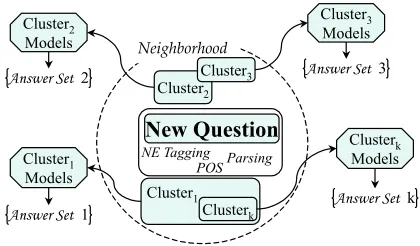
in some fashion to the new question. The obvious next step would be to learn from the entire neigh-borhood - similar to KNN classification. However, due to the sparsity of the data and because different groups of neighbors capture different aspects of the test question, we choose to cluster the neighborhood instead. Inside the neighborhood, we build individ-ual clusters based on internal similarity. Figure 1 shows an example of neighborhood clustering. No-tice that clusters may also have different granularity - i.e. can share more or less features with the new question.
Cluster1 Models
Answer Set 1 Cluster2
Models
Answer Set 2
Cluster3 Models
Answer Set3
Clusterk Models
Answer Setk
Neighborhood
Cluster
2
Cluster3
Clusterk
New Question
NE Tagging POSParsing
Cluster1
Figure 2: The new question is projected onto the multi-dimensional feature space. A set of neighborhood clus-ters are identified and a model is dynamically built for each of them. Each model is applied to the test question in order to produce its own set of candidate answers.
[image:3.595.322.532.412.535.2]multiple clusters, it benefits from different answer-seeking strategies and different granularities.
Answering clusters of similar questions involves several steps: learning the distribution of the expected answer type, learning the structure and content of queries, and learning how to extract the answer. Although present in most systems, these steps are often static, manually defined, or based on limited resources (section 2). This paper proposes a set of trainable, cluster-specific models:
1. the Answer Model Ai learns the cluster-specific
distribution of answer types.
2. the Query Content ModelUiis trained to enhance
the keyword-based queries with cluster-specific content conducive to better document retrieval. This model is orthogonal to query expansion.
3. the Extraction Model Ei is dynamically built
for answer candidate extraction, by classifying snippets of text whether they contain a correct answer or not.
Answer Model
Query Content Model Extraction Model
Cluster Models
[image:4.595.84.288.348.415.2]Training Samples (Q, A)
Figure 3:Three cluster-specific components are learned in order to better retrieve relevant documents, model the expected answer, and then extract it from raw text. Local question-answer pairs (Q,A) are used as training data.
These models are derived directly from cluster data and collectively define a focused strategy for finding answers to similar questions (Figure 3).
4.1 The Answer Model
Learning cluster-specific answer type distributions is useful not only in terms of identifying answers in running text but also in answer ranking. A prob-abilistic approach has the advantage of postponing answer type decisions from early in the QA process until answer extraction or answer ranking. It also has the advantage of allowing training data to shape the expected structure of answers.
The answer modeling task consists of learning specific answer type distributions for each cluster of questions. Provided enough data, simple techniques such as constructing finite state machines or learn-ing regular expressions are sufficient. The principle can also be applied to current answer ontologies by replacing the hard classification with a distribution over answer types.
For high-density clusters, the problem of ing the expected answer type is reduced to learn-ing possible answer types and performlearn-ing a reliable frequency count. However, very often clusters are sparse (e.g. are based on rare features) and a more reliable method is required. k-nearest training data pointsQ1..Qk can be used in order to estimate the
probability that the test question q will observe an answer typeαj:
P(αj, q) =µ· k
X
i=0
P(αj|Qi)·δ(q, Qi) (1)
where P(αj, Qi) is the probability of observing
an answer of type αj when asking question Qi.
δ(q, Qi) represents a distance function between q
and Qi, and µis a normalizing factor over the set
of all viable answer types in the neighborhood ofq.
4.2 The Query Content Model
Current Question Answering systems use IR in a straight-forward fashion. Query terms are extracted and then expanded using statistical and semantic similarity measures. Documents are retrieved and the topK are further processed. This approach de-scribes the traditional IR task and does not take ad-vantage of specific constraints, requirements, and rich context available in the QA process.
The data-driven framework we propose takes ad-vantage of knowledge available at retrieval time and incorporates it to create better cluster-specific queries. In addition to query expansion, the goal is to learn content features: n-grams and paraphrases (Hermjakob et al., 2002) which yield better queries when added to simple keyword-based queries. The
Query Content Model is a cluster-specific
collec-tion of content features that generate the best docu-ment set (Table 1).
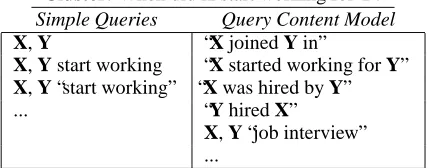
Cluster: When did X start working for Y?
Simple Queries Query Content Model
X, Y “X joined Y in”
X, Y start working “X started working for Y”
X, Y “start working” “X was hired by Y”
... “Y hired X”
X, Y “job interview”
...
Table 1: Queries based only on X and Y question terms may not be appropriate if the two entities share a long history. A focused, cluster-specific content model is likely to generate more precise queries.
[image:4.595.321.535.568.652.2](n-grams and paraphrases) are extracted and scored based on their co-occurrence with the correct an-swer. More specifically, consider a positive class: documents which contain the correct answer, and a negative class: documents which do not contain the answer. We compute the average mutual informa-tion I(C;Fi) between a class of a document, and
the absence or presence of a feature fi in the
doc-ument (McCallum and Nigam, 1998). We letCbe the class variable andFithe feature variable:
I(C;Fi) = H(C)−H(C|Fi)
= X
c∈C
X
fi∈0,1
P(c, fi) log
P(c, fi)
P(c)P(fi)
whereH(C)is the entropy of the class variable and
H(C|Fi)is the entropy of the class variable
condi-tioned on the feature variable. Features that best dis-criminate passages containing correct answers from those that do not, are selected as potential candi-dates for enhancing keyword-based queries.
For each question-answer pair, we generate can-didate queries by individually adding selected fea-tures (e.g. table 1) to the expanded word-based query. The resulting candidate queries are subse-quently run through a retrieval engine and scored based on the number of passages containing cor-rect answers (precision). The content features found in the top u candidate queries are included in the Query Content Model.
The Content Model is cluster specific and not in-stance specific. It does not replace traditional query expansion - both methods can be applied simulta-neously to the test questions: specific keywords are the basis for traditional query expansion and clus-ters of similar questions are the basis for learning additional content conducive to better document re-trieval. Through the Query Content Model we al-low shared context to play a more significant role in query generation.
4.3 The Extraction Model
During training, documents are retrieved for each question cluster and a set of one-sentence passages containing a minimum number of query terms is selected. The passages are then transformed into feature vectors to be used for classification. The features consist of n-grams, paraphrases, distances between keywords and potential answers, simple statistics such as document and sentence length, part of speech features such as required verbs etc. More extensive sets of features can be found in informa-tion extracinforma-tion literature (Bikel et al., 1999).
Under our data-driven approach, answer extrac-tion consists of deciding the correctness of
candi-date passages. The task is to build a model that accepts snippets of text and decides whether they contain a correct answer.
A classifier is trained for each question cluster. When new question instances arrive, the already trained cluster-specific models are applied to new, relevant text snippets in order to test for correctness. We will refer to the resulting classifier scores as an-swer confidence scores.
5 Experiments
We present a basic implementation of the instance-based approach. The resulting QA system is fully automatically trained, without human intervention.
Instance-based approaches are known to require large, dense training datasets which are currently under development. Although still sparse, the subset of all temporal questions from the TREC 9-12 (Voorhees, 2003) datasets is relatively dense compared to the rest of the question space. This makes it a good candidate for evaluating our instance-based QA approach until larger and denser datasets become available. It is also broad enough to include different question structures and varying degrees of difficulty and complexity such as:
• “When did Beethoven die?”
• “How long is a quarter in an NBA game?”
• “What year did General Montgomery lead the Allies
to a victory over the Axis troops in North Africa?”
The 296 temporal questions and their correspond-ing answer patterns provided by NIST were used in our experiments. The questions were processed with a part of speech tagger (Brill, 1994) and a parser (Collins, 1999).
The questions were clustered using template-style frames that incorporate lexical items, parser labels, and surface form flags (Figure 1). Consider the following question and several of its corre-sponding frames:
“When did Beethoven die?”
when did<NNP>die
when did<NNP> <VB>
when did<NNP> <Q>
when did<NP> <Q>
when did<Q>
where <NNP>,<NP>,<VB>,<Q> denote: proper noun, noun phrase, verb, and generic ques-tion term sequence, respectively. Initially, frames are generated exhaustively for each question. Each frame that applies to more than three questions is then selected to represent a specific cluster.
(www.google.com/api). Documents containing the full question, question number, references to TREC, NIST, AQUAINT, Question Answering and other similar problematic content were filtered out.
When building the Query Content Model keyword-based queries were initially formulated and expanded. From the retrieved documents a set of content features (n-grams and paraphrases) were selected through average mutual information. The features were added to the simple queries and a new set of documents was retrieved. The enhanced queries were scored and the corresponding top 10 n-grams/paraphrases were included in the Query Con-tent Model. The maximum n-gram and paraphrase size for these features was set to 6 words.
The Extraction Model uses a support vector ma-chine (SVM) classifier (Joachims, 2002) with a lin-ear kernel. The task of the classifier is to decide if text snippets contain a correct answer. The SVM was trained on features extracted from one-sentence passages containing at least one keyword from the original question. The features consist of: distance between keywords and potential answers, keyword density in a passage, simple statistics such as doc-ument and sentence length, query type, lexical n-grams (up to 6-n-grams), and paraphrases.
We performed experiments using leave-one-out cross validation. The system was trained and tested without any question filtering or manual input. Each cluster produced an answer set with correspond-ing scores. Top 5 answers for each instance were considered by a mean reciprocal rank (MRR) met-ric over all N questions: M RRN = PNi=0
1 ranki,
whererankirefers to the first correct occurrence in
the top 5 answers for questioni. While not the fo-cus of this paper, answer clustering algorithms are likely to further improve performance.
6 Results
The most important step in our instance-based ap-proach is identifying clusters of questions. Figure 4 shows the question distribution in terms of num-ber of clusters. For example: 30 questions belong to exactly 3 clusters. The number of clusters cor-responding to a question can be seen as a measure of how common the question is - the more clusters a question has, the more likely it is to have a dense neighborhood.
The resulting MRR is 0.447 and 61.5% ques-tions have correct answers among the first five pro-posed answers. This translates into results consis-tently above the sixth highest score at each TREC 9-12. Our results were compared directly to the top performing systems’ results on the same temporal
2 3 4 5 6 7 8 9 larger 0
10 20 30 40 50 60 70
80 Question Distribution With Number of Clusters
# clusters
# questions
[image:6.595.338.515.71.221.2](avg)
Figure 4: Question distribution - each bar shows the
number of questions that belong to exactlycclusters.
1 2 3 4 5 6 7 8 0
10 20 30 40 50 60 70
80 Cluster Contribution to Top 10 Answers
# clusters
# questions
Figure 5: Number of clusters that contribute with cor-rect answers to the final answer set - only the top 10 an-swers were considered for each question.
question test set.
Figure 5 shows the degree to which clusters pro-duce correct answers to test questions. Very often, more than one cluster contributes to the final answer set, which suggests that there is a benefit in cluster-ing the neighborhood accordcluster-ing to different similar-ity features and granularsimilar-ity.
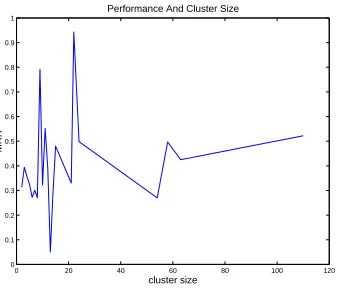
It is not surprising that cluster size is not cor-related with performance (Figure 6). The overall strategy learned from the cluster “When did<NP>
die?” corresponds to an MRR of 0.79, while the strategy learned from cluster “How<Q>?” corre-sponds to an MRR of0.13. Even if the two clusters generate strategies with radically different perfor-mance, they have the same size - 10 questions are covered by each cluster.
[image:6.595.338.513.266.411.2]unsta-0 20 40 60 80 100 120 0
0.1 0.2 0.3 0.4 0.5 0.6 0.7 0.8 0.9 1
Performance And Cluster Size
cluster size
[image:7.595.314.549.70.198.2]MRR
Figure 6:Since training data is not uniformly distributed in the feature space, cluster size is not well correlated with performance. A specific cardinality may represent a small and dense part cluster, or a large and sparse cluster.
0.1 0.2 0.3 0.4 0.5 0.6 0.7 0.8 0.9 0.2
0.3 0.4 0.5 0.6 0.7 0.8 0.9 1
Performance And Confidence Thresholds
confidence threshold
MRR
[image:7.595.102.272.72.217.2]Cardinality 2+ Cardinality 3+ Cardinality 4+ Cardinality 5+
Figure 7:MRR of predicted answers varies with answer confidence thresholds. There is a tradeoff between confi-dence threshold and MRR . The curves represent differ-ent thresholds for minimum cluster size.
ble strategies and have extremely low performance. Often times structurally different but semantically equivalent clusters have a higher cardinality and much better performance. For example, the cluster “What year did<NP>die?” has cardinality 2 and a corresponding MRR of zero. However, as seen previously, the cluster “When did<NP>die?” has cardinality 10 and a corresponding MRR of0.79.
Table 2 presents an intuitive cluster and the top n-grams and paraphrases with most information con-tent. Each feature has also a corresponding average mutual information score. These particular content features are intuitive and highly indicative of a cor-rect answer. However, in sparse clusters, the con-tent features have less information concon-tent and are more vague. For example, the very sparse cluster “When was<Q>?” yields content features such as “April”, “May”, “in the spring of”, “back in” which only suggest broad temporal expressions.
Cluster: When did<QTERM>die?
N-grams Paraphrases
0.81 his death in 0.80 <Q>died in
0.78 died on 0.78 <Q>died
0.77 died in 0.68 <Q>died on
0.75 death in 0.58 <Q>died at
0.73 of death 0.38 <Q>, who died
0.69 to his death 0.38 <Q>dies
0.66 died 0.38 <Q>died at the age of
0.63 , born on 0.38 <Q>, born
0.63 date of death 0.35 <Q>’s death on
Table 2: Query Content Model: learning n-grams and
paraphrases for class “When did <NP> die?”, where
<Q>refers to a phrase in the original question.
7 Conclusions
This paper presents an principled, statistically based, instance-based approach to Question An-swering. Strategies and models required for answer-ing new questions are directly learned from trainanswer-ing data. Since training requires very little human ef-fort, relevant context, high information query con-tent, and extraction are constantly improved with the addition of more question-answer pairs.
Training data is a critical resource for this ap-proach - clusters with very few data points are not likely to generate accurate models. However, re-search efforts involving data acquisition are promis-ing to deliver larger datasets in the near future and solve this problem. We present an implementation of the instance-based QA approach and we eval-uate it on temporal questions. The dataset is of reasonable size and complexity, and is sufficiently dense for applying instance-based methods. We per-formed leave-one-out cross validation experiments and obtained an overall mean reciprocal rank of 0.447. 61.5%of questions obtained correct answers among the top five which is equivalent to a score in the top six TREC systems on the same test set.
The experiments show that strategies derived from very small clusters are noisy and unstable. When larger clusters are involved, answer confi-dence becomes correlated with higher predictive performance. Moreover, when ignoring sparse data, answering strategies tend to be more stable. This supports the need for more training data as means to improve the overall performance of the data driven, instance based approach to question answering.
8 Current & Future Work
[image:7.595.98.271.293.436.2]most question types, as well as the use of trivia questions in the training process.
Our data-driven approach to Question Answering has the advantage of incorporating learning com-ponents. It is very easy to train and makes use of very few resources. This property suggests that lit-tle effort is required to re-train the system for dif-ferent domains as well as other languages. We plan to apply instance-based QA to European languages and test this hypothesis using training data acquired through unsupervised means.
More effort is required in order to better integrate the cluster-specific models. Strategy overlap analy-sis and refinement of local optimization criteria has the potential to improve overall performance under time constraints.
References
E. Agichtein, S. Lawrence, and L. Gravano. 2001. Learning search engine specific query transfor-mations for question answering. WWW.
D. Bikel, R. Schwartz, and R. Weischedel. 1999. An algorithm that learns what’s in a name. Ma-chine Learning.
E. Brill. 1994. Some advances in rule-based part of speech tagging. AAAI.
J. Burger, L. Ferro, W. Greiff, J. Henderson, M. Light, and S. Mardis. 2002. Mitre’s qanda at trec-11. TREC.
J. Chu-Carroll, K. Czuba, J. Prager, and A. Itty-cheriah. 2003. In question answering, two heads are better than one. HLT-NAACL.
C. Clarke, G. Cormack, G. Kemkes, M. Laszlo, T. Lynam, E. Terra, and P. Tilker. 2003. Statis-tical selection of exact answers. TREC.
M. Collins. 1999. Head-driven statistical models for natural language parsing. Ph.D. Disertation. S. Dumais, M. Banko, E. Brill, J. Lin, and A. Ng.
2002. Web question answering: Is more always better? SIGIR.
A. Echihabi and D. Marcu. 2003. A noisy channel approach to question answering. ACL.
M. Fleischman, E. Hovy, and A. Echihabi. 2003. Offline strategies for online question answering: Answering questions before they are asked. ACL. R. Girju, D. Moldovan, and A. Badulescu. 2003. Learning semantic constraints for the automatic discovery of part-whole relations. HLT-NAACL. S. Harabagiu, D. Moldovan, M. Pasca, R. Mihalcea,
R. Bunescu, R. Girju, V. Rus, and P. Morarescu. 2000. Falcon: Boosting knowledge for answer engines. TREC.
U. Hermjakob, E. Hovy, and C. Lin. 2000. Knowledge-based question answering. TREC.
Ulf Hermjakob, Abdessamad Echihabi, and Daniel Marcu. 2002. Natural language based reformu-lation resource and web exploitation for question answering. TREC.
E. Hovy, L. Gerber, U. Hermjakob, M. Junk, and C.Y. Lin. 2000. Question answering in webclo-pedia. TREC.
E. Hovy, U. Hermjakob, C. Lin, and D. Ravichan-dran. 2002. Using knowledge to facilitate factoid answer pinpointing. COLING.
T. Joachims. 2002. Learning to classify text using support vector machines. Disertation.
B. Magnini, S. Romagnoli, A. Vallin, J. Herrera, A. Penas, V. Peiado, F. Verdejo, and M. de Rijke. 2003. The multiple language question answering track at clef 2003. CLEF.
A. McCallum and K. Nigam. 1998. A comparison of event models for naive bayes text classifica-tion. AAAI, Workshop on Learning for Text Cate-gorization.
D. Moldovan, S. Harabagiu, M. Pasca, R. Mihalcea, R. Girju, R. Goodrum, and V. Rus. 2000. The structure and performance of an open-domain question answering system. ACL.
D. Moldovan, D. Clark, S. Harabagiu, and S. Maio-rano. 2003. Cogex: A logic prover for question answering. ACL.
E. Nyberg, T. Mitamura, J. Callan, J. Carbonell, R. Frederking, K. Collins-Thompson, L. Hiyaku-moto, Y. Huang, C. Huttenhower, S. Judy, J. Ko, A. Kupsc, L.V. Lita, V. Pedro, D. Svoboda, and B. Vand Durme. 2003. A multi strategy approach with dynamic planning. TREC.
J. Prager, D. Radev, E. Brown, A. Coden, and V. Samn. 1999. The use of predictive annotation for question answering in trec8. TREC.
D. Ravichandran, A. Ittycheriah, and S. Roukos. 2003. Automatic derivation of surface text pat-terns for a maximum entropy based question an-swering system. HLT-NAACL.
E.M. Voorhees. 2003. Overview of the trec 2003 question answering track. TREC.
J.R. Wen and H.J. Zhang. 2003. Query clustering in the web context. IR and Clustering.
J. Xu, A. Licuanan, and R. Weischedel. 2003. Trec 2003 qa at bbn: Answering definitional ques-tions. TREC.
H. Yang, T.S. Chua, S. Wang, and C.K. Koh. 2003. Structured use of external knowledge for event-based open domain question answering. SIGIR. P. Zweigenbaum. 2003. Question answering in